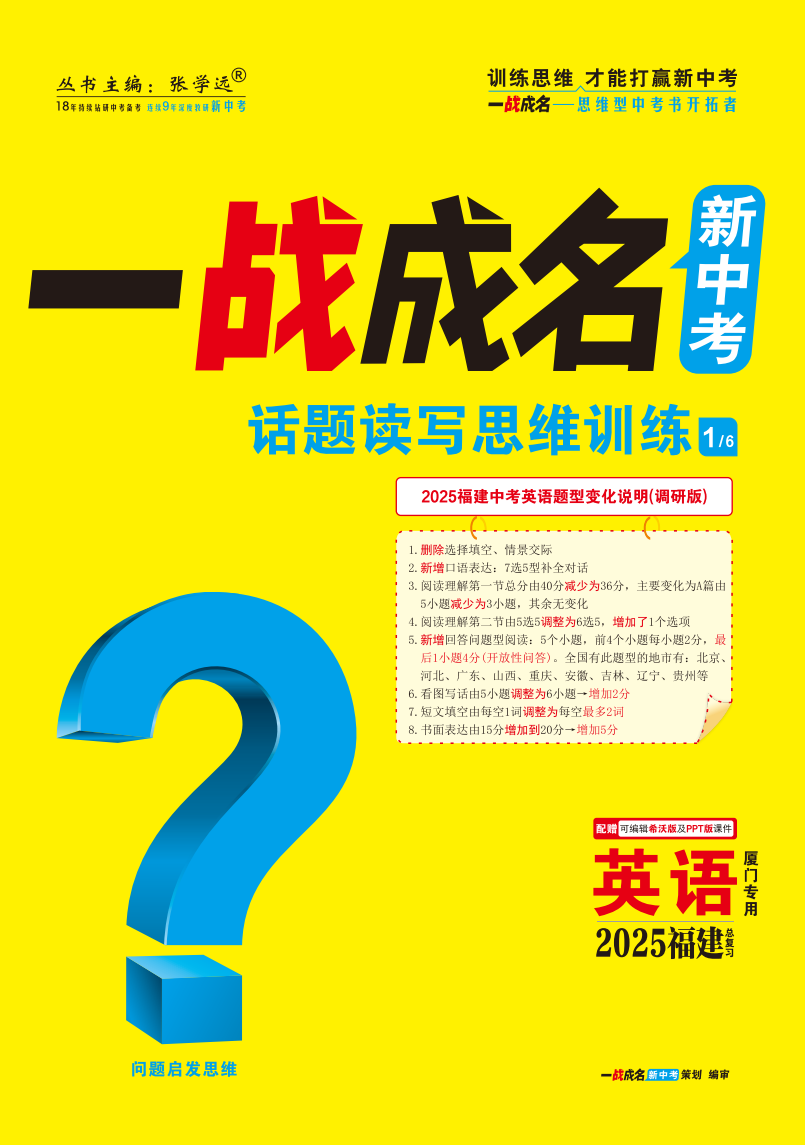
话题13 文化与风俗-【一战成名新中考】2025福建厦门中考英语(人教版)·一轮复习·话题读写思维训练(讲册)
2025-02-06
|
2份
|
14页
|
72人阅读
|
2人下载
教辅
内容正文:
参考答案·福建英语(厦门专用)
话
题
读
写
思
维
训
练
Passage
5
1.
C 2.
B 3.
C 4.
B 5.
B
【读后迁移练】
1.
A 2.
C
Passage
6
1.
On
an
evening
in
May
2024.
2.
He
passed
by
it
without
minding
much.
3.
To
keep
the
dog
safe.
4.
Take
action
even
if
others
do
not. / We
should
reach
out
a
helping
hand
to
others.
5.
If
I
see
a
stray-animal,
I
will
keep
it
well
by
taking
it
to
an
animal
hospital
and
call
the
stray-animal
home.
Because
animals
are
our
friends
and
we
should
protect
them.
话题 12 社会的发展与变迁
话题语篇“精讲”
1.
or 2.
was
spread 3.
mainly 4.
the 5.
fifteenth
6.
brought 7.
reading 8.
opinions 9.
to 10.
us
【读后迁移练】
C
话题语篇“精练”
Passage
1
1.
A 2.
C 3.
C 4.
B 5.
A 6.
C 7.
B 8.
C
9.
C 10.
B
【读后迁移练】
一、1.
A 2.
C
二、1.
Thanks
to
the
good
policies,
villagers
have
more
ways
to
make
money.
2.
Now
many
young
people
study
in
paid
study
rooms
to
prepare
for
their
exams.
Passage
2
1.
B 2.
D 3.
B 4.
C 5.
A
【读后迁移练】
一、C
二、1.
Nowadays,
more
and
more
people
have
the
chance
to
get
a
good
education.
2.
When
my
grandparents
were
young,
they
wrote
letters
to
keep
in
touch
with
others.
Passage
3
1.
D 2.
C 3.
E 4.
A 5.
B
【读后迁移练】
一、D
二、1.
Nowadays,
our
country
has
made
great
achievements
in
many
fields,
such
as
technology
and
economy.
2.
I
think
life
in
the
twenty-second
century
will
be
very
different
from
that
in
the
twenty-first
century.
Passage
4
1.
In
the
Shang
Dynasty.
2.
He
asked
people
to
use
the
money
in
the
same
shape.
3.
Marco
Polos
book
about
the
use
of
paper
money.
4.
Behind
them
lies
the
rich
culture
of
China.
5.
Its
becoming
much
easier
to
carry
and
use.
And
it
makes
our
life
more
convenient.
话题 13 文化与风俗
话题语篇“精讲”
1.
A 2.
B 3.
F 4.
C 5.
E
【读后迁移练】
一、1.
A 2.
A
二、1.
My
friends
are
ready
for
the
art
show
on
Sunday.
2.
Chinese
people
will
not
open
the
gift
in
front
of
the
person
who
gives
them.
话题语篇“精练”
Passage
1
1.
C 2.
A 3.
C 4.
B 5.
B 6.
C 7.
A 8.
B
9.
C 10.
A
【读后迁移练】
一、1.
C 2.
B
二、 1.
Chinese
people
seldom
drop
by
a
friends
home
without
calling
first.
2.
During
the
dog
days,
Chinese
people
follow
different
traditional
ways
to
deal
with
the
heat.
Passage
2
1.
A 2.
A 3.
C 4.
B 5.
C 6.
B 7.
A 8.
B
9.
C 10.
C
【读后迁移练】
一、1.
A 2.
D
二、1.
It
is
helpful
for
us
to
learn
about
some
foreign
customs
before
we
visit
a
foreign
country.
2.
The
dragon
is
considered
as
the
symbol
of
China.
Passage
3
1.
C 2.
D 3.
C 4.
B 5.
A
【读后迁移练】
一、1.
C 2.
A
二、 1.
Its
said
that
the
more
Chinese
culture
you
know
about,
the
more
you
love
it.
2.
Many
of
the
characters
we
use
today
are
similar
to
those
used
3,000
years
ago.
3.
Red
often
means
bringing
good
luck
and
happiness
to
people
in
China.
Passage
4
1.
A 2.
D 3.
B 4.
C 5.
A
【读后迁移练】
一、B
二、1.
Its
a
pity
that
I
missed
the
traditional
medicine
speech.
2.
China
is
an
ancient
country
which
is
rich
in
all
kinds
of
traditional
cultural
forms.
21
参考答案·福建英语(厦门专用)
话
题
读
写
思
维
训
练
Passage
5
1.
B 2.
A 3.
C 4.
D 5.
A
【读后迁移练】
1.
A 2.
A
Passage
6
1.
takes 2.
mainly 3.
the 4.
up 5.
washing 6.
luckier
7.
and 8.
their 9.
is
regarded 10.
tourists
【读后迁移练】
一、1.
D 2.
A
二、 1.
My
whole
family
gets
together
at
almost
every
traditional
festival
to
have
dinner.
2.
At
present,
more
people
are
encouraged
to
join
in
the
traditional
activities.
Passage
7
1.
began 2.
called 3.
quickly 4.
fans 5.
about
6.
but 7.
their 8.
the 9.
shares 10.
better
【读后迁移练】
1.
Dont
be
worried
about
tomorrows
test.
Youll
make
it.
2.
We
teenagers
should
learn
English
well
so
that
we
can
spread
traditional
Chinese
culture
to
the
world.
Passage
8
1.
On
the
inner
surface
of
the
glass
bottles.
2.
Peoples
wishes
for
good
luck
and
a
happy
life.
3.
Being
skilled
and
confident.
4.
By
making
use
of
social
media.
5.
Yes,
Id
like
to.
Because
inner
painting
is
a
cultural
treasure
of
China,
and
it
is
our
duty
to
pass
it
down.
话题 14 文娱、艺术与体育
话题语篇“精讲”
1.
a 2.
but 3.
like 4.
setting 5.
are
designed
6.
players 7.
safer 8.
is 9.
his 10.
easily
【读后迁移练】
一、1.
C 2.
D
二、I
happened
to
take
up
painting
two
years
ago
and
it
has
brought
great
pleasure
to
me.
话题语篇“精练”
Passage
1
1.
D 2.
C 3.
B 4.
B 5.
D
Passage
2
1.
B 2.
A 3.
C 4.
B 5.
D
【读后迁移练】
1.
It
is
the
second
time
for
me
to
read
Journey
to
the
West.
2.
As
we
all
know,
China
has
a
long-standing
history
and
is
known
for
its
colorful
culture.
Passage
3
1.
B 2.
E 3.
A 4.
C 5.
D
【读后迁移练】
一、D
二、1.
Its
hard
to
say
what
kind
of
music
is
my
favourite.
2.
Its
time
to
do
some
morning
exercises.
Passage
4
1.
were
created 2.
the 3.
were 4.
Their 5.
shows
6.
wearing 7.
and 8.
perfectly 9.
with 10.
characters
【读后迁移练】
一、1.
B 2.
A
二、A
new
word
“together”
has
been
added
to
the
Olympics
motto,
which
stands
for
team
spirit.
Passage
5
1.
but 2.
an 3.
her 4.
by 5.
mainly 6.
visitors
7.
is / was 8.
hiding 9.
found 10.
was
taken
【读后迁移练】
一、1.
B 2.
D
二、1.
Ping-pong
is
one
of
the
most
popular
events
in
the
Olympics.
2.
My
sister
asked
me
to
go
to
the
movies
with
her
last
week.
Passage
6
1.
From
a
paper
folding
book.
2.
Because
he
found
it
interesting.
3.
At
the
age
of
ten.
4.
Its
not
just
a
hobby.
Its
a
great
way
to
clear
his
mind.
5.
One
of
my
hobbies
is
reading. I
enjoy
reading
different
kinds
of
books
because
it
helps
me
relax
and
gain
new
knowledge.
话题 15 科技与生活
话题语篇“精讲”
1.
B 2.
A 3.
D 4.
C 5.
D
话题语篇“精练”
Passage
1
1.
C 2.
B 3.
A 4.
A 5.
D
【读后迁移练】
一、1.
B 2.
A
二、1.
Through
WeChat,
I
can
feel
that
he
is
friendly
to
every
friend
on
the
Internet.
2.
A
smart
home
will
come
in
handy
when
you
forget
to
turn
off
the
power.
Passage
2
1.
D 2.
A 3.
C 4.
B 5.
D
【读后迁移练】
一、B
二、Robots
will
be
able
to
help
humans
in
many
ways.
Passage
3
1.
D 2.
A 3.
B 4.
B 5.
B
31
话题读写思维训练·福建英语(厦门专用)
话
题
读
写
进
阶
练
话题 13 文化与风俗
(8 年 4 考)
【话题角度】节日与习俗(2017 短文填空)、传统艺术形式(2021 短文填空)、跨文化交际
(2024 阅读 D)、文化传承与传播(2023 短文填空)
【教材单元链接】
七下 U10
Id
like
some
noodles.
不同国家的生日食物
九全 U5
What
are
the
shirts
made
of?
Section
B
传统
艺术形式
八上 U5
Do
you
want
to
watch
a
game
show?
文化象征
九全 U10
Youre
supposed
to
shake
hands.
跨文化交
际
九全 U2
I
think
that
mooncakes
are
delicious!
节日与习
俗
/
话题词句梳理
话题词汇
节日及习俗
1.
the
Spring
Festival 春节
2.
the
Lantern
Festival 元宵节
3.
the
Tomb-sweeping
Festival 清明节
4.
the
Dragon
Boat
Festival 端午节
5.
the
Mid-Autumn
Festival 中秋节
6.
the
Double
Ninth
Festival 重阳节
7.
the
Water
Festival 泼水节
8.
get
together 聚会
9.
clean
up
the
house 打扫房屋
10.
make
dumplings 包饺子
11.
visit
relatives
and
friends 走亲访友
12.
watch
the
Spring
Festival
Gala 看春晚
13.
set
off
fireworks 放烟花
14.
guess
riddles 猜字谜
15.
watch
lantern
shows 看灯展
16.
watch
lion
dances 看舞狮
17.
enjoy
eating
delicious
zongzi 享用美味的粽子
18.
share
mooncakes
with
family 与家人分享月饼
19.
admire
the
full
moon 赏月
20.
watch / hold
dragon
boat
races 观看 / 举行龙舟
比赛
21.
throw
water
at
each
other 互相泼水
我来补充:
传统艺术与风俗
1.
traditional
culture 传统文化
2.
social
customs 社会风俗
3.
chopstick 筷子
4.
paper-cutting 剪纸
5.
kung
fu 功夫
6.
face-changing 变脸
7.
Chinese
knots 中国结
8.
Chinese
painting 国画
9.
Chinese
characters 汉字
10.
Chinese
calligraphy 书法
11.
Beijing / Peking
Opera 京剧
12.
shadow
plays 皮影戏
13.
dragon / lion
dances 舞龙 / 狮
14.
playing
the
guzheng 弹古筝
15.
use
red
paper 使用红纸
16.
respect
the
local
customs 尊重当地风俗
17.
spread
Chinese
culture 传播中国文化
我来补充:
521
话题读写思维训练·福建英语(厦门专用)
话
题
读
写
进
阶
练
文化礼仪
1.
bow 鞠躬
2.
kiss 亲吻
3.
shake
hands 握手
4.
stand
in
line 排队
5.
arrive
on
time 准时到达
6.
bring
a
gift / present 带礼物
7.
give
gifts 送礼物
8.
accept
gifts
with
both
hands 双手接礼物
9.
go
into
ones
house
with
your
shoes 穿鞋进某
人家
10.
table
manners 餐桌礼仪
11.
take
off
gloves 脱下手套
12.
put
hands
together 把手放在一起
13.
nod / shake
ones
head 点头 / 摇头
14.
hug
each
other 互相拥抱
15.
behave
politely 表现得体
16.
keep
your
voice
down
in
public 在公共场合小
点儿声
17.
knock
on / at
the
door
first
先敲门
18.
make
sb.
feel
at
home
让某人感到宾至如归
我来补充:
功能句型
点餐
1.
—What
would
you
like? / May
I
take
your
order?
—Id
like
some
noodles. / Im
not
sure
yet.
2.
—What
size
would
you
like?
—Id
like
a
large / medium / small
bowl.
3.
—May
I
have
the
bill,
please?
—Yes.
Its
200
yuan.
谈论喜好
1.
—What
do
you
think
of
talk
shows?
—I
dont
mind
them. / I
cant
stand
them. / I
love
watching
them.
2.
—Why
do
you
like
watching
the
news?
—Because
I
hope
to
find
out
whats
going
on
around
the
world.
给出个人反应
1.
What
fun
the
Water
Festival
is!
2.
I
believe
that
April
is
the
hottest
month
in
Thailand.
谈论习俗和应该做什么
1.
—What
are
you
supposed
to
do
when
you
meet
someone
for
the
first
time?
—You
are
supposed
to
shake
hands.
2.
—Is
it
impolite
to
keep
others
waiting?
—Yes.
Its
very
impolite
to
keep
others
waiting.
写作佳句
1.
The
long
noodles
are
a
symbol
of
long
life.
长面
条是长寿的象征。
2.
Mooncakes
carry
peoples
wishes
to
the
families
they
love
and
miss.
月饼承载着人们对他们所
爱和所想念的家人的祝福。
3.
New
Year
is
a
wonderful
time
when
family
and
friends
come
together
to
say
goodbye
to
the
old
year
and
welcome
the
new
one.
新年是一个美
好的时刻,家人和朋友聚在一起辞旧迎新。
4.
Sky
lanterns
are
seen
as
bright
symbols
of
happiness
and
good
wishes.
孔明灯被视为幸
福和美好祝愿的鲜明标志。
5.
If
someone
invites
you
to
meet
him
or
her
at
noon,
then
you
are
expected
to
be
there
at
noon.
如果有人邀请你中午去见他 / 她,那么
你中午就应该到那里。
6.
I
find
it
difficult
to
remember
everything,
but
Im
gradually
getting
used
to
it.
我发现很难记住每
一件事,但我逐渐习惯了。
7.
When
in
Rome,
do
as
the
Romans
do.
入乡
随俗。
621
话题读写思维训练·福建英语(厦门专用)
话
题
读
写
进
阶
练
话题语篇“精讲”
Different
countries
have
different
manners
about
social
situations.
In
Mexico,
people
shake
hands
when
they
meet
for
the
first
time.
In
Brazil,
people
sometimes
kiss.
In
Korea,
people
usually
bow.
Do
you
know
Chinese
fist
and
palm
salute(拱手礼)?
It
is
one
of
classic
greeting
manners
in
China.
1.
The
occasions
of
making
fist
and
palm
salute.
For
centuries,
China
has
been
known
as
a
“Liyi
Zhibang”.
Nowadays,
Chinese
usually
shake
hands
when
meeting
others,
but
sometimes
they
also
make
fist
and
palm
salute.
2.
People
make
fist
and
palm
salute
when
they
visit
someone
during
the
Spring
Festival
or
attend
someones
wedding
ceremony,
birthday
party
and
so
on.
The
history
of
fist
and
palm
salute.
3.
It
started
in
West
Zhou
Dynasty.
If
people
met
strangers,
they
would
prepare
for
a
fight
if
necessary,
and
hands
were
always
ready
for
holding
weapons(武器).
Holding
hands
together
pointed
to
themselves
was
a
meaning
of
expressing
kindness.
▲
4.
How
do
you
make
fist
and
palm
salute
properly?
First,
stand
at
attention.
Then,
if
you
are
a
man,
right-hand
half-fist,
and
then
left-hand
hold
the
right-hand
in
front
of
your
chest.
For
a
woman,
left-hand
half-fist,
then
right-hand
put
the
left-hand
on
the
top.
Next,
watch
each
other,
raise
both
hands
to
brow
(额头)
and
bend
down.
5.
Also,
you
could
say
some
lucky
greeting
words
to
each
other
for
three
times.
【2024
凉山州改编】
A.
Now
lets
learn
more
about
it.
B.
When
and
where
do
people
use
it?
C.
The
way
to
make
fist
and
palm
salute.
D.
It
is
often
widely
used
among
western
countries.
E.
Finally,
shake
hands
towards
each
other
for
three
times.
F.
Fist
and
palm
salute
has
a
history
of
more
than
3,000
years.
语篇研读
1.
Theme(主题):人与社会———世界主要国家的文化习俗
2.
What(主旨):介绍了中国的拱手礼
3.
Why(意图):鼓励读者尊重中国传统文化,以及在社交场合中使用正确的礼仪。
721
话题读写思维训练·福建英语(厦门专用)
话
题
读
写
进
阶
练
4.
How(结构):
读后迁移练
一、一材多设
1.
新考法·句子还原 Which
of
the
following
sentences
can
be
put
in
the
“ ▲ ”?
A.
Later
it
became
one
of
the
traditional
Chinese
manners
when
meeting
each
other.
B.
It
is
often
widely
used
among
western
countries.
C.
They
do
this
when
they
say
goodbye
to
each
other.
D.
It
is
polite
to
support
the
right
forearm
with
the
left
hand.
2.
Which
picture
shows
the
correct
way
for
women
to
do
the
fist
and
palm
salute?
二、句子仿写
1.
be
ready
for 为……做准备
仿写:
2.
in
front
of
在……前面
仿写:
821
话题读写思维训练·福建英语(厦门专用)
话
题
读
写
进
阶
练
话题语篇“精练”
Passage
1
Alaina
is
a
shy
French
college
girl.
Last
year,
she
came
to
Beijing,
the
1
of
China,
for
the
first
time.
As
a
foreign
student,
she
2
little
about
Chinese
culture
and
customs,
so
sometimes
she
didnt
know
what
she
should
do.
One
day,
she
dropped
by
her
Chinese
friend
Wu
Li.
When
she
arrived
at
her
friends
house,
she
was
3
welcomed.
Wu
Lis
parents
4
her
at
the
door.
After
entering
the
house,
Alaina
was
given
a
cup
of
tea
and
she
drank
it
up.
Then
every
time
her
cup
was
5 ,
Wu
Lis
mom
would
fill
it
up.
In
fact,
Alaina
was
not
thirsty,
but
she
didnt
know
how
to
6
Wu
Lis
mom.
After
drinking
ten
cups
of
tea,
she
had
to
go
to
the
toilet
twice.
At
noon,
they
ate
lunch
at
home
together.
Wu
Lis
parents
served
many
dishes.
Alaina
thought
they
were
much
too
7
but
she
didnt
know
how
to
deal
with
the
dishes.
In
European
8
like
France,
each
time
people
only
have
one
plate
of
dish.
So
Alaina
couldnt
9
this
way
of
treating
guests.
After
that
day,
Alaina
learned
more
about
Chinese
culture
and
customs.
Now
she
knows
10
she
puts
down
the
cup,
the
host
will
stop
offering
her
tea.
And
if
she
says
she
has
been
full,
the
host
will
not
serve
her
dishes.
( C )1.
A.
countryside B.
world C.
capital
( A )2.
A.
knew B.
realized C.
thought
( C )3.
A.
slowly B.
brightly C.
warmly
( B )4.
A.
thanked B.
greeted C.
praised
( B )5.
A.
dirty B.
empty C.
full
( C )6.
A.
agree B.
promise C.
refuse
( A )7.
A.
warm B.
shy C.
silent
( B )8.
A.
places B.
countries C.
cities
( C )9.
A.
look
forward
to B.
pay
attention
to C.
get
used
to
( A )10.
A.
if B.
before C.
though
读后迁移练
一、一材多设
1.
What
does
the
underlined
word
“it”
in
Paragraph
2
refer
to?
A.
The
house. B.
The
door. C.
The
cup. D.
The
toilet.
2.
新考法·细节排序 Whats
the
right
order
of
the
following
events?
①Alaina
came
to
Beijing.
②They
ate
lunch
together.
③Alaina
dropped
by
her
Chinese
friend
Wu
Li.
④Alaina
was
given
a
cup
of
tea
and
she
drank
it
up.
A.
①②③④ B.
①③④② C.
①④②③ D.
①②④③
921
话题读写思维训练·福建英语(厦门专用)
话
题
读
写
进
阶
练
二、句子仿写
1.
drop
by 顺道拜访
仿写:
2.
deal
with 处理
仿写:
Passage
2
Recently,
students
went
to
Yuxian
County
in
Hebei
to
learn
about
a
special
kind
of
Chinese
art
called
“Yuxian
County
paper-cutting”.
It
is
considered
as
a
national
intangible
cultural
heritage(非物质文化遗
产).
When
they
1
the
studio(工作室)
of
Zhou
Shuying,
the
inheritor(传承人),
they
were
amazed
by
the
artworks
on
display.
They
are
not
only
beautiful
2
lively.
According
to
Zhou,
Yuxian
County
paper-cutting
is
3
others.
It
mainly
uses
dyeing
techniques
(染色技法),
4
the
paper
images
lively
and
beautiful.
This
style
has
been
around
for
more
than
200
years.
To
show
the
charm
of
the
5 ,
Zhou
created
a
piece
right
in
front
of
us.
With
quick
movements,
she
cut
two
butterflies
with
heart-shaped
6 .
Finally,
Zhou
showed
students
an
award-winning
piece,
in
which
nine
dragons
were
beautifully
shown,
each
7
in
its
own
way.
Through
this
experience,
the
students
truly
felt
the
8
of
Chinese
paper-cutting
and
admired
Zhous
pursuit(追求)
of
her
artwork.
They
also
9
understood
the
rich
paper-cutting
culture
of
Yuxian
County.
How
they
wish
to
10
this
kind
of
tradition!
It
should
be
known
by
more
and
more
people.
( A )1.
A.
entered B.
arrived C.
built
( A )2.
A.
but B.
and C.
or
( C )3.
A.
similar
to B.
popular
with C.
different
from
( B )4.
A.
stopping B.
making C.
learning
( C )5.
A.
place B.
people C.
art
( B )6.
A.
arms B.
wings C.
bodies
( A )7.
A.
unique B.
same C.
perfect
( B )8.
A.
pride B.
beauty C.
success
( C )9.
A.
nearly B.
suddenly C.
deeply
( C )10.
A.
control B.
admire C.
spread
读后迁移练
一、一材多设
1.
What
did
Zhou
cut
to
show
the
charm
of
the
art?
2.
In
which
section
of
a
magazine
can
you
probably
read
the
text?
A.
Music. B.
Sports. C.
Medicine. D.
Culture.
031
话题读写思维训练·福建英语(厦门专用)
话
题
读
写
进
阶
练
二、句子仿写
1.
learn
about
学习,了解
仿写:
2.
be
considered
as
被认为是
仿写:
Passage
3
Different
from
other
festivals,
the
traditional
Spring
Festival
lasts
more
than
a
month,
starting
from
the
second
half
of
La
Yue(the
twelfth
month)
and
the
first
half
of
Zheng
Yue(the
first
month)
of
the
lunar
(农历)
year.
But
what
are
the
special
days
during
this
period
and
what
do
people
do
on
those
days?
Here
are
some
customs
that
you
should
know.
The
24th
day
of
La
Yue
in
South
China
is
Xiao
Nian,
the
“Little
Chinese
New
Year”.
It
means
the
start
of
the
Spring
Festival.
On
this
day,
people
usually
do
house
cleaning.
Its
said
that
the
year-end
cleaning
brings
good
luck
to
the
coming
year.
On
the
25th
day,
it
is
a
tradition
to
make
and
eat
tofu.
Because
the
pronunciation
of
“tofu”
is
similar
to
the
word
“toufu”,
the
first
fortune(福气),
or
“tóufù”,
the
first
wealth.
So
eating
tofu
has
become
popular
among
Chinese
people.
The
26th
day
is
the
day
to
cook
meat,
usually
mutton
or
pork(猪肉),
celebrating
the
coming
of
the
new
year.
On
the
27th
day,
people
wash
clothes
and
take
a
good
shower.
These
activities
mean
washing
away
all
the
bad
luck
and
illness.
It
is
a
tradition
to
prepare
dough(面团)
on
the
28th
day.
Because
many
kinds
of
traditional
foods
during
the
Spring
Festival
such
as
dumplings
are
made
of
dough.
This
also
means
preparing
plenty
of
food
for
the
whole
family.
The
29th
day
is
important.
People
in
most
areas
get
up
early
and
honor
their
ancestors.
It
is
because
the
preparations
for
the
festival
are
almost
finished,
so
its
time
to
invite
the
ancestors
back
home
for
the
New
Year.
Finally,
its
the
Spring
Festival
Eve.
1.
How
long
does
the
traditional
Spring
Festival
usually
last?
A.
More
than
a
day. B.
More
than
a
week.
C.
More
than
a
month. D.
More
than
a
season.
2.
Which
of
the
following
is
TRUE
about
the
Spring
Festival?
A.
The
first
day
of
La
Yue
is
Xiao
Nian.
B.
Eating
tofu
means
washing
away
bad
luck.
C.
All
foods
during
the
Spring
Festival
are
made
of
dough.
D.
The
preparations
are
almost
finished
on
the
29th
day
of
La
Yue.
3.
新考法·细节排序 What
is
the
correct
time
order
of
activities
before
the
Spring
Festival?
①make
and
eat
tofu ②cook
meat ③prepare
dough
④honor
ancestors ⑤do
house
cleaning ⑥wash
clothes
and
take
a
shower
A.
①②③④⑤⑥ B.
⑤③⑥④①② C.
⑤①②⑥③④ D.
⑥⑤③②①④
4.
Whats
the
main
idea
of
the
text?
A.
What
to
do
after
the
Spring
Festival. B.
What
to
do
before
the
Spring
Festival.
C.
Where
to
go
before
the
Spring
Festival. D.
What
to
buy
after
the
Spring
Festival.
5.
新考法·后续推断 What
is
the
text
probably
going
to
talk
about
next?
A.
The
30th
day
of
La
Yue. B.
The
31st
day
of
Zheng
Yue.
C.
The
Spring
Festival
in
other
countries. D.
The
New
Years
Day
in
other
cultures.
131
话题读写思维训练·福建英语(厦门专用)
话
题
读
写
进
阶
练
读后迁移练
一、题型加练
1.
What
does
the
underlined
word
“It”
in
Paragraph
2
refer
to?
A.
La
Yue. B.
South
China. C.
Xiao
Nian. D.
House
cleaning.
2.
What
do
people
usually
do
on
the
25th
day
of
La
Yue?
二、句子仿写
1.
Its
said
that
据说……
仿写:
2.
be
similar
to
与……相似
仿写:
3.
mean
doing
sth.
意味着做某事
仿写:
Passage
4【2024 南充改编】
Sugar
painting,
as
the
name
means,
is
a
painting
made
of
sugar.
Its
the
sugar
for
us
to
taste,
and
the
painting
for
us
to
admire.
Since
the
Warring
States
Period(战国时代),
the
ancient
people
loved
sweets
and
developed
methods
of
producing
sugar.
In
the
Tang
Dynasty,
there
was
huge
progress
in
the
technology
of
sugar
making.
And
sugar,
the
precious
product
once
only
served
to
the
emperors
and
princes,
also
went
into
common
peoples
homes.
With
the
cultural
and
economic(经济的)
development
of
Song
and
Yuan
Dynasties,
people
became
less
interested
in
only
tasting
sweetness.
In
the
Ming
Dynasty,
some
people
added
pictures
with
good
luck
into
the
bowl
of
sugar,
and
sugar
painting
appeared.
Sugar
painting
is
different
from
normal
painting.
Sugar
painters
use
syrup(糖浆)
as
the
material,
a
spoon
as
the
“paintbrush”,
and
a
smooth
table
as
the
“paper”.
To
make
syrup,
they
have
to
make
sugar
hot
before
painting.
Since
syrup
may
become
hard
if
it
cools,
the
painters
have
to
produce
the
work
very
quickly.
They
move
the
spoon
full
of
syrup
up
and
down,
left
and
right.
Soon
a
sugar
painting
is
done.
However,
its
a
pity
that
this
folk
art
is
dying
recently.
The
sugar
painting
that
used
to
be
rich
in
shapes
has
become
poorer
and
poorer
because
of
fewer
needs.
Whats
worse,
few
people
seem
to
be
willing
to
pass
on
the
art
except
those
aging
sugar
painters.
For
most
people,
painting
is
a
kind
of
art
and
difficult
to
understand.
However,
sugar
painting
has
pulled
the
art
down
into
peoples
daily
lives.
Through
it,
we
may
see
the
spiritual
support
of
the
ancient
people
across
centuries.
Now,
sugar
painting
has
been
listed
as
an
intangible
cultural
heritage(非物质文
化遗产)
in
China.
Therefore,
the
art
should
be
remembered,
missed
and
passed
on.
231
话题读写思维训练·福建英语(厦门专用)
话
题
读
写
进
阶
练
1.
新考法·英英释义 What
does
the
underlined
word
“precious”
in
Paragraph
2
probably
mean?
A.
Valuable
and
expensive. B.
Useful
and
cheap.
C.
Special
but
worthless. D.
Simple
but
priceless.
2.
When
did
sugar
painting
appear?
A.
In
the
Warring
States
Period. B.
In
the
Tang
Dynasty.
C.
In
the
Yuan
Dynasty. D.
In
the
Ming
Dynasty.
3.
Why
should
sugar
painters
make
the
work
very
quickly?
A.
To
show
their
excellent
skills. B.
To
avoid
syrup
becoming
hard.
C.
To
protect
the
spoon
and
the
table. D.
To
reduce
peoples
waiting
time.
4.
新考法·观点态度 Whats
the
writers
attitude
towards
todays
sugar
painting
according
to
Paragraph
4?
A.
Uncaring. B.
Doubtful. C.
Worried. D.
Unclear.
5.
What
could
be
the
best
title
of
the
text?
A.
Exploring
the
Art
of
Sugar
Painting B.
Improving
the
Taste
of
Sugar
Painting
C.
Effects
of
the
Sugar
Producing
Technology D.
Ways
to
Change
the
Future
of
Sugar
Painting
读后迁移练
一、题型加练
新考法·细节归纳 What
does
the
text
mention
about
sugar
painting?
①The
history
of
sugar
painting. ②Ways
to
make
sugar
painting.
③Why
sugar
painting
is
popular. ④The
present
condition
of
sugar
painting.
A.
①②③ B.
①②④ C.
①③④ D.
②③④
二、句子仿写
1.
Its
a
pity
that
令人遗憾的是……
仿写:
2.
be
rich
in
富于
仿写:
Passage
5【2024 三明一检】
Few
words
are
spoken
more
often
every
day
on
the
streets
of
Britain
than
“Im
sorry”.
This
phrase
has
become
such
a
common
response(响应)
that
it
has
taken
on
a
lot
of
meanings.
Saying
“Sorry”
means
apologizing(道歉).
This
is
simple
and
easy
to
understand.
We
learn
it
both
as
a
native
speaker
and
as
a
student
of
foreign
languages.
But
in
Britain,
it
takes
on
another
meaning.
It
is
a
cultural
expression.
Imagine
this:
a
man
walks
down
the
street,
looking
down
at
his
phone.
A
woman
is
walking
in
the
opposite
direction,
towards
the
man.
She
sees
him,
but
she
cant
get
out
of
the
way
in
time.
The
man
bumps(碰撞)
into
the
woman.
Who
should
say
sorry?
Naturally,
the
man
should
say
sorry,
because
it
was
he
who
wasnt
looking
at
where
he
was
going.
Yet
in
Britain,
it
is
common
for
both
to
apologize.
331
话题读写思维训练·福建英语(厦门专用)
话
题
读
写
进
阶
练
It
is
known
that
British
people,
like
most
people,
do
not
enjoy
conflicts(冲突).
So
to
quickly
calm
the
situation,
British
people
will
apologize
to
each
other.
Other
times
it
may
sound
funny
to
hear
“sorry”.
Some
of
my
friends
say
it
at
restaurants,
as
they
ask
the
waiter,
“Sorry,
but
can
I
order
another
drink?”
It
is
not
to
apologize,
but
just
to
express
that
we
need
the
waiter.
In
Britain,
sorry
doesnt
always
mean
exactly
what
you
think.
1.
According
to
the
text,
“saying
sorry”
is
a
cultural
expression
in
.
A.
the
USA B.
the
UK C.
the
PRC D.
the
UN
2.
What
does
the
underlined
word
“it”
in
Paragraph
3
refer
to?
A.
Saying
“Sorry”. B.
A
foreign
language. C.
A
native
speaker. D.
The
mans
phone.
3.
Which
picture
can
describe
the
situation
in
Paragraph
3?
4.
The
restaurant
example
shows
that
“sorry”
can
be
used
to
.
A.
make
an
apology B.
calm
a
situation
down
C.
explain
what
youre
thinking
about D.
ask
a
waiter
to
bring
something
5.
The
text
mainly
talks
about
.
A.
different
meanings
of
“sorry” B.
traditional
British
manners
C.
how
to
best
catch
others
attention D.
a
way
out
of
a
difficult
situation
读后迁移练
题型加练
1.
What
is
the
last
paragraph
mainly
about?
A.
Other
situations
of
saying
“sorry”. B.
Funny
ways
to
apologize.
C.
The
manners
in
British
restaurants. D.
Cultural
expressions
in
Britain.
2.
新考法·篇章结构 Whats
the
structure
of
the
text?
Passage
6
The
Water
Festival
is
the
New
Year
in
the
Dai
calendar.
It
usually
1.
( take)
place
in
mid-April
and
lasts
three
to
seven
days.
The
Water
Festival
is
celebrated
by
over
1. 3
million
Dai
people
living
in
China,
2.
(main)
in
Yunnans
Xishuangbanna
and
Dehong.
There
are
many
kinds
of
activities
during
3.
festival,
such
as
exciting
water
splashing(泼
水),
amazing
dance
and
music
performances
and
some
other
traditional
activities.
During
these
days,
people
dress
4.
in
traditional
clothes
and
splash
water
on
anyone
passing
by.
It
means
5.
( wash)
away
the
unhappiness
and
the
bad
luck
during
the
last
year,
so
the
good
things
will
be
around.
The
more
water
people
get,
the
6.
(lucky)
they
will
be
in
the
coming
year.
431
话题读写思维训练·福建英语(厦门专用)
话
题
读
写
进
阶
练
Besides,
people
of
all
ages
get
together
in
the
village
square,
where
men,
women
7.
children
dance
in
a
circle
to
the
beat
of
the
elephant-foot
drums(象脚鼓).
The
Dai
elephant-foot
drum
dance
is
not
only
a
way
for
the
Dai
people
to
express
their
joy,
but
also
a
reflection(反映)
of
8.
( they)
village
culture.
In
the
evening,
thousands
of
people
light
up
sky
lanterns
by
the
Lancang
River.
It
is
a
traditional
folk
activity
and
9.
(regard)
as
a
way
for
people
to
send
their
best
wishes.
Nowadays,
as
more
and
more
10.
(tourist)
join
in
this
exciting
festival,
it
has
become
a
great
chance
to
show
Dai
water
culture
as
well
as
its
music
and
dance
culture.
读后迁移练
一、一材多设
1.
What
does
the
underlined
word
“It”
in
Paragraph
3
refer
to?
A.
Water
splashing. B.
Music
performance.
C.
Dancing
in
a
circle. D.
Lighting
up
sky
lanterns.
2.
In
which
section
of
a
magazine
can
you
probably
read
the
text?
A.
Culture. B.
Science. C.
Health. D.
Sports.
二、句子仿写
1.
get
together
聚在一起
仿写:
2.
join
in
加入
仿写:
Passage
7【2024 宁夏改编】
More
Than
Just
A
Noodle
Shop
Guo
Zhanglong,a
Chinese
young
man,
has
lived
in
France
for
12
years.
In
2022,
he
1.
(begin)
selling
traditional
Shanxi
sliced
noodles
in
France.
Sliced
noodles
are
also
2.
(call)
Daoxiaomian
in
Chinese.
Guo
shared
some
videos
of
his
noodle
shop
online,
and
the
shop
3.
(quick)
became
popular.
So
far,
he
has
already
had
millions
of
4.
( fan)
all
over
the
world.
At
first,
Guo
was
worried
5.
whether
his
noodles
would
be
popular
with
French
customers.
However,
he
found
the
French
customers
not
only
could
eat
it,
6.
also
accepted
it
with
gusto
(津津有味).
“ Many
French
friends
have
added
our
noodles
to
7.
( they)
daily
diet
now. ”
Guo
said.
“Food
knows
no
borders(国界). ”
Since
8.
noodle
shop
opened,
Guo
has
hosted (招待)
many
French
people
who
are
interested
in
China.
Over
dinner,
Guo
often
9.
(share)
his
knowledge
of
China
with
them.
“I
want
more
and
more
foreigners
to
learn
about
Chinese
food
and
Chinese
culture,
so
that
they
can
understand
China
10.
(well),”
he
said.
531
话题读写思维训练·福建英语(厦门专用)
话
题
读
写
进
阶
练
读后迁移练
句子仿写
1.
be
worried
about 担心;担忧
仿写:
2.
so
that 以便;为了
仿写:
Passage
8
Inner
painting,
a
kind
of
traditional
Chinese
art,
is
marked
as
a
national-level
intangible
cultural
heritage(非物质文化遗产).
Inner
painting
artists
traditionally
create
works
on
the
inner
surface
of
the
glass
bottles
by
using
special
fine
brushes
that
can
enter
the
tiny
bottles.
It
is
mainly
divided
into
four
major
schools:
Beijing,
Hebei,
Shandong
and
Guangdong.
When
we
look
at
the
inner
painting
of
an
object,
we
experience
an
indescribable
beauty.
Patterns
on
the
painting
often
symbolize
peoples
wishes
for
good
luck
and
a
happy
life.
The
production
of
inner
painting
is
difficult
because
it
requires
high
precision(精确)
and
the
process
of
painting
is
totally
reversed(反向的).
During
painting,
there
is
no
room
for
corrections.
And
a
shaky
hand
leads
to
mistakes.
Only
those
who
are
skilled
and
confident
in
their
abilities
can
paint
well.
Most
artists
need
to
learn
inner
painting
for
years
before
creating
great
and
fine
pieces.
Inner
painting
has
its
advantages
due
to
its
uniqueness(独特性),
but
it
also
faces
challenges
such
as
limited
market
needs,
and
a
shortage
of
learners
and
talented
artists
to
drive
its
development.
Luckily,
todays
artists
are
trying
to
make
inner
painting
more
included
in
our
lives.
It
is
now
used
on
everyday
objects,
like
tea
sets
and
folding
screens.
One
of
the
artists
invented
a
new
type
of
brush,
which
improved
the
speed
of
drawing.
Some
young
artists
are
making
use
of
social
media
to
help
more
people
learn
about
inner
painting
skills.
1.
Where
do
inner
painting
artists
traditionally
create
their
works?
2.
What
do
patterns
on
the
inner
painting
often
symbolize?
3.
What
qualities
does
an
inner
painting
artist
need
according
to
the
third
paragraph?
4.
How
are
some
young
artists
helping
more
people
learn
about
inner
painting
skills?
5.
If
your
school
offers
an
inner
painting
course,
would
you
like
to
take
it
or
not?
Why?
(开放性试题,言之有理即可)
631
资源预览图

1

2

3

4
相关资源
示范课
由于学科网是一个信息分享及获取的平台,不确保部分用户上传资料的 来源及知识产权归属。如您发现相关资料侵犯您的合法权益,请联系学科网,我们核实后将及时进行处理。