七年级(上)Units 1-4(含Starter Units)-【一战成名新中考】2025云南中考英语(人教版)·一轮复习·精讲册(讲册)
2025-07-17
|
2份
|
7页
|
49人阅读
|
0人下载
教辅

资源信息
| 学段 | 初中 |
|---|---|
| 学科 | 英语 |
| 教材版本 | - |
| 年级 | 九年级 |
| 章节 | - |
| 类型 | 教案-讲义 |
| 知识点 | 词汇,语法 |
| 使用场景 | 中考复习 |
| 学年 | 2025-2026 |
| 地区(省份) | 云南省 |
| 地区(市) | - |
| 地区(区县) | - |
| 文件格式 | ZIP |
| 文件大小 | 4.98 MB |
| 发布时间 | 2025-07-17 |
| 更新时间 | 2025-07-17 |
| 作者 | 陕西灰犀牛图书策划有限公司 |
| 品牌系列 | 一战成名·新中考·考前新方案 |
| 审核时间 | 2024-12-14 |
| 下载链接 | https://m.zxxk.com/soft/49326938.html |
| 价格 | 3.00储值(1储值=1元) |
| 来源 | 学科网 |
内容正文:
精讲册·云南英语
第一部分 教材知识精讲练
教
材
知
识
精
讲
练
七年级(上)
Units
1~ 4(含 Starter
Units)
教材重点精讲练
考点 1
辨析 good 与 well(12 年 3 考)
Good
morning!
Im
Cindy.
早上好! 我是辛迪。 (Unit
1
P1)
辨析 含义及用法 搭配 / 示例
good
作形容词,意为
“好的;品行优良
的;愉快的”。
be
good
at 擅长……
be
good
with 善于应付……
的;对……有办法
be
good
for 对……有好处
be
good
to 对……好
good
idea 好主意
good
girl 好女孩
have
a
good
time 玩得开心
Have
a
good
day! (表示祝
愿)过得愉快!
用于问候语, 意
为“好”。
Good
morning.
早上好。
Good
afternoon.
下午好。
Good
evening.
晚上好。
well
作副词,意为“好
地”, 用 来 修 饰
动词。
do
well
in( = be
good
at)
擅
长……
get
on
well
with 与……相
处融洽
well
done 做得好
作形容词,意为
“ 良 好 的, 健 康
的”,用作表语。
My
father
is
very
well
re-
cently.
我父亲最近身体
很好。
作感叹词,意为
“嗯;啊;好吧”等。
Well,
it
is
a
good
idea.
嗯,
这是个好主意。
good 与 well 的比较级为 better,
最高级为 best。
1.
Volunteering
our
time
to
help
people
is
a
A
way
to
learn
new
things.
A.
good B.
well
C.
bad D.
badly
2.
—If
you
want
to
get
C
soon,
dont
for-
get
to
take
your
medicine
on
time.
—OK,
Mom.
A.
sick B.
good C.
well D.
happy
3.
—Instead
of
sitting
in
front
of
the
computer,
kids
should
play
outdoor
games
more.
—Youre
right.
It
is
good
C
their
eyes.
A.
at B.
to C.
for
D.
with
4.
Jessica
does
well
in
all
her
subjects.
She
is
one
of
the
students
in
our
class.
(good)
5.
Tell
Chinese
stories
in
English
and
let
the
world
understand
China
and
more
easily.
(well)
6.
Lily
developed
a
of
getting
up
early
and
sleeping
early
during
the
past
summer
holiday.
(好习惯)
7.
Life
is
full
of
joy
and
luck
as
long
as
you
finding.
(擅长)
口语突破:选择括号内正确提示语用英文作答
8.
Shall
we
go
to
the
library
to
do
some
reading
this
Saturday? (不介意;好主意)
1
精讲册·云南英语
教
材
知
识
精
讲
练
考点 2
辨析 too,
as
well,
also,
either 与 neither(12 年 3 考)
Nice
to
meet
you,
too.
也很高兴见到你。 (Unit
1
P1)
辨析 含义 用法
too
as
well
also
either
也
①位于肯定句句末,其前用逗号
隔开。
②Me,
too.
我也是。
位于肯定句句末,其前不用逗号
隔开。
位于 be 动词、情态动词或助动词
之后,行为动词之前;当位于句首
时,其后用逗号隔开, 意为 “ 而
且”。
位于否定句句末,
其前用逗号
隔开。
neither 也不
①用于倒装句中。
②Me,
neither.
我也不。
9.
—Im
interested
in
todays
fashion
show.
—Me,
A .
I
like
the
idea
of
using
old
things
to
design
clothes.
A.
too B.
also C.
either D.
neither
10.
The
earth
travels
around
the
sun,
and
other
planets
C
travel
around
the
sun.
A.
too B.
neither
C.
also D.
either
11.
—I
dont
play
computer
games
after
school.
—I
dont
do
it,
C .
I
think
its
a
waste
of
time.
A.
too B.
also
C.
either D.
neither
12.
If
you
dont
go
skiing
tomorrow,
D
will
I.
A.
either B.
too
C.
also D.
neither
13.
Reading
is
a
good
way
to
relax
ourselves
and
widen
our
mind
.
(也)
考点 3
family 的用法(12 年 2 考)
Thats
my
family.
那是我的家庭。 (Unit
2
P7)
拓展
辨析 family,
house,
home,
room
family 家庭,家人;house 房子,强调建筑物;
home 家,指居住的地方,通常含有感情色彩,常
用短语:at
home 在家,go
home 回家;room 指房
子里的房间。
14.
All
of
Saras
family
B
friendly.
They
often
help
people
in
need.
A.
is B.
are C.
was D.
were
15.
Mary
and
Tina
are
old
enough
to
clean
their
on
their
own.
(room)
16.
Tony,
your
with
a
big
yard
is
very
beautiful
and
warm.
(新房)
17.
We
should
go
outside
instead
of
watching
TV
on
such
a
sunny
day.(在家)
18.
I
was
busy
preparing
a
yesterday
afternoon,
so
I
didnt
have
time
to
watch
the
football
game.
(家庭晚餐;家宴)
19.
The
earth
is
our
.
We
should
try
our
best
to
protect
it.
(共同的家园)
2
精讲册·云南英语
教
材
知
识
精
讲
练
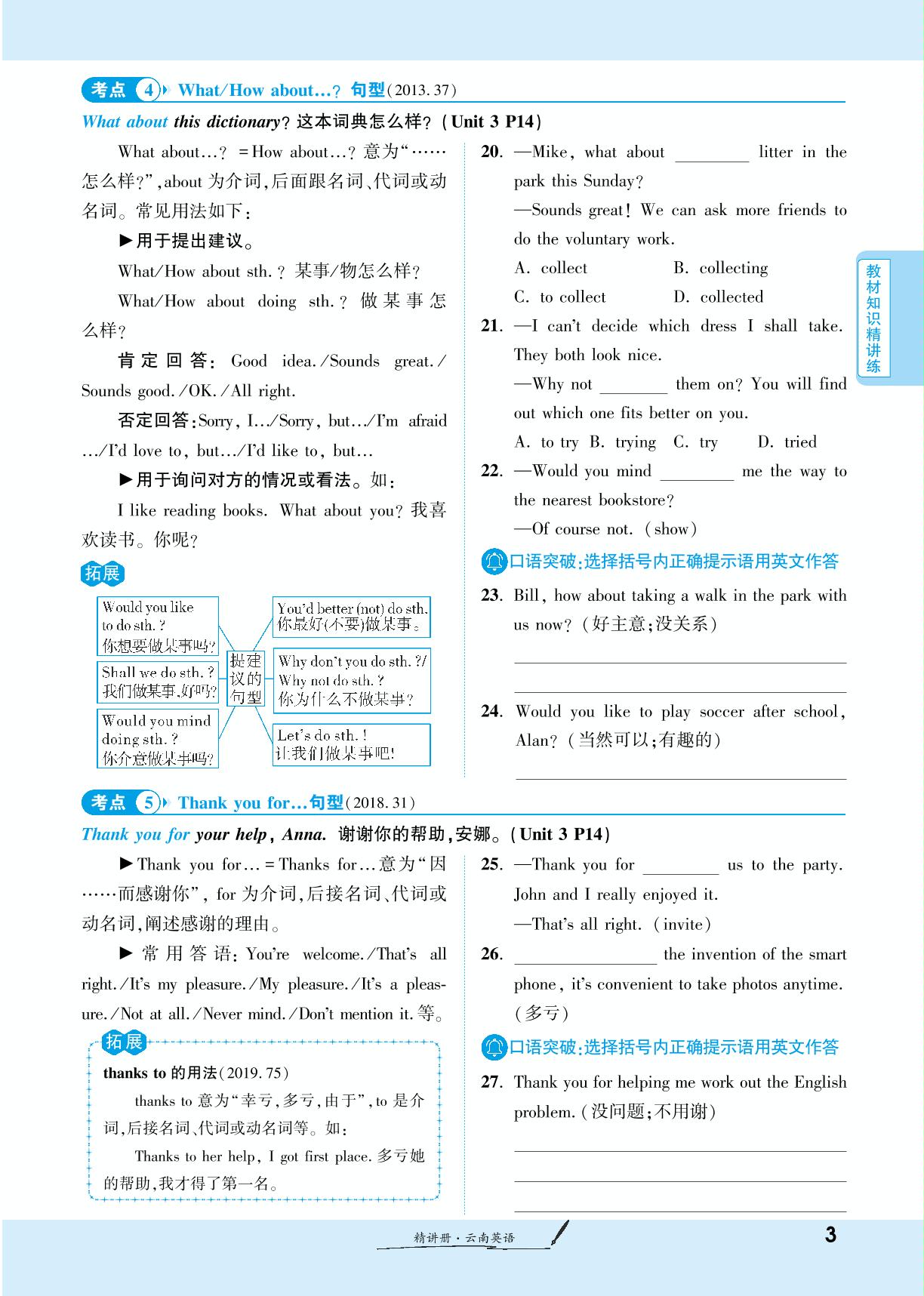
考点 4
What / How
about? 句型(2013. 37)
What
about
this
dictionary?
这本词典怎么样? (Unit
3
P14)
What
about? = How
about?
意为“ ……
怎么样?”,about 为介词,后面跟名词、代词或动
名词。 常见用法如下:
▶用于提出建议。
What / How
about
sth. ? 某事 / 物怎么样?
What / How
about
doing
sth. ? 做 某 事 怎
么样?
肯 定 回 答:
Good
idea. / Sounds
great. /
Sounds
good. / OK. / All
right.
否定回答:Sorry,
I/ Sorry,
but/ Im
afraid
/ Id
love
to,
but / Id
like
to,
but
▶用于询问对方的情况或看法。 如:
I
like
reading
books.
What
about
you?
我喜
欢读书。 你呢?
拓展
20.
—Mike,
what
about
B
litter
in
the
park
this
Sunday?
—Sounds
great!
We
can
ask
more
friends
to
do
the
voluntary
work.
A.
collect B.
collecting
C.
to
collect D.
collected
21.
—I
cant
decide
which
dress
I
shall
take.
They
both
look
nice.
—Why
not
C
them
on?
You
will
find
out
which
one
fits
better
on
you.
A.
to
try B.
trying C.
try D.
tried
22.
—Would
you
mind
me
the
way
to
the
nearest
bookstore?
—Of
course
not.
(show)
口语突破:选择括号内正确提示语用英文作答
23.
Bill,
how
about
taking
a
walk
in
the
park
with
us
now? (好主意;没关系)
24.
Would
you
like
to
play
soccer
after
school,
Alan? (当然可以;有趣的)
考点 5
Thank
you
for句型(2018. 31)
Thank
you
for
your
help,
Anna.
谢谢你的帮助,安娜。 (Unit
3
P14)
▶Thank
you
for = Thanks
for意为“因
……而感谢你”,
for 为介词,后接名词、代词或
动名词,阐述感谢的理由。
▶ 常 用 答 语: Youre
welcome. / Thats
all
right. / Its
my
pleasure. / My
pleasure. / Its
a
pleas-
ure. / Not
at
all. / Never
mind. / Dont
mention
it. 等。
拓展
thanks
to 的用法(2019. 75)
thanks
to 意为“幸亏,多亏,由于”,to 是介
词,后接名词、代词或动名词等。 如:
Thanks
to
her
help,
I
got
first
place. 多亏她
的帮助,我才得了第一名。
25.
—Thank
you
for
us
to
the
party.
John
and
I
really
enjoyed
it.
—Thats
all
right.
(invite)
26.
the
invention
of
the
smart
phone,
its
convenient
to
take
photos
anytime.
(多亏)
口语突破:选择括号内正确提示语用英文作答
27.
Thank
you
for
helping
me
work
out
the
English
problem. (没问题;不用谢)
3
精讲册·云南英语
教
材
知
识
精
讲
练
考点 6
help 的用法【help(v. &
n. )→helpful(adj. )有用的;有帮助的→helpless(adj. )无助的】
Thank
you
for
your
help,
Anna.
谢谢你的帮助,安娜。 (Unit
3
P14)
▶help 用作动词,意为“帮助,援助”。 用法
如下:
▶help 用作名词,意为“帮助,援助”。 用法
如下:
28.
—Can
you
spare
some
time
to
help
me
D
maths
this
Saturday
or
Sunday?
—Either
day
is
OK.
A.
at B.
on C.
for
D.
with
29.
—Can
you
help
me
A
the
house?
—Sure,
Mom.
I
will
help
you
after
I
finish
my
homework.
A.
clean B.
cleaning
C.
cleaned D.
cleans
30.
The
result
of
the
competition
was
exciting
and
we
couldnt
help
.
(cry)
31.
Jenny
gave
us
a
talk
about
how
to
learn
Eng-
lish
well.
It
was
to
us.
(help)
32.
The
mooncakes
are
very
delicious.
Please
help
,
Jack. (you)
33.
the
tour
guide,
the
trip
was
smooth
and
enjoyable.
(在……的帮助下)
考点 7
ask 的用法
Ask
the
teacher
for
it.
去找老师要一下它。 (Unit
3
P17)
34.
Tina
knows
a
lot
about
biology,
and
we
all
like
to
ask
her
A
it.
A.
about B.
to C.
for D.
at
35.
The
teacher
asked
me
aloud
so
that
the
other
students
could
hear
me.
(read)
36.
When
you
visit
a
foreign
country,
it
is
neces-
sary
to
know
how
to
help
politely.
(请求)
考点 8
find 的用法
I
must
find
it.
我必须找到它。 (Unit
3
P17)
37.
Learn
to
express
yourself
honestly,
and
you
will
find
it
easy
B
some
friends.
A.
make B.
to
make
C.
made D.
making
38.
This
is
the
third
time
Ive
read
this
story
and
I
still
find
it
.
(interest)
4
精讲册·云南英语
教
材
知
识
精
讲
练
拓展
find,
find
out 与 look
for 的区别
1.
find 强调找的结果,指经过一番努力之
后找到丢失的人或东西。
2.
find
out
强调经过调查、研究或询问等获
知、得知,意为“查明,弄清”。
3.
look
for
强调找的过程,意为“寻找”。
39.
When
Lily
got
home
after
school,
she
found
her
cat
in
her
bed
quietly.
(lie)
40.
Dave,
if
you
dont
want
to
waste
too
much
time
things,
you
should
put
everything
in
order.
(寻找)
41.
We
must
when
Karl
is
coming,
so
we
can
book
a
room
for
him.
(弄清)
考点 9
打电话常用表达(2017. 22)
Call
me
at
685-6034.
拨打 685-6034 找我。 (Unit
3
P17)
拓展
1.
打电话自我介绍时,用“This
is(speak-
ing)”,询问对方是谁时,用 “ Who
is
that? / Is
that(speaking)?”。
2.
如果对方要找的人是你,用“ This
is
speaking. / Speaking,
please. ” 回答;如果对方要
找的人不在身边,用“ Hold
on,
please. / Hold
the
line,
please. / Sorry,
is
not
in. ”回答。 如:
—Hello.
Is
that
Mandy
speaking? 你好,是
曼迪吗?
—Sorry,
she
isnt
in.
抱歉,她不在。
42.
—Is
Mr.
White
at
home?
—Sorry,
I
dont
know.
But
you
can
call
him
A
773-8966.
A.
at B.
for
C.
on D.
to
43.
Make
a
call
C
us
as
soon
as
you
know
the
result
of
the
speech
competition.
We
are
hoping
for
your
good
news.
A.
in B.
with
C.
to D.
at
口语突破:选择括号内正确提示语用英文作答
44.
Can
I
speak
to
Nina,
please? (请稍等;我不
介意)
45.
Hello!
May
I
speak
to
Michael? (友好的;抱
歉,他不在)
1.
冠词(Starter 单元)(讲解见本书 P138)
2.
一般现在时(to
be)(讲解见本书 P100)
3.
一般疑问句及其回答(讲解见本书 P149)
4.
基数词(讲解见本书 P135)
5.
名词复数(讲解见本书 P85)
6.
由 what,
who,
where 引导的特殊疑问句
(讲解见本书 P149)
7.
方位介词(on,
in,
under)(讲解见本书 P143)
8.
连词(and)(讲解见本书 P156)
9.
人称代词、物主代词(讲解见本书 P128)与指示代
词(讲解见本书 P134)
5
精讲册·云南英语
教
材
知
识
精
讲
练
词汇 & 语法综合练
Ⅰ.
单项填空
1.
The
man
in
the
middle
of
this
picture
is
my
B ,
my
fathers
brother.
A.
aunt B.
uncle
C.
son D.
sister
2.
—Its
said
that
your
English
teacher
is A
to
you.
—Yes,
she
is
kind
and
helpful.
A.
nice B.
bad
C.
normal D.
awful
3.
Since
we
C
the
importance
of
saving
wa-
ter,
we
shouldnt
waste
water.
A.
tell B.
come
C.
know D.
help
4.
—I
have
never
been
to
the
Summer
Palace
to
enjoy
the
beauty.
—Me,
C .
A.
too B.
either
C.
neither D.
also
5.
The
way
to
get
happiness
is
to
love
your
life,
and
the
way
to
fall
in
love
with
life
is
to
D
everyone
around
you.
A.
ask B.
think
C.
find D.
thank
6.
As
we
all
know,
China
is
B
Asian
country.
A.
a B.
an C.
the D.
/
7.
—Excuse
me.
Is
this
your
English
book?
— D .
I
think
its
Monicas.
Her
name
is
on
it.
A.
Yes,
it
is B.
No,
it
is
C.
Yes,
it
isnt D.
No,
it
isnt
8.
—Work
hard,
A
you
will
pass
the
exam.
—OK,
I
will.
A.
and B.
so
C.
or D.
but
9.
— B
is
our
grandpa?
I
cant
find
him.
—Oh,
maybe
he
is
in
the
living
room.
A.
Who B.
Where
C.
When D.
What
10.
Open
your
pencil
case
and
you
can
see
your
erasers
A
it.
A.
in B.
on C.
under D.
at
Ⅱ.
词形转换
1.
(2021 云南 70 题)Chinas
population
on
the
main-
land
reached
1. 41178
billion
according
to
the
national
population
census(普查).
(seven)
2.
(2018 云南 70 题)
are
those
who
make
you
smile,
always
open
their
hearts
to
you
and
encourage
you
to
succeed.
(friend)
3.
(2024 昆明统测)You
should
always
be
to
your
parents
for
giving
you
a
good
education.
(thank)
4.
Listening
to
soft
music
can
help
me
well.
(sleep)
5.
Miss
Li
likes
to
communicate
with
students,
so
her
students
like
her
very
much.
(she)
Ⅲ.
短语翻译
1.
(2020 云南 71 题)Lots
of
tourists
are
amazed
at
the
beauty
of
the
in
Yun-
nan.
(蓝天)
2.
(2019 云南 72 题)The
students
often
ask
Mr.
Li
for
some
advice
on
improving
.
(英语口语)
3.
Our
aunt
will
come
to
see
us
this
weekend.
She
told
me
that
this
morning.
(通过邮件)
4.
!
There
is
little
time
left.
We
may
be
late.
(快点儿)
5.
To
live
a
,
we
should
always
produce
less
waste,
reuse
or
recycle
things.
(绿
色生活)
6
参考答案·云南英语
一战成名新中考·英语(2025 云南)
参考答案
精
讲
册
精讲册
第一部分 教材知识精讲练
七年级(上)
Units
1~ 4(含 Starter
Units)
教材重点精讲练
1. A 2. C 3. C 4. best 5. better 6. good
habit 7. are
good
at / do
well
in 8. Good
idea. / Sounds
good. / That
sounds
good. / Thats
a
good
idea. 9. A 10. C 11. C
12. D 13. as
well 14. B 15. rooms 16. new
house
17. at
home 18. family
dinner 19. common
home 20. B
21. C 22. showing 23. Good
idea. / Sounds
good. / That
sounds
good. / Thats
a
good
idea. 24. Sure. / Certainly. / Of
course. 25. inviting 26. Thanks
to 27. Youre
welcome. /
My
pleasure. / Its
my
pleasure. / Not
at
all. / Dont
mention
it. / Thats
all
right. 28. D 29. A 30. crying 31. helpful
32. yourself 33. With
the
help
of 34. A 35. to
read
36. ask
for 37. B 38. interesting 39. lying 40. looking
for 41. find
out 42. A 43. C 44. Wait
a
minute,
please. / Hold
on
( a
moment ),
please. / Hold
the
line,
please. 45. Sorry,
he
isnt
in.
词汇
&
语法综合练
Ⅰ. 1. B 2. A 3. C 4. C 5. D 6. B 7. D 8. A 9. B
10. A
Ⅱ. 1. seventh 2. Friends 3. thankful 4. ( to)
sleep
5. her
Ⅲ.
1. blue
sky / blue
skies 2. spoken
English / oral
English
3. by
e-mail 4. Come
on / Hurry
up 5. green
life
七年级(上)
Units
5~ 9
教材重点精讲练
1. A 2. A 3. Good
idea. / Sounds
great. / That
sounds
good. / Thats
a
good
idea. 4. A 5. B 6. C 7. plays
8. D 9. A 10. C 11. feeling 12. interesting 13. A
14. B 15. A 16. A 17. relaxed 18. surprising
19. excited 20. is
interested
in 21. D 22. C 23. watches
24. talking 25. watch
a
game 26. look
at 27. B 28. to
study 29. A 30. D 31. C 32. at
high
prices 33. About
150
yuan. / Its
about
150
yuan. 34. 10
yuan. / It
cost
10
yuan. 35. C 36. D 37. to
worry 38. turning 39. in
need 40. C 41. C 42. B 43. take
a
taxi 44. B 45. A
46. C 47. sold
out 48. on
sale 49. A 50. preparing
51. are
busy
with
词汇
&
语法综合练
Ⅰ. 1. A 2. B 3. D 4. C 5. A 6. C 7. D 8. C 9. B
10. D
Ⅱ. 1. tomatoes 2. our 3. twentieth 4. player 5. easily
Ⅲ. 1. Womens
Day 2. was
late
for 3. think
about 4. for
sure 5. favo(u)rite
writer
七年级(下)
Units
1~ 4
教材重点精讲练
1. B 2. D 3. D 4. to
use 5. talk
with / to 6. tells
a
story / tells
stories 7. talked
about 8. C 9. A 10. be
good
with 11. is
good
for 12. D 13. show
up 14. C
15. yourself 16. B 17. C 18. his 19. on
foot 20. B
21. D 22. to
have 23. A 24. was
afraid
of 25. A
26. leave
her
alone 27. left
a
message 28. a
long
leave
29. C 30. D 31. C 32. put
on 33. dress
up 34. B
35. D 36. too
much 37. C 38. C 39. to
ask 40. putting
41. A 42. D 43. healthy 44. keep
away
from
45. keeping
a
diary / keeping
diaries
词汇
&
语法综合练
Ⅰ. 1. B 2. C 3. A 4. D 5. B 6. D 7. C 8. A 9. B
10. C
Ⅱ. 1. worker 2. hundredth / 100th 3. waiting 4. rules
5. truly
Ⅲ. 1. at
home 2. come
true 3. good
luck 4. are
strict
with 5. Helping
with
七年级(下)
Units
5~ 8
教材重点精讲练
1. A 2. C 3. wishes 4. to
get 5. were 6. make
a
wish
7. B 8. rainy 9. Its
cloudy. / Its
cloudy
in
Kunming.
10. D 11. D 12. D 13. A 14. crossing 15. B 16. A
17. D 18. talking 19. pay
for 20. A 21. to
clean 22. to
2
资源预览图

1

2
3
相关资源
由于学科网是一个信息分享及获取的平台,不确保部分用户上传资料的 来源及知识产权归属。如您发现相关资料侵犯您的合法权益,请联系学科网,我们核实后将及时进行处理。