Unit9同步练习 -重庆八中2024-2025学年人教版英语八年级下册
2024-12-04
|
18页
|
334人阅读
|
16人下载
资源信息
| 学段 | 初中 |
|---|---|
| 学科 | 英语 |
| 教材版本 | 初中英语人教版(2012)八年级下册 |
| 年级 | 八年级 |
| 章节 | Unit 9 Have you ever been to a museum? |
| 类型 | 作业-同步练 |
| 知识点 | - |
| 使用场景 | 同步教学-单元练习 |
| 学年 | 2025-2026 |
| 地区(省份) | 重庆市 |
| 地区(市) | - |
| 地区(区县) | - |
| 文件格式 | DOCX |
| 文件大小 | 65 KB |
| 发布时间 | 2024-12-04 |
| 更新时间 | 2024-12-04 |
| 作者 | 匿名 |
| 品牌系列 | - |
| 审核时间 | 2024-12-04 |
| 下载链接 | https://m.zxxk.com/soft/49111841.html |
| 价格 | 0.50储值(1储值=1元) |
| 来源 | 学科网 |
内容正文:
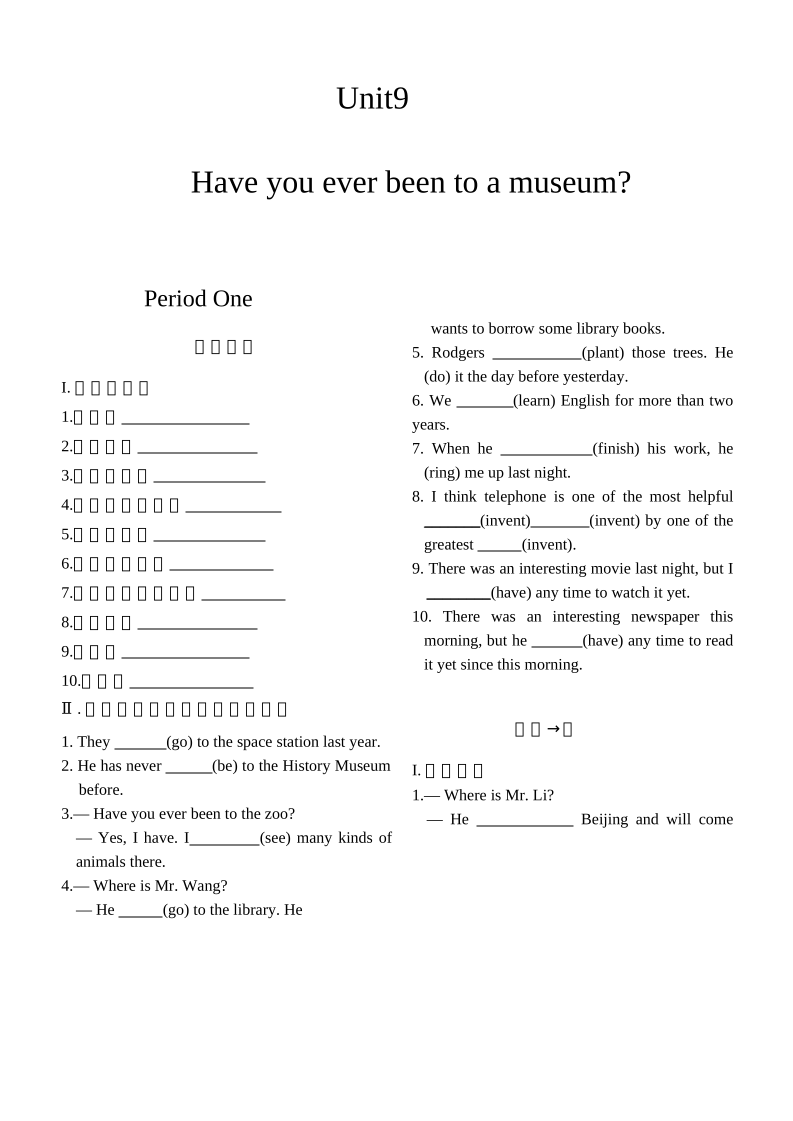
Unit9
Have you ever been to a museum?
Period One
自学导航
I. 翻译短语。
1.游乐场
2.水上乐园
3.历史博物馆
4.国家科学博物馆
5.自然博物馆
6.去过某个地方
7.去某个不同的地方
8.搭乘地铁
9.去滑冰
10.搭帐篷
Ⅱ. 用所给单词的适当形式填空。
1. They (go) to the space station last year.
2. He has never (be) to the History Museum before.
3.— Have you ever been to the zoo?
— Yes, I have. I (see) many kinds of animals there.
4.— Where is Mr. Wang?
— He (go) to the library. He
wants to borrow some library books.
5. Rodgers (plant) those trees. He (do) it the day before yesterday.
6. We (learn) English for more than two years.
7. When he (finish) his work, he (ring) me up last night.
8. I think telephone is one of the most helpful _______(invent) (invent) by one of the greatest (invent).
9. There was an interesting movie last night, but I ________(have) any time to watch it yet.
10. There was an interesting newspaper this morning, but he (have) any time to read it yet since this morning.
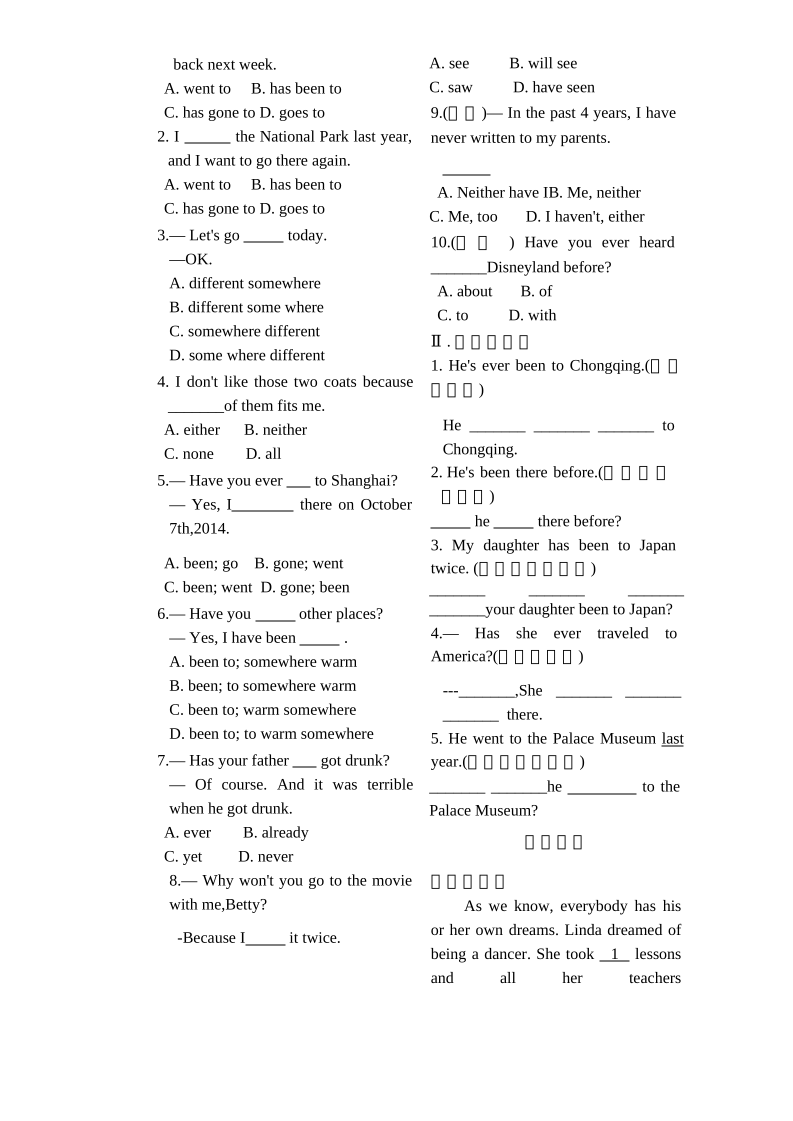
一课→得
I. 选择题。
1.— Where is Mr. Li?
— He Beijing and will come
back next week.
A. went to B. has been to
C. has gone to D. goes to
2. I the National Park last year, and I want to go there again.
A. went to B. has been to
C. has gone to D. goes to
3.— Let's go today.
—OK.
A. different somewhere
B. different some where
C. somewhere different
D. some where different
4. I don't like those two coats because _______of them fits me.
A. either B. neither
C. none D. all
5.— Have you ever to Shanghai?
— Yes, I there on October 7th,2014.
A. been; go B. gone; went
C. been; went D. gone; been
6.— Have you other places?
— Yes, I have been .
A. been to; somewhere warm
B. been; to somewhere warm
C. been to; warm somewhere
D. been to; to warm somewhere
7.— Has your father got drunk?
— Of course. And it was terrible when he got drunk.
A. ever B. already
C. yet D. never
8.— Why won't you go to the movie with me,Betty?
-Because I it twice.
A. see B. will see
C. saw D. have seen
9.(多选)— In the past 4 years, I have never written to my parents.
A. Neither have IB. Me, neither
C. Me, too D. I haven't, either
10.(多选 ) Have you ever heard _______Disneyland before?
A. about B. of
C. to D. with
Ⅱ. 句型转换。
1. He's ever been to Chongqing.(改为否定句)
He _______ _______ _______ to Chongqing.
2. He's been there before.(改为一般疑问句)
he there before?
3. My daughter has been to Japan twice. (对画线部分提问)
_______ _______ _______ _______your daughter been to Japan?
4.— Has she ever traveled to America?(作否定回答)
---_______,She _______ _______ _______ there.
5. He went to the Palace Museum last year.(对画线部分提问)
_______ _______he to the Palace Museum?
能力训练
完形填空。
As we know, everybody has his or her own dreams. Linda dreamed of being a dancer. She took 1 lessons and all her teachers
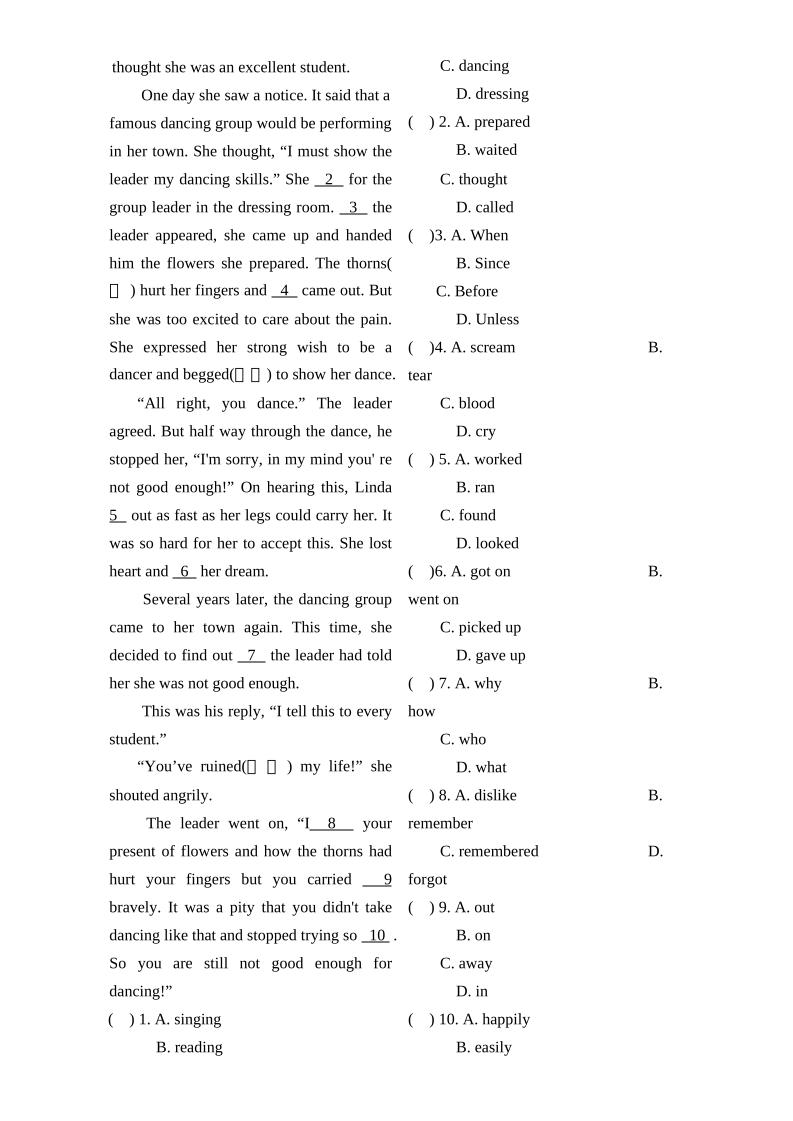
thought she was an excellent student.
One day she saw a notice. It said that a famous dancing group would be performing in her town. She thought, “I must show the leader my dancing skills.” She 2 for the group leader in the dressing room. 3 the leader appeared, she came up and handed him the flowers she prepared. The thorns(刺 ) hurt her fingers and 4 came out. But she was too excited to care about the pain. She expressed her strong wish to be a dancer and begged(乞求) to show her dance.
“All right, you dance.” The leader agreed. But half way through the dance, he stopped her, “I'm sorry, in my mind you' re not good enough!” On hearing this, Linda 5 out as fast as her legs could carry her. It was so hard for her to accept this. She lost heart and 6 her dream.
Several years later, the dancing group came to her town again. This time, she decided to find out 7 the leader had told her she was not good enough.
This was his reply, “I tell this to every student.”
“You’ve ruined(毁掉) my life!” she shouted angrily.
The leader went on, “I 8 your present of flowers and how the thorns had hurt your fingers but you carried 9 bravely. It was a pity that you didn't take dancing like that and stopped trying so 10 . So you are still not good enough for dancing!”
( ) 1. A. singing B. reading
C. dancing D. dressing
( ) 2. A. prepared B. waited
C. thought D. called
( )3. A. When B. Since
C. Before D. Unless
( )4. A. scream B. tear
C. blood D. cry
( ) 5. A. worked B. ran
C. found D. looked
( )6. A. got on B. went on
C. picked up D. gave up
( ) 7. A. why B. how
C. who D. what
( ) 8. A. dislike B. remember
C. remembered D. forgot
( ) 9. A. out B. on
C. away D. in
( ) 10. A. happily B. easily
C. luckily D. safely
博学近思
短文填空。
Body image— the way people feel about their looks— is a big problem for many young people today. 1 to a study, more than half the teenage girls in the USA think they should be on a diet(节食) and almost one in five teenage boys are worried about their bodies and their weight. It seems that they don't care about their health so much.
But 2 causes the problem? In the study, many blame(责备) the media(媒体). Turn on the TV and you' ll always see beautiful models, handsome actors and fit sports stars. Open a magazine or a newspaper, look through the Internet, and it's usually the 3 .
In the USA, the average (平均的) woman is 163 cm tall and weighs 64 kilos, but the average model is 180 cm tall and weighs 53 kilos. Many young people feel pressure to look like these“perfect” people. But for most, this is just not possible 4 they begin to become less confident. As a result, some stop eating healthily in order to lose weight. Students who lose so much confidence 5 to take part in classroom activities at school, but they don't now.
Is there a 6 to the problem? In 2019a study in the UK advised that body image
lessons should be provided in schools. Other believe it's a problem that all of society need to deal 7 . As Meaghan Ramsey says, “W shouldn't judge (评 判 ) people by what the) look like. 8 , we should do it by what they do.”
1. 2.
3. 4.
5. 6.
7. 8.
Period Two
自学导航
I. 翻译短语。
1.茶艺
2.收集茶具
3.一对; 两个
4.鼓励某人做某事
5.以如此迅速的方式
6.一个品茶的好地方
7.许多不同种类
8.一个非同寻常的博物馆
Ⅱ. 预习本单元 Section A 3a部分, 回答下列问题。
1. What is the most interesting museum Ken has ever been to?
3. Where has Amy recently been?
4. What does Linlin think of the Hangzhou| National Tea Museum?
5. What do the tea art performances show?
一课一得
I. 选择题。
1.— Sandy, I called you at 9 : 00 last night.
—I'm sorry. We a birthday party.
A. had B. were having
C. are having D. have
2. He promised to pick me up at the school gate. However, he yet.
A. didn't arrive B. doesn't arrive
C. isn't arriving D. hasn't arrived
3. My parents always encourage me ________hard.
A. study B. studied
C. studying D. to study
4.—I hear Mr. Zhang has gone to Beijing for a meeting.
— Do you know when he ?
A. leaves B. was leaving
C. has left D. left
5.— you ever to an aquarium (水族馆) ?
— Yes, we had a good time there.
A. Have; gone B. Had; been
C. Have; been D. Had; gone
6. Mr. Walson to America 20 years ago and has been here .
A. has gone; since then
B. went; since ever
C. has gone; ever since
D. came; ever since
7.—I French food and I don't want to eat it again.
— Really, when did you it?
A. tried; try B. have tried; try
C. tried; tried D. have tried; tried
8.— you to another province of China?
— Not yet.
A. Did; travel B. Were; traveling
C. Have; traveled D. Will; travel
9.(多选) We need days to solve the problem.
A. another two B. two another
C. other two D. two more
10.(多选) My sister would like to be a dancer a singer. She likes dancing more.
A. rather than B. than rather
C. instead of D. instead
Ⅱ. 句型转换。
1. Peter has never been to Hangzhou and I have never been there either.(改为同义句)
Peter has never been to Hangzhou._______ _______ _______.
2. We have traveled to another province of China.(改为否定句)
We to another province of China.
3. They have been there before. So have I.(改为同义句)
They have been there before. ,_______.
4. Mike has ever visited the Great Wall. (改为反义疑问句)
Mike has ever visited the Great Wall,_______ _______?
5.你们认识那个叫丽萨的女孩吗? (完成译句)
Do you know the girl Lisa?
能力训练
完形填空。
When the young are free, they like going to the zoo to watch animals. But a few of them don't look on the animals 1 their
friends. So sometimes there are 2 to the animals or the young men. For example, one day, some children came to see animals in a zoo in Guiyang. They wanted to play jokes on them. They did the 3 actions again and again, but they 4 away the food in their hand time after time. This made the monkeys very angry. One of them came up and hurt a boy's hand finally. He had to go to 5 . In fact, there's a“Notice Board” beside the cage. It says, “Don't trick(玩弄) the monkeys! It's dangerous!”
In 6 zoo in Liuzhou,a small seal(海豹 ) died in 2002. Later, the doctors found some skewers(串肉扦) 7 bamboo sticks(签) in its stomach. Those skewers were thrown to the seal by the 8 . The small seal ate the meat and the sticks together. Then it couldn't eat any more and became 9 till it died at last.
All these are because the travelers didn't 10 the zoo rules. In zoos visitors should not throw food to some animals. So when we go to the zoo, we must know the zoo rules clearly.
( ) 1. A. for B. after
C. like D. as
( ) 2. A. accidents B. stories
C. celebrations D. parties
( ) 3. A. keeping B. feeding
C. digging D. protecting
( ) 4. A. ran B. walked
C. threw D. took
( ) 5. A. his home
B. the office
C. hospital
D. the police station
( ) 6. A. another B. other
C. the other D. others
( ) 7. A. looked after B. lent to
C. made of D. protected from
( ) 8. A. workers B. travelers
C. doctors D. animals
( ) 9. A. ill B. sad
C. worried D. tired
( ) 10. A. like B. follow
C. hold D. act
博学近思
短文填空。
Do you enjoy visiting a museum? Did you ever 1 a plan before a visit? Every museum must have something that attracts you. If you follow these steps below, you' ll know what is worth seeing and doing, so that you can make the most of your time at the museum.
2 what museum you will visit. There are so many different kinds of museums and you first need to find 3 that you like. It's easy for you to choose one and start an enjoyable visit!
Do some 4 online. On the website of each museum, you may look for such things as: the exhibits(展品), the history of the museum, activities and cost, food or shortage.
Learn at least one thing on your visit. It is always good to learn something 5 from your visit.
Plan breaks into your visit. 6 when you walk around, standing here and studying exhibits there, you may become very tired. It is important to take breaks. A 7 is a good opportunity for you to think of what you have
seen and what else you might want to do in museum.
Take a friend or two. Visiting museums is always a lot 8 fun when you are with someone else than doing it alone. You can talk over what you' re seeing. A friend also brings
another way of thinking when you talk about the exhibit.
1. 2.
3. 4.
5. 6.
7. 8.
Period Three
自学导航
I. 翻译短语。
1.数以千计的
2.一方面……另一方面
3.全年
4.在白天
5.离……远 —
6.三分之二
7.尝试中国菜
8.参观故宫
9.害怕做某事
10.做某事有困难
Ⅱ. 根据上下文,在每个设空处填入一个适当的单词。
Peter has 1 in China for two weeks, and he's going back to Australia tomorrow. He has 2 many places here. He went to the Palace Museum last week. It was wonderful and he saw so many beautiful treasures. He also went to the Great Wall and the Bird's Nest, but there 3 too many people. Did he go
4 outside Beijing? Of course yes. Three days 5 he went to see the Terracotta Army in Xi’ an. It was fantastic. During his stay in China, he has tried many kinds of 6 food, and his favorite is Beijing Duck. It looks 7 he really enjoys his trip in China.
一课一得
I. 选择题。
1. Two and three joined the sports club last week.
A. Germans; Japanese
B. Germen; Japaneses
C. Germans; Japaneses
D. German; Japanese
2.— Can you come on Monday or Tuesday?
—I'm afraid day is possible.
A. either B. neither
C. some D. any
3. The thing that matters is not whether you fail
or not, whether you try or not.
A. and B. or
C. so D. but
4.—I am sorry to have kept you waiting.
— That's all right. I here for only a few minutes.
A. have been B. had been
C. was D. will be
5. Chinese used to go to American schools every year, but now they don't because of COVID-19.
A. Thousand of B. Thousands of
C. 5 thousands D. Thousands
6. In our class of the students ________foreign students.
A. three fifths; are B. three fifth; are
C. three fifths; is D. three fifth; is
7. You can choose to go to Singapore you like, spring, summer, autumn or winter.
A. when B. what
C. whenever D. whatever
8. Is China to Japan or far it?
A. closing; to B. closed; to
C. close; from D. far; close
9. you like Asian food western food, you can find it in China.
A. If; or B. Whether; or
C. Both; and D. Neither; nor
10.(多选) you arrive in Beijing, remember to call me.
A. The minute B. As soon as
C. While D. The moment
Ⅱ. 用所给词的适当形式填空。
1. What Judy said is (believe), so nobody believes it.
2. When you are upset, you should go somewhere (peace) .
3. Mr. Li often (encourage) us to think about ways to improve our studies when he taught us.
4. Ten kilometers (seem)a long way for the old to walk.
5. It's amazing that China has developed 80 (rapid) .
能力训练
I. 完形填空。
Modern life is good with traveling. The 1 way of traveling is by air. With a modem airline you can travel in one day to places. But it 2 a month or more to get to these places a hundred years ago.
Traveling by train is slower than by air, 3 it has its advantages(便利 ). You can see the country you are traveling through. Modern trains have comfortable seats and dining cars. They make even the longest journey 4 .
Some people like to travel by sea if it is possible. There are large liners and river boats. You can visit many 5 countries and different places. Traveling by sea is a very pleasant(令人愉快的 ) way to take a holiday.
Many people like to travel by 6 . You can make your own timetable. You can travel three or four hundred miles or only fifty or one hundred miles a day, just 7 you like. You can stop 8 you wish— where there is something interesting to see, at a good 9 where you can enjoy a good meal, or at
a hotel to spend the night. That is why traveling by car is popular for 10 trips, while people usually take a train or a plane when they are traveling on business.
( ) 1. A. fastest B. faster
C. slowest D. slower
( ) 2. A. spend B. took
C. cost D. paid
( ) 3. A. and B. so
C. but D. or
( ) 4. A. boring B. harmful
C. enjoyable D. tired
( ) 5. A. other B. another
C. the other D. others
( ) 6. A. walking B. riding
C. driving D. a car
( ) 7. A. to B. from
C. as D. with
( ) 8. A. whatever B. wherever
C. however D. whichever
( ) 9. A. university B. museum
C. city D. restaurant
( ) 10. A. business B. pleasure
C. school D. work
Ⅱ. 阅读理解。
Everyone faces challenges in their life, but some are more difficult than others. Daniel Kish had serious problems with his eyes when he was born. And doctors took away both of his eyes before he was fourteen months old.
Soon after, however, he started to do an amazing thing. He started to make clicking(咔哒) sounds with his tongue to help him move around. Much like a bat, he now moves about using sonar(声呐) . He is so good at it that he can ride a bicycle in traffic. He and his group,
World Access for the Blind, teach others how to use sonar. In this interview with National Geographic, Kish explains how the process(过程) works.
How does sonar work?
“When I make a clicking sound, it makes sound waves. These waves reflect off surfaces(表面) all around and return to my ears. My brain then processes the sounds into images( 图像) . It's like having a conversation with the environment.”
When you click, what do you see in your mind?
“Each click is like a camera flash. I make a3D image of the things around me for hundreds of feet in every direction (方向).”
▲ ?
“It's exciting and enjoyable but needs a lot of focus. I click up to two times per second, much more than I usually do.”
Is it dangerous to move around the world in this way?
“Much of the world lives in fear of things that we mostly imagine. I have a habit of climbing anything and everything, but I never broke a bone as a kid.”
How challenging is it to teach people to use sonar?
“Many students are surprised how quickly results come. Seeing isn't in the eyes; it's in the mind.”
1. When did Kish lose his eyes?
A. When he was born.
B. When he was more than one year old.
C. When World Access for the Blind helped him.
D. When he was less than one year old.
2. What's the main idea of Paragraph 2?
A. Kish explains how sonar works. B. Kish teaches people how to use sonar.
C. Kish started to move around using sonar. D. Kish is good at riding a bicycle in traffic.
3. Which of the following sentences can be put in the ▲ ?
A. How often do you practice with your group
B. When do you usually use sonar
C. How long does it take to master such skills
D. What is it like riding a bike using sonar
4. What would be the best title for the passage?
A. How Sonar Works
B. Riding a Bike Using Sonar
C. Seeing with the Mind
D. How the Blind Move Around
博学近思
任务型阅读。
We all have those moments when bright ideas hit us, but not everyone can develop such moments into the fruits of creative thinking. While we believe creative thinking is the falling apple of Isaac Newton, one of the greatest scientists, we seldom notice that creative thinking is in fact a process(过程) .
Let's look at what happened in 1666. Sitting in the garden, Newton watched an apple fall from a tree. He began to wonder if the same force that pulled the apple down also kept the moon circling the earth. Newton believed it did. He called it“gravity (重力)”.
This story has become one of the most popular examples of“eureka”(我发现了,找到了) moment. But when we cheer for the great discovery (发现 ), the whole process creative thinking shouldn't be forgotten.
Newton studied mathematics for long to have a better understanding of the world He always enjoyed finding new ways to solve problems. The falling apple was only the fruit of years of hard work before. It also started the train of thought that continued for the next twenty years.
Newton began to examine(测验)“gravity carefully. He experimented(做实验) . Then he studied the results and used what he had learned to do new experiments. In 1687, the greatest scientific work ever written came out.
The whole process of creative thinking works the same in our life. In school, we prepare ourselves for the right moment. Once the moment comes, we catch it and then keep on working in the years to come. It takes much to get the fruits of creative thinking, but the sweetest fruits will be ready for those who wait the longest.
1. Can all of us develop our bright ideas into the, fruits of creative thinking?
2. What's the force that pulled the apple down?
3. What order does the process of creative thinking for Newton follow?
4. Do you agree that the sweetest fruits will only be ready for those who wait the longest? Why or why not?
Period Four
自学导航
I. 根据句意或首字母提示,完成句子。
1. The inventor invented many great i_______ which have changed people's life a lot.
2. It's u that it snows in June.
3. About three q of the earth is ocean.
4. At last, the old man arrived at the airport s .
5. People there m speak Chinese and English.
6. W it rains or not, we will take a trip.
7. On the one hand, cars are useful. On________ ________ ________ , they cause pollution.
8. Mike and Linda f no difficulty and that's why they can be successful.
9. W we meet difficulty, they will offer to help.
10. Claudia is from Japan and speaks J .
Ⅱ. 翻译句子。
1.新加坡还是个品尝新食物的极好的地方。
Singapore is________ ________ ________
________try new food.
2.不管你喜欢印度食品、西方食品还是日本食品,你在新加坡都能找到!
you like Indian food, Western food ________Japanese food, you’ ll ________ ________ ________in Singapore.
3.对于成千上万的中国游客来说,这个位于东南亚的小岛是一个极好的度假之地。
For ________ ________tourists from China, this small island in________ ________is a good place to________ ________________.
4.许多动物只在晚上醒来,因此这是观看它们的最佳时间。
A lot of animals only________ ________at night, so this is the best time ________ ________them.
5.因此,你可以选择在任何你喜欢的时候去,春天、夏天、秋天或冬天都行。当然,它离中国也不远!
So you can choose to go________ ________ ________ , spring, summer, autumn or winter. And, of course, it's not too ________ ________ China!
一课一得
1. 选择题。
1. This is a foreign language bookstore, and of the books are English books.
A. third four B. fourth three
C. three quarters D. three four
2.— is the population of your city?
— More than one million.
A. How much B. How many
C. What D. How
3. There are books in the library, and you can always find the book you want.
A. two thousand of
B. two thousands
C. thousand of
D. thousands of
4. The elegant housewife had difficulty _______her keys yesterday.
A. finding B. find
C. to find D. found
5. Neither of the two boys from the USA.
A. will come B. don't come
C.comes D. doesn't come
6. Have you ever seen him ?
A. ago B. two days ago
C. before D. just now
7.— Would you like some tea or coffee?
— is OK. I am very thirsty now.
A. Neither B. Either
C. Both D. Any
8. you are free, come to my home and let's have some coffee.
A. Whatever B. Whenever
C. Whoever D. However
9、(多选) It he has been ill for long time.
A. seems that B. looks like
C. looks D. seems like
10.( 多选 )— Jack can sing the song in English
A. So I can B. So can I
C. I can also sing D. I can, too
Ⅱ. 用所给词的适当形式填空。
1. There are quite a few (fox) living in this jungle, and we need to protect them.
2. Sandy met some (Germany) on her way home.
3. He can open the box (simple) though it is hard for most people.
4. I (not hear) about this story yet.
5. Singapore is a good place _______(practice) English.
Ⅲ. 句型转换。
1. They have ever been to a foreign country.(改为一般疑问句)
they ever to a foreign country?
2. Both of us have heard of the news that Yang Qian won the championship.(改为否定句) _______of us heard of the news that Yang Qian won the championship.
3. The boys have been to Japan lots of times.(改为一般疑问句)
the boys to Japan lots of times?
4. I think Mr. Smith has changed a lot since three years ago.(对画线部分提问)
_______ _______you think has
changed a lot since three years ago?
能力训练
完形填空。
My name is Philippe and my wife's name is Sophie. We' re from 1 . Recently we were faced with a difficult situation while traveling by car in the mountains with our hired driver. Just as we began to doze (打盹), the car made a strange, loud 2 and then stopped working.
We tried communicating with the driver but with little 3 because he couldn't speak French. He tried to tell us with body language that he was going to get help and then he left.
We were in a poor area, with no houses in sight. We started to hear the cries of wild animals. Sophie was very afraid. We didn't have much food and it was getting 4 and darker.I began to lose confidence. Should we leave the car? Would our driver ever 5 ? Was he a trustworthy (值得信任的) man? We were very worried.
A couple of hours passed. 6 , the headlights from another car appeared in the dark. A man got out of the car. Finding us cold and hungry, he kindly asked us to 7 his car.
8 we left, he put a note on the windshield (挡风玻璃) of the car with his phone number on it. Then he drove us to a nearby village, and we met his family. His cousin spoke French and he 9 us tea and local foods. Everyone asked us questions and they were excited to have unexpected guests.
Later that evening, the phone rang. It was
our driver. He had kept his word and 10 the car.
I will never forget the warmth we received on that day because we depended on a complete stranger for help.
( ) 1. A. China B. Germany
C. France D. America
( )2. A. cry B. noise
C. voice D. ring
( ) 3. A. suspect B. advice
C. magic D. success
( ) 4. A. colder B. warmer
C. heavier D. lighter
( )5. A. leave B. return
C. drive D. wait
( ) 6. A. Suddenly B. Sadly
C. Exactly D. Safely
( ) 7. A. get to B. get on
C. get off D. get into
( ) 8. A. Since B. After
C. Before D. Until
( ) 9. A. donated B. offered
C. sold D. lent
( ) 10. A. returned B. found
C. fixed D. bought
博学近思
I. 短文填空。
Dear Bill,
I'm glad to receive your letter. Thank you for your caring for the weather and my health. But I am sorry to tell you that I have to stay at home because of the heavy fog and haze.
1 the winter last year, the fog and haze has appeared a lot of times. It has done
great harm 2 our daily life. Many traffic accidents happened just because of the heavy fog and haze weather. More and more people have to go to see the doctor because of the serious disease caused by the fog and haze. Quite a lot of flights(航班) have to be put 3 , and a great number of people have to stay at home for fear of the poisonous air caused by the fog and haze.
According to the Chinese Academy of Science, driving cars and burning coals(煤) are two main reasons. People have been told: Don't do outdoor sports. 4 you have to go out, wear a mask. Wash your face and clean your nose as soon as you get home.
People have 5 the great harm caused by the fog and haze and the importance of 6 the environment. People all over the country are taking measures (方法) to reduce(减少) the fog and haze weather. The government suggests that people should go to work or school with the 7 traffic, such as the bus and the underground.
As for me, I will go to school by bike or on foot, and I won't throw the waste anywhere. In addition, I will tell the people to try 8 best to protect the environment. Would you like to tell me some good ideas? I'm looking forward to your reply.
Yours,
Li Hua
1. 2.
3. 4.
5. 6.
7. 8.
Ⅱ. 书面表达。
你的美国笔友 Jack要来中国游玩,1你咨询中国一些博物馆的情况。请给他写、封邮件,向他介绍一下你了解的中国的某博物馆。
见多母广
The British Museum
The British Museum was established in 1753, largely based on the collections of the physician and scientist Sir Hans Sloane. The museum first opened to the public on15th January 1759 in Montagu House in Bloomsbury, on the site of the current museum building. Its expansion over the following two and a half centuries has resulted in the creation of several branch institutions, the first being the British Museum (Natural History) in South Kensington in 1887. Until 1973, when the British Library opened to the public, the British Museum was unique in that it housed both a national museum of antiquities and a national library in the same building. Its present chairman is Sir John Boyd and its director is Neil MacGregor.
As with all other national museums and art galleries in Britain, the Museum charges no l admission fee, although charges are levied for some temporary special exhibitions.
KEYS:
Unit 9 Have you ever been to a museum?
Period One
自学导航
I. 翻译下列短语。
1. amusement park 2. water park 3. history museum 4. National Science Museum
5. nature museum 6. have been to 7. go somewhere different 8. take the subway
9. go skating 10. put up a tent
II.用所给单词的正确形式填空。
1. went, 2. has, been 3. saw 4. has gone 5. has planted, did 6. have learned
7. finished, rang 8. inventions, invented, inventors 9. haven't had10. hasn't had
一课一得
I. 选择题。 1-5 CACBC 6-8AAD 9. ABD 10. AB
II. 句型转换。
1. has never been 2. Has been 3. How many times has
4. No, has never traveled/ travelled5. When did go
能力训练
完形填空。1-5 CBACB 6-10 DABBB
博学近思:短文填空。
1. According 2. what 3. same 4. so
5. used 6. solution 7. with 8. Instead
Period Two
自学导航
I.翻译下列短语。
1. tea art 2. collect tea sets 3. a couple of 4. encourage sb. to do sth.
5. in such a rapid way 6. a good place to enjoy tea 7 many different kinds of
8. an unusual museum
II.课文预习。
1. The American Computer Museum.
2. Different computers and their inventors.
3. The International Museum of Toilets in India.
4. She thinks it's a relaxing and peaceful place.
5. How to make a perfect cup of tea with beautiful tea sets.
一课一得
I.单项选择。1-4 BDDD 5-8 CDBC 9. AD 10. AC
II.句型转换。
1. Neither/ Nor have I. 2. haven't travelled/ traveled 3. Me, too. 4. hasn't he
5. named/ called
能力训练
完形填空。1-5 DABDC 6-10ACBAB
博学近思:短文填空。
1. make 2. Decide/ Choose 3. one 4. research
5. new/ useful6. Because/ For 7. break 8. more
Period Three
自学导航
I. 翻译下列重要短语。
1. thousands of 2. on the one hand... on the other hand3. all year round
4. in the day 5. be far from6. two thirds7. try Chinese food
8. visit the Palace Museum 9. fear to do sth 10. have problems doing sth
II. 根据上下文填词。
1. been/ stayed 2. visited 3. were 4. anywhere 5. ago 6. delicious/ tasty 7. like
一课一得
I. 单项选择。
1-5ABDAB 6-9ACCB 10. ABD
II.用所给词的适当形式填空。
1. unbelievable 2. peaceful 3. encouraged 4. seems/ seemed 5. rapidly
能力训练
I. 完型填空。1-5ABCCA 6-10CCBAB
II.阅读理解。
1-4BADC
博学近思:
任务型阅读。
1. No./ No, we can't.
2. Gravity.
3. First, study mathematics for long; second, see an apple fall from a tree; third, catch the right moment; fourth, do experiments carefully.
4. 言之有理即可。
Period Four
自学导航
I.根据句意或首字母提示,完成句子。
1. inventions 2. unusual 3. quarters 4. safely 5. mostly/ mainly/ may 6. Whether 7. the other hand 8. fear 9. Whenever 10. Japanese
II. 完成句子。
1. a good place to 2. Whether, or, find it all 3. thousands of, Southeast Asia, take a holiday
4. wake up, to watch 5. whenever/ anytime you like, far from
一课一得:
I. 单项选择。1-5 CCDAC 6-8CBB 9. ABD 10. BCD
II. 用所给词的适当形式填空。
1. foxes 2. Germans 3. simply 4. haven't heard5. to practice
III. 句型转换。
1. Have, been 2. Neither, have/ has 3 . Have; been4. Who do
能力训练
完形填空。1-5CBDAB 6-10ADCBC
博学近思:短文填空。
1. Since 2. To 3. Off 4. When/ If
5. realized/ known/ understood6. Protecting7. Public8. their
学科网(北京)股份有限公司
$$
资源预览图
1
2
3
相关资源
由于学科网是一个信息分享及获取的平台,不确保部分用户上传资料的 来源及知识产权归属。如您发现相关资料侵犯您的合法权益,请联系学科网,我们核实后将及时进行处理。