Unit2 Morals and Virtues 单元自主检测-2024-2025学年高中英语人教版(2019)必修第三册
2024-10-22
|
6页
|
549人阅读
|
2人下载
资源信息
| 学段 | 高中 |
|---|---|
| 学科 | 英语 |
| 教材版本 | 高中英语人教版必修第三册 |
| 年级 | 高一 |
| 章节 | Unit 2 Morals and Virtues |
| 类型 | 作业-同步练 |
| 知识点 | - |
| 使用场景 | 同步教学-单元练习 |
| 学年 | 2024-2025 |
| 地区(省份) | 全国 |
| 地区(市) | - |
| 地区(区县) | - |
| 文件格式 | DOCX |
| 文件大小 | 41 KB |
| 发布时间 | 2024-10-22 |
| 更新时间 | 2024-10-22 |
| 作者 | 匿名 |
| 品牌系列 | - |
| 审核时间 | 2024-10-22 |
| 下载链接 | https://m.zxxk.com/soft/48128871.html |
| 价格 | 0.50储值(1储值=1元) |
| 来源 | 学科网 |
内容正文:
必修三Unit2 Morals and Virtues单元自主检测
1、 基础词汇检查
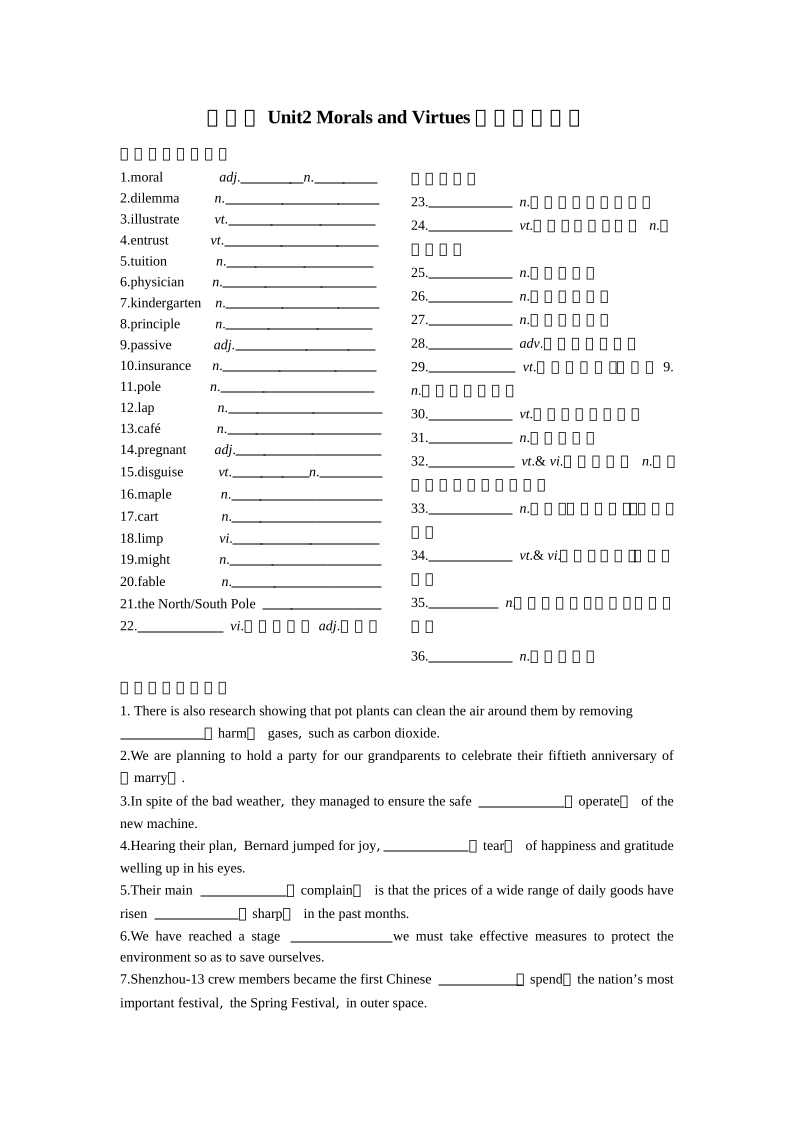
1.moral adj. n.
2.dilemma n.
3.illustrate vt.
4.entrust vt.
5.tuition n.
6.physician n.
7.kindergarten n.
8.principle n.
9.passive adj.
10.insurance n.
11.pole n.
12.lap n.
13.café n.
14.pregnant adj.
15.disguise vt. n.
16.maple n.
17.cart n.
18.limp vi.
19.might n.
20.fable n.
21.the North/South Pole
22. vi.昏倒;晕厥adj.不清楚的;微弱的
23. n.协会;联合会;工会
24. vt.聘任;雇用;租用 n.租借;租用
25. n.同事;同僚
26. n.诊所;门诊部
27. n.十年;十年期
28. adv.在别处;去别处
29. vt.发表(作品);出版9. n.员工;全体职员
30. vt.接替;取代;更换
31. n.子夜;午夜
32. vt.& vi.咬;叮;蜇 n.咬;(咬下的)一口;咬伤
33. n.一连串(人或事);链子;链条
34. vt.& vi.(使)洒出;(使)溢出
35. n.(网球等的)球场;法院;法庭
36. n.收入;收益
二、单句语法填空
1. There is also research showing that pot plants can clean the air around them by removing
(harm) gases, such as carbon dioxide.
2.We are planning to hold a party for our grandparents to celebrate their fiftieth anniversary of (marry).
3.In spite of the bad weather, they managed to ensure the safe (operate) of the new machine.
4.Hearing their plan, Bernard jumped for joy, (tear) of happiness and gratitude welling up in his eyes.
5.Their main (complain) is that the prices of a wide range of daily goods have risen (sharp) in the past months.
6.We have reached a stage we must take effective measures to protect the environment so as to save ourselves.
7.Shenzhou-13 crew members became the first Chinese (spend) the nation’s most important festival, the Spring Festival, in outer space.
8.Unfortunately, as our economy advances, recent years (see) the oceans being polluted.
9.The students seemed to expect another boring and dull English lesson, some dropping their eyes and some (whisper) in the back rows.
10.After Lincoln (elect) President of the US in 1861, they rented the house and sold most of their furniture.
11. (bite) by the snake in the bush, Susan was sent back to the camp.
三、阅读理解
A
In Fujian Province during the Northern Song Dynasty (960-1127) there lived a man called Yang Shi. He devoted his whole life to study, and to spreading his ideas and theories. At that time, the brothers Cheng Hao and Cheng Yi, famous scholars in the capital, Luoyang, were teachers of the Way of Confucius and Mencius.
When Yang Shi heard of them, instead of going to where an official post had been assigned to him, he made his way to Luoyang and became Cheng Hao’s student. When Yang Shi finished his studies and left for home, Cheng Hao said with satisfaction, “My ideas are finally being spread in the south.” Four years later, Cheng Hao died and Yang Shi was extremely sad.
Later, Yang Shi made his way once more to Luoyang, where he asked Cheng Yi, Cheng Hao’s younger brother, to be his teacher. He wanted to make further progress in his studies. At that time Yang Shi was over forty years old, and a pretty well-known scholar, but he was very modest and respectful of teachers.
One day, Yang Shi and a fellow student, You Zuo, got into a dispute over a certain matter. Finding that they could not reconcile their differences, they decided to consult their teacher.
It happened to be the deep winter. When they reached Cheng Yi’s house they found him sitting by a stove meditating (冥想). Yang Shi and his classmate did not dare to disturb their teacher, but stood respectfully outside the door waiting for him to wake up.
The snow fell relentlessly, thicker and thicker. After a long time, Cheng Yi came out of his reverie. He looked out of the window, to see the two men standing in a blizzard, covered in snow. The teacher hastily arose and ushered them inside.
Later, when Yang Shi had completed his study with Master Cheng Yi, he returned to the south and spread his teacher’s ideas. The story “Standing in the Snow at Cheng’s Door” became a fine tale transmitted from generation to generation advocating respect for teachers and for study.
1.What did Yang Shi do before he became Cheng Hao’s student?
A.He learned from Cheng Yi.
B.He gave up an official post.
C.He paid a visit to Cheng Yi.
D.He spread Cheng Yi’s ideas.
2.What does the underlined word “reconcile” in Paragraph 4 mean?
A.Settle. B.Notice.
C.Identify. D.Explain.
3.How did Cheng Yi probably feel when he saw his two students?
A.Surprised and moved.
B.Satisfied and delighted.
C.Confused and doubtful.
D.Disappointed and curious.
4.What message does this story intend to convey?
A.Always have a thirst for knowledge.
B.Keep learning from different teachers.
C.Acquire as much knowledge as possible.
D.Show respect for teachers and knowledge.
B
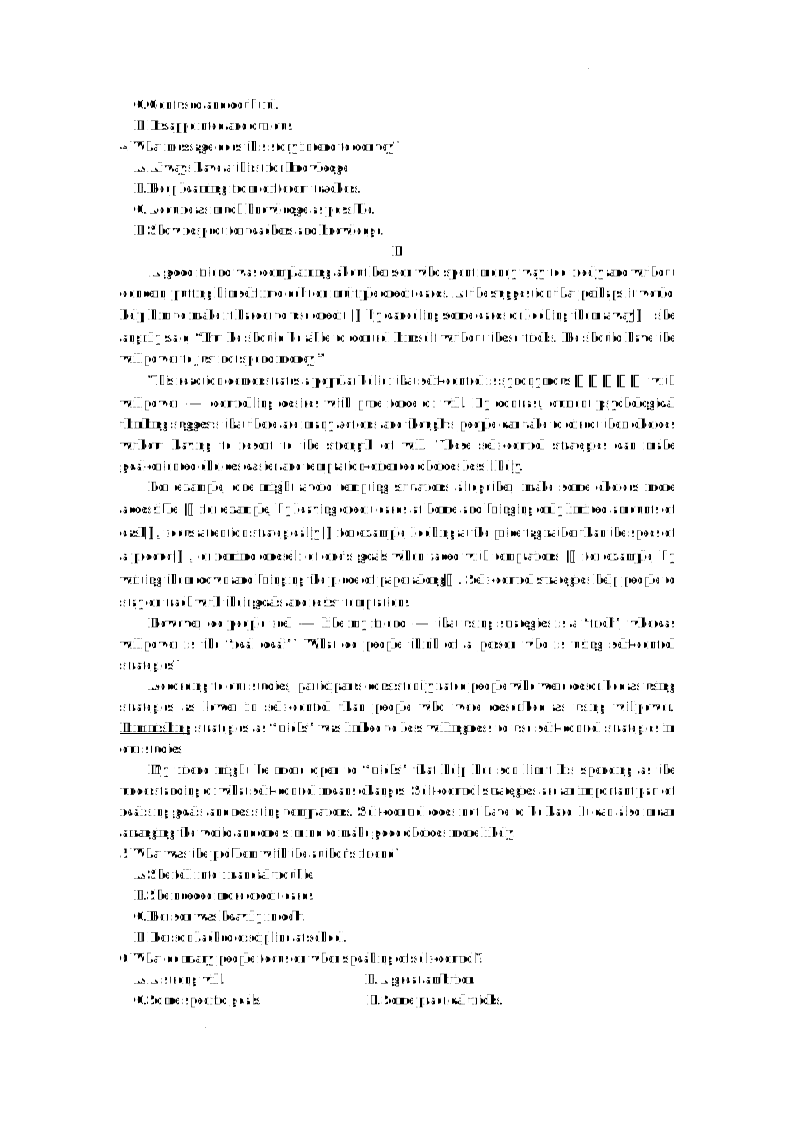
A good friend was complaining about her son who spent money way too freely and without concern, putting himself into debt on multiple credit cards. At the suggestion that perhaps it would help him to make it harder to use credit (by canceling some cards or locking them away) she angrily said, “But he should be able to control himself without these tricks. He should have the willpower to just not spend money.”
This reaction demonstrates a popular belief that self-control is synonymous (同义的) with willpower — controlling desires with pure force of will. By contrast, current psychological thinking suggests that there are many actions and thoughts people can take to direct their choices without having to resort to the strength of will. These self-control strategies can make goal-oriented choices easier and temptation-oriented choices less likely.
For example, one might avoid tempting situations altogether, make some choices more accessible (for example, by leaving credit cards at home and bringing only limited amounts of cash), focus attention strategically (for example, looking at the price tag rather than the specs of a product), or remind oneself of one’s goals when faced with temptations (for example, by writing them down and bringing the piece of paper along). Self-control strategies help people to stay on track with their goals and resist temptations.
However, do people feel — like my friend — that using strategies is a “trick”, whereas willpower is the “real deal”? What do people think of a person who is using self-control strategies?
According to our studies, participants consistently rated people who were described as using strategies as lower in self-control than people who were described as using willpower. Diminishing strategies as “tricks” was linked to less willingness to use self-control strategies in our studies.
My friend might be more open to “tricks” that help her son limit his spending as the understanding of what self-control means changes. Self-control strategies are an important part of realising goals and resisting temptations. Self-control does not have to be hard. It can also mean arranging the world and one’s mind to make good choices more likely.
5.What was the problem with the author’s friend?
A.She fell into financial trouble.
B.She needed more credit cards.
C.Her son was heavily in debt.
D.Her son lacked discipline at school.
6.What do many people focus on when speaking of self-control?
A.A strong will. B.A great ambition.
C.Some specific goals. D.Some practical tricks.
7.Why does the author give some examples in Paragraph 3?
A.To show there are many tempting situations.
B.To show self-control strategies are effective.
C.To prove it isn’t difficult to resist temptations.
D.To prove we are faced with many temptations.
8.What does the underlined word “Diminishing” in Paragraph 5 mean?
A.Reducing in value.
B.Changing in position.
C.Improving in popularity.
D.Increasing in importance.
四、阅读七选五
Having a good sense of humor makes you more enjoyable to be around. 9 . Here’s how you can develop your sense of humor.
·Surround yourself with humor.
You learn more effectively when you fully expose yourself to a subject. Similarly, you can improve your sense of humor by surrounding yourself with humor. Watch stand-up comedians. Listen to programs that amuse you.Read humorous books. 10 .
·Learn what amuses you.
11 . We amuse our friends by praising a change they made. However, when it comes to being funny, don’t change your sense of humor to amuse other people. Instead, start with what amuses you. Then, if you think the other person will also be amused with it, share it with them.
·Think about timing and audience.
You don’t have to be funny all the time, so don’t expect that of yourself. When you catch yourself trying to be funny, slow down. Simply speak slower so you’re not as likely to stop and repeat yourself. Try speaking at 60%-70% of your usual rate. 12 .
· 13 .
You don’t need to seize every single opportunity to be funny. If you’re in the middle of a bad joke, just end it. “You know what, now that I’m telling it, it’s not as funny as it sounded in my head,” can be a bit of an awkward end and hurt your pride a little bit, but it saves everyone time and patience. In the long run, they’ll respect your taste.
A.Be creative, not silly
B.Pause in between sentences
C.There’s a lot of fun out there
D.You might also do better at work
E.Know when and where to stop
F.You can also try your hand in the real world
G.A lot of times, we say things purely to please others
答案:
一、基础词汇检查
1.道德的;道义上的 品行;道德;寓意 2.进退两难的境地;困境 3.(举例)说明;阐明;给(书或文章)加插图 4.委托;交付 5.(小组)教学;讲课 6.医师;(尤指)内科医生 7.学前班;幼儿园 8.道德原则;法则;原则 9.被动的;顺从的 10.保险;保险业 11.(行星的)极;地极 12.(坐着时的)大腿部;(跑道等的)一圈 13.咖啡馆;小餐馆 14.怀孕的;妊娠的 15.装扮;假扮;掩盖 伪装;化装用具 16.枫树;槭树 17.手推车;运货马车 18.跛行;一瘸一拐地走 19.力量;威力 20.寓言;寓言故事 21.北极/南极 22.faint 23.union 24.hire 25.colleague 26.clinic 27.decade 28.elsewhere 29.publish 30.staff 31.replace 32.midnight
二、单句语法填空
1.harmful 2.marriage 3.operation 4.tears 5.complaint; sharply 6.where 7.to spend 8.have seen 9.whispering 10.was elected 11.Bitten
三、阅读理解
A
语篇解读:本文是一篇记叙文。程颢、程颐兄弟俩都是宋代极有学问的人。进士杨时先拜程颢为师,后来又拜程颐为师。一次杨时和同学去请教程颐问题,适逢老师休息,于是他们在门外等候,直至地面积雪一尺多厚。
1.B 推理判断题。根据第二段可知,杨时先放弃了自己的高官厚禄,然后去洛阳拜程颢为师。
2.A 词义猜测题。根据第四段可知,一天,杨时和他的同学游酢为一件事发生了争执。由于他们无法解决分歧,所以才决定去找老师。因此画线词与settle意思相近。
3.A 推理判断题。根据倒数第二段可知,当程颐向窗外望去,看到那两个人站在暴风雪中,浑身是雪。程颐急忙站起来,把他们领进房间。根据当时的情景可以推出,老师会非常吃惊和感动。
4.D 主旨大意题。综合全文可知,“程门立雪”这一故事,主要揭示了尊师重道这一中华民族的传统美德。最后一段对本文的主旨作了概括。
B
语篇解读:本文是一篇说明文。提到自控,人们通常会强调意志力的重要性;可是,心理学家认为,采取一些有助于我们抵制诱惑的技巧也非常重要。
5.C 细节理解题。根据第一段可知,作者的这位朋友遇到的问题是:她的儿子由于缺乏自控、花钱无度,因此陷入了信用卡债务中。
6.A 细节理解题。根据第二段可知,提到自控,人们普遍认为自控与意志力是同义词——即用纯粹的意志力控制个人欲望。
7.B 推理判断题。根据第三段可知,作者通过举例说明,自控策略可以帮助人们坚持自己的目标,抵制诱惑。最后一句是对本段大意的总结。
8.A 词义猜测题。根据上下文可知,作者所从事的研究表明,研究对象普遍认为,比起那些单纯利用意志力的人来,那些借助策略的人自控能力更低;另外,很多研究对象也不愿采用这些策略。这说明他们“看不起”这些自控策略,也就是“贬低”它们。
四、七选五
语篇解读:本文是一篇说明文。文章主要介绍了如何培养幽默感。
9.D 根据上文Having a good sense of humor makes you more enjoyable to be around.可知,上文介绍有幽默感的好处。根据下文Here’s how you can develop your sense of humor.可知,下文引出如何培养幽默感。因此空格处应承接上文,继续说明幽默感的好处,D项(你也可能在工作上做得更好)符合语境。
10.C 根据上文Watch stand-up comedians. Listen to programs that amuse you. Read humorous books.可知,上文提到的这些做法都可以帮助培养幽默感。C项说明这些做法可以获得乐趣,符合语境。
11.G 下文提到我们通过赞扬朋友所做的改变来取悦他们,但紧接着又说我们不要为了取悦他人而改变自己的幽默感。由此推知,空格处应谈到“取悦他人”,G项(很多时候,我们说的话纯粹是为了取悦别人)符合语境。
12.B 根据本段小标题可知,本段主要围绕时机、受众及讲话的语速提出建议。B项(在句子之间停顿)符合本段主旨。
13.E 设空处为本段小标题。从上文几个小标题的句式结构可知,此处应填入祈使句。根据下文可知,本段主要建议人们要学会适可而止。E项最能概括本段主旨。
学科网(北京)股份有限公司
$$
资源预览图
1

2
3
相关资源
由于学科网是一个信息分享及获取的平台,不确保部分用户上传资料的 来源及知识产权归属。如您发现相关资料侵犯您的合法权益,请联系学科网,我们核实后将及时进行处理。