Unit 2 Exploring English Listening and Speaking 听力教学设计-2024-2025学年高一上学期英语外研版(2019)必修第一册
2024-09-10
|
7页
|
1873人阅读
|
15人下载
普通
资源信息
| 学段 | 高中 |
|---|---|
| 学科 | 英语 |
| 教材版本 | 高中英语外研版必修第一册 |
| 年级 | 高一 |
| 章节 | Using language |
| 类型 | 教案-教学设计 |
| 知识点 | - |
| 使用场景 | 同步教学-新授课 |
| 学年 | 2024-2025 |
| 地区(省份) | 全国 |
| 地区(市) | - |
| 地区(区县) | - |
| 文件格式 | DOCX |
| 文件大小 | 40 KB |
| 发布时间 | 2024-09-10 |
| 更新时间 | 2024-09-10 |
| 作者 | 匿名 |
| 品牌系列 | - |
| 审核时间 | 2024-09-09 |
| 下载链接 | https://m.zxxk.com/soft/47279784.html |
| 价格 | 0.50储值(1储值=1元) |
| 来源 | 学科网 |
内容正文:
Teaching Design
Basic information
Time duration: 1 period
Students: First term of grade one in senior high school.
Material: Unit 2 Exploring English
Lesson type: Listening & Speaking
Analysis of material
The main content
This unit focuses on cultural differences. It talks about the differences between British English and American English, and then the unfamiliar expressions are easily misunderstood by students in English learning.
The type of the text
The article is expository. It mainly talks about the meanings and origin of three foreign words.
The purpose of this unit
By understanding and analyzing the dialogue, students will know some differences in British English and American English and form the awareness of every country has its own language and culture, so
we should respect the cultural differences all around the world!
Analysis of students
Student status
Merits: The students are active and curious. They have mastered some simple words and expressions to learn this lesson.
Shortcomings: They might lack the awareness of the cultural differences.
Solutions:
Teacher shows a video about differences between British English and American English. Teacher gives students some time to freely discuss the cultural differences.
Teaching objectives
By the end of the class, students will be able to
1. Know different expressions in British and American.
2. Analyze meaning and origin of dim sum, cellfish and LOL
3. Retell the dialogue work in group by using the sentence patterns learned in this lesson.
4. Express their ideas about a foreign word.
Key points
1. Know different expressions in British and American.
2. Analyze meaning and origin of dim sum, cellfish and LOL
Difficult point
. Express their ideas about a foreign word.
Teaching method
Task-based Language Teaching Method
Learning methods
· Initiative Learning
· Exploratory Learning
· Cooperative Learning
Teaching aids
Blackboard, projector
Teaching procedures
Stage 1 Lead-in (2mins)
Stage 2 pre-listening (4mins)
Stage 3 while-listening (17mins)
Stage 4 post-listening(13mins)
Stage 5 Summary & Evaluation (3mins)
Stage 6 Homework (1min)
Teacher Activity
Student Activity
Stage 1 Lead-in (2mins)
1.Show a video to students about the differences between American English and British English.
2.What British and American expressions does this video focus on?
1.Enjoy a video.
2.What British and American expressions does this video focus on?
Purpose
To arouse students’ interest and lead in today’s topic.
(Learning ability)
Stage2
Pre-listening
(4mins)
1.Fill in the blanks.
Noah Webster, who made one of American first dictionaries, changed ''re'' spellings to ''-er'', which is why � is spelt �in American English.
2.Americans talk about putting �in their cars and driving along the �, whereas in the UK, people put �in their cars and drive along the �.
3.Americans take the� to the top floor of a building, but British use the�.
4.In the US, they take the�, but in the UK, people travel on the�
5. Americans live in a(n)�, while British live in a(n) �.
2.Explain listening skills.
1.Fill in the blanks.
Noah Webster, who made one of American first dictionaries, changed ''re'' spellings to ''-er'', which is why � is spelt �in American English.
2.Americans talk about putting �in their cars and driving along the �, whereas in the UK, people put �in their cars and drive along the �.
3.Americans take the� to the top floor of a building, but British use the�.
4.In the US, they take the�, but in the UK, people travel on the�
5. Americans live in a(n)�, while British live in a(n) �.
2.Take notes.
Purpose
To lay the foundation for later listening and cultivate their awareness of cultural differences.
(Learning ability)
Stage3 while-listening (17mins)
Listening practice
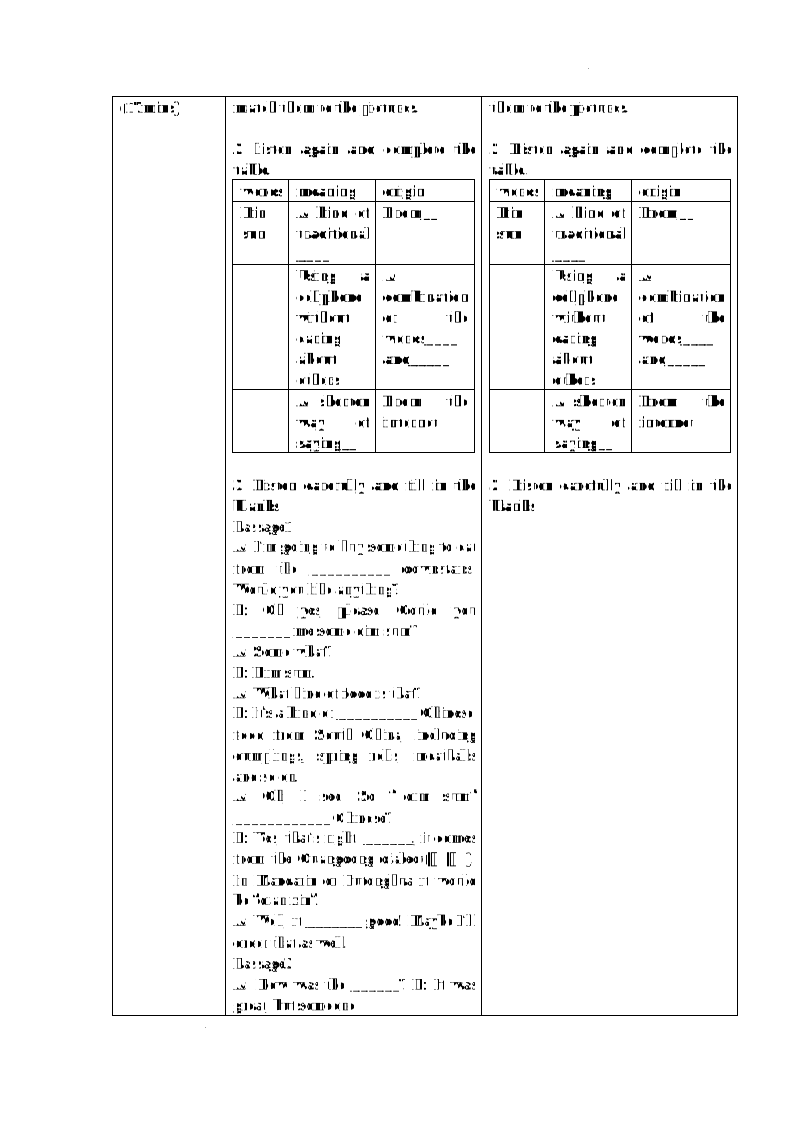
1. Listen to the conversations and match them to the pictures.
2. listen again and complete the table.
words
meaning
origin
Din sun
A kind of traditional ____
From__
Using a cellphone without caring about others
A combination of the words____ and_____
A shorten way of saying__
From the internet
3. Listen carefully and fill in the blanks.
Passage1
A: I’m going to buy something to eat from the __________ downstairs. Would you like anything?
B: Oh yes, please. Could you _______ me some dim sum?
A: Some what?
B: Dim sum.
A: What kind of food is that?
B: It’s a kind of __________ Chinese food from South China, including dumplings, spring rolls, meatballs and so on.
A: Oh, I see. So “dim sum” ____________ Chinese?
B: Yes, that’s right. ______, it comes from the Guangdong dialect(方言). In Mandarin or Putonghua it would be “dian xin”.
A: Well, it _______ good! Maybe I’ll order that as well.
Passage2
A: How was the ______? B: It was great, but someone
___________ me was talking so ________ on her phone.
A: How cellfish!
B: Yes, I agree. Very _______.
A: Ah, do you know what I mean by “cellfish” ?
B: Of course! When you say “selfish”, you mean only
___________ yourself and not about other people, right?
A: That’s what “selfish” with an “s” means, but I’m talking about “cellfish” starting with the letter “c”.
B: I haven’t ______ that word before. What does it mean?
A: It means using a cellphone in a way that shows you don’t ___________ the other people around you.
B: That’s ___________. How do you spell it?
A: C-E-L-L-F-I-S-H. It’s the words “cellphone” and “selfish” put together.
B: Oh, I see......
Passage3
A: Darling, could you __________ at this message from Lucy? I have ________what she's talking about... again.
B: What has she said?
A: Well, I told her a _____ that Bob told me today at the office, and, as you see, she _______ "LOL”. What's that for?
B: Oh, LOL! It's a _______ way of saying “laugh out loud.”
A: I've never seen or heard that before. Where does it come from?
B: It was first used on the ________. You use it to show you think something is very _______.
A: Oh, okay.
B: ____________ the times, darling!
Listening practice
1. Listen to the dialogue and match them to the pictures.
2. Listen again and complete the table.
words
meaning
origin
Din sun
A kind of traditional ____
From__
Using a cellphone without caring about others
A combination of the words____ and_____
A shorten way of saying__
From the internet
3. Listen carefully and fill in the blanks.
Purpose
1. To grasp the main idea of the dialogue.
2. To get more detailed information of the dialogue.
(Language ability, thinking capacity and learning ability)
Stage4 post-listening
(13mins)
Group work
1.Act out the dialogue.
2. role play and make a conversation.
Plot:
Student A:
You see a sign in a supermaket saying “3 for 2”
You don’t know what it means and ask the shop assistant to explain.
Student B
You are a shop assistant. A customer asks you what “3 for 2” means. (Notes: “3 for 2” means that if you buy two items, you get a third one for free.
Some useful can help you
Student A
I beg your pardon
What does…mean?
What’s that for?
When you say…you mean. , right?
Student B
It means…
It’s a shorten way of saying…
It’s a kind of…
Group work
1.Act out the dialogue.
2. role play and make a conversation.
Plot:
Student A:
You see a sign in a supermaket saying “3 for 2”
You don’t know what it means and ask the shop assistant to explain.
Student B
You are a shop assistant. A customer asks you what “3 for 2” means. (Notes: “3 for 2” means that if you buy two items, you get a third one for free.
Some useful can help you
Student A
I beg your pardon
What does…mean?
What’s that for?
When you say…you mean. , right?
Student B
It means…
It’s a shorten way of saying…
It’s a kind of…
Purpose
1. To express their ideas about what vehicle you choose and why you choose it and so on.
2.To understand the characteristics of vehicles and learn to be safe.
3. To cultivate students’ communicative and cooperative strategies in learning English as well as their critical thinking.
(Language ability, cultural awareness and thinking capacity)
Stage 5 Summary (3mins)
Make a brief summary.
What we have learned today?
Make a brief summary.
What we have learned today?
Purpose
To review what students have learned today.
(Thinking capacity and learning ability)
Stage 6 Homework (1min)
1. Remember the new words we have learned in this lesson.
2. Find more words of differences between American and British English.
1. Remember the new words we have learned in this lesson.
2. Find more words of differences between American and British English.
Purpose
To consolidate what students have learned in this class.
(Thinking capacity and learning ability)
Blackboard Design
Unit 2 Exploring English
American British
subway underground
highway motorway
theater theatre
gas petrol
apartment flat
elevator lift
Reflection
According to the teaching design, the teaching of listening will be done in a flexible way. This unit focuses on cultural differences. Most of the students can involve in the class, but some of them still dare not to speak. The teacher should encourage students to speak more.
学科网(北京)股份有限公司
$$
资源预览图

1

2
3
相关资源
由于学科网是一个信息分享及获取的平台,不确保部分用户上传资料的 来源及知识产权归属。如您发现相关资料侵犯您的合法权益,请联系学科网,我们核实后将及时进行处理。