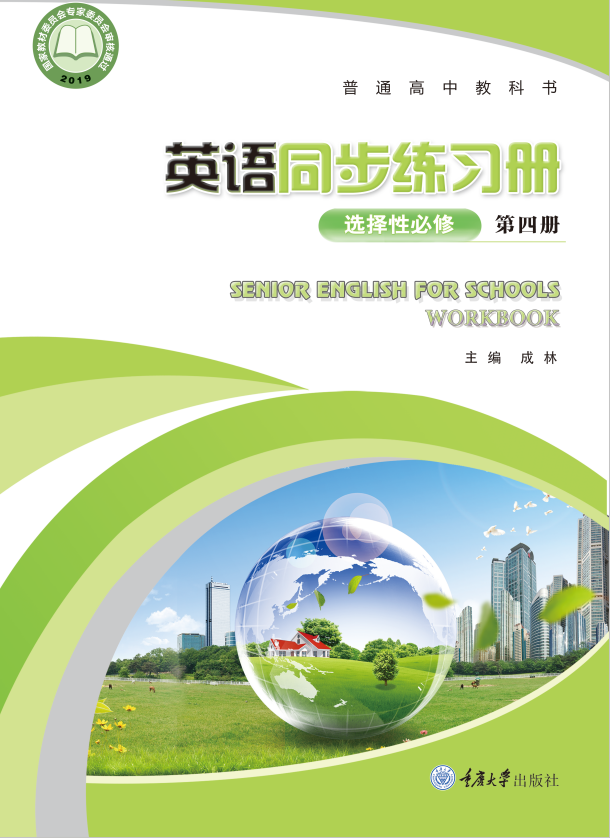
Unit 4 Space Exploration-高中英语选择性必修第四册同步练习册(重大版2019)
2024-08-19
|
2份
|
16页
|
85人阅读
|
1人下载

内容正文:
Reading Actively
Match the words and phrases in the box with the definitions.
launch orbit smoothly aboard man⁃made astronaut
1. a person whose job involves travelling and working in a spacecraft
2. to send sth. such as a spacecraft, weapon, etc. into space, into the sky or through water
3. in an even way, without suddenly stopping and starting again
4. on or onto a ship, plane, bus or train
5. made by people; not natural
6. to move in a curved path around a much larger object, especially a planet, star, etc.
Complete the sentences with the correct forms of the words in the box.
smoothly intend prepare orbit regular serve launch
1. The third book in the series is currently in .
2. We a big advertising campaign to promote our new toothpaste since then.
3. The Moon the Earth once a month.
4. They are introducing new measures to ensure the running of the business.
5. Tiangong⁃1 was shot into orbit, as both a laboratory and an experimental testbed.
6. He exercised with a that amazed us.
7. He has announced his to retire.
Make sentences with the underlined parts.
1. In 1970, Dongfanghong⁃1 on the back of a Long March rocket was lifted into space.
74
2. Following the footsteps of the US and Russia, China is striving to open a space station.
3. Most importantly, make sure someone is available to answer questions.
4. She needed a clear head to carry out her instructions.
5. They are collecting information in preparation for the day when the two sides sit down and talk.
6. The judge said the punishment would serve as a warning to others.
Read the passage and complete the tasks.
An exciting landing process of Change⁃4 lunar probe was seen through the monitor at Beijing
Aerospace Control Centre in Beijing, Jan. 3, 2019. It touched down on the far side of the Moon at
10:26 a.m. Beijing Time, becoming the first spacecraft soft⁃landing on the Moons unknown side never
visible from the Earth.
Chinas Change⁃4 probe has started the exploration on the far side of the Moon thanks to the relay
satellite that provides a communication link with ground control. The relay satellite, named Queqiao,
meaning Magpie Bridge, after a Chinese legend, was launched on May 21, 2018, and became the first
communication satellite operating in the halo orbit, nearly 500,000 km from the Earth. It can also
provide communication for probes from other countries. The relay satellite will also be used for scientific
and technological experiments. The maximum distance between the satellite and the Change⁃4 probe on
the far side of the Moon is 79,000 km. The satellite processes data from the probe and sends it to the
Earth.
The satellite can stay in its orbit for a long time due to its relatively low fuel consumption, as the
Earths and Moons gravity balances its orbital moving. While in orbit, it can “see” both the Earth and
the far side of the Moon.
The concept of using a relay satellite in the halo orbit was first put forward by US space experts in
the 1960s, but was realised by Chinese space engineers. Researchers hope to use the cameras on the
satellite to record asteroids (小行星) hitting the far side of the Moon. To control the cost of the
Change⁃4 probe, the relay satellite was designed to be relatively small, weighing about 400 kg.
Researchers had just 30 months to develop the satellite, putting them under high pressure. To
promote public interest in space exploration, the China National Space Administration invited people to
write down their wishes for lunar and space exploration, and the relay satellite carries the names of tens
84
of thousands of participants and their messages.
1. Read the passage quickly and underline the sentence which contains its most important information.
2. Read the passage again and decide whether the sentences are true (T) or false (F).
1) Change⁃4 lunar probe became the second spacecraft soft⁃landing on the Moons unknown side
never visible from the Earth. ( )
2) Change⁃4 probe has started the exploration on the far side of the Moon due to a Chinese legend.
( )
3) The relay satellite, named Queqiao, meaning Magpie Bridge, after an asteroid. ( )
4) While in orbit, the relay satellite can see both the Earth and the far side of the Moon. ( )
5) The relay satellite can stay in its orbit for a long time due to its relatively low fuel consumption.
( )
3. Translate the following sentences into Chinese with the help of a dictionary.
1) The relay satellite, named Queqiao, meaning Magpie Bridge, after a Chinese legend, was
launched on May 21, 2018, and became the first communication satellite operating in the halo
orbit, nearly 500,000 km from the Earth.
2) The concept of using a relay satellite in the halo orbit was first put forward by US space experts in
the 1960s, but was realised by Chinese space engineers.
3) To control the cost of the Change⁃4 probe, the relay satellite was designed to be relatively small,
weighing about 400 kg.
4) To promote public interest in space exploration, the China National Space Administration invited
people to write down their wishes for lunar and space exploration, and the relay satellite carries
the names of tens of thousands of participants and their messages.
Exploring and Using
Complete the sentences with proper words.
1. The new sports centre will be (benefit) to the community.
2. The of the first satellite, named Dongfanghong⁃1, into space meant that China had become
the fifth country able to satellites. ( launch)
3. Yang Liwei (orbit) the Earth 14 times during his 21⁃hour flight aboard the Shenzhou⁃5.
94
4. With the first space station Tiangong⁃1 (shoot) into orbit, China opened a space station
circling our planet.
5. A milestone was reached on Oct. 15, 2003 China became the third nation to independently
launch an astronaut into Earths orbit.
6. It was stupid me to be so careless.
7. Susan is always the first (come) and the last (leave) the reading room.
8. Li Hua is really a diligent student, setting a good example us.
Underline all the ⁃ing forms and the infinitives in the following sentences and then
decide what they function as.
1. Living without an aim is like sailing without a compass.
2. His job is delivering newspapers.
3. He admitted having smoked in the hall.
4. The kid was heard crying in the next room.
5. Those wishing to join this club should sign here.
6. Having lived in Beijing for years, I almost know every place quite well.
7. We are proud to be members of this team.
8. I have a strong wish to go to college.
9. The doctors made him give up smoking.
10. He has nothing to do except watch TV.
Make sentences according to the given sentence patterns.
1. (⁃ing; subject)
2. (⁃ing; predicative)
3. (⁃ing; object)
4. (⁃ing; object complement)
5. (⁃ing; attribute)
6. (⁃ing; adverbial)
7. (infinitive; adverbial)
8. (infinitive; attribute)
9. (infinitive; predicative)
10. (infinitive; subject complement)
05
Read the passage and complete the tasks.
Satellites are an important part of our ordinary lives. For example, the information for weather
forecasts is sent by satellite. Some satellites have cameras which take photographs of the Earth to show
how clouds are moving. Satellites are also used to connect our international phone calls.
Computer connections of the World Wide Web and Internet also use satellites. Many of our TV
programmes come to us through satellite. Airplane pilots sometimes also use a satellite to help them find
their exact location.
We use satellites to send television pictures from one part of the world to another. They are usually
35,880 kilometres above the equator. Sometimes we can see a satellite in the sky and it seems to stay in
the same place. This is because it is moving around the world at 11,000 kilometres an hour—exactly
the same speed that the Earth rotates (转动). A satellite must orbit the Earth with its antennae (天线)
facing the Earth. Sometimes, it moves away from its orbit, so there are little rockets on it which are
used to put the satellite back in the right position. This usually happens about every five or six days.
Space is not empty! Every week, more and more satellites are sent into space to orbit the Earth. A
satellite usually works for about 10⁃12 years. Satellites which are broken are sometimes repaired by
astronauts or sometimes brought back to the Earth to be repaired. Often, very old or broken satellites are
left in space to orbit the Earth for a very long time. This is very serious because some satellites use
nuclear power and they can crash into each other.
1. List three things that a satellite can do according to the passage.
2. Whats the speed the Earth rotates at?
3. What does the underlined word “This” in the 3rd paragraph refer to?
A. A satellite.
B. A little rocket.
C. A satellite seems to stay in the same place in the sky.
D. The satellite puts the rockets in the right position.
4. Which of the following statements about satellites is TRUE?
A. A satellite usually works for about 10⁃12 years.
B. Every time a satellite gets broken, it is brought back to the Earth to be repaired.
C. A broken satellite is never left in space.
D. Broken satellites often crash into each other.
15
Listening, Understanding and Communicating
Listen and fill in the blanks with the words you hear.
Chinas space started later than those of Russia and the US, but it has made great
progress in a short time. China became the third country in the world to send humans into
space in 2003, when Yang Liwei successfully the Earth in the Shenzhou⁃5 . Then
Shenzhou 6 and 7 completed a second manned orbit and the first Chinese spacewalk, by the
vehicle Jade Rabbit being sent to the Moon to study its surface. After that, China the
Tiangong 2 space lab into space and Tianzhou⁃1 to with it. This signalled one step further in
Chinas plan to a space station in the future. More , China has sent Change⁃4 to
the surface of the far side of the Moon to make measurements and observations.
Read the passage and choose the correct answer to fill in each blank.
The International Space Station (ISS) is a huge space station. It is being constructed by thousands
of people from 16 countries. All these people are trying to find out if humans can one day build 1
in space.
Floating 230 miles above the Earth, the International Space Station currently 2 a huge
building⁃block project out in space. US space shuttles and Russian rockets have been transporting tools
and pieces of the 3 into space to help finish building it. From the beginning of its construction in
1998 to its 4 , more than 100 major pieces will be put together to create this amazing space station.
When 5 , it will be the largest structure ever to fly above the Earth. The ISS will be 6 than a
football field and will weigh about one million pounds.
In addition to helping build the space station, 7 are trying to answer such questions as these:
How does space travel affect germs? Does the human body break down food 8 in space? Someday,
the station may even serve as a launchpad (发射台) for trips to other 9 , such as the Mars.
Because of its 10 size, the ISS needs a lot of power. Like other man⁃made bodies in space, its
power comes from the 11 . To create solar energy, large panels are lined with special materials.
These materials 12 the suns energy and change it into electricity.
So what does it cost to build such a 13 ? It costs over$60 billion dollars. 14 this may
seem astronomical, it may be a small price to 15 a project that enables some of the worlds finest
scientists to work together, exploring space for the worlds future.
25
1. A. schools B. shops C. homes D. factories
2. A. looks like B. comes from C. turns into D. belongs to
3. A. station B. material C. metal D. product
4. A. design B. progress C. popularity D. completion
5. A. applied B. closed C. entered D. finished
6. A. longer B. larger C. better D. more
7. A. scientists B. professors C. architects D. workers
8. A. differently B. actively C. instantly D. wholly
9. A. surfaces B. planets C. locations D. lands
10. A. limited B. standard C. middle D. impressive
11. A. wind B. air C. sun D. water
12. A. collect B. produce C. provide D. consume
13. A. house B. structure C. mode D. system
14. A. Since B. If C. When D. Although
15. A. take over B. set up C. pay for D. lead to
Listening, Speaking and Writing
Listen to the passage for the first time and complete its main idea.
The passage is mainly about .
Listen to the passage again and fill in the blanks with the words you hear.
1. Everyone gets excited by the news of .
2. I cannot understand spending all money on when so many people need food.
3. On the other hand, we hear on TV that for , a child in Africa can be saved.
4. When your house gets dirty, you spend time and money to .
5. Finally, there are a lot of on the Earth.
Study the underlined parts and use them to make sentences about space exploration.
1. However, we should be spending our money more wisely on what people need.
2. Around the world, millions of people are hungry and dying of starvation.
35
3. Considering the billions spent on space travel, it just seems a better investment to feed the hungry.
4. It makes more sense to use our time and money to take care of our planet, rather than look for a new
home.
Study the passage and write a short paragraph about your opinion on space
exploration.
Step 1: Study the structure of the passage.
Step 2: List some phrases to express your ideas. For example: spend on; make sense; rather than.
Step 3: Use words like however, considering, firstly, secondly, thirdly to connect your ideas.
Step 4: Write the first draft and revise it.
Step 5: Write the final draft.
Reading Further
Correct the mistake in each of the sentences.
1. Even if we have no immediate need for them, they will perhaps be useful later.
2. By exploring, any danger in surrounding areas can be identified and prepared.
3. What drove our ancestors move from the trees into the plains, and on into all possible areas?
4. The wide the spread of a species, the better its chance of survival.
45
5. The Earth which we are living is the third planet from the sun.
6. Why should money, time and effort be spent explore something with so few apparent benefits?
Fill in the blanks with proper words.
1. The Sputnik I satellite (launch) by the USSR and successfully (orbit) around
the Earth in 1957.
2. There are many kinds of (resource) like coal, oil, and copper in the ocean.
3. It is necessary for us (recycle) cans, bottles, newspapers and other materials that can be
used again.
4. These are questions that, (understand), are very often asked.
5. They are hoping to learn more about how the universe expands and (shrink).
6. Resources may be more than just physical (possess).
Translate the following sentences into English.
1. 农业方面进步最为显著,这点不难理解。 (understandably)
2. 我紧张时总爱唠叨。 (tendency)
3. 要不是爱迪生,今天我们享用的很多东西都将不会存在。 (benefit from)
4. 这些措施不能帮助缓和现在的紧张局势。 (lessen)
5. 付出越多,收获越多。 (the+比较级,the+比较级)
Read the passages and complete the tasks.
A
In America, we often regard Sally Ride as the first female astronaut. But the first woman in space
is actually a Soviet astronaut who beat out 400 applicants to pilot the Vostok 6 spacecraft in 1963—
twenty years before Ride took her historic spaceflight.
There was nothing in Valentina Tereshkovas early life that showed she would become a space
pioneer. Tereshkova finished school at age 16 and went to work to help support her family. She seemed
55
to follow her mothers footsteps as a textile factory worker, except one interest: skydiving. By the time
she was 22, she was jumping out of a plane pretty regularly. And then came the space race.
By 1962, the competition to get into space had been starting between the Soviet Union and the
United States for about seven years. The two countries, in an effort to do better than the other in
exploring space, had each launched men into space.
During the space race, the Soviet Union and the US constantly tried to be better. After putting a
man in space, the obvious next step was to send a woman into space. The Soviet Unions lead spacecraft
designer, Sergey Korolyov, is said to have been helpful in the decision. There are rumors (传言) that
the Soviet Union knew that the US was planning to send a woman to space and wanted to beat the
Americans.
Inspired by Gagarins flight, Tereshkova wrote to the Soviet authorities (当局) hoping for any
future training program for female astronauts. The authorities answered and in early 1962 she became
one of just five women accepted for astronaut training. On June 16, 1963, Tereshkova took off,
eventually circling the Earth 48 times over the course of almost three days and securing her place in
history as the first woman to leave the Earths atmosphere.
1. When did Sally Ride go into space?
A. In 1963. B. In 1973. C. In 1983. D. In 1993.
2. Why did Tereshkova choose to be a textile factory worker?
A. Because she thought highly of her mother.
B. Because she had to give a hand to her family.
C. Because she wanted to save money for the space race.
D. Because she was allowed to do skydiving.
3. What did Tereshkova do on knowing a woman to be sent to space?
A. She suggested some training program for women.
B. She refused the Soviet authoritiesinvitation.
C. She introduced herself to the training program.
D. She announced she would be the first woman in space.
B
Some people asked me how I could suggest the expenses of billions of dollars for a voyage to Mars,
at a time when many children on this Earth are starving to death. I know that they do not expect an
answer such as “Oh, I did not know that there are children dying from hunger, but from now on I will
stop any kind of space research until mankind has solved that problem!” In fact, I have known of this
long before.
But I firmly believe that by working for the space program we can make some contributions to the
65
relief and eventual solution of such serious problems as poverty and hunger on the Earth. Two basic
factors causing the poverty and hunger problems are the production of food and the distribution (分布)
of food. In fact, large areas of land could be used far better if efficient methods of farming, fertiliser
use, weather forecasting, field selection, planting, crop surveys, harvest planning and so on were
applied. The best tool for the improvement of all these methods undoubtedly is the artificial Earth
satellite. Circling the globe at a high altitude, it can screen wide areas of land within a short time;it can
observe and measure a large variety of factors indicating the status and condition of crops, soil,
droughts, rainfall, snow cover, etc.
Besides, in the modern society, there is a continuing great need for new basic knowledge in
science if we wish to improve the condition of human life on the Earth. We need more knowledge in
physics and chemistry, in biology and physiology, and particularly in medicine to cope with all these
problems which threaten mans life: hunger, disease, overpopulation, pollution of water and the
environment. In a way, the space age not only holds out a mirror in which we can see ourselves, it also
provides us with the technologies.
4. According to the author, what plays an important part in dealing with poverty and hunger?
5. What can we infer from the last paragraph?
6. What is the passage mainly about?
Accumulating
Recommendation.
Sentences about Space Exploration
1. Thats one small step for a man, one giant leap for mankind.
2. Once the cost of putting something into space goes down, the number of things you can afford to do
goes up greatly.
3. The reusability of this next wave of spacecraft will help develop the commercial market, which is
believed to be space tourism.
4. China has become the first country to land a spacecraft on the far side of the Moon.
5. Its a new era of spacecraft design, in which spaceships can be treated more like aircraft and the
passengers wont be professional astronauts, but adventure seekers or space enthusiasts.
75
My contribution.
85
Unit 4
Reading Actively
Ⅰ. 1. astronaut 2. launch
3. smoothly 4. aboard
5. man⁃made 6. orbit
Ⅱ. 1. preparation 2. have launched
3. orbits 4. smooth
5. serving 6. regularity
7. intention
Ⅲ. 1. Chemical rockets have the high thrust necessary to lift rockets into space, overcoming the Earths
gravitational pull.
2. The children came into the classroom, following the foot steps of their teacher.
3. Most importantly: we can do better.
4. Extensive tests have been carried out on the patient.
5. They are taking preliminary steps in preparation for a possible war.
6. The sofa will serve as a bed for a night or two.
Ⅳ. 1. It touched down on the far side of the Moon at 10:26 a.m. Beijing Time, becoming the first spacecraft
soft⁃landing on the Moons unknown side never visible from Earth.
2. 1) F 2) F 3) F 4) F 5) T
3. 1) 2018 年 5 月 21 日,“鹊桥”中继卫星发射升空,成为首颗在距地球近 50 万公里的光环轨道上
运行的通信卫星。
2) 在光环轨道上使用中继卫星的概念最早是由美国航天专家在 20 世纪 60 年代提出的,但后
来由中国航天工程师实现了。
3) 为了控制嫦娥四号探测器的成本,中继卫星被设计得相对较小,重约 400 千克。
4) 为了提升公众对太空探索的兴趣,国家航天局邀请人们写下对月球和太空探索的愿望,中继
卫星上有数万名参与者的名字和留言。
Exploring and Using
Ⅰ. 1. beneficial 2. launching; launch
3. orbited 4. shot
5. when 6. of
7. to come; to leave 8. for
Ⅱ. 1. subject; object 2. predicative
401
3. object 4. object complement
5. attribute 6. adverbial
7. adverbial 8. attribute
9. object 10. attribute
Ⅲ. 1. Working hard will produce good results.
2. The dinner looks inviting.
3. Mary was angry about not being invited to the party.
4. She found that book very interesting to read.
5. The building being built now is a hospital.
6. While reading the book, he nodded from time to time.
7. He lifted a rock only to drop it on his own feet.
8. The teacher is a pleasant person to work with.
9. This matter remains to be seen.
10. I was warned not to touch it.
Ⅳ. 1. Sending information for weather forecasts; Taking photographs of the Earth; Sending TV pictures.
2. 11,000 kilometres per hour.
3. C
4. A
Listening, Understanding and Communicating
Ⅰ. 1. programme 2. independently
3. orbited 4. spacecraft
5. followed 6. launched
7. dock 8. establish
9. recently 10. explore
Ⅱ. 1—5 CAADD
6—10 BAABD
11—15 CABDC
Listening, Speaking and Writing
Ⅰ. spending our money more wisely on what people need
Ⅱ. 1. the most recent space flights
2. expensive research and experiments
3. as little as a dollar a day
4. clean it up
501
5. unsolved mysteries
Ⅲ. 1. We should stop spending time and money on space exploration.
2. Otherwise, millions of people would have died of starvation.
3. Considering all the benefits it brings, space exploration should continue.
4. They dont think space exploration make sense.
Ⅳ.
Some people argue that we should stop spending time and money on space exploration, which they dont
think make sense. It seems that it sounds reasonable. However, in my opinion, this is a shallow view which
fails to realise how space exploration helps us.
Firstly, space exploration has already made a difference in the fight against world hunger. Otherwise,
millions of people would have died of starvation. Secondly, space exploration has already promoted
technological improvements that benefit us all. Thirdly, sending astronauts into space has helped people to
think about the worlds problems and even to find ways to solve them. Therefore, considering all the benefits
it brings, space exploration should continue so as to provide newer and better solutions to peoples short⁃term
and long⁃term problems rather than stop.
Script:
Everyone gets excited by the news of the most recent space flights, and I too share in peoples sense of awe
and wonder at the photos from space that we see. However, we should be spending our money more wisely on
what people need.
I cannot understand spending all money on expensive research and experiments when so many people need
food. Around the world, millions of people are hungry and dying of starvation. On the other hand, we hear on
TV that for as little as a dollar a day, a child in Africa can be saved. Considering the billions spent on space
travel, it just seems a better investment to feed the hungry.
Some people argue that someday we will have to go live in space because the world will be made impossible
to live in through pollution. This seems silly. When your house gets dirty, you spend time and money to clean it
up. You dont need to move house. In the same way, it makes more sense to use our time and money to take
care of our planet, rather than look for a new home.
Finally, there are a lot of unsolved mysteries on the Earth. So why are we going into space to explore?
Reading Further
Ⅰ. 1. for 改为 of
2. prepared 后加 for
3. 在 move 前加 to
601
4. wide 改为 wider
5. 在 which 前加 on 或改为 where
6. explore 改为 exploring
Ⅱ. 1. was launched; orbited 2. resources
3. to recycle 4. understandably
5. shrinks 6. possessions
Ⅲ. 1. Understandably, the most progress is being made in agriculture.
2. I have a tendency to talk too much when Im nervous.
3. Many of the things we now benefit from would not be around but for Thomas Edison.
4. These measures cant help to lessen the existing tension.
5. The more you pay, the more you get.
Ⅳ. A: 1—3 CBC
B: 4. Food supply.
5. Technologies can help to improve our living quality.
6. It is about whether it is worth spending much money on space research.
Challenging Yourself B
Ⅰ. 1. Rarely 2. regularly
3. lacking 4. to help
5. determination 6. astronauts
7. flatten 8. depends
9. the 10. fully
Ⅱ. 1. on 2. Launched
3. an 4. flying
5. after 6. distance
7. successfully 8. to carry
9. is scheduled 10. its
Ⅲ. 1—5 CBBDA
6—10 CABCD
11—15 ABCAD
Ⅳ. A: 1—4 DCDB
701
资源预览图

1

2

3

4
相关资源
示范课
由于学科网是一个信息分享及获取的平台,不确保部分用户上传资料的 来源及知识产权归属。如您发现相关资料侵犯您的合法权益,请联系学科网,我们核实后将及时进行处理。