Unit 1 第1课时 Section A 1a-2d(分层作业)-【上好课】2024-2025学年九年级英语全册同步精品课堂(人教版)
2024-06-15
|
2份
|
19页
|
2896人阅读
|
30人下载

资源信息
| 学段 | 初中 |
|---|---|
| 学科 | 英语 |
| 教材版本 | 初中英语人教版(2012)九年级全册 |
| 年级 | 九年级 |
| 章节 | 1a-1c,2a-2d |
| 类型 | 作业-同步练 |
| 知识点 | - |
| 使用场景 | 同步教学-新授课 |
| 学年 | 2024-2025 |
| 地区(省份) | 全国 |
| 地区(市) | - |
| 地区(区县) | - |
| 文件格式 | ZIP |
| 文件大小 | 225 KB |
| 发布时间 | 2024-06-15 |
| 更新时间 | 2024-06-15 |
| 作者 | 创佳质英语乐园 |
| 品牌系列 | 上好课·上好课 |
| 审核时间 | 2024-06-15 |
| 下载链接 | https://m.zxxk.com/soft/45770401.html |
| 价格 | 3.00储值(1储值=1元) |
| 来源 | 学科网 |
内容正文:
Unit 1 第1课时Section A 1a-2d
一、词汇
1.发音;读音n.
2.教科书;课本n.
3.交谈;谈话n. →和……交谈(短语)
4.句子n. 造句(短语) /
5.大声地;出声地adv. →喧闹地;大声地;响亮地adv. →响亮的;大声的adj.
6.有耐心的adj. 病人n. →对……有耐心(短语)
7.制作单词卡
8.向……求助
9.观看视频
10.口语技能
11.做报告
12.逐词
二、完成句子
13.“你如何学习备考?”“我通过小组合作学习。”
— you ?
—I study .
14.听磁带怎么样?
to tapes?
15.理解英语口语太难了。
It’s hard understand spoken English.
16.“你曾经参加过小组学习吗?”
“是的,我参加过。通过那种方式我学到了很多。”
— you ever ?
—Yes, I have. I’ve .
17.你读得越多,你(读得)就越快。
you read, you’ll be.
18.你和朋友用英语谈话吗?
Do you friends ?
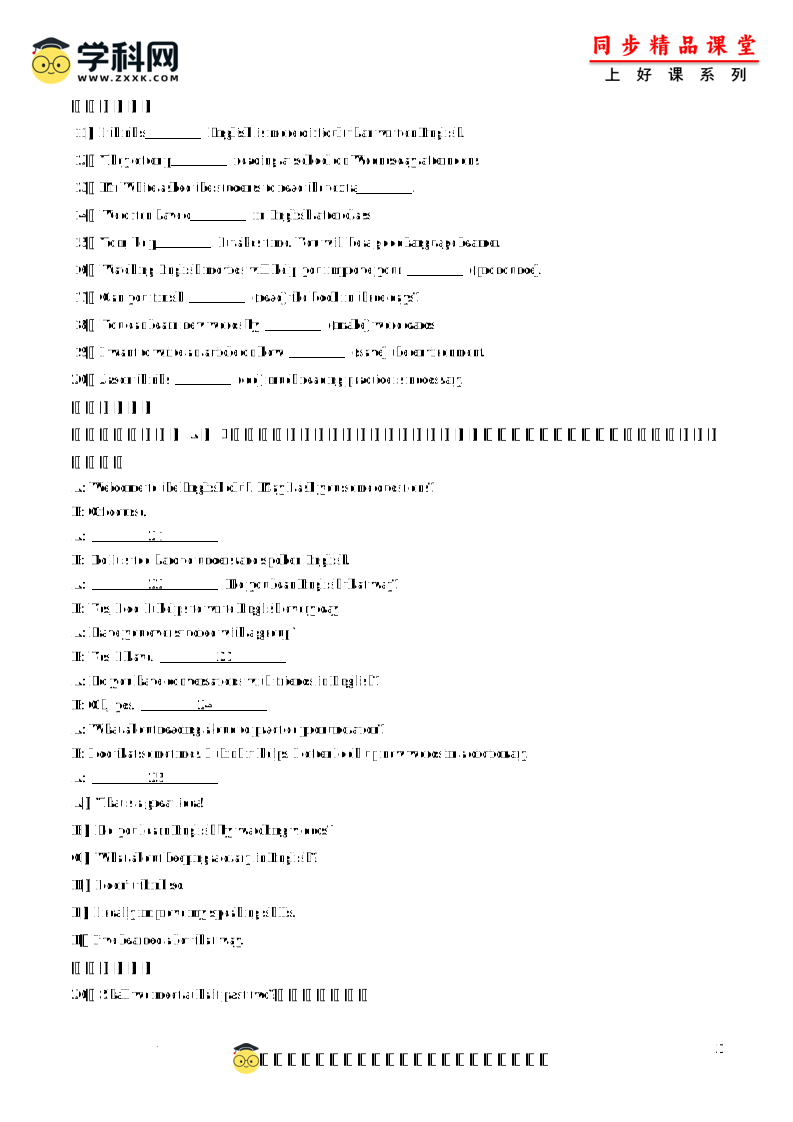
一、单项选择
1.—________ do you improve your English?
—I improve it speaking it with others more often.
A.How; with B.What; with C.How; by D.What; by
2.—How can I improve my English?
—________ you speak, ________ your English will be.
A.The less; the more B.The less; the better
C.The more; the less D.The more; the better
3.—Bella, your mobile phone is ringing.
—Wait a minute. It’s dangerous ________ it while crossing the street.
A.answer B.answered C.to answer D.answering
4.—What can we do for Ms. White on Teachers’ Day?
—I have a good idea. ________ sending her some flowers?
A.What about B.Why not C.Would you like D.Could you please
5.—I think our teacher, Mrs Allen, knows everything.
—I agree. Because she _________ over 2,000 books.
A.read B.has read C.reads D.is reading
6.If you are in trouble, you can _________ the police _________ help.
A.ask; for B.want; for C.ask; to D.want; to
7.Our teacher is patient ________ us.
A.at B.with C.for D.of
8.Do you often practice ________ English?
A.speaking B.to speak C.saying D.to say
9.Mr.Cooper is________ tired________ do anything this morning.
A.so; that B.too; to
C.both; and D.so; as
10.—We will go to Ann’s birthday party tonight. Can you ________ us?
—Sure, I’d love to.
A.take part in B.join in C.join with D.join
二、单词拼写
11.I think s English is more difficult than written English.
12.They often p reading at school on Wednesday afternoons.
13.Mr White asked the students to read the text a .
14.We often have c in English after class.
15.Tom, be p . It takes time. You will be a good language learner.
16.Watching English movies will help you improve your (pronounce).
17.Can you finish (read) the book in three days?
18.You can learn new words by (make) word cards.
19.I want to write an article on how (save) the environment.
20.Jason thinks (do) much reading practice is necessary.
三、补全对话
根据对话内容,从A到F选项中,选出能填入空白处的最佳选项,每个选项只使用一次,选项中有一项为多余项。
A: Welcome to the English club. May I ask you some questions?
B: Of course.
A: 21
B: No It’s too hard to understand spoken English.
A: 22 Do you lean English that way?
B: Yes, I do. It helps to write English every day.
A: Have you ever studied with a group?
B: Yes. I have. 23
A: Do you have conversations with friends in English?
B: Oh, yes. 24
A: What about reading aloud to practice pronunciation?
B: I do that sometimes. I think it helps. I often look up new words in a dictionary.
A: 25
A.That’s a great idea!
B.Do you learn English by watching videos?
C.What about keeping a diary in English?
D.I don’t think so.
E.I really improve my speaking skills.
F.I’ve learned a lot that way.
四、完成句子
26.Shall we meet at half past two?(改为同义句)
What at half past two?
27.I study for a test by listening to tapes.(对画线部分提问)
you for a test?
28.The girl is so young that she can't go to school.(改为同义句)
The girl is young go to school.
29.It makes my listening skills better.(改为同义句)
It my listening skills.
30.I won’t go to the park if it rains tomorrow. (改为同义句)
I go to the park it rains tomorrow.
一、完形填空
There is an English corner in our school.Every afternoon,many of my classmates come to the corner.My teacher Miss Li comes here, 1 .At the corner,we all speak English.
The corner started last year.There were only 2 students because many were afraid to speak English.After a few weeks,more and more students came here.At first,some students just 3 to the other students.I was one of them.I was afraid to speak English.I thought someone would 4 me,but I wanted to speak.I always spoke English in my heart.My teacher went on saying,“Don’t be afraid.Open your mouth.”I tried and tried to open my mouth.At last,I said“Hello!”to the teacher.The teacher was very 5 .She said“Hello!”to me at once.From 6 on,I began to speak English.I work hard at English and I try my best 7 more.I learn 8 my teacher and my classmates at the corner.Now I can speak a little English.Every Sunday afternoon,I come to the corner 9 .
It’s a good 10 to speak English.Please join us.
1.A.also B.either C.too D.as well
2.A.a lot of B.a little C.a bit of D.a few
3.A.talked B.spoke C.listened D.came
4.A.help B.laugh at C.stop D.fit into
5.A.happy B.interesting C.sad D.afraid
6.A.now B.then C.today D.that
7.A.to speak B.of talk C.saying D.telling
8.A.to B.at C.for D.from
9.A.late B.often C.early D.too
10.A.room B.school C.home D.place
二、阅读理解
When you speak, write a letter, or make a telephone, your words carry a message. People communicate with words. 11 A smile on your face shows you are happy or friendly. Tears (眼泪) in your eyes tell others that you are sad. 12 the teacher knows you want to say something or ask questions, You shake your head and people know you are saying "No". You nod and people know you are saying "Yes".
13 For example, a sign at the bus stop helps you to know which bus to take. A sign on the door tells you where to go in or out. Have you ever thought that there are a lot of other signs around you and that you receive messages from them all the time? 14 An artist can use his drawings to tell about the beautiful mountains, the blue seas and many other thing. A writer writes books to tell you about all the wonderful things in the world and also about people and their ideas. 15 They can help us to know what is going on in the world and what other people are thinking about.
A.People can communicate in many other ways.
B.But do you know people also communicate without words?
C.If you make noise in class.
D.When you put up your hands in class.
E.Magazines, TV, radio and films all help us communicate with others.
F.Other things can also carry messages.
三、任务型阅读
Do you know the ways to learn a language well? To learn a language well, people must be able to speak and understand the spoken language as well as to read and write. Lenin and his wife Krupskaya translated(翻译)a long English book(A)_______ Russian. But when they went to England in 1902,(B)English people couldn’t understand a word they said and they couldn’t understand what was said to them. Nowadays more and more foreigners are coming to China and more Chinese are going out to foreign countries to work or study. So the spoken language is becoming more and more important.
① Speaking, of course, can’t go without listening. If you want to pronounce a word correctly, first you must hear it correctly. The sounds of the Chinese and English languages are not exactly the same.(C)如果你不认真听, you’ll find it difficult or even impossible to understand the native speakers.
② Like speaking, it’s to exchange ideas. People usually use shorter words and shorter sentences in their writing. The important thing is to make your idea clear in your head and then to write it in lively language.
The students of learning a foreign language need special knowledge, the knowledge of the life, history and geography of the people whose language they are studying. ③ They should study these subjects in the foreign language, not only in translation. In this way, one can kill(D)_______ birds with one stone: learn a foreign language and get some knowledge of the foreign country at the same time.
16.在文中(A)和(D)的空白处分别填入适当的单词。
A B
17.文中画线部分(B)可改写为:English people to understand a word they said.
18.将文中画线部分(C)译成英语:
19.在文中①②③选出能填入 “Well, what about writing?” 的位置。
20.从文中找出能表达本文主旨大意的中心短语:
原创精品资源学科网独家享有版权,侵权必究!1
学科网(北京)股份有限公司
$$
Unit 1 第1课时Section A 1a-2d
一、词汇
1.发音;读音n.
【答案】pronunciation
【详解】根据所给中文和词性提示,此处用名词形式pronunciation表示“发音”,故填pronunciation。
2.教科书;课本n.
【答案】textbook
【详解】textbook“教科书;课本”,可数名词。故填textbook。
3.交谈;谈话n. →和……交谈(短语)
【答案】 conversation have a conversation with
【详解】交谈;谈话:conversation,名词;和……交谈:have a conversation with,动词短语。故填conversation;have a conversation with。
4.句子n. 造句(短语) /
【答案】 sentence make a sentence make sentences
【详解】sentence“句子”,名词;make a sentence/make sentences“造句”,动词短语。故填sentence;make a sentence;make sentences。
5.大声地;出声地adv. →喧闹地;大声地;响亮地adv. →响亮的;大声的adj.
【答案】 aloud loudly loud
【详解】根据所给中文及词性,此处用副词aloud表示“出声地”;用副词loudly表示“大声地”;用形容词loud表示“大声的”。故填aloud;loudly;loud。
6.有耐心的adj. 病人n. →对……有耐心(短语)
【答案】 patient be patient with
【详解】根据所给中文和词性提示,此处用patient表示“有耐心的(形容词)”或“病人(名词)”。短语be patient with...表示“对……有耐心”。故填patient;be patient with。
7.制作单词卡
【答案】make word cards
【详解】制作:make;单词卡:word cards,此处用名词复数表示泛指。故填make word cards。
8.向……求助
【答案】ask...for help
【详解】ask...for help意为“向……求助”,动词ask后面跟某人做宾语,如果是人称代词,就要用代词的宾格。
9.观看视频
【答案】watch videos
【详解】watch“观看”,动词;video“视频”,此处要用复数表示泛指;因此“观看视频”的英文表达为watch videos。故填watch videos。
10.口语技能
【答案】speaking skills
【详解】口语技能:speaking skills,名词短语。故填speaking skills。
11.做报告
【答案】give a report
【详解】give“做(动作)”,report“报告”,give a report“做报告”。故填give a report。
12.逐词
【答案】word by word
【详解】根据汉语提示可知,此处word by word“逐词”,word“词”,为名词,by为介词。故填word by word。
二、完成句子
13.“你如何学习备考?”“我通过小组合作学习。”
— you ?
—I study .
【答案】 How do study for a test by working with a group
【详解】how“如何,怎样”,引导特殊疑问句,位于句首首字母大写;疑问词后加助动词,主语是you,助动词用do;study for a test“学习备考”,助动词后接动词原形;by“通过”,work with a group“小组合作”,by是介词,后接动名词。故填How do;study for a test;by working with a group。
14.听磁带怎么样?
to tapes?
【答案】What about listening
【详解】What about doing …?为固定句型,意为“做……怎么样?”,listen to意为“听……”,此处动词listen应用动名词形式,故填What about listening。
15.理解英语口语太难了。
It’s hard understand spoken English.
【答案】 too to
【详解】too...to“太……而不能……”,too后接形容词或副词,to+动词原形。结合题干,故填too;to。
16.“你曾经参加过小组学习吗?”
“是的,我参加过。通过那种方式我学到了很多。”
— you ever ?
—Yes, I have. I’ve .
【答案】 Have studied with a group learned/learnt much
In that way
【详解】根据汉语可知,问句时态为现在完成时,结构为have done;你“you”,作主语;学习“study”,此处要用过去分词studied;参加小组学习“study with a group”。学到“learn”,由空前的“I’ve”可知,此处要用过去分词learned/learnt;很多“much”,修饰动词;通过那种方式“in that way”。故填Have;studied;with;a;group;learned/learnt;much;in;that;way。
17.你读得越多,你(读得)就越快。
you read, you’ll be.
【答案】 The more the faster
【详解】根据汉英对照可知,本题考查the+比较级,the+比较级“越……,就越……”。“读得多”对应的英文为read much,其比较级为read more;“读得快”对应的英文为read fast,其比较级为read faster。故填The more;the faster。
18.你和朋友用英语谈话吗?
Do you friends ?
【答案】 have conversations with in English
【详解】与……交谈:have conversations with,助动词do后加动词原形;用英语:in English。故填have;conversations;with;in;English。
一、单项选择
1.—________ do you improve your English?
—I improve it speaking it with others more often.
A.How; with B.What; with C.How; by D.What; by
【答案】C
【详解】句意:——你如何提高你的英语水平?——我通过多与他人交谈来提高英语水平。
考查特殊疑问句、介词辨析。how怎样,问方式;what什么,问事或物;with带有;by通过;空格1的句子主谓宾成分完整,可知排除B和D;根据“improve it”和“speaking it with others more often”可知此处表示“手段”,指“通过多与他人交谈来提高”,排除A。故选C。
2.—How can I improve my English?
—________ you speak, ________ your English will be.
A.The less; the more B.The less; the better
C.The more; the less D.The more; the better
【答案】D
【详解】句意:——我怎样才能提高我的英语水平?——你说得越多,你的英语就会越好。
考查形容词比较级。“the+比较级 ...,the+比较级 ...”意为“越……就越……”,根据“How can I improve my English?”可知要提高英语,应是说得越多,英语就会越好,用The more及the better。故选D。
3.—Bella, your mobile phone is ringing.
—Wait a minute. It’s dangerous ________ it while crossing the street.
A.answer B.answered C.to answer D.answering
【答案】C
【详解】句意:——贝拉,你的手机在响。——等一会儿。过马路时接电话很危险。
考查非谓语动词。根据“It’s dangerous … it while crossing the street.”可知,it is+adj.+to do sth.“做某事是……的”,不定式作句子主语。故选C。
4.—What can we do for Ms. White on Teachers’ Day?
—I have a good idea. ________ sending her some flowers?
A.What about B.Why not C.Would you like D.Could you please
【答案】A
【详解】句意:——教师节我们能为怀特女士做些什么?——我有个好主意。送她些花怎么样?
考查特殊疑问句。What about doing sth做某事怎么样;Why not do sth为什么不做某事;Would you like to do sth你想要做某事吗;Could you please do sth能请你做某事吗;根据“sending her some flowers”是V-ing形式,可知用what about。故选A。
5.—I think our teacher, Mrs Allen, knows everything.
—I agree. Because she _________ over 2,000 books.
A.read B.has read C.reads D.is reading
【答案】B
【详解】句意:——我认为我们的老师艾伦女士知道每一件事情。——我同意,因为她已经读了2000多本书。
考查时态。根据“our teacher, Mrs Allen, knows everything”可知,因为我们的老师已经读了两千多本书,所以她知道每一件事。过去发生的动作对现在造成的影响,即“现在她知道很多事情”,用现在完成时,故选B。
6.If you are in trouble, you can _________ the police _________ help.
A.ask; for B.want; for C.ask; to D.want; to
【答案】A
【详解】句意:如果你有麻烦,你可以向警察求救。
考查固定词组。ask“问,要求”常用于ask...for或ask sb for sth结构中;want“想要”,常用于want sth或want to do结构中。第二空后help为名词形式,ask sb for help“向某人求助”,故选A。
7.Our teacher is patient ________ us.
A.at B.with C.for D.of
【答案】B
【详解】句意:我们的老师对我们很耐心。
考查介词。at在;with和……一起;for为了;of的。根据“Our teacher is patient ”可知,此处是固定短语be patient with“对于某人有耐心”。故选B。
8.Do you often practice ________ English?
A.speaking B.to speak C.saying D.to say
【答案】A
【详解】句意:你经常练习说英语吗?
考查非谓语动词。practice doing sth“练习做某事”,动名词作宾语,故选A。
9.Mr.Cooper is________ tired________ do anything this morning.
A.so; that B.too; to
C.both; and D.so; as
【答案】B
【详解】试题分析:句意:Cooper先生今天早上太疲倦了而没做任何事情。 A. so; that 如此……,以至于……; B. too; to 太……而不能……;C. both; and 两者都; D. so; as和……一样;代词anything用于否定句,故用句型too;to。故选B。
10.—We will go to Ann’s birthday party tonight. Can you ________ us?
—Sure, I’d love to.
A.take part in B.join in C.join with D.join
【答案】D
【详解】句意:——今晚我们将去参加安的生日聚会。你能加入我们吗?——当然,我很乐意。
考查动词和动词短语用法。take part in和join in的区别是:用法不同。这两个词的意思都是“参加”,join in用于参加小规模的某些活动,如“球赛、游戏”等;而take part in则用于参加会议或群众性活动(例如游行)等;join with“用……把……连接”;join是指加入某个group、club或者organization或者其他的团体或者协会,强调“个人加入到集体中”。此空是加入“我们”,应该用join,故选D。
二、单词拼写
11.I think s English is more difficult than written English.
【答案】(s)poken
【详解】句意:我认为英语口语比书面英语难。根据“written English”和首字母提示可知,此处要填spoken;spoken English“英语口语”。故填(s)poken。
12.They often p reading at school on Wednesday afternoons.
【答案】(p)ractice
【详解】句意:他们经常在星期三下午在学校练习阅读。根据“They often… reading at school on Wednesday afternoons.”和首字母提示可知,此处要填practice,表示“练习”;再根据“often”可知,时态为一般现在时,主语为“they”,动词用原形。故填(p)ractice。
13.Mr White asked the students to read the text a .
【答案】(a)loud
【详解】句意:怀特先生让学生大声地读这篇文章。根据句意可知,空处用副词修饰动词read,aloud大声地。故填(a)loud。
14.We often have c in English after class.
【答案】(c)onversations
【详解】句意:我们经常在课后用英语交谈。根据题干“We often have…in English after class”和首字母提示,conversation“交谈/谈话”符合语境;have conversations对话,have a conversation交谈,都是固定短语;结合语境可知用复数形式,故填(c)onversations。
15.Tom, be p . It takes time. You will be a good language learner.
【答案】(p)atient
【详解】句意:汤姆,耐心些。这需要时间。你会成为一个优秀的语言学习者的。根据“It takes time.”和所给字母“p”可知,此处应是patient,意为“有耐心的”,形容词。故填(p)atient。
16.Watching English movies will help you improve your (pronounce).
【答案】pronunciation
【详解】句意:看英语电影将会帮助你改善你的发音。根据空前形容词性物主代词your可知,空处用名词。pronunciation“发音”,名词。故填pronunciation。
17.Can you finish (read) the book in three days?
【答案】reading
【详解】句意:你能在三天内读完这本书吗?read读;finish doing sth.完成做某事,固定结构,故填reading。
18.You can learn new words by (make) word cards.
【答案】making
【详解】句意:你可以通过制作单词卡片来学习新单词。make制作;by通过,表方式,介词后接动名词,故填making。
19.I want to write an article on how (save) the environment.
【答案】to save
【详解】句意:我想写一篇关于如何保护环境的文章。根据“how”可知,表示“如何保护环境”,使用“疑问词+动词不定式”的固定结构,故填to save。
20.Jason thinks (do) much reading practice is necessary.
【答案】doing
【详解】句意:贾森认为大量的阅读练习是必要的。该句是宾语从句,空处缺少的是从句的主语,结合所给单词,使用动名词doing作主语,故填doing。
三、补全对话
根据对话内容,从A到F选项中,选出能填入空白处的最佳选项,每个选项只使用一次,选项中有一项为多余项。
A: Welcome to the English club. May I ask you some questions?
B: Of course.
A: 21
B: No It’s too hard to understand spoken English.
A: 22 Do you lean English that way?
B: Yes, I do. It helps to write English every day.
A: Have you ever studied with a group?
B: Yes. I have. 23
A: Do you have conversations with friends in English?
B: Oh, yes. 24
A: What about reading aloud to practice pronunciation?
B: I do that sometimes. I think it helps. I often look up new words in a dictionary.
A: 25
A.That’s a great idea!
B.Do you learn English by watching videos?
C.What about keeping a diary in English?
D.I don’t think so.
E.I really improve my speaking skills.
F.I’ve learned a lot that way.
【参考答案】
21.B 22.C 23.F 24.E 25.A
【语篇解读】
这个对话是A询问B是通过什么方法学英语的。
【详情解析】
21.根据下文No It’s too hard to understand spoken English.可知上文是Do you learn English by watching videos? 你看录像学英语吗?故选B。
22.根据Do you lean English that way?及下文Yes, I do. It helps to write English every day.可知,这里是What about keeping a diary in English?用英语记日记怎么样?故选C。
23.根据上文Have you ever studied with a group?及回答Yes. I have可知这里是I’ve learned a lot that way. 我从那里学到了很多东西。故选F。
24.根据Do you have conversations with friends in English?及Oh, yes.可知下文是I really improve my speaking skills.我真得提高了我的说的技能。故选E。
25.根据上文I do that sometimes. I think it helps. I often look up new words in a dictionary.可知下文是That’s a great idea!那是一个好主意。故选A。
【点睛】
1、通过阅读中心句快速掌握文章脉络
2、划出句子中的关键词
3、 题干中通常会有指示性词汇
4、首次阅读中不确定的位置做个记号
在首次阅读的过程中如果不能确定某些单句是否与该段落相匹配,最好做个记号,以便第二次阅读时更有针对性。第二次阅读的目的:一是检查已初步确定的段落与单句是否确实匹配;二是完成第一遍阅读中尚未解答的题目。
四、完成句子
26.Shall we meet at half past two?(改为同义句)
What at half past two?
【答案】 about meeting
【详解】句意:我们在两点半见面怎么样?根据“Shall we”可知此处是提建议的句型,根据What可知可同义替换为What about doing sth. “……怎么样?。故填about;meeting。
27.I study for a test by listening to tapes.(对画线部分提问)
you for a test?
【答案】 How do study
【详解】句意:我通过听磁带来准备考试。划线部分表示学习的方式,对此提问用how,study是动词原形,疑问句借助于助动词do,故填How;do;study。
28.The girl is so young that she can't go to school.(改为同义句)
The girl is young go to school.
【答案】 too to
【详解】句意:这女孩太小了,以至于她不能去上学。根据句意判断,此处空白处的意思为“太……而不能……”,即考查固定短语too...to...,意为“太……而不能……”,too修饰形容词或副词,此处修饰形容词young,后跟动词不定式。故填too;to。
29.It makes my listening skills better.(改为同义句)
It my listening skills.
【答案】improves
【详解】句意:它使我的听力技能更好了。“它使我的听力技能更好了”和“它提高了我的听力技能”意思相同的,improve“提高”,动词;时态是一般现在时,主语It是第三人称单数,因此谓语动词improve用第三人称单数形式improves。故填improves。
30.I won’t go to the park if it rains tomorrow. (改为同义句)
I go to the park it rains tomorrow.
【答案】 will unless
【详解】句意:如果明天下雨,我就不去公园了。根据原句可知,要改为同义句,可改为“我将会去公园除非明天下雨”,该句使用一般将来时,使用unless“除非”引导条件状语从句,故填will;unless。
一、完形填空
There is an English corner in our school.Every afternoon,many of my classmates come to the corner.My teacher Miss Li comes here, 1 .At the corner,we all speak English.
The corner started last year.There were only 2 students because many were afraid to speak English.After a few weeks,more and more students came here.At first,some students just 3 to the other students.I was one of them.I was afraid to speak English.I thought someone would 4 me,but I wanted to speak.I always spoke English in my heart.My teacher went on saying,“Don’t be afraid.Open your mouth.”I tried and tried to open my mouth.At last,I said“Hello!”to the teacher.The teacher was very 5 .She said“Hello!”to me at once.From 6 on,I began to speak English.I work hard at English and I try my best 7 more.I learn 8 my teacher and my classmates at the corner.Now I can speak a little English.Every Sunday afternoon,I come to the corner 9 .
It’s a good 10 to speak English.Please join us.
1.A.also B.either C.too D.as well
2.A.a lot of B.a little C.a bit of D.a few
3.A.talked B.spoke C.listened D.came
4.A.help B.laugh at C.stop D.fit into
5.A.happy B.interesting C.sad D.afraid
6.A.now B.then C.today D.that
7.A.to speak B.of talk C.saying D.telling
8.A.to B.at C.for D.from
9.A.late B.often C.early D.too
10.A.room B.school C.home D.place
【参考答案】
1.C 2.D 3.C 4.B 5.A 6.B 7.A 8.D 9.C 10.D
【语篇解读】
短文主要讲述作者当初参加英语角的经历。像大多数同学一样,起初,作者因为怕被嘲笑而害怕说英语。后来,因为老师的鼓励,作者终于开口说了。
【详情解析】
1.句意:李老师也来。
考查副词的用法。A. also意为“也”,位于实义动词前,be动词、情态动词或助动词后。B. either意为“也”,用于否定句,一般位于句末。C. too意为“也”,一般位于句末,用逗号与前面的句子隔开,也可不用。D. as well意为“也”,一般位于句末。综上所述,故选C。
2.句意:仅有几个学生(来参加英语角),因为很多人都害怕说英语。
考查固定搭配。A. a lot of意为“许多的”,既可修饰复数可数名词也可修饰不可数名词。由下文可知,“仅有几个学生参加英语角”,所以排除A项。B. a little意为“一些”,修饰不可数名词,所以排除B项。C. a bit of意为“一点,有些”,修饰不可数名词,所以排除C项。D. a few意为“几个,一些”,修饰复数可数名词。students为复数可数名词。故选D。
3.句意:起初,一些学生只是听其他的学生(说英语)。
考查动词词义辨析。A. talked意为“谈话,交谈”,talk的过去式,talk to sb.意为“和某人交谈”,不符合语境,故排除。B. spoke意为“说”, speak的过去式。C. listened意为“听”,listen的过去式,不及物动词,常借助介词to连接宾语。D. came意为“来”,come的过去式。综上所述,故选C。
4.句意:我想有人会嘲笑我,但我很想说。
考查动词词义辨析。A. help帮助,B. laugh at嘲笑,C. stop停止,D. fit into融入,与…相处融洽。上文:我害怕说英语。原因是,“我想有人会嘲笑我。”故选B。
5.句意:老师很高兴。
考查形容词词义辨析。A. happy高兴的,B. interesting令人感兴趣的,C. sad悲伤的,D. afraid害怕的。上文语境:老师鼓励我说英语,我最终说出来了。由此可知,“老师很高兴。” 故选A。
6.句意:从那时起,我开始说英语了。
考查固定词组。A. now现在,B. then那时,C. today今天,D. that那个(代词)。上文描述作者刚加入英语角的经历。from then on意为“从那时起”,可承上启下。故选B。
7.句意:我努力学习英语并尽最大地努力多说英语。
考查固定搭配。A. to speak 意为“说”,动词不定式结构。B. of talk交谈,谈话。C. saying意为“说”,强调说的内容。D. telling意为“告诉”。try one’s best to do sth.意为“尽某人最大地努力做某事”,固定搭配。B、C、D三项语法形式不正确。故选A。
8.句意:我在英语角向老师和同学们学习。
考查固定搭配。A. to朝、往, B. at在, C. for为了,D. from从、来自。learn from sb.固定搭配,意为“向某人学习”。其他选项为干扰项,无实义,所以排除。故选D。
9.句意:每周星期天下午,我早早来到英语角。
考查副词的用法。A. late晚地,B. often经常,C. early早地,D. too也。上文说,我现在会说一点英语了。由此可推测,作者早早就来到英语角了。故选C。
10.句意:这是一个说英语的好地方。
考查名词词义辨析。A. room房间,B. school学校,C. home家,D. place地方。通读全文可知,“英语角是说英语的好地方”。故选D。
二、阅读理解
When you speak, write a letter, or make a telephone, your words carry a message. People communicate with words. 11 A smile on your face shows you are happy or friendly. Tears (眼泪) in your eyes tell others that you are sad. 12 the teacher knows you want to say something or ask questions, You shake your head and people know you are saying "No". You nod and people know you are saying "Yes".
13 For example, a sign at the bus stop helps you to know which bus to take. A sign on the door tells you where to go in or out. Have you ever thought that there are a lot of other signs around you and that you receive messages from them all the time? 14 An artist can use his drawings to tell about the beautiful mountains, the blue seas and many other thing. A writer writes books to tell you about all the wonderful things in the world and also about people and their ideas. 15 They can help us to know what is going on in the world and what other people are thinking about.
A.People can communicate in many other ways.
B.But do you know people also communicate without words?
C.If you make noise in class.
D.When you put up your hands in class.
E.Magazines, TV, radio and films all help us communicate with others.
F.Other things can also carry messages.
【参考答案】
11.B 12.D 13.F 14.A 15.E
【语篇解读】
本文介绍了人们交流用的许多方式,有语言,肢体语言,牌子等。而且人们会用许多其他方式来与人沟通:画画,写书等。
【详情解析】
11.B
根据A smile on your face shows you are happy or friendly.可知微笑能表明你是高兴或是友好的,因此介绍没有语言的交流方式,故选B。
12.D
根据the teacher knows you want to say something or ask questions,可知老师知道你想要说些事情或问问题,应是你在课上举手了,故选D。
13.F
根据A sign on the door tells you where to go in or out.“门上的标志告诉你要去哪里或者在哪里出去”,这是介绍了其他事物也能传达信息,故选F。
14.A
根据后文的An artist can use his drawings to tell about the beautiful mountains, the blue seas and many other thing. A writer writes books to tell you about all the wonderful things in the world and also about people and their ideas.可知提到的艺术家通过画画告诉一些东西和作家通过写书告诉人们他们的想法,因此人们用许多其他方式来交流沟通,故选A。
15.E
根据They can help us to know what is going on in the world and what other people are thinking about.可知此处表示帮助我们知道世界正在发生的事和其他人的想法的物体,是杂志,电视,收音机和电影帮助我们和其他人交流,故选E。
三、任务型阅读
Do you know the ways to learn a language well? To learn a language well, people must be able to speak and understand the spoken language as well as to read and write. Lenin and his wife Krupskaya translated(翻译)a long English book(A)_______ Russian. But when they went to England in 1902,(B)English people couldn’t understand a word they said and they couldn’t understand what was said to them. Nowadays more and more foreigners are coming to China and more Chinese are going out to foreign countries to work or study. So the spoken language is becoming more and more important.
① Speaking, of course, can’t go without listening. If you want to pronounce a word correctly, first you must hear it correctly. The sounds of the Chinese and English languages are not exactly the same.(C)如果你不认真听, you’ll find it difficult or even impossible to understand the native speakers.
② Like speaking, it’s to exchange ideas. People usually use shorter words and shorter sentences in their writing. The important thing is to make your idea clear in your head and then to write it in lively language.
The students of learning a foreign language need special knowledge, the knowledge of the life, history and geography of the people whose language they are studying. ③ They should study these subjects in the foreign language, not only in translation. In this way, one can kill(D)_______ birds with one stone: learn a foreign language and get some knowledge of the foreign country at the same time.
16.在文中(A)和(D)的空白处分别填入适当的单词。
A B
17.文中画线部分(B)可改写为:English people to understand a word they said.
18.将文中画线部分(C)译成英语:
19.在文中①②③选出能填入 “Well, what about writing?” 的位置。
20.从文中找出能表达本文主旨大意的中心短语:
【参考答案】
16. into two 17. weren’t/were able/unable 18.If you don’t listen carefully 19.② 20.the ways to learn a language well
【语篇解读】
本文主要讲述了学习一门语言时,听、说、读、写的技能是很重要的,还要掌握所学语言的文化及历史背景。
【详情解析】
16.根据“Lenin and his wife Krupskaya translated(翻译)a long English book…Russian.”可知, translate...into...“把……翻译……”,因此A空填into;根据“one can kill...birds with one stone”可知,此处是中国的成语“一石二鸟”,因此D空填two。故填into;two.
17.原句“English people couldn’t understand a word they said”意思是“英国人听不懂他们说的话”,couldn’t加动词原形,相当于be not able to或be unable to;根据语境是一般过去时态,be动词用过去式,主语是复数,be动词用were。故填weren’t/were;able/unable.
18.如果“If”;你“you”;认真听“listen carefully”,此处是if引导的条件状语从句,主语是you,谓语动词是listen,主句是一般将来时,从句应是一般现在时,因此否定句要借助助动词don’t。故填If you don’t listen carefully.
19.根据下文“Like speaking, it’s to exchange ideas. People usually use shorter words and shorter sentences in their writing.”可知,和听力一样,人们通常在写作中使用较短的单词和较短的句子。可知,此段是说写作,因此“Well, what about writing?”用来引出下文,带入写作这个话题,这个句子放在②处合适。故填②。
20.本文讲述了学习一门语言时,听、说、读、写的技能是很重要的,可知,这篇短文主语讲述了学好语言的方法。故填the ways to learn a language well.
原创精品资源学科网独家享有版权,侵权必究!1
学科网(北京)股份有限公司
$$
资源预览图

1

2
3

相关资源
由于学科网是一个信息分享及获取的平台,不确保部分用户上传资料的 来源及知识产权归属。如您发现相关资料侵犯您的合法权益,请联系学科网,我们核实后将及时进行处理。