2024年北京高三英语二模试题汇编:阅读理解D篇
2024-06-09
|
12页
|
777人阅读
|
52人下载
资源信息
| 学段 | 高中 |
|---|---|
| 学科 | 英语 |
| 教材版本 | - |
| 年级 | 高三 |
| 章节 | - |
| 类型 | 题集-试题汇编 |
| 知识点 | - |
| 使用场景 | 高考复习-二模 |
| 学年 | 2024-2025 |
| 地区(省份) | 北京市 |
| 地区(市) | - |
| 地区(区县) | - |
| 文件格式 | DOCX |
| 文件大小 | 187 KB |
| 发布时间 | 2024-06-09 |
| 更新时间 | 2024-06-09 |
| 作者 | xkw_037067653 |
| 品牌系列 | - |
| 审核时间 | 2024-06-09 |
| 下载链接 | https://m.zxxk.com/soft/45670962.html |
| 价格 | 1.50储值(1储值=1元) |
| 来源 | 学科网 |
内容正文:
2024北京高三二模英语汇编
阅读理解D篇
一、阅读理解
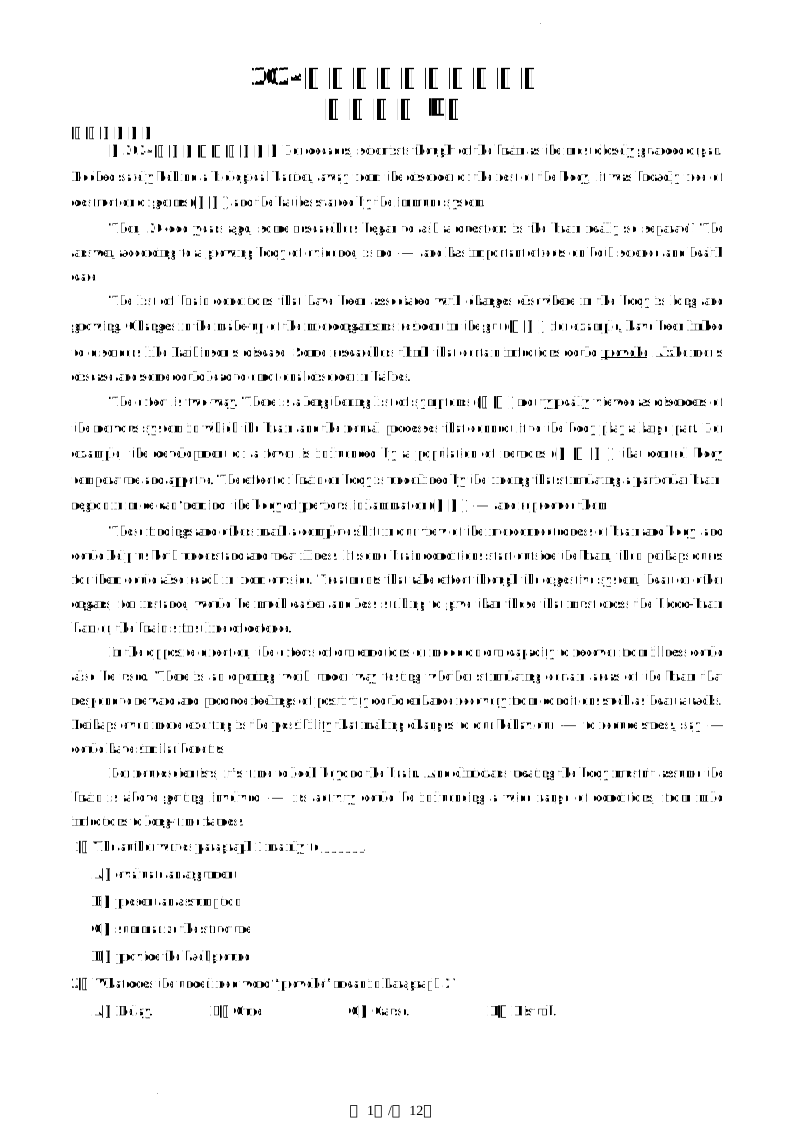
(2024北京顺义高三二模)For decades, scientists thought of the brain as the most closely guarded organ. Locked safely behind a biological barrier, away from the disorder of the rest of the body, it was broadly free of destruction of germs (病菌) and the battles started by the immune system.
Then, 20-odd years ago, some researchers began to ask a question: is the brain really so separate? The answer, according to a growing body of evidence, is no — and has important effects on both science and health care.
The list of brain conditions that have been associated with changes elsewhere in the body is long and growing. Changes in the make-up of the microorganisms resident in the gut (肠道), for example, have been linked to disorders like Parkinson’s disease. Some researchers think that certain infections could provoke Alzheimer’s disease and some could lead to emotional disorder in babies.
The effect is two-way. There is a lengthening list of symptoms (症状) not typically viewed as disorders of the nervous system in which the brain and the neural processes that connect it to the body play a large part. For example, the development of a fever is influenced by a population of neurons (神经元) that control body temperature and appetite. The effect of brain on body is underlined by the finding that stimulating a particular brain region in mice can ‘remind’ the body of previous inflammation (炎症) — and reproduce them.
These findings and others mark a complete shift in our view of the interconnectedness of brain and body, and could help us both understand and treat illness. If some brain conditions start outside the brain, then perhaps cures for them could also reach in from outside. Treatments that take effect through the digestive system, heart or other organs, for instance, would be much easier and less striking to give than those that must cross the blood-brain barrier, the brain’s first line of defence.
In the opposite direction, the effects of our emotions or mood on our capacity to recover from illness could also be used. There is an opening work under way testing whether stimulating certain areas of the brain that respond to reward and produce feelings of positivity could enhance recovery from conditions such as heart attacks. Perhaps even more exciting is the possibility that making changes to our behaviour — to reduce stress, say — could have similar benefits.
For neuroscientists, it’s time to look beyond the brain. And clinicians treating the body mustn’t assume the brain is above getting involved — its activity could be influencing a wide range of conditions, from mild infections to long-time fatness.
1.The author writes paragraph 1 mainly to ______.
A.evaluate an argument
B.present an assumption
C.summarize the structure
D.provide the background
2.What does the underlined word “provoke” mean in Paragraph 3?
A.Delay. B.Cure. C.Cause. D.Disturb.
3.What can we learn from the passage?
A.Treatments that cross brain-blood barrier are less used.
B.Previous diseases could cause the production of new ones.
C.Emotions could affect the capacity to fight against diseases.
D.Treatment of the brain takes priority over other treatments.
4.Which of the following shows the development of ideas in the passage?
I: Introduction P: Point Sp: Sub-point (次要点) C: Conclusion
A. B.
C. D.
(2024北京丰台高三二模)A shopkeeper’s son breaks a window, causing a crowd to gather. They tell the shopkeeper not to be angry: actually, the broken window is a reason to celebrate, since it will create work for the glazier (装玻璃的工人). In the story, written by a 19th-century economist, the crowd envisions the work involved in repairing the window, but not that involved in everything else on which the shopkeeper could have spent his money — unseen possibilities that would have brought him greater happiness.
If that window were to be broken these days, people might have a different reaction, especially if they were NIMBYs (Not In My Back Yard) who oppose any local construction that affects their quality of life. Their concern might be with the “embodied carbon”. The production of a piece of glass would carry a sizeable carbon cost. Similarly, the bricks and concrete in a building are relics of past emissions. They are, the logic goes, embodied carbon.
Conserving what already exists, rather than adding to the building stock, will avoid increasing these embodied emissions — or so NIMBYs often suggest. At its worst, this idea is based on a warped logic. Greenhouse gases released by the construction of an existing building will heat the planet whether the building is repaired or knocked down. The emissions have been taken out of the world’s “carbon budget”, so treating them as anew debit means double counting. The right question to ask is whether it is worth using the remaining carbon budget to repair a building or it is better to knock it down.
Choosing between these possibilities requires thinking about the unseen. It used to be said that construction emitted two types of emissions. Besides the embodied sort, there were operational ones from cooling, heating and providing electricity to residents. Around the world, buildings account for 39% of annual emissions, according to the World Green Building Council, of which 28% come from operational carbon.
These two types of emissions might be enough for the architects designing an individual building. But when it comes to broader questions, economists ought also to consider how the placement of buildings affects the manner in which people work, shop and travel. Density (密度) lowers the per-person cost of public transport, and this reduces car use. Research by Green Alliance, a pressure group, suggests that in Britain a policy of “demolish (拆除) and densify” — replacing semi-detached housing near public transport with blocks of flats — would save substantial emissions. Without such demolition, potential residents would typically have to move to the suburbs instead, saving money on rent but consuming more energy.
Targeted subsidies (补贴), especially for research and development into construction materials, could speed up the pace at which the built environment decarbonises. What will never work, however, is allowing the loudest voices to decide how to use land and ignoring the carbon emissions of their would-be neighbours once they are out of sight.
5.The first two paragraphs are written to ________.
A.exemplify an outlook on energy conservation
B.present a new way of relieving energy crisis
C.explain people’s reaction to a broken window
D.introduce an argument on carbon emission
6.What does the underlined word “warped” in Paragraph 3 probably mean?
A.Unsound. B.Complicated. C.Distinctive. D.Underlying.
7.What can be learnt from the passage?
A.Operational carbon accounts for a larger share of carbon emission.
B.Repairing old buildings outweighs demolition in energy conservation.
C.Higher residential density near public transport may help reduce emission.
D.Stopping residents from living in new buildings is sensible to energy saving.
8.As for decarbonization of the built environment, which would the author agree with?
A.Interests of NIMBYs are worthy of consideration.
B.A comprehensive insight into emission is essential.
C.Upgrading construction materials should be prioritized.
D.Every resident should do their bit in reducing carbon emission.
(2024北京昌平高三二模)In 1992, Edward de Bono argued that “creativity is the most important human resource of all.” But might computers have the capacity to be creative? Could artificial intelligence outperform us in even the most human of phenomena? These questions have moved to the forefront of society with the launch of ChatGPT and DALL - E, two powerful deep learning models capable of creating art.
Where human creativity comes from is a complex and heavily-debated topic. One theory supposes that creativity emerges from solving problems in new ways. The game designer Mark Rosewater explains that “if you use the same neural pathways, you get to the same answers, and with creativity, that’s not your goal.” But studies from the University of Virginia suggest humans most default (默认)to solving problems by building on known solutions, restricting originality. Some neuroscientists propose another theory regarding creativity. Research from the University of Calgary reveals that when being creative, humans don’t use the same brain regions associated with thought and problem-solving, implying that creativity is primarily an unconscious process. According to this theory, the brain solves problems best when not directly focusing on them using the frontal lobe(前额叶), instead letting the other parts of the brain take over.
A. I. cannot currently emulate(仿真) the full complexity of the human mind. Do these deep learning networks even have the required components that we use when we are creative? Douglas Hofstadter explains how “emergent phenomena,” such as creativity, correspond to connections between levels within mental systems. Similar connections could exist in artificial neural networks, even if the mechanics differ. For example, modern artificial intelligence employs attention circuits that may cause it to behave similarly to the frontal lobe where most of the brain’s focusing tendencies come from.
The emergent nature of creativity opens the door for similar tendencies in machines, but they are tuned so carefully to copy existing ideas that it may not be enough for true originality. Mr. Rosewater’s theory on creativity suggests that for A. I. to be creative, it should be able to solve problems in new ways, which is difficult because A. I. is based so heavily on already existing ideas. Alternatively, if creativity is an unconscious process as the University of Calgary research suggests, then it occurs mostly outside the frontal lobe and may not exist in machine learning networks. Either way, current A. I. probably lacks the capacity for genuine creativity and originality, but it can combine existing ideas in interesting ways.
The question of machine creativity has repercussions in many areas, such as developing copyright law regarding A. I. works, considering A. I. submissions in art contests, and determining the use of ChatGPT as a tool for school assignments. Creativity may be, at least for now, a unique human quality. Computers are not yet starting revolutionary artistic movements, but they are already combining what exists into something new, challenging us to look deeper into our own creativity.
9. About the source of human creativity, research from the University of Calgary discovers that ______.
A. human creativity heavily relies on the existing ideas
B. dealing with problems helps develop human creativity
C. being creative is closely related to certain brain regions
D. human creativity is a process that happens automatically
10. The author would probably agree that ______.
A. efforts should be put into the study of human creativity
B. creativity can be attained consciously on most occasions
C. A. I. creates better than humans in some areas at present
D. humans need machines to be more creative in various areas
11. What does the underlined word “repercussions” in Paragraph 5 probably mean?
A. Influences. B. Objections. C. Doubts. D. Causes.
12. Which would be the best title for the passage?
A. Computing Creativity: Is it a good thing?
B. Computing Creativity: Can it be possible?
C. Human Creativity: Why does human develop it?
D. Human Creativity: How can A. I. help human create?
(2024北京朝阳高三二模)It is perhaps easy to accept the statement that the universe is expanding. It is just some strange physics indicating that, as time goes on, galaxies (星系) get further away from each other just like two cars racing away from each other.
I personally don’t like it and prefer the balloon analogy. In this situation, there are dots all over a balloon. When we blow it up in real life, the dots would increase in size. In this analogy, let’s assume they don’t. What we are interested in is how the distance between the dots on the surface of the balloon grows as we put more air into it.
The balloon analogy relies somewhat on our geometric sensibilities which refer to our sense of shapes and how they change over time. At its core, what we are trying to develop a sense for is how we measure distances. This concept is also the fundamental goal of general relativity, Einstein’s theory of gravity. In general relativity, the most important piece of information is what we call the metric, an equation that describes how distances are measured, and therefore also tells us about the shape space-time is taking.
The whole idea that space-time is expanding was first noticed as a mathematical consequence of general relativity by Georges Lemaitre in 1927, when he solved Einstein’s equation and found a solution for the metric showing that distances grow with time. His work provided a theoretical explanation: the standard for measuring cosmic (宇宙的) distance was itself changing with time.
What is delightful is that it means we can quite reasonably say that universe’s expansion is a gravitational effect. I enjoy this because it is so deeply counterintuitive to our usual understanding of gravity, which teaches us that it is a force that always draws things together. But in this case where gravity is a geometric effect, we are offered a broader range of gravitational possibilities.
It is worth noting that the geometric explanation of general relativity hasn’t been universally popular. The late physicist Steven Weinberg wrote that the geometric explanation of the theory of gravitation has been reduced to a mere analogy, but is otherwise not very useful. Another challenge with the balloon analogy and our reliance on geometric explanation is to explain why gravity seems to pull things together in many situations, while universe is expanding. This difference is resolved by acknowledging that local gravitational effects due to massive objects dominate over large-scale expansion effects, leading to the formation of structures like stars, galaxies and, eventually us.
In fact, the analogy where universe is only expanding and this is the only gravitational effect at play is a very idealized situation where matter was initially spread out perfectly evenly across the universe.
13. The author presents the balloon analogy in Paragraph 2 mainly to _________.
A. introduce a topic
B. draw a comparison
C. confirm a theory
D. evaluate a statement
14. What does the underlined word “counterintuitive” in Paragraph 5 probably mean?
A. Unchallenging.
B. Contradictory.
C. Satisfying.
D. Relevant.
15 What can be inferred from the passage?
A. Universe’s expansion results in the creation of structures like galaxies.
B. Lemaitre’s work suggests the standard for cosmic distance is consistent.
C. A uniform distribution of matter can overcome the universe’s expansion.
D. The metric is key to sensing the shape of space-time in general relativity.
16. Which would be the best title for the passage?
A. Studying Galaxies—Has the Balloon Analogy Been Outdated?
B. Rethinking Gravity—Is it a Way to Make Sense of the Balloon Analogy?
C. Arguing against the Car Analogy—Does the Balloon Analogy Win Over?
D. Understanding Universe Expansion—Is the Balloon Analogy Acceptable?
(2024北京东城高三二模)You might not think that an AI capable of making music would stimulate your emotion, but others think differently, particularly those who gathered at Mexico City’s Symphony Hall in 2019 for Schubert’s Unfinished Symphony, which I finished using melodies generated by an AI.
As the orchestra(管弦乐团) finished Schubert’s original work and began the music the AI and I had written, I could feel the crowd’s energy shift from astonishment to indignation and fear. They seemed afraid that an AI might be able to make emotional symphonic music. You can see their point: an AI that makes emotional music could affect the emotional lives of thousands or even millions of people in a small, but profound way, just like a human musician does.
Positive and negative, people reacted very strongly to AI’s symphonic debut(首秀). Even though most people don’t believe that AI can create something enjoyable, they, at least partly, did enjoy the Unfinished Symphony.
Enjoyment in music implies that there’s something in the music that the listener connects to, a perception of shared emotion. But, in the case of AI music, an emotion shared with who? AI, as of yet, has no emotions. So what is the meaning of music made without an emotional composer? The unsatisfying answer is that music has no objective meaning. A composer can decide how a piece of music sounds, but it’s the listener that decides what it means.
No matter how it s created, music doesn’t exist in a vacuum(真空) to the listener. The meaning we assign to music depends on its context — how the piece connects to other elements in our lives. Without context, music is like the results of a game whose rules have been lost. The context for a music is part of who you are. The music is emotional to you because you have the context to appreciate it. As it continues to evolve, AI music will develop its own context. Certainly, it’ll be different from human-made music. It’ll mix existing genres to create new ones; it’ll combine instruments that we wouldn’t think of combining. Its rules will be different.
I’m now always asked the same question: “Who put the emotion in that music: you, the composer, or the AI?” But that’s not the question they really want to ask, though. There’s a deeper question that most people are too afraid to ask right now: “Are my emotions so simple that they can be maneuvered by a machine?”
In my experience, this could be possible one day. If a modestly capable music AI in 2019 could stir up emotions of an audience, maybe AI can have a more powerful effect on our emotional lives than we’d like to admit.
17. The audience reacted strongly to the symphony mainly due to ______.
A. their doubts about AI’s capabilities
B. their uneasiness about AI’s influence
C. the orchestra’s brilliant presentation of AI music
D. the likeness between AI music and the original work
18. What might the author agree with?
A. AI poses little impact on people’s emotions.
B. Music bears no intended emotional meaning.
C. AI music will outperform human-made music.
D. The context reflects people’s interpretation of music.
19. What does the word “maneuvered” underlined in Paragraph 6 most probably mean?
A. Refreshed. B. Challenged. C. Revealed. D. Directed.
20. Which would be the best title for the passage?
A. Are Composers To Be Replaced?
B. Would AI Music Be a Rising Trend?
C. Could AI Make Music That Moves You?
D. Was the Unfinished Symphony Successful?
(2024北京海淀高三二模)We are a social animal. Indeed, it is our sociality—such as the ability to make sense of each other, to communicate, to work cooperatively and, finally, to create culture—that marks us off from other animal species.
But then why are we everywhere striving to increase our isolation and limit our contact with others? As musician David Byrne argues in an essay published last month, it is a striking fact about the new technologies that have so come to shape our lives, that they have precisely this effect: they limit our need for human contact. Online shopping? Check. Automated checkout? Check. Ride hail apps? Check. Efficiency is the key. We purchase efficiency by limiting the human aspect, known as “autonomous operation”. This is perhaps even more pronounced with new technologies on the horizon. Take the MOOC, the teacher-less virtual classroom. As Byrne notes, this is meant to deliver the values of a learning environment without, well, without the environment—you get to stay at home—no teacher, but also, no fellow students.
Byrne isn’t claiming we are consciously choosing to isolate ourselves. We shop online because it is convenient. The absence of contact with others is a side-effect. Maybe even an unavoidable one, as one of the things that makes online shopping so easy is precisely the absence of contact with other people.
But Bryne’s thought is that whatever our intention, the tendency of our tech to isolate us may be a feature, not a bug. His hypothesis is that we actually, at some level, crave (渴望) the increased isolation and we are actually making technologies to satisfy impulses that, in some way, go beyond—or against—our social nature. But I wonder, is this really new?
Even if we are social by nature, and do everything we can to embed ourselves socially, the need to find ways to be alone is, well, nothing new. It’s also striking that the very activities that risk separating us—in the old days, books, newspapers, TV; nowadays, the latest apps—also connect us. We read about each other. What we read gives us information to share with each other.
I am well aware of the data that shows the more time you spend on social media, the sadder and more isolated and envious you feel of others. But how novel is the isolating effect of social media? Being there reminds me a lot of what it was like to be social in high school—you have a vivid sense of your status and your standing in relation to others, and you have to deal with that.
This may be isolating, sure. But it’s the isolating face of the social lives we’ve always had. It is isolating because of the ways technology brings us into real contact with others, not because it removes that contact.
I wonder whether more isolation is a real option, after all.
21. Which of the following best reflects “autonomous operation”?
A. Getting a toothbrush via a hotel delivery robot.
B. Teaching mom how to establish a smart home.
C. Seeking help by calling human customer services.
D. Having an online meeting at home with colleagues.
22. Which of the following might the author agree?
A. Technology offers fresh insights into our social status.
B. Actions seemingly isolating can bond people.
C. Social platforms help bring people closer.
D. Social media has come to define our life.
23. What would be the best title for the passage?
A. What Technologies Do to Human Nature
B. Do Technologies Shape Our Lives?
C. How Isolation Changes with Connection
D. Can We Erase Human Element?
(2024北京西城高三二模)Can you imagine getting a major dental procedure without novocaine (一种麻醉药)? A scientist colleague of mine recently told me, rather than use it, he used a “focus in” meditation (冥想) technique to direct all of his attention to his mouth with as much calming equanimity as he could gather. Doing so transformed the pain for a few minutes.
A stream of scientific articles suggests that there are benefits in turning toward discomfort or negative emotions with acceptance. In addition, all of us can gain from finding ways to cope with stress and suffering—particularly when larger circumstances are beyond our control. As a researcher who has studied meditation for more than 20 years, I believe that the cultivation of equanimity can help.
It’s important to first define the idea of turning toward discomfort. I’m not advocating for people to put themselves in dangerous positions. But when we push ourselves into challenging or embarrassing situations, much like trainers who push athletes just past their comfort zone to make gains, learning often happens.
My own research indicates that meditation provides an ideal way to practice turning toward discomfort—particularly when it trains up one’s equanimity. In my laboratory at Carnegie Mellon University, we conducted several clinical trials on developing equanimity during mindfulness meditation training. This approach includes guided meditation exercises such as using a matter-of-fact voice to label uncomfortable feelings in the body or welcoming uncomfortable feelings by saying “yes” aloud each time a feeling is detected.
We hired 153 stressed adults and offered them a mindfulness meditation training program with or without training in equanimity. Our equanimity skills training group had significantly better outcomes on several measures. After just 14 days of training, for example, the participants who learned equanimity skills had significantly lower biological stress responses when asked to deliver a difficult speech and solve math problems in front of experts in white lab coats. This group also had significantly lower blood pressure and stress levels. In the days after training, people introduced to equanimity exercises also reported significantly higher positive emotions and well-being throughout the day and more meaningful social interactions than participants who received mindfulness training without the equanimity component. It was as though developing equanimity had transformed their emotional reactivity to stress, helping them better appreciate and enjoy daily life’s many little positive experiences and making them more curious and open to connecting with others.
We are expanding on this work in several ways—including through the development of an app that offers equanimity training on demand and with trials involving participants with stress-related gastrointestinal (胃肠的) disorders. Meanwhile other scientists are further exploring equanimity’s power. We are convinced we can each build our resilience (恢复力) on a personal level by cultivating greater acceptance of our experience—good or bad, painful or pleasant—in the present moment.
24. What can be learned about equanimity?
A. It is a state of mental calmness.
B. It is a form of negative emotions.
C. It is a replacement for novocaine.
D. It is the result of mindfulness meditation.
25. Which of the following is a good example of equanimity training?
A. Ignoring discomfort totally. B. Detecting unusual behavior.
C. Keeping emotions to oneself. D. Seeing negative feelings objectively.
26. Paragraph 5 is written to show ______.
A. the benefits of developing equanimity
B. the procedure of mindfulness meditation
C. the performances of two meditation training groups
D. the relationship between equanimity and well-being
27. What can be inferred from the last paragraph?
A. Stress contributes to physical disorders.
B. Pleasant experiences result in greater equanimity.
C. People are likely to have easy access to equanimity training.
D. Resilience can help people gain more acceptance of hardship.
参考答案
1.D 2.C 3.C 4.A
【导语】本文为一篇说明文,说明了大脑并不是独立存在的,它对科学和医疗保健都有重要影响。
1.推理判断题。根据文章第一段“For decades, scientists thought of the brain as the most closely guarded organ. Locked safely behind a biological barrier, away from the disorder of the rest of the body, it was broadly free of destruction of germs and the battles started by the immune system. (几十年来,科学家们一直认为大脑是最严密保护的器官。它被安全地锁在生物屏障后面,远离身体其他部分的混乱,基本上没有细菌的破坏,也没有免疫系统发起的战斗。)”及第二段“Then, 20-odd years ago, some researchers began to ask a question: is the brain really so separate? The answer, according to a growing body of evidence, is no—and has important effects on both science and health care. (然后,20多年前,一些研究人员开始提出一个问题:大脑真的如此独立吗?根据越来越多的证据,答案是否定的,而且对科学和医疗保健都有重要影响。)”可知,第一段为引出本文主旨的背景信息,故选D。
2.词义猜测题。根据划线词前文“The list of brain conditions that have been associated with changes elsewhere in the body is long and growing. Changes in the make-up of the microorganisms resident in the gut, for example, have been linked to disorders like Parkinson’s disease. (与身体其他部位的变化有关的大脑疾病的清单很长,而且还在不断增加。例如,肠道微生物组成的变化与帕金森病等疾病有关。)”及“certain infections(特定感染)”及后文“Alzheimer’s disease and some could lead to emotional disorder in babies. (阿尔茨海默病和一些可能导致婴儿情绪紊乱的疾病。)”可知,研究者认为一些特定感染能引发阿尔茨海默病和一些可能导致婴儿情绪紊乱的疾病。划线词与cause意思相近,表示“激起,引起”。故选C。
3.推理判断题。根据文章倒数第二段“In the opposite direction, the effects of our emotions or mood on our capacity to recover from illness could also be used. There is an opening work under way testing whether stimulating certain areas of the brain that respond to reward and produce feelings of positivity could enhance recovery from conditions such as heart attacks. Perhaps even more exciting is the possibility that making changes to our behaviour—to reduce stress, say—could have similar benefits. (相反,我们的情绪或心情对我们从疾病中恢复的能力的影响也可以被利用。目前正在进行一项开放性研究,测试刺激大脑中对奖励做出反应并产生积极情绪的特定区域是否能促进心脏病发作等疾病的恢复。也许更令人兴奋的是,改变我们的行为——比如减少压力——可能会有类似的好处。)”可推知,情绪会影响我们对抗疾病的能力。故选C。
4.推理判断题。根据文意①②段引出话题,表示“大脑并不是独立的,它对科学和医疗保健都有重要影响”;第三段“The list of brain conditions that have been associated with changes elsewhere in the body is long and growing. (与身体其他部位的变化有关的大脑疾病的清单很长,而且还在不断增加。)”及第四段“The effect is two-way. (这种影响是双向的。)”等内容分别解释了大脑对于健康的影响的两个方面——不仅可以影响身体其他部位,且可以引起症状;第五段“These findings and others mark a complete shift in our view of the interconnectedness of brain and body, and could help us both understand and treat illness. (这些发现和其他发现标志着我们对大脑和身体相互联系的看法的彻底转变,可以帮助我们理解和治疗疾病。)”等内容及第六段“In the opposite direction, the effects of our emotions or mood on our capacity to recover from illness could also be used. (相反,我们的情绪或情绪对我们从疾病中恢复的能力的影响也可以被利用。)”分别从身体、精神上介绍了大脑对于健康影响的发现可以帮助我们通过科学的角度理解、治疗疾病的两个方面;最后一段进行总结。因此A选项结构符合本文。故选A。
5.D 6.A 7.C 8.B
【导语】这是一篇说明文。文章主要说明了建筑行业中的“隐含碳”问题,指出建筑物中的砖块和混凝土是过去排放的遗迹。从逻辑上讲,它们是隐含的碳。无论是修缮还是拆除现有建筑,建筑所释放的温室气体都将使地球升温。
5.推理判断题。根据第一段“A shopkeeper’s son breaks a window, causing a crowd to gather. They tell the shopkeeper not to be angry: actually, the broken window is a reason to celebrate, since it will create work for the glazier (装玻璃的工人). In the story, written by a 19th-century economist, the crowd envisions the work involved in repairing the window, but not that involved in everything else on which the shopkeeper could have spent his money — unseen possibilities that would have brought him greater happiness.(一个店主的儿子打破了一扇窗户,引起了一群人的聚集。他们告诉店主不要生气:实际上,打破窗户是一个值得庆祝的理由,因为这将为玻璃匠创造工作机会。在这个由一位19世纪经济学家撰写的故事中,人们想象的是修理窗户的工作,而不是店主本可以花钱购买的其他东西,这些东西看不见,可能会给他带来更大的幸福)”以及第二段“If that window were to be broken these days, people might have a different reaction, especially if they were NIMBYs (Not In My Back Yard) who oppose any local construction that affects their quality of life. Their concern might be with the “embodied carbon”. The production of a piece of glass would carry a sizeable carbon cost. Similarly, the bricks and concrete in a building are relics of past emissions. They are, the logic goes, embodied carbon.(如果这扇窗户现在被打破了,人们可能会有不同的反应,特别是如果他们是邻避主义者(不要在我的后院),他们反对任何影响他们生活质量的地方建设。他们担心的可能是“隐含碳”。一块玻璃的生产将带来相当大的碳成本。同样,建筑物中的砖块和混凝土是过去排放的遗迹。从逻辑上讲,它们是隐含的碳)”可推知,前两段是用来介绍一个关于碳排放的论点。故选D。
6.词句猜测题。根据第三段“Conserving what already exists, rather than adding to the building stock, will avoid increasing these embodied emissions — or so NIMBYs often suggest.(保护已经存在的东西,而不是增加建筑存量,将避免增加这些隐含的排放——邻避主义者经常这样建议)”以及“Greenhouse gases released by the construction of an existing building will heat the planet whether the building is repaired or knocked down.(无论是修缮还是拆除现有建筑,建筑所释放的温室气体都将使地球升温)”可知,邻避主义者的建议是不健康的,故划线词意思是“不健康的”。故选A。
7.细节理解题。根据倒数第二段“Density (密度) lowers the per-person cost of public transport, and this reduces car use. Research by Green Alliance, a pressure group, suggests that in Britain a policy of “demolish (拆除) and densify” — replacing semi-detached housing near public transport with blocks of flats — would save substantial emissions.(人口密度降低了公共交通的人均成本,从而减少了汽车的使用。压力集团绿色联盟的研究表明,在英国,“拆除和密集”政策——用公寓楼取代公共交通附近的半独立式住房——将节省大量的排放)”可知,公共交通附近较高的住宅密度可能有助于减少排放。故选C。
8.推理判断题。根据最后一段“Targeted subsidies (补贴), especially for research and development into construction materials, could speed up the pace at which the built environment decarbonises. What will never work, however, is allowing the loudest voices to decide how to use land and ignoring the carbon emissions of their would-be neighbours once they are out of sight.(有针对性的补贴,尤其是对建筑材料研发的补贴,可能会加快建筑环境脱碳的步伐。然而,允许最响亮的声音来决定如何使用土地,而忽视潜在邻居在视线之外的碳排放,这是永远行不通的)”可推知,关于建筑环境的脱碳,作者同意对排放的全面了解是必要的。故选B。
9. D
10. A
11. A
12. B
13.A
14.B
15.D
16.D
17. B
18. B
19. D
20. C
21.A
22.B
23.D
24. A
25. D
26. A
27. C
第1页/共1页
学科网(北京)股份有限公司
$$
资源预览图
1

2

3

相关资源
由于学科网是一个信息分享及获取的平台,不确保部分用户上传资料的 来源及知识产权归属。如您发现相关资料侵犯您的合法权益,请联系学科网,我们核实后将及时进行处理。