北京市顺义区2022-2024年(三年)中考二模英语试题汇编:阅读理解
2024-05-31
|
17页
|
260人阅读
|
4人下载
资源信息
| 学段 | 初中 |
|---|---|
| 学科 | 英语 |
| 教材版本 | - |
| 年级 | 九年级 |
| 章节 | - |
| 类型 | 题集-试题汇编 |
| 知识点 | - |
| 使用场景 | 中考复习-二模 |
| 学年 | 2024-2025 |
| 地区(省份) | 北京市 |
| 地区(市) | 北京市 |
| 地区(区县) | 顺义区 |
| 文件格式 | DOCX |
| 文件大小 | 978 KB |
| 发布时间 | 2024-05-31 |
| 更新时间 | 2024-05-31 |
| 作者 | 匿名 |
| 品牌系列 | - |
| 审核时间 | 2024-05-31 |
| 下载链接 | https://m.zxxk.com/soft/45512186.html |
| 价格 | 0.50储值(1储值=1元) |
| 来源 | 学科网 |
内容正文:
北京市顺义区2022-2024年(三年)中考二模英语试题汇编
阅读理解
2024年北京市顺义区中考二模英语试题
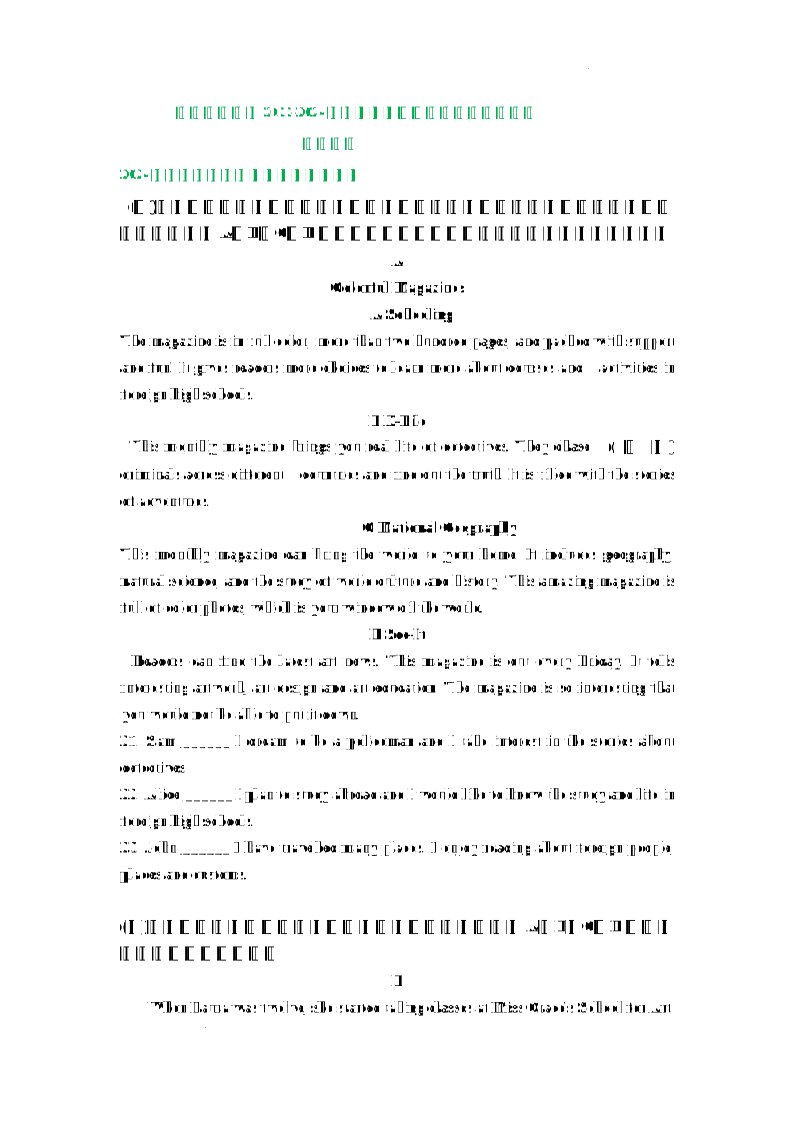
(一)阅读下列关于四本杂志的介绍,请根据人物需求匹配最适合的一本杂志,并将其对应的A、B、C、D选项填在相应位置上。选项中有一项为多余选项。
A
Colorful Magazines
A Schooling
The magazine is in full color, more than two hundred pages, and packed with support and fun! It gives readers more choices to learn more about courses and activities in foreign high schools.
B X-File
This monthly magazine brings you real life of detectives. They chase ( 迫 捕) criminals across different countries and find out the truth. It is filled with the stories of adventures.
C National Geography
This monthly magazine can bring the world to your home. It includes geography, natural science, and the study of world culture and history. This amazing magazine is full of color photos, which is your window oil the world.
D See-It
Readers can find the latest art news. This magazine is out every Friday. It tells interesting artwork, art design and art education. The magazine is so interesting that you would not be able to put it down.
21. Sam ______ I dream to be a policeman and I take interest in the stories about detectives.
22. Alice ______ I plan to study abroad and I would like to know the study and life in foreign high schools.
23. John ______ I have travelled many places. I enjoy reading about foreign people, places and customs.
(二)阅读下列短文,根据短文内容,从短文后各题所给的A、B、C、D四个选项中,选择最佳选项。
B
When Laura was twelve, she started taking classes at Miss Grace's School for Art. At first, she didn't enjoy it; the “novice artists”—the kids who hadn't really done art before—worked mostly with clay, and Laura. didn't do well in it.
It wasn't until her third year that Laura found something she was really good at—charcoal drawing (素描). She loved watching the lines spread across the page as she moved the charcoal back and forth over the paper.
One day, Sophia, the best artist in her class, sat down and set up her easel next to Laura. Laura felt uneasy. She'd actually found an art form that she enjoyed—and was good at—and now Sophia was going to outshine
(胜过) her again? Laura fought back tears when Miss Grace entered the room.
“Hello class,” Miss Grace said. “We'll continue to work on the project today.”
What masterpiece (杰作) would Sophia have come up with?
Laura looked at Sophia's easel and she couldn't believe it—it was a mess! For a brief moment, Laura couldn't actually believe her drawing was better than Sophia's. But then she looked at Sophia, who was watching Laura with an anxious expression.
“I... I couldn't decide what to do,” Sophia said. “And you're so good. Sometimes I feel like my work is just so bad in comparison."
Laura looked to see if Sophia was joking, but she seemed completely serious. Now Laura was shocked. “I'm not talented... Miss Grace seldom praises me. You're the best one in our class!”
Sophia raised her eyebrows. “I might be a really good copier, but I have no idea what to do when it comes to making up my own images. You are so great at making new things out of the old ones. I've loved your works.”
“I've loved yours, too,” Laura said.
“Well, definitely not this one,” Sophia said.
Laura smiled. “Maybe not right now. But if you move these lines up...” she said, pointing her finger on Sophia's paper.
Sophia was quiet for a moment. “That's a great idea!” she said finally.
Laura smiled and turned back to her drawing, looking every so often at Sophia's work to see that she was taking her advice, down to the last line.
24. When Laura started art classes, she ______.
A. didn't do well in the course B. didn't feel confident in drawing
C. didn't like working with clay D. didn't get along with her classmates
25. Why did Laura feel uneasy when Sophia sat next to her?
A. Because she was punished by her teacher.
B. Because she had not really done art before.
C. Because she thought Sophia was better than her.
D. Because she had no idea what Sophia wanted to draw.
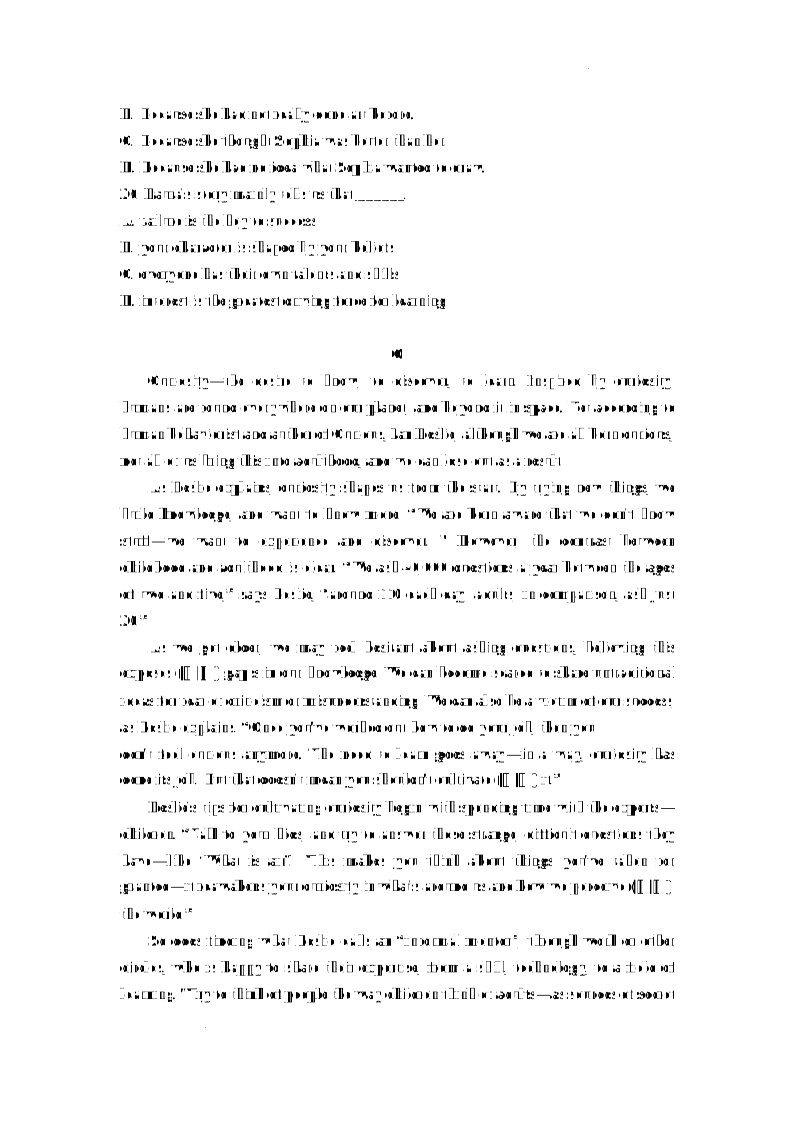
26. Laura's story mainly tells us that ______.
A. failure is the key to success
B. your character is shaped by your beliefs
C. everyone has their own talents and skills
D. interest is the greatest driving force for learning
C
Curiosity—the desire to know, to discover, to learn. Inspired by curiosity, humans are found everywhere on our planet, and beyond it in space. Yet according to human behaviorist and author of Curious, Ian Leslie, although we are all born curious, not all of us bring this into adulthood, and we can lose out as a result.
As Leslie explains, curiosity shapes us from the start. By trying new things, we build knowledge, and want to know more. “We are born aware that we don't know stuff—we want to experience and discover. " However, the contrast between childhood and adulthood is clear. “We ask 40,000 questions a year between the ages of two and five,” says Leslie, “around 110 each day; adults, in comparison, ask just 20.”
As we get older, we may feel hesitant about asking questions, believing this exposes (暴露) gap s in our knowledge. We can become scared to share untraditional ideas for fear of criticism or misunderstanding. We can also be a victim of our success, as Leslie explains. “Once you've worked out how to do your job, then you
don't feel curious anymore. The need to learn goes away—in a way, curiosity has done its job. But that doesn't mean you shouldn't cultivate (培养) it.”
Leslie's tips for cultivating curiosity begin with spending time with the experts— children. “Talk to your kids, and try to answer those strange, difficult questions they have—like ‘What is air?’ This makes you think about things you've taken for granted—it reawakens your curiosity in what's around us and how we perceive (感知) the world.”
So does finding what Leslie calls an “informal mentor”, through work or other circles, who is happy to share their expertise, from a skill, technology, to a field of learning. "Try to think of people the way children think of adults—as sources of secret knowledge, a great store of learning you can tap into," says Leslie.
Leslie also suggests creating a “spark file” —a digital or physical notebook in which you collect interesting thoughts. “Fill it with facts you've come across, sentences you like, insights that strike you. Let it be random. And let it build. Over time you'll build up a rich source of inspiration, and you'll think, ‘Oh that's interesting, that relates to this...' And suddenly your mind starts firing away with new ideas and ways of thinking.”
27. According to Leslie, when we get older we may ______.
A. try more new things B. fill our knowledge gaps
C. ask some strange questions D. lose our natural curiosity
28. The word “contrast” in Paragraph 2 is closest in meaning to ______.
A. difference B. relationship C. argument D. secret
29. What can we learn from the passage?
A. We can talk to children to reawaken our curiosity.
B. We are willing to share our expert knowledge with others.
C. We can cultivate our curiosity by using a digital notebook.
D. We are afraid of asking questions because of misunderstanding.
D
Everyone looks forward to progress, whether in one's personal life or in the society. Progress shows a person's ability to change the way he is living at the moment. Progress must lead to a better way of doing things. All these, however, remain true only if people choose to accept technology and find new and more efficient (高效的) ways to move forward.
However, at the back of the minds of many people, especially those who missed the “good old days”, efficiency comes with a price. When communication becomes efficient, people are able to contact one another no matter where they are and whenever they wish to. The click of a button allows people miles apart to talk or to see each other without even leaving their homes. With the communication tools, such as mobile phones and iPads, people often do not take the effort to visit one another personally. A personal visit carries with its additional feature of having to be in the person's presence for as long as the visit lasts.
With efficiency also comes nass production (大规模生产). Such is the nature of factories and the success of industrialization today. Factories have improved efficiency. Unskillful tasks are left to machines and products are better made and produced with greater accuracy (精确) than any human hand. However, with the improvements in efficiency also comes the loss of the personal touch when making these products. For example, many handicrafts (手工艺品) are now produced in a factory. Although this means that supply is better able to increase demand, now that the supply is quick and efficient, the demand might fall because mass production lowers the quality of the handicraft and it is difficult to find unique designs on each item.
Nevertheless, we must not make the mistake of analyzing progress only from one point of view. In fact,
progress has allowed tradition to keep up. It is only with progress and the invention of new technology that many old products can be brought back to their old state. New technology is required for old products to stay old.
It is people's attitude towards progress that causes the type of influence that technology has on society. Technology is flexible. There is no fixed way of making use of it. Everything depends on people's attitude. The worst effects of progress will fall on those who are unable to think again about their attitudes and views of society.
When we accept progress and adapt it to suit our needs, a new “past” is created.
30. Progress can benefit people when they are willing to ______.
A. live a better life than before
B. look for more efficient methods
C. change the way of living at the moment
D. accept technology and find ways to move forward
31. Why does the writer talk about handicrafts in Paragraph 3?
A. To explain supply can increase the demand.
B. To stress efficiency may have a negative effect.
C. To suggest factories should improve efficiency.
D. To show handmade objects may be of low quality.
32. What is the last paragraph mainly about?
A. Progress can meet the needs of daily life.
B. Technology can be used in different ways.
C. A new past can be created by making progress.
D. People's attitude decides the use of technology.
33. What can we learn from the passage?
A. Technology can make the old products new.
B. Technology may cause fewer personal visits.
C. Technology can lead to higher quality in production.
D. Technology may reduce people's contact with others.
2023年北京市顺义区中考二模英语试题
三、阅读理解
配对阅读。下面的材料分别介绍了学校四项不同的社团活动。请根据题中所描述的 Amy, Emma 和David 的需求,选择一项最适合他们的活动,其中有一个选项是多余的。
21.Amy likes Chinese food. She wants to learn to cook wonderful dishes.
22.David is crazy about playing basketball and he is a huge fan of Yi Jianlian.
23.Emma enjoys singing and dancing. She wants to play a role in a music video.
Truly a Wonder!
Anna was a 9-year-old girl from a small village. She finished attending primary school till the 4th grade at her village. For the 5th grade, she would have to get an admission(入学) in a school at a city nearby. She was very happy knowing that she was accepted in a famous school in the city.
When she reached her school on the first day, all students started going to their classes. Anna also made it to her classroom. When seeing her simple clothing and knowing she was from a small village, other students started making fun of her. The teacher soon arrived. She introduced Anna to the class and told them that she would study with them from that day on.
During the class the teacher told the students to be ready for the surprise test now! She told everyone to write down the Seven Wonders of the world. Everyone started writing the answer quickly. But Anna started to write the answer slowly.
When everyone except Anna had presented their answer paper, the teacher asked Anna, “What happened, dear? Don’t worry. Just write what you know as other students learned about it just a few days ago.”
Anna replied, “There are many things. Which seven can I pick to write?” And then she handed her answer paper to the teacher. The teacher started reading everyone’s answers and most of the students had answered them correctly such as The Great Wall of China, Stonehenge, Great Pyramid of Giza, Leaning Tower of Pisa, Taj Mahal, etc.
The teacher was happy as students had remembered what she had taught them. At last the teacher picked up Anna’s answer paper and started reading. “The Seven Wonders are—To be able to See, To be able to Hear, To be able to Feel, To Laugh ,To Think, To be Kind, To Love!”
The teacher stood shocked and the whole class was speechless. Today, a girl from a small village reminded us about the gifts we have, which are truly a wonder. So value what we have and use what we have.
24.How did Anna feel when she was accepted in a new school?
A.Nervous. B.Happy. C.Surprised. D.Excited.
25.What did the teacher ask the students to do during the class?
A.To draw a picture. B.To take a good rest.
C.To have a test. D.To give a speech.
26.The teacher felt very shocked because ________.
A.Anna didn’t know the answers
B.all the students’ answers were correct
C.students had remembered what they learned
D.Anna’s answers reminded them what they have is truly a wonder
On April 18th—the International Day for Monuments and Sites, China Daily’s digital employee Yuanxi and Dunhuang Mogao Grottoes’official virtual(虚拟的) cartoon figure Jiayao together introduced an interactive digital platform(数字化互动平台) that hosts a virtual copy of the Mogao Grottoes’ Library Cave to the world.
The platform was developed jointly by the Dunhuang Academy and the Chinese tech firm Tencent. It uses gaming technologies to show the historical scenes of the Library Cave in the digital world.
The Library Cave in Mogao Grottoes was discovered in 1900, with more than 60,000 cultural relics dating from the 4th century to the 11th century unearthed. It was one of the most important archaeological discoveries in the 20th century.
On the platform, visitors can role-play and “time travel” to ancient dynasties and talk with eight historical figures. The public can enter the platform through the Digital Dunhuang website and its WeChat mini program.
In the digital age, the model of “culture + technology” has been adopted to promote(促进) the development of Chinese culture. The digitalization rate of China’s precious cultural relics has been more than 70 percent, according to the 2022 China Digital Collection Industry Research Report released by iResearch.
Institutions(机构) such as the Palace Museum have also launched online digital services of their own. Artificial intelligence (AI) technology allows the public to view the interior of the buildings through the Palace Museum’s WeChat mini program.
The Ministry of Culture and Tourism has also encouraged the development and transformation (转型) of cultural intellectual property by digital means. China Central Television has created a series of digital collections with different Dunhuang themes, such as the Dunhuang divine deer Youyou. It was created based on the image of the nine-colored deer from Dunhuang murals. The public can see the divine deer on CCTV’s own digital platform.
Digital collections cater to(迎合) the consumption habits of young people. They not only protect the intellectual property of the collections but also bring the public closer to China’s “excellent traditional culture”, noted Dunhuang Art Institute.
Su Bomin, director of the Dunhuang Academy, told Xinhua that more efforts will be made to explore new forms for showing cultural relics and offer the public more immersive cultural experiences to develop Dunhuang culture.
27.On the interactive digital platform for the Mogao Grottoes’ Library Cave, visitors can ________.
A.play role-playing games set in ancient times
B.play video games named historical characters
C.design digital caves showing historical culture
D.talk to the designer of the digital Library Cave
28.What is the purpose of developing digital platforms for cultural institutions?
A.To show the latest gaming technologies.
B.To help cultural institutions make money.
C.To promote the development of Chinese culture.
D.To encourage people to explore new forms of digital collections.
29.Which of the following would be the best title for the passage?
A.Presenting Digital Collections B.Experiencing History Online
C.Creating Mini Programs D.Introducing Gaming Technologies
Does Music Make You Smarter?
What interests many parents is that musical training improves the development of the brain — that “music makes us smarter”. According to a study published by the UK’s largest music education body, 7 out of every 10 children say they presently play a musical instrument. Whether this figure (数字) shows that most parents do believe the statement, or whether the potential benefits of music are hard to ignore (忽视). Ongoing research looks for suggestive evidence proving that musical training may actually strengthen the so-called “smart skills”.
The relationship between music and memory has long been the subject of research. In the 2003 study by The Chinese University of Hong Kong were 90 boys between the ages of 6 and 15, half of whom had 1 to 5 years of musical training and half of whom had none at all. Each of them had a memory test, with the musically trained students recalling more words, and being able to memorize more words after 30 minutes. One year later, a follow-up study showed that those students who had continued training, as well as novices who had recently begun musical training, both showed improvement in retention. However, students who had stopped music practice fewer than three months after the first study showed no further improvement. These results suggest that music training might improve memory function.
There is also increasing evidence that musical training may result in structural changes to the brain. Noticeable differences have been found between the brains of musicians and non-musicians. The size of those areas of the musician’s brain connected with hearing and visuospatial abilities is larger. A 2014 study found that the part of the cortex (大脑皮层) was thicker in children who had taken musical training.
However, like many scientific studies, research into the benefits of music remains ongoing, with many different opinions. Some deny (否认) that music makes people smarter. Others think that people who are naturally gifted in the cognitive (认知的) functions are simply more likely to play musical instruments. It would therefore be premature (草率的) to state without any doubt that music makes people smarter. Whatever the truth behind the statement that “music makes us smarter”, it should eventually come second only to the fact that music is one of life’s greatest pleasures.
30.The studies by The Chinese University of Hong Kong show that ________.
A.most parents believe the statement
B.people who take musical training might be happier
C.musical training may result in changes to the brain
D.musical training might improve students’ ability to remember things
31.The word “retention” in Paragraph 2 probably means “_________.”
A.memory B.practice C.train D.subject
32.What can we learn from the passage?
A.People have different opinions on whether music can make them smarter.
B.A child whose cortex is thicker prefers to take musical training.
C.70 percent of students like playing musical instrument.
D.Students who had taken the test had continued training.
33.What is the writer’s main purpose in writing this passage?
A.To stress that musical training may benefit the brain.
B.To show that finding pleasure in music is important.
C.To suggest that people learn a musical instrument.
D.To remind that musicians are usually smart.
2022年北京市顺义区中考二模英语试题
三、阅读理解
If you have problems describing people, don’t worry! We’ll use popular film characters to help you learn some useful words.
NaiveMeaning: If someone is naive, they have little experience and believe good things will always happen.
Example: In the film Elf, Buddy is a naive person who grows up with elves(精灵). One day, he goes to New York City but finds things very different there.
Director: David Berenbaum
LoyalMeaning: If you’re loyal, you always give support to a person or a group and help them and act honestly.
Example: In the film Toy Story, Woody is loyal to his friends and owner, Andy. He stays with Andy, even when Andy grows up and goes to college.
Director: John Lasseter
DemandingMeaning: If someone is demanding, they are not easily satisfied or pleased.
Example: In the film The Devil Wears Prada, Miranda is very demanding. She always works very hard, and expects others to do the same.
Director: David Frankel
TalentedMeaning: If you’re talented, you have a natural ability to do something well.
Example: In the film McFarland, USA, coach White notices some talented runners in his PE class. He forms a cross-country group that races against other schools.
Director: Niki Caro
21.If you want to use the word “naive” to describe people, the film ________ will help you.
A.Elf B.Toy Story
C.The Devil Wears Prada D.McFarland, USA
22.Who always gives support to friends according to the films?
A.Buddy. B.Woody. C.David Frankel. D.Niki Caro.
23.Which word is used to describe a person with a natural ability to do something well?
A.Naive. B.Loyal. C.Demanding. D.Talented.
Three Fingers of Patience
Once there was a farmer with his wife and children living a happy life by earning from their own land in a village. The family planted the crops in spring, and harvested the crops in autumn. The only issue(问题) faced by the farmer was a lack of water for the fields. After discussing with his family, the farmer decided to dig a well near his land.
After managing to get all the materials prepared, he went to visit an expert to ask for advice on where he should dig one. Under the guidance, he started the project at the edge of the land with great expectation. He worked very hard to dig day and night. But his hard work was not rewarded. The whole family advised him not to lose hope. He didn’t want to disappoint anyone, especially himself, and began his project again. Another two days went by, and there was not a single drop of water coming from the well. He was completely tired, lost patience and went home thinking that everything was a waste of time. In case passers-by fell into the hole by mistake, he put a piece of wood which was the size of five fingers long near the unfinished well.
One night, a villager walked beside the well and hit his leg on that wood by mistake. This man became so annoyed that with all his frustration and anger he lifted the piece of wood, and with full energy threw the wood inside the well. The moment the man threw the wood, it went and hard hit the ground nearly three fingers deep.
Water sprang up(涌出) from the well as soon as the wood was hit down and rose to a certain level. When the farmer heard about this, he rushed to his well. Seeing water rising up from the well, he was too choked with emotion to speak. His eyes filled with tears as his hard work eventually paid off. He knew if he had a little more patience he would have succeeded earlier. He was delighted that it helped him realize one requires more patience in any task being accomplished.
24.What problem did the farmer face?
A.His fields were not enough. B.His fields were short of water.
C.He couldn’t get help from his wife. D.He couldn’t make money from fields.
25.Why did the farmer put a piece of wood near the unfinished well?
A.To ask for help from passers-by. B.To measure the depth of the well.
C.To test the water source of the well. D.To remind passers-by of possible danger.
26.Finally, the farmer realized that ________.
A.the villager fell into the hole B.the expert’s guidance was wrong
C.he needed more patience D.his family’s supports were useless
How Music Changes Your Life
There was an amazing video I watched online the other day about a man playing the piano in the middle of the airport. And without a single ounce of communication, another guy randomly sat next to him and started playing along. Why would a person want to get involved in music? Here are four reasons.
Music helps you gain friends.
It didn’t matter who the people were, where they belonged to, or what their appearances were, the music that was being played had united them all. Even musicians who barely know one another have situations where they get together through music.
Music helps you find out who you are and what you’re meant to do.
Because I didn’t have much support in school, I often felt rather lonely. Without music to stir my thoughts and dig deep into my emotions, discovering what my passions were would have been nearly impossible. But after beginning my life as a musician it suddenly made life clearer. My decisions and thoughts became easier to understand and who I was began standing out. You see, when you play an instrument for a given time period, you stop questioning what keys you have to stroke next. Your fingers and hands are guided by your emotions and natural instincts.
Music has the uncanny ability to heal(治愈) you.
A key note I’ve taken while either playing an instrument or listening to others play theirs is that the melodies and beats are what help regulate your heart rate. This is why listening to classical or soft music can lower people’s anxieties and calm their nerves. Your brain responds to music by releasing the chemical dopamine(多巴胺), which is associated with(与……有关系) pleasure and relief. That is why music is repeatedly used to remedy negative emotions.
________
If you’re in a foreign country and you don’t know their native language very well, get a musical instrument and start busking(街头卖艺) on the street corner. Play something that will provide a soundtrack for a lazy Sunday in the park, and you just might find a friend or two who might help you out. Music has penetrated(渗入) everyone’s lives throughout history in every part of the world. Whether you live in the United States, Europe, Asia or Africa, music has shaped societies and histories.
27.What’s the writer of this passage?
A.A scientist. B.A teacher. C.A doctor. D.A musician.
28.The underlined word “remedy” in Paragraph 4 probably means “________”.
A.add B.improve C.create D.avoid
29.Which of the following would be the best heading for Paragraph 5?
A.Music connects us all.
B.Music helps you learn native language.
C.Music makes us happier on the street corner.
D.Music provides a soundtrack for a lazy Sunday.
Do you know the proverb “no pains, no gains”? It gives the impression that we ought to be suffering while we study. It seems that the only way to know if we’re putting in enough work is how much hardship we bear. We are totally taken up with study, shutting ourselves away for a big exam. Is that necessarily true?
When we haven’t taken the time to come up with another idea, we just shut ourselves in a room with a book. It’s no surprise that we find revision boring and difficult. Just as children learn from playing, we can learn from doing, or at least from study techniques that interest us, rather than make us switch off. Shutting ourselves away can make us learn to hate studying, leading to a situation where, instead of being able to concentrate on our work, we are troubled by how unfair it is that we must study. This can be part of a vicious(恶性的) cycle that traps us into ineffective revision, or poor progress fueling(增加) further annoyance.
Thankfully, working in the company of other people really helps fight against that. We just need to learn how to deal with distractions(分心). It’s not necessary to avoid all company, just lazy company. They constantly try to keep others in conversation. While studying in the same room with someone who is ironing or working out is perfectly possible. Of course, it’s also a good idea to avoid the company of people involved in activities where you would rather be playing than studying. Working while sitting next to someone playing video games is most likely to end with a new high score game rather than productive revision.
If being around others means working in a noisy environment, a pair of headphones and some background music can block out noises. They also act as a psychological barrier, so that people think twice before interrupting you. Besides, we should know friends and family can lessen feelings of isolation. And connecting with other people makes us happy, so it’s important not to give that up and to make sure that we take the time to socialize.
30.What can we learn from Paragraph 2?
A.Good ideas are needed in terms of progress.
B.Ways that interest us can lead to effective revision.
C.Shutting ourselves away can help concentrate on work.
D.Revision is interesting and easy with study techniques for certain.
31.According to Paragraph 3, the writer probably agrees that ________.
A.one should learn from certain activities that interest us
B.playing video games is helpful for an effective study
C.one shouldn’t study with the company of a video player
D.the more time one spends in playing games, the higher test scores one will get
32.In the writer’s opinion, if you study in a noisy environment, you should ________.
A.spend no time socializing B.give up others’ company at once
C.give signs of not wanting to be interrupted D.force yourself to be used to the environment
33.What is the writer’s main purpose in writing this passage?
A.To introduce an effective studying means. B.To encourage us to work as hard as possible.
C.To remind us to balance activities and study. D.To discuss the importance of family company.
参考答案
2024年北京市顺义区中考二模英语试题
三、 阅读
A-BAC
B-ACC
C-DAA
D-DBDB
2023年北京市顺义区中考二模英语试题
21.C
22.D
23.B
24.B 25.C 26.D
27.A 28.C 29.B
30.D 31.A 32.A 33.A
2022年北京市顺义区中考二模英语试题
21.A 22.B 23.D
24.B 25.D 26.C
27.D 28.B 29.A
30.B 31.C 32.C 33.A
答案第1页,共2页
学科网(北京)股份有限公司
$$
资源预览图
1

2
3
相关资源
由于学科网是一个信息分享及获取的平台,不确保部分用户上传资料的 来源及知识产权归属。如您发现相关资料侵犯您的合法权益,请联系学科网,我们核实后将及时进行处理。