Test 5-【沸腾英语】2024年新高考英语(阅+完+七选五+语法+续写)五项全练
2023-04-06
|
2份
|
11页
|
107人阅读
|
3人下载
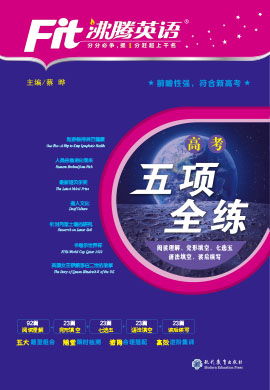
内容正文:
五项全练 高 考
34
Test 5
阅读理解第 部分一
第一节 阅读下列短文,从每题所给的四个选项(A、B、C 和 D)中,选出最佳选项。
A
The blue badge ( 徽章 ) programme allows certain groups of disabled people to park in parking
restricted areas. For example, the blue badge enables disabled people to park free of charge and without
time limit at on-street parking meters ( 停车计时器 ). Some London streets and other town centres
don’t operate this programme. You should check whether the programme operates before parking with
your blue badge. There is an online service called the blue badge parking map which can help you fi nd
blue badge parking bays in 64 towns and cities across the UK. You can fi nd the map at www.direct.gov.
uk/bluebadgemap.
You may be able to get a blue badge if you are a driver or passenger who:
• has a permanent and substantial disability which means you are unable to walk or walk only
with considerable diffi culty.
• has very severe upper limb disabilities (drivers only).
• is a child under two who has a medical condition that requires them to be close to a motor
vehicle for emergency medical treatment or if they need to have huge medical equipment transported
with them.
To apply for a blue badge in England and Wales, contact your local social services department. In
Scotland, contact the chief executive or social work department of the local authority, and in Northern
Ireland, the Department for Regional Development. There is a small fee.
If you have a blue badge you may be able to get parking concessions ( 减价 ) when travelling
in another country that also recognizes the badge. However, each country continues to determine its
own set of parking concessions for which the badge can be used.
( ) 1. Who is the most likely to get a blue badge?
A. A passenger who is blind in the both eyes. B. A driver who suffers from high lood pressure.
C. A driver whose hand is badly burnt. D. A two-year-old child who has a cold.
( ) 2. With a blue badge, you can .
A. park your car in any place in L
资源预览图

1

2

3

4
相关资源
示范课
由于学科网是一个信息分享及获取的平台,不确保部分用户上传资料的 来源及知识产权归属。如您发现相关资料侵犯您的合法权益,请联系学科网,我们核实后将及时进行处理。