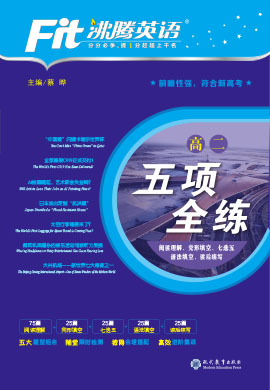
Test 4-【沸腾英语】2024年高二英语(阅+完+七选五+语法+续写)五项全练
2023-04-06
|
2份
|
10页
|
81人阅读
|
2人下载
内容正文:
Test 4
21
阅读理解第 部分一
第一节 阅读下列短文,从每题所给的四个选项 (A、B、C 和 D) 中,选出最佳选项。
A
Isn’t it interesting how we expect others to behave in a certain way so we can feel good about
ourselves? And then when people don’t behave as we want them to, we feel so disappointed and
angry—when really, most times, we’re not actually surprised at their actions? We just want those
actions to be different—actions we’d be more comfortable with.
This week I shared a friend a wonderful home-cooked meal and a bottle of wine. About the time
we got to the freshly-baked cookies, the conversation turned to her somewhat crazy sister. I had to
smile, just a little, since her sister’s stories had had much the same theme for the last two decades.
When her frustration was just about to peak over her sister’s latest unbelievably selfi sh act, I suggested
she begin trying “The Law of Patient Acceptance.” “How can I possibly accept her behavior?” my
friend asked. “Acceptance doesn’t necessarily mean tolerance,” I shared. “It just means that you
accept the person for who they are and you stop knocking yourself out trying to change them.”
Everyone has these diffi cult people in their lives from time to time. “Think of it this way,” I said.
“If you were to go out and buy an ottoman ( 搁脚凳 ) today, thinking you were buying a chair, you’d
be really angry that the ottoman was such a pathetic ( 可怜的 ) chair. But once you realize what you’re
dealing with, once you accept the ottoman for what it is and you stop trying to turn it into a chair, your
anger largely goes away.”
You have to accept people for who they are. Even when you’ve had high hopes that they might have
been able to be someone else. “You can’t change people,” my mother always said. And she was right. The
best we can do is to see people as clearly and objectively as possible. For they rarely change.
( ) 1. According to the second paragraph, we can know that .
A. the writer thinks her friend should talk about her sister that way
B. the wr
资源预览图

1

2

3
相关资源
示范课
由于学科网是一个信息分享及获取的平台,不确保部分用户上传资料的 来源及知识产权归属。如您发现相关资料侵犯您的合法权益,请联系学科网,我们核实后将及时进行处理。