2020高考英语新课标地区专用版考前冲刺8周练辑:第6周 (精练组合3套+真题素养练1套) (共4份打包)
2019-11-19
|
4份
|
23页
|
267人阅读
|
53人下载
资源信息
| 学段 | 高中 |
|---|---|
| 学科 | 英语 |
| 教材版本 | - |
| 年级 | 高三 |
| 章节 | - |
| 类型 | 题集-试题汇编 |
| 知识点 | - |
| 使用场景 | 高考复习-真题 |
| 学年 | 2019-2020 |
| 地区(省份) | 全国 |
| 地区(市) | - |
| 地区(区县) | - |
| 文件格式 | ZIP |
| 文件大小 | 186 KB |
| 发布时间 | 2019-11-19 |
| 更新时间 | 2023-04-09 |
| 作者 | 匿名 |
| 品牌系列 | - |
| 审核时间 | 2019-11-19 |
| 下载链接 | https://m.zxxk.com/soft/11894436.html |
| 价格 | 0.50储值(1储值=1元) |
| 来源 | 学科网 |
内容正文:
一、真题精练,感悟经典
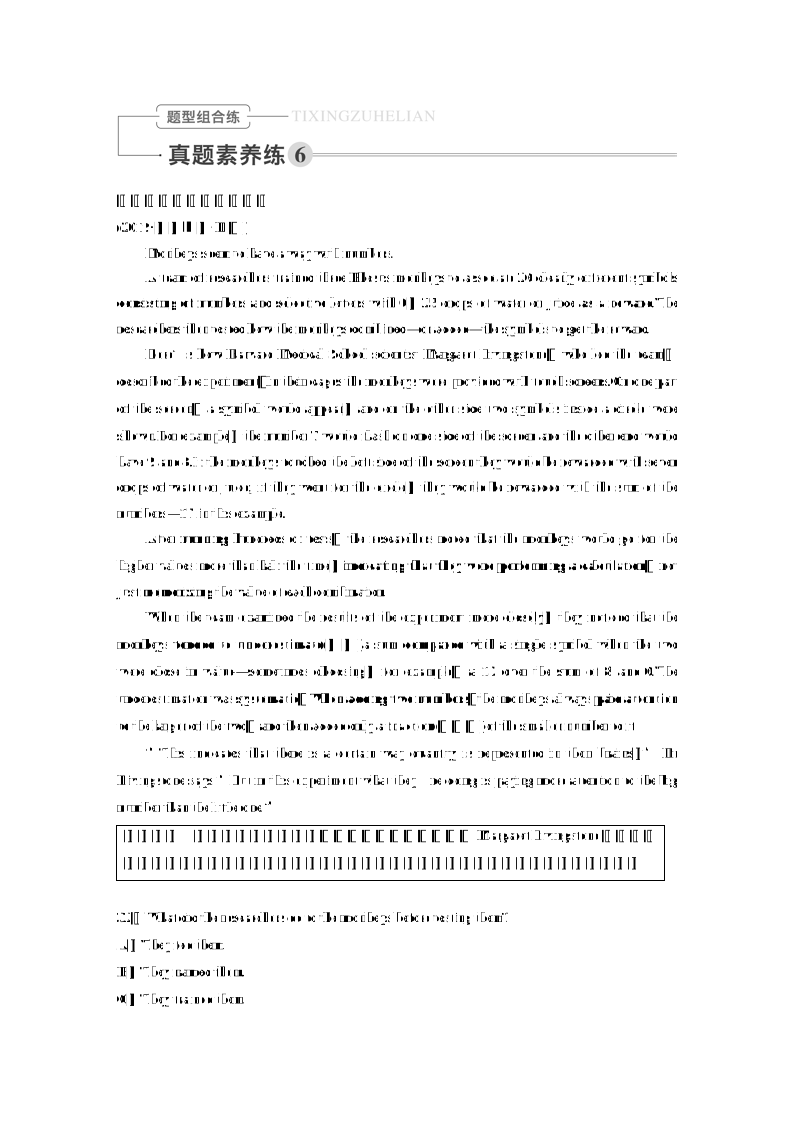
(2019·全国Ⅲ卷·D篇)
Monkeys seem to have a way with numbers.
A team of researchers trained three Rhesus monkeys to associate 26 clearly different symbols consisting of numbers and selective letters with 0-25 drops of water or juice as a reward.The researchers then tested how the monkeys combined—or added—the symbols to get the reward.
Here’s how Harvard Medical School scientist Margaret Livingstone,who led the team,described the experiment:In their cages the monkeys were provided with touch screens.On one part of the screen,a symbol would appear,and on the other side two symbols inside a circle were shown.For example,the number 7 would flash on one side of the screen and the other end would have 9 and 8.If the monkeys touched the left side of the screen they would be rewarded with seven drops of water or juice; if they went for the circle,they would be rewarded with the sum of the numbers—17 in this example.
After running hundreds of tests,the researchers noted that the monkeys would go for the higher values more than half the time,indicating that they were performing a calculation,not just memorizing the value of each combination.
When the team examined the results of the experiment more closely,they noticed that the monkeys tended to underestimate(低估)a sum compared with a single symbol when the two were close in value—sometimes choosing,for example,a 13 over the sum of 8 and 6.The underestimation was systematic:When adding two numbers,the monkeys always paid attention to the larger of the two,and then added only a fraction(小部分)of the smaller number to it.
“This indicates that there is a certain way quantity is represented in their brains,” Dr Livingstone says.“But in this experiment what they’re doing is paying more attention to the big number than the little one.”
语篇解读 本文是一篇说明文。介绍了哈佛医学院科学家Margaret Livingstone及其带领的团队通过反复实验得出结论:猴子能算算术,且它们对大数值的关注胜过小数值。
32.What did the researchers do to the monkeys before testing them?
A.They fed them.
B.They named them.
C.
资源预览图
1
相关资源
由于学科网是一个信息分享及获取的平台,不确保部分用户上传资料的 来源及知识产权归属。如您发现相关资料侵犯您的合法权益,请联系学科网,我们核实后将及时进行处理。