1.2(练习)Workplace Manners-Reading and writing & Culture Notes-《英语 服务类职业模块》(高教版 第三版)【上好课】(原卷版+解析版)
|
2份
|
19页
|
1人阅读
|
0人下载
内容正文:
《英语 职业模块(服务类)》(高教版 第三版)
Unit 1 Workplace Manners
Reading and writing & Culture Notes同步练习
班级:__________ 姓名:__________ 学号:__________ 得分:__________
基础巩固
1、 单项选择:语法与词汇
从 A、B、C、D 四个选项中选出可以填入空白处的最佳选项。
1. ______ customers feel appreciated determines whether they will recommend you to others.
A. Make B. Makes C. Making D. Made
2. A simple “Welcome” ______ that you notice the customer and leads them into your business.
A. indicate B. indicates C. indicating D. indicated
3. After understanding the problem, make sure ______ a timely solution.
A. find B. found C. finding D. to find
4. Before ______ with an angry customer, take a deep breath to calm down.
A. speak B. speaks C. speaking D. spoken
5. ______ customers are asking about prices ______ traveling schedules, we should listen attentively.
A. Whether; or B. Both; and C. Either; or D. Neither; nor
6. A smile communicates to customers that you are friendly and ______.
A. cheer B. cheerful C. cheerfully D. cheering
7. Be ______ to the customers’ questions or comments, even if you know the answer immediately.
A. attention B. attentive C. attentively D. attentiveness
8. The hotel received a room ______ from Mr. Smith this morning.
A. cancel B. canceling C. cancelation D. canceled
9. When customers are leaving, we can get some of the most valuable ______ from them.
A. feeding B. feeds C. feedbacks D. feedback
10. Good service workers ______ a friendly and caring tone even when a customer is angry.
A. maintain B. remain C. contain D. obtain
二、单项选择:交际用语与情境应对
根据服务情境,从 A、B、C、D 中选出最得体、最专业的应答。
1. —Good morning. I’d like to check in. My name is Tom Smith.
—Welcome, Mr. Smith. ______
A. Breakfast ends at ten. B. The lift is over there.
C. May I see your passport? D. Our gym is on floor six.
2. —Excuse me, I want to say something about your service.
—Please go on. ______
A. I’m listening carefully. B. I’m checking the bill now.
C. I’m cleaning the desk now. D. I’m closing the shop now.
3. —I’ve waited half an hour. My food still hasn’t come!
—I’m sorry. ______
A. The kitchen is so busy now. B. I’ll check it for you now.
C. Some guests are waiting too. D. You ordered too many dishes.
4. —I’m leaving now. Thank you for your help.
—Thank you for staying. ______
A. Your taxi is over there. B. Here is your room card.
C. Lunch starts at twelve. D. May I have your feedback?
5. —How much is the ticket to Orange Isle? Do you know?
—Sorry, ______
A. I don’t know. Let me check for you. B. I’m new here. Ask the guide, please.
C. It’s sold out. Come again tomorrow. D. I’m busy now. Please wait over there.
6. —Can I smoke here? I really need one now.
—I’m afraid ______
A. the restaurant closes at ten. B. we have run out of tea today.
C. smoking is not allowed here. D. your table is not ready yet.
7. —Could I ______
—Of course. Here is a blanket and a cup of hot water.
A. open the window now, please? B. have something warm, please?
C. pay by credit card, please? D. leave my bags here, please?
8. —Thank you. You’ve been really helpful during my stay.
—It’s my pleasure. ______
A. The bill is on the desk. B. Your bags are in the car.
C. Check-out time is twelve. D. I hope to see you again.
9. —I’m looking for the manager. Is he in the office?
—Just a moment. ______
A. I’ll call him right now. B. He is in a meeting, sir.
C. The office is over there. D. I’m answering the phone.
10. —I’m afraid I have to cancel my reservation for tonight.
—That’s all right. ______
A. The room is free for tonight. B. Please pay the deposit first.
C. We hope to see you again soon. D. Our hotel is near the station.
能力进阶
三、完形填空
阅读下面短文,从 A、B、C、D 四个选项中选出可以填入空白处的最佳选项。
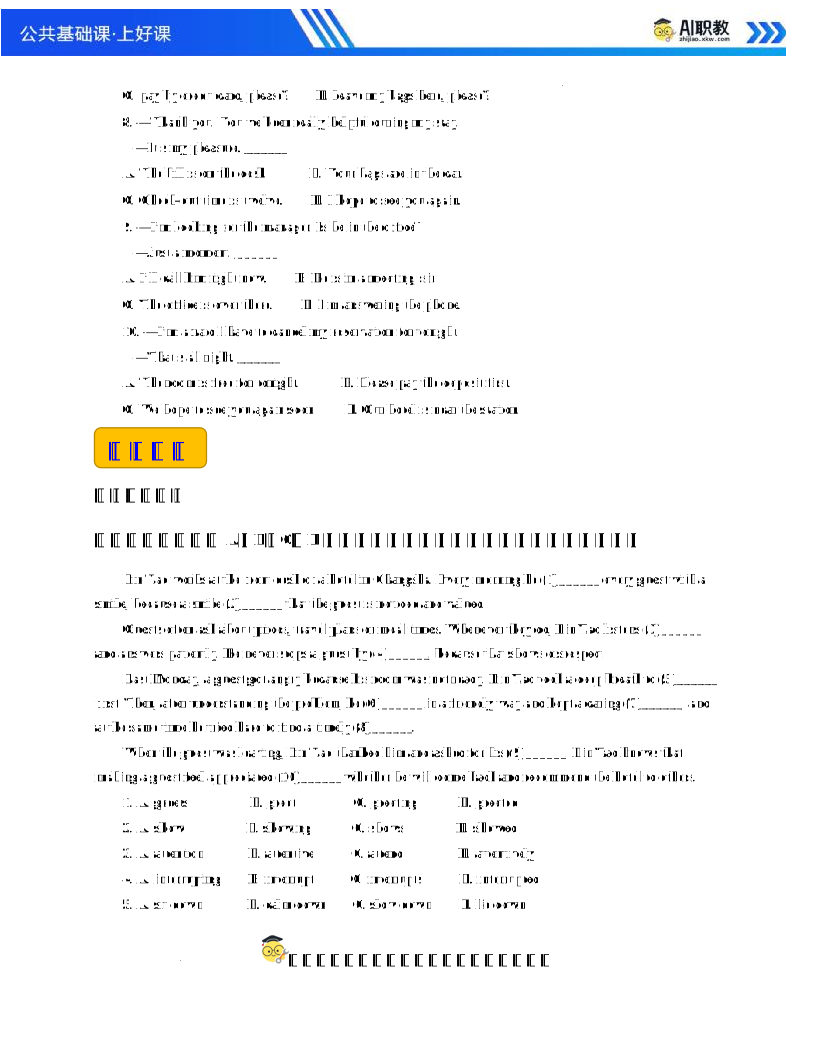
Lin Tao works at the front desk of a hotel in Changsha. Every morning he (1)______ every guest with a smile, because a smile (2)______ that the guest is noticed and valued.
Guests often ask about prices, travel plans or meal times. Whenever they do, Lin Tao listens (3)______ and answers patiently. He never stops a guest by (4)______, because that shows disrespect.
Last Monday, a guest got angry because his room was not ready. Lin Tao took a deep breath to (5)______ first. Then, after understanding the problem, he (6)______ in a friendly way and kept a caring (7)______, and at the same time he tried hard to find a timely (8)______.
When the guest was leaving, Lin Tao thanked him and asked for his (9)______. Lin Tao knows that making a guest feel appreciated (10)______ whether he will come back and recommend the hotel to others.
1. A. greets B. greet C. greeting D. greeted
2. A. show B. showing C. shows D. showed
3. A. attention B. attentive C. attend D. attentively
4. A. interrupting B. interrupt C. interrupts D. interrupted
5. A. sit down B. calm down C. slow down D. lie down
6. A. apologize B. apologizing C. apologized D. apologizes
7. A. voice B. sound C. noise D. tone
8. A. solve B. solution C. solving D. solved
9. A. feed B. feeding C. feedbacks D. feedback
10. A. determines B. determine C. determining D. determined
四、阅读理解
阅读下列短文,从每题所给的 A、B、C、D 四个选项中选出最佳选项。
Mei Ling works at the customer service centre of a busy tea shop in Changsha. Her job looks simple, but she follows four rules every day.
First, she greets every customer with a smile. A smile costs nothing, but it tells people that they are noticed and valued. Second, she listens attentively. Whether customers ask about prices or make comments about the drinks, she never interrupts them, because interrupting shows disrespect.
Third, she handles complaints in a helpful manner. Before she speaks, she takes a deep breath to calm down. Then she maintains a friendly tone, apologizes first, and makes sure to find a timely solution.
Fourth, she says goodbye in the right way. When customers leave, she thanks them and asks for feedback. She knows that making customers feel appreciated, even in the face of cancelation, determines whether they will recommend the shop to friends and colleagues.
“Good manners are not a small thing,” Mei Ling often says. “They are the reason why people come back.”
1. How many rules does Mei Ling follow every day?
A. Two. B. Three. C. Four. D. Five.
2. What does Mei Ling do before she speaks to an unhappy customer?
A. She calls her manager at once. B. She takes a deep breath first.
C. She asks the customer to leave. D. She writes down the complaint.
3. Why does Mei Ling never interrupt her customers?
A. Because she already knows the answer. B. Because she is always too busy to talk.
C. Because the shop has a very strict rule. D. Because interrupting shows disrespect.
4. What does the word “valued” most probably mean in Paragraph 2?
A. Important. B. Cheap. C. Angry. D. Careless.
5. What is the best title for the passage?
A. A Busy Tea Shop in Changsha B. Four Rules of Good Service Manners
C. How to Make a Cup of Chinese Tea D. A Hard Day at the Service Centre
五、根据中文提示,完成句子(每空一词)
根据中文提示,用本课所学词汇完成下列句子,每空一词。
1. 一句简单的“你好”表明你注意到了顾客。
A simple “Hello” ______ that you ______ the customer.
2. 无论顾客询问价格还是行程安排,我们都要专注地听。
______ customers ask about prices ______ traveling schedules, we listen ______.
3. 在和顾客说话之前,先深呼吸让自己冷静下来。
Before ______ with the customer, take a deep breath to ______ ______.
4. 了解问题之后,你应该先道歉,并确保找到及时的解决方案。
After understanding the problem, you should ______ first and make sure to find a ______ ______.
5. 让顾客感到被重视,决定了他们是否会把你推荐给朋友和同事。
Making customers feel appreciated ______ whether they will ______ you to friends and colleagues.
素养提升
六、句子翻译
将下列句子翻译成英语,注意使用本课所学的词汇与职场礼仪表达。
1. 用微笑迎接顾客,他们会感到自己受到重视。
________________________________________
2. 无论顾客问什么,我们都要专注地倾听,绝不打断他们。
________________________________________
3. 打断顾客显得不尊重,也绝不会改善你们之间的关系。
________________________________________
4. 处理投诉时,要先道歉并确保找到及时的解决方案。
________________________________________
5. 良好的服务礼仪决定顾客是否会向朋友和同事推荐你。
________________________________________
七、仿写写作:职场礼仪我来做
参考教材范文结构,完成一段职场礼仪短文写作。
情景:教材范文介绍了客服中心职员 Linda 的职场礼仪。请参考范文结构,从下列长沙服务岗位中任选一个,以第三人称写一段 60 词左右的短文,介绍该岗位员工 Li Mei 或 Li Tao 的职场礼仪表现。
岗位:① 橘子洲景区导游 ② 酒店前台接待员 ③ 茶饮店服务员 ④ 汉服体验馆店员
要求:① 至少包含“微笑迎客—专注倾听—妥善处理投诉—得体道别”四条礼仪中的三条;② 正确使用第三人称单数;③ 至少使用 3 个本课所学词汇或短语(如 greet, valued, listen attentively, handle, apologize, timely solution, feedback, recommend 等);④ 语句连贯,书写规范。
____________________________________________________________________
____________________________________________________________________
____________________________________________________________________
____________________________________________________________________
____________________________________________________________________
____________________________________________________________________
精品资源学科网独家享有版权,侵权必究!
学科网(北京)股份有限公司
$
《英语 职业模块(服务类)》(高教版 第三版)
Unit 1 Workplace Manners
Reading and Writing & Culture Notes同步练习(教师版)
班级:__________ 姓名:__________ 学号:__________ 得分:__________
一、单项选择:语法与词汇(基础巩固)
从 A、B、C、D 四个选项中选出可以填入空白处的最佳选项。
1. ______ customers feel appreciated determines whether they will recommend you to others.
A. Make B. Makes C. Making D. Made
【答案】C
【解析】考查动名词短语作主语。句中已有谓语 determines,其前需用动名词短语 Making customers feel appreciated 作主语,表示“让顾客感到被重视”这一行为;动名词短语作主语时,谓语用第三人称单数形式。
2. A simple “Welcome” ______ that you notice the customer and leads them into your business.
A. indicate B. indicates C. indicating D. indicated
【答案】B
【解析】考查主谓一致。主语 A simple “Welcome” 视为第三人称单数,且 and 后的并列谓语 leads 同为第三人称单数形式,故填 indicates。
3. After understanding the problem, make sure ______ a timely solution.
A. find B. found C. finding D. to find
【答案】D
【解析】考查非谓语动词。make sure 后接动词不定式,make sure to do sth. 意为“务必/确保做某事”,为教材原句结构。
4. Before ______ with an angry customer, take a deep breath to calm down.
A. speak B. speaks C. speaking D. spoken
【答案】C
【解析】考查介词后的动词形式。此处 before 为介词,后接动名词 speaking;教材原句为 Before you speak with the customer...,本题考查该句式的同义转换。
5. ______ customers are asking about prices ______ traveling schedules, we should listen attentively.
A. Whether; or B. Both; and C. Either; or D. Neither; nor
【答案】A
【解析】考查让步状语从句。Whether...or... 意为“无论……还是……”,与教材原句 Whether customers are asking about prices of products or traveling schedules 完全一致;both...and 表并列,either...or 表选择,neither...nor 表双重否定,均不合句意。
6. A smile communicates to customers that you are friendly and ______.
A. cheer B. cheerful C. cheerfully D. cheering
【答案】B
【解析】考查构词法与并列结构。and 连接两个并列成分,friendly 为形容词,故此处也用形容词;cheer + -ful → cheerful“愉快的、令人愉快的”。
7. Be ______ to the customers’ questions or comments, even if you know the answer immediately.
A. attention B. attentive C. attentively D. attentiveness
【答案】B
【解析】考查词性与固定搭配。be attentive to sth. 意为“专注对待……”,系动词 be 后接形容词作表语;attention 与 attentiveness 为名词,attentively 为副词。
8. The hotel received a room ______ from Mr. Smith this morning.
A. cancel B. canceling C. cancelation D. canceled
【答案】C
【解析】考查词性转换。冠词 a 后需接名词,cancel + -ation → cancelation“取消”,对应教材原词(教材采用美式拼写,英式标准拼写为 cancellation,两种拼写可一并板书)。
9. When customers are leaving, we can get some of the most valuable ______ from them.
A. feeding B. feeds C. feedbacks D. feedback
【答案】D
【解析】考查不可数名词。feedback 为不可数名词,没有复数形式,不能加 -s;valuable feedback 意为“宝贵的反馈”。
10. Good service workers ______ a friendly and caring tone even when a customer is angry.
A. maintain B. remain C. contain D. obtain
【答案】A
【解析】考查词义辨析。maintain 意为“保持、维持”,maintain a friendly and caring tone 意为“保持友好关切的语气”;remain 为系动词“仍然是”,contain“包含”,obtain“获得”,均不符合搭配。
【教学提示】本大题覆盖本课 Language points 的核心词汇与句式:动名词短语作主语、主谓一致、make sure to do、介词 before + doing、Whether...or... 让步从句,以及 -ful / -ation 构词法与不可数名词。讲评时重点让学生说出第 1、4 题的判断依据(先找谓语、再看成分),并把第 8 题的 cancelation / cancellation 两种拼写一并板书,回应学情分析中“拼写混淆”的预判。
二、单项选择:交际用语与情境应对(基础巩固)
根据服务情境,从 A、B、C、D 中选出最得体、最专业的应答。
1. —Good morning. I’d like to check in. My name is Tom Smith.
—Welcome, Mr. Smith. ______
A. Breakfast ends at ten. B. The lift is over there.
C. May I see your passport? D. Our gym is on floor six.
【答案】C
【解析】考查“迎客”环节。服务人员应先问候、确认身份,再礼貌提出下一步要求。C 用 May I...? 的委婉句式请求出示证件,得体且专业;A、B、D 均答非所问。
2. —Excuse me, I want to say something about your service.
—Please go on. ______
A. I’m listening carefully. B. I’m checking the bill now.
C. I’m cleaning the desk now. D. I’m closing the shop now.
【答案】A
【解析】考查“专注倾听”原则。顾客主动表达意见时,服务人员应鼓励其说下去并表明自己在认真听。A 的 I’m listening carefully. 正是 listen attentively 的口语化表达;B、C、D 都把注意力放在自己的事情上,属失礼。
3. —I’ve waited half an hour. My food still hasn’t come!
—I’m sorry. ______
A. The kitchen is so busy now. B. I’ll check it for you now.
C. Some guests are waiting too. D. You ordered too many dishes.
【答案】B
【解析】考查投诉处理。面对等待过久的抱怨,应先致歉并立即采取行动。B 的 I’ll check it for you now. 给出可执行的解决方案;A、C 强调客观原因,D 归咎于顾客,都会激化矛盾。
4. —I’m leaving now. Thank you for your help.
—Thank you for staying. ______
A. Your taxi is over there. B. Here is your room card.
C. Lunch starts at twelve. D. May I have your feedback?
【答案】D
【解析】考查“得体道别”原则。顾客离店时正是收集宝贵反馈的机会,D 在致谢后顺势请求反馈,与教材 When customers are leaving, you have the chance to get some of the most valuable feedback 相呼应;A、B、C 与情境无关。
5. —How much is the ticket to Orange Isle? Do you know?
—Sorry, ______
A. I don’t know. Let me check for you. B. I’m new here. Ask the guide, please.
C. It’s sold out. Come again tomorrow. D. I’m busy now. Please wait over there.
【答案】A
【解析】考查“诚实”原则。不知道答案时不可编造,应先承认再主动查询。A 的 Let me check for you. 即教材 say “I’ll find out for you.” 的同类表达;B 推诿,C 提供错误信息,D 怠慢顾客。
6. —Can I smoke here? I really need one now.
—I’m afraid ______
A. the restaurant closes at ten. B. we have run out of tea today.
C. smoking is not allowed here. D. your table is not ready yet.
【答案】C
【解析】考查“坚持原则+保持礼貌”的拒绝策略。C 用 I’m afraid... 客观指向场所规定而非顾客个人,既守住规则又保全对方面子;A、B、D 答非所问。
7. —Could I ______
—Of course. Here is a blanket and a cup of hot water.
A. open the window now, please? B. have something warm, please?
C. pay by credit card, please? D. leave my bags here, please?
【答案】B
【解析】考查上下文逻辑。答语中的 a blanket 与 a cup of hot water 均为保暖用品,故上文应为取暖请求;Could I...? 是礼貌请求的典型句式。
8. —Thank you. You’ve been really helpful during my stay.
—It’s my pleasure. ______
A. The bill is on the desk. B. Your bags are in the car.
C. Check-out time is twelve. D. I hope to see you again.
【答案】D
【解析】考查回应感谢。服务场景的标准应答是 It’s my pleasure.,D 后半句 I hope to see you again. 顺势延伸了服务关系;A、B、C 后半句与致谢场景无关。
9. —I’m looking for the manager. Is he in the office?
—Just a moment. ______
A. I’ll call him right now. B. He is in a meeting, sir.
C. The office is over there. D. I’m answering the phone.
【答案】A
【解析】考查转介与协作。客人要找负责人时,服务人员应请对方稍候并主动联系。A 的 I’ll call him right now. 体现主动服务;B 只说明情况未提供帮助,C 答非所问,D 态度生硬。
10. —I’m afraid I have to cancel my reservation for tonight.
—That’s all right. ______
A. The room is free for tonight. B. Please pay the deposit first.
C. We hope to see you again soon. D. Our hotel is near the station.
【答案】C
【解析】考查取消场景的服务态度。教材强调 even in the face of cancelation 也要让顾客感到被重视。C 既安抚客人又留住回头客;B 与取消情境矛盾,A、D 答非所问。
【教学提示】本大题对应“四条礼仪原则”的情境化运用:第 1 题对应迎客,第 2 题对应倾听,第 3 题对应投诉处理,第 4 题对应道别与反馈,第 5、9 题对应诚实与主动服务,第 6、10 题对应坚持原则下的委婉拒绝。各题应答的礼貌开场(Welcome... / I’m sorry... / I’m afraid... 等)已统一上移到题干,选项只呈现关键的后半句,既压缩阅读量,也消除“正确项明显偏长”的提示性线索。讲评时可让学生把正确项归入“迎客—倾听—投诉—道别”四栏,体会礼貌表达背后的职业逻辑。
三、完形填空(能力进阶)
阅读下面短文,从 A、B、C、D 四个选项中选出可以填入空白处的最佳选项。
Lin Tao works at the front desk of a hotel in Changsha. Every morning he (1)______ every guest with a smile, because a smile (2)______ that the guest is noticed and valued.
Guests often ask about prices, travel plans or meal times. Whenever they do, Lin Tao listens (3)______ and answers patiently. He never stops a guest by (4)______, because that shows disrespect.
Last Monday, a guest got angry because his room was not ready. Lin Tao took a deep breath to (5)______ first. Then, after understanding the problem, he (6)______ in a friendly way and kept a caring (7)______, and at the same time he tried hard to find a timely (8)______.
When the guest was leaving, Lin Tao thanked him and asked for his (9)______. Lin Tao knows that making a guest feel appreciated (10)______ whether he will come back and recommend the hotel to others.
1. A. greets B. greet C. greeting D. greeted
【答案】A
【解析】考查主谓一致与时态。主语 he 为第三人称单数,且全文主体为一般现在时,谓语用 greets。
2. A. show B. showing C. shows D. showed
【答案】C
【解析】考查主谓一致。主语 a smile 为第三人称单数,谓语用 shows。
3. A. attention B. attentive C. attend D. attentively
【答案】D
【解析】考查副词。修饰动词 listens 需用副词 attentively“专注地”。
4. A. interrupting B. interrupt C. interrupts D. interrupted
【答案】A
【解析】考查介词后的动词形式。介词 by 后接动名词,by interrupting 意为“通过打断(别人)”。
5. A. sit down B. calm down C. slow down D. lie down
【答案】B
【解析】考查短语辨析。take a deep breath to calm down 意为“深呼吸以冷静下来”,为教材“妥善处理投诉”原则的原句表达。
6. A. apologize B. apologizing C. apologized D. apologizes
【答案】C
【解析】考查时态。本段叙述上周发生的事(Last Monday),谓语动词用过去式 apologized。
7. A. voice B. sound C. noise D. tone
【答案】D
【解析】考查名词辨析。tone 意为“语气”,keep a caring tone 意为“保持关切的语气”;voice 指“嗓音”,sound 指“声音”,noise 指“噪音”。
8. A. solve B. solution C. solving D. solved
【答案】B
【解析】考查词性。冠词 a 后需接名词,find a timely solution 意为“找到及时的解决方案”。
9. A. feed B. feeding C. feedbacks D. feedback
【答案】D
【解析】考查不可数名词。feedback 无复数形式,ask for feedback 意为“征求反馈”。
10. A. determines B. determine C. determining D. determined
【答案】A
【解析】考查动名词短语作主语。making a guest feel appreciated 为动名词短语,作主语时谓语用第三人称单数 determines。
【教学提示】本大题检测词汇从“认得”走向“用得”。讲评时引导学生先通读全文把握“酒店前台一日”的主线,再按“词性判断 → 固定搭配 → 上下文逻辑 → 时态线索”四步解题:第 3、4 题看词性,第 5、8 题看搭配,第 1、2、10 题看主谓一致,第 6 题看时间状语 Last Monday。避免逐空孤立作答。
四、阅读理解(能力进阶)
阅读下列短文,从每题所给的 A、B、C、D 四个选项中选出最佳选项。
Mei Ling works at the customer service centre of a busy tea shop in Changsha. Her job looks simple, but she follows four rules every day.
First, she greets every customer with a smile. A smile costs nothing, but it tells people that they are noticed and valued. Second, she listens attentively. Whether customers ask about prices or make comments about the drinks, she never interrupts them, because interrupting shows disrespect.
Third, she handles complaints in a helpful manner. Before she speaks, she takes a deep breath to calm down. Then she maintains a friendly tone, apologizes first, and makes sure to find a timely solution.
Fourth, she says goodbye in the right way. When customers leave, she thanks them and asks for feedback. She knows that making customers feel appreciated, even in the face of cancelation, determines whether they will recommend the shop to friends and colleagues.
“Good manners are not a small thing,” Mei Ling often says. “They are the reason why people come back.”
1. How many rules does Mei Ling follow every day?
A. Two. B. Three. C. Four. D. Five.
【答案】C
【解析】细节题。第二至五段依次以 First、Second、Third、Fourth 领起,共四条规则。
2. What does Mei Ling do before she speaks to an unhappy customer?
A. She calls her manager at once. B. She takes a deep breath first.
C. She asks the customer to leave. D. She writes down the complaint.
【答案】B
【解析】细节题。第四段指出 Before she speaks, she takes a deep breath to calm down.,与选项 B 完全一致。
3. Why does Mei Ling never interrupt her customers?
A. Because she already knows the answer. B. Because she is always too busy to talk.
C. Because the shop has a very strict rule. D. Because interrupting shows disrespect.
【答案】D
【解析】细节题。第三段结尾 because interrupting shows disrespect 与选项 D 完全一致。
4. What does the word “valued” most probably mean in Paragraph 2?
A. Important. B. Cheap. C. Angry. D. Careless.
【答案】A
【解析】词义猜测题。valued 与 important 同现于 they are noticed and valued,意为“受重视的”,与 important 含义最接近。
5. What is the best title for the passage?
A. A Busy Tea Shop in Changsha B. Four Rules of Good Service Manners
C. How to Make a Cup of Chinese Tea D. A Hard Day at the Service Centre
【答案】B
【解析】主旨大意题。全文围绕四条服务礼仪规则展开,B 概括最全面;A、D 只涉及背景信息,C 与礼仪主题无关。
【教学提示】阅读语篇与教材语篇 Good Manners with Customers 同构(总分结构 + 四条原则 + 长沙本土情境),是课内阅读的平行迁移。建议训练“题干定位—原文比对—排除干扰”三步法:第 1 题抓语篇标志词,第 2、3 题定位原句,第 4 题依据并列结构猜词义,第 5 题区分“主旨”与“细节”。讲评后可让学生把四条规则译成服务守则张贴在实训室,实现语言学习向职业行为的转化。
五、根据中文提示,完成句子(每空一词)(能力进阶)
根据中文提示,用本课所学词汇完成下列句子,每空一词。
1. 一句简单的“你好”表明你注意到了顾客。
A simple “Hello” ______ that you ______ the customer.
【答案】indicates; notice
【解析】indicates 与主语 A simple “Hello” 保持一致,用第三人称单数;notice 在 that 从句中作谓语,主语 you 后用动词原形。
2. 无论顾客询问价格还是行程安排,我们都要专注地听。
______ customers ask about prices ______ traveling schedules, we listen ______.
【答案】Whether; or; attentively
【解析】Whether...or... 意为“无论……还是……”;修饰动词 listen 需用副词 attentively。
3. 在和顾客说话之前,先深呼吸让自己冷静下来。
Before ______ with the customer, take a deep breath to ______ ______.
【答案】speaking; calm down
【解析】before 作介词时后接动名词 speaking;calm down 意为“冷静下来”,与 take a deep breath 构成教材原句。
4. 了解问题之后,你应该先道歉,并确保找到及时的解决方案。
After understanding the problem, you should ______ first and make sure to find a ______ ______.
【答案】apologize; timely solution
【解析】情态动词 should 后接动词原形 apologize;timely solution 意为“及时的解决方案”,为教材核心短语。
5. 让顾客感到被重视,决定了他们是否会把你推荐给朋友和同事。
Making customers feel appreciated ______ whether they will ______ you to friends and colleagues.
【答案】determines; recommend
【解析】动名词短语作主语,谓语用第三人称单数 determines;recommend sb. to sb. 意为“把某人推荐给某人”。
【教学提示】本题既是词汇检测,也是 Self-Assessment 中“词汇漏洞清单”的书面化。讲评时要求学生口述完整句子而不是只填词,避免出现“会拼写不会运用”;第 3 题可顺势复习 before 作介词与作连词两种用法的转换。
六、句子翻译(素养提升)
将下列句子翻译成英语,注意使用本课所学的词汇与职场礼仪表达。
1. 用微笑迎接顾客,他们会感到自己受到重视。
【答案】Greet customers with a smile, and they will feel valued and important.
【解析】greet sb. with a smile 意为“以微笑迎接某人”;“祈使句 + and + 陈述句”表示顺承结果;feel valued 意为“感到被重视”。
2. 无论顾客问什么,我们都要专注地倾听,绝不打断他们。
【答案】Whatever customers ask, we listen attentively and never interrupt them.
【解析】Whatever = No matter what,引导让步状语从句;listen attentively 意为“专注地倾听”,interrupt 意为“打断”。
3. 打断顾客显得不尊重,也绝不会改善你们之间的关系。
【答案】Interrupting customers shows disrespect and never improves the relationship.
【解析】动名词短语 Interrupting customers 作主语,谓语用第三人称单数 shows;show disrespect 意为“显得不尊重”。
4. 处理投诉时,要先道歉并确保找到及时的解决方案。
【答案】When handling a complaint, apologize first and make sure to find a timely solution.
【解析】when + doing 作时间状语,省略主语与 be 动词;make sure to do sth. 意为“务必/确保做某事”。
5. 良好的服务礼仪决定顾客是否会向朋友和同事推荐你。
【答案】Good service manners determine whether customers will recommend you to friends and colleagues.
【解析】主语 manners 为复数,谓语用 determine;whether 引导宾语从句;recommend sb. to sb. 意为“把某人推荐给某人”。
【教学提示】翻译题检测“从汉语思维到英语表达”的转换能力。讲评时可展示 2—3 种可接受译法(如第 2 题 Whatever 与 No matter what 均可),并让学生对比哪一种更符合服务场景的语体,落实思维差异感知素养。
七、仿写写作:职场礼仪我来做(素养提升)
参考教材范文结构,完成一段职场礼仪短文写作。
情景:教材范文介绍了客服中心职员 Linda 的职场礼仪。请参考范文结构,从下列长沙服务岗位中任选一个,以第三人称写一段 60 词左右的短文,介绍该岗位员工 Li Mei 或 Li Tao 的职场礼仪表现。
岗位:① 橘子洲景区导游 ② 酒店前台接待员 ③ 茶饮店服务员 ④ 汉服体验馆店员
要求:① 至少包含“微笑迎客—专注倾听—妥善处理投诉—得体道别”四条礼仪中的三条;② 正确使用第三人称单数;③ 至少使用 3 个本课所学词汇或短语(如 greet, valued, listen attentively, handle, apologize, timely solution, feedback, recommend 等);④ 语句连贯,书写规范。
____________________________________________________________________
____________________________________________________________________
____________________________________________________________________
____________________________________________________________________
____________________________________________________________________
____________________________________________________________________
【答案】参考范文
Li Mei works at the front desk of a hotel in Changsha. She greets every guest with a smile, because a smile shows that the guest is valued. When guests ask about prices or travel schedules, she listens to them attentively and never interrupts them. When dealing with complaints, she apologizes first and makes sure to find a timely solution. She thanks every guest and asks for feedback when they leave. (68 words)
【写作指导】本题考查 Think and write 的迁移能力,评分可参照四个维度:① 四条礼仪是否覆盖三条以上(每条 2 分,共 6 分);② 第三人称单数是否准确(greets / listens / apologizes / says,3 分);③ 本课词汇短语运用是否准确(valued / listen attentively / timely solution / feedback / recommend 等,3 分);④ 语篇连贯与书写(3 分)。讲评时可先让学生用符号标出范文中“四条礼仪”的对应句,再对照自己的作文补充缺失步骤。
【教学提示】本题是 Think and write 的迁移创新落点,直接对应教学目标 3。建议采用“范文拆解—句库支撑—同伴互评”三步:先让学生标出范文中的四条礼仪与动词形式,再借助句库独立仿写,最后用量表互评。基础薄弱的学生可先完成半句填空版,再独立成文。
精品资源学科网独家享有版权,侵权必究!
学科网(北京)股份有限公司
$
资源预览图