Unit 2 课时5 Focusing on culture&Cross-curricular connection&Project(教学课件)英语新教材沪教版九年级下册
|
15页
|
1人阅读
|
0人下载
精品
内容正文:
Keeping a Positive Attitude
沪教牛津版 · 九年级英语 · Section 4 Extending and developing competencies
Focusing on culture
Cross-curricular connection
Project
Unit 2 Finding balance in life
学习目标 Learning Objectives
01
Read and think
Read two poems about facing difficulties and find out how the poets keep a positive attitude.
02
Learn and use
Learn useful words and phrases: upright, careless of, merry, in a moment, deceive, dismal, grief ...
03
Talk and create
Talk about healthy living and make a cube of healthy living tips to share with your classmates.
Lead-in Free talk
How can you maintain a positive attitude towards life?
listening to music
doing sports
reading poems
talking to friends
enjoying art
……
03
Focusing on culture Poem 1
Bamboo in the Rock
by Zheng Xie(郑燮) · Translated by Xu Yuanchong(许渊冲)
Upright stands the bamboo amid green mountains steep,
Its toothlike root in broken rock is planted deep.
It's strong and firm though struck and beaten without rest,
Careless of the wind from north or south, east or west.
原诗:咬定青山不放松,立根原在破岩中。
千磨万击还坚劲,任尔东西南北风。
04
Focusing on culture Poem 2
If by Life You Were Deceived
by Aleksandr Pushkin(亚历山大·普希金)
If by life you were deceived,
Don't be dismal, don't be wild!
In the day of grief, be mild.
Merry days will come, believe.
Heart is living in tomorrow;
Present is dejected here;
In a moment, passes sorrow;
That which passes will be dear.
名句直译:假如生活欺骗了你,不要悲伤,不要心急!
Pushkin wrote this poem in 1825, in exile.
05
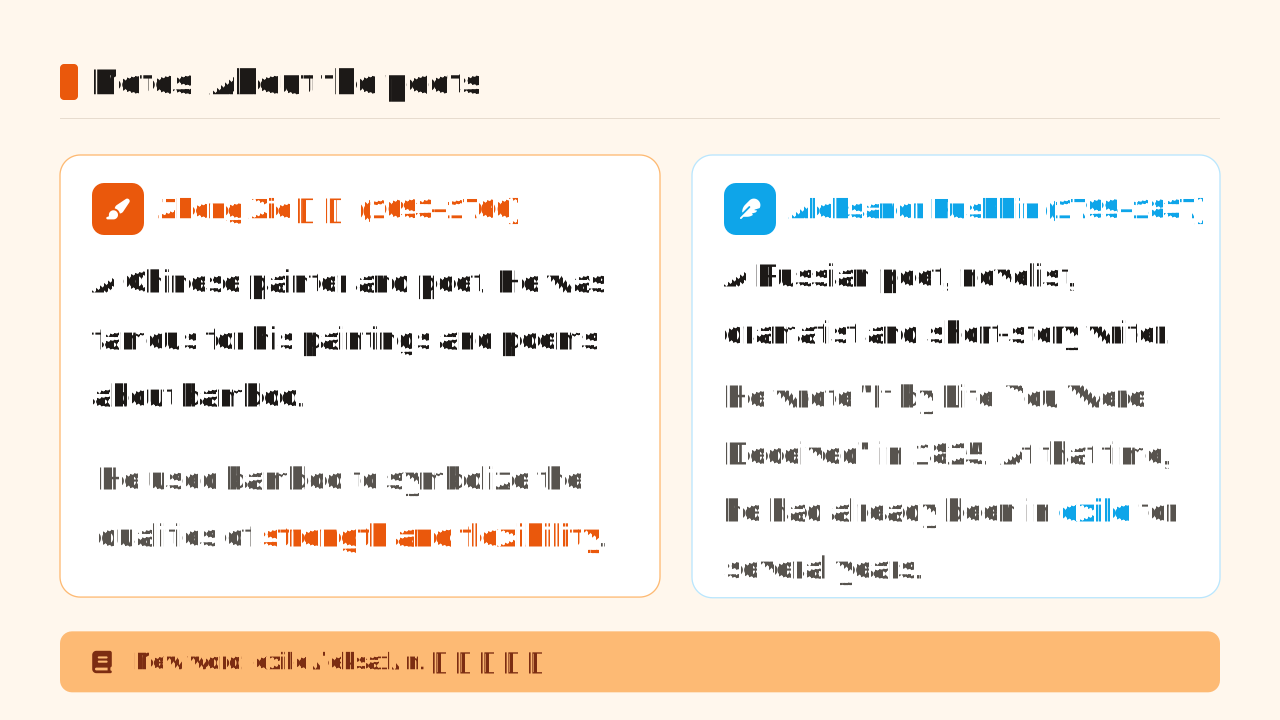
Notes About the poets
Zheng Xie 郑燮 (1693–1766)
A Chinese painter and poet. He was famous for his paintings and poems about bamboo.
He used bamboo to symbolize the qualities of strength and flexibility.
Aleksandr Pushkin (1799–1837)
A Russian poet, novelist, dramatist and short-story writer.
He wrote "If by Life You Were Deceived" in 1825. At that time, he had already been in exile for several years.
New word: exile /ˈeksaɪl/ n. 流放;流亡
06
Read and think 理解与词组
Q1 In the first poem, how does the bamboo react to the harsh environment?
It stays strong and firm though struck and beaten, careless of the wind from
all directions.
Q2 What do you think the second poem is trying to tell us?
A: When life is hard, stay calm and hopeful — merry days will come.
Match the words with their meanings 词组配对
1 upright (line 1)
c standing straight up
2 careless of (line 4)
b not concerned about
3 merry (line 9)
d happy and cheerful
4 in a moment (line 12)
a in a short while
Your ideas Exploring more
What do the two poems have in common? You can discuss with your partner.
Both poems encourage us to stay strong and hopeful in the face of difficulties.
Explore: What are good ways to relieve stress?
Enjoying literature, art and music is an excellent way to deal with stress and anxiety.
· What is the book / exhibition / music about?
· What impressed you the most?
· How does it help you reduce stress?
Read, listen and share your thoughts with friends.
Be active! Cross-curricular connection · Physical education
(1) The benefits 好处
· Exercise makes our brains release feel-good chemicals.
· Ten minutes of working out can leave us feeling happier.
· It improves our sleep, energy and confidence.
(2) Making it a routine
· Do it at more or less the same time every day.
· Listen to music or podcasts while you work out — you'll exercise your brain too!
(3) Choosing your exercise
· You don't need a gym — simply walk or cycle.
· Take up dancing or swimming.
· Choose an activity you enjoy.
09
Read the passage again and answer the following questions.
Level 1 · Read for details
Q1 Why does exercise make us feel so good?
Because exercise makes our brains release feel-good chemicals. Even ten minutes of working out can leave us feeling happier.
Q2 Do we have to go to a gym to get a workout? Why not?
No! You don't need a gym — simply walk or cycle everywhere, or take up dancing or swimming. Choose an activity you enjoy.
Think further 2
Level 2 · Read between the lines
Q3 The leaflet says "you'll exercise your brain as well as your body". What does the writer mean?
While you listen to music or podcasts, your brain is learning too — so working out trains both your body and your brain at the same time.
Q4 Why is choosing an activity you enjoy so important?
Because that way you'll never give it up — exercise becomes a happy
routine, not a chore.
Think further 3
Level 3 · Connect and transfer
Q5 How much time do you spend sitting / lying down / moving? Do you need to change anything?
For example: I sit about eight hours and move for only one hour on weekdays.
Yes — I will stand up and move every hour.
Q6 Design a 10-minute daily exercise plan for your class.
What would you choose?
For example: Dance for ten minutes after the second class every day — no equipment, easy to enjoy and we do it at the same time daily.
Think and discuss 说一说
How much time do you spend sitting / lying down / moving on weekdays and at weekends?
Compare your answers with a classmate. Do you need to change anything?
Sitting: ______ hours a day
Lying down: ______ hours a day
Moving: ______ hours a day
Small changes work: stand up and move every hour, walk or cycle to school, play ball games with friends!
13
Project Making a cube for healthy living tips
One tip on each side,
with a picture.
How to make it
① Cut a large piece of paper into the cube shape.
② Write one healthy living tip on each side and draw pictures.
③ Fold along the dotted lines, glue and stick the cube.
④ Roll the cube and mime the action — let your classmate guess!
⑤ Roll your cube every day for a week and follow the advice.
Six aspects 六个方面
Dealing with stress
Regular exercise
Healthy diet
Good quality sleep
Active social life
Other tips
14
A light heart lives long.
— William Shakespeare
Keep a light heart, and keep a positive attitude towards life.
$
资源预览图