Unit 5 Wild animals Reading课件 2026-2027学年译林版英语八年级上册
|
15页
|
2802人阅读
|
21人下载
普通
摘要:
该初中英语课件围绕“野生动物”主题,聚焦大熊猫的生长、生存挑战及保护措施。课堂导入通过猜谜游戏(描述熊猫黑白毛、国宝、食竹特征)激发兴趣,Pre-reading引导结合标题“Xiwang in safe hands”和图片预测内容,搭建从已知到未知的学习支架,帮助学生建立阅读逻辑。
其亮点在于融合语言能力、思维品质与文化意识培养。While-reading通过时间排序任务(Xiwang成长阶段)训练找关键词技巧,Post-reading分析“where there is Xiwang, there is hope”双关意义提升思维深度。小组设计WWF海报活动强化环保责任,让学生在实践中运用语言,增强家国情怀,教师可通过结构化环节高效开展阅读教学。
内容正文:
Unit 5
Wild animals
Reading I
Guessing game
It is a cute animal with black and white fur.
It lives on bamboo.
It is China’s national treasure.
Lead-in
Pre-reading
While-reading
Post-reading
Homework
What else do you know about giant pandas?
They represent peace and friendship.
Giant pandas are in danger because people cut down trees and they lose their homes.
China has some research bases (研究基地) to protect giant pandas.
the cutest diplomat 外交官
Lead-in
Pre-reading
While-reading
Post-reading
Homework
Simon is reading an article by a panda keeper.
What do you think the article will talk about?
being taken good care of by someone
Name?
Growth?
Maybe it’s about the growth of a giant panda named Xiwang and how it is being taken good care of.
Tip 1:
Title and pictures can help predict the content of the article.
Lead-in
While-reading
Post-reading
Homework
Pre-reading
What's the type of this article?
A. Expository article说明文 B. Narrative记叙文
C. Applied reading应用文 D. Argumentation 议论文
Lead-in
Post-reading
Homework
Pre-reading
While-reading
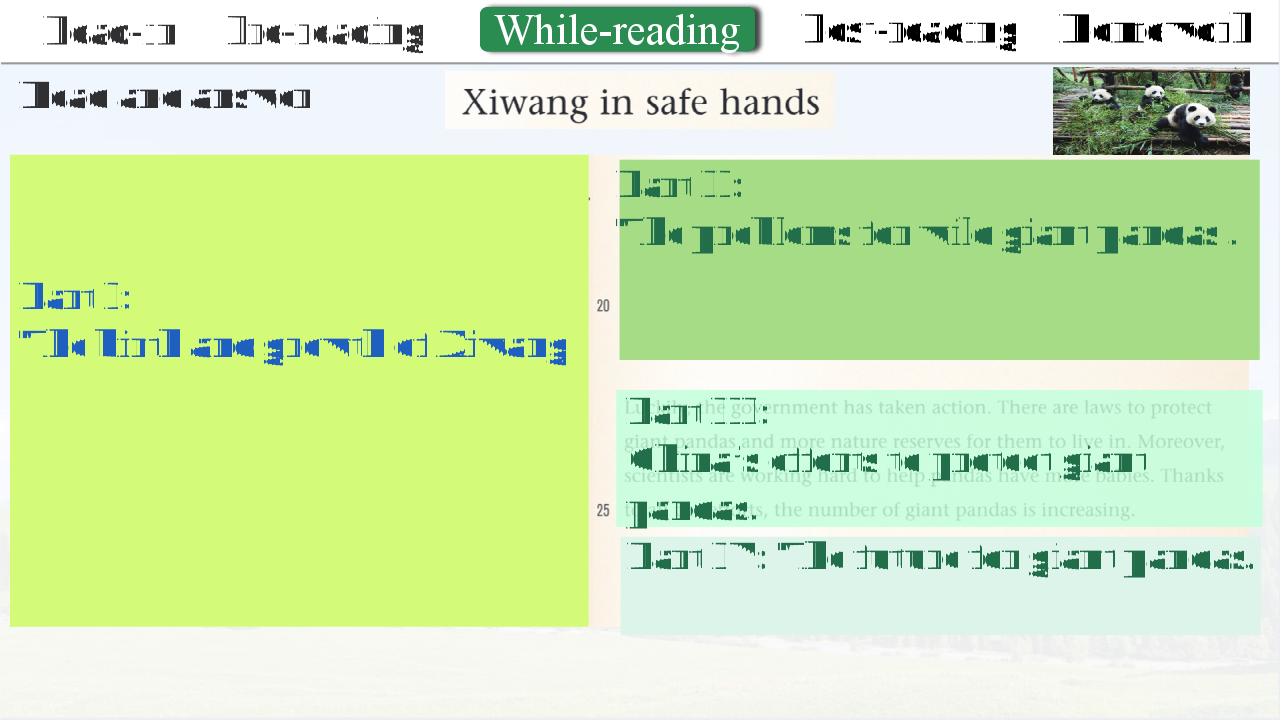
Read and answer
Part I:
The birth and growth of Xiwang
Part II:
The problems for wild giant pandas .
Part IV: The future for giant pandas.
Read and answer
While-reading
Lead-in
Post-reading
Homework
Pre-reading
While-reading
Part III:
China’s efforts to protect giant pandas.
What is the order of this part?
Time order.
Events/Features
When I first saw her
In the beginning
At six months old
Half a year later
When she was 20 months old
tiny, pink and quiet,
with eyes closed,
100 grams
couldn’t see, hear or move
began to eat bamboo
weighed over 35 kilograms,
like a big ball of fur
learnt to look after herself
Why do we call her Xiwang?
It means “hope”.
Tip 2:
Find key words to know about the order.
metaphor比喻
Lead-in
Post-reading
Homework
Pre-reading
While-reading
1. Is Xiwang's growth very easy?
2. Is Xiwang happy in the zoo?
Love and care
personification拟人
3. Why does the writer use "she" to talk about Xiwang?
Humans and animals are the family under the same sky.
Lead-in
Post-reading
Homework
Pre-reading
While-reading
Lead-in
Post-reading
Homework
Pre-reading
While-reading
have babies difficultly, easily get sick and die.
not have a place to live or enough food to eat.
special animals
smaller and smaller bamboo forests
What has China done to protect them?
Scientists are working hard to help pandas have more babies.
Government has made laws to protect giant pandas and build more nature reserves for them to live in.
Lead-in
Post-reading
Homework
Pre-reading
While-reading
双关(pun)
Literally (字面意义上), it means where this panda named Xiwang is, there is hope.
More deeply, as long as we keep working hard to protect pandas like Xiwang, there will be hope for the protection of more giant pandas or other wild animals.
Lead-in
Post-reading
Homework
Pre-reading
While-reading
Whose "hands" are these?
panda keepers
scientists
law and rule makers
local communities
...
Further thinking
Lead-in
Homework
Pre-reading
While-reading
Post-reading
Let's be wild animals' guardians!
Design a poster for WWF.
Tip:
Your poster should include:
Our theme is...
The slogan of our poster is...
. ..were ... in danger. Then...
However, they face serious problems, ...
We should...
Group work
Lead-in
Homework
Pre-reading
While-reading
Post-reading
Assessment Chart
Group work Do they have proper suggestions?
Do they have persuasive?
Do they have clear structure?
Excellent Good To be improved
Show time
We can also be part of "safe hands".
Lead-in
Homework
Pre-reading
While-reading
Post-reading
Homework
Have to do:
Polish your poster and share it with others.
Choose to do:
Search for more ways about how to protect wild animals.
Pre-reading
Lead-in
While-reading
Post-reading
Homework
$
资源预览图