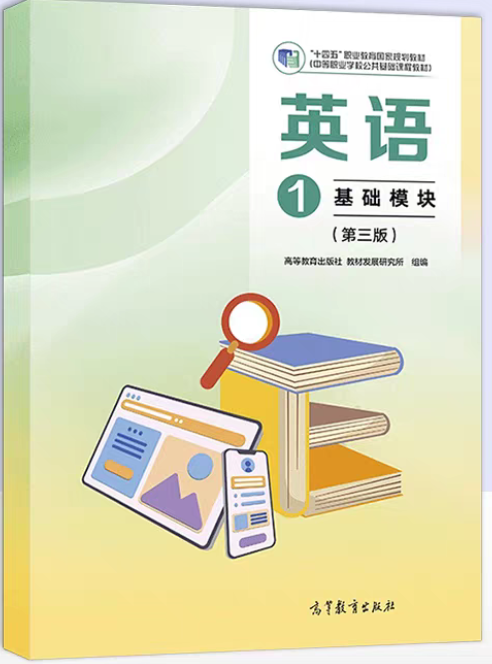
Unit 8 People and Events(A卷·基础巩固)《英语 基础模块1》(高教版第三版)单元过关卷(原卷版+解析版)
2026-09-14
|
2份
|
34页
|
35人阅读
|
0人下载
内容正文:
编写说明:本套试卷紧扣《英语 基础模块1》(高教版第三版)教材,以教材单元为基准精准覆盖核心考点。
每个单元设置AB卷,A卷为基础巩固卷,侧重基础考点训练,帮助学生扎实掌握知识要点;B卷为能力提升卷,注重知识整合与全面检测,引导学生构建知识网络。全书设计4份综合测试卷,模拟实战情境,聚焦解题能力突破,全面提升应试能力与知识应用水平。
《英语 基础模块1》(高教版第三版)《单元过关卷》
Unit 8 People and Events
A卷·基础巩固
考试时间:90分钟 满分:90分
班级 姓名 学号 成绩
第二部分 知识运用(共三节,满分 40 分)
第一节:词汇与语法 (共10小题;每小题1分,满分10分)
阅读下面句子,从A、B、C、D四个选项中选出可以填入空白处的最佳选项。
21.— ______ I use your pen? I forgot to bring mine.
— Of course.
A.May B.Must C.Should D.Need
【答案】A
【详解】考查情态动词。句意:——我可以用你的钢笔吗?我忘带了。——当然。May I...表示请求许可。故选A。
22.You ______ finish your homework before you watch TV.
A.may B.must C.can D.could
【答案】B
【详解】考查情态动词。句意:看电视前你必须先完成作业。must“必须”表示义务。故选B。
23.Students ______ run in the classroom. It’s dangerous.
A.may not B.can’t C.mustn’t D.shouldn’t
【答案】C
【详解】考查情态动词。句意:学生禁止在教室里奔跑,太危险了。mustn’t“禁止”表示不允许。故选C。
24.— Listen! Someone is knocking at the door.
— It ______ be Jim. He said he would come.
A.must B.can’t C.shouldn’t D.mustn’t
【答案】A
【详解】考查情态动词表推测。句意:——听!有人在敲门。——一定是吉姆,他说过要来的。must“一定”表示肯定推测。故选A。
25.You look tired. You ______ go to bed earlier tonight.
A.must B.may C.can D.should
【答案】D
【详解】考查情态动词。句意:你看起来很累,今晚应该早点睡。should“应该”表示建议。故选D。
26.Cai Lun ______ paper-making a lot in the Han Dynasty.
A.improved B.invented C.created D.designed
【答案】A
【详解】考查动词辨析。句意:蔡伦在汉代大大改进了造纸术。improve“改进”符合语境。invent“发明”;create“创造”;design“设计”。故选A。
27.The light bulb is a great ______. It changed people’s lives.
A.invent B.invention C.method D.schedule
【答案】B
【详解】考查名词辨析。句意:电灯泡是一项伟大的发明,它改变了人们的生活。invention“发明”符合语境。method“方法”;schedule“日程”。故选B。
28.We should ______ the difficulties and never give up.
A.record B.design C.overcome D.reduce
【答案】C
【详解】考查动词辨析。句意:我们应该克服困难,永不放弃。overcome“克服”符合语境。record“记录”;design“设计”;reduce“减少”。故选C。
29.Zhan Tianyou ______ building the Jingzhang Railway in 1909.
A.succeeded B.success C.successful D.succeeded in
【答案】D
【详解】考查动词短语。句意:詹天佑于1909年成功建成京张铁路。succeed in doing sth.“成功做成某事”。故选D。
30.The road ______ from Beijing to Zhangjiakou.
A.stretch B.stretches C.stretched D.stretching
【答案】B
【详解】考查动词。句意:这条路从北京延伸到张家口。stretch from...to...“从……延伸到……”,主语the road为单数,用stretches。故选B。
第二节:交际用语 (共20分)
(一) 选择 (共10小题,每小题1分)
看下面10组小对话,根据文字提供的信息,从A、B、C、D四个选项选出符合对话情景和含义的最佳选项。
31.— Can you finish your math homework this afternoon?
— __________. You know, I am good at math.
A.A piece of cake B.It serves you right C.Sorry, I can’t D.I’m not sure
【答案】A
【详解】考查情景交际辨析。句意:——你今天下午能完成数学作业吗?——小菜一碟。你知道的,我很擅长数学。A. A piece of cake小菜一碟,很容易;B. It serves you right你活该;C. Sorry, I can’t抱歉,我不能;D. I’m not sure我不确定。根据后文“I am good at math”可知,说话人认为完成作业很轻松。故选A项。
32.— Why do you like the tablet?
— ______
A. It helps me with my studies. B.It’s expensive.
C.I don’t know. D.Never mind.
【答案】A
【详解】考查情景交际。句意:——你为什么喜欢平板电脑?——它能帮助我学习。询问原因,应回答原因。故选A。
33.— I guess you want to play tennis.
— __________ That’s exactly what I was thinking too.
A.I didn’t get it. B.You read my mind. C.You never know. D.It’s up to you.
【答案】B
【详解】考查情景交际。句意:——我猜你想打网球。——你真是了解我。那正是我也正在想的事情。A. I didn’t get it.我没明白;B. You read my mind.你真是了解我;C. You never know.你永远不知道;D. It’s up to you.由你决定。根据“That’s exactly what I was thinking too.”可知,此处表示对方猜中了自己的想法,所以用“你真是了解我”来回应。故选B。
34.—The film is very interesting.
—______. I want to see it again.
A.Of course not B.I’m afraid not C.I’m not sure D.I can’t agree more
【答案】D
【详解】考查情景交际。句意:——这部电影很有趣。——我完全同意。我想再看一遍。A. Of course not当然不;B. I’m afraid not我恐怕不行;C. I’m not sure我不确定;D. I can’t agree more我完全赞同。根据“I want to see it again”可知,答语应该是赞同电影有意思。故选D。
35.—I forgot to bring my homework again.
— _________ Just remember to set a reminder next time.
A.Go ahead. B.It happens. C.Of course. D.No way.
【答案】B
【详解】考查情景交际。句意:——我又忘带作业了。——这是常有的事。下次记得设个提醒就好。A. Go ahead.去吧;B. It happens.这是常有的事;C. Of course.当然;D. No way.没门。结合“Just remember to set a reminder next time.”可知,此处是对对方的疏忽表示安慰,用It happens。故选B。
36.— I can’t sleep well at night.
— ______
A.You could try going to bed earlier. B.That’s too bad.
C.Never mind. D.You’re welcome.
【答案】A
【详解】考查情景交际。句意:——我晚上睡不好。——你可以试着早点睡。对方说睡不好,应给出建议。故选A。
37.— May I come in, please?
— ______
A.Yes, please come in. B.No, I’m busy. C.It’s cold. D.Thank you.
【答案】A
【详解】考查情景交际。句意:——请问我可以进来吗?——请进。May I表示请求许可,应允许对方。故选A。
38.— Good inventions make life better, don’t they?
— ______
A.Yes, I agree. B.No, I don’t. C.I don’t know. D.It’s too bad.
【答案】A
【详解】考查情景交际。句意:——好的发明让生活更美好,不是吗?——是的,我同意。对反意疑问句表示赞同,用Yes, I agree。故选A。
39.— I hope I can create something helpful someday.
— ______
A.Me too! B.Good luck! C.That’s too bad. D.Never mind.
【答案】A
【详解】考查情景交际。句意:——希望有一天我能创造出有用的东西。——我也是!对对方的愿望表示同感,用Me too。故选A。
40..— I keep on meeting with difficulties in the experiment. I can hardly go on.
— Where there are difficulties, there are ways to get over them. ________
A.Suit yourself. B.Pull yourself together.
C.Good for you. D.What’s the deal?
【答案】B
【详解】考查情景交际。句意:——我在实验中不断遇到困难,几乎进行不下去了。——有困难的地方,就有克服困难的办法。振作起来。A. Suit yourself.随便你吧;B. Pull yourself together.振作起来;C. Good for you.真为你高兴,你真棒;D. What’s the deal?怎么回事。根据“Where there are difficulties, there are ways to get over them.”可知,此处鼓励对方振作起来。故选B。
(二) 补全对话 (共5小题,每小题1分)
根据下面一段对话,从A、B、C、D、E、F、G七个选项中选出五个选项补全到空缺处,使对话完整、符合情景和含义。
A: What’s your favorite invention?
B: ____41____
A: Why do you like it?
B: ____42____ What about you?
A: I like the smartphone.
B: Really? ____43____
A: It’s so useful! It helps me stay connected and have fun.
B: I get it. ____44____
A: Yes, I hope I can create something helpful someday.
B: ____45____
A.The tablet, of course.
B.It helps me with my studies.
C.Why is that?
D.Good inventions make life better.
E.Me too!
F.I’m sorry to hear that.
G.Thank you very much.
【答案】41.A 42.B 43.C 44.D 45.E
【导语】本文是一段关于最喜欢的发明的对话。
【详解】41.根据上文“What’s your favorite invention?”可知,回答最喜欢的发明,选项A“当然是平板电脑。”符合语境。故选A。
42.根据上文“Why do you like it?”可知,回答喜欢的原因,选项B“它对我的学习有帮助。”符合语境。故选B。
43.根据下文“It’s so useful!”可知,上文询问原因,选项C“为什么这么说?”符合语境。故选C。
44.根据下文“Yes, I hope I can create something helpful someday.”可知,上文总结观点,选项D“好的发明让生活更美好。”符合语境。故选D。
45.根据上文“I hope I can create something helpful someday.”可知,表达同感,选项E“我也是!”符合语境。故选E。
(三)匹配:中英文短语匹配 (共5小题,每小题1分)
请将Ⅰ栏中的中文短语与Ⅱ栏中的英文短语进行匹配。
Ⅰ
Ⅱ
46 放射防护
47 禁止超高
48 火警报警器
49 事故多发点
50 特色餐饮
A.Don’t Exceed Height Limit
B.Radiation Protection
C. Accident Area
D.Fire Alarm
E. Food Specialties
F. Discount
G. Don’t Exceed Speed Limit
【答案】46.B 47.A 48.D 49.C 50.E
【解析】46.考查名词短语。“放射防护”,即“为防止放射性物质对人体或环境造成危害而采取的防护措施”。放射:radiation,名词,作定语修饰 protection;防护:protection,名词。故选B。
47.考查祈使句。“禁止超高”,即“不允许超过规定的高度限制”。禁止:Don’t;超过:exceed,动词;高度限制:height limit,名词短语。故选A。
48.考查名词短语。“火警报警器”,即“用于检测火灾并发出警报的设备”。火警:fire,名词,作定语修饰alarm;报警器:alarm,名词。故选D。
49.考查名词短语。“事故多发点”,即“发生事故频率较高的地点”。事故:accident,名词,作定语修饰 area;点、区域:area,名词。故选C。
50.考查名词短语。“特色餐饮”,即“具有独特风格、口味或特色的餐饮服务或食品”。 食物:food,名词;特色:specialties,名词。故选E。
第三节:完形填空 (共10小题;每小题1分,满分10分)
阅读下列短文,从各题所给的A、B、C、D四个选项中选出最佳选项。
Li Ming is a student at a vocational school. He is very interested in ____51____ things. Last year, he had a great idea to ____52____ a useful tool for his grandmother.
His grandmother is old and often ____53____ it hard to find her glasses. So Li Ming decided to design a small box that could ____54____ her glasses safely and remind her where they were. He worked on the project for several months.
At first, he met many ____55____. Some of his designs did not work well. But he did not ____56____ up. He kept trying and improving his design. He believed that if he ____57____ hard, he could succeed.
Finally, he ____58____ in making the box. It was simple but very useful. His grandmother was very happy, and his teachers praised him for his ____59____.
Li Ming learned that great things often start from small ideas. He hopes to ____60____ more useful things in the future to help others.
51.A.inventing B.invent C.invention D.invented
52.A.creates B.create C.created D.creating
53.A.find B.found C.finds D.finding
54.A.hold B.holds C.held D.holding
55.A.difficult B.difficulties C.difficulty D.difficultly
56.A.gives B.gave C.give D.given
57.A.worked B.works C.work D.working
58.A.success B.succeeded C.successful D.succeed
59.A.create B.creation C.creativity D.creative
60.A.invent B.invents C.invented D.inventing
【答案】51.A 52.B 53.C 54.A 55.B 56.C 57.A 58.B 59.C 60.A
【详解】这是一篇记叙文。作者讲述了职业学校学生李明为奶奶设计小工具并最终成功的经历。
51.考查动词。句意:他对发明东西很感兴趣。be interested in doing sth.,用动名词inventing。故选A。
52.考查动词。句意:他有个好主意,为奶奶创造一个有用的工具。to后接动词原形create。故选B。
53.考查动词。句意:奶奶经常觉得很难找到眼镜。find it hard to do“觉得做某事困难”,主语为单数,用finds。故选C。
54.考查动词。句意:设计一个能安全装眼镜的小盒子。情态动词could后接动词原形hold。故选A。
55.考查名词。句意:他遇到了许多困难。many后接可数名词复数difficulties。故选B。
56.考查动词。句意:但他没有放弃。give up“放弃”,did not后接原形give。故选C。
57.考查动词。句意:他相信只要努力就能成功。从句用一般过去时worked。故选A。
58.考查动词。句意:他终于成功做出了盒子。succeed in doing sth.“成功做成某事”。故选B。
59.考查名词。句意:老师称赞他的创造力。creativity“创造力”符合语境。故选C。
60.考查动词。句意:他希望能发明更多有用的东西。hope to do sth.,用动词原形invent。故选A。
第三部分 阅读理解(共三节,满分 30 分)
第一节:选择 (共15小题;每小题1分,满分15分)
阅读下列短文,从各题所给的A、B、C、D四个选项中选出最佳选项。
(A)
Great inventions have changed the way people live, work and travel. Without them, our life today would be completely different. Here are four important inventions and their key information. Each of them has played an important role in human history, and we still use them in our daily life.
Paper
Inventor: Cai Lun (improved it in the Han Dynasty)
Time: About 2,000 years ago
Use: Writing, drawing and recording ideas
Note: Paper is cheap and light. It made knowledge much easier to record and share among people, and it helped spread culture all over the world.
The Light Bulb
Inventor: Thomas Edison
Time: 1879
Use: Giving light in the dark
Note: It lets people see clearly at night and gives them more time to learn, work and have fun after the sun goes down.
The Train
Inventor: George Stephenson (the father of railways)
Time: 1825
Use: Carrying people and goods over long distances
Note: It changed how people travel and brought great convenience to our lives. Today, high-speed trains can take us to faraway places very quickly.
The Smartphone
Time: The early 21st century
Use: Communication, learning, shopping and entertainment
Note: It is small but powerful. With a smartphone and the Internet, people can do almost everything in their daily life, from studying to paying for things.
These inventions show the wisdom and creativity of human beings. They have made our life easier, faster and more colorful. Maybe one day, you will also create something wonderful that changes the world.
61.Who improved paper-making in the Han Dynasty?
A.Thomas Edison. B.Cai Lun.
C.George Stephenson. D.Zhan Tianyou.
62.When was the light bulb invented?
A.In 1825. B.In 1879. C.About 2,000 years ago. D.In the 21st century.
63.Who is known as the father of railways?
A.Cai Lun. B.Thomas Edison.
C.George Stephenson. D.Zhan Tianyou.
64.Which invention lets people do almost everything in daily life?
A.Paper. B.The light bulb. C.The train. D.The smartphone.
65.What do these inventions have in common?
A.They are all cheap. B.They were all invented by Chinese.
C.They have all made our life easier. D.They are all used for travel.
【答案】61.B 62.B 63.C 64.D 65.C
【导语】本文是一篇应用文,介绍了纸、电灯泡、火车和智能手机四项重要发明及其信息。
【详解】61.细节理解题。根据“Paper...Cai Lun (improved it in the Han Dynasty)”可知,蔡伦改进了造纸术。故选B。
62.细节理解题。根据“The Light Bulb...1879”可知,电灯泡发明于1879年。故选B。
63.细节理解题。根据“George Stephenson (the father of railways)”可知,斯蒂芬森被称为铁路之父。故选C。
64.细节理解题。根据“The Smartphone...People can do almost everything with it”可知,智能手机能做几乎所有事。故选D。
65.细节理解题。根据“They have made our life easier and more colorful”可知,共同点是让生活更便利。故选C。
(B)
Zhan Tianyou is one of the most famous engineers in Chinese history. He is remembered for building the Jingzhang Railway, which was the first railway designed and built completely by Chinese engineers.
Zhan Tianyou was born in Guangdong Province in 1861. When he was young, he showed a great interest in science and machines. At the age of eleven, he was sent to the United States to study. Later, he graduated from Yale University with a degree in engineering.
In 1905, the Chinese government asked Zhan Tianyou to build the Jingzhang Railway, which connects Beijing and Zhangjiakou. It was a very difficult task, because the railway had to go through an area of hills and mountains. Many people thought it was impossible, but Zhan Tianyou did not give up.
Zhan Tianyou and his team overcame many difficulties and succeeded in completing the railway. The 200-kilometer railway was finished in 1909, two years ahead of the plan. People think of it as a brilliant project in the history of Chinese railways.
Zhan Tianyou was not only a great engineer, but also a great teacher. He trained many young Chinese engineers, and he always encouraged them to work hard for their country.
Zhan Tianyou’s spirit of hard work and never giving up has inspired many Chinese people. He is a true hero in the hearts of the Chinese people, and his story is still told in schools all over China today.
66.What is the Jingzhang Railway famous for?
A.It is the longest railway in the world.
B.It was the first railway designed and built by Chinese engineers.
C.It is the fastest railway in China.
D.It was built by American engineers.
67.Where did Zhan Tianyou graduate from?
A.Yale University. B.Tsinghua University.
C.Peking University. D.A school in Guangdong.
68.What was the main difficulty in building the railway?
A.The lack of money. B.The railway had to go through hills and mountains.
C.The lack of workers. D.The bad weather.
69.When was the railway completed?
A.In 1905. B.In 1907. C.In 1909. D.In 1911.
70.What can we learn from Zhan Tianyou?
A.We should give up when facing difficulties.
B.We should work hard and never give up.
C.We should only study abroad.
D.We should build railways.
【答案】66.B 67.A 68.B 69.C 70.B
【导语】本文是一篇说明文,介绍了詹天佑的生平以及他主持修建京张铁路的事迹。
【详解】66.细节理解题。根据“the first railway designed and built completely by Chinese engineers”可知,京张铁路是第一条由中国人自行设计建造的铁路。故选B。
67.细节理解题。根据“graduated from Yale University”可知,詹天佑毕业于耶鲁大学。故选A。
68.细节理解题。根据“the railway had to go through an area of hills and mountains”可知,主要困难是要穿过山岭。故选B。
69.细节理解题。根据“The 200-kilometer railway was finished in 1909”可知,铁路于1909年竣工。故选C。
70.主旨推断题。根据“spirit of hard work and never giving up”可知,我们应学习他努力奋斗、永不放弃的精神。故选B。
(C)
Inventions have changed our lives in many ways. They make our life easier, more comfortable and more interesting. Let us look at how some inventions have changed the world.
First, the invention of the wheel changed the way people travel and carry things. Thousands of years ago, people had to carry heavy things on their backs. After the wheel was invented, people could move things much more easily and quickly.
Second, the invention of paper and printing made knowledge spread widely. Before that, people wrote on stones or animal skins, which was very slow and expensive. With paper and printing, books became cheaper, and more people could learn to read and write.
Third, the invention of electricity changed our life at night. Before electricity, people could do little after the sun went down. Now, with lights and all kinds of electric machines, we can work and play even at night, and our cities are bright and lively after dark.
Fourth, the invention of the Internet has connected the whole world. With the Internet, people can communicate with each other in seconds, no matter how far away they are. They can also find information and learn new things very easily.
In short, every great invention comes from a simple idea. They all show the wisdom and creativity of human beings. Maybe one day, you will also create something useful to change the world.
71.What did the invention of the wheel change?
A.The way people travel and carry things. B.The way people cook.
C.The way people write. D.The way people speak.
72.What did people write on before paper was invented?
A.Paper. B.Stones or animal skins. C.Books. D.Cloth.
73.What made books become cheaper?
A.The wheel. B.Electricity.
C.Paper and printing. D.The train.
74.What could people do little after the sun went down before electricity?
A.Work and play. B.Read books.
C.Travel. D.Cook food.
75.What is the main idea of the passage?
A.Inventions have changed our lives in many ways.
B.The wheel is the most important invention.
C.Electricity is the most useful invention.
D.We should not use inventions.
【答案】71.A 72.B 73.C 74.A 75.A
【导语】本文是一篇说明文,通过轮子、纸和印刷术、电三项发明,说明发明如何改变我们的生活。
【详解】71.细节理解题。根据“the invention of the wheel changed the way people travel and carry things”可知,轮子改变了出行和搬运方式。故选A。
72.细节理解题。根据“people wrote on stones or animal skins”可知,古人写在石头或兽皮上。故选B。
73.细节理解题。根据“With paper and printing, books became cheaper”可知,纸和印刷术让书更便宜。故选C。
74.细节理解题。根据“people could do little after the sun went down”可知,有电之前,太阳下山后人们几乎做不了什么。故选A。
75.主旨大意题。全文围绕“发明在多方面改变我们的生活”展开。故选A。
第二节:判断(共5小题;每小题1分,满分5分)
请根据下面的短文内容判断下列句子,如果正确就选“T”,如果错误就选“F”,如果文中没有提到就选“N”。
George Stephenson is known as the father of railways. He was a British engineer, and he built the world’s first passenger train.
Stephenson was born in 1781 in a poor family. When he was young, he worked in a coal mine. He did not have the chance to go to school, but he taught himself to read and write. He was very interested in machines and always tried to improve them.
In 1825, Stephenson built the first passenger train. The train used steam to move and could go 24 kilometers an hour. It first ran on September 27, 1825. People consider this day the beginning of railway transportation.
Stephenson’s invention changed the way people travel. Before the train, people traveled mainly on foot or by horse. After the train, people could travel much faster and carry more goods. His work has brought great convenience to our lives even today.
Stephenson continued to improve trains throughout his life. He also helped design many railways in Britain and other countries. His son Robert Stephenson also became a famous engineer and worked together with his father.
Today, trains have become much faster than Stephenson’s first train. High-speed trains can now travel at more than 300 kilometers an hour, but we should never forget the man who started it all.
76.George Stephenson was an American engineer.
77.Stephenson taught himself to read and write.
78.Stephenson built the first passenger train in 1825.
79.The first passenger train could go 240 kilometers an hour.
80.Stephenson’s favorite food was bread and milk.
【答案】76.F 77.T 78.T 79.F 80.N
【导语】本文是一篇记叙文,介绍了铁路之父乔治·斯蒂芬森的生平和第一列客运火车的诞生。
【详解】76.细节理解题。根据“He was a British engineer”可知,斯蒂芬森是英国工程师,而非美国。故填F。
77.细节理解题。根据“he taught himself to read and write”可知,他自学读写。故填T。
78.细节理解题。根据“In 1825, Stephenson built the first passenger train”可知,他于1825年建成第一列客运火车。故填T。
79.细节理解题。根据“could go 24 kilometers an hour”可知,时速24千米,而非240千米。故填F。
80.细节理解题。文中未提及斯蒂芬森最喜欢的食物。故填N。
第三节:简答(共5小题;每小题2分,满分10分)
请根据以下短文内容,回答短文后面的问题,答题回答词数不得超过10个单词。
Folke Borgstrom, an 18-year-old from Sweden, bought a jade necklace (玉项链) in Beijing. He came to China to take part in the 16th “Chinese Bridge” Chinese Proficiency Competition for Foreign Secondary School Students (世界中学生中文比赛) in Beijing and Yunnan from Oct. 16 to Oct. 30, 2023. Borgstrom knew about jade from a Chinese TV series. “A main character looks so cool with jade,” Borgstrom said. After doing some online research on jade, he found out that it has cultural meaning. “People believe that jade, as a symbol of virtue (美德), can bring good fortune,” Borgstrom added.
When it comes to promoting (弘扬) Chinese culture internationally, pop culture, such as Chinese TV series, is getting more popular with young people in other countries.
Chulkyu Lee, a 16-year-old Korean, likes to watch short videos on TikTok. Lee said, “Through TikTok, I’ve seen many real-life moments of Chinese people. It lets me know more about the daily lives of Chinese people and the real China.”
As many as 110 middle and high school students from more than 90 countries and regions (地区) took part in the 16th “Chinese Bridge” Chinese Proficiency Competition for Foreign Secondary School Students. In it, they took cultural trips and answered questions about Chinese culture, including Chinese characters.
81.Where did Folke Borgstrom go to join the competition?
.
82.What did Folke think of the main character with jade in the Chinese TV series?
.
83.Who is pop culture popular with?
.
84.How did Lee see many real-life moments of Chinese people?
.
85.How many students took park in the 16th “Chinese Bridge” Chinese Proficiency Competition, 110 or 90?
【答案】81.In Beijing and Yunnan. 82.Cool. 83.Young people in other countries. 84.Through TikTok. 85.110.
【导语】本文主要介绍的是可以使用更有创意的方式促进中国文化的传播,并列举了瑞典和韩国作为例子。
81.根据第一段中“He came to China to take part in the 16th ‘Chinese Bridge’ Chinese Proficiency Competition for Foreign Secondary School Students (世界中学生中文比赛) in Beijing and Yunnan from Oct. 16 to Oct. 30, 2023. (他来到中国参加2023年10月16日至10月30日在北京和云南举行的第16届‘汉语桥’外国中学生汉语比赛。)”可知,福克·博格斯特罗姆去北京和云南参加比赛。故填In Beijing and Yunnan.
82.根据第一段中“‘A main character looks so cool with jade,’ Borgstrom said. (博格斯特罗姆说:‘主角戴上翡翠看起来很酷。’)”可知,他认为这部中国电视剧里带着玉石的主角很酷。故填Cool.
83.根据第二段“When it comes to promoting (弘扬) Chinese culture internationally, pop culture, such as Chinese TV series, is getting more popular with young people in other countries. (说到在国际上推广中国文化,流行文化,比如中国电视剧,在其他国家的年轻人中越来越受欢迎。)”可知,这些流行文化越来越受到其他国家年轻人的欢迎。故填Young people in other countries.
84.根据第三段中“Through TikTok, I’ve seen many real-life moments of Chinese people. (通过TikTok,我看到了许多中国人的现实生活时刻。)”可知,他是通过TikTok了解到中国人的许多真实时刻的。故填Through TikTok.
85.根据最后一段中“As many as 110 middle and high school students from more than 90 countries and regions (地区) took part in the 16th ‘Chinese Bridge’ Chinese Proficiency Competition for Foreign Secondary School Students. (来自90多个国家和地区的110名初高中学生参加了第16届‘汉语桥’外国中学生汉语比赛。)”可知,来自90多个国家和地区的110名初高中学生参加第16届‘汉语桥’比赛。故填110.
第四部分 书面表达(共两节,满分20分)
第一节:英汉互译(共5小题;每小题2分,满分10分)
将86-88句译为中文,将89及90句括号里的中文译为英文。
86.You must finish your homework before you watch TV.
____________________________________________________________
【答案】看电视前你必须先完成作业。
【详解】考查句子翻译。must:必须;finish your homework:完成作业。故本句译为:看电视前你必须先完成作业。
87.Zhan Tianyou succeeded in building the Jingzhang Railway.
____________________________________________________________
【答案】詹天佑成功建成了京张铁路。
【详解】考查句子翻译。succeed in doing sth.:成功做成某事;Jingzhang Railway:京张铁路。故本句译为:詹天佑成功建成了京张铁路。
88.Good inventions make our life easier and more colorful.
____________________________________________________________
【答案】好的发明让我们的生活更便利、更丰富多彩。
【详解】考查句子翻译。invention:发明;make our life easier:让生活更便利。故本句译为:好的发明让我们的生活更便利、更丰富多彩。
89.We should ______ (克服) all the difficulties and never give up.
【答案】overcome
【详解】考查动词。句意:我们应该克服所有困难,永不放弃。“克服”对应的英文为overcome。故填overcome。
90.The engineer wants to ______ (改进) his design.
【答案】improve
【详解】考查动词。句意:工程师想改进他的设计。“改进”对应的英文为improve,want to后接动词原形。故填improve。
第二节:应用文写作(共10小题;每小题1分,满分10分)
请根据括号中的汉语提示,将文章补充完整。
Dear students,
Our school will hold a Science and Technology Week next month. We would like to ____91____ (邀请) all of you to take part in it.
During the week, we will have a talk about great ____92____ (发明) in history. We will also ____93____ (展示) some interesting science experiments, and you can try them by yourself.
There will also be a small competition. You can ____94____ (设计) your own invention and ____95____ (记录) your ideas on paper. The best works will win ____96____ (奖品).
If you want to take part, please ____97____ (确认) your attendance before Friday. You can ____98____ (发送) an email to the Student Union. We look ____99____ (期待) to seeing your wonderful works!
Remember, every great invention starts from a small ____100____ (想法).
Best regards,
The Student Union
【答案】91.invite 92.inventions 93.show 94.design 95.record 96.prizes 97.confirm 98.send 99.forward 100.idea
【导语】本文是学生会关于举办科技周的通知。
【详解】91.考查动词。句意:我们想邀请大家参加。“邀请”对应的英文为invite。故填invite。
92.考查名词。句意:关于历史上伟大发明的讲座。“发明”对应的英文为invention,此处用复数inventions。故填inventions。
93.考查动词。句意:我们会展示一些有趣的科学实验。“展示”对应的英文为show。故填show。
94.考查动词。句意:你可以设计自己的发明。“设计”对应的英文为design。故填design。
95.考查动词。句意:把想法记录在纸上。“记录”对应的英文为record。故填record。
96.考查名词。句意:最好的作品将获奖。“奖品”对应的英文为prize,此处用复数prizes。故填prizes。
97.考查动词。句意:请在周五前确认出席。“确认”对应的英文为confirm。故填confirm。
98.考查动词。句意:可以给学生会发邮件。“发送”对应的英文为send。故填send。
99.考查动词。句意:期待见到你们的作品。look forward to意为“期待”。故填forward。
100.考查名词。句意:每一项伟大发明都始于一个小想法。“想法”对应的英文为idea。故填idea。
学科网(北京)股份有限公司 (
1
)原创精品资源学科网独家享有版权,侵权必究!
学科网(北京)股份有限公司
$
编写说明:本套试卷紧扣《英语 基础模块1》(高教版第三版)教材,以教材单元为基准精准覆盖核心考点。
每个单元设置AB卷,A卷为基础巩固卷,侧重基础考点训练,帮助学生扎实掌握知识要点;B卷为能力提升卷,注重知识整合与全面检测,引导学生构建知识网络。全书设计4份综合测试卷,模拟实战情境,聚焦解题能力突破,全面提升应试能力与知识应用水平。
《英语 基础模块1》(高教版第三版)《单元过关卷》
Unit 8 People and Events
A卷·基础巩固
考试时间:90分钟 满分:90分
班级 姓名 学号 成绩
第二部分 知识运用(共三节,满分 40 分)
第一节:词汇与语法 (共10小题;每小题1分,满分10分)
阅读下面句子,从A、B、C、D四个选项中选出可以填入空白处的最佳选项。
21.— ______ I use your pen? I forgot to bring mine.
— Of course.
A.May B.Must C.Should D.Need
22.You ______ finish your homework before you watch TV.
A.may B.must C.can D.could
23.Students ______ run in the classroom. It’s dangerous.
A.may not B.can’t C.mustn’t D.shouldn’t
24.— Listen! Someone is knocking at the door.
— It ______ be Jim. He said he would come.
A.must B.can’t C.shouldn’t D.mustn’t
25.You look tired. You ______ go to bed earlier tonight.
A.must B.may C.can D.should
26.Cai Lun ______ paper-making a lot in the Han Dynasty.
A.improved B.invented C.created D.designed
27.The light bulb is a great ______. It changed people’s lives.
A.invent B.invention C.method D.schedule
28.We should ______ the difficulties and never give up.
A.record B.design C.overcome D.reduce
29.Zhan Tianyou ______ building the Jingzhang Railway in 1909.
A.succeeded B.success C.successful D.succeeded in
30.The road ______ from Beijing to Zhangjiakou.
A.stretch B.stretches C.stretched D.stretching
第二节:交际用语 (共20分)
(一) 选择 (共10小题,每小题1分)
看下面10组小对话,根据文字提供的信息,从A、B、C、D四个选项选出符合对话情景和含义的最佳选项。
31.— Can you finish your math homework this afternoon?
— __________. You know, I am good at math.
A. A piece of cake B.It serves you right
C.Sorry, I can’t D.I’m not sure
32.— Why do you like the tablet?
— ______
A. It helps me with my studies. B.It’s expensive.
C.I don’t know. D.Never mind.
33.— I guess you want to play tennis.
— __________ That’s exactly what I was thinking too.
A.I didn’t get it. B.You read my mind. C.You never know. D.It’s up to you.
34.—The film is very interesting.
—______. I want to see it again.
A.Of course not B.I’m afraid not C.I’m not sure D.I can’t agree more
35.—I forgot to bring my homework again.
— _________ Just remember to set a reminder next time.
A.Go ahead. B.It happens. C.Of course. D.No way.
36.— I can’t sleep well at night.
— ______
A.You could try going to bed earlier. B.That’s too bad.
C.Never mind. D.You’re welcome.
37.— May I come in, please?
— ______
A.Yes, please come in. B.No, I’m busy. C.It’s cold. D.Thank you.
38.— Good inventions make life better, don’t they?
— ______
A.Yes, I agree. B.No, I don’t. C.I don’t know. D.It’s too bad.
39.— I hope I can create something helpful someday.
— ______
A.Me too! B.Good luck! C.That’s too bad. D.Never mind.
40..— I keep on meeting with difficulties in the experiment. I can hardly go on.
— Where there are difficulties, there are ways to get over them. ________
A.Suit yourself. B.Pull yourself together.
C.Good for you. D.What’s the deal?
(二) 补全对话 (共5小题,每小题1分)
根据下面一段对话,从A、B、C、D、E、F、G七个选项中选出五个选项补全到空缺处,使对话完整、符合情景和含义。
A: What’s your favorite invention?
B: ____41____
A: Why do you like it?
B: ____42____ What about you?
A: I like the smartphone.
B: Really? ____43____
A: It’s so useful! It helps me stay connected and have fun.
B: I get it. ____44____
A: Yes, I hope I can create something helpful someday.
B: ____45____
A.The tablet, of course.
B.It helps me with my studies.
C.Why is that?
D.Good inventions make life better.
E.Me too!
F.I’m sorry to hear that.
G.Thank you very much.
(三)匹配:中英文短语匹配 (共5小题,每小题1分)
请将Ⅰ栏中的中文短语与Ⅱ栏中的英文短语进行匹配。
Ⅰ
Ⅱ
46 放射防护
47 禁止超高
48 火警报警器
49 事故多发点
50 特色餐饮
A.Don’t Exceed Height Limit
B.Radiation Protection
C. Accident Area
D.Fire Alarm
E. Food Specialties
F. Discount
G. Don’t Exceed Speed Limit
第三节:完形填空 (共10小题;每小题1分,满分10分)
阅读下列短文,从各题所给的A、B、C、D四个选项中选出最佳选项。
Li Ming is a student at a vocational school. He is very interested in ____51____ things. Last year, he had a great idea to ____52____ a useful tool for his grandmother.
His grandmother is old and often ____53____ it hard to find her glasses. So Li Ming decided to design a small box that could ____54____ her glasses safely and remind her where they were. He worked on the project for several months.
At first, he met many ____55____. Some of his designs did not work well. But he did not ____56____ up. He kept trying and improving his design. He believed that if he ____57____ hard, he could succeed.
Finally, he ____58____ in making the box. It was simple but very useful. His grandmother was very happy, and his teachers praised him for his ____59____.
Li Ming learned that great things often start from small ideas. He hopes to ____60____ more useful things in the future to help others.
51.A.inventing B.invent C.invention D.invented
52.A.creates B.create C.created D.creating
53.A.find B.found C.finds D.finding
54.A.hold B.holds C.held D.holding
55.A.difficult B.difficulties C.difficulty D.difficultly
56.A.gives B.gave C.give D.given
57.A.worked B.works C.work D.working
58.A.success B.succeeded C.successful D.succeed
59.A.create B.creation C.creativity D.creative
60.A.invent B.invents C.invented D.inventing
第三部分 阅读理解(共三节,满分 30 分)
第一节:选择 (共15小题;每小题1分,满分15分)
阅读下列短文,从各题所给的A、B、C、D四个选项中选出最佳选项。
(A)
Great inventions have changed the way people live, work and travel. Without them, our life today would be completely different. Here are four important inventions and their key information. Each of them has played an important role in human history, and we still use them in our daily life.
Paper
Inventor: Cai Lun (improved it in the Han Dynasty)
Time: About 2,000 years ago
Use: Writing, drawing and recording ideas
Note: Paper is cheap and light. It made knowledge much easier to record and share among people, and it helped spread culture all over the world.
The Light Bulb
Inventor: Thomas Edison
Time: 1879
Use: Giving light in the dark
Note: It lets people see clearly at night and gives them more time to learn, work and have fun after the sun goes down.
The Train
Inventor: George Stephenson (the father of railways)
Time: 1825
Use: Carrying people and goods over long distances
Note: It changed how people travel and brought great convenience to our lives. Today, high-speed trains can take us to faraway places very quickly.
The Smartphone
Time: The early 21st century
Use: Communication, learning, shopping and entertainment
Note: It is small but powerful. With a smartphone and the Internet, people can do almost everything in their daily life, from studying to paying for things.
These inventions show the wisdom and creativity of human beings. They have made our life easier, faster and more colorful. Maybe one day, you will also create something wonderful that changes the world.
61.Who improved paper-making in the Han Dynasty?
A.Thomas Edison. B.Cai Lun.
C.George Stephenson. D.Zhan Tianyou.
62.When was the light bulb invented?
A.In 1825. B.In 1879. C.About 2,000 years ago. D.In the 21st century.
63.Who is known as the father of railways?
A.Cai Lun. B.Thomas Edison.
C.George Stephenson. D.Zhan Tianyou.
64.Which invention lets people do almost everything in daily life?
A.Paper. B.The light bulb. C.The train. D.The smartphone.
65.What do these inventions have in common?
A.They are all cheap. B.They were all invented by Chinese.
C.They have all made our life easier. D.They are all used for travel.
(B)
Zhan Tianyou is one of the most famous engineers in Chinese history. He is remembered for building the Jingzhang Railway, which was the first railway designed and built completely by Chinese engineers.
Zhan Tianyou was born in Guangdong Province in 1861. When he was young, he showed a great interest in science and machines. At the age of eleven, he was sent to the United States to study. Later, he graduated from Yale University with a degree in engineering.
In 1905, the Chinese government asked Zhan Tianyou to build the Jingzhang Railway, which connects Beijing and Zhangjiakou. It was a very difficult task, because the railway had to go through an area of hills and mountains. Many people thought it was impossible, but Zhan Tianyou did not give up.
Zhan Tianyou and his team overcame many difficulties and succeeded in completing the railway. The 200-kilometer railway was finished in 1909, two years ahead of the plan. People think of it as a brilliant project in the history of Chinese railways.
Zhan Tianyou was not only a great engineer, but also a great teacher. He trained many young Chinese engineers, and he always encouraged them to work hard for their country.
Zhan Tianyou’s spirit of hard work and never giving up has inspired many Chinese people. He is a true hero in the hearts of the Chinese people, and his story is still told in schools all over China today.
66.What is the Jingzhang Railway famous for?
A.It is the longest railway in the world.
B.It was the first railway designed and built by Chinese engineers.
C.It is the fastest railway in China.
D.It was built by American engineers.
67.Where did Zhan Tianyou graduate from?
A.Yale University. B.Tsinghua University.
C.Peking University. D.A school in Guangdong.
68.What was the main difficulty in building the railway?
A.The lack of money. B.The railway had to go through hills and mountains.
C.The lack of workers. D.The bad weather.
69.When was the railway completed?
A.In 1905. B.In 1907. C.In 1909. D.In 1911.
70.What can we learn from Zhan Tianyou?
A.We should give up when facing difficulties.
B.We should work hard and never give up.
C.We should only study abroad.
D.We should build railways.
(C)
Inventions have changed our lives in many ways. They make our life easier, more comfortable and more interesting. Let us look at how some inventions have changed the world.
First, the invention of the wheel changed the way people travel and carry things. Thousands of years ago, people had to carry heavy things on their backs. After the wheel was invented, people could move things much more easily and quickly.
Second, the invention of paper and printing made knowledge spread widely. Before that, people wrote on stones or animal skins, which was very slow and expensive. With paper and printing, books became cheaper, and more people could learn to read and write.
Third, the invention of electricity changed our life at night. Before electricity, people could do little after the sun went down. Now, with lights and all kinds of electric machines, we can work and play even at night, and our cities are bright and lively after dark.
Fourth, the invention of the Internet has connected the whole world. With the Internet, people can communicate with each other in seconds, no matter how far away they are. They can also find information and learn new things very easily.
In short, every great invention comes from a simple idea. They all show the wisdom and creativity of human beings. Maybe one day, you will also create something useful to change the world.
71.What did the invention of the wheel change?
A.The way people travel and carry things. B.The way people cook.
C.The way people write. D.The way people speak.
72.What did people write on before paper was invented?
A.Paper. B.Stones or animal skins. C.Books. D.Cloth.
73.What made books become cheaper?
A.The wheel. B.Electricity.
C.Paper and printing. D.The train.
74.What could people do little after the sun went down before electricity?
A.Work and play. B.Read books.
C.Travel. D.Cook food.
75.What is the main idea of the passage?
A.Inventions have changed our lives in many ways.
B.The wheel is the most important invention.
C.Electricity is the most useful invention.
D.We should not use inventions.
第二节:判断(共5小题;每小题1分,满分5分)
请根据下面的短文内容判断下列句子,如果正确就选“T”,如果错误就选“F”,如果文中没有提到就选“N”。
George Stephenson is known as the father of railways. He was a British engineer, and he built the world’s first passenger train.
Stephenson was born in 1781 in a poor family. When he was young, he worked in a coal mine. He did not have the chance to go to school, but he taught himself to read and write. He was very interested in machines and always tried to improve them.
In 1825, Stephenson built the first passenger train. The train used steam to move and could go 24 kilometers an hour. It first ran on September 27, 1825. People consider this day the beginning of railway transportation.
Stephenson’s invention changed the way people travel. Before the train, people traveled mainly on foot or by horse. After the train, people could travel much faster and carry more goods. His work has brought great convenience to our lives even today.
Stephenson continued to improve trains throughout his life. He also helped design many railways in Britain and other countries. His son Robert Stephenson also became a famous engineer and worked together with his father.
Today, trains have become much faster than Stephenson’s first train. High-speed trains can now travel at more than 300 kilometers an hour, but we should never forget the man who started it all.
76.George Stephenson was an American engineer.
77.Stephenson taught himself to read and write.
78.Stephenson built the first passenger train in 1825.
79.The first passenger train could go 240 kilometers an hour.
80.Stephenson’s favorite food was bread and milk.
第三节:简答(共5小题;每小题2分,满分10分)
请根据以下短文内容,回答短文后面的问题,答题回答词数不得超过10个单词。
Folke Borgstrom, an 18-year-old from Sweden, bought a jade necklace (玉项链) in Beijing. He came to China to take part in the 16th “Chinese Bridge” Chinese Proficiency Competition for Foreign Secondary School Students (世界中学生中文比赛) in Beijing and Yunnan from Oct. 16 to Oct. 30, 2023. Borgstrom knew about jade from a Chinese TV series. “A main character looks so cool with jade,” Borgstrom said. After doing some online research on jade, he found out that it has cultural meaning. “People believe that jade, as a symbol of virtue (美德), can bring good fortune,” Borgstrom added.
When it comes to promoting (弘扬) Chinese culture internationally, pop culture, such as Chinese TV series, is getting more popular with young people in other countries.
Chulkyu Lee, a 16-year-old Korean, likes to watch short videos on TikTok. Lee said, “Through TikTok, I’ve seen many real-life moments of Chinese people. It lets me know more about the daily lives of Chinese people and the real China.”
As many as 110 middle and high school students from more than 90 countries and regions (地区) took part in the 16th “Chinese Bridge” Chinese Proficiency Competition for Foreign Secondary School Students. In it, they took cultural trips and answered questions about Chinese culture, including Chinese characters.
81.Where did Folke Borgstrom go to join the competition?
.
82.What did Folke think of the main character with jade in the Chinese TV series?
.
83.Who is pop culture popular with?
.
84.How did Lee see many real-life moments of Chinese people?
.
85.How many students took park in the 16th “Chinese Bridge” Chinese Proficiency Competition, 110 or 90?
第四部分 书面表达(共两节,满分20分)
第一节:英汉互译(共5小题;每小题2分,满分10分)
将86-88句译为中文,将89及90句括号里的中文译为英文。
86.You must finish your homework before you watch TV.
____________________________________________________________
87.Zhan Tianyou succeeded in building the Jingzhang Railway.
____________________________________________________________
88.Good inventions make our life easier and more colorful.
____________________________________________________________
89.We should ______ (克服) all the difficulties and never give up.
90.The engineer wants to ______ (改进) his design.
第二节:应用文写作(共10小题;每小题1分,满分10分)
请根据括号中的汉语提示,将文章补充完整。
Dear students,
Our school will hold a Science and Technology Week next month. We would like to ____91____ (邀请) all of you to take part in it.
During the week, we will have a talk about great ____92____ (发明) in history. We will also ____93____ (展示) some interesting science experiments, and you can try them by yourself.
There will also be a small competition. You can ____94____ (设计) your own invention and ____95____ (记录) your ideas on paper. The best works will win ____96____ (奖品).
If you want to take part, please ____97____ (确认) your attendance before Friday. You can ____98____ (发送) an email to the Student Union. We look ____99____ (期待) to seeing your wonderful works!
Remember, every great invention starts from a small ____100____ (想法).
Best regards,
The Student Union
学科网(北京)股份有限公司 (
1
)原创精品资源学科网独家享有版权,侵权必究!
学科网(北京)股份有限公司
$
资源预览图

1

2

3
由于学科网是一个信息分享及获取的平台,不确保部分用户上传资料的 来源及知识产权归属。如您发现相关资料侵犯您的合法权益,请联系学科网,我们核实后将及时进行处理。