U5 Power of Ideas Vocabulary in Use-【绿卡初中创新题】2026-2027学年九年级上册英语习题课件(人教版·新教材)河北专版
|
9页
|
74人阅读
|
1人下载
教辅
摘要:
该初中英语课件围绕Unit 5 "Power of Ideas" 核心词汇及语法运用展开,通过"学霸笔记"梳理知识点,以"练基础"(单词适当形式填空)到"练提升"(完形填空)搭建学习支架,帮助学生从词汇辨析逐步过渡到语篇理解。
其亮点在于融入"科技创新""五育并举"主题,如盲文阅读器发明的完形填空,既提升语言能力(词汇运用与语法掌握),又培养思维品质(分析问题与推断能力)和文化意识(社会责任感)。分层练习设计让学生高效巩固知识,教师可直接用于课堂分层教学,提升教学效率。
内容正文:
Unit 5 Power of Ideas
Vocabulary in Use
2
练基础
目 录
练提升
3
练基础
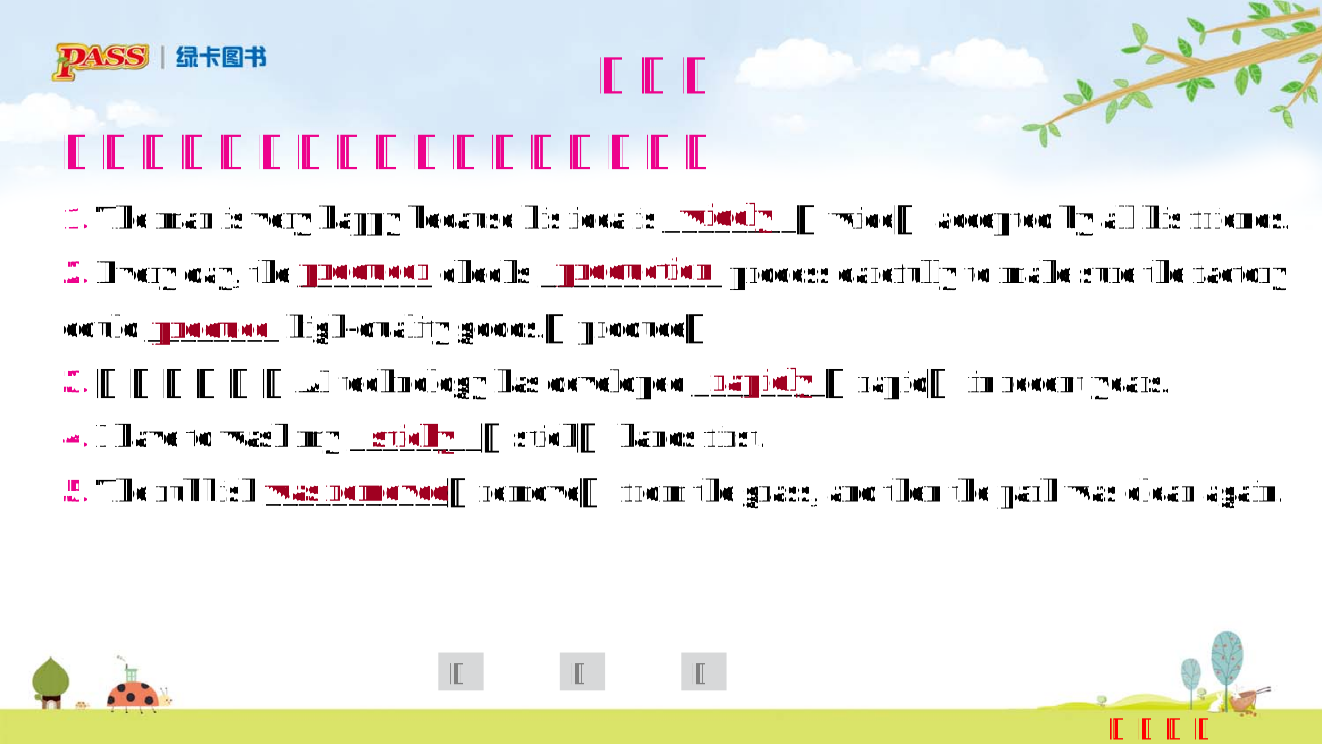
一、用括号内所给单词的适当形式填空
1. The man is very happy because his idea is ________(wide) accepted by all his friends.
2. Every day, the ________ checks ___________ process carefully to make sure the factory could ________ high-quality goods.(produce)
3. [科技创新]AI technology has developed ________(rapid) in recent years.
4. I have to wash my ________(stick) hands first.
5. The rubbish ___________(remove) from the grass, and then the park was clean again.
widely
producer
production
produce
rapidly
sticky
was removed
目 录 导 航
二
三
一
4
6. My grandparents used to be poor and they even couldn’t ________ a fridge.
7. [五育并举]Don’t tell lies to your friends, or you may _________ lose their trust.
8. The girl is very ________ and she can use old things to make some great objects by hand.
9. Before making a decision, you must think about all the possible ________.
10. The man is rich and he has three ___________ in total.
二、用方框内所给单词的适当形式填空
afford
gradually
creative
results
companies
目 录 导 航
二
三
一
5
Feng Boyao often goes to the library to read books. One day, he noticed that there weren’t many Braille(盲文) books 11 for the blind and that most of those books were outdated(过时的). At the same time, Meng Shuqi, knew that one of her relatives couldn’t read the latest books for the same 12 . Then she met up with Feng. Finally, they 13 a team to solve the problem.
One year later, they succeeded in 14 a new kind of Braille reader. In July, their invention won first prize in a competition. Their Braille reader can turn words into raised dots(凸起的点) when it is connected to a computer.
三、完形填空
练提升
目 录 导 航
二
三
一
6
“There are many 15 producing Braille readers. After doing market research, we’ve found out that most Braille readers are very hard to use and 16 ,” Feng said. “So we decided to develop a user-friendly 17 especially for young blind children from Grade 1 to Grade 3.”
To make their invention better, the team 18 lots of knowledge and skills by reading online materials and asking their teachers for help.
After making their first device, Feng and Meng visited a school for the blind to get advice. They then improved their device according to the students’ ideas. “We hope our invention will be 19 used in the future. We want to help those blind people who can’t 20 expensive Braille readers,” Meng said.
Feng and Meng are confident in their device. They are sure it will become popular soon. They will be happy because they could help the blind people.
目 录 导 航
二
三
一
7
11. A. provided B. borrowed C. checked D. lent
12. A. result B. survey C. reason D. material
13. A. gave up B. made up C. showed up D. put up
14. A. inventing B. finding C. writing D. reading
15. A. schools B. companies C. cities D. workshops
16. A. cheap B. expensive C. high D. low
17. A. term B. size C. shape D. product
18. A. lost B. beat C. gained D. missed
19. A. slowly B. clearly C. loudly D. widely
20. A. sell B. explain C. suit D. afford
A
C
B
A
B
B
D
C
D
D
目 录 导 航
二
三
一
8
9
$
资源预览图