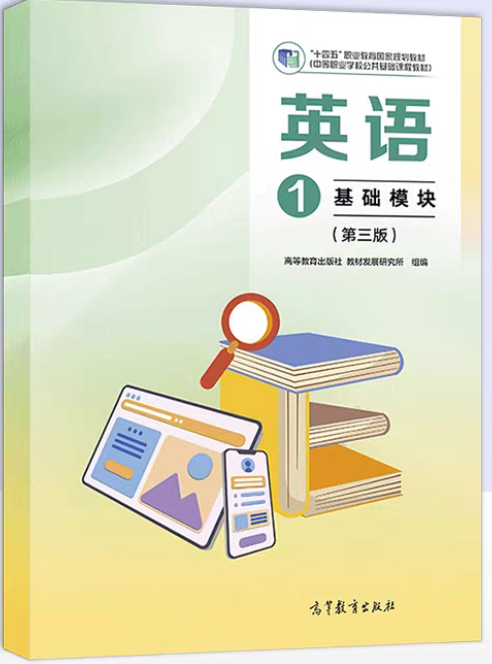
Unit 1——Unit 4阶段测试卷(A卷·基础巩固)《英语 基础模块1》(高教版第三版)单元过关卷(原卷版+解析版)
2026-07-21
|
2份
|
36页
|
72人阅读
|
0人下载
内容正文:
编写说明:本套试卷紧扣《英语 基础模块1》(高教版第三版)教材,以教材单元为基准精准覆盖核心考点。
每个阶段设置AB卷,A卷为基础巩固卷,侧重基础考点训练,帮助学生扎实掌握知识要点;B卷为能力提升卷,注重知识整合与全面检测,引导学生构建知识网络。全书设计4份综合测试卷,模拟实战情境,聚焦解题能力突破,全面提升应试能力与知识应用水平。
《英语 基础模块1》(高教版第三版)《单元过关卷》
Unit 1——Unit 4阶段测试卷
A卷·基础巩固
考试时间:120分钟 满分:150分
班级_____姓名_____学号_____成绩_____
第一部分:单项选择题(共25小题;每小题1分,满分25分)
从A、B、C、D四个选项中,选出可以填入空白处的最佳选项。
1.My aunt works as ______ manager in a local company near Bayi Square.
A. a B. an
C. the D. /
2.Zhang Wei ______ with his grandparents and visits them every evening.
A. lives B. live
C. living D. lived
3.The new student is friendly and often ______ herself to classmates first.
A. protects B. changes
C. compares D. introduces
4.My parents are strict ______ my study, but they always listen to my ideas.
A. for B. by
C. about D. from
5.—Could you tell me something about your brother?
—Sure. He ______ cars in a 4S store.
A. plans B. sells
C. turns D. holds
6.The visitor wants to get to the museum. Please tell him to ______ at the second crossing.
A. pay with B. try on
C. turn left D. take care
7.It is rush hour now. Taking the subway is usually ______ than taking a taxi.
A. faster B. fast
C. fastest D. the fastest
8.Don't ______ the traffic. The map app will show us another way.
A. look after B. get on
C. try out D. worry about
9.______ straight along this road, and you will see the library on your right.
A. Going B. Go
C. Goes D. Went
10.The bus stop is ______ the school gate, so we can walk there in two minutes.
A. near B. over
C. during D. without
11.This sweater is too large for me. Do you have a ______ size?
A. longer B. deeper
C. smaller D. heavier
12.The online store will ______ free gifts to customers who buy two dictionaries.
A. fit B. compare
C. explain D. offer
13.Before buying shoes online, Chen Lin often ______ prices and customer reviews.
A. compares B. borrows
C. misses D. repairs
14.This pair of jeans fits me ______ than the black pair.
A. well B. better
C. best D. the best
15.—How much is the notebook? —It is on sale, so you can buy it ______ 12 yuan.
A. from B. about
C. for D. into
16.Li Hua ______ an English speech competition tomorrow afternoon.
A. joins B. joined
C. has joined D. is going to join
17.The practical training class ______ at 3:30, so we can meet at 3:40.
A. is ending B. ends
C. ended D. has ended
18.The students are preparing ______ the school skills competition carefully.
A. for B. with
C. on D. by
19.The subject ______ I like best is information technology.
A. who B. where
C. that D. when
20.—Shall we go to the English Corner after class? —______. I want to practice speaking.
A. That's too bad B. Never mind
C. You're welcome D. Good idea
21.There ______ a meeting hall and two training rooms on the second floor.
A. is B. are
C. were D. be
22.The students ______ a handmade gift for their grandmother every Chongyang Festival.
A. made B. make
C. will made D. are made
23.The phone case is beautiful, ______ it is too expensive for me.
A. or B. so
C. because D. but
24.The notice asks every student ______ the hall before 3:50 p.m.
A. arrive B. arriving
C. to arrive at D. arrived
25.—______ will the club activity last?
—About one hour.
A. How long B. How often
C. How far D. How many
第二部分:完形填空(共20小题;每小题1.5分,满分30分)
阅读下面短文,从各题所给的A、B、C、D四个选项中选出可以填入空白处的最佳选项。
Lin Tao is a first-year student at a vocational school in Nanchang, and he wants to make his first month meaningful.
On Monday morning, his teacher asked each student to introduce ____26____ family and daily life. Lin Tao stood up and spoke ____27____ a clear voice. He said ____28____ in his family took care of one another. After class, he planned ____29____ visit his grandmother at the weekend, but he also needed to finish a project. His friend Mei helped him make a simple ____30____: buy a gift, take the subway, and return before dinner.
On Saturday, they went to a small shopping mall near Bayi Square. Lin Tao compared two scarves and chose the ____31____ one because it was warm and not expensive. The shop assistant ____32____ the discount patiently. Then the two students opened a map app. It showed that the subway was faster during rush hour, so they got ____33____ at the nearest station and changed lines downtown. Lin Tao felt a little ____34____, but Mei reminded him to read the signs carefully.
When they arrived, Grandma smiled and praised the handmade card. Lin Tao cooked a simple meal and talked about his school subjects. Although the day was busy, he felt ____35____ because he had managed time well. He learned that good plans, polite words and careful choices could make school life and family life work ____36____. The next Monday, his classmates agreed that ____37____ people can solve small problems if they prepare early. ____38____ students use what they learn in real life, each ordinary day can become useful. Lin Tao wrote one sentence on his notebook: “____39____.” This sentence ____40____ him to study harder.
At the end of the month, students shared stories about green travel and shopping mistakes. Lin Tao found that every story had a useful ____41____. When his teacher asked him to give advice, he said, “Be ____42____ with your time and money.” A classmate asked, “____43____” Lin Tao answered, “Start with a small plan.” He knew the plan was simple, ____44____ it could guide daily action. For him, the first month was a lesson in ____45____.
26.A. his B. her C. their D. our
27.A. on B. in C. by D. for
28.A. someone B. nothing C. everyone D. anywhere
29.A. book B. road C. photo D. to
30.A. plan B. price C. review D. subject
31.A. larger B. cheaper C. louder D. deeper
32.A. borrowed B. missed C. explained D. broke
33.A. up B. out C. away D. on
34.A. nervous B. empty C. plastic D. silent
35.A. tired B. proud C. late D. absent
36.A. quietly B. badly C. well D. early
37.A. absent B. young C. careless D. hungry
38.A. Unless B. If C. Although D. Until
39.A. Stop reading B. Never plan ahead C. Learn and use D. Forget your family
40.A. warned B. hurt C. lost D. encouraged
41.A. lesson B. address C. ticket D. station
42.A. careless B. careful C. hungry D. absent
43.A. Where is the river? B. How much is the cup? C. What should we do first? D. Who broke the window?
44.A. or B. unless C. because D. but
45.A. growth B. danger C. anger D. noise
第三部分:阅读理解(共25小题;每小题2分,满分50分)
阅读下列短文,从每题所给的A、B、C、D四个选项中,选出最佳选项。
A
Nanchang Youth Center: Four-Week Life Skills Program
The Youth Center near Bayi Square will hold a four-week program for vocational school students from April 8 to May 3. The program is free, but students must register before April 2. Only sixty students can join, so early registration is suggested.
Week 1 is Personal and Family Communication. Students will learn how to introduce themselves, describe family members, and speak politely with older people. They will also make a small card for a family member. Week 2 is Green Transportation. Students will read bus and subway maps, compare travel time and cost, and design a safe route from school to the center. Week 3 is Responsible Shopping. Students will compare product features, prices, materials and customer reviews before making a buying decision. Week 4 is School Life Planning. Students will make a timetable for study, practical training, clubs and rest.
Classes are held every Tuesday and Friday from 4:30 p.m. to 6:00 p.m. in Room 302. Students should bring a notebook, a pen and their student card. For questions, call 0791-6234-5186 between 9:00 a.m. and 5:00 p.m. The center hopes the program will help young people use English in real situations and make better daily choices.
The teachers will also keep a short record for each student. At the end of every week, students need to write two or three sentences about what they have learned and how they have used it. For example, they may describe a polite family talk, a subway route, a careful shopping choice or a school timetable. These records will not be used for ranking. They are used to help students notice progress and correct small problems in daily learning.
46.When should students register for the program?
A. Before April 2. B. On April 8.
C. After May 3. D. Every Friday.
47.What will students learn in Week 2?
A. How to cook dinner. B. How to read transport maps.
C. How to sell cars. D. How to repair computers.
48.Where are the classes held?
A. At the school gate. B. In the library.
C. In Room 302. D. At a subway station.
49.What should students bring?
A. A family photo only. B. A taxi ticket.
C. A shopping bag. D. A notebook, a pen and a student card.
50.Which of the following is TRUE?
A. Students must pay 60 yuan. B. The program lasts four weeks.
C. Classes are on weekends. D. The center accepts only parents.
B
Chen Yu had just entered a vocational school in Ganzhou. In the first week, he was quiet because everything was new to him. He wanted to make friends, but he did not know how to introduce himself naturally. During an English class, the teacher asked students to prepare a one-minute talk called “My Family and My Dream”. Chen Yu became worried.
That evening, he looked at an old family photo. His father was a technician who repaired machines carefully. His mother worked as a shop assistant and always smiled at customers. His grandmother lived nearby and cooked dinner for the family every Friday. Chen Yu wrote these details in a notebook. He also added that he hoped to become a skilled worker like his father.
The next day, his deskmate Luo Ming read the draft and gave him two suggestions. First, he should speak about one family member at a time. Second, he should end the talk with his own plan. Chen Yu practiced after dinner. He changed some long sentences into short ones and tried to look up when speaking.
On Friday, Chen Yu stood in front of the class. His voice was not very loud, but his words were clear. He introduced his family name, his parents' jobs, his grandmother's love and his future dream. After the talk, several classmates came to ask about his father's work. Chen Yu smiled. He found that a good introduction was not about using difficult words. It was about sharing real life with others politely and confidently.
Chen Yu also learned from listening to other students. One classmate talked about a firefighter uncle, and another introduced a grandmother who lived alone but stayed active. Their stories helped Chen Yu understand that every family has its own way of showing love. After the activity, the teacher asked students to write one useful expression from each talk. Chen Yu wrote, 'be strict with', 'take care of' and 'work as' in his notebook.
51.Why was Chen Yu quiet in the first week?
A. He disliked English class. B. He lost his family photo.
C. Everything was new to him. D. His classmates laughed at him.
52.What did Chen Yu's father do?
A. A shop assistant. B. A technician.
C. A teacher. D. A cook.
53.What was Luo Ming's first suggestion?
A. Speak about one family member at a time. B. Use more difficult words.
C. Read without looking up. D. Talk only about shopping.
54.How did Chen Yu perform on Friday?
A. He refused to speak. B. He sang a song.
C. He forgot every detail. D. He spoke clearly.
55.What can we learn from the passage?
A. Family photos are useless in learning. B. A talk must be full of long sentences.
C. Real sharing can help people communicate. D. Students should never ask questions.
C
On a rainy Thursday afternoon, Liu Min and her group had to finish a transportation plan for a school visit to Tengwang Pavilion. The class would leave from their vocational school at 8:00 the next morning and return before 4:30 p.m. Their teacher did not give them the answer. She only said, “A good plan should be safe, green and practical.”
At first, Liu Min wanted to take taxis because taxis seemed comfortable. Her classmate He Jun disagreed. He checked the map app and found that forty students would need at least ten taxis. The cost would be high, and the road near the bridge was often busy on Friday mornings. Another student suggested taking the subway. The school was ten minutes' walk from Line 2, and the group could get off near the pavilion. The whole trip would take about forty minutes.
The group compared time, cost and convenience. They decided to walk to the subway station, take Line 2, and then walk five minutes to the gate. For two students who had trouble walking, they planned to ask teachers for help and leave more time. Liu Min wrote the final plan in clear steps: meet at the school gate, check the name list, get on together, change seats for students in need, and keep the tickets.
The next day, the plan worked well. No one was late, and the class arrived safely. Liu Min understood that planning was not just choosing the fastest way. It was caring about people, cost and the environment at the same time.
Before they handed in the plan, the group also thought about possible accidents. If it rained, students would bring umbrellas and walk more slowly. If the subway was crowded, group leaders would stand near the doors and remind others to wait in line. These details made the route safer. The teacher praised the group because their plan was not only about arriving on time, but also about helping every student feel included.
56.What did the teacher say a good plan should be?
A. Hard, old and personal. B. Fast, secret and expensive.
C. Short, noisy and funny. D. Safe, green and practical.
57.Why did He Jun disagree with taking taxis?
A. The pavilion was closed. B. The taxis were free.
C. The cost would be high and roads were busy. D. The school had no gate.
58.How long would the subway plan take?
A. About ten minutes. B. About forty minutes.
C. About four hours. D. About one day.
59.What does the underlined word “practical” mean in the passage?
A. Useful and possible to do. B. Beautiful but useless.
C. Difficult to understand. D. Only about money.
60.What lesson did Liu Min learn?
A. A visit plan needs no details. B. The fastest way is always the best.
C. Students should never use maps. D. Planning should consider people, cost and environment.
D
Responsible shopping is an important life skill for young people. It does not mean buying the cheapest thing every time. It means thinking carefully before paying: Do I really need it? Is the material suitable? Can I use it for a long time? Are the reviews believable? These questions help shoppers avoid waste.
Many students like online shopping because it is fast and convenient. A product page usually gives pictures, sizes, prices, discounts and customer reviews. However, a low price may not always mean a good choice. For example, a schoolbag may be half price, but if the material is weak, it may break after one month. A sweater may look beautiful in pictures, but the size may not fit. Reading reviews can help, but shoppers should compare several reviews, not just one short comment.
Responsible shopping also includes planning money. Some students buy snacks, drinks or stationery because of advertisements. Later they find that they have little money left for things they truly need. A simple shopping list can solve this problem. Before going to a mall or opening an app, write down what to buy and how much to spend.
Young shoppers can also care about the environment. They can choose useful products, refuse unnecessary bags, and share things that are still in good condition. When students compare products wisely, they are not only saving money. They are learning to make decisions and take responsibility for daily life.
There is another reason to shop responsibly. Many products are made from natural materials or need energy during production and delivery. If students buy things only because of a short discount, some products may be left unused in drawers. This wastes money and resources. Schools can help by holding exchange corners where students share books, stationery or sports things they no longer need. In this way, shopping becomes connected with kindness and environmental care.
61.What does responsible shopping mean according to the passage?
A. Buying only the cheapest things. B. Thinking carefully before paying.
C. Following every advertisement. D. Shopping without a list.
62.Why may a half-price schoolbag still be a poor choice?
A. It may have weak material. B. It must be too large.
C. It has no pictures online. D. It cannot be used at school.
63.What can help students plan money?
A. A new subway card. B. A longer advertisement.
C. A simple shopping list. D. A family photo.
64.Which action is good for the environment?
A. Buying many unnecessary bags. B. Throwing away useful things.
C. Reading only one review. D. Choosing useful products and sharing good things.
65.What is the main idea of the passage?
A. Where students can buy snacks. B. Why online stores are always dangerous.
C. How young people can shop responsibly. D. When shopping festivals first started.
E
A vocational school is a place where students prepare for both further study and future work. Some people think school life is only about sitting in classrooms, but modern vocational school life is much richer. Students study basic subjects such as Chinese, math and English. They also learn special subjects related to their majors, and they practice skills in training rooms.
A balanced school day needs good time planning. In the morning, students may have English and information technology. At noon, they rest in the cafeteria and talk with friends. In the afternoon, they may take practical training or join a club activity. After school, some students go to the library, some play basketball, and others prepare for competitions. If students only study without rest, they may feel tired. If they only play without planning, they may miss important tasks.
Communication is another part of school life. Students introduce themselves to new classmates, ask for directions on campus, compare products for class projects, and discuss activity plans. These small conversations help them become more confident. When they meet problems, polite questions such as “Could you help me?” or “Shall we work together?” can make teamwork easier.
Good school life is not perfect every day. It may be busy, but it can be meaningful. Students who plan time, practice skills, communicate politely and care about others will grow step by step. They are preparing not only for tests, but also for real life.
In many vocational schools, teachers also encourage students to reflect after activities. Reflection means looking back and asking what went well and what needs to be improved. A student who fails to finish a task on time may learn to make a clearer timetable. A student who is shy in group work may learn to ask one polite question first. These small steps are important because future work also needs planning, communication and responsibility.
66.What do vocational school students learn besides basic subjects?
A. Special subjects and practical skills. B. Only family names.
C. Only shopping discounts. D. Nothing after class.
67.Why does the writer mention morning, noon and afternoon activities?
A. To ask students to leave school. B. To show a balanced school day.
C. To compare bus prices. D. To introduce a hotel route.
68.What does the underlined word “they” in Paragraph 3 refer to?
A. Training rooms. B. New products.
C. Small conversations. D. Difficult tests.
69.Which of the following is the writer's opinion?
A. Club activities are always useless. B. Students should only study without rest.
C. Polite questions make teamwork harder. D. School life can be busy but meaningful.
70.What is the best title for the passage?
A. A Family Dinner Plan B. A Cheap Online Product
C. The Fastest Subway Line D. A Meaningful Vocational School Life
第四部分:情景对话(共10小题;每小题2分,满分20分)
根据对话内容,从所给选项中选出能填入空白处的最佳选项。
A
At the school gate
A: Excuse me. I want to go to the training center. ____71____
B: Yes. Go straight along this road and turn right at the library.
A: ____72____
B: About five minutes on foot.
A: Great. I also need to get to the meeting hall at four o'clock.
B: The meeting hall is next to the training center. ____73____
A: Thank you. You are very helpful.
B: ____74____ Enjoy your visit.
A: I will. ____75____
A. How long does it take?
B. Could you tell me the way?
C. You can visit it after training.
D. My pleasure.
E. See you later.
B
In a shop
A: Good afternoon. What can I do for you?
B: I want to buy a gift for my grandmother. ____76____
A: How about this scarf? It is soft and warm.
B: It looks nice. ____77____
A: It is made of cotton.
B: Good. My grandmother likes soft materials. ____78____
A: It is 68 yuan after the discount.
B: OK. ____79____
A: Sure. You can pay with your phone.
B: Here is the payment code. ____80____
A. How much is it?
B. I will take it.
C. Could you give me some advice?
D. What is it made of?
E. Thank you.
第五部分:书面表达(满分20分)
假设你是李华,本周英语课上你要介绍一位家人。请以“My Family Member”为题,写一篇100词左右的短文。内容包括:1. 他/她的职业或日常生活;2. 他/她的性格或爱好;3. 你从他/她身上学到的品质。
____________________________________________________________________________________________________________________________________________________________________________________________________________________________________________________________________________________________________________________________
原创精品资源学科网独家享有版权,侵权必究!
学科网(北京)股份有限公司
$
编写说明:本套试卷紧扣《英语 基础模块1》(高教版第三版)教材,以教材单元为基准精准覆盖核心考点。
每个阶段设置AB卷,A卷为基础巩固卷,侧重基础考点训练,帮助学生扎实掌握知识要点;B卷为能力提升卷,注重知识整合与全面检测,引导学生构建知识网络。全书设计4份综合测试卷,模拟实战情境,聚焦解题能力突破,全面提升应试能力与知识应用水平。
《英语 基础模块1》(高教版第三版)《单元过关卷》
Unit 1——Unit 4阶段测试卷
A卷·基础巩固
考试时间:120分钟 满分:150分
班级_____姓名_____学号_____成绩_____
第一部分:单项选择题(共25小题;每小题1分,满分25分)
从A、B、C、D四个选项中,选出可以填入空白处的最佳选项。
1.My aunt works as ______ manager in a local company near Bayi Square.
A. a B. an
C. the D. /
【答案】A
【解析】manager以辅音音素开头,表示“一名经理”应用不定冠词a。故选A。
2.Zhang Wei ______ with his grandparents and visits them every evening.
A. lives B. live
C. living D. lived
【答案】A
【解析】主语Zhang Wei为第三人称单数,描述日常情况用一般现在时lives。故选A。
3.The new student is friendly and often ______ herself to classmates first.
A. protects B. changes
C. compares D. introduces
【答案】D
【解析】introduce oneself表示“自我介绍”,符合新同学主动认识他人的语境。故选D。
4.My parents are strict ______ my study, but they always listen to my ideas.
A. for B. by
C. about D. from
【答案】C
【解析】be strict about sth.表示“对某事要求严格”,study属于事情。故选C。
5.—Could you tell me something about your brother?
—Sure. He ______ cars in a 4S store.
A. plans B. sells
C. turns D. holds
【答案】B
【解析】sell cars表示“卖汽车”,与4S店工作场景一致。故选B。
6.The visitor wants to get to the museum. Please tell him to ______ at the second crossing.
A. pay with B. try on
C. turn left D. take care
【答案】C
【解析】turn left表示“左转”,与问路指路语境一致。故选C。
7.It is rush hour now. Taking the subway is usually ______ than taking a taxi.
A. faster B. fast
C. fastest D. the fastest
【答案】A
【解析】than提示比较级,fast的比较级为faster。故选A。
8.Don't ______ the traffic. The map app will show us another way.
A. look after B. get on
C. try out D. worry about
【答案】D
【解析】worry about表示“担心”,符合后文会有另一条路线的安慰语气。故选D。
9.______ straight along this road, and you will see the library on your right.
A. Going B. Go
C. Goes D. Went
【答案】B
【解析】祈使句以动词原形开头,表示指路建议。故选B。
10.The bus stop is ______ the school gate, so we can walk there in two minutes.
A. near B. over
C. during D. without
【答案】A
【解析】near表示“在……附近”,与两分钟步行距离吻合。故选A。
11.This sweater is too large for me. Do you have a ______ size?
A. longer B. deeper
C. smaller D. heavier
【答案】C
【解析】前句说明毛衣太大,因此询问更小的尺码。故选C。
12.The online store will ______ free gifts to customers who buy two dictionaries.
A. fit B. compare
C. explain D. offer
【答案】D
【解析】offer free gifts表示“提供赠品”,符合网店促销语境。故选D。
13.Before buying shoes online, Chen Lin often ______ prices and customer reviews.
A. compares B. borrows
C. misses D. repairs
【答案】A
【解析】compare prices and reviews表示“比较价格和评价”,符合理性购物。故选A。
14.This pair of jeans fits me ______ than the black pair.
A. well B. better
C. best D. the best
【答案】B
【解析】than提示比较级,well的比较级为better。故选B。
15.—How much is the notebook? —It is on sale, so you can buy it ______ 12 yuan.
A. from B. about
C. for D. into
【答案】C
【解析】buy sth. for+价格表示“以某价格购买某物”。故选C。
16.Li Hua ______ an English speech competition tomorrow afternoon.
A. joins B. joined
C. has joined D. is going to join
【答案】D
【解析】tomorrow afternoon提示将来安排,用is going to join。故选D。
17.The practical training class ______ at 3:30, so we can meet at 3:40.
A. is ending B. ends
C. ended D. has ended
【答案】B
【解析】课程表时间可用一般现在时表示将来安排,主语class为单数。故选B。
18.The students are preparing ______ the school skills competition carefully.
A. for B. with
C. on D. by
【答案】A
【解析】prepare for表示“为……做准备”,符合比赛前准备。故选A。
19.The subject ______ I like best is information technology.
A. who B. where
C. that D. when
【答案】C
【解析】先行词subject指物,定语从句可用that引导。故选C。
20.—Shall we go to the English Corner after class? —______. I want to practice speaking.
A. That's too bad B. Never mind
C. You're welcome D. Good idea
【答案】D
【解析】答语说明想练口语,对建议表示赞同,Good idea符合语境。故选D。
21.There ______ a meeting hall and two training rooms on the second floor.
A. is B. are
C. were D. be
【答案】A
【解析】there be结构遵循就近原则,a meeting hall为单数。故选A。
22.The students ______ a handmade gift for their grandmother every Chongyang Festival.
A. made B. make
C. will made D. are made
【答案】B
【解析】every Chongyang Festival表示经常发生的动作,用一般现在时。故选B。
23.The phone case is beautiful, ______ it is too expensive for me.
A. or B. so
C. because D. but
【答案】D
【解析】前后构成转折关系,but符合语义。故选D。
24.The notice asks every student ______ the hall before 3:50 p.m.
A. arrive B. arriving
C. to arrive at D. arrived
【答案】C
【解析】ask sb. to do sth.为固定结构,arrive at the hall表示到达大厅。故选C。
25.—______ will the club activity last?
—About one hour.
A. How long B. How often
C. How far D. How many
【答案】A
【解析】答语About one hour表示持续时间,应用How long提问。故选A。
第二部分:完形填空(共20小题;每小题1.5分,满分30分)
阅读下面短文,从各题所给的A、B、C、D四个选项中选出可以填入空白处的最佳选项。
Lin Tao is a first-year student at a vocational school in Nanchang, and he wants to make his first month meaningful.
On Monday morning, his teacher asked each student to introduce ____26____ family and daily life. Lin Tao stood up and spoke ____27____ a clear voice. He said ____28____ in his family took care of one another. After class, he planned ____29____ visit his grandmother at the weekend, but he also needed to finish a project. His friend Mei helped him make a simple ____30____: buy a gift, take the subway, and return before dinner.
On Saturday, they went to a small shopping mall near Bayi Square. Lin Tao compared two scarves and chose the ____31____ one because it was warm and not expensive. The shop assistant ____32____ the discount patiently. Then the two students opened a map app. It showed that the subway was faster during rush hour, so they got ____33____ at the nearest station and changed lines downtown. Lin Tao felt a little ____34____, but Mei reminded him to read the signs carefully.
When they arrived, Grandma smiled and praised the handmade card. Lin Tao cooked a simple meal and talked about his school subjects. Although the day was busy, he felt ____35____ because he had managed time well. He learned that good plans, polite words and careful choices could make school life and family life work ____36____. The next Monday, his classmates agreed that ____37____ people can solve small problems if they prepare early. ____38____ students use what they learn in real life, each ordinary day can become useful. Lin Tao wrote one sentence on his notebook: “____39____.” This sentence ____40____ him to study harder.
At the end of the month, students shared stories about green travel and shopping mistakes. Lin Tao found that every story had a useful ____41____. When his teacher asked him to give advice, he said, “Be ____42____ with your time and money.” A classmate asked, “____43____” Lin Tao answered, “Start with a small plan.” He knew the plan was simple, ____44____ it could guide daily action. For him, the first month was a lesson in ____45____.
26.A. his B. her C. their D. our
27.A. on B. in C. by D. for
28.A. someone B. nothing C. everyone D. anywhere
29.A. book B. road C. photo D. to
30.A. plan B. price C. review D. subject
31.A. larger B. cheaper C. louder D. deeper
32.A. borrowed B. missed C. explained D. broke
33.A. up B. out C. away D. on
34.A. nervous B. empty C. plastic D. silent
35.A. tired B. proud C. late D. absent
36.A. quietly B. badly C. well D. early
37.A. absent B. young C. careless D. hungry
38.A. Unless B. If C. Although D. Until
39.A. Stop reading B. Never plan ahead C. Learn and use D. Forget your family
40.A. warned B. hurt C. lost D. encouraged
41.A. lesson B. address C. ticket D. station
42.A. careless B. careful C. hungry D. absent
43.A. Where is the river? B. How much is the cup? C. What should we do first? D. Who broke the window?
44.A. or B. unless C. because D. but
45.A. growth B. danger C. anger D. noise
【答案】26.A 27.B 28.C 29.D 30.A 31.B 32.C 33.D 34.A 35.B 36.C 37.B 38.B 39.C 40.D 41.A 42.B 43.C 44.D 45.A
【导语】本文是一篇记叙文,围绕学生在家庭沟通、交通规划、购物选择和校园活动中的真实任务展开,表现计划意识、礼貌交流和责任担当。
【详解】
26.空后family指Lin Tao自己的家庭,his符合语境。故选A。
27.in a clear voice表示“用清楚的声音”。故选B。
28.句意为家里每个人互相关心,everyone符合语境。故选C。
29.plan to do sth.表示“计划做某事”。故选D。
30.冒号后列出buy、take、return等步骤,说明制定计划。故选A。
31.后文not expensive说明选择更便宜的一条。故选B。
32.店员耐心说明折扣,explained符合购物场景。故选C。
33.get on at the station表示“在车站上车”。故选D。
34.换乘时有些紧张,nervous符合情绪线索。故选A。
35.完成计划并管理好时间后感到自豪。故选B。
36.work well表示“运转良好、配合得好”。故选C。
37.同学们认为年轻人通过提前准备也能解决问题,young符合语境。故选B。
38.如果把所学用于生活,每天都会有用,If引导条件。故选B。
39.全文强调学以致用,Learn and use最能概括。故选C。
40.这句话鼓励他更努力学习并关心家人。故选D。
41.前文说每个故事都有启发,因此lesson符合语境。故选A。
42.对时间和金钱要认真谨慎,careful符合语境。故选B。
43.后文回答从小计划开始,说明询问首先做什么。故选C。
44.计划虽简单但能指导行动,前后为转折关系。故选D。
45.全文强调学生在真实任务中的成长,growth概括主旨。故选A。
第三部分:阅读理解(共25小题;每小题2分,满分50分)
阅读下列短文,从每题所给的A、B、C、D四个选项中,选出最佳选项。
A
Nanchang Youth Center: Four-Week Life Skills Program
The Youth Center near Bayi Square will hold a four-week program for vocational school students from April 8 to May 3. The program is free, but students must register before April 2. Only sixty students can join, so early registration is suggested.
Week 1 is Personal and Family Communication. Students will learn how to introduce themselves, describe family members, and speak politely with older people. They will also make a small card for a family member. Week 2 is Green Transportation. Students will read bus and subway maps, compare travel time and cost, and design a safe route from school to the center. Week 3 is Responsible Shopping. Students will compare product features, prices, materials and customer reviews before making a buying decision. Week 4 is School Life Planning. Students will make a timetable for study, practical training, clubs and rest.
Classes are held every Tuesday and Friday from 4:30 p.m. to 6:00 p.m. in Room 302. Students should bring a notebook, a pen and their student card. For questions, call 0791-6234-5186 between 9:00 a.m. and 5:00 p.m. The center hopes the program will help young people use English in real situations and make better daily choices.
The teachers will also keep a short record for each student. At the end of every week, students need to write two or three sentences about what they have learned and how they have used it. For example, they may describe a polite family talk, a subway route, a careful shopping choice or a school timetable. These records will not be used for ranking. They are used to help students notice progress and correct small problems in daily learning.
46.When should students register for the program?
A. Before April 2. B. On April 8.
C. After May 3. D. Every Friday.
47.What will students learn in Week 2?
A. How to cook dinner. B. How to read transport maps.
C. How to sell cars. D. How to repair computers.
48.Where are the classes held?
A. At the school gate. B. In the library.
C. In Room 302. D. At a subway station.
49.What should students bring?
A. A family photo only. B. A taxi ticket.
C. A shopping bag. D. A notebook, a pen and a student card.
50.Which of the following is TRUE?
A. Students must pay 60 yuan. B. The program lasts four weeks.
C. Classes are on weekends. D. The center accepts only parents.
【答案】46.A 47.B 48.C 49.D 50.B
【导语】本文是一则青少年中心活动通知,介绍生活技能项目的时间、内容、地点、报名要求和参加物品。
【详解】
46.细节理解题。原文写明students must register before April 2,说明报名截止时间在4月2日前。B、C、D均与报名要求不符。干扰项与原文关键信息、对象或逻辑不符。故选A。
47.细节理解题。Week 2说明学生将read bus and subway maps并比较时间和费用,B项为同义概括。干扰项与原文关键信息、对象或逻辑不符。故选B。
48.细节理解题。原文Classes are held...in Room 302直接给出地点。干扰项与原文关键信息、对象或逻辑不符。故选C。
49.细节理解题。通知要求bring a notebook, a pen and their student card,D项完整对应。干扰项与原文关键信息、对象或逻辑不符。故选D。
50.细节理解题。标题和第一段均说明该项目为four-week program。其余选项与free、Tuesday and Friday、students等信息矛盾。干扰项与原文关键信息、对象或逻辑不符。故选B。
B
Chen Yu had just entered a vocational school in Ganzhou. In the first week, he was quiet because everything was new to him. He wanted to make friends, but he did not know how to introduce himself naturally. During an English class, the teacher asked students to prepare a one-minute talk called “My Family and My Dream”. Chen Yu became worried.
That evening, he looked at an old family photo. His father was a technician who repaired machines carefully. His mother worked as a shop assistant and always smiled at customers. His grandmother lived nearby and cooked dinner for the family every Friday. Chen Yu wrote these details in a notebook. He also added that he hoped to become a skilled worker like his father.
The next day, his deskmate Luo Ming read the draft and gave him two suggestions. First, he should speak about one family member at a time. Second, he should end the talk with his own plan. Chen Yu practiced after dinner. He changed some long sentences into short ones and tried to look up when speaking.
On Friday, Chen Yu stood in front of the class. His voice was not very loud, but his words were clear. He introduced his family name, his parents' jobs, his grandmother's love and his future dream. After the talk, several classmates came to ask about his father's work. Chen Yu smiled. He found that a good introduction was not about using difficult words. It was about sharing real life with others politely and confidently.
Chen Yu also learned from listening to other students. One classmate talked about a firefighter uncle, and another introduced a grandmother who lived alone but stayed active. Their stories helped Chen Yu understand that every family has its own way of showing love. After the activity, the teacher asked students to write one useful expression from each talk. Chen Yu wrote, 'be strict with', 'take care of' and 'work as' in his notebook.
51.Why was Chen Yu quiet in the first week?
A. He disliked English class. B. He lost his family photo.
C. Everything was new to him. D. His classmates laughed at him.
52.What did Chen Yu's father do?
A. A shop assistant. B. A technician.
C. A teacher. D. A cook.
53.What was Luo Ming's first suggestion?
A. Speak about one family member at a time. B. Use more difficult words.
C. Read without looking up. D. Talk only about shopping.
54.How did Chen Yu perform on Friday?
A. He refused to speak. B. He sang a song.
C. He forgot every detail. D. He spoke clearly.
55.What can we learn from the passage?
A. Family photos are useless in learning. B. A talk must be full of long sentences.
C. Real sharing can help people communicate. D. Students should never ask questions.
【答案】51.C 52.B 53.A 54.D 55.C
【导语】本文是一篇记叙文,讲述陈宇准备自我与家庭介绍并逐渐敢于表达的过程。
【详解】
51.细节理解题。第一段说明he was quiet because everything was new to him。干扰项与原文关键信息、对象或逻辑不符。故选C。
52.细节理解题。第二段写His father was a technician who repaired machines carefully,B项正确。干扰项与原文关键信息、对象或逻辑不符。故选B。
53.细节理解题。第三段First后面指出he should speak about one family member at a time。干扰项与原文关键信息、对象或逻辑不符。故选A。
54.细节理解题。第四段说明his words were clear,D项为同义表达。干扰项与原文关键信息、对象或逻辑不符。故选D。
55.推理判断题。结尾指出好的介绍在于礼貌、自信地分享真实生活,说明真实分享有助于交流。干扰项与原文关键信息、对象或逻辑不符。故选C。
C
On a rainy Thursday afternoon, Liu Min and her group had to finish a transportation plan for a school visit to Tengwang Pavilion. The class would leave from their vocational school at 8:00 the next morning and return before 4:30 p.m. Their teacher did not give them the answer. She only said, “A good plan should be safe, green and practical.”
At first, Liu Min wanted to take taxis because taxis seemed comfortable. Her classmate He Jun disagreed. He checked the map app and found that forty students would need at least ten taxis. The cost would be high, and the road near the bridge was often busy on Friday mornings. Another student suggested taking the subway. The school was ten minutes' walk from Line 2, and the group could get off near the pavilion. The whole trip would take about forty minutes.
The group compared time, cost and convenience. They decided to walk to the subway station, take Line 2, and then walk five minutes to the gate. For two students who had trouble walking, they planned to ask teachers for help and leave more time. Liu Min wrote the final plan in clear steps: meet at the school gate, check the name list, get on together, change seats for students in need, and keep the tickets.
The next day, the plan worked well. No one was late, and the class arrived safely. Liu Min understood that planning was not just choosing the fastest way. It was caring about people, cost and the environment at the same time.
Before they handed in the plan, the group also thought about possible accidents. If it rained, students would bring umbrellas and walk more slowly. If the subway was crowded, group leaders would stand near the doors and remind others to wait in line. These details made the route safer. The teacher praised the group because their plan was not only about arriving on time, but also about helping every student feel included.
56.What did the teacher say a good plan should be?
A. Hard, old and personal. B. Fast, secret and expensive.
C. Short, noisy and funny. D. Safe, green and practical.
57.Why did He Jun disagree with taking taxis?
A. The pavilion was closed. B. The taxis were free.
C. The cost would be high and roads were busy. D. The school had no gate.
58.How long would the subway plan take?
A. About ten minutes. B. About forty minutes.
C. About four hours. D. About one day.
59.What does the underlined word “practical” mean in the passage?
A. Useful and possible to do. B. Beautiful but useless.
C. Difficult to understand. D. Only about money.
60.What lesson did Liu Min learn?
A. A visit plan needs no details. B. The fastest way is always the best.
C. Students should never use maps. D. Planning should consider people, cost and environment.
【答案】56.D 57.C 58.B 59.A 60.D
【导语】本文讲述刘敏小组为参观活动制定交通方案,通过比较交通方式学会兼顾安全、成本与环保。
【详解】
56.细节理解题。第一段教师原话为safe, green and practical,D项完全对应。干扰项与原文关键信息、对象或逻辑不符。故选D。
57.细节理解题。第二段说明打车需要至少十辆、费用高且道路繁忙,C项概括准确。干扰项与原文关键信息、对象或逻辑不符。故选C。
58.细节理解题。第二段结尾指出The whole trip would take about forty minutes。干扰项与原文关键信息、对象或逻辑不符。故选B。
59.词义猜测题。上下文要求方案安全、绿色,并能顺利执行,因此practical意为“实用可行”。干扰项与原文关键信息、对象或逻辑不符。故选A。
60.主旨理解题。最后一句说明计划要同时关心people, cost and environment。干扰项与原文关键信息、对象或逻辑不符。故选D。
D
Responsible shopping is an important life skill for young people. It does not mean buying the cheapest thing every time. It means thinking carefully before paying: Do I really need it? Is the material suitable? Can I use it for a long time? Are the reviews believable? These questions help shoppers avoid waste.
Many students like online shopping because it is fast and convenient. A product page usually gives pictures, sizes, prices, discounts and customer reviews. However, a low price may not always mean a good choice. For example, a schoolbag may be half price, but if the material is weak, it may break after one month. A sweater may look beautiful in pictures, but the size may not fit. Reading reviews can help, but shoppers should compare several reviews, not just one short comment.
Responsible shopping also includes planning money. Some students buy snacks, drinks or stationery because of advertisements. Later they find that they have little money left for things they truly need. A simple shopping list can solve this problem. Before going to a mall or opening an app, write down what to buy and how much to spend.
Young shoppers can also care about the environment. They can choose useful products, refuse unnecessary bags, and share things that are still in good condition. When students compare products wisely, they are not only saving money. They are learning to make decisions and take responsibility for daily life.
There is another reason to shop responsibly. Many products are made from natural materials or need energy during production and delivery. If students buy things only because of a short discount, some products may be left unused in drawers. This wastes money and resources. Schools can help by holding exchange corners where students share books, stationery or sports things they no longer need. In this way, shopping becomes connected with kindness and environmental care.
61.What does responsible shopping mean according to the passage?
A. Buying only the cheapest things. B. Thinking carefully before paying.
C. Following every advertisement. D. Shopping without a list.
62.Why may a half-price schoolbag still be a poor choice?
A. It may have weak material. B. It must be too large.
C. It has no pictures online. D. It cannot be used at school.
63.What can help students plan money?
A. A new subway card. B. A longer advertisement.
C. A simple shopping list. D. A family photo.
64.Which action is good for the environment?
A. Buying many unnecessary bags. B. Throwing away useful things.
C. Reading only one review. D. Choosing useful products and sharing good things.
65.What is the main idea of the passage?
A. Where students can buy snacks. B. Why online stores are always dangerous.
C. How young people can shop responsibly. D. When shopping festivals first started.
【答案】61.B 62.A 63.C 64.D 65.C
【导语】本文是一篇说明文,介绍负责任购物的含义、方法和价值,引导学生理性比较并减少浪费。
【详解】
61.细节理解题。第一段指出It means thinking carefully before paying,B项正确。干扰项与原文关键信息、对象或逻辑不符。故选B。
62.细节理解题。第二段举例说明如果书包材质较弱,可能一个月后就坏。干扰项与原文关键信息、对象或逻辑不符。故选A。
63.细节理解题。第三段写A simple shopping list can solve this problem。干扰项与原文关键信息、对象或逻辑不符。故选C。
64.细节理解题。第四段说明可选择实用产品、拒绝不必要袋子并分享仍完好的物品,D项概括准确。干扰项与原文关键信息、对象或逻辑不符。故选D。
65.主旨大意题。全文围绕responsible shopping展开,说明青少年如何负责任购物。干扰项与原文关键信息、对象或逻辑不符。故选C。
E
A vocational school is a place where students prepare for both further study and future work. Some people think school life is only about sitting in classrooms, but modern vocational school life is much richer. Students study basic subjects such as Chinese, math and English. They also learn special subjects related to their majors, and they practice skills in training rooms.
A balanced school day needs good time planning. In the morning, students may have English and information technology. At noon, they rest in the cafeteria and talk with friends. In the afternoon, they may take practical training or join a club activity. After school, some students go to the library, some play basketball, and others prepare for competitions. If students only study without rest, they may feel tired. If they only play without planning, they may miss important tasks.
Communication is another part of school life. Students introduce themselves to new classmates, ask for directions on campus, compare products for class projects, and discuss activity plans. These small conversations help them become more confident. When they meet problems, polite questions such as “Could you help me?” or “Shall we work together?” can make teamwork easier.
Good school life is not perfect every day. It may be busy, but it can be meaningful. Students who plan time, practice skills, communicate politely and care about others will grow step by step. They are preparing not only for tests, but also for real life.
In many vocational schools, teachers also encourage students to reflect after activities. Reflection means looking back and asking what went well and what needs to be improved. A student who fails to finish a task on time may learn to make a clearer timetable. A student who is shy in group work may learn to ask one polite question first. These small steps are important because future work also needs planning, communication and responsibility.
66.What do vocational school students learn besides basic subjects?
A. Special subjects and practical skills. B. Only family names.
C. Only shopping discounts. D. Nothing after class.
67.Why does the writer mention morning, noon and afternoon activities?
A. To ask students to leave school. B. To show a balanced school day.
C. To compare bus prices. D. To introduce a hotel route.
68.What does the underlined word “they” in Paragraph 3 refer to?
A. Training rooms. B. New products.
C. Small conversations. D. Difficult tests.
69.Which of the following is the writer's opinion?
A. Club activities are always useless. B. Students should only study without rest.
C. Polite questions make teamwork harder. D. School life can be busy but meaningful.
70.What is the best title for the passage?
A. A Family Dinner Plan B. A Cheap Online Product
C. The Fastest Subway Line D. A Meaningful Vocational School Life
【答案】66.A 67.B 68.C 69.D 70.D
【导语】本文是一篇说明文,介绍职业学校生活的学习内容、时间安排、交流合作和成长意义。
【详解】
66.细节理解题。第一段说明学生还学习special subjects并在training rooms练习skills。干扰项与原文关键信息、对象或逻辑不符。故选A。
67.推理判断题。第二段首句提出balanced school day,随后列举一天不同时段活动来说明平衡安排。干扰项与原文关键信息、对象或逻辑不符。故选B。
68.代词指代题。前句提到These small conversations,后句they指这些小交流能帮助学生自信。干扰项与原文关键信息、对象或逻辑不符。故选C。
69.观点态度题。最后一段明确Good school life...may be busy, but it can be meaningful,D项正确。干扰项与原文关键信息、对象或逻辑不符。故选D。
70.最佳标题题。全文围绕有意义的职业学校生活展开,D项概括最准确。干扰项与原文关键信息、对象或逻辑不符。故选D。
第四部分:情景对话(共10小题;每小题2分,满分20分)
根据对话内容,从所给选项中选出能填入空白处的最佳选项。
A
At the school gate
A: Excuse me. I want to go to the training center. ____71____
B: Yes. Go straight along this road and turn right at the library.
A: ____72____
B: About five minutes on foot.
A: Great. I also need to get to the meeting hall at four o'clock.
B: The meeting hall is next to the training center. ____73____
A: Thank you. You are very helpful.
B: ____74____ Enjoy your visit.
A: I will. ____75____
A. How long does it take?
B. Could you tell me the way?
C. You can visit it after training.
D. My pleasure.
E. See you later.
【答案】71.B 72.A 73.C 74.D 75.E
【导语】本文是校园问路对话,访客询问实训中心和会议厅位置,学生给予路线建议。
【详解】
71.根据答语Go straight...可知此处询问路线,B项符合语境。故填B。
72.根据答语About five minutes on foot可知询问花费时间,A项符合语境。故填A。
73.前文说明会议厅在实训中心旁边,此处补充可在训练后参观,C项承接自然。故填C。
74.上文表达感谢,下文Enjoy your visit,D项“不客气”符合语境。故填D。
75.对话结束,E项“回头见”符合告别语境。故填E。
B
In a shop
A: Good afternoon. What can I do for you?
B: I want to buy a gift for my grandmother. ____76____
A: How about this scarf? It is soft and warm.
B: It looks nice. ____77____
A: It is made of cotton.
B: Good. My grandmother likes soft materials. ____78____
A: It is 68 yuan after the discount.
B: OK. ____79____
A: Sure. You can pay with your phone.
B: Here is the payment code. ____80____
A. How much is it?
B. I will take it.
C. Could you give me some advice?
D. What is it made of?
E. Thank you.
【答案】76.C 77.D 78.A 79.B 80.E
【导语】本文是购物对话,顾客为奶奶购买围巾,询问材质、价格并完成支付。
【详解】
76.前文说明想买礼物,后文店员推荐围巾,C项请求建议符合语境。故填C。
77.答语It is made of cotton说明询问材质,D项正确。故填D。
78.答语为价格,A项询问多少钱。故填A。
79.后文店员说明可以手机支付,说明顾客决定购买,B项符合。故填B。
80.付款后常表达感谢,E项符合结束语境。故填E。
第五部分:书面表达(满分20分)
假设你是李华,本周英语课上你要介绍一位家人。请以“My Family Member”为题,写一篇100词左右的短文。内容包括:1. 他/她的职业或日常生活;2. 他/她的性格或爱好;3. 你从他/她身上学到的品质。
____________________________________________________________________________________________________________________________________________________________________________________________________________________________________________________________________________________________________________________________【参考范文】
My Family Member
My mother is an important person in my family. She works as a shop assistant in a small store. She gets up early every day and treats every customer politely. After work, she often cooks dinner and talks with me about my school life. She is energetic and patient. When I meet problems, she never gives me the answer at once. She asks me to think carefully and make a plan first. From her, I learn that a good life needs hard work, kindness and responsibility. I hope I can become a warm and useful person like her.
【词汇积累】work as从事;treat...politely礼貌对待;make a plan制定计划;responsibility责任
【句式拓展】When I meet problems, she...;From her, I learn that...;I hope I can...
【点睛】范文围绕人物身份、日常行为和个人收获展开,使用一般现在时,层次清楚,适合仿写。
原创精品资源学科网独家享有版权,侵权必究!
学科网(北京)股份有限公司
$
资源预览图

1

2

3
由于学科网是一个信息分享及获取的平台,不确保部分用户上传资料的 来源及知识产权归属。如您发现相关资料侵犯您的合法权益,请联系学科网,我们核实后将及时进行处理。