2026-2027学年人教版英语七年级上册暑期语法预习—句子种类(陈述句、疑问句)
2026-07-11
|
2份
|
16页
|
392人阅读
|
5人下载
普通
摘要:
**基本信息**
这份暑期语法预习同步练聚焦陈述句和疑问句,通过基础认知、技能应用、综合拓展三层设计,实现从单一句型到综合运用的知识巩固,提升语言能力与学习能力。
**分层设计**
|层次|知识覆盖|设计特色|
|----|----------|----------|
|基础认知层|陈述句肯定/否定结构、疑问句基本形式|以选择题为主(如陈述句第1-8题、疑问句第1-10题),直接考查概念理解|
|技能应用层|陈述句改写、疑问句词形变化|包含填空题(陈述句第9题)、单词拼写(疑问句第11题),强化语法规则运用|
|综合拓展层|句型转换、情境表达|设置汉译英(陈述句第10题)、对划线部分提问(疑问句第14题),培养语言综合运用能力|
内容正文:
2026-2027学年人教版英语七年级上册暑期语法预习—句子种类(陈述句、疑问句)
语法知识点1:陈述句
1.概念:
陈述句是说明事实或陈述说话人观点的句子。
陈述句包括肯定结果和否定结构。在肯定结构中,谓语动词不含否定词。在否定结构中,系动词be、助动词或情态动词后加not,或用no、never等词语表示。
陈述句句末用句号。
2.用法:
陈述句基本结构:主语+谓语+其他
(1)肯定陈述句 We all like pandas very much.
(2)否定陈述句 He doesn’t do housework at weekends.
(3)肯定陈述句改否定陈述句
①一般是在be动词或情态动词后加not
Mary was at school yesterday. → Mary was not at school yesterday.
I can make a model plane. → I can not make a model plane.
②不含be动词或情态动词的,行为动词前要用助动词的否定式(don’t,doesn’t,didn’t),后面跟动词的原形
He likes drawing pictures.→ He doesn’t like drawing pictures.
I went to the park yesterday. → I didn’t go to the park yesterday.
变形总结:
A:“be+not” eg:I am not a student.
B:“do/does/did +not” eg:He does not like playing basketball.
C:“助动词/情态动词+not” eg:I can not swim.
D:用no、nothing、nobody表否定 eg:I know nothing about it.
(4)陈述句改一般疑问句
①有be动词或情态动词的,把be动词或情态动词提前
Mary was at school yesterday. → Was Mary at school yesterday?
I can make a model plane. → Can you make a model plane?
②不含be动词或情态动词的句子,借助助动词开头,动词还原成原形
He likes drawing pictures. → Does he like drawing pictures.
I went to the park yesterday. → Did you go to the park yesterday?
变形口诀:如何将一个肯定的陈述句变为一般疑问句:
A:看句中有无be动词,如果有be动词提到句首即可
B:看句中有无情态动词,如果有情态动词提到句首即可
C:如上述两者都没有,就应把助动词提到句首
陈述句专项练习:
1.—What does “I’m Simon.” mean(意思是)?
—_______
A.I’m not Simon. B.Are you Simon?
C.This is Simon. D.My name is Simon.
【答案】D
【详解】句意:——“我是Simon”是什么意思?——我的名字叫Simon。
考查常识。I’m not Simon我不是Simon;Are you Simon你是Simon吗;This is Simon这是Simon;My name is Simon我的名字叫Simon。I’m Simon的同义句是My name is Simon。故选D。
2.Lisa always gets A in math. She ________ it well.
A.don’t learn B.learns C.doesn’t learn D.learn
【答案】B
【详解】句意:丽萨在数学中总是得A。她学得很好。
考查一般现在时。don’t learn用于一般现在时,主语是复数或第一、第二人称,表否定;learns动词单三形式,用于一般现在时,主语是单数;doesn’t learn用于一般现在时,主语是单数,表否定;learn学习,动词原形,用于一般现在时,主语是复数或第一、第二人称。根据Lisa always gets A in math可知总是得A,可知学得好,表肯定,故排除A、C;主语为she,一般现在时中she后谓语动词用第三人称单数形式,故选B。
3.Kate ________ any scarves in the shop.
A.buy B.don’t buy
C.doesn’t buy D.doesn’t buys
【答案】C
【详解】句意:凯特在商店里没有买围巾。
考查动词第三人称单数形式。根据句中any提示,该句为否定句,A选项排除,D选项语法错误,可排除。主语为Kate,故助动词do应用第三人称单数形式。故选C。
4.The boy ____ his homework. His teacher ____ very angry.
A.doesn’t; is B.don’t do; is C.doesn’t do; is D.doesn’t do; are
【答案】C
【详解】句意:这个男孩不做作业。他的老师很生气。
考查助动词和be动词。do one’s homework“做作业”为固定搭配,do是实义动词,其否定形式应借助于助动词,主语是单数第三人称The boy,故使用doesn’t do;be angry“生气”是固定搭配,主语是His teacher,是单数,be动词用is。故选C。
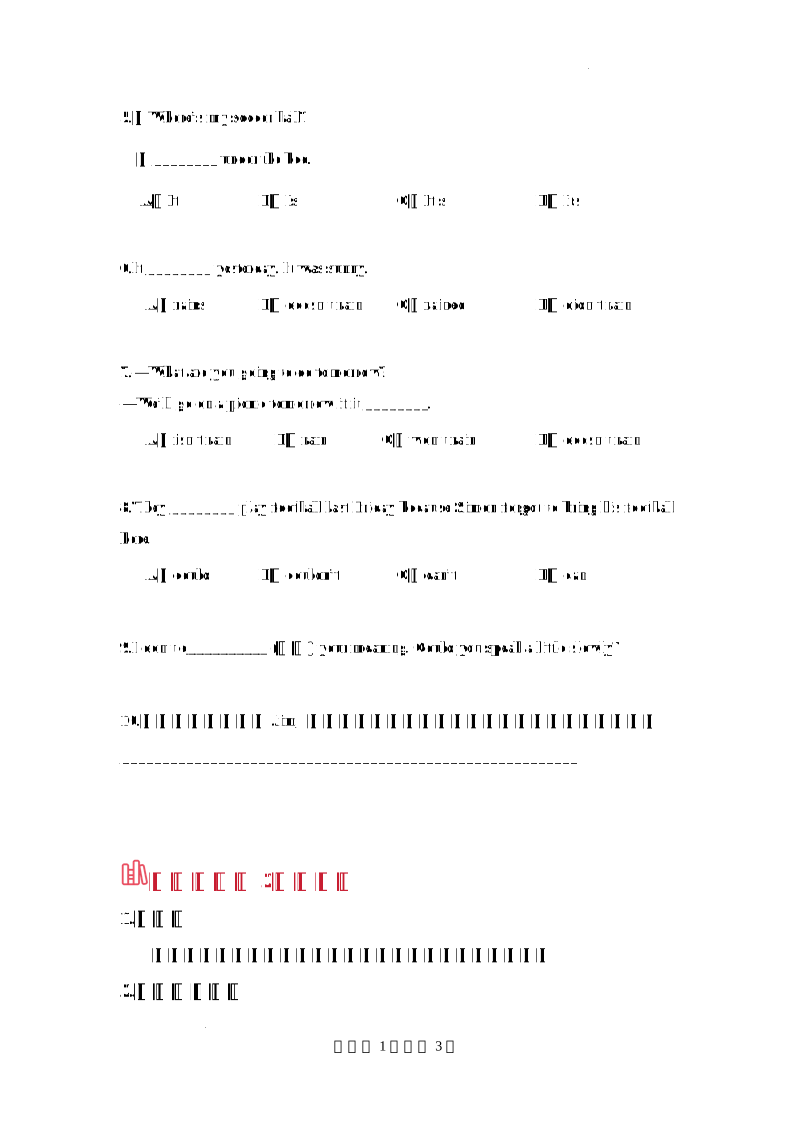
5.-Where’s my soccer ball?
-________ under the bed.
A.It B.Is C.It’s D.Its
【答案】C
【详解】句意:-我的足球在哪里?-在床底下。
用代词it代替前面句子的名词,主语是第三人称单数,所以连系动词be用is,it和is可以缩写为It’s。故选C。
6.It ________ yesterday. It was sunny.
A.rains B.doesn’t rain C.rained D.didn’t rain
【答案】D
【详解】句意:昨天没下雨。天气晴朗。
考查一般过去时的否定句。根据yesterday可知此句时态为一般过去时,排除A和B,根据下文It was sunny.可知没有下雨,故选D。
7.—What are you going to do tomorrow?
—We’ll go on a picnic tomorrow if it ________.
A.isn’t rain B.rain C.won’t rain D.doesn’t rain
【答案】D
【详解】句意:——你们明天去做什么?——如果明天不下雨,我们就去野餐。
考查时态。if引导的条件状语从句,主句是一般将来时,从句用一般现在时(即“主将从现”),排除C项;从句主语it是第三人称单数,排除B项;谓语动词是rain“下雨”,需要与助动词doesn’t构成否定形式。故选D。
8.They ________ play football last Friday because Simon forgot to bring his football here.
A.could B.couldn’t C.can’t D.can
【答案】B
【详解】句意:上周五他们不可能踢了足球,因为西蒙忘记把足球带来了。
考查情态动词。根据last Friday和because Simon forgot to bring his football here可知,是对过去进行推测,应该是说上周五他们不可能踢了足球,因此couldn’t符合句意。故选B。
9.I don’t c__________ (理解) your meaning. Could you speak a little slowly?
【答案】(c)atch
【详解】句意:我听不懂你的意思。你能说慢点儿吗?
助动词don’t后需接动词原形,由前一句speak a little more slowly和首字母提示可知,动词catch“抓住,领会,理解”,catch your meaning意为“理解你的意思”,符合题意,故填(c)atch。
10.你想告诉你的朋友Jim, 穿蓝色体恤衫的那个男孩是你的弟弟,该怎么说?
_________________________________________________________
【答案】The boy in a blue T-shirt is my brother.
【详解】你想告诉你的朋友Jim, 穿蓝色体恤衫的那个男孩是你的弟弟,应该说“那个穿蓝色t恤的男孩是我弟弟。”故填The boy in a blue T-shirt is my brother.
语法知识点2:疑问句
1.概念:
疑问句:用来提出问题,询问情况的句子,末尾用问号。
2.一般疑问句:
一般疑问句常用来询问一件事是否属实,通常以be动词,助动词或情态动词开头,用yes或no来回答。
—Is Mr Green from the UK? —Yes,he is. / No,he isn’t.
—Do you have any hobbies? —Yes,I do. / No,I don’t.
—Can you play the guitar? —Yes,I can. / No,I can’t.
3.特殊疑问句:
(1)定义:当疑问代词what who whom which whose或疑问副 when where why how引导 的问句,不能用yes,no来回答。
(2)句式:当疑问词在句中作主语时,用正常语序 eg:Who is that boy?
特殊疑问词+一般疑问句 eg:When did you go to the cinema ?
(3)对画线部分提问的顺序:(一代二移三倒四抄)
一代:用疑问代词代替画线部分
二移:把疑问词移至句首
三倒:颠倒主谓语
四抄:照抄其他部分,变句号为问号
疑问句专项练习:
1.—Hello,are you Li Lei?
—____________ .
A.Thank you B.Yes,I am
C.Fine, thanks D.Nice to meet you
【答案】B
【详解】你好,你是李雷吗?是的,我是。
考查一般疑问句。A. Thank you(谢谢你);B. Yes,I am(是的,我是。);C. Fine, thanks(很好,谢谢。);D. Nice to meet you(很高兴见到你。);问句是一般疑问句,答语用yes或no回答,故选B。
2.—I like Chinese and English. ________ you, Mary?
—I like Chinese, but I don’t like English.
A.What about B.What time C.Where are D.How are
【答案】A
【详解】句意:——我喜欢汉语和英语。你呢,玛丽?——我喜欢汉语,但我不喜欢英语。
考查特殊疑问句。What about……怎么样;What time什么时间;Where are在哪里;How are怎样。根据答语I like Chinese, but I don’t like English.可知是玛丽的观点,因此是“你呢?”即What about you?故选A。
3.—Did you use to have long hair or short hair, Sally?
—____________ .
A.Yes, I did B.No, I didn't
C.Long hair D.Curly hair
【答案】C
【详解】试题分析:句意:—Sally,你过去留长发还是短发?—长发。
选择疑问句回答时,要选择其中一项来回答,AB是一般疑问句的回答方式,D不在选择范围之内,故选C。
4.—____________?
—She’s tall and slim.
A.What’s she like B.What does she like
C.How does she look like D.How is she like
【答案】A
【详解】句意:——她长什么样?——她又高又苗条。
考查特殊疑问句。What’s she like她长什么样,她是什么样的人,What+be+sb.+like?询问某人的外貌或性格特征;What does she like她喜欢什么;How does she look like句式错误,无此种用法;How is she like句式错误,无此种用法。根据She’s tall and slim.可知,此处询问外貌。故选A。
5.______ do you think ______ Chinese education?
A.How; like B.What; of C.Where; of D.Who; about
【答案】B
【详解】句意:你认为中国教育怎么样?
考查特殊疑问句。根据句式What do you think of…(你认为……怎么样)可知,挖空处应填What和of。故选B。
6.—______ will you go to the gym?
—In two hours.
A.How long B.How often C.How soon D.When
【答案】C
【详解】句意:——你多久以后去健身房?——两个小时后。
考查特殊疑问句。how long多长时间;how often多久一次;how soon多久;when什么时候,根据答句In two hours可知,应该问的是你多久以后去健身房,用how soon,故选C。
7.—________ pork would you like?
—One and a half ________.
A.How many; kilo B.How many; kilos
C.How much; kilos D.How much; kilo
【答案】C
【详解】句意:——你要多少猪肉?——1.5千克。
考查特殊疑问词和名词。How many“多少”,对可数名词复数提问;How much“多少”,对不可数名词提问。pork意为“猪肉”,是不可数名词,用How much提问;one and a half数量大于1,kilo要加s。故选C。
8.It’s unfair,________?
A.isn’t it B.is it C.isn’t he D.is he
【答案】A
【详解】句意:这是不公平的,不是吗?
反意疑问句:前半句是肯定句,后半句是否定句;前半句是否定句,后半句是肯定句。此处前半句是肯定句,故后半句是否定句,故排除BD两项。主语是it,故排除C;故选A。
9.—Can they go to the party?
—________, they have to go to a concert.
A.No, they can B.No, they can’t
C.Yes, they can D.Yes, they can’t
【答案】B
【详解】句意:——他们能来聚会吗?——不,不能。他们得去听音乐会。
考查一般疑问句。由Can they go to the party可知,是情态动词的一般疑问句,肯定回答用Yes, they can,否定回答用No, they can’t,排除A和D;由they have to go to a concert可知,是不能去,应作否定回答。故选B。
10.— ________ is it from Dalian to Shenzhen?
— Less than three ________ flight.
A.How long;hour’s B.How long;hours’
C.How far;hour’s D.How far;hours’
【答案】D
【详解】句意:——从大连到深圳有多远?——坐飞机不到三个小时。
考查特殊疑问句和名词所有格。第二空前为three,空格后为名词flight,故空格处应用hour复数的所有格形式,即hours’,A、C选项可排除。How long多长时间,问一段时间;How far多远,提问两地之间的距离。根据答句Less than three hours’ flight可知,此处是在问两地距离,故应用How far提问,故选D。
11.Do you ________ /əʊn/ a car?
【答案】own
【详解】句意:你有汽车吗?
根据音标提示可知英文表达的是own,意为“拥有”,动词;助动词之后,使用动词原形。故填own。
12.—What time is __________ now?
—It’s 10 o’clock.
【答案】it
【详解】句意:——现在几点了?——十点了。
此处是固定句型What time is it,用来询问“几点了”。故填it。
13.—W________ cap is it?
—It’s Liu Tao’s.
【答案】(W)hose
【详解】句意:——这是谁的帽子?——是刘涛的。
根据答语It’s Liu Tao’s.可知,询问是谁的,whose“谁的”符合语境,故填(W)hose。
14.— ____________________?
— She wants to join the music club.
【答案】Which club does she want to join?
【详解】句意:——她想要加入哪个俱乐部?——她想要加入音乐俱乐部。
考查特殊疑问句,根据回答可以推测问句是“她想要参加什么哪一个俱乐部?”那么可知是一个Which club开头的特殊疑问句,特殊疑问句=特殊疑问词+一般疑问句。这里的谓语动词用实义动词want,且主语为she,那么要借助does,想要做某事用want to do sth.,故答案为Which club does she want to join?
15.用do或does填空
① your parents have ping-pong bats?
② your uncle play computer games?
③ the boys go to school today?
④ our teacher have a volleyball?
⑤ Miss Song know the answer?
【答案】①Do ②Does ③Do ④Does ⑤Does
【详解】①句意:你父母有乒乓球拍吗?
主语your parents是复数,句中含有实义动词have,需要借助助动词do构成一般疑问句,句首首字母大写。故填Do。
②句意:你的叔叔玩电脑游戏吗?
主语your uncle是第三人称单数,句中含有实义动词play,需要借助助动词does构成一般疑问句,句首首字母大写。故填Does。
③句意:男孩们今天上学吗?
主语the boys是复数,句中含有实义动词go,需要借助助动词do构成一般疑问句,句首首字母大写。故填Do。
④句意:我们老师有一个排球吗?
主语our teacher是第三人称单数,句中含有实义动词have,需要借助助动词does构成一般疑问句,句首首字母大写。故填Does。
⑤句意:宋小姐知道答案吗?主
语Miss Song是第三人称单数,句中含有实义动词know,需要借助助动词does构成一般疑问句,句首首字母大写。故填Does。
试卷第1页,共3页
学科网(北京)股份有限公司
$
2026-2027学年人教版英语七年级上册暑期语法预习—句子种类(陈述句、疑问句)
语法知识点1:陈述句
1.概念:
陈述句是说明事实或陈述说话人观点的句子。
陈述句包括肯定结果和否定结构。在肯定结构中,谓语动词不含否定词。在否定结构中,系动词be、助动词或情态动词后加not,或用no、never等词语表示。
陈述句句末用句号。
2.用法:
陈述句基本结构:主语+谓语+其他
(1)肯定陈述句 We all like pandas very much.
(2)否定陈述句 He doesn’t do housework at weekends.
(3)肯定陈述句改否定陈述句
①一般是在be动词或情态动词后加not
Mary was at school yesterday. → Mary was not at school yesterday.
I can make a model plane. → I can not make a model plane.
②不含be动词或情态动词的,行为动词前要用助动词的否定式(don’t,doesn’t,didn’t),后面跟动词的原形
He likes drawing pictures.→ He doesn’t like drawing pictures.
I went to the park yesterday. → I didn’t go to the park yesterday.
变形总结:
A:“be+not” eg:I am not a student.
B:“do/does/did +not” eg:He does not like playing basketball.
C:“助动词/情态动词+not” eg:I can not swim.
D:用no、nothing、nobody表否定 eg:I know nothing about it.
(4)陈述句改一般疑问句
①有be动词或情态动词的,把be动词或情态动词提前
Mary was at school yesterday. → Was Mary at school yesterday?
I can make a model plane. → Can you make a model plane?
②不含be动词或情态动词的句子,借助助动词开头,动词还原成原形
He likes drawing pictures. → Does he like drawing pictures.
I went to the park yesterday. → Did you go to the park yesterday?
变形口诀:如何将一个肯定的陈述句变为一般疑问句:
A:看句中有无be动词,如果有be动词提到句首即可
B:看句中有无情态动词,如果有情态动词提到句首即可
C:如上述两者都没有,就应把助动词提到句首
陈述句专项练习:
1.—What does “I’m Simon.” mean(意思是)?
—_______
A.I’m not Simon. B.Are you Simon?
C.This is Simon. D.My name is Simon.
2.Lisa always gets A in math. She ________ it well.
A.don’t learn B.learns C.doesn’t learn D.learn
3.Kate ________ any scarves in the shop.
A.buy B.don’t buy
C.doesn’t buy D.doesn’t buys
4.The boy ____ his homework. His teacher ____ very angry.
A.doesn’t; is B.don’t do; is C.doesn’t do; is D.doesn’t do; are
5.-Where’s my soccer ball?
-________ under the bed.
A.It B.Is C.It’s D.Its
6.It ________ yesterday. It was sunny.
A.rains B.doesn’t rain C.rained D.didn’t rain
7.—What are you going to do tomorrow?
—We’ll go on a picnic tomorrow if it ________.
A.isn’t rain B.rain C.won’t rain D.doesn’t rain
8.They ________ play football last Friday because Simon forgot to bring his football here.
A.could B.couldn’t C.can’t D.can
9.I don’t c__________ (理解) your meaning. Could you speak a little slowly?
10.你想告诉你的朋友Jim, 穿蓝色体恤衫的那个男孩是你的弟弟,该怎么说?
_________________________________________________________
语法知识点2:疑问句
1.概念:
疑问句:用来提出问题,询问情况的句子,末尾用问号。
2.一般疑问句:
一般疑问句常用来询问一件事是否属实,通常以be动词,助动词或情态动词开头,用yes或no来回答。
—Is Mr Green from the UK? —Yes,he is. / No,he isn’t.
—Do you have any hobbies? —Yes,I do. / No,I don’t.
—Can you play the guitar? —Yes,I can. / No,I can’t.
3.特殊疑问句:
(1)定义:当疑问代词what who whom which whose或疑问副 when where why how引导 的问句,不能用yes,no来回答。
(2)句式:当疑问词在句中作主语时,用正常语序 eg:Who is that boy?
特殊疑问词+一般疑问句 eg:When did you go to the cinema ?
(3)对画线部分提问的顺序:(一代二移三倒四抄)
一代:用疑问代词代替画线部分
二移:把疑问词移至句首
三倒:颠倒主谓语
四抄:照抄其他部分,变句号为问号
疑问句专项练习:
1.—Hello,are you Li Lei?
—____________ .
A.Thank you B.Yes,I am
C.Fine, thanks D.Nice to meet you
2.—I like Chinese and English. ________ you, Mary?
—I like Chinese, but I don’t like English.
A.What about B.What time C.Where are D.How are
3.—Did you use to have long hair or short hair, Sally?
—____________ .
A.Yes, I did B.No, I didn't
C.Long hair D.Curly hair
4.—____________?
—She’s tall and slim.
A.What’s she like B.What does she like
C.How does she look like D.How is she like
5.______ do you think ______ Chinese education?
A.How; like B.What; of C.Where; of D.Who; about
6.—______ will you go to the gym?
—In two hours.
A.How long B.How often C.How soon D.When
7.—________ pork would you like?
—One and a half ________.
A.How many; kilo B.How many; kilos
C.How much; kilos D.How much; kilo
8.It’s unfair,________?
A.isn’t it B.is it C.isn’t he D.is he
9.—Can they go to the party?
—________, they have to go to a concert.
A.No, they can B.No, they can’t
C.Yes, they can D.Yes, they can’t
10.— ________ is it from Dalian to Shenzhen?
— Less than three ________ flight.
A.How long;hour’s B.How long;hours’
C.How far;hour’s D.How far;hours’
11.Do you ________ /əʊn/ a car?
12.—What time is __________ now?
—It’s 10 o’clock.
13.—W________ cap is it?
—It’s Liu Tao’s.
14.— ____________________?
— She wants to join the music club.
15.用do或does填空
① your parents have ping-pong bats?
② your uncle play computer games?
③ the boys go to school today?
④ our teacher have a volleyball?
⑤ Miss Song know the answer?
试卷第1页,共3页
学科网(北京)股份有限公司
$
资源预览图

1

2
3
相关资源
示范课
由于学科网是一个信息分享及获取的平台,不确保部分用户上传资料的 来源及知识产权归属。如您发现相关资料侵犯您的合法权益,请联系学科网,我们核实后将及时进行处理。