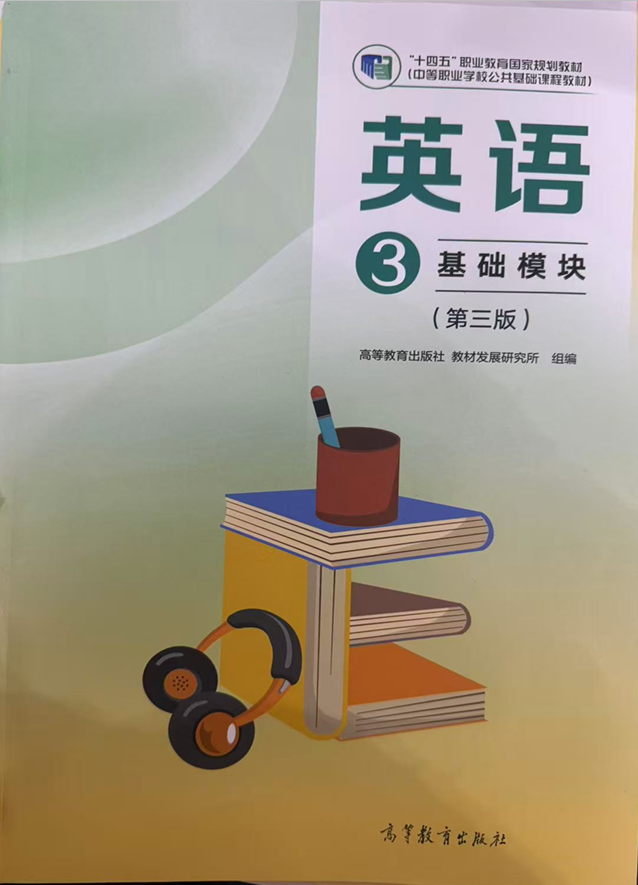
Unit 3 Artificial Intelligence(B卷·能力提升)《英语 基础模块3》(高教版第三版)单元过关卷(原卷版+解析版)
2026-07-08
|
2份
|
22页
|
39人阅读
|
1人下载
内容正文:
编写说明:本套试卷紧扣《英语 基础模块3》(高教版第三版)教材,以教材单元为基准精准覆盖核心考点。
每个单元设置AB卷,A卷为基础巩固卷,侧重基础考点训练,帮助学生扎实掌握知识要点;B卷为能力提升卷,注重知识整合与全面检测,引导学生构建知识网络。全书设计4份综合测试卷,模拟实战情境,聚焦解题能力突破,全面提升应试能力与知识应用水平。
《英语 基础模块3》(高教版第三版)《单元过关卷》
Unit 3 Artificial Intelligence
B卷·能力提升
考试时间:120分钟 满分:100分
班级_____姓名_____学号_____成绩_____
Ⅰ.语音辨析。 (共5小题;每小题1分,满分5分)
读下列单词,从每题所给的 A、B、C 和 D 四个选项中,选出画线部分发音不同的一项。
1.A.thin B.this C.those D.they
2.A.near B.hear C.earth D.clear
3.A.scan B.safe C.hand D.factory
4.A.education B.application C.information D.question
5.A.blood B.food C.room D.tool
【答案】1.A 2.C 3.B 4.D 5.A
【解析】1.A项画线部分发/θ/,B、C、D项画线部分均发/ð/,故选A。
【解析】2.A、B、D项画线部分均发/ɪə/,C项画线部分发/ɜː/,故选C。
【解析】3.A、C、D项画线部分均发/æ/,B项画线部分发/eɪ/,故选B。
【解析】4.A、B、C项画线部分均发/ʃn/,D项画线部分发/tʃən/,故选D。
【解析】5.A项画线部分发/ʌ/,B、C、D项画线部分均发/uː/,故选A。
Ⅱ. 单项选择(共15小题;每小题1分,满分15分)
阅读下列句子,从每题所给的 A、B、C 和 D 四个选项中,选出最佳选项。
6.The company invited several workers ______ the new AI system.
A. testing B. tested
C. test D. to test
【答案】D
【解析】invite sb. to do sth.表示“邀请某人做某事”,故选D。
7.The information ______ from the screen helped the nurse save time.
A. collect B. collected
C. collecting D. collects
【答案】B
【解析】information与collect之间是被动关系,过去分词collected作后置定语,故选B。
8.Students ______ AI tools should still check answers carefully.
A. using B. used
C. use D. uses
【答案】A
【解析】students与use之间是主动关系,using AI tools作后置定语,故选A。
9.There is no doubt ______ smart devices can bring convenience to old people.
A. whether B. where
C. that D. when
【答案】C
【解析】There is no doubt that...为固定句式,表示“毫无疑问……”,故选C。
10.The guide showed us a model ______ by students from different majors.
A. build B. building
C. to build D. built
【答案】D
【解析】model与build之间是被动关系,built作后置定语,故选D。
11.If the robot ______ moving, call the engineer at once.
A. stops B. stopped
C. will stop D. stopping
【答案】A
【解析】if引导条件状语从句,主句为祈使句,从句用一般现在时,主语robot为单数,故选A。
12.We should know both benefits and risks ______ we use a new AI product.
A. after B. before
C. until D. because
【答案】B
【解析】语义为“在使用新AI产品之前要了解利弊”,before符合语境,故选B。
13.The engineer explained ______ the robot could follow the table number.
A. who B. whose
C. how D. which
【答案】C
【解析】从句表示机器人如何跟随桌号,应用how引导,故选C。
14.______ the app is useful, we must protect our private information.
A. Because B. If
C. Until D. Though
【答案】D
【解析】前后为让步关系,表示“尽管应用有用,仍要保护隐私”,故选D。
15.The smart lamp makes Grandma's room ______ at night.
A. brighter B. bright
C. brightest D. brightly
【答案】A
【解析】结合语境表示“更明亮”,make sth. +形容词,应用比较级brighter,故选A。
16.The teacher asked us ______ personal photos to unknown websites.
A. not upload B. not to upload
C. don't upload D. not uploading
【答案】B
【解析】ask sb. not to do sth.表示“要求某人不要做某事”,故选B。
17.The robot can answer simple questions, ______ it cannot understand every feeling.
A. so B. but
C. or D. because
【答案】B
【解析】前后存在转折关系,应用but,故选B。
18.This is the service desk ______ residents can get help quickly.
A. which B. that
C. where D. whose
【答案】C
【解析】先行词service desk表示地点,空处在从句中作地点状语,故选C。
19.By the end of last week, our group ______ the smart helper twice.
A. tests B. will test
C. is testing D. had tested
【答案】D
【解析】By the end of last week提示过去完成时,应用had tested,故选D。
20.The purpose of technology is ______ real problems, not to create cold machines.
A. solve B. solved
C. to solve D. solving
【答案】C
【解析】不定式作表语说明purpose的具体内容,故选C。
Ⅲ. 完形填空(共10小题;每小题1分,满分10分)
阅读下面短文,从短文后各题所给的 A、B、C 和 D 四个选项中,选出可以填入空白处的最佳选项。
Li Na's grandmother lives alone, but her home is no longer quiet or difficult to manage. Last year, Li Na helped her install a simple smart home system.
The system was not expensive, but it changed many small things. Every morning, a voice speaker reads the weather and reminds Grandma ____21____ her medicine. If the room is too dark, a smart lamp turns on by itself. At first, Grandma was afraid that the machines would be difficult ____22____. Li Na wrote the steps on a card and practiced with her patiently. After two weeks, Grandma could use the speaker to call her family, listen to news and control the lamp. She said the technology made her life more ____23____.
One evening, the system sent Li Na a message because the kitchen smoke alarm was ringing. Li Na called her grandmother at once. Luckily, it was only a pot of soup boiling over, but the warning still showed the value of the system. Later, the family added a small camera at the door. It helped Grandma see who was outside before she opened the door. However, Li Na also knew there were risks. She chose strong passwords and never connected unknown devices, because private information must be protected ____24____.
During the Spring Festival, some relatives praised the smart home and said machines might soon replace family visits. Grandma shook her head. She said the system could help her, ____25____ it could not talk with her like her children. Li Na agreed. She realized ____26____ AI should not make people lazy or cold. It should give families more time to care for each other. Now she plans to design a small class for older residents in the community. She wants to teach them how to enjoy the benefits of smart devices and avoid possible problems. In her view, the best technology is the one that makes people safer, closer and more ____27____. In the class, she will first explain the pros and cons of each device. Then she will show ____28____ to scan a code safely and when to refuse a strange link. Finally, she will remind everyone that no machine should control their choices. A smart home is useful only ____29____ people understand it and use it with care. This idea has become the most important ____30____ from her experience.
21.A.take B.taking C.to take D.taken
22.A.to use B.using C.used D.uses
23.A.expensive B.lonely C.difficult D.convenient
24.A.suddenly B.properly C.loudly D.angrily
25.A.so B.or C.but D.because
26.A.where B.when C.which D.that
27.A.connected B.careless C.crowded D.broken
28.A.why B.how C.who D.where
29.A.unless B.although C.after D.if
30.A.lesson B.risk C.machine D.price
【答案】21.C 22.A 23.D 24.B 25.C 26.D 27.A 28.B 29.D 30.A
【导语】本文是一篇记叙文。文章讲述李娜帮助独居奶奶使用智能家居系统的经历,说明智能设备能提高安全性和便利性,但仍需保护隐私并保持人与人之间的关爱。
【详解】21.考查非谓语动词。remind sb. to do sth.表示“提醒某人做某事”,故选C。
【详解】22.考查非谓语动词。be difficult to use表示“难以使用”,不定式主动形式表达被动意义,故选A。
【详解】23.考查形容词。前文提到可打电话、听新闻、控制灯,说明生活更方便,convenient符合语境,故选D。
【详解】24.考查副词。根据“strong passwords”和“不连接未知设备”可知要恰当地保护私人信息,properly符合语境,故选B。
【详解】25.考查连词。前句说系统能帮她,后句说不能像孩子一样交流,前后转折,用but,故选C。
【详解】26.考查宾语从句连接词。从句“AI should not make people lazy or cold”结构完整,用that引导,故选D。
【详解】27.考查形容词。前文提到让家人有更多时间彼此关心,因此技术让人更安全、更亲近、更有联系,connected符合语境,故选A。
【详解】28.考查疑问副词。scan a code safely表示“如何安全扫码”,用how,故选B。
【详解】29.考查连词。句意为只有当人们理解并小心使用时智能家居才有用,if符合语境,故选D。
【详解】30.考查名词。This idea来自她的经历,表示“最重要的一课”,lesson符合语境,故选A。
Ⅳ.补全对话(共5小题;每小题2分,满分10分)
根据对话内容,从对话后所给的七个选项中,选出能填入空白处的最佳选项。(选项中有两项是多余的)
M: I heard your group made a smart medicine box. ____31____
W: It reminds elderly people to take medicine on time.
M: Sounds useful. ____32____
W: Yes, it can send a message to family members if the box is not opened.
M: What about privacy? ____33____
W: We only collect necessary information and protect it carefully.
M: Good. Do you think it can replace family care?
W: No. ____34____
M: I agree. Technology should make people closer.
W: Exactly. ____35____
A.How do you protect users' information?
B.What does it do?
C.We are on the same page.
D.It can cook dinner for everyone.
E.Can it give a warning?
F.It should be used without rules.
G.It is only a helper, not real family care.
【答案】31.B 32.E 33.A 34.G 35.C
【解析】31.根据答语“It reminds...”可知上文询问智能药盒的功能,B项符合。
【解析】32.根据“Yes”和“send a message”可知上文询问是否能发出提醒或警报,E项符合。
【解析】33.根据答语“protect it carefully”可知上文询问信息如何保护,A项符合。
【解析】34.根据上文“能否替代家庭照护”和“No”可知G项“它只是助手”符合。
【解析】35.根据“I agree”及双方观点一致可知,C项符合语境。
Ⅴ.阅读理解(共15小题;每小题2分,满分30分)
阅读下面短文A,判断36~40小题是否正确。若正确,把选项T涂黑;若错误,把选项F涂黑。阅读短文B和C,从每小题所给的A、B、C和D四个选项中选出最佳选项。
A
Many students use AI learning tools to check words, translate sentences or make study plans. These tools can be helpful if students use them wisely. For example, an AI dictionary can pronounce a new word again and again, so learners can compare their own pronunciation with it. A writing tool can point out spelling mistakes and remind students to use clearer sentence order. A planning tool can help students divide a large task into smaller steps. Thanks to these functions, students may improve efficiency and feel less nervous before a test.
However, AI learning tools are not magic. If students copy answers without thinking, they may finish homework quickly but learn very little. Some tools may give wrong or incomplete information, especially when the question is not clear. Students still need to read carefully, ask teachers for help and check different sources. AI can process data fast, but it does not know each student's feelings, habits or long-term goals as well as a good teacher does.
To use AI properly, students should follow three rules. First, ask specific questions instead of typing a whole homework task and waiting for a finished answer. Second, use AI suggestions as a draft, not as the final result. Third, protect personal information and avoid uploading private photos, phone numbers or school accounts. In short, AI can be a useful learning partner, but the learner must remain the real thinker. Whether the tool becomes a blessing or a problem depends on the student's attitude and behavior.
36.AI learning tools can help students check words and make study plans.
37.Students can learn well by copying AI answers without thinking.
38.A good teacher understands students' feelings and goals better than AI tools do.
39.Students should upload private photos to AI tools to get better answers.
40.The passage suggests that learners should remain the real thinkers when using AI.
【答案】36.T 37.F 38.T 39.F 40.T
【导语】本文是一篇说明文。文章介绍AI学习工具在发音、写作检查和学习规划方面的帮助,同时指出复制答案、信息错误和隐私泄露等风险,强调学生应把AI建议当作辅助而不是最终答案。
【详解】36.细节判断题。根据第一段“check words...make study plans”可知说法正确。
【详解】37.细节判断题。根据第二段“If students copy answers without thinking...learn very little”可知不思考复制答案学不到多少,故错误。
【详解】38.细节判断题。根据第二段“it does not know each student's feelings...as well as a good teacher does”可知说法正确。
【详解】39.细节判断题。根据第三段“avoid uploading private photos...”可知不能上传私人照片,故错误。
【详解】40.细节判断题。根据最后“the learner must remain the real thinker”可知说法正确。
B
Chen Yu works as a trainee in a hotel near a railway station. This year the hotel introduced two service robots. One robot can lead guests from the front desk to the elevator, and the other can deliver towels, drinking water and small packages to rooms. At first, Chen Yu worried that guests would no longer need human workers. He also felt embarrassed when a child asked whether the robot was better than him.
His manager noticed his worry and asked him to observe the robots for a week. Chen Yu soon found that robots were good at repeated tasks, but they could not solve every problem. One afternoon, a guest from another city could not find a nearby clinic. The robot only showed a map on its screen, while Chen Yu listened to the guest, wrote down the clinic's opening hours and helped call a taxi. Another night, the delivery robot stopped outside a room because a bag blocked the corridor. Chen Yu moved the bag and explained the situation to the guest politely.
Gradually, Chen Yu understood that robots changed his work instead of ending it. Because robots delivered simple things, he had more time to communicate with guests and improve service quality. He learned to restart the robot, report system problems and protect guest information. He also suggested adding clearer signs in the corridor so that robots could move more smoothly. At the end of the month, the manager praised him for working well with technology. Chen Yu wrote in his training diary that future workers should not fear AI blindly. They should learn to control tools, solve human problems and offer warm service that machines cannot provide.
41.Why did Chen Yu feel worried at first?
A.He could not find the railway station.
B.He thought robots might make guests need no human workers.
C.He had to design a robot by himself.
D.He wanted to leave the hotel immediately.
42.What can we learn from the guest who needed a clinic?
A.The robot gave emotional comfort to the guest.
B.Chen Yu offered more practical human help.
C.The manager refused to help the guest.
D.The guest only wanted a package delivered.
43.Why did the delivery robot stop one night?
A.The elevator was closed for repair.
B.The guest gave it a wrong room number.
C.A bag blocked the corridor.
D.A child turned off its screen.
44.Which skill did Chen Yu learn after working with robots?
A.How to cook all hotel meals.
B.How to sell railway tickets.
C.How to build private apartments.
D.How to report system problems.
45.What is the main idea of the passage?
A.Robots are useless in hotels.
B.Hotel workers should avoid all technology.
C.Workers can improve service by working with AI.
D.Guests prefer machines to people in every situation.
【答案】41.B 42.B 43.C 44.D 45.C
【导语】本文是一篇记叙文。文章讲述酒店实习生陈宇从担心机器人取代自己,到发现机器人擅长重复任务、人类员工更适合沟通和解决复杂问题,最终学会与技术协作提升服务质量。
【详解】41.细节理解题。根据第一段“worried that guests would no longer need human workers”可知他担心客人不再需要人工服务,故选B。
【详解】42.推理判断题。根据第二段陈宇写下开放时间并帮忙叫车可知,他提供了比地图更实际的人性化帮助,故选B。
【详解】43.细节理解题。根据第二段“because a bag blocked the corridor”可知机器人停止是因为走廊被袋子挡住,故选C。
【详解】44.细节理解题。根据第三段“He learned to...report system problems”可知他学会报告系统问题,故选D。
【详解】45.主旨归纳题。文章强调员工通过与机器人协作,有更多时间沟通并提升服务,C项最能概括,故选C。
C
China's high-speed development in science and technology has made many young people interested in artificial intelligence. In some vocational schools, students are no longer satisfied with simply watching robots in videos. They want to build small devices, test programs and understand how intelligent systems are applied to real work. A school in Baotou recently started an AI practice project called "Smart Helper". Students from different majors joined the project, including computer, machinery, nursing and tourism service.
The project began with a simple question: What problem around us can AI help solve? The nursing group designed a reminder box for elderly people. It could make a sound when it was time to take medicine. The tourism group designed a guide program that introduced local food and traffic routes in simple English. The machinery group built a small model of an assembly line, and the computer group wrote a program to count objects passing on it. None of these works was perfect, but every group had to explain the benefits, risks and possible improvements of its design.
During the final show, teachers did not only ask whether the devices worked. They also asked whether the students had considered privacy, safety and real needs. One teacher said, "Good technology should solve a real problem and respect people." The project helped students see AI from a balanced view. It can improve efficiency and open new chances, but it may also cause trouble if people ignore risks. For vocational students, learning AI is not just learning a fashionable word. It is learning how to connect knowledge, skills and responsibility in future workplaces.
46.Who joined the “Smart Helper” project?
A.Only students from computer majors.
B.Students from several different majors.
C.Only teachers from the machinery group.
D.Workers from nearby hotels only.
47.What did the nursing group design?
A.A guide program for tourists.
B.A model of an assembly line.
C.A reminder box for elderly people.
D.A machine for selling local food.
48.Why did teachers ask about privacy and safety during the final show?
A.They wanted students to consider real needs and responsibility.
B.They hoped to stop every student from using technology.
C.They cared only about whether the devices looked expensive.
D.They believed AI had no possible risks.
49.Which of the following statements is TRUE?
A.Every group's work was already perfect.
B.The project asked students to ignore possible improvements.
C.Students only watched robots in videos during the project.
D.The project helped students form a balanced view of AI.
50.Which is the best title for the text?
A.A Fashionable Word Without Practice
B.How to Avoid All Intelligent Systems
C.Connecting AI Skills with Responsibility
D.Why Vocational Students Stop Learning
【答案】46.B 47.C 48.A 49.D 50.C
【导语】本文是一篇说明文。文章介绍包头一所职业学校开展“Smart Helper”AI实践项目,不同专业学生围绕真实问题设计作品,并在展示中说明功能、风险、改进和责任。
【详解】46.细节理解题。根据第一段“Students from different majors joined the project”可知不同专业的学生参与项目,故选B。
【详解】47.细节理解题。根据第二段“The nursing group designed a reminder box for elderly people”可知护理组设计了老人提醒盒,故选C。
【详解】48.推理判断题。根据第三段“considered privacy, safety and real needs”及“respect people”可知教师希望学生考虑真实需求和责任,故选A。
【详解】49.细节理解题。根据第三段“The project helped students see AI from a balanced view”可知项目帮助学生形成平衡视角,故选D。
【详解】50.标题归纳题。全文围绕AI实践项目如何连接技能、真实需求与责任展开,C项最贴切,故选C。
VI.句子改错 (共10小题;每小题1分,满分10分)
每个句子只有一处错误,每处错误仅涉及一个单词的增加、删除或修改。不允许改变原句的意思。
51.The student using AI tools should checked answers carefully. (单句改错)
【答案】checked→check
【解析】情态动词should后接动词原形,应用check。
52.The information collecting by the desk saved time. (单句改错)
【答案】collecting→collected
【解析】information与collect之间是被动关系,应用过去分词collected作后置定语。
53.This is a device to designed for elderly people. (单句改错)
【答案】删除to
【解析】device与design之间是被动关系,designed for elderly people作后置定语,不加to。
54.There is many risks when private information is shared online. (单句改错)
【答案】is→are
【解析】many risks为复数,there be结构中be动词应用are。
55.The robot can lead guests from the desk at the elevator. (单句改错)
【答案】at→to
【解析】from...to...表示“从……到……”,介词应用to。
56.We should use technology proper in daily life. (单句改错)
【答案】proper→properly
【解析】修饰动词use应用副词properly。
57.The purpose of AI are to solve real problems. (单句改错)
【答案】are→is
【解析】主语purpose为单数,系动词应用is。
58.She asked me not share my password. (单句改错)
【答案】not后加to
【解析】ask sb. not to do sth.表示“要求某人不要做某事”。
59.Although the robot is useful, but it cannot understand every feeling. (单句改错)
【答案】删除but
【解析】although不能与but连用,保留although即可。
60.The app has improve our work efficiency. (单句改错)
【答案】improve→improved
【解析】has后接过去分词构成现在完成时,应用improved。
Ⅶ. 短语适当形式填空(共10小题;每小题2分,满分20分)
根据句子内容选择正确短语并用其适当形式填空。
face recognition
cause job losses
smart home
protect personal information
communicate with
lower costs
thanks to
be used in
improve efficiency
pros and cons
61. Before using a new app, students should learn to _____ carefully.
62. _____ the warning system, Li Na found the kitchen problem in time.
63. Some people worry that AI may _____ in certain fields.
64. The hotel uses robots to deliver towels and _____ during busy hours.
65. A _____ system can turn on lights and remind people to take medicine.
66. In some stations, passengers enter quickly by using _____.
67. We need to discuss the _____ of smart devices before buying them.
68. Robots help restaurants _____ because they can do repeated work.
69. AI has _____ education, hotels, factories and health centers.
70. Machines are useful, but they cannot _____ people as warmly as family members do.
【答案】61. protect personal information 62. Thanks to 63. cause job losses 64. improve efficiency 65. smart home 66. face recognition 67. pros and cons 68. lower costs 69. been used in 70. communicate with
【解析】61. protect personal information:保护个人信息;should后接动词原形。
【解析】62. thanks to:多亏;位于句首首字母大写,说明警报系统带来的帮助。
【解析】63. cause job losses:造成失业;情态动词may后接动词原形。
【解析】64. improve efficiency:提高效率;and连接并列动作,to后接动词原形。
【解析】65. smart home:智能家居;system提示该短语作定语修饰system。
【解析】66. face recognition:人脸识别;using后接名词短语作宾语。
【解析】67. pros and cons:利弊;discuss后接名词短语作宾语。
【解析】68. lower costs:降低成本;help后接动词原形,主语robots为复数,动词用原形。
【解析】69. be used in:被用于;has后用been used in构成现在完成时被动语态。
【解析】70. communicate with:与……交流;cannot后接动词原形。
原创精品资源学科网独家享有版权,侵权必究!
学科网(北京)股份有限公司
$
编写说明:本套试卷紧扣《英语 基础模块3》(高教版第三版)教材,以教材单元为基准精准覆盖核心考点。
每个单元设置AB卷,A卷为基础巩固卷,侧重基础考点训练,帮助学生扎实掌握知识要点;B卷为能力提升卷,注重知识整合与全面检测,引导学生构建知识网络。全书设计4份综合测试卷,模拟实战情境,聚焦解题能力突破,全面提升应试能力与知识应用水平。
《英语 基础模块3》(高教版第三版)《单元过关卷》
Unit 3 Artificial Intelligence
B卷·能力提升
考试时间:120分钟 满分:100分
班级_____姓名_____学号_____成绩_____
Ⅰ.语音辨析。 (共5小题;每小题1分,满分5分)
读下列单词,从每题所给的 A、B、C 和 D 四个选项中,选出画线部分发音不同的一项。
1.A.thin B.this C.those D.they
2.A.near B.hear C.earth D.clear
3.A.scan B.safe C.hand D.factory
4.A.education B.application C.information D.question
5.A.blood B.food C.room D.tool
Ⅱ. 单项选择(共15小题;每小题1分,满分15分)
阅读下列句子,从每题所给的 A、B、C 和 D 四个选项中,选出最佳选项。
6.The company invited several workers ______ the new AI system.
A. testing B. tested
C. test D. to test
7.The information ______ from the screen helped the nurse save time.
A. collect B. collected
C. collecting D. collects
8.Students ______ AI tools should still check answers carefully.
A. using B. used
C. use D. uses
9.There is no doubt ______ smart devices can bring convenience to old people.
A. whether B. where
C. that D. when
10.The guide showed us a model ______ by students from different majors.
A. build B. building
C. to build D. built
11.If the robot ______ moving, call the engineer at once.
A. stops B. stopped
C. will stop D. stopping
12.We should know both benefits and risks ______ we use a new AI product.
A. after B. before
C. until D. because
13.The engineer explained ______ the robot could follow the table number.
A. who B. whose
C. how D. which
14.______ the app is useful, we must protect our private information.
A. Because B. If
C. Until D. Though
15.The smart lamp makes Grandma's room ______ at night.
A. brighter B. bright
C. brightest D. brightly
16.The teacher asked us ______ personal photos to unknown websites.
A. not upload B. not to upload
C. don't upload D. not uploading
17.The robot can answer simple questions, ______ it cannot understand every feeling.
A. so B. but
C. or D. because
18.This is the service desk ______ residents can get help quickly.
A. which B. that
C. where D. whose
19.By the end of last week, our group ______ the smart helper twice.
A. tests B. will test
C. is testing D. had tested
20.The purpose of technology is ______ real problems, not to create cold machines.
A. solve B. solved
C. to solve D. solving
Ⅲ. 完形填空(共10小题;每小题1分,满分10分)
阅读下面短文,从短文后各题所给的 A、B、C 和 D 四个选项中,选出可以填入空白处的最佳选项。
Li Na's grandmother lives alone, but her home is no longer quiet or difficult to manage. Last year, Li Na helped her install a simple smart home system.
The system was not expensive, but it changed many small things. Every morning, a voice speaker reads the weather and reminds Grandma ____21____ her medicine. If the room is too dark, a smart lamp turns on by itself. At first, Grandma was afraid that the machines would be difficult ____22____. Li Na wrote the steps on a card and practiced with her patiently. After two weeks, Grandma could use the speaker to call her family, listen to news and control the lamp. She said the technology made her life more ____23____.
One evening, the system sent Li Na a message because the kitchen smoke alarm was ringing. Li Na called her grandmother at once. Luckily, it was only a pot of soup boiling over, but the warning still showed the value of the system. Later, the family added a small camera at the door. It helped Grandma see who was outside before she opened the door. However, Li Na also knew there were risks. She chose strong passwords and never connected unknown devices, because private information must be protected ____24____.
During the Spring Festival, some relatives praised the smart home and said machines might soon replace family visits. Grandma shook her head. She said the system could help her, ____25____ it could not talk with her like her children. Li Na agreed. She realized ____26____ AI should not make people lazy or cold. It should give families more time to care for each other. Now she plans to design a small class for older residents in the community. She wants to teach them how to enjoy the benefits of smart devices and avoid possible problems. In her view, the best technology is the one that makes people safer, closer and more ____27____. In the class, she will first explain the pros and cons of each device. Then she will show ____28____ to scan a code safely and when to refuse a strange link. Finally, she will remind everyone that no machine should control their choices. A smart home is useful only ____29____ people understand it and use it with care. This idea has become the most important ____30____ from her experience.
21.A.take B.taking C.to take D.taken
22.A.to use B.using C.used D.uses
23.A.expensive B.lonely C.difficult D.convenient
24.A.suddenly B.properly C.loudly D.angrily
25.A.so B.or C.but D.because
26.A.where B.when C.which D.that
27.A.connected B.careless C.crowded D.broken
28.A.why B.how C.who D.where
29.A.unless B.although C.after D.if
30.A.lesson B.risk C.machine D.price
Ⅳ.补全对话(共5小题;每小题2分,满分10分)
根据对话内容,从对话后所给的七个选项中,选出能填入空白处的最佳选项。(选项中有两项是多余的)
M: I heard your group made a smart medicine box. ____31____
W: It reminds elderly people to take medicine on time.
M: Sounds useful. ____32____
W: Yes, it can send a message to family members if the box is not opened.
M: What about privacy? ____33____
W: We only collect necessary information and protect it carefully.
M: Good. Do you think it can replace family care?
W: No. ____34____
M: I agree. Technology should make people closer.
W: Exactly. ____35____
A.How do you protect users' information?
B.What does it do?
C.We are on the same page.
D.It can cook dinner for everyone.
E.Can it give a warning?
F.It should be used without rules.
G.It is only a helper, not real family care.
Ⅴ.阅读理解(共15小题;每小题2分,满分30分)
阅读下面短文A,判断36~40小题是否正确。若正确,把选项T涂黑;若错误,把选项F涂黑。阅读短文B和C,从每小题所给的A、B、C和D四个选项中选出最佳选项。
A
Many students use AI learning tools to check words, translate sentences or make study plans. These tools can be helpful if students use them wisely. For example, an AI dictionary can pronounce a new word again and again, so learners can compare their own pronunciation with it. A writing tool can point out spelling mistakes and remind students to use clearer sentence order. A planning tool can help students divide a large task into smaller steps. Thanks to these functions, students may improve efficiency and feel less nervous before a test.
However, AI learning tools are not magic. If students copy answers without thinking, they may finish homework quickly but learn very little. Some tools may give wrong or incomplete information, especially when the question is not clear. Students still need to read carefully, ask teachers for help and check different sources. AI can process data fast, but it does not know each student's feelings, habits or long-term goals as well as a good teacher does.
To use AI properly, students should follow three rules. First, ask specific questions instead of typing a whole homework task and waiting for a finished answer. Second, use AI suggestions as a draft, not as the final result. Third, protect personal information and avoid uploading private photos, phone numbers or school accounts. In short, AI can be a useful learning partner, but the learner must remain the real thinker. Whether the tool becomes a blessing or a problem depends on the student's attitude and behavior.
36.AI learning tools can help students check words and make study plans.
37.Students can learn well by copying AI answers without thinking.
38.A good teacher understands students' feelings and goals better than AI tools do.
39.Students should upload private photos to AI tools to get better answers.
40.The passage suggests that learners should remain the real thinkers when using AI.
B
Chen Yu works as a trainee in a hotel near a railway station. This year the hotel introduced two service robots. One robot can lead guests from the front desk to the elevator, and the other can deliver towels, drinking water and small packages to rooms. At first, Chen Yu worried that guests would no longer need human workers. He also felt embarrassed when a child asked whether the robot was better than him.
His manager noticed his worry and asked him to observe the robots for a week. Chen Yu soon found that robots were good at repeated tasks, but they could not solve every problem. One afternoon, a guest from another city could not find a nearby clinic. The robot only showed a map on its screen, while Chen Yu listened to the guest, wrote down the clinic's opening hours and helped call a taxi. Another night, the delivery robot stopped outside a room because a bag blocked the corridor. Chen Yu moved the bag and explained the situation to the guest politely.
Gradually, Chen Yu understood that robots changed his work instead of ending it. Because robots delivered simple things, he had more time to communicate with guests and improve service quality. He learned to restart the robot, report system problems and protect guest information. He also suggested adding clearer signs in the corridor so that robots could move more smoothly. At the end of the month, the manager praised him for working well with technology. Chen Yu wrote in his training diary that future workers should not fear AI blindly. They should learn to control tools, solve human problems and offer warm service that machines cannot provide.
41.Why did Chen Yu feel worried at first?
A.He could not find the railway station.
B.He thought robots might make guests need no human workers.
C.He had to design a robot by himself.
D.He wanted to leave the hotel immediately.
42.What can we learn from the guest who needed a clinic?
A.The robot gave emotional comfort to the guest.
B.Chen Yu offered more practical human help.
C.The manager refused to help the guest.
D.The guest only wanted a package delivered.
43.Why did the delivery robot stop one night?
A.The elevator was closed for repair.
B.The guest gave it a wrong room number.
C.A bag blocked the corridor.
D.A child turned off its screen.
44.Which skill did Chen Yu learn after working with robots?
A.How to cook all hotel meals.
B.How to sell railway tickets.
C.How to build private apartments.
D.How to report system problems.
45.What is the main idea of the passage?
A.Robots are useless in hotels.
B.Hotel workers should avoid all technology.
C.Workers can improve service by working with AI.
D.Guests prefer machines to people in every situation.
C
China's high-speed development in science and technology has made many young people interested in artificial intelligence. In some vocational schools, students are no longer satisfied with simply watching robots in videos. They want to build small devices, test programs and understand how intelligent systems are applied to real work. A school in Baotou recently started an AI practice project called "Smart Helper". Students from different majors joined the project, including computer, machinery, nursing and tourism service.
The project began with a simple question: What problem around us can AI help solve? The nursing group designed a reminder box for elderly people. It could make a sound when it was time to take medicine. The tourism group designed a guide program that introduced local food and traffic routes in simple English. The machinery group built a small model of an assembly line, and the computer group wrote a program to count objects passing on it. None of these works was perfect, but every group had to explain the benefits, risks and possible improvements of its design.
During the final show, teachers did not only ask whether the devices worked. They also asked whether the students had considered privacy, safety and real needs. One teacher said, "Good technology should solve a real problem and respect people." The project helped students see AI from a balanced view. It can improve efficiency and open new chances, but it may also cause trouble if people ignore risks. For vocational students, learning AI is not just learning a fashionable word. It is learning how to connect knowledge, skills and responsibility in future workplaces.
46.Who joined the “Smart Helper” project?
A.Only students from computer majors.
B.Students from several different majors.
C.Only teachers from the machinery group.
D.Workers from nearby hotels only.
47.What did the nursing group design?
A.A guide program for tourists.
B.A model of an assembly line.
C.A reminder box for elderly people.
D.A machine for selling local food.
48.Why did teachers ask about privacy and safety during the final show?
A.They wanted students to consider real needs and responsibility.
B.They hoped to stop every student from using technology.
C.They cared only about whether the devices looked expensive.
D.They believed AI had no possible risks.
49.Which of the following statements is TRUE?
A.Every group's work was already perfect.
B.The project asked students to ignore possible improvements.
C.Students only watched robots in videos during the project.
D.The project helped students form a balanced view of AI.
50.Which is the best title for the text?
A.A Fashionable Word Without Practice
B.How to Avoid All Intelligent Systems
C.Connecting AI Skills with Responsibility
D.Why Vocational Students Stop Learning
VI.句子改错 (共10小题;每小题1分,满分10分)
每个句子只有一处错误,每处错误仅涉及一个单词的增加、删除或修改。不允许改变原句的意思。
51.The student using AI tools should checked answers carefully. (单句改错)
52.The information collecting by the desk saved time. (单句改错)
53.This is a device to designed for elderly people. (单句改错)
54.There is many risks when private information is shared online. (单句改错)
55.The robot can lead guests from the desk at the elevator. (单句改错)
56.We should use technology proper in daily life. (单句改错)
57.The purpose of AI are to solve real problems. (单句改错)
58.She asked me not share my password. (单句改错)
59.Although the robot is useful, but it cannot understand every feeling. (单句改错)
60.The app has improve our work efficiency. (单句改错)
Ⅶ. 短语适当形式填空(共10小题;每小题2分,满分20分)
根据句子内容选择正确短语并用其适当形式填空。
face recognition
cause job losses
smart home
protect personal information
communicate with
lower costs
thanks to
be used in
improve efficiency
pros and cons
61. Before using a new app, students should learn to _____ carefully.
62. _____ the warning system, Li Na found the kitchen problem in time.
63. Some people worry that AI may _____ in certain fields.
64. The hotel uses robots to deliver towels and _____ during busy hours.
65. A _____ system can turn on lights and remind people to take medicine.
66. In some stations, passengers enter quickly by using _____.
67. We need to discuss the _____ of smart devices before buying them.
68. Robots help restaurants _____ because they can do repeated work.
69. AI has _____ education, hotels, factories and health centers.
70. Machines are useful, but they cannot _____ people as warmly as family members do.
原创精品资源学科网独家享有版权,侵权必究!
学科网(北京)股份有限公司
$
资源预览图

1

2

3
由于学科网是一个信息分享及获取的平台,不确保部分用户上传资料的 来源及知识产权归属。如您发现相关资料侵犯您的合法权益,请联系学科网,我们核实后将及时进行处理。