精品解析:北京市2025-2026学年高三下学期7月期末英语试题
 切换试卷
切换试卷
2026-07-06
|
2份
|
32页
|
141人阅读
|
0人下载
资源信息
| 学段 | 高中 |
|---|---|
| 学科 | 英语 |
| 教材版本 | - |
| 年级 | 高三 |
| 章节 | - |
| 类型 | 试卷 |
| 知识点 | - |
| 使用场景 | 同步教学-期末 |
| 学年 | 2026-2027 |
| 地区(省份) | 北京市 |
| 地区(市) | - |
| 地区(区县) | - |
| 文件格式 | ZIP |
| 文件大小 | 114 KB |
| 发布时间 | 2026-07-06 |
| 更新时间 | 2026-07-06 |
| 作者 | 匿名 |
| 品牌系列 | - |
| 审核时间 | 2026-07-06 |
| 下载链接 | https://m.zxxk.com/soft/58678866.html |
| 价格 | 5.00储值(1储值=1元) |
| 来源 | 学科网 |
内容正文:
英 语
姓名: 准考证号:
本试卷共10页,100分。考试时长 90 分钟。
考生务必在答题卡指定区域作答,在试卷上作答无效。
考试结束后,将本试卷和答题卡一并交回。
第一部分 知识运用(共两节,30分)
第一节 完形填空(共10小题;每小题1.5分,共15分)
阅读下面短文,掌握其大意,从每题所给的A、B、C、D四个选项中,选出最佳选项,并在答题卡上将该项涂黑。
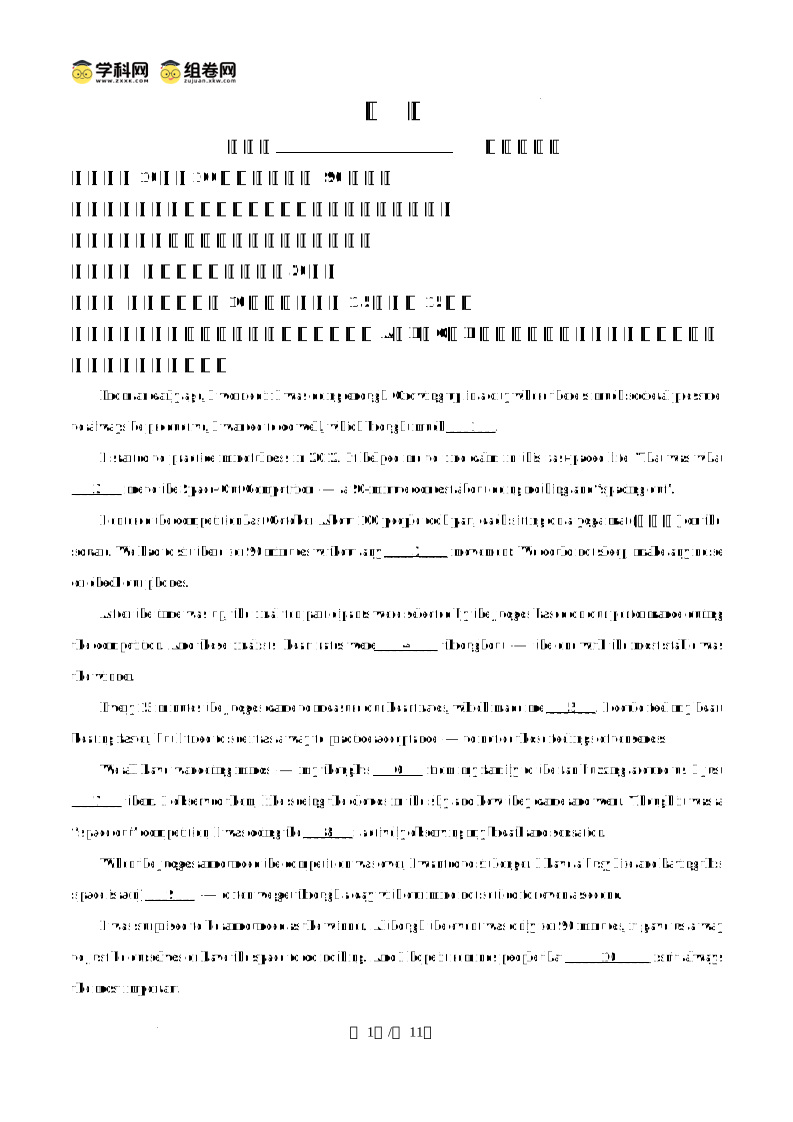
From an early age, I worried if I was doing enough. Growing up in a city where there’s much societal pressure to always be productive, I wanted to do well, which brought much ___1___.
I started to practice mindfulness in 2012. It helped me to find calm in this fast-paced life. That was what ___2___ me to the Space-Out Competition — a 90-minute contest about doing nothing and “spacing out”.
I entered the competition last October. About 100 people took part, each sitting on a yoga mat (瑜伽垫) on the square. We had to sit there for 90 minutes without any ____3____ movement: We could not sleep, make any noise or check our phones.
After the time was up, the final ten participants were selected by the judges based on our performance during the competition. And these finalists’ heart rates were____4____ throughout — the one with the most stable was the winner.
Every 15 minutes the judges came to measure our heart rates, which made me ___5___. I could feel my heart beating faster, but I tried to see it as a way to practice acceptance — to notice those feelings of tenseness.
We all have wandering minds — my thoughts ___6___ from my family to the fan buzzing around us. I just ___7___ them. I observed them, like seeing the clouds in the sky and how they came and went. Though it was a “space out” competition, I was doing the ___8___: actively observing my breath and sensation.
When the judges announced the competition was over, I wanted to sit longer. I have a busy life and having this space is a(n) ___9___ — often we get through a day with our mind not settled for even a second.
I was surprised to be announced as the winner. Although the event was only for 90 minutes, it gave us a way to just be ourselves or have the space to do nothing. And I hope it reminds people that _____10_____ isn’t always the most important.
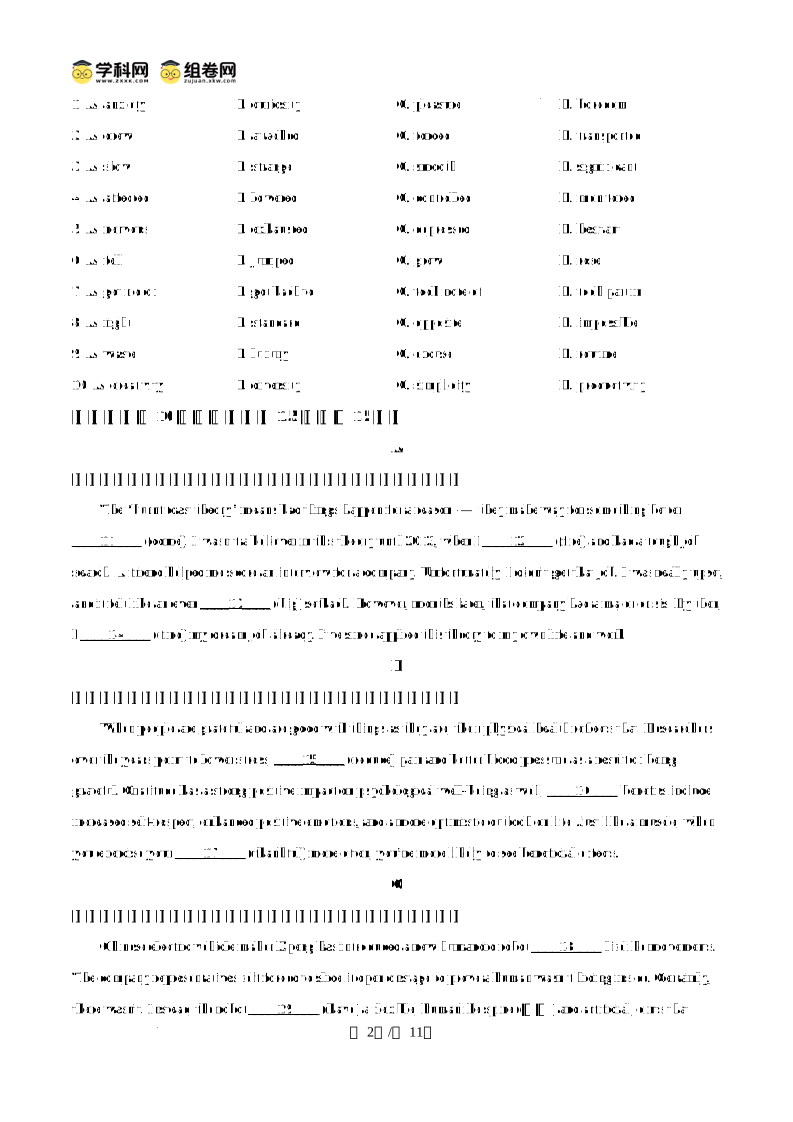
1. A. anxiety B. curiosity C. pleasure D. boredom
2. A. drew B. attached C. forced D. transported
3. A. slow B. strange C. smooth D. significant
4. A. affected B. lowered C. controlled D. monitored
5. A. nervous B. exhausted C. depressed D. hesitant
6. A. fell B. jumped C. grew D. rose
7. A. got rid of B. got back to C. took note of D. took part in
8. A. right B. standard C. opposite D. impossible
9. A. waste B. luxury C. excuse D. routine
10. A. creativity B. diversity C. simplicity D. productivity
【答案】1. A 2. A 3. D 4. D 5. A 6. B 7. C 8. C 9. B 10. D
【解析】
【导语】本文是一篇记叙文。主要讲述作者因身处高压力环境接触正念,参加放空比赛并夺冠,领悟到放空的意义与高效并非唯一重要的道理。
【1题详解】
考查名词词义辨析。句意:在一个总被要求保持高效的城市长大,我想把一切做好,这给我带来了很多焦虑。A. anxiety焦虑;B. curiosity好奇心;C. pleasure愉悦;D. boredom无聊。根据前文“From an early age, I worried if I was doing enough”可知,作者总担心自己做得不够,这种想法带来了焦虑。故选A项。
【2题详解】
考查动词词义辨析。句意:这正是吸引我参加放空比赛的原因——一场时长90分钟、什么都不做只是“放空”的比赛。A. drew吸引;B. attached附上;C. forced强迫;D. transported运输。根据前文“It helped me to find calm in this fast-paced life”可知,正念练习让作者找到平静,这份体验吸引作者参加放空比赛,draw sb. to sth.为固定搭配,意为“吸引某人去做某事”。故选A项。
【3题详解】
考查形容词词义辨析。句意:我们必须在那里坐90分钟,不能有任何明显的动作:不能睡觉、不能发出任何声音、也不能看手机。A. slow缓慢的;B. strange奇怪的;C. smooth平稳的;D. significant明显的。根据后文“We could not sleep, make any noise or check our phones”可知,此处讲述的是比赛的要求,由此可知,此处指的是参赛者不能有明显的肢体动作。故选D项。
【4题详解】
考查动词词义辨析。句意:这些决赛选手的心率全程都被监测——心率最稳定的那个人就是获胜者。A. affected影响;B. lowered降低;C. controlled控制;D. monitored监测。根据后文“Every 15 minutes the judges came to measure our heart rates”可知,裁判每15分钟测量一次心率,即选手的心率全程被监测。故选D项。
【5题详解】
考查形容词词义辨析。句意:裁判每15分钟就来测量一次我们的心率,这让我很紧张。A. nervous紧张的;B. exhausted疲惫的;C. depressed沮丧的;D. hesitant犹豫的。根据后文“I could feel my heart beating faster”可知,作者因裁判测量心率感到心跳加速,内心十分紧张。故选A项。
【6题详解】
考查动词词义辨析。句意:我们都有思绪飘忽的时候——我的思绪从家人突然转到身边嗡嗡作响的风扇上。A. fell落下;B. jumped跳转;C. grew成长;D. rose升起。根据前文“We all have wandering minds”可知,人的思绪会飘忽不定,从一件事突然转到另一件事,jump from...to...为固定搭配,意为“从……跳到……”。故选B项。
【7题详解】
考查动词短语辨析。句意:我只是留意着这些思绪。A. got rid of摆脱;B. got back to回到;C. took note of留意、注意;D. took part in参加。根据后文“I observed them, like seeing the clouds in the sky and how they came and went”可知,作者并未抗拒飘忽的思绪,而是去观察、留意它们。故选C项。
【8题详解】
考查形容词词义辨析。句意:虽然这是一场“放空”比赛,但我做的却是相反的事:主动观察自己的呼吸和感觉。A. right正确的;B. standard标准的;C. opposite相反的;D. impossible不可能的。根据前文“spacing out”以及后文“actively observing my breath and sensation”可知,作者主动进行观察的做法和“放空”的表面意思是相反的。故选C项。
【9题详解】
考查名词词义辨析。句意:我的生活十分忙碌,能有这样一段放空的时光是一种奢侈——我们常常一整天下来,思绪连一秒钟都无法平静。A. waste浪费;B. luxury奢侈;C. excuse借口;D. routine常规。根据前文“I have a busy life”以及后文“often we get through a day with our mind not settled for even a second”可知,作者日常生活忙碌,很难有放空的时间,因此这样的时光是一种奢侈。故选B项。
【10题详解】
考查名词词义辨析。句意:我希望这能提醒人们,高效并非总是最重要的。A. creativity创造力;B. diversity多样性;C. simplicity简单;D. productivity高效。根据前文“Growing up in a city where there’s much societal pressure to always be productive”可知,作者成长的环境总强调要保持高效,而这次比赛让作者领悟到高效并非唯一重要的事。故选D项。
第二节(共10小题;每小题1.5分,共15分)
A
阅读下列短文,根据短文内容或括号内所给词的恰当形式填空。
The “burnt toast theory” means bad things happen for a reason — they make way for something better ____11____ (come). I wasn’t a believer in this theory until 2013, when I ____12____ (fire) and had a tough job search. A friend helped me score an interview for a company. Unfortunately, I didn’t get that job. I was really upset, and it felt like an even ____13____ (big) setback. However, months later, that company had a major crisis. By then, I ____14____ (find) my dream job already. I’ve since applied this theory to my own life and work.
【答案】11. to come
12. was fired
13. bigger 14. had found
【解析】
【导语】这篇文章主要介绍了作者通过自身求职经历,感悟“烤焦面包理论”—— 坏事发生皆有缘由,会为更好的事情让路,并将这一人生道理运用到生活和工作中。
【11题详解】
考查非谓语动词。句意:“烤焦面包理论” 意思是坏事的发生皆有缘由 —— 它们会为更好的事情到来让路。make way for sth. to do表示“为即将……的事情让路”,用不定式to come作后置定语。
【12题详解】
考查时态语态。句意:我一直不相信这个理论,直到2013年,我被解雇,找工作屡屡碰壁。时间为2013年,用一般过去时,主语I与fire是被动关系,用一般过去时被动语态was fired。
【13题详解】
考查形容词。句意:我非常沮丧,感觉这是一个更大的挫折。空处需填形容词作定语,even后常修饰形容词比较级,big的比较级为bigger。
【14题详解】
考查时态。句意:到那时,我已经找到了自己理想的工作。此处by then表示“到公司面临危机的那个时候”,公司面临危机(company had a major crisis)是过去的事情,找到工作发生在该动作之前,表示“过去的过去” 用过去完成时had found。
B
阅读下列短文,根据短文内容或括号内所给词的恰当形式填空。
When people are grateful and are good with things as they are, their physical health reflects that. Researchers over the years point to lower stress, ____15____ (reduce) pain and better blood pressure as a result of being grateful. Gratitude has a strong positive impact on psychological well-being as well, ____16____ benefits include increased self-respect, enhanced positive emotions, and a more optimistic outlook on life. Just like a muscle, when you exercise your ____17____ (thankful) more often, you’re more likely to see beneficial effects.
【答案】15. reduced
16. whose 17. thankfulness
【解析】
【导语】这篇文章主要介绍了心怀感恩、坦然接纳现状对人的身体健康和心理健康都有积极影响,并指出感恩如同肌肉,经常锻炼就能收获益处。
【15题详解】
考查非谓语动词。句意:多年来研究人员指出,心怀感恩能缓解压力、减轻疼痛并改善血压状况。此处与lower stress、better blood pressure并列,用过去分词reduced作定语修饰名词pain,表被动和完成。
【16题详解】
考查定语从句。句意:感恩对心理健康也有很强的积极影响,其好处包括增强自尊、提升积极情绪以及拥有更乐观的人生态度。空处引导非限制性定语从句,指代先行词Gratitude,在从句中作定语修饰benefits,用关系代词whose引导从句。
【17题详解】
考查名词。句意:就像肌肉一样,当你更频繁地锻炼自己的感恩之心时,就更有可能看到有益的效果。形容词性物主代词your后接名词,thankful对应的名词形式是thankfulness,是不可数名词。
C
阅读下列短文,根据短文内容或括号内所给词的恰当形式填空。
Chinese electric vehicle maker Xpeng has introduced a new humanoid robot ____18____ lifelike movements. The company representatives felt forced to slice it open onstage to prove a human wasn’t hiding inside. Certainly, there wasn’t. Instead, the robot ____19____ (have) a flexible, humanlike spine (脊柱) and artificial joints that allow it to move like a human model. This is thanks to Xpeng’s custom AI robotics architecture, which enables it to interpret visual inputs and respond physically without needing to first translate ____20____ it sees into language.
【答案】18. with
19. has 20. what
【解析】
【导语】这篇文章主要介绍了中国电动汽车制造商小鹏推出一款拥有逼真动作的人形机器人,介绍了其身体构造、技术架构以及无需语言转化即可做出肢体反应的特点。
【18题详解】
考查介词。句意:中国电动汽车制造商小鹏推出了一款拥有逼真动作的新型人形机器人。此处表示“带有、拥有”,用介词with。
【19题详解】
考查时态。句意:相反,这款机器人拥有一根灵活的、类人的脊柱和人造关节,能让它像人类模特一样活动。描述客观事实用一般现在时,主语the robot是单数第三人称,谓语动词用has。
【20题详解】
考查宾语从句。句意:这得益于小鹏自研的人工智能机器人架构,该架构使其能够解读视觉信息并做出肢体反应,而无需先把它所看到的东西转化为语言。空格处引导宾语从句,从句中sees缺宾语,表示“所……的事物”,用what引导宾语从句。
第二部分 阅读理解(共两节,38分)
第一节(共14小题;每小题2分,共28分)
阅读下列短文,从每题所给的A、B、C、D四个选项中,选出最佳选项,并在答题卡上将该项涂黑。
A
Loved Before
The first eco-friendly, fully sustainable soft toy adoption agency
“Several years back, during my time as a volunteer at a charity shop, I observed the arrival of second-hand toys at the store. These pre-loved toys, often handed over with cherished memories and emotional significance, were carelessly cast aside, sometimes became dog toys or, even more dishearteningly, destined for the landfill.
It became evident to me how the love, lively life, and stories of these eco-toys were at risk of being lost and forgotten in an instant. That was when Loved Before was born with the mission to revolutionize our perspective on sustainable toys.”
---Charlotte, Founder
What we do
Your pre-loved toys arrive at our headquarter where they officially become Loved Befores and have a tailored and thorough “Spa” treatment to make them clean.
Each toy will have its own photoshoot, be added to the store along with the story of their previous lives and adventures, and be re-homed to their new family!
At least half of the profit from every one of our sustainable toys once adopted goes to Make-A-Wish, a non-profit organization who creates and fulfils life-changing wishes for children living with critical illnesses.
What we believe
Imperfect I’m perfect: Our collections showcase toys that have weathered the journey of life---worn and beautifully imperfect. Loved Before believes that in the world of love and acceptance, “imperfections” hold no weight. True beauty lies in the individuality of each toy, and there’s no such thing as “perfect”.
Saving the world, one teddy at a time: While our passion for teddies is undeniable, at Loved Before, we view our mission as a driving force for a broader shift in mindset---one where sustainable toys, particularly our eco-friendly teddies, mark just the beginning! We passionately believe that the world is already filled with enough soft toys to last a lifetime, eliminating (消除) the necessity to produce more. By shifting perceptions of pre-loved items, we’re on a mission to revolutionize the toy industry forever. Our collection is a movement towards a greener, more conscious playtime.
21. What inspired Charlotte to start Loved Before?
A. The improper treatment of old toys. B. The new attitude toward dog toys.
C. The profits from charities. D. The donations from kids.
22. According to the passage, Loved Before ________.
A. fulfils toy owners’ wishes B. helps to cure sick children
C. shares the toys’ life stories D. buys thoroughly cleaned toys
23. What is the significance of Loved Before?
A. Achieving perfection in life. B. Stressing the impact of teddies.
C. Promoting the production of toys. D. Raising environmental awareness.
【答案】21. A 22. C 23. D
【解析】
【导语】主要介绍Loved Before这家全球首个环保且完全可持续的毛绒玩具收养机构,讲述其创立原因、运营模式及秉持理念,强调对环保和改变玩具行业观念的重要意义。
【21题详解】
细节理解题。根据创始人Charlotte所说“These pre-loved toys, often handed over with cherished memories and emotional significance, were carelessly cast aside, sometimes became dog toys or, even more dishearteningly, destined for the landfill. It became evident to me how the love, lively life, and stories of these eco-toys were at risk of being lost and forgotten in an instant.(这些承载着珍贵回忆和情感意义的二手玩具被随意丢弃,有时沦为狗狗的玩具,更令人沮丧的是,它们最终被送去填埋。我意识到这些环保玩具的爱、鲜活的生命和故事可能瞬间就会被遗忘。)”可知,旧玩具受到的不当对待启发Charlotte创立了Loved Before。
【22题详解】
细节理解题。根据“What we do”部分“Each toy will have its own photoshoot, be added to the store along with the story of their previous lives and adventures, and be re-homed to their new family!(每个玩具都会有自己的照片拍摄,连同它们以前的生活和冒险故事一起被添加到商店里,然后被重新安置到它们的新家庭!)”可知,Loved Before会分享玩具的生活故事。
【23题详解】
推理判断题。根据“What we believe”部分“By shifting perceptions of pre-loved items, we’re on a mission to revolutionize the toy industry forever. Our collection is a movement towards a greener, more conscious playtime.(通过改变对二手物品的看法,我们致力于永远彻底改变玩具行业。我们的收藏是朝着更环保、更有意识的玩耍时间的一种行动)”可知,Loved Before的意义在于提高环保意识。
B
I have always felt most comfortable in the classroom, and I enjoy the recognition from family and teachers for accomplishing a job well. Although I was a high achiever, I was not a student who joined every club. Throughout my life, I wanted to learn more than I wanted to be in a bunch of extracurriculars (课外活动).
My academic journey continued at a community college, where I joined the student newspaper. In the newsroom, I discovered an engaging, fast-paced world that allowed me to never stop learning. It was just what I had expected. Now my transfer (转学) to Drake University for a journalism degree was a no-brainer. It was exciting to see my future become clear, but I never pictured the shock waves headed my way.
The campus phenomenon known as “Drake Busy” was completely unexpected. The term describes the idea that constant busyness is the main indicator of college success. Within the first week, I felt heavy pressure to be active in all the ways my peers (同伴) were. I saw students trying to balance multiple jobs and organizations alongside schoolwork. As a student used to having confidence in the classroom, I felt this new standard threatened my identity and worsened my anxiety. I spent my first term struggling with doubts about my worthiness. My anxious thoughts tricked my mind into believing lies like “You’re not good enough.” A part of my mind realized those thoughts were not true, but that sensible voice was a whisper compared to the shouts of doubt. As a witness to this battle every day, I have learned that sometimes it just takes time to chip away at my mind’s inventions.
In time, I recognized that my experience as a transfer student was different but valuable. The outsider perspective helped me tackle “Drake Busy”. I watched people trying to do too much at the expense of their well-being. I wanted to shake them and say, “Why do this to yourself?”
Instead of fighting the current, I eventually learned to swim in my own lane. The pressure didn’t disappear, but my need to give in to it did. I realized that my worth wasn’t calculated by the number of meetings on my calendar, but by the real satisfaction I felt in my work. On the days I managed to balance my ambition with my peace of mind, I felt most motivated. I discovered that: true success is defined internally, not by the noise around you.
24. Before entering Drake University, the author ________.
A. adopted a relaxing lifestyle B. longed to become a teacher
C. struggled to choose a major D. performed well academically
25. How did the author feel within the first week at Drake University?
A. Unaccustomed. B. Relieved. C. Regretful. D. Expectant.
26. What does the author think of the “Drake Busy” lifestyle?
A. It lowers students’ learning efficiency. B. It indicates students’ future success.
C. It threatens students’ well-being. D. It erases students’ self-doubt.
27. What message does the passage deliver?
A. Outsiders rarely win. B. Your own pace matters.
C. Busyness equals worthiness. D. Your anxiety drives you forward.
【答案】24. D 25. A 26. C 27. B
【解析】
【导语】文章主要讲述了作者从社区学院转学到德雷克大学后,面对校园内“Drake Busy”现象带来的压力与焦虑,最终学会按照自己的节奏生活、重新找到自我价值的心路历程。
【24题详解】
细节理解题。根据第一段“Although I was a high achiever, I was not a student who joined every club. (虽然我是一个成绩优异的学生,但我并不是一个参加所有社团的学生。)”可知,作者在转学之前学业上表现优异。
【25题详解】
推理判断题。根据第三段“Within the first week, I felt heavy pressure to be active in all the ways my peers were. (在第一周内,我感到巨大的压力,要以同伴们所有的活跃方式去参与活动。)”以及“As a student used to having confidence in the classroom, I felt this new standard threatened my identity and worsened my anxiety. (作为一个习惯在课堂上有自信的学生,我感到这种新标准威胁到了我的身份认同,并加剧了我的焦虑。)”可知,作者第一周感到不适应这种全新的校园氛围。
【26题详解】
细节理解题。根据第四段“I watched people trying to do too much at the expense of their well-being. (我看到人们试图做太多事情,却以牺牲自己的幸福感为代价。)”可知,作者认为“Drake Busy”这种生活方式威胁到了学生的身心健康。
【27题详解】
主旨大意题。根据最后一段中“Instead of fighting the current, I eventually learned to swim in my own lane. (我不再与潮流对抗,最终学会了在自己的泳道里游泳。)”以及“I discovered that: true success is defined internally, not by the noise around you. (我发现:真正的成功是由内心定义的,而非周围的喧嚣。)”可知,文章传达的信息是:走自己的路、按照自己的节奏生活才是最重要的。
C
Whales are some of the most highly intelligent species on Earth. Each species of whale has a distinct communication system that often varies within populations. Since humans have been researching and observing these forms of communication, a question has surfaced: Could humans one day engage in acoustic (声学的) interactions with whales? And what could these interactions reveal about non-human intelligence? Researchers from the University of California and the Alaska Whale Foundation have been exploring whale-to-human communication with humpback whales, and they’ve come up with some fascinating conclusions.
When scientists recorded a humpback whale contact call, known as a whup, and played it underwater around their research vessel, they were surprised when a whale named Twain became a more than willing participant in the call-and-response exchange. Scientists produced a single sound, or whup call, that Twain would then respond with her own whup call to them, a “conversation” described in their PeerJ paper.
“It might loosely translate to ‘hello’ or some sort of greeting call for when animals come together or just to signal that individuals are in a certain location,” says Dawson Hubbard, study author and animal behaviourist with Whale SETI. In this case, it was as if Twain was either saying “hello” to scientists or “I’m over here.” But in both instances, she was responding to and engaging with whale signals that humans produced.
Of course, whether whales want to communicate with humans varies by the temperament of the whale and by the situation. Just like some humans are more extroverted than others, this could also be true for whales, although this would need more research to understand. Twain circled around the scientists’ boat and was in proximity to its speakers. Permit limitations only allow for researchers to produce the sound for 20 minutes, but once they stopped, Twain continued to produce more signals before leaving. “What’s cool about Twain is that she could have left at any point, as it wasn’t a caged environment where she couldn’t leave, so she was choosing to be close to us,” says Hubbard.
Often, a willingness to communicate with humans would be food-mediated, but in this case, it wasn’t. There have also been other examples. Gray whales in the San Ignacio lagoon in Mexico, for example, are famously friendly. In fact, some gray whales regularly approach boats and allow visitors to have gentle contact with them.
According to the Oceanic Society, this behaviour isn’t shared amongst all gray whales, and in fact, this species of whale was almost hunted to extinction just a generation ago. But the behaviour may have been passed down through generations, and some gray whales in this population voluntarily approach humans. In the end, these and other encounters show that, in some cases, individual whales appear willing to engage with humans. And the more we learn about their mode of communication and what they are saying to us, the more we can learn about them.
28. To study whales, the scientists _______.
A. caught whales for controlled experiments
B. trained whales to converse with humans
C. responded to whales with recorded calls
D. played whale calls to interact with them
29. What can we infer from the passage?
A. The maximum duration of whales’ response is 20 minutes.
B. Gray whales’ friendly behaviour may be a learned feature.
C. Whales’ personality decides their willingness to interact.
D. Humpback whales respond to humans for food rewards.
30. Which of the following can be the best title for the passage?
A. Decoding the Talk Between Humans and Whales
B. Are Whales Willing to Talk with Humans?
C. Could Humans Ever Talk with Whales?
D. Unlocking the Secret of Whale Whups
【答案】28. D 29. B 30. C
【解析】
【导语】文章围绕人类能否与鲸鱼开展声学交流展开,介绍相关实验发现与鲸鱼互动的相关特点。
【28题详解】
细节理解题。根据第二段中的“When scientists recorded a humpback whale contact call, known as a whup, and played it underwater around their research vessel, they were surprised when a whale named Twain became a more than willing participant in the call-and-response exchange.(当科学家录制了一种座头鲸的联络叫声,名为呜呜声,并在研究船的水下播放该声音时,他们惊讶地发现一头名为吐温的鲸鱼十分乐意参与这场一问一答的交流)”可知,科学家通过播放鲸鱼叫声与鲸鱼互动开展研究。
【29题详解】
推理判断题。根据第六段中的“But the behaviour may have been passed down through generations, and some gray whales in this population voluntarily approach humans.(但这种行为可能代代相传,该种群中的一些灰鲸会主动靠近人类)”可知,灰鲸友好的行为可能是后天习得、代代传承的特征。
【30题详解】
主旨大意题。根据第一段中的“Could humans one day engage in acoustic interactions with whales? And what could these interactions reveal about non-human intelligence?(人类有朝一日能否与鲸鱼开展声学交流?这些交流又能揭示出哪些非人类智慧的信息?)”以及全文内容可知,文章围绕人类能否与鲸鱼交流这一核心问题,结合实验、案例展开探讨。C选项“人类终将与鲸鱼对话吗?”精准概括全文主旨,是最佳标题。
D
Pictures and videos of all sorts of animals regularly go viral these days because people connect with the apparent joy, friendship and playfulness of these animals. Unfortunately, the initial enthusiasm of these posts is often squashed by someone rightly noting that the animal’s reaction is not joy or pleasure, but fear, anger or pain.
The reason we often get cases like this wrong is that we interpret the emotional content of many behaviors automatically and unconsciously. This is a version of anthropomorphism: interpreting animals as we would interpret another human. The standard view has been that anthropomorphism is primarily an error of overestimating the intelligence of animals. In recent decades, many authors have pushed back against this attitude towards anthropomorphism, arguing animals are a lot like us and that many “anthropomorphic” claims about animals are actually true.
Instead of getting caught in a black-and-white debate, however, I want a more complicated, informed discussion of competing ideas. Once we agree that animals do in fact, have emotions, we can acknowledge that the anthropomorphic mistake is not seeing emotion where there is none — it is seeing the wrong emotion.
Each of us has a set of perceptual, emotional and cognitive capacities that allow us to engage and understand one another socially. These capacities help guide and structure all sorts of interactions, and we are generally not even aware we are using them. They are generally, but not perfectly, tuned for human interaction. Things can get messy, though, when we use them to interpret animals. Perhaps the best-studied version of this is the primate “grin” (灵长类动物的咧嘴笑). The animal is not happy, it turns out. The exact signaling function varies by species, but it usually signals something more like fear or anxiety, often by a submissive individual in a tense social situation. This is, in fact, anthropomorphism, because you are interpreting an animal’s behavior in the same way we would interpret human behavior. This kind of anthropomorphism is a form of cognitive bias (偏见) resulting from shortcuts taken by our reasoning processes, usually without our awareness.
We should approach the topic of anthropomorphism from the angle of bias. Traditionally, assumptions about how and when people anthropomorphise have been so fixed that the psychology did not seem worth investigating. Slightly different attitudes can be found. For example, even though they advocate for anthropomorphic views of animals, the zoologists Jesus Rivas and Gordon Burghardt memorably note that it can be tricky: “Anthropomorphism comes in many forms and can catch you off guard!” While the recognition of “many forms” is progress, it makes the need for evidence-based research only more pressing. By focusing on implicit (隐性的) anthropomorphism, we shift attention from debating specific “humanlike” features to examining the deeper psychological mechanisms that make anthropomorphism so slippery. This, I believe, is the most challenging and most significant dimension of the problem.
31. What does the word “squashed” underlined in Paragraph 1 probably mean?
A. Awakened. B. Dampened. C. Misguided. D. Underestimated.
32. What can we learn about anthropomorphism?
A. It turns animals’ negative emotions into positive ones
B. It underrates the emotional capacities of animal species.
C. It contributes to the shortcuts of our reasoning processes.
D. It reflects the projection of human qualities onto animals
33. The author quotes Jesus and Gordon to ________.
A. confirm the value of anthropomorphism
B. highlight the complexity of anthropomorphism
C. warn us of the limitations of anthropomorphism
D. remind us to view anthropomorphism positively
34. What does the author intend to do by writing this passage?
A. Propose a fresh perspective. B. Analyze a worrying tendency.
C. Evaluate the credibility of a theory. D. Explore the origin of a phenomenon.
【答案】31. B 32. D 33. B 34. A
【解析】
【导语】文章主要探讨了人类对动物行为的拟人化解释现象,指出这往往源于认知偏差,并呼吁从偏见角度深入研究这一复杂问题。
【31题详解】
词句猜测题。根据第一段“Pictures and videos of all sorts of animals regularly go viral these days because people connect with the apparent joy, friendship and playfulness of these animals. Unfortunately, the initial enthusiasm of these posts is often squashed by someone rightly noting that the animal’s reaction is not joy or pleasure, but fear, anger or pain.(如今,各类动物的图片和视频时常在网上疯传,因为人们会被这些动物流露出的喜悦、友谊和嬉戏感所打动。不幸的是,这些帖子的最初热情常常被一些人_____,他们有理有据地指出,动物的反应不是喜悦或快乐,而是恐惧、愤怒或痛苦)”可知,动物的反应是恐惧、愤怒或痛苦,而不是人们所以为的喜悦或快乐,因此人们对这些帖子的热情会减弱,故划线词squashed意为“减弱,受到抑制”,与“Dampened”意思相近。
【32题详解】
细节理解题。根据第二段中“This is a version of anthropomorphism: interpreting animals as we would interpret another human. (这是一种拟人化:像解读另一个人一样解读动物)”可知,拟人化用解读人的方式来解读动物,反映了将人类特质投射到动物身上的现象。
【33题详解】
推理判断题。根据第五段中“For example,even though they advocate for anthropomorphic views of animals, the zoologists Jesus Rivas and Gordon Burghardt memorably note that it can be tricky: “Anthropomorphism comes in many forms and can catch you off guard!” (例如,动物学家Jesus Rivas和Gordon Burghardt虽然主张对动物采取拟人化的看法,但他们特别指出,这可能会很棘手:“拟人化有多种形式,可能会让你措手不及!”)”可知,作者引用Jesus和Gordon的话是为了说明拟人化并非简单的问题,它形式多样,容易让人在不经意间犯错,从而强调了拟人化这一现象的复杂性。
【34题详解】
推理判断题。通读全文,结合最后一段中“We should approach the topic of anthropomorphism from the angle of bias. Traditionally, assumptions about how and when people anthropomorphise have been so fixed that the psychology did not seem worth investigating...By focusing on implicit (隐性的) anthropomorphism, we shift attention from debating specific “humanlike” features to examining the deeper psychological mechanisms that make anthropomorphism so slippery. This, I believe, is the most challenging and most significant dimension of the problem. (我们应该从偏见的角度来探讨拟人化这一话题。传统上,关于人们如何以及何时进行拟人化的假设太过固定,以至于其背后的心理机制似乎不值得研究。……通过关注隐性拟人化,我们将注意力从争论具体的“类人”特征转移到审视使拟人化如此难以捉摸的更深层次的心理机制上。我相信,这是这个问题最具挑战性也最有意义的维度)”可知,作者分析了拟人化的现象、问题及成因,并指出传统研究的不足,进而提出从“偏见”和“心理机制”角度研究拟人化的新方向。因此,作者通过写这篇文章旨在提出一个新的研究视角。
第二节(共5小题;每小题2分,共10分)
根据短文内容,从短文后的七个选项中选出能填入空白处的最佳选项,并在答题卡上将该项涂黑。选项中有两项为多余选项。
Cut your sugar, get some exercise, eat your vegetables, sleep well. Every day, we are surrounded by information about how to live longer, healthier, happier lives. ___35___ It is to engage in the arts.
Over the past few decades, evidence has been increasing to suggest that being more creative works wonders for our health. ___36___ And the results are astonishing, from music in surgery reducing the amount of painkillers and anti-anxiety medicines needed, to dance programs helping people with Parkinson’s disease to walk.
But the arts aren’t just there for us when we are sick. As a public health scientist. I spend my days looking at data from studies — massive datasets that contain thousands of individuals who have completed questionnaires, had nurse interviews, donated blood samples and undergone brain imaging every few years of their lives. ___37___Using complex statistical methods, we can look at the long-term relationship between everyday arts engagement and dozens of health outcomes.
The results are remarkable. Children who engage more with the arts have a reduced risk of developing problems like depression later in life. Adults who participate more frequently in the arts and visit cultural venues are happier and feel more satisfied with their lives over the years and decades that follow
___38___ Kindergarteners who engage in music activities have increased prosocial skills as they head into primary school. Teenagers who are involved in bands, dance and editing school newspapers are less likely to get involved in antisocial behaviors or crime.
I want to be clear: I am not suggesting the arts can solve all problems.___39___ But the evidence remains that engaging regularly in creative activities that you enjoy is an investment in your health that is worth making.
A. The benefits aren’t just psychological either.
B. Regular arts engagement goes beyond boosting physical health.
C. But there is one piece of advice I bet you have never been given.
D. Many of these studies contain buried questions on arts engagement.
E. Arts can be inaccessible to people because of cost and other reasons.
F. Crafts, singing, theatre and writing are good for us as part of our daily lives.
G. Programs being developed around the world are starting to integrate the arts into healthcare.
【答案】35. C 36. G 37. D 38. A 39. E
【解析】
【导语】本文主要介绍了参与艺术活动对健康的益处,并通过科学研究数据支持了这一观点,说明将艺术融入日常生活是一种值得的健康投资。
【35题详解】
根据上文“Cut your sugar, get some exercise, eat your vegetables, sleep well. Every day, we are surrounded by information about how to live longer, healthier, happier lives. (少吃糖、多运动、吃蔬菜、睡好觉。每天,我们都被如何活得更长久、更健康、更幸福的信息所包围。)”可知,这是在列举常见的生活建议。再结合下文“It is to engage in the arts. (那就是参与艺术活动。)” 可知,下文“It”指代一种建议,因此空处应引出一种与众不同的建议,与上文的常见建议形成对比。C选项“But there is one piece of advice I bet you have never been given. (但我打赌有一条建议你从未得到过。)” 以“But”转折,引出下文不常见的建议“参与艺术活动”,其中“one piece of advice”与下文的“It”指代一致,符合语境。
【36题详解】
根据下文“And the results are astonishing, from music in surgery reducing the amount of painkillers and anti-anxiety medicines needed, to dance programs helping people with Parkinson’s disease to walk.(结果令人惊讶,从手术中的音乐减少了所需的止痛药和抗焦虑药物的数量,到舞蹈项目帮助帕金森病患者行走。)”可知,此处提到了艺术在医疗方面的应用,G选项“Programs being developed around the world are starting to integrate the arts into healthcare.(世界各地正在开发的项目开始将艺术融入医疗保健。)”引出了下文的医疗应用实例“music in surgery”和“dance programs”,符合语境。
【37题详解】
根据上文“As a public health scientist. I spend my days looking at data from studies — massive datasets that contain thousands of individuals who have completed questionnaires, had nurse interviews, donated blood samples and undergone brain imaging every few years of their lives. (作为一名公共卫生科学家,我每天研究来自大量研究的数据集,其中包含数千名个体,他们每隔几年完成问卷、接受护士访谈、捐献血液样本并进行脑成像。)” 可知,这些研究数据集内容广泛。再根据下文“Using complex statistical methods, we can look at the long-term relationship between everyday arts engagement and dozens of health outcomes.(使用复杂的统计方法,我们可以研究日常艺术参与与数十种健康结果之间的长期关系。)”可知, 此处开始讨论“arts engagement”与健康的关系,因此空处应能建立起“庞大研究数据”与“艺术参与”之间的联系。D选项“Many of these studies contain buried questions on arts engagement.( 其中许多研究都包含了关于艺术参与的隐含问题。)”完美地起到了这个桥梁作用,说明这些庞大的数据集中也包含了关于艺术参与的信息,从而使得下文研究两者的长期关系成为可能,符合语境。
【38题详解】
根据下文“Kindergarteners who engage in music activities have increased prosocial skills as they head into primary school. Teenagers who are involved in bands, dance and editing school newspapers are less likely to get involved in antisocial behaviors or crime.(参与音乐活动的幼儿园儿童在进入小学时亲社会技能有所提高。参与乐队、舞蹈和编辑校报的青少年不太可能参与反社会行为或犯罪。)”可知,此处提到了艺术参与对儿童心理和行为方面的益处,A选项“The benefits aren’t just psychological either.(这些益处不仅仅是心理上的。)”中的“psychological”总结上文(抑郁、幸福感、生活满意度),并用“aren’t just”自然引出下文的社会行为益处(亲社会技能、减少反社会行为),起到了承上启下作用。
【39题详解】
根据上文“I want to be clear: I am not suggesting the arts can solve all problems. (我想澄清一点:我并不是说艺术能解决所有问题。)”可知,作者在客观地指出艺术的局限性。下文提到“But the evidence remains that engaging regularly in creative activities that you enjoy is an investment in your health that is worth making. (但证据仍然表明,定期参与你喜欢的创造性活动是对你健康的投资,是值得的。)”定期参加创造性活动有益处,这是一个转折,重申了艺术对健康的积极价值。因此,空处的内容应既能体现艺术的某种局限性(与上文“不能解决所有问题”呼应),又不能完全否定其价值,从而为下文的转折“But...”做铺垫。E选项“Arts can be inaccessible to people because of cost and other reasons. (艺术可能因为成本和其他原因而让一些人难以接触。) 指出了艺术的一个现实局限(可及性问题),这与“不能解决所有问题”的逻辑一致,同时为下文“但……值得投资”的转折提供了合理的过渡,符合语境。
第三部分 书面表达(共两节,32分)
第一节(共4小题;第40、41题各2分,第42题3分,第43题5分,共12分)
阅读下面短文,根据题目要求用英文回答问题。请在答题卡指定区域作答。
Over breakfast, I chatted with Mia, my Spanish study buddy. I reviewed my recent lesson and shared what I’d learned from a podcast. By the end of our 10-minute talk, I felt I had gained more than from another textbook exercise.
Mia, however, is not a real person. She is an AI I created to make use of the “protege effect.” It is a psychological phenomenon where we learn more effectively when we teach someone else about a topic we’ve just explored — even if that person doesn’t really exist.
The principle of “learning by teaching” was first introduced in the early 1980s by Jean-Pol Martin, a French teacher, who allowed students to research and present parts of the curriculum to their classmates. The technique boosted their motivation and self-confidence, and it soon spread to many other schools.
In one study, a US scientist, Caroline Chase tested its effectiveness. Her team asked 62 eighth-graders to use a computer program to learn about the biological changes during a fever. Over two lessons, students read a text and created a flowchart. Half did it as self-study; the others were told their work would help teach a virtual character on the screen.
It was a small change, but the students in the role of teacher scored significantly better. This increased engagement made a big difference in both the amount they absorbed and the depth of their understanding.
Chase’s team named this the “protege effect”, and it has since been confirmed by later studies. Knowing that others will learn from us creates a sense of responsibility to provide accurate information. This responsibility drives us to make a greater effort to fill in the gaps in our own understanding and correct any mistaken assumptions before we pass them on. Explaining our knowledge then helps to strengthen what we have learned.
So why not give it a try? To truly master something, start teaching it — even if your student is only a virtual one.
40. What is the “protege effect”?
______________________________________________________________
41. Why did students in the role of teacher score better in Chase’s study?
______________________________________________________________
42. Please decide which part is false in the following statement, then underline it and explain why.
➤The responsibility to teach others pushes us to point out their mistaken assumptions.
______________________________________________________________
43. How can you put the “protege effect” into practice? (In about 40 words)
______________________________________________________________
【答案】40. It is a psychological phenomenon where we learn more effectively when we teach someone else about a topic we’ve just explored.
41. Because this increased engagement made a big difference in both the amount they absorbed and the depth of their understanding.
42. The responsibility to teach others pushes us to point out their mistaken assumptions.
The responsibility to teach others pushes us to correct our mistaken assumptions.
43. Possible Version
I often ask a friend or AI to be my student. After learning, I explain in my own words and take questions. This helps me organize my thoughts and find areas for improvement, which is how I truly learn.
【解析】
【导语】本文是一篇说明文。文章主要讲述了“门生效应”这一心理现象及其在教学中的应用和效果。
【40题详解】
考查细节理解。根据第二段“She is an AI I created to make use of the ‘protege effect.’ It is a psychological phenomenon where we learn more effectively when we teach someone else about a topic we’ve just explored — even if that person doesn’t really exist.(她是我创造出来利用“门生效应”的人工智能。这是一种心理现象,即当我们向他人传授我们刚刚探索过的话题时,我们会学得更有效——即使那个人并不真正存在)”可知,“门生效应”指的是当我们向他人传授我们刚刚探索过的话题时,我们会学得更有效这种心理现象。故答案为It is a psychological phenomenon where we learn more effectively when we teach someone else about a topic we’ve just explored.
【41题详解】
考查细节理解。根据第五段“It was a small change, but the students in the role of teacher scored significantly better. This increased engagement made a big difference in both the amount they absorbed and the depth of their understanding.(这是一个小小的变化,但扮演教师角色的学生得分明显更高。这种增加的参与度对他们吸收的知识量和理解的深度都产生了很大的影响)”可知,在Chase的研究中,扮演教师角色的学生得分更高是因为这种增加的参与度对他们吸收的知识量和理解的深度都产生了很大的影响。故答案为Because this increased engagement made a big difference in both the amount they absorbed and the depth of their understanding.
【42题详解】
考查细节判断。根据第六段“This responsibility drives us to make a greater effort to fill in the gaps in our own understanding and correct any mistaken assumptions before we pass them on.(这种责任感促使我们在传递信息之前,更加努力地填补自己理解上的空白,纠正任何错误的假设)”可知,是纠正我们自己错误的假设,而不是指出他们错误的假设,所以原句“The responsibility to teach others pushes us to point out their mistaken assumptions.”表述错误,应改为“The responsibility to teach others pushes us to correct our mistaken assumptions”。故答案为The responsibility to teach others pushes us to point out their mistaken assumptions. The responsibility to teach others pushes us to correct our mistaken assumptions。
【43题详解】
考查开放性题目。根据最后一段“So why not give it a try? To truly master something, start teaching it — even if your student is only a virtual one.(那么为什么不试一试呢?要真正掌握某样东西,就开始教它——即使你的学生只是一个虚拟的)”以及结合全文对“门生效应”的介绍可知,要真正掌握某样东西,就可以利用“门生效应”,我经常让一位朋友或人工智能充当我的“学生”。学习之后,我会用自己的话进行解释并回答问题。这样做能帮助我理清思路,找出需要改进的地方,从而真正学习。故答案为:I often ask a friend or AI to be my student. After learning, I explain in my own words and take questions. This helps me organize my thoughts and find areas for improvement, which is how I truly learn.
第二节(20分)
44. 假设你是红星中学高三学生李华。你们学校上周开展了主题为“运动邂逅青春”的活动。你的外国好友Jim来信就此询问。请你用英文给他回复,内容包括:
1.活动情况;
2.你的感受。
注意:1.词数100左右;
2.开头和结尾已给出,不计入总词数。
Dear Jim,
____________________________________________________________________________________________________________________________________________________________________________________________________________________________________________________________________________________
Yours,
Li Hua
【答案】Dear Jim,
Glad to share with you the “Sports Meet Youth” activity held in our school last week.
The event lasted for a week. On the first day, three famous young athletes came and joined us in various sports, like ball games and running. In the following days, we participated in different sports competitions. My favorite was group rope skipping. It was super fun and my class won the first prize! Exciting, right?
All of us find the event truly meaningful for us youth. Personally, I’m convinced that in addition to improving our physical health, doing sports helps us reduce stress and bring us closer. And I have decided to take regular exercise in future.
I’m really looking forward to playing a basketball game with you!
Yours,
Li Hua
【解析】
【导语】本篇书面表达属于应用文。要求考生给外国好友Jim回信,介绍学校上周“运动邂逅青春”活动情况并分享感受。
【详解】1. 词汇积累
高兴的:glad → delighted
各种各样的:various → diverse
有意义的:meaningful → significant
减少:reduce → lessen
2. 句式拓展
简单句变复合句
原句:Glad to share with you the “Sports Meet Youth” activity held in our school last week.
拓展句:Glad to share with you the “Sports Meet Youth” activity, which was held in our school last week.
【点睛】【高分句型1】Personally, I’m convinced that in addition to improving our physical health, doing sports helps us reduce stress and bring us closer. (运用了that引导的宾语从句)
【高分句型2】I’m really looking forward to playing a basketball game with you! (运用了动名词短语作宾语)
第1页/共1页
学科网(北京)股份有限公司
$
英 语
姓名: 准考证号:
本试卷共10页,100分。考试时长 90 分钟。
考生务必在答题卡指定区域作答,在试卷上作答无效。
考试结束后,将本试卷和答题卡一并交回。
第一部分 知识运用(共两节,30分)
第一节 完形填空(共10小题;每小题1.5分,共15分)
阅读下面短文,掌握其大意,从每题所给的A、B、C、D四个选项中,选出最佳选项,并在答题卡上将该项涂黑。
From an early age, I worried if I was doing enough. Growing up in a city where there’s much societal pressure to always be productive, I wanted to do well, which brought much ___1___.
I started to practice mindfulness in 2012. It helped me to find calm in this fast-paced life. That was what ___2___ me to the Space-Out Competition — a 90-minute contest about doing nothing and “spacing out”.
I entered the competition last October. About 100 people took part, each sitting on a yoga mat (瑜伽垫) on the square. We had to sit there for 90 minutes without any ____3____ movement: We could not sleep, make any noise or check our phones.
After the time was up, the final ten participants were selected by the judges based on our performance during the competition. And these finalists’ heart rates were____4____ throughout — the one with the most stable was the winner.
Every 15 minutes the judges came to measure our heart rates, which made me ___5___. I could feel my heart beating faster, but I tried to see it as a way to practice acceptance — to notice those feelings of tenseness.
We all have wandering minds — my thoughts ___6___ from my family to the fan buzzing around us. I just ___7___ them. I observed them, like seeing the clouds in the sky and how they came and went. Though it was a “space out” competition, I was doing the ___8___: actively observing my breath and sensation.
When the judges announced the competition was over, I wanted to sit longer. I have a busy life and having this space is a(n) ___9___ — often we get through a day with our mind not settled for even a second.
I was surprised to be announced as the winner. Although the event was only for 90 minutes, it gave us a way to just be ourselves or have the space to do nothing. And I hope it reminds people that _____10_____ isn’t always the most important.
1. A. anxiety B. curiosity C. pleasure D. boredom
2. A. drew B. attached C. forced D. transported
3. A. slow B. strange C. smooth D. significant
4. A. affected B. lowered C. controlled D. monitored
5. A. nervous B. exhausted C. depressed D. hesitant
6. A. fell B. jumped C. grew D. rose
7. A. got rid of B. got back to C. took note of D. took part in
8. A. right B. standard C. opposite D. impossible
9. A. waste B. luxury C. excuse D. routine
10. A. creativity B. diversity C. simplicity D. productivity
第二节(共10小题;每小题1.5分,共15分)
A
阅读下列短文,根据短文内容或括号内所给词的恰当形式填空。
The “burnt toast theory” means bad things happen for a reason — they make way for something better ____11____ (come). I wasn’t a believer in this theory until 2013, when I ____12____ (fire) and had a tough job search. A friend helped me score an interview for a company. Unfortunately, I didn’t get that job. I was really upset, and it felt like an even ____13____ (big) setback. However, months later, that company had a major crisis. By then, I ____14____ (find) my dream job already. I’ve since applied this theory to my own life and work.
B
阅读下列短文,根据短文内容或括号内所给词的恰当形式填空。
When people are grateful and are good with things as they are, their physical health reflects that. Researchers over the years point to lower stress, ____15____ (reduce) pain and better blood pressure as a result of being grateful. Gratitude has a strong positive impact on psychological well-being as well, ____16____ benefits include increased self-respect, enhanced positive emotions, and a more optimistic outlook on life. Just like a muscle, when you exercise your ____17____ (thankful) more often, you’re more likely to see beneficial effects.
C
阅读下列短文,根据短文内容或括号内所给词的恰当形式填空。
Chinese electric vehicle maker Xpeng has introduced a new humanoid robot ____18____ lifelike movements. The company representatives felt forced to slice it open onstage to prove a human wasn’t hiding inside. Certainly, there wasn’t. Instead, the robot ____19____ (have) a flexible, humanlike spine (脊柱) and artificial joints that allow it to move like a human model. This is thanks to Xpeng’s custom AI robotics architecture, which enables it to interpret visual inputs and respond physically without needing to first translate ____20____ it sees into language.
第二部分 阅读理解(共两节,38分)
第一节(共14小题;每小题2分,共28分)
阅读下列短文,从每题所给的A、B、C、D四个选项中,选出最佳选项,并在答题卡上将该项涂黑。
A
Loved Before
The first eco-friendly, fully sustainable soft toy adoption agency
“Several years back, during my time as a volunteer at a charity shop, I observed the arrival of second-hand toys at the store. These pre-loved toys, often handed over with cherished memories and emotional significance, were carelessly cast aside, sometimes became dog toys or, even more dishearteningly, destined for the landfill.
It became evident to me how the love, lively life, and stories of these eco-toys were at risk of being lost and forgotten in an instant. That was when Loved Before was born with the mission to revolutionize our perspective on sustainable toys.”
---Charlotte, Founder
What we do
Your pre-loved toys arrive at our headquarter where they officially become Loved Befores and have a tailored and thorough “Spa” treatment to make them clean.
Each toy will have its own photoshoot, be added to the store along with the story of their previous lives and adventures, and be re-homed to their new family!
At least half of the profit from every one of our sustainable toys once adopted goes to Make-A-Wish, a non-profit organization who creates and fulfils life-changing wishes for children living with critical illnesses.
What we believe
Imperfect I’m perfect: Our collections showcase toys that have weathered the journey of life---worn and beautifully imperfect. Loved Before believes that in the world of love and acceptance, “imperfections” hold no weight. True beauty lies in the individuality of each toy, and there’s no such thing as “perfect”.
Saving the world, one teddy at a time: While our passion for teddies is undeniable, at Loved Before, we view our mission as a driving force for a broader shift in mindset---one where sustainable toys, particularly our eco-friendly teddies, mark just the beginning! We passionately believe that the world is already filled with enough soft toys to last a lifetime, eliminating (消除) the necessity to produce more. By shifting perceptions of pre-loved items, we’re on a mission to revolutionize the toy industry forever. Our collection is a movement towards a greener, more conscious playtime.
21. What inspired Charlotte to start Loved Before?
A. The improper treatment of old toys. B. The new attitude toward dog toys.
C. The profits from charities. D. The donations from kids.
22. According to the passage, Loved Before ________.
A. fulfils toy owners’ wishes B. helps to cure sick children
C. shares the toys’ life stories D. buys thoroughly cleaned toys
23. What is the significance of Loved Before?
A. Achieving perfection in life. B. Stressing the impact of teddies.
C. Promoting the production of toys. D. Raising environmental awareness.
B
I have always felt most comfortable in the classroom, and I enjoy the recognition from family and teachers for accomplishing a job well. Although I was a high achiever, I was not a student who joined every club. Throughout my life, I wanted to learn more than I wanted to be in a bunch of extracurriculars (课外活动).
My academic journey continued at a community college, where I joined the student newspaper. In the newsroom, I discovered an engaging, fast-paced world that allowed me to never stop learning. It was just what I had expected. Now my transfer (转学) to Drake University for a journalism degree was a no-brainer. It was exciting to see my future become clear, but I never pictured the shock waves headed my way.
The campus phenomenon known as “Drake Busy” was completely unexpected. The term describes the idea that constant busyness is the main indicator of college success. Within the first week, I felt heavy pressure to be active in all the ways my peers (同伴) were. I saw students trying to balance multiple jobs and organizations alongside schoolwork. As a student used to having confidence in the classroom, I felt this new standard threatened my identity and worsened my anxiety. I spent my first term struggling with doubts about my worthiness. My anxious thoughts tricked my mind into believing lies like “You’re not good enough.” A part of my mind realized those thoughts were not true, but that sensible voice was a whisper compared to the shouts of doubt. As a witness to this battle every day, I have learned that sometimes it just takes time to chip away at my mind’s inventions.
In time, I recognized that my experience as a transfer student was different but valuable. The outsider perspective helped me tackle “Drake Busy”. I watched people trying to do too much at the expense of their well-being. I wanted to shake them and say, “Why do this to yourself?”
Instead of fighting the current, I eventually learned to swim in my own lane. The pressure didn’t disappear, but my need to give in to it did. I realized that my worth wasn’t calculated by the number of meetings on my calendar, but by the real satisfaction I felt in my work. On the days I managed to balance my ambition with my peace of mind, I felt most motivated. I discovered that: true success is defined internally, not by the noise around you.
24. Before entering Drake University, the author ________.
A. adopted a relaxing lifestyle B. longed to become a teacher
C. struggled to choose a major D. performed well academically
25. How did the author feel within the first week at Drake University?
A. Unaccustomed. B. Relieved. C. Regretful. D. Expectant.
26. What does the author think of the “Drake Busy” lifestyle?
A. It lowers students’ learning efficiency. B. It indicates students’ future success.
C. It threatens students’ well-being. D. It erases students’ self-doubt.
27. What message does the passage deliver?
A. Outsiders rarely win. B. Your own pace matters.
C. Busyness equals worthiness. D. Your anxiety drives you forward.
C
Whales are some of the most highly intelligent species on Earth. Each species of whale has a distinct communication system that often varies within populations. Since humans have been researching and observing these forms of communication, a question has surfaced: Could humans one day engage in acoustic (声学的) interactions with whales? And what could these interactions reveal about non-human intelligence? Researchers from the University of California and the Alaska Whale Foundation have been exploring whale-to-human communication with humpback whales, and they’ve come up with some fascinating conclusions.
When scientists recorded a humpback whale contact call, known as a whup, and played it underwater around their research vessel, they were surprised when a whale named Twain became a more than willing participant in the call-and-response exchange. Scientists produced a single sound, or whup call, that Twain would then respond with her own whup call to them, a “conversation” described in their PeerJ paper.
“It might loosely translate to ‘hello’ or some sort of greeting call for when animals come together or just to signal that individuals are in a certain location,” says Dawson Hubbard, study author and animal behaviourist with Whale SETI. In this case, it was as if Twain was either saying “hello” to scientists or “I’m over here.” But in both instances, she was responding to and engaging with whale signals that humans produced.
Of course, whether whales want to communicate with humans varies by the temperament of the whale and by the situation. Just like some humans are more extroverted than others, this could also be true for whales, although this would need more research to understand. Twain circled around the scientists’ boat and was in proximity to its speakers. Permit limitations only allow for researchers to produce the sound for 20 minutes, but once they stopped, Twain continued to produce more signals before leaving. “What’s cool about Twain is that she could have left at any point, as it wasn’t a caged environment where she couldn’t leave, so she was choosing to be close to us,” says Hubbard.
Often, a willingness to communicate with humans would be food-mediated, but in this case, it wasn’t. There have also been other examples. Gray whales in the San Ignacio lagoon in Mexico, for example, are famously friendly. In fact, some gray whales regularly approach boats and allow visitors to have gentle contact with them.
According to the Oceanic Society, this behaviour isn’t shared amongst all gray whales, and in fact, this species of whale was almost hunted to extinction just a generation ago. But the behaviour may have been passed down through generations, and some gray whales in this population voluntarily approach humans. In the end, these and other encounters show that, in some cases, individual whales appear willing to engage with humans. And the more we learn about their mode of communication and what they are saying to us, the more we can learn about them.
28. To study whales, the scientists _______.
A. caught whales for controlled experiments
B. trained whales to converse with humans
C. responded to whales with recorded calls
D. played whale calls to interact with them
29. What can we infer from the passage?
A. The maximum duration of whales’ response is 20 minutes.
B. Gray whales’ friendly behaviour may be a learned feature.
C. Whales’ personality decides their willingness to interact.
D. Humpback whales respond to humans for food rewards.
30. Which of the following can be the best title for the passage?
A. Decoding the Talk Between Humans and Whales
B. Are Whales Willing to Talk with Humans?
C. Could Humans Ever Talk with Whales?
D. Unlocking the Secret of Whale Whups
D
Pictures and videos of all sorts of animals regularly go viral these days because people connect with the apparent joy, friendship and playfulness of these animals. Unfortunately, the initial enthusiasm of these posts is often squashed by someone rightly noting that the animal’s reaction is not joy or pleasure, but fear, anger or pain.
The reason we often get cases like this wrong is that we interpret the emotional content of many behaviors automatically and unconsciously. This is a version of anthropomorphism: interpreting animals as we would interpret another human. The standard view has been that anthropomorphism is primarily an error of overestimating the intelligence of animals. In recent decades, many authors have pushed back against this attitude towards anthropomorphism, arguing animals are a lot like us and that many “anthropomorphic” claims about animals are actually true.
Instead of getting caught in a black-and-white debate, however, I want a more complicated, informed discussion of competing ideas. Once we agree that animals do in fact, have emotions, we can acknowledge that the anthropomorphic mistake is not seeing emotion where there is none — it is seeing the wrong emotion.
Each of us has a set of perceptual, emotional and cognitive capacities that allow us to engage and understand one another socially. These capacities help guide and structure all sorts of interactions, and we are generally not even aware we are using them. They are generally, but not perfectly, tuned for human interaction. Things can get messy, though, when we use them to interpret animals. Perhaps the best-studied version of this is the primate “grin” (灵长类动物的咧嘴笑). The animal is not happy, it turns out. The exact signaling function varies by species, but it usually signals something more like fear or anxiety, often by a submissive individual in a tense social situation. This is, in fact, anthropomorphism, because you are interpreting an animal’s behavior in the same way we would interpret human behavior. This kind of anthropomorphism is a form of cognitive bias (偏见) resulting from shortcuts taken by our reasoning processes, usually without our awareness.
We should approach the topic of anthropomorphism from the angle of bias. Traditionally, assumptions about how and when people anthropomorphise have been so fixed that the psychology did not seem worth investigating. Slightly different attitudes can be found. For example, even though they advocate for anthropomorphic views of animals, the zoologists Jesus Rivas and Gordon Burghardt memorably note that it can be tricky: “Anthropomorphism comes in many forms and can catch you off guard!” While the recognition of “many forms” is progress, it makes the need for evidence-based research only more pressing. By focusing on implicit (隐性的) anthropomorphism, we shift attention from debating specific “humanlike” features to examining the deeper psychological mechanisms that make anthropomorphism so slippery. This, I believe, is the most challenging and most significant dimension of the problem.
31. What does the word “squashed” underlined in Paragraph 1 probably mean?
A. Awakened. B. Dampened. C. Misguided. D. Underestimated.
32. What can we learn about anthropomorphism?
A. It turns animals’ negative emotions into positive ones
B. It underrates the emotional capacities of animal species.
C. It contributes to the shortcuts of our reasoning processes.
D. It reflects the projection of human qualities onto animals
33. The author quotes Jesus and Gordon to ________.
A. confirm the value of anthropomorphism
B. highlight the complexity of anthropomorphism
C. warn us of the limitations of anthropomorphism
D. remind us to view anthropomorphism positively
34. What does the author intend to do by writing this passage?
A. Propose a fresh perspective. B. Analyze a worrying tendency.
C. Evaluate the credibility of a theory. D. Explore the origin of a phenomenon.
第二节(共5小题;每小题2分,共10分)
根据短文内容,从短文后的七个选项中选出能填入空白处的最佳选项,并在答题卡上将该项涂黑。选项中有两项为多余选项。
Cut your sugar, get some exercise, eat your vegetables, sleep well. Every day, we are surrounded by information about how to live longer, healthier, happier lives. ___35___ It is to engage in the arts.
Over the past few decades, evidence has been increasing to suggest that being more creative works wonders for our health. ___36___ And the results are astonishing, from music in surgery reducing the amount of painkillers and anti-anxiety medicines needed, to dance programs helping people with Parkinson’s disease to walk.
But the arts aren’t just there for us when we are sick. As a public health scientist. I spend my days looking at data from studies — massive datasets that contain thousands of individuals who have completed questionnaires, had nurse interviews, donated blood samples and undergone brain imaging every few years of their lives. ___37___Using complex statistical methods, we can look at the long-term relationship between everyday arts engagement and dozens of health outcomes.
The results are remarkable. Children who engage more with the arts have a reduced risk of developing problems like depression later in life. Adults who participate more frequently in the arts and visit cultural venues are happier and feel more satisfied with their lives over the years and decades that follow
___38___ Kindergarteners who engage in music activities have increased prosocial skills as they head into primary school. Teenagers who are involved in bands, dance and editing school newspapers are less likely to get involved in antisocial behaviors or crime.
I want to be clear: I am not suggesting the arts can solve all problems.___39___ But the evidence remains that engaging regularly in creative activities that you enjoy is an investment in your health that is worth making.
A. The benefits aren’t just psychological either.
B. Regular arts engagement goes beyond boosting physical health.
C. But there is one piece of advice I bet you have never been given.
D. Many of these studies contain buried questions on arts engagement.
E. Arts can be inaccessible to people because of cost and other reasons.
F. Crafts, singing, theatre and writing are good for us as part of our daily lives.
G. Programs being developed around the world are starting to integrate the arts into healthcare.
第三部分 书面表达(共两节,32分)
第一节(共4小题;第40、41题各2分,第42题3分,第43题5分,共12分)
阅读下面短文,根据题目要求用英文回答问题。请在答题卡指定区域作答。
Over breakfast, I chatted with Mia, my Spanish study buddy. I reviewed my recent lesson and shared what I’d learned from a podcast. By the end of our 10-minute talk, I felt I had gained more than from another textbook exercise.
Mia, however, is not a real person. She is an AI I created to make use of the “protege effect.” It is a psychological phenomenon where we learn more effectively when we teach someone else about a topic we’ve just explored — even if that person doesn’t really exist.
The principle of “learning by teaching” was first introduced in the early 1980s by Jean-Pol Martin, a French teacher, who allowed students to research and present parts of the curriculum to their classmates. The technique boosted their motivation and self-confidence, and it soon spread to many other schools.
In one study, a US scientist, Caroline Chase tested its effectiveness. Her team asked 62 eighth-graders to use a computer program to learn about the biological changes during a fever. Over two lessons, students read a text and created a flowchart. Half did it as self-study; the others were told their work would help teach a virtual character on the screen.
It was a small change, but the students in the role of teacher scored significantly better. This increased engagement made a big difference in both the amount they absorbed and the depth of their understanding.
Chase’s team named this the “protege effect”, and it has since been confirmed by later studies. Knowing that others will learn from us creates a sense of responsibility to provide accurate information. This responsibility drives us to make a greater effort to fill in the gaps in our own understanding and correct any mistaken assumptions before we pass them on. Explaining our knowledge then helps to strengthen what we have learned.
So why not give it a try? To truly master something, start teaching it — even if your student is only a virtual one.
40. What is the “protege effect”?
______________________________________________________________
41. Why did students in the role of teacher score better in Chase’s study?
______________________________________________________________
42. Please decide which part is false in the following statement, then underline it and explain why.
➤The responsibility to teach others pushes us to point out their mistaken assumptions.
______________________________________________________________
43. How can you put the “protege effect” into practice? (In about 40 words)
______________________________________________________________
第二节(20分)
44. 假设你是红星中学高三学生李华。你们学校上周开展了主题为“运动邂逅青春”的活动。你的外国好友Jim来信就此询问。请你用英文给他回复,内容包括:
1.活动情况;
2.你的感受。
注意:1.词数100左右;
2.开头和结尾已给出,不计入总词数。
Dear Jim,
____________________________________________________________________________________________________________________________________________________________________________________________________________________________________________________________________________________
Yours,
Li Hua
第1页/共1页
学科网(北京)股份有限公司
$
资源预览图
1
2

3
相关资源
由于学科网是一个信息分享及获取的平台,不确保部分用户上传资料的 来源及知识产权归属。如您发现相关资料侵犯您的合法权益,请联系学科网,我们核实后将及时进行处理。