江苏盐城市2025-2026学年高一下学期期末考试英语试题
 切换试卷
切换试卷
2026-06-27
|
2份
|
13页
|
202人阅读
|
3人下载
资源信息
| 学段 | 高中 |
|---|---|
| 学科 | 英语 |
| 教材版本 | - |
| 年级 | 高一 |
| 章节 | - |
| 类型 | 试卷 |
| 知识点 | - |
| 使用场景 | 同步教学-期末 |
| 学年 | 2026-2027 |
| 地区(省份) | 江苏省 |
| 地区(市) | 盐城市 |
| 地区(区县) | - |
| 文件格式 | ZIP |
| 文件大小 | 73 KB |
| 发布时间 | 2026-06-27 |
| 更新时间 | 2026-06-27 |
| 作者 | 匿名 |
| 品牌系列 | - |
| 审核时间 | 2026-06-27 |
| 下载链接 | https://m.zxxk.com/soft/58526974.html |
| 价格 | 3.00储值(1储值=1元) |
| 来源 | 学科网 |
内容正文:
2025/2026学年度第二学期高一年级期终考试
英语试题
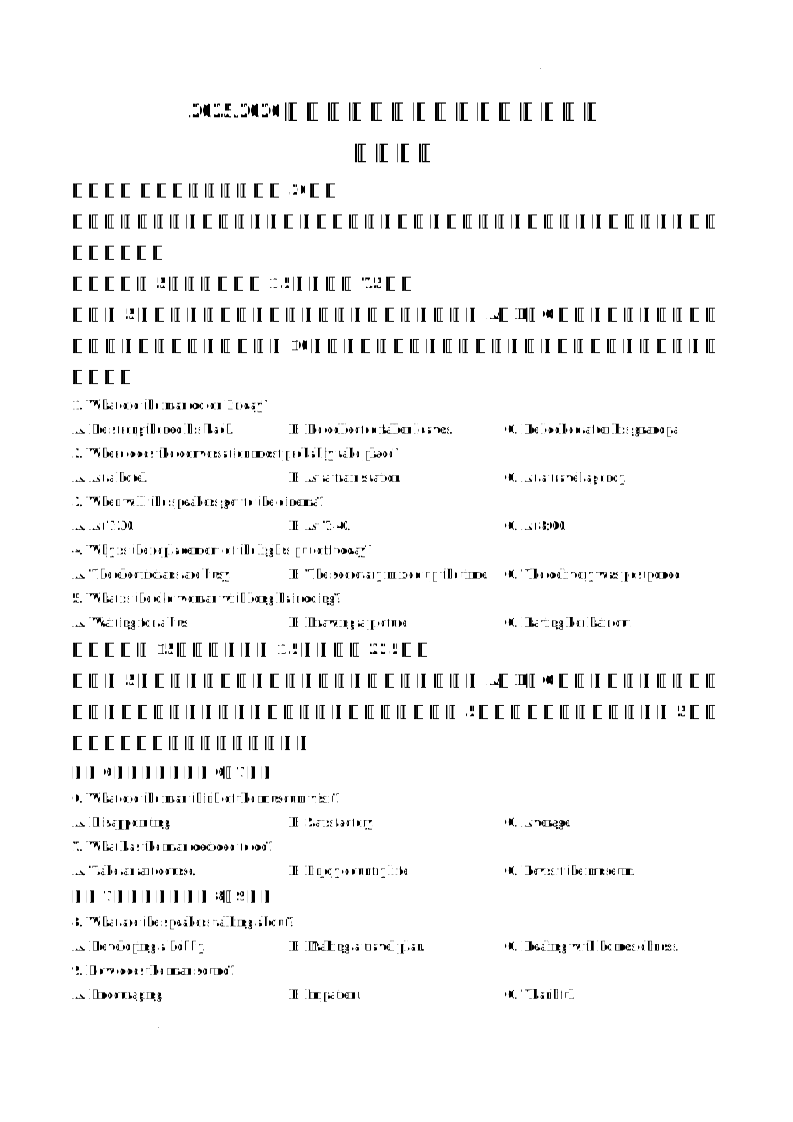
第一部分 听力(共两节,满分 30 分)
做题时,先将答案标在试卷上。录音内容结束后,你将有两分钟的时间将试卷上的答案转涂到答题卡上。
第一节(共 5 小题;每小题 1.5 分,满分 7.5 分)
听下面 5 段录音。每段录音后有一个小题,从题中所给的 A、B、C 三个选项中选出最佳选项。听完每段录音后,你都有 10 秒钟的时间来回答有关小题和阅读下一小题。每段录音播放两遍。
1. What did the man do on Friday?
A. He strengthened his back. B. He collected fallen leaves. C. He looked after his grandpa.
2. Where does the conversation most probably take place?
A. At a hotel. B. At a train station. C. At a travel agency.
3. When will the speakers get to the cinema?
A. At 7:30. B. At 7:40. C. At 8:00.
4. Why is the replacement of the lights put off today?
A. The electricians are busy. B. The secretary mixed up the time. C. The delivery was postponed.
5. What is the old woman with long hair doing?
A. Waiting for a bus. B. Drawing a picture. C. Having her hair cut.
第二节(共 15 小题;每小题 1.5 分,满分 22.5 分)
听下面 5 段录音。每段录音后有几个小题,从题中所给的 A、B、C 三个选项中选出最佳选项。听每段录音前,你将有时间阅读各个小题,每小题 5 秒钟;听完后,每小题都有 5秒钟的作答时间。每段录音播放两遍。
听第 6 段录音,回答第 6、7 题。
6. What did the man think of the museum visit?
A. Disappointing. B. Satisfactory. C. Average.
7. What has the man decided to do?
A. Take an art course. B. Enjoy country life. C. Revisit the museum.
听第 7 段录音,回答第 8、9 题。
8. What are the speakers talking about?
A. Developing a hobby. B. Making a travel plan. C. Dealing with homesickness.
9. How does the man sound?
A. Encouraging. B. Impatient. C. Thankful.
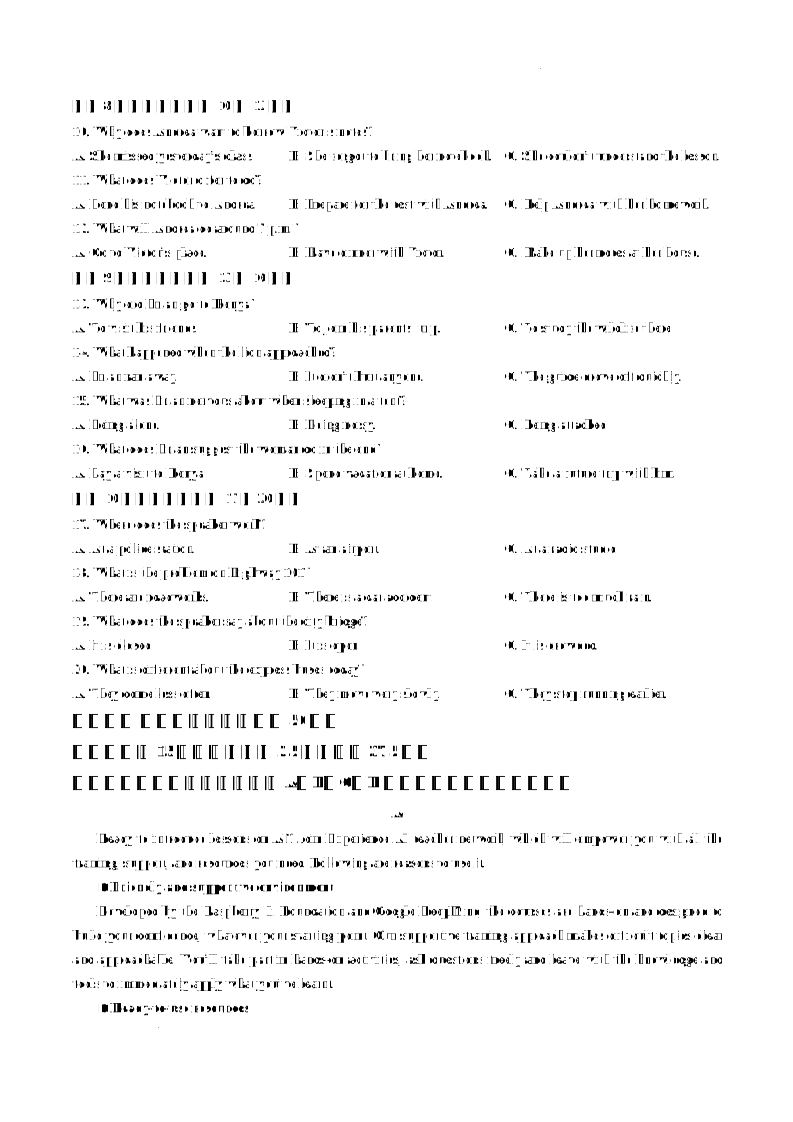
听第 8 段录音,回答第 10 至 12 题。
10. Why does Andrea want to borrow Victor’s notes?
A. She missed yesterday’s class. B. She forgot to bring her notebook. C. She couldn’t understand the lesson.
11. What does Victor offer to do?
A. Lend his notebook to Andrea. B. Prepare for the test with Andrea. C. Help Andrea with her homework.
12. What will Andrea do around 7 p.m.?
A. Go to Victor’s place. B. Have dinner with Victor. C. Make up her notes at her house.
听第 9 段录音,回答第 13 至 16 题。
13. Why did Brian go to Kenya?
A. To visit his friends. B. To join his parents’ trip. C. To study the wildlife there.
14. What happened when the lion approached?
A. Brian ran away. B. It didn’t hurt anyone. C. The guide drove off quickly.
15. What was Brian nervous about when sleeping in a tent?
A. Being alone. B. Being noisy. C. Being attacked.
16. What does Brian suggest the woman do in the end?
A. Pay a visit to Kenya. B. Spend vacation at home. C. Take a future trip with him.
听第 10 段录音,回答第 17 至 20 题。
17. Where does the speaker work?
A. At a police station. B. At an airport. C. At a radio studio.
18. What is the problem on Highway 101?
A. There are roadworks. B. There is a car accident. C. There is too much rain.
19. What does the speaker say about the city bridge?
A. It is closed. B. It is open. C. It is crowded.
20. What is different about the express buses today?
A. They come less often. B. They move very slowly. C. They stop running earlier.
第二部分 阅读(共两节,满分 50 分)
第一节(共 15 小题;每小题 2.5 分,满分 37.5 分)
阅读下列短文,从每题所给的 A、B、C、D 四个选项中选出最佳选项。
A
Ready to introduce lessons on AI? Join Experience AI teacher network, which will empower you with all the training, support, and resources you need. Following are reasons to use it.
►Friendly and supportive environment
Developed by the Raspberry Pi Foundation and Google DeepMind, the courses are hands-on and designed to build your confidence, whatever your starting point. Our supportive training approach makes difficult topics clear and approachable. You’ll take part in hands-on activities, ask questions freely and leave with the knowledge and tools to immediately apply what you’ve learnt.
►Ready-to-use resources
The lesson resources include slides, videos, interactive (互动的) activities that make AI interesting and accessible. The resources are designed to be used straight away, with the training ensuring that you can deliver lessons with confidence.
►Flexible and future-focused training
You can choose from in-person training or in-school training. Each option is free, expertly delivered and packed with practical takeaways. Our training lets educators take the lead in preparing students for the digital future. Our courses will equip you to guide meaningful, informed discussions in the classroom, and help students become not just consumers of AI, but critical (批判性的) thinkers and responsible digital citizens.
For more information, feel free to email us at: programmes@experienceai.org.uk.
21. Who is the Experience AI most suitable for?
A. A teacher new to AI teaching. B. A student eager for AI basics.
C. An expert devoted to AI research. D. A parent interested in AI learning.
22. What benefit can Experience AI bring?
A. Various paid training courses on AI. B. Quick access to teaching resources.
C. Responsible instructions on school life. D. Professional guidance on school subjects.
23. What is the purpose of the text?
A. To describe. B. To comment. C. To entertain. D. To advertise.
B
I was a shy and nervous boy when Mother attempted to give me courage. Among my earliest memories are her words, “Go right up and look your fears in the face — and then do something!” To help me overcome my fear of the dark, Mother invented a game for us to play. She ran around the house in one direction, I in the other. At the far corner, I would run straight into her comforting arms. Soon, I was joyfully facing the dark alone for as long as my parents would let me stay outdoors.
Her lesson of facing fear bravely has stayed with me ever since. I remember clearly my first job of taking pictures for an airline (航空公司) over the Blue Ridge Mountains in North Carolina. We were in a wilderness where clouds hid the highest mountains, driving the pilot to direct the way by guess. Turbulence (湍流) increased by the moment, throwing the plane about like a chip in the sea. It was a struggle just to keep my heavy camera, which I was holding tightly, from flying up and hitting me in the face. But my real worry was the growing fear that we would not get out alive.
Then Mother’s advice came to mind. “Get your work done,” I said seriously to myself. Below us, Lake Lure was occasionally visible, then hiding itself in clouds. Perhaps my pictures would be made unclear beyond recognition by the shaking camera. However, I stretched as far out as my ropes would allow and, for the next several minutes, whenever the plane broke through into a clearing I took a shot. I became so completely lost in the beauty that by the time we flew out of the mountains I was truly sorry we had to go.
At that moment, I fully understood Mother’s words: “Go right up and look your fears in the face — and then do something!” Her timeless wisdom saw me through this dangerous situation.
24. Why did the author recall his childhood experience?
A. To state his fear of dark. B. To show his mother’s wisdom.
C. To establish his mother’s authority. D. To stress his efforts to run fast.
25. What forced the pilot to guess the way?
A. The increasing turbulence. B. The frozen wilderness.
C. The camera hitting the face. D. The clouds covering mountaintops.
26. Why did the author feel sorry when leaving the mountains?
A. He wanted to stay with the pilot longer. B. The weather became too bad.
C. He was deeply attracted by the scenery. D. The mountains became very clear.
27. Which of the following best describes his mother?
A. Brave and strict. B. Wise and inspiring. C. Caring and humorous. D. Confident and outgoing.
C
In 2012, Africa’s elephant population was facing the worst illegal (非法的) hunting in decades. To help stop the killing, Jake Wall, a Canadian researcher wrote a programme, which was designed to discover when an elephant’s GPS device had stopped moving for more than five or six hours — signaling the animal might be dead. It was a pioneering step that marked the beginning of EarthRanger, a wildlife-management platform.
Launched in 2015, EarthRanger is now a tech-based platform that gives conservationists (环保主义者) the real-time information. It collects, processes and displays data not just from GPS devices, but from camera traps and remote sensors. Today, more than 900 sites use the platform across six continents and 90 countries. EarthRanger is free, but its potential economic impact is vast. It has become a tool necessary to the global ecotourism market. And in Africa where recent conservation efforts have helped stop the sharp fall in the number of elephants, its practical value is particularly obvious.
Africa’s conservationists are already on board. Among them is Jochen Zeitz, the owner of Segera, an eco-friendly resort (度假村). “The most important idea is to use technology to reduce the cost of conservation,” Zeitz says of EarthRanger, “But technology works effectively only when the infrastructure (基础设施) and the training are in place.” Segera adopted EarthRanger as its main wildlife monitoring platform in 2021. A 2024 upgrade equipped the platform with a Long Range Wide Area Network (LoRaWAN) that connects battery-powered devices over long distances with low power consumption, and with tech-powered camera management software. In May 2025, Zeitz led the relocation of 20 elephants to the resort. By the time the first group of elephants arrived, 28 of the resort’s staff had received training on EarthRanger’s mobile app.
The final goal of EarthRanger is to enable the people on the ground to be more effective in their work by giving them tools. That’s where technology can help — and where technology can close the gap between data and successful conservation.
28. What was Jake Wall’s programme aimed at?
A. Counting endangered elephants. B. Rescuing hurt African elephants.
C. Telling whether an elephant had died. D. Measuring how far an elephant had moved.
29. What can we learn about EarthRanger from paragraph 2?
A. It serves camera traps. B. It expands the habitat of elephants.
C. It provides instant data. D. It benefits the developer economically.
30. Why is LoRaWAN mentioned?
A. To indicate the resort is expensive. B. To explain staff training is necessary.
C. To reveal the network consumes little power. D. To prove technology use depends on infrastructure.
31. What can be a suitable title for the text?
A. EarthRanger: Cost cutter B. EarthRanger: Habitat Defender
C. EarthRanger: Conservation Helper D. EarthRanger: Ecotourism Promoter
D
Diana Flores is giving back to the sport that shaped her as an athlete and person. The Mexican national flag football team quarterback (四分卫) is launching her first book Flag Football For Dummies. The 250-plus-page book is a practical, step-by-step beginner’s guide to flag football.
Flag football will appear for the first time at the 2028 Olympics in Los Angeles, and Diana Flores will lead Mexico’s push for gold. It’s a favorable time to promote the book. “We’re living through one of the fastest-growing sports and it has changed into a movement of opportunities,” she said. “Flag football is one of the most affordable sports to play. To me, it can and will be the next soccer.”
Still, as a first-time writer, putting the pen to paper didn’t come naturally. Flores often found herself writing too much and deleting (删除) later, remembering that the goal was to introduce newcomers to a sport she has played since she was 8 years old in Mexico City. “This book challenged me in ways I never experienced before, because I had the opportunity to start from scratch,” she said. “That was actually one of the biggest challenges: explaining how to break down things and make them easy to understand and easy to apply for people who may have never even heard about the sport.”
Now with her first book completed, Flores wants to turn her focus to creating more economic opportunities for flag football players, especially women, who she said have to work 10 hours more to earn what male players earn in one hour. “This sport is going to open up so many doors for boys and girls to achieve their dreams. My next big step is to give the opportunity to women like me to make a living from playing the sport we love,” Flores said. “There are investments (投资) and opportunities already and, hopefully, the Olympics will raise awareness. That’s what gets me excited about this sport in the coming years.”
32. What can we learn about flag football?
A. It costs a lot to play. B. It will become an Olympic sport.
C. It is well-known for a book. D. It is developing slowly in Mexico.
33. Why does Diana Flores refer to soccer in paragraph 2?
A. To confirm they have similar rules. B. To emphasize flag football is better.
C. To predict flag football has a bright future. D. To advise flag football follow soccer’s pattern.
34. What does the underlined phrase “start from scratch” in paragraph 3 probably mean?
A. Create something from zero. B. Do something hurriedly.
C. Learn something from mistakes. D. Follow something blindly.
35. What is Diana Flores’ next major goal?
A. To attract young people to sports. B. To write more books about sports.
C. To develop her sports skills further. D. To help female players earn more.
第二节(共 5 小题;每小题 2.5 分,满分 12.5 分)
阅读下面短文,从短文后的选项中选出可以填入空白处的最佳选项。选项中有两项为多余选项。
Walking to class one day, Laura, a member of our kindness programme, saw a young student crying and waiting for his mother to arrive. He had injured his chin (下巴) while playing. When Laura got to class, the other students were upset and afraid for their friend, full of questions about what would happen to him. 36
“Caring practice!” shouted one of the children, and they all sat in a circle offering support and well wishes. 37 In it, children were introduced to stories and practices for paying attention, regulating their emotions, and developing kindness.
Why teach kindness to kids? The school environment can be very stressful. 38 Being ignored, or laughed at is painful for a young child, and we thought it could be helpful to teach kindness. When other kids are suffering, can we understand how they might be feeling? Kindness bridges those gaps and helps build a sense of connection among students.
You might have seen a poster on our classroom wall called “Kindness Garden”. When kids performed an act of kindness or benefited from one, they added a sticker to the poster. Through the activity, we got students talking about how kindness feels good and how we might grow more friendship in the classroom. 39 That care often begins with simple acts of kindness.
To teach kindness, we can use caring practice. When the boy injured his chin, the other kids got together to do this practice: “May you be safe, may you be happy, may you be healthy.” 40 To my school, to my whole community... Faced with unhappiness, the children found comfort and support for themselves and their friend rather than feeling upset and worried. It’s these small changes, spread across classrooms, that could make schools nicer and educate a new generation of kinder and more connected citizens.
A. Young kids can be as brave as adults.
B. These wishes can be extended further.
C. Students learn to see themselves as performers.
D. Laura decided to ask the class how they could help him.
E. Many struggle to make friends and perform well in class.
F. The idea is that friendship, like a young plant, needs care to grow.
G. This is what’s possible when kids learn kindness from the programme.
第三部分 语言运用(共两节,满分 30 分)
第一节(共 15 小题;每小题 1 分,满分 15 分)
阅读下面短文,从短文后各题所给的 A、B、C、D 四个选项中选出可以填入空白处的最佳选项。
A few years ago I was sitting in a bar garden when a dirty pigeon (鸽子) landed on a chair. After a while, the pigeon 41 me, and before I knew it she’d jumped onto my lap. A waitress came over and explained some customers kicked her around to 42 her. For the next three hours, this pigeon didn’t leave my 43 . Then I drove home with her on my shoulder.
My mum had a cat carrier ready to 44 the pigeon, so we got some bird food and a hot water bottle. The next day, she seemed a lot better. When we bathed her I could see how 45 she was from being kicked. I 46 the entire thing on my phone and put it online. The video became a 47 , and a netizen named her Penny.
Every day I 48 to let her go. She would just 49 the garden, stay within eyesight, and then fly straight back. At night, she lived in a big cage. Penny was always with me. I taught her 50 so she could recognize flash cards. On the anniversary (周年纪念日) of her 51 , I made her a tiny cake.
I 52 with two women online and we established Penny’s Pigeon Aid to change the negative opinions about pigeons. They’re 53 : they’re incredibly intelligent, 54 and adorable. Just like Penny was. I was never 55 while she was in my life.
41. A. greeted B. approached C. praised D. attacked
42. A. get rid of B. make use of C. take care of D. keep track of
43. A. office B. bar C. room D. side
44. A. hide B. drive C. house D. dress
45. A. wounded B. curious C. gentle D. relaxed
46. A. documented B. downloaded C. searched D. removed
47. A. mystery B. hit C. model D. reminder
48. A. refused B. managed C. attempted D. hesitated
49. A. dig B. water C. decorate D. circle
50. A. honesty B. politeness C. beliefs D. tricks
51. A. graduation B. rescue C. escape D. marriage
52. A. argued B. competed C. connected D. traded
53. A. misjudged B. protected C. trained D. welcomed
54. A. noisy B. distant C. devoted D. guarded
55. A. lonely B. careless C. busy D. confused
第二节(共 15 小题;每小题 1 分,满分 15 分)
阅读下列句子,在空白处填入 1 个适当的单词或括号内单词的正确形式。
56. One quality of literature is its ▲ (describe) of truth and beauty.
57. Over the past 50 years, about 17 percent of the rainforest ▲ (disappear) due to human activities such as agriculture and cattle farming.
58. Sliding into the habit of smoking is easy but it is difficult ▲ (quit) it.
59. A typhoon is a destructive storm ▲ (occur) in the north-west Pacific Ocean.
60. Spending a whole week without my smartphone was ▲ (scare) at first but then I began to feel free.
61. The Internet has brought unbelievable ▲ (convenient), with all sorts of goods and services provided by e-commerce.
62. Please spare a thought for those talented people ▲ the scenes when entering the cinema.
63. Emojis, which are used to express ideas or feelings in electronic communication, ▲ (create) in 1999.
64. Unfortunately, your parents do not always agree with you, ▲ makes you feel unhappy.
65. Jenny felt sorry that she might not able to make ▲ to the cinema.
66. We will explore a particular type of food ▲ power mainly lies in the associations it calls to mind.
67. What deeply depressed Beethoven was his hearing ▲ (lose).
68. When blood sugar levels drop, we are likely to feel sad again and will ▲ (greedy) eat more comfort food.
69. ▲ (conduct) on a stormy day, the experiment proved lightning was really just electricity.
70. When Liang Shanbo and Zhu Yingtai first meet, the music is light and pleasant, as if ▲ (whisper) to the audience.
第四部分 写作(共两节,满分 40 分)
第一节(满分 15 分)
假定你是李华,上周五参加了你校“想唱就唱”活动,请你给英国朋友 Mark 写一封邮件分享这次经历,内容包括:
(1) 活动过程;
(2) 你的收获。
注意:
(1) 写作词数应为 80 个左右;
(2) 请按如下格式在答题卡的相应位置作答。
Dear Mark,
I’m writing to share with you the “Sing Your Heart Out” activity held at our school last Friday.
Yours,
LiHua
第二节 (满分 25 分)
阅读下面材料,根据其内容和所给段落开头语续写两段,使之构成一篇完整的短文。
On a freezing winter evening, seventeen-year-old Marcus was walking home from his part-time job at a grocery store. He had saved for months to buy his younger sister, Lily, a new wheelchair, as her old one was broken and uncomfortable. With his earnings finally enough, he would place the order online the next day, expecting delivery before her birthday next week. Lost in happy thoughts, he took a shortcut (近路) through the park, a path he knew well even in the dark.
Suddenly, a weak cry for help broke the silence. Marcus stopped and listened carefully. The cry came again, weaker this time, from the direction of the old oak tree near the pond. Following the sound, he found an elderly woman lying on the frozen ground, her leg twisted awkwardly beneath her. Her name was Mrs. Clark, and she had slipped (滑倒) on black ice while walking her small dog, Max. Marcus quickly helped her into a sitting position and wrapped his own scarf (围巾) around her shaking shoulders. She told him that she had been lying there for nearly an hour and that her phone had fallen into the pond, unable to reach her daughter. Marcus knew he had to get her to a hospital immediately, but his phone battery was dead, and the park was deserted at this hour. Without hesitation, he helped Mrs. Clark onto his back and began the long, difficult walk toward the main road, with Max following closely behind.
After what felt like half an hour, they finally reached the street, and a passing driver stopped to take them to the county hospital. Mrs. Clark was diagnosed (诊断) with a broken leg and would need surgery. Marcus stayed with her until the nurses assured him she would be fine. When he finally returned home late that night, he was tired but felt a deep sense of peace.
注意:
(1)续写词数应为 150 个左右;
(2)请按如下格式在答题卡的相应位置作答。
The next morning, Marcus received a phone call.
A week later, Marcus and Lily met Mrs. Clark at a community thank-you event.
学科网(北京)股份有限公司
$
2025/2026学年度第二学期高一年级期终考试
英语试题参考答案
第一部分 听力(共两节,满分 30 分)
1. B 2. A 3. B 4. C 5. A 6. B 7. A 8. C 9. A 10. C
11. C 12. A 13. B 14. B 15. C 16. A 17. C 18. B 19. B 20. A
第二部分 阅读(共两节,满分50分)
第一节(共15小题;每小题2.5分,满分37.5分)
21. A 22. B 23. D 24. B 25. D 26. C 27. B 28. C 29. C 30. D
31. C 32. B 33. C 34. A 35. D
第二节 (共5小题;每小题2.5分,满分12.5分)
36. D 37. G 38. E 39. F 40. B
第三部分 语言运用(共两节,满分30分)
第一节 (共15小题;每小题1分,满分15分)
41. B 42. A 43. D 44. C 45. A 46. A 47. B 48. C 49. D 50. D
51. B 52. C 53. A 54. C 55. A
第二节 (共15小题;每小题1分,满分15分)
56. description 57. has disappeared 58. to quit 59. occurring
60. scary 61. convenience 62. behind 63. were created
64. which 65. it 66. whose 67. loss
68. greedily 69. Conducted 70. whispering
第四部分 写作(共两节,满分40分)
第一节(满分15分)
Dear Mark,
I’m writing to share with you the “Sing Your Heart Out” activity held at our school last Friday. It attracted many students eager to show their singing skills.
We took turns to sing our favorite songs, immersing ourselves in the charm of music. The atmosphere was full of excitement and we cheered and applauded wildly for every performer. I sang a pop song that I had practiced for a week, winning warm applause from my classmates.
Not only did this meaningful activity boost my confidence but it also let me truly taste the joy of sharing music and happiness with others. Have your ever joined in similar meaningful activities at school? I’m eagerly looking forward to your reply.
Yours,
Li Hua
第二节 (满分 25 分)
The next morning, Marcus received a phone call. It was from Mrs. Clark’s daughter, who tearfully expressed her family’s heartfelt gratitude. She explained that her mother’s surgery had gone well and that they had learned about Marcus’s act of kindness from the nurses. But that was not all. Mrs. Clark, a retired engineer, had heard about Marcus’s saving for Lily’s wheelchair. Deeply moved by his sacrifice — risking the delivery money for taxi fare — she decided to help. Before Marcus could refuse, the daughter told him that a brand-new, customized wheelchair had already been ordered and would arrive at Lily’s birthday party.
A week later, Marcus and Lily met Mrs. Clark at a community thank-you event. Mrs. Clark was sitting in a regular chair, her leg still in a cast but her smile warm and bright. Lily, now comfortably sitting in the new wheelchair, rolled over to give her a big hug. “Thank you for my wonderful chair!” Lily beamed. Mrs. Clark gently stroked Lily’s hair and said, “It is your brother who should be thanked. He taught us that a good heart is the most valuable gift one can give.” As Marcus looked at the two, one young and one old, both grateful and smiling, he understood that true happiness did not come from receiving, but from the quiet joy of having made a difference in someone’s life.
听力录音稿
Text 1
M: On Friday we picked up all the leaves outside.
W: Was your grandfather tired after that?
M: Well, he’s very strong, you know, but I think his back hurt.
Text 2
M: I’d like to check in, please. I have a reservation under the name Jim Smith.
W: Certainly, Mr. Smith. May I see your passport? And would you prefer a room on a higher floor?
Text 3
M: Linda, I was wondering if you’d like to see that new comedy with me. It’s on at 8:00.
W: Sure, I’d love to!
M: OK, I’ll be at your house at 7:30. It takes us 10 minutes to get there.
W: OK. See you then.
Text 4
W: It seems strange that the electricians haven’t shown up yet. I thought they were coming at 9 a.m.
M: The secretary at the company called me about 20 minutes ago. The delivery of the lights was put off, so they can’t replace the lights today.
W: Can I draw now?
M: Yes. Can you see the old woman waiting for the number 12 bus?
W: With long hair?
M: Yes. That’s her. Draw her with gray hair.
Text 6
W: Did you enjoy your visit to the museum last Saturday?
M: I did. Thanks. You know how much I’d been looking forward to it. The paintings there really didn’t let me down.
W: Sounds great.
M: There are paintings of the countryside around here. It made me realize I’d really like to do something like that too. So I’ve signed up for a beginner’s painting course.
W: Great. And was the museum busy?
M: Oh, yes. I’ve heard the places are always packed these days. I thought it would have been quiet on a Monday.
Text 7
W: I just feel like I need to get back to New York. Back home I used to feel so relaxed just hanging out with people.
M: Susie, you are only here for three months. I know you can deal with it.
W: I know. But I just don’t have any friends here.
M: Do you have any activities you enjoy?
W: I love swimming. It always makes me feel excited and energized.
M: Try going to the pool every night. Do this for a week and if you don’t feel any better, come see me again.
W: OK. Thanks.
Text 8
W: Victor! Wait up a second!
M: Hi, Andrea. What’s up?
W: Can I borrow your notes from math class? I couldn’t really follow yesterday’s lesson, so I want to borrow your notes to study for the test.
M: You will have a difficult time on the math test if you didn’t understand yesterday’s lesson.
W: That is what I’m worried about. I know you always pay attention in class and take good notes. And I find it very difficult to solve the word problems. It will be a struggle to do my homework.
M: What if I help you do the homework?
W: I guess that would be OK, too. Can we study at your house?
M: Sure. Come over around seven o’clock tonight after dinner.
W: Hey, Brian! You spent your summer in Kenya?
M: Yes. My parents were invited by their friends to visit them in Kenya. They brought me along.
W: What did you do there?
M: We went on an African wildlife tour. We rode in a jeep, which was driven by a Kenyan tour guide. He was telling us exciting stories when a lion came toward us. I was so scared, but thankfully, it was just looking at us and then went away.
W: Wow, that’s amazing! I wish I could go to Kenya like you.
M: I’m sure you would have a great time, too. We were sleeping outdoors in a tent. At first, I couldn’t sleep, though, because I heard some strange sounds. I was afraid that some wild animals might attack us.
W: Now I’m glad that I spent my vacation at home.
M: But still, it was a wonderful adventure. You should give it a try someday.
Text 10
M: Good morning. This is Traffic Radio on 98.5 FM with your morning traffic report. It’s 7:45 a.m. and we have some important news for you. Two cars hit each other on Highway 101 near Exit 23, and now cars are moving very slowly. You may need to wait about 45 minutes to get through that area. Good news for people driving into the city center. The bridge work there is not happening today because of last night’s heavy rain. So, the bridge will stay open all day, and you won’t have any problems crossing it. For bus riders, please note that the express buses are running every 20 minutes today, not every 10 minutes like usual. This is because today is a public holiday. Plan your trip carefully so you won’t be late. One more thing to remember: the road to the airport will close at 9:00 tonight for repair work. It will reopen early tomorrow morning. If you need to catch a late flight, use the eastern road instead. That’s all for now. Have a safe drive.
学科网(北京)股份有限公司
$
资源预览图
1
2

3

相关资源
由于学科网是一个信息分享及获取的平台,不确保部分用户上传资料的 来源及知识产权归属。如您发现相关资料侵犯您的合法权益,请联系学科网,我们核实后将及时进行处理。