Unit3-6复习(课件)-2025-2026学年冀教版(三起)英语三年级下册
2026-06-19
|
16页
|
149人阅读
|
3人下载
普通
摘要:
这是一份小学英语期末复习课件,围绕“时间与动词短语”主题,通过词汇(时间名词、星期、动词短语)、句型(询问日常活动、星期、时间)及练习(看图连线、情景对话)等学习支架,系统整合第三、六单元核心内容。
资料特色突出,注重核心素养培养,如动词短语搭配“Let's do the actions”指令提升语言运用能力,星期表达规则渗透文化意识,句型转换练习发展思维品质,教师提示帮助养成学习策略。多样互动设计(情景对话、动作跟随)能激发学生兴趣,也为教师提供高效复习工具。小学期末学生需巩固基础、提升综合应用能力,该资料通过结构化复习和互动练习,帮助学生整合知识,教师可直接用于课堂,提升复习效率。
内容正文:
Unit 3 -6 Review
Time---days---week
第三、六单元复习:时间与动词短语
Miss Chai
1.7.2013
Hello, boys and girls! Welcome back to our English class. Today, we are going to review what we've learned in Unit 3 and Unit 6. We'll talk about our daily routines and how to tell the time. Let's have fun together!
‹#›
Vocabulary Review: Nouns (名词家族)
morning(早上)
I get up in themorning. (我早上起床。)
afternoon(下午)
I play with my friends in theafternoon. (我下午和朋友们一起玩。)
evening(晚上)
I do my homework in theevening. (我晚上做作业。)
night(夜晚)
I go to bed atnight. (我晚上睡觉。)
in +早中晚
at night
Good night!
1.7.2013
Now let's review some nouns. Look at the screen. This is 'morning'. We get up in the morning. This is 'afternoon'. We play in the afternoon. And this is 'night'. We go to bed at night. Please read after me: morning, afternoon, night.
‹#›
一周七天 Days of the week.
Monday(周一)
Wesdenday(周三)
Tuesday(周二)
Friday(周五)
Saturday(周六)
Sunday(周日)
Thursday(周四)
星期几开头字母要大写
一周的第一天时Sunday
On+星期几
School days
Weekends
询问星期几
What day is it?
-It’s+星期几.
问一周有几天?
How many days are there in a week?
--Seven days.
1.7.2013
Now let's review some nouns. Look at the screen. This is 'morning'. We get up in the morning. This is 'afternoon'. We play in the afternoon. And this is 'night'. We go to bed at night. Please read after me: morning, afternoon, night.
‹#›
Vocabulary Review: Nouns (名词家族)
day(天) week(星期) time(时间) room(房间) sock(袜子)
dog
n. 狗,小狗。
tooth / teeth
n. 牙齿。Tooth是单数,Teeth是复数,这是一个特殊的不规则变化哦!
ball
n. 球,球类。
Teacher's Tip:注意单词tooth的复数形式不是 "tooths",而是teeth,这是英语中常见的不规则名词复数变化,大家要特别记忆哦!
1.7.2013
Let's learn more nouns. Repeat after me: day, week, time, room, sock, dog, ball. Now, look at this picture. This is a tooth, one tooth. But when we have many, we say teeth. One tooth, two teeth. It's a special word.
‹#›
Vocabulary Review: Verbs (动词家族)
get up(起床)
I get up early in the morning to start my day.
make my bed(整理床铺)
After getting up, I make my bed neatly.
wash my face(洗脸)
I wash my face with warm water to feel fresh.
brush my hair(梳头)
I brush my hair carefully to make it look nice.
🌟 Let's do the actions together! Stand up and follow me! 🌟
1.7.2013
Now let's learn some action words, or verbs. Please stand up! When I say 'get up', you jump out of your seat! When I say 'make my bed', pretend to make your bed. Ready? get up! make my bed! wash my face! brush my hair! Excellent!
‹#›
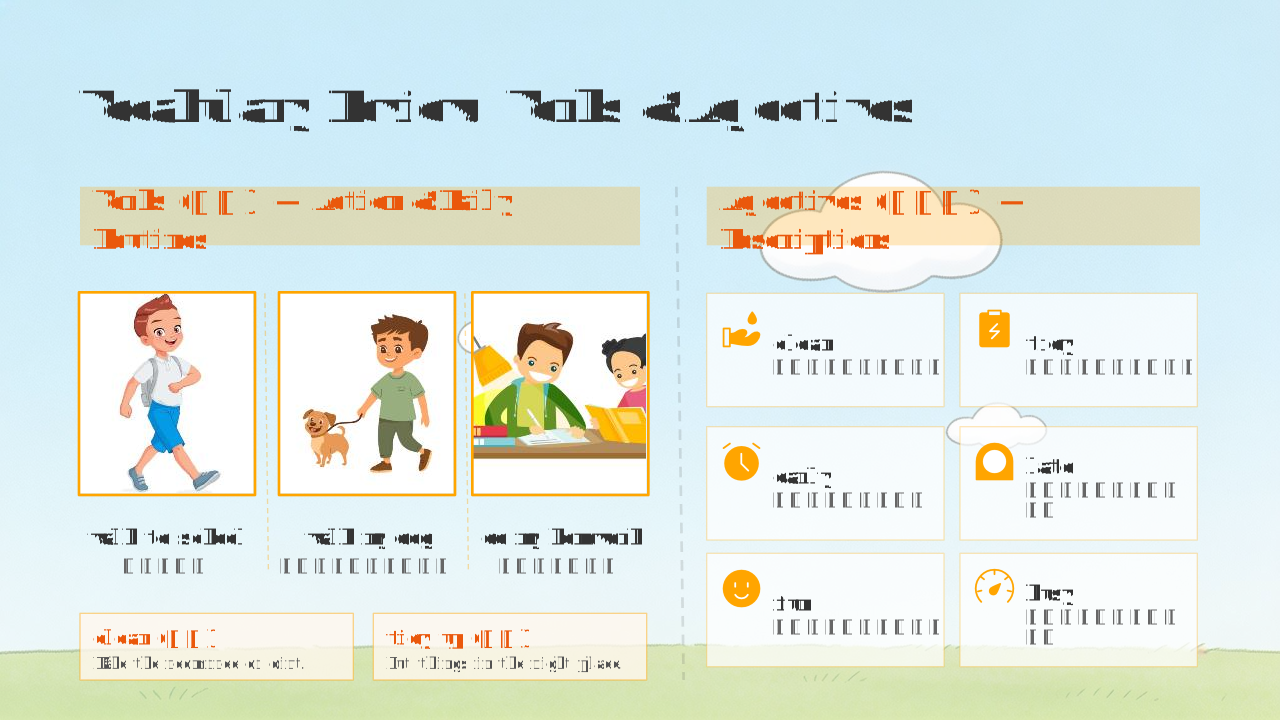
Vocabulary Review: Verbs & Adjectives
Verbs (动词) — Action & Daily Routines
walk to school
走路去上学
walk my dog
遛狗,带着我的狗散步
do my homework
做我的家庭作业
clean (打扫)
Make the room free of dirt.
tidy up (整理)
Put things in the right place.
Adjectives (形容词) — Descriptions
clean
干净的,没有污垢的。
tidy
整洁的,井井有条的。
early
早的,提前到达的。
late
晚的,迟到的,未按时。
fun
有趣的,使人快乐的。
busy
忙碌的,有很多事做的。
1.7.2013
Let's continue with more verbs. Look at the pictures. He walks to school. He walks his dog. They do their homework. Now for the adjectives. If your room is nice and neat, it is clean and tidy. If you get up before 7 o'clock, you are early. If you arrive after the bell, you are late.
‹#›
Phrases Review (短语加油站)
01. in the morning
在早上 —— 开启活力满满的一天
02. in the afternoon
在下午 —— 享受午后的阳光和时光
03. in the evening
在晚上 —— 月亮出来,准备休息啦
04. get up
起床 —— 伸个懒腰,告别被窝
05. make my bed
整理我的床铺 —— 让房间整整齐齐
06. brush my teeth
刷我的牙 —— 保护牙齿,笑容更甜
07. wash my face
洗我的脸 —— 清清爽爽,精神百倍
08. brush my hair / 09. wash up / 10. walk to school
梳头发 · 洗漱/洗餐具 · 走路去上学 —— 每天的快乐日常,从好好照顾自己开始!
1.7.2013
Now let's put the words together to make phrases. Repeat after me: in the morning, in the afternoon, in the evening, get up, make my bed, brush my teeth, wash my face, brush my hair, wash up, walk to school.
‹#›
Phrases Review (短语加油站)
12. Do housework
帮助家人做一些力所能及的家务,比如扫地、擦桌子,做个勤劳的小帮手!
14. Pack schoolbag
每天晚上整理好第二天要用的书本和文具,养成自己的事情自己做的好习惯。
15. Wash hands
饭前便后要洗手,用肥皂和流动水,赶走细菌,保护我们的身体健康。
11. walk my dog(牵着我的小狗出门散步,享受户外时光)
13. do my homework(认真完成老师布置的家庭作业,巩固知识)
16. wash my socks(自己洗袜子,学会独立照顾自己的生活)
17-18. tidy & clean my room(整理和打扫房间,保持居住环境整洁)
19. take a bath(舒舒服服洗个热水澡,消除一天的疲惫)
20. go to school(背上书包去上学,见到亲爱的老师和同学)
1.7.2013
Let's learn more phrases. Repeat after me: walk my dog, do some housework, do my homework, pack my schoolbag, wash my hands, wash my socks, tidy up my room, clean my room, take a bath, go to school.
‹#›
Phrases Review (短语加油站)
24. Play ball games
玩球类游戏,在草地上奔跑,和伙伴们一起享受运动的快乐!
26. Go swimming
在炎热的夏天去游泳,感受清凉的水,是周末很棒的放松方式。
27. Read books
坐在书堆里阅读有趣的故事书,在知识的海洋里尽情遨游。
21. have fun (玩得开心) 22. go home (回家)
23. play with my friends (和朋友们玩) 25. make model robot (做模型机器人)
28. go to bed (上床睡觉)
29. school day (上学日) 30. on weekends (在周末)
我们在上学日努力学习,在周末享受丰富多彩的休闲时光,平衡好学习与生活,每一天都过得充实又快乐!
1.7.2013
Let's finish the phrases. Repeat after me: have fun, go home, play with my friends, play ball games, make model robot, go swimming, read books, go to bed, school day, on weekends. Great job!
‹#›
Sentence Patterns (句型讲解)
01. 询问日常活动 (Daily Routine)
问句结构:What do you do in the morning/afternoon/evening?
(你在早上/下午/晚上做什么?)
答句结构:I + 动词短语 (e.g., get up, brush teeth).
Example:Q: What do you do in the morning? A: I get up and brush my teeth.
02. 表达喜好 (Expressing Likes)
核心句型:I like to + 动词原形 (verb).
(用来表达自己喜欢做的事情,to后面的动词必须使用原形。)
Example:I like to play with my friends. (我喜欢和朋友们一起玩。)
More: I like to read books. / I like to watch cartoons.
Tip: 记住 "do" 用于询问日常行为,"like to" 用于表达兴趣,多加练习就能熟练运用哦!
1.7.2013
Now let's learn some important sentences. To ask about someone's daily routine, we say: 'What do you do in the morning?'. And you can answer: 'I get up'. To say what you like to do, we use 'I like to' plus a verb. For example, 'I like to play with my friends'.
‹#›
Sentence Patterns (句型讲解)
句型三:询问数量 (Asking about Quantity)
问句结构:How many +名词复数+ are there in a + 名词单数?
(中文释义:在一个……里面有多少个……?)
答句 & 例句:
Q: How manydaysare there in aweek? (一周有几天?)
A:Sevendays. (七天。)
Time for Fun!
Look at the calendar! Let's learn how to ask about the day of the week in English together.
句型四:询问星期 (Asking about the Day)
Q: What day is it today? (今天星期几?)
A: It's + 星期.e.g. It'sMonday. (今天星期一。)
1.7.2013
To ask 'how many', we use 'How many'. Remember, 'How many' is always followed by a plural noun. For example, 'How many days are there in a week?'. To ask the day of the week, we say 'What day is it today?'. And you can answer 'It's Monday'.
‹#›
Sentence Patterns (句型讲解)
01 提醒时间 · It's time to...
句型结构:It's time to + 动词原形.=It’s time for +名词
(中文含义:到做……的时间了。)
例句:It's time togo to school. (到上学的时间了。)
02 确认星期 · Is it...?
问句结构:Is it + 星期? (今天是星期……吗?)
回答:Yes, it is. / No, it isn't.
Q:Is itMonday? (今天是星期一吗?)
A:Yes, it is. / No, it isn't.
小技巧:在表达“该做某事”时用It's time to...;询问星期几的一般疑问句,要用 be 动词 is 来提问和回答哦!
1.7.2013
When you want to say it's time to do something, you can say 'It's time to...'. For example, 'It's time to go to school'. To ask a yes-or-no question about the day, we say 'Is it Monday?'. The answer is 'Yes, it is' or 'No, it isn't'.
‹#›
Sentence Patterns (句型讲解)
Look at the clock! It's time to learn!
01. 核心句型:询问具体时间
问:What time is it?(几点了?)
答:It's + 时间.(现在是……点。) 例:It's5:00. (五点了。)
整点
小时数 + o'clock。
如: four o'clock
半点
小时数 + thirty。
如: eleven thirty
分钟数
小时数 + 分钟数。
如: six twenty
1.7.2013
To ask for the exact time, we say 'What time is it?'. You can answer 'It's 5 o'clock'. Look at the clock. We can say the time in different ways. For a full hour, we say 'four o'clock'. For half past the hour, we say 'eleven thirty'. For other minutes, we just say the numbers, like 'six twenty'.
‹#›
Practice (练习天地) - Part 1
01. Look and Match (看图连线)
Morning
I get up
in the morning.
Evening
I do homework
in the evening.
Night
I sleep well
at night.
☀️
Noon
I eat rice
at noon.
02. Sentence Swap (句型转换)
Statement: It is Monday.
Q: Is it Monday?→ A: Yes, it is.
Tip: Swap "It is" to "Is it" to make a question!
Statement: I like to read books.
Q: Do you like to read books?→ A: Yes, I do.
Tip: Use "Do" at the start for 'I like...' questions!
1.7.2013
It's practice time! First, let's match the pictures with the correct time phrases. Next, let's change these sentences into questions. For example, 'It is Monday' becomes 'Is it Monday?'. Who can try?
‹#›
Practice (练习天地) - Part 2
01. 情景对话 · 周末下午
A:What day is it today?
B:It's Wednesday.
A:What do you do in the afternoon?
B:I play ball games. It's fun!
和同桌扮演A和B,用这些句子来练习对话吧!试着用自己的周末安排替换 "play ball games"。
02. 时间表达 · 看看时钟
4:00 →It's four o'clock.
整点用 "o'clock" 表示哦。
11:30 →It's eleven thirty.
直接读小时和分钟。
试着说说看:6:20 是 "It's six twenty.",你还能想到其他时间的表达吗?
1.7.2013
Let's do more practice. Now, work with your partner. One of you is A, and the other is B. Use the dialogue on the screen. Then, look at the clocks and tell me the time. What time is it?
‹#›
Good-bye!
Have a great day and see you next class! 🌟
1.7.2013
Great job today, everyone! We've reviewed a lot about our daily routines and telling time. For your homework, please read the new words, draw your daily routine, and talk with your family. Class is over. Goodbye!
‹#›
$
资源预览图

1

2

3

4

5
6
相关资源
示范课
由于学科网是一个信息分享及获取的平台,不确保部分用户上传资料的 来源及知识产权归属。如您发现相关资料侵犯您的合法权益,请联系学科网,我们核实后将及时进行处理。