湖北武汉市黄陂区第六中学2025-2026学年高一下学期5月英语试题(无答案)
 切换试卷
切换试卷
2026-05-30
|
9页
|
31人阅读
|
0人下载
资源信息
| 学段 | 高中 |
|---|---|
| 学科 | 英语 |
| 教材版本 | - |
| 年级 | 高一 |
| 章节 | - |
| 类型 | 试卷 |
| 知识点 | - |
| 使用场景 | 同步教学-阶段检测 |
| 学年 | 2026-2027 |
| 地区(省份) | 湖北省 |
| 地区(市) | 武汉市 |
| 地区(区县) | 黄陂区 |
| 文件格式 | DOCX |
| 文件大小 | 60 KB |
| 发布时间 | 2026-05-30 |
| 更新时间 | 2026-05-30 |
| 作者 | 匿名 |
| 品牌系列 | - |
| 审核时间 | 2026-05-30 |
| 下载链接 | https://m.zxxk.com/soft/58128286.html |
| 价格 | 1.00储值(1储值=1元) |
| 来源 | 学科网 |
内容正文:
高一5月英语训练卷
考试时间:120分钟;满分:150分
注意事项:
答题前填写好自己的姓名、班级、考号等信息
请将答案正确填写在答题卡上
第Ⅰ卷(选择题)
第一部分 听力(共两节,满分30分)
做题时,先将答案标在试卷上。录音内容结束后,你将有两分钟的时间将试卷上的答案转涂到答题卡上。
第一节(共5小题;每小题1.5分,满分7.5分)
听下面5段对话。每段对话后有一个小题,从题中所给的A、B、C三个选项中选出最佳选项。听完每段对话后,你都有10秒钟的时间来回答有关小题和阅读下一小题。每段对话读两遍。
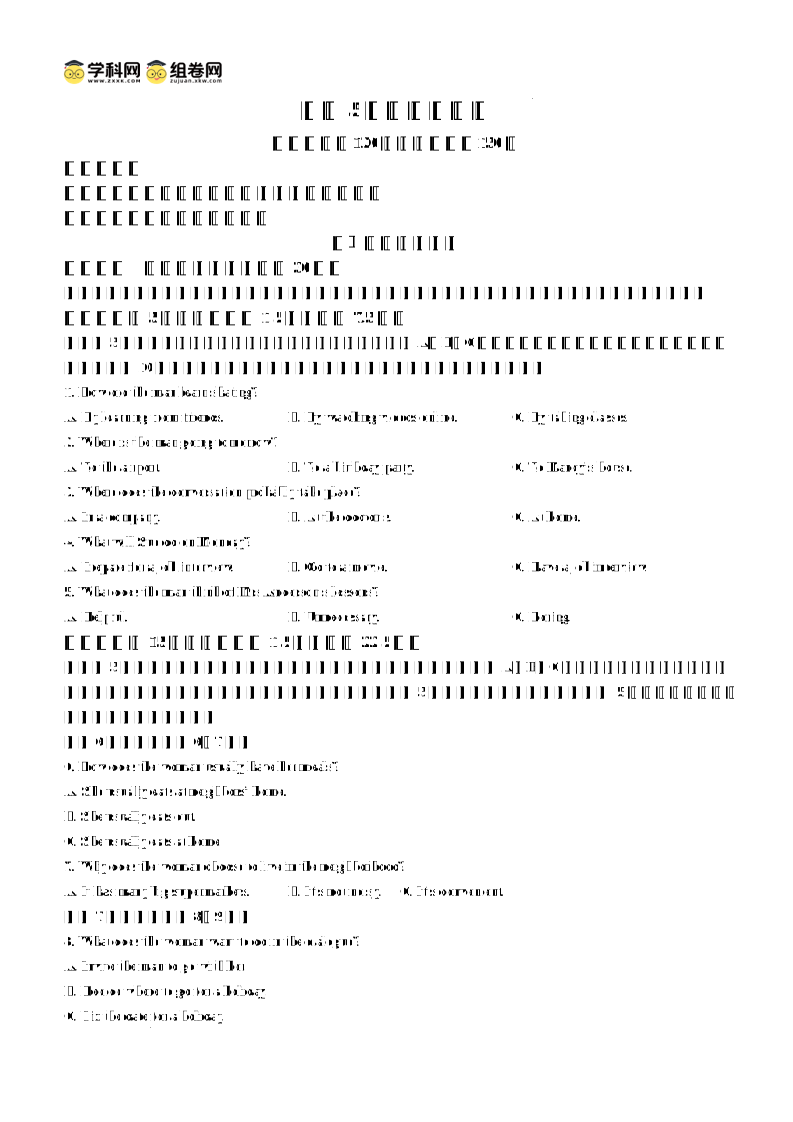
1. How did the man learn skating?
A. By learning from friends. B. By watching videos online. C. By taking classes.
2. Where is the man going tomorrow?
A. To the airport. B. To a birthday party. C. To Nancy’s house.
3. Where does the conversation probably take place?
A. In a company. B. At the doctor’s. C. At home.
4. What will Sue do on Monday?
A. Prepare for a job interview. B. Go to a movie. C. Have a job interview.
5. What does the man think of Mrs Anderson’s lessons?
A. Helpful. B. Unnecessary. C. Boring.
第二节(共15小题;每小题1.5分,满分22.5分)
听下面5段对话或独白。每段对话或独白后有几个小题,从题中所给的A、B、C三个选项中选出最佳选项。听每段对话或独白前,你将有时间阅读各个小题,每小题5秒钟;听完后,各小题将给出 5秒钟的作答时间。每段对话或独白读两遍。
听第6段材料,回答6、7题。
6. How does the woman usually have her meals?
A. She usually eats at neighbors’ home.
B. She usually eats out.
C. She usually eats at home.
7. Why does the woman choose to live in the neighborhood?
A. It has many big supermarkets. B. It’s not noisy. C. It’s convenient.
听第7段材料,回答8、9题。
8. What does the woman want to do in the dialogue?
A. Invite the man to go with her.
B. Decide where to go for a holiday.
C. Fix the date for a holiday.
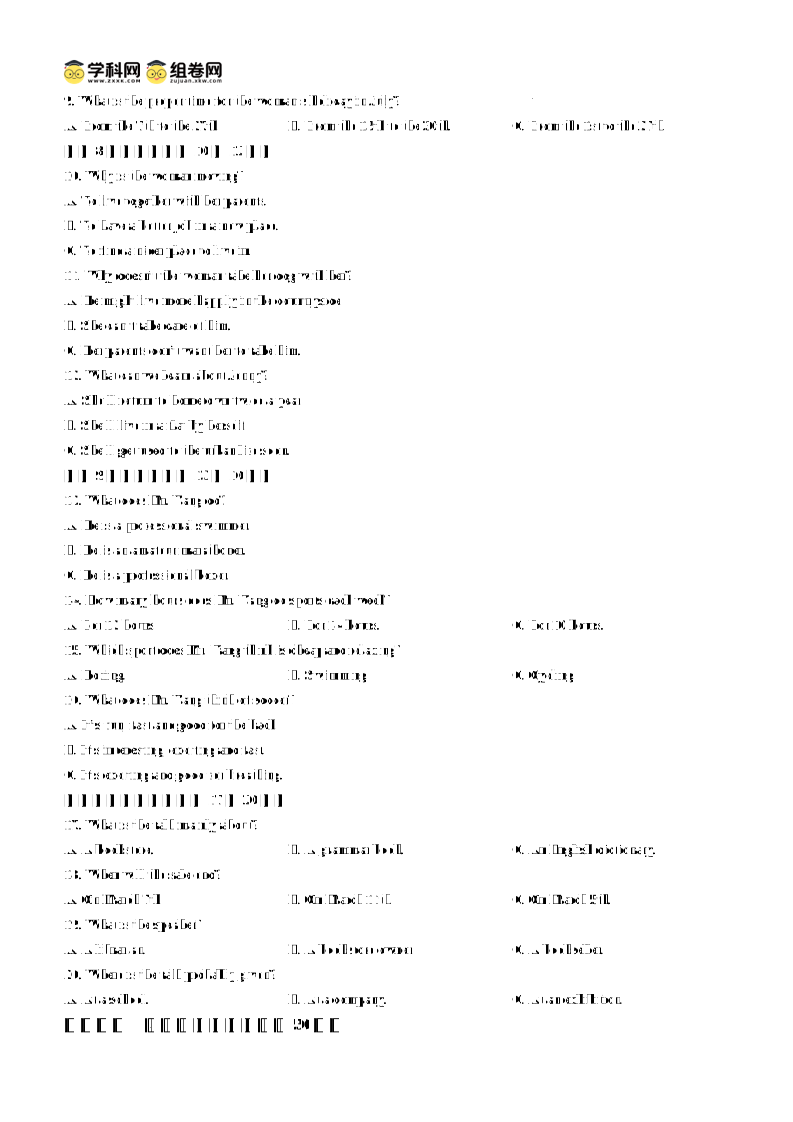
9. What is the proper time for the woman’s holiday in July?
A. From the 7th to the 27th. B. From the 15th to the 30th. C. From the 1st to the 27th.
听第8段材料,回答10至12题。
10. Why is the woman moving?
A. To live together with her parents.
B. To have a better job in a new place.
C. To find a nicer place to live in.
11. Why doesn’t the woman take her dog with her?
A. He might live more happily in the countryside.
B. She can’t take care of him.
C. Her parents don’t want her to take him.
12. What can we learn about Jenny?
A. She’ll return to hometown twice a year.
B. She’ll live in a flat by herself.
C. She’ll get used to the urban life soon.
听第9段材料,回答13至16题。
13. What does Mr. Yang do?
A. He is a professional swimmer.
B. He is an amateur marathoner.
C. He is a professional boxer.
14. How many hours does Mr. Yang do sports each week?
A. For 12 hours. B. For 14 hours. C. For 10 hours.
15. Which sport does Mr. Yang think is cheap and relaxing?
A. Boxing. B. Swimming. C. Cycling.
16. What does Mr. Yang think of soccer?
A. It’s fun, fast and good for the back.
B. It’s interesting, exciting and fast.
C. It’s exciting and good for breathing.
听下面一段独白,回答17至20题。
17. What is the talk mainly about?
A. A bookstore. B. A grammar book. C. An English dictionary.
18. When will the sale end?
A. On March 7th. B. On March 11th. C. On March 5th.
19. What is the speaker?
A. A librarian. B. A bookstore owner. C. A bookseller.
20. Where is the talk probably given?
A. At a school. B. At a company. C. At an exhibition.
第二部分 阅读(共两节,满分50分)
第一节(共15小题;每小题2.5分,满分37.5分)
阅读下列短文,从每题所给的A、B、C、D四个选项中选出最佳选项。
A
Volunteer as a Musician
Are you looking to make a difference in the lives of patients, families and caregivers and bring the healing power of music to the bedsides of patients? Join us as a Volunteer Musician for MOC Virtual and MOC Bedside.
Volunteer Roles
· Perform in person for patients from room to room
· Virtually deliver one-on-one performances and hospital-wide concerts
· Deliver live music to children and adults facing any health challenge
· Bring joy to family members supporting loved ones in need and healthcare workers caring for patients
Volunteer Requirements
· Be 18 years or older, a resident of the United States, and have a passion for giving back to the community and belief in the healing power of music
· Represent Musicians On Call and its core values
· Be able to remember and perform 3-5 songs from our approved song list. The songs should be positive, gentle, and suitable for a hospital environment, avoiding bad language, drug-related content, or heavy topics.
· Be able to do 90 minutes of volunteer work each month for at least a year
Preparing for your Application
· You need to complete a quick account set-up so you can come back and revisit your saved progress at any time.
· You’ll fill in your contact information, volunteer history, and interest in MOC.
· All musicians are required to submit their audition videos through the link below.
· For questions about becoming a volunteer, please contact volunteers@ musiciansoncall. org.
21. What can volunteer musicians do?
A. Teach patients and family members how to play musical instruments.
B. Provide medical help to patients in hospitals.
C. Only give concerts to large groups of people.
D. Perform music for patients both in person and online.
22. Which of the following is a requirement for volunteer musicians?
A. Being a professional musician with years of experience.
B. Being able to work 90 minutes each week for at least a year.
C. Being willing to serve the community through music.
D. Being able to write 3-5 original songs for patients.
23. Where is the text most likely taken from?
A. A website for volunteer programs. B. A magazine about daily life.
C. A guide to hospital services. D. A report on music and health.
B
For most of her life, Dr. Sarah Thomas viewed the vastness of the ocean not as a barrier, but as a calling. As a biological oceanographer, she had spent decades studying the migratory patterns of marine life. But it was a deeply personal discovery that shifted her focus from the life in the ocean to the health of the ocean itself.
In 2018, during a routine research expedition in the North Atlantic, Thomas’s team collected water samples that revealed an alarming concentration of micro-plastics. However, it wasn’t the data that changed her; it was a video call with her young nephew back home. He asked her, “Auntie Sarah, are you taking the rubbish out of the water so the fish won’t be sick?” His innocent question struck her. She realized that her years of publishing papers in scientific journals were not enough; she needed to translate the complex science into a story that everyone, especially the next generation, could understand and act upon.
Returning from her voyage, Thomas didn’t just write another report. She partnered with a local artist and a children’s book author to create The Voyage of the Violet, a beautifully illustrated book telling the story of a young sea turtle who gets tangled (缠绕) in plastic waste. The book, based on her scientific findings, simplifies the problem of plastic pollution without losing the truth. “We often think we need to impress people with data,” Thomas explained in an interview. “But to inspire them, we first need to connect with their hearts.”
Now, Thomas spends half her time at sea and the other half in schools and libraries, reading her book and teaching children about ocean stewardship. Her scientific work continues, but her mission has expanded. She is no longer just a scientist collecting data; she is a translator, bridging the gap between the laboratory and the living room.
24. What was Dr. Sarah Thomas’s initial professional focus?
A. Publishing children’s books about the ocean. B. Treating sick marine animals like sea turtles.
C. Studying the movements of ocean creatures. D. Measuring the levels of pollution in the Atlantic.
25. What directly inspired Thomas to change her approach to her work?
A. The invitation from a local artist. B. The simple question from her nephew.
C. The frustration with scientific progress. D. The high levels of micro-plastics in the ocean.
26. What’s the meaning of the underlined word “stewardship” in the last paragraph?
A. The scientific study of a particular subject. B. The financial support provided for a project.
C. The responsible use and protection of something. D. The commercial exploration of natural resources.
27. Which of the following can best describe Dr. Sarah Thomas?
A. Strict and demanding. B. Caring and responsible.
C. Creative and humorous. D. Ambitious and adventurous.
C
From an early age we tend to divide ourselves and others into opposing groups— such as “smart vs. dumb” in school or “rich vs. poot” in adulthood. This thinking is often used for simpler identification, but it carries significant risks.
Once we assign people or ourselves to a group, several psychological effects take hold. First of all, the group members assume an identity. A label is placed on them, which over time achieves a level of permanency. For example, if you decide yourself as belonging to the “I’m really not creative” group, you tend to view yourself as primarily and permanently uncreative. The longer this belief lasts, the harder it is to change.
Moreover, groups provide us with a false sense of comfort. By joining the “I’m not creative” group, we also conveniently protect ourselves from moving beyond the borders of that group into new and often unfamiliar areas. Like birds that hesitate to leave their cages even when the door is open, we eschew the desire to get out of our comfort zone — not because we can’t, but because we won’t. There are not just many like-minded people in the group, but it offers a safe environment to work and play.
But the problem doesn’t end there. There is a tsunami of books and articles that use language such as the following: “Creative people are individuals like Leonardo, Edison, Picasso, or Einstein who have changed our culture in some important respects” and “Creative people are the ones who get ahead in their jobs, start new businesses, invent products… paint pictures, and make things of beauty.” When reading these statements, we automatically assign ourselves to that “other group”, knowing that we can never measure up.
However, as psychological research has convincingly demonstrated, creativity is not exclusive to a select few; it is a birthright shared by everyone. So, be mindful of what you read. Sometimes, others may be putting you in a box without your knowing.
28. What does the underlined word “eschew” probably mean in paragraph 3?
A. Avoid. B. Arouse. C. Express D. Spark
29. What can we learn from paragraph 4?
A. Creative people are very few. B. Labels may limit our thoughts.
C. All great people are creative D. We can match great people easily.
30. What might the author agree with?
A. Creativity belongs to everyone. B. Groups help us know ourselves.
C. We should read more books. D. Labels help us identify others.
31. What can be the suitable title for the passage?
A. Group Identity: Its Hidden Benefits. B. Age Groups: Key Comparisons.
C. Social Labels: Their Hidden Harm. D. Creative Thinking: Ways to Develop It
D
My great-grandfather moved to Mexico more than 100 years ago. He learned Spanish and raised five children in a family with both German and Mexican culture, but he didn’t teach them German, and the language was lost in one generation. However, three generations later, my children rediscovered it during visits to Germany. This story is a case study about human cognition (认知) .
When people who speak two languages switch between languages, they pick the right one by connecting situations to what they say and making sure they stay correct. This system works in many areas. Taxi drivers change their brain to remember thousands of routes and choose the best one. Musicians are always changing between musical notes, rhythms, and feelings, needing to adjust their thinking often. Learning, understanding, and changing are all like translation—matching what we expect with the world around us. This changes how we see intelligence. Intelligence isn’t just using one area of knowledge. It’s the skill to move between areas and turn ideas into actions.
This is important now because of AI. Big language models can process huge amounts of information and do well in many tasks, but they get stuck in fixed systems. They fail when the environment changes in ways unforeseen by training data, lacking domain translation, physical experience, and real life.
Humans survive change by switching their cognition. When one system doesn’t work, we turn to another— from using symbols to relying on our senses. This flexibility is our greatest power. We aren’t just information processors; we are translators between areas. If moving between areas is our main way to adapt, succeeding in the AI age means improving this skill: spotting when we’re trapped in one area, translating across them, and building thinking structures that help us switch.
AI will keep getting better at tasks in one area, but only humans can jump between unrelated areas. The future won’t belong to those who process the most data, but to those who translate between humans and AI, different meaning systems, and our present and future. Adaptation is translation. And translation is what makes us truly human.
32. Why does the author mention the family story?
A. To stress human capacity. B. To present a language problem.
C. To praise family education. D. To explain a thinking system.
33. What is the new understanding of intelligence in paragraph 2?
A. Translation between areas. B. Constant in thoughts.
C. Effective action-taking. D. Large- scale calculations.
34. What is mainly discussed in paragraph 4?
A. Human’s special thinking power. B. AI’s ability to adapt to many systems.
C. Human’s cognitive advantage. D. AI’s huge information storage.
35. According to the last paragraph, who will succeed in the future?
A. Those processing massive data. B. Those switching between different areas.
C. Those focusing on one fixed field. D. Those creating new meaning rules.
第二节(共5小题;每小题2.5分,满分12.5分)
阅读下面短文,从短文后的选项中选出可以填入空白处的最佳选项。选项中有两项为多余选项。
Successful team cooperation is essential for achieving complex goals. It involves more than just working alongside others; it requires intentional strategies to use collective strengths. Then how can a team cooperate effectively?
36
Every team member needs a shared understanding of the project’s objectives and their specific responsibilities. This prevents misunderstandings and ensures accountability (问责制) . Ambiguity (模棱两可) in roles often leads to repeated efforts, overlooked tasks, and frustration. Clearly outlining expectations from the outset sets the stage for productive work.
Foster open and respectful communication.
Create an environment where team members feel safe to share ideas, ask questions, and voice concerns without fear of judgment. 37 Actively listening to understand different viewpoints, rather than just waiting to speak, is crucial for building trust and finding the best solutions.
Address conflicts constructively.
38 View conflicts as opportunities to explore different perspectives and improve outcomes. The goal should be to understand the root cause and find a mutually acceptable resolution. Focusing on the issue at hand, not personal attacks, and seeking common ground helps the team move forward positively.
Make the most of diverse strengths.
Recognize that each member brings unique skills, experiences, and perspectives to the table. 39 Assigning tasks based on individual strengths not only improves efficiency but also increases engagement and satisfaction.
Establish regular check-ins and feedback loops.
Don’t wait until the project deadline to assess progress. Schedule frequent, brief meetings to discuss updates, roadblocks, and next steps. Constructive feedback, both on the work and the process, should be encouraged. 40
A. Define clear goals and roles.
B. Encourage brainstorming sessions.
C. Effective communication is the basis of any strong team dynamic.
D. A team that communicates poorly will surely struggle with cooperation.
E. Disagreements are unavoidable in teamwork, but they don’t have to be destructive.
F. Intentionally discuss and map out these differences to maximize the team’s potential.
G. This allows the team to adapt quickly and ensure everyone keeps in line with the overall goal.
第Ⅱ卷(非选择题)
第三部分 语言运用(共两节,满分30分)
第一节(共15小题;每小题1分,满分15分)
阅读下面短文,从每题所给的A、B、C、D四个选项中选出最佳选项。
When Mo Yan was a child in the 1960s, his family was very poor and he couldn’t afford to go to school. Every morning, he would stand outside the village school, walking slowly and 41 looking into the classroom. He stopped in front of the window and tried to 42 the words on the blackboard, but he didn’t know most of them.
The village teacher, Mr. Wang, noticed him standing outside day after day. He walked over and asked him politely what he was looking for. Mo Yan smiled and said he wanted to learn to read and write, but he didn’t have the 43 to go to school. He only remembered that he loved listening to stories and wanted to know more words to read storybooks. Mr. Wang told him he would help him 44 to read and asked him to sit outside the classroom to listen.
As Mr. Wang gave lessons, Mo Yan started to 45 every word the teacher said, writing them down on the ground with a stick. He said he had to help his family do farm work every day. and listening to the teacher’s lessons was his only 46 to pursue knowledge.
After several months of listening, Mo Yan could read simple words. When Mr. Wang handed him a worn storybook, his hands 47 with excitement. He thanked Mr. Wang again and again, saying that no one had ever been so 48 to him. He noticed that his eyes were filled with tears, and he realized that a little 49 could mean a lot to a child who was eager to learn.
Mr. Wang asked Mo Yan to read a few sentences to him, and Mo Yan agreed happily. As he read, he pronounced every word carefully, nodding his head from time to time. When he finished, Mr. Wang told him that his reading 50 him of his own childhood of pursuing knowledge. Mo Yan finished reading the book and was about to return it, but Mr. Wang offered to 51 him more books— he had a small collection of storybooks at home.
Mo Yan tried to refuse, but Mr. Wang insisted, saying it was his 52 to help a child who loved learning. When they got to Mr. Wang’s home, Mr. Wang shook his hand 53 and said, “You are such a hard-working child. This book means a lot to you, I believe.” Mo Yan watched Mr. Wang take out the books and felt warm in his heart.
That day, Mo Yan learned that helping others is not only a 54 , but also a way to make ourselves feel happy. Even a small act of kindness can 55 a child’s life and bring light to their future.
41. A. blindly B. carefully C. anxiously D. definitely
42. A. read B. copy C. interpret D. describe
43. A. coverage B. expense C. title D. opportunity
44. A. acquire B. master C. borrow D. seek
45. A. overlook B. preserve C. recall D. imagine
46. A. approach B. reason C. excuse D. objective
47. A. trembled B. shifted C. waved D. elevated
48. A. impolite B. patient C. indifferent D. rigorous
49. A. money B. duration C. kindness D. conviction
50. A. reminded B. notified C. admonished D. persuaded
51. A. convey B. lend C. drive D. transfer
52. A. obligation B. honor C. habit D. belief
53. A. gently B. lightly C. firmly D. carelessly
54. A. burden B. annoyance C. pleasure D. stress
55. A. ruin B. brighten C. squander D. transform
第二节(共10小题;每小题1.5分,满分15分)
阅读下面短文,在空白处填入1个适当的单词或括号内单词的正确形式。
As a foreign visitor to China, I once only knew Hangzhou from books and online videos. However, a recent trip gave me a new view, telling me 56. __________ perfectly nature and civilization combine in this ancient city.
To enjoy local culture in person, I found the great wisdom and creativity 57. __________ (hide) behind every bridge and lake scene were absolutely impressive, passing down beauty for centuries. It hit me that West Lake is not just a lake, 58. __________ a symbol of peace and harmony.
Wandering along the lake in the evening, I 59. __________ (bring) into a peaceful world with gentle wind, shining lights and quiet paths. Walking around the old streets, 60. __________ old houses stand beside modern shops, I sensed the endless charm of Hangzhou. A tour to Lingyin Temple was even 61. __________ (amaze) . Standing among old trees, I imagined the people 62. __________ (pray) here in ancient times.
Hangzhou fully lives up to its reputation 63. __________ a paradise on earth, from historic attractions to modern streets, quiet lakes to lively local life. This journey was a meaningful 64. __________ (discover) of China’s perfect balance of old and new. I built a stronger love for Chinese culture. A trip to Hangzhou is never just a travel experience, but a purification (净化) of one’s 65. __________ (spirit) mind.
第四部分 写作(共两节,满分40分)
第一节(满分15分)
假定你是李华,上周六你校志愿者社团在朝阳社区中心组织了“帮助老人跨越数字鸿沟”活动。请你在班级英语展示角写一篇短文分享,内容包括:
(1)活动具体内容;
(2)你的个人体会。
注意:
1. 写作词数应为80左右;
2. 可适当增加细节,以使行文连贯。
______________________________________________________________________________________________________________________________________________________________________________________________
第二节(满分25分)
阅读下面短文,根据所给情节进行续写,使之构成一个完整的故事。
Emma, a sophomore at Greenfield College, could barely go 10 minutes without checking her phone. Whether it was scrolling through social media, replying to group chats, or browsing study materials, her phone was always in her hand. Last week, her dorm mate Lisa introduced her to the “Phone-Free Hour” club—a student group that meets every Wednesday evening to do activities like reading, board games, or casual talks without any electronic devices.
At first, Emma laughed it off. “How can I survive an hour without my phone? What if my mom texts me emergency news?” she asked Lisa. But Lisa shook her head, saying, “You’ll be surprised how relaxed you feel. Last week, we talked about our favorite childhood books— no one even thought about their phones!”
Curiosity got the better of Emma. On Wednesday, she put her phone on “Do Not Disturb” and followed Lisa to the club room. When she walked in, she saw about 20 students sitting in a circle: some were folding paper cranes, others were playing chess, and a few were sharing homemade cookies. A boy named Tom waved at her to sit down. “First time here?” he asked with a smile. Emma nodded, feeling a little awkward as she tucked her empty hands into her pockets— she wasn’t used to having nothing to “fiddle with.”
Five minutes passed, and Emma kept glancing at the door, half-expecting to rush back to her dorm to check her phone. Just then, Lisa handed her a book of short stories. “Try this— my grandma gave it to me. The stories are really warm,” Lisa said. Emma took the book slowly, opened it to the first page, and started reading. But before she could get into the story, her mind wandered: Did I post that homework photo correctly? Will my friend comment on my last post? She bit her lip, tempted to stand up and leave.
注意:
(1)续写词数应为150左右;
(2)请按如下格式在答题卡的相应位置作答:
Paragraph 1:
Just as Emma was about to stand up, Tom tapped her shoulder gently.
_______________________________________________________________________________________________
Paragraph 2:
That night at her dorm, Emma checked her phone: no ‘emergency messages,” just casual texts.
_______________________________________________________________________________________________
学科网(北京)股份有限公司
$
资源预览图
1
2

3
相关资源
由于学科网是一个信息分享及获取的平台,不确保部分用户上传资料的 来源及知识产权归属。如您发现相关资料侵犯您的合法权益,请联系学科网,我们核实后将及时进行处理。