2026年河北廊坊市霸州市九年级二模英语试题
 切换试卷
切换试卷
2026-05-29
|
10页
|
111人阅读
|
5人下载
资源信息
| 学段 | 初中 |
|---|---|
| 学科 | 英语 |
| 教材版本 | - |
| 年级 | 九年级 |
| 章节 | - |
| 类型 | 试卷 |
| 知识点 | - |
| 使用场景 | 中考复习-二模 |
| 学年 | 2026-2027 |
| 地区(省份) | 河北省 |
| 地区(市) | 廊坊市 |
| 地区(区县) | 霸州市 |
| 文件格式 | DOCX |
| 文件大小 | 400 KB |
| 发布时间 | 2026-05-29 |
| 更新时间 | 2026-05-29 |
| 作者 | 匿名 |
| 品牌系列 | - |
| 审核时间 | 2026-05-29 |
| 下载链接 | https://m.zxxk.com/soft/58119828.html |
| 价格 | 1.00储值(1储值=1元) |
| 来源 | 学科网 |
内容正文:
九年级英语(L)
2026.5
第一部分 听力(共四节,满分30分)
第一节 听句子,选择最佳答语(共5小题;每小题1分,满分5分)
1. A. OK, thanks. B. On the first floor. C. It’s blue.
2. A. It’s seven. B. It is so cute. C. It likes meat.
3. A. I’m fine. B. You too! C. Sounds great.
4. A. Yes, I like fruit. B. I prefer bananas. C. I have two apples.
5. A. Nice to meet you. B. You’re welcome. C. See you next time.
第二节 听对话和问题,选择正确答案(共13小题;每小题1分,满分13分)
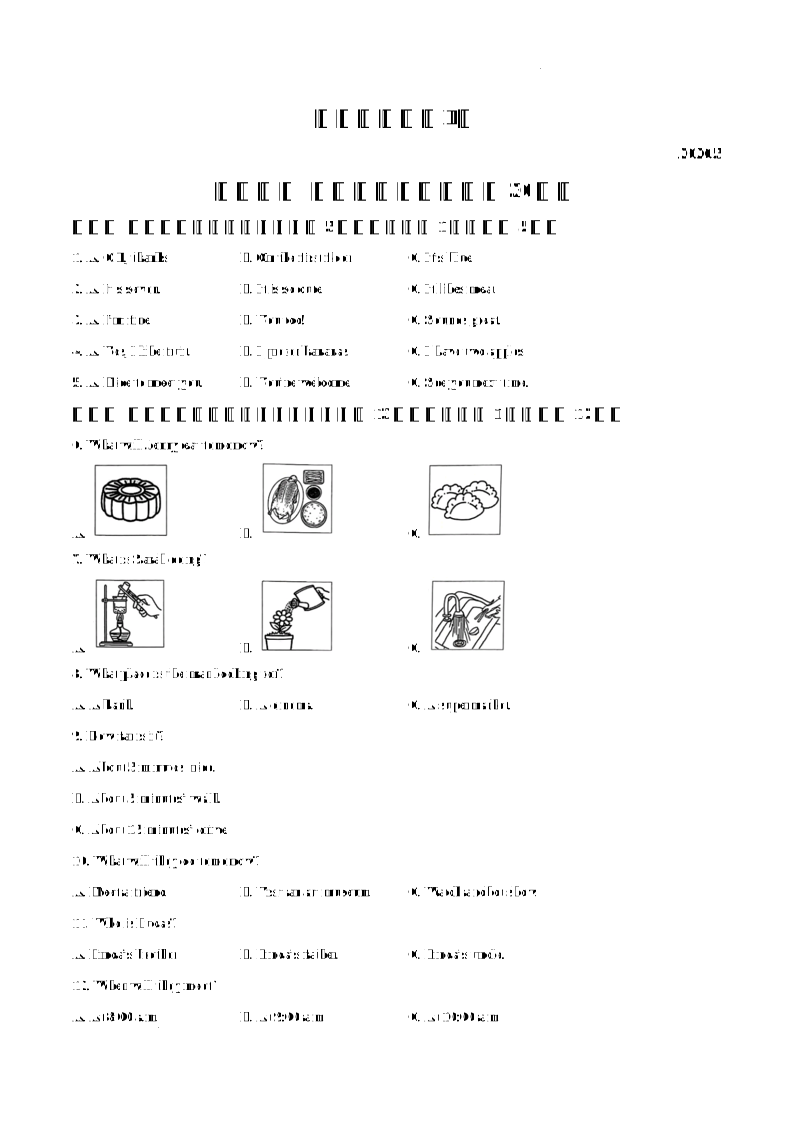
6. What will Jenny eat tomorrow?
A. B. C.
7. What is Sarah doing?
A. B. C.
8. What place is the man looking for?
A. A bank. B. A cinema. C. A supermarket.
9. How far is it?
A. About 5 minutes’ ride.
B. About 5 minutes’ walk.
C. About 15 minutes’ drive.
10. What will they do tomorrow?
A. Meet a friend. B. Visit an art museum. C. Watch a robot show.
11. Who is Lucas?
A. Linda’s brother. B. Linda’s father. C. Linda’s uncle.
12. When will they meet?
A. At 8:00 a.m. B. At 9:00 a.m. C. At 10:00 a.m.
13. Where is the volunteer activity?
A. At the city park. B. In the woods. C. On the playground.
14. What will they do there?
A. Do some cleaning. B. Water the flowers. C. Plant some trees.
15. How will they get there?
A. On foot. B. By bike. C. By bus.
16. What do Li Lei’s family do to celebrate the Double Ninth Festival?
A. Have a big dinner. B. Have a party. C. Climb mountains.
17. When is Li Lei’s grandfather’s birthday?
A. On lunar September 8. B. On lunar September 9. C. On lunar September 10.
18. What gift does Li Lei plan to give his grandfather this year?
A. Chongyang cake. B. A 3D-printed cat. C. A lovely dog.
第三节 听短文和问题,选择正确答案(共7小题;每小题1分,满分7分)
19. Who is speaking?
A. A student. B. A teacher. C. An artist.
20. How long will the art festival last?
A. For 3 days. B. For 5 days. C. For 7 days.
21. Where can students sign up?
A. In the art room. B. In the music room. C. In the reading room.
22. What is Li Ming talking about?
A. His hobbies. B. His school life. C. His future plans.
23. What subject does Li Ming like best?
A. PE. B. Chinese. C. English.
24. What do the teachers often remind students to do?
A. Study hard. B. Have a rest. C. Follow the rules.
25. How does Li Ming feel every day?
A. Busy. B. Surprised. C. Happy.
第四节 听短文填空(共5小题;每小题1分,满分5分)
Join Our Beijing Opera Club!
When and where: 26. every ______ afternoon in the library
What to do: 27. enjoy Beijing Opera shows and ______ the old stories
28. wear beautiful clothes and paint lovely Beijing Opera ______
29. have a chance to meet ______ actors
Why to join: 30. to learn about the ______ and culture of Beijing Opera
第二部分 语言运用(共两节,满分25分)
第一节 完形填空(共10小题;每小题1分,满分10分)
阅读下面短文,从每题所给的A、B、C、D四个选项中选出最佳选项。
Outdoor sports are becoming more popular. Outdoor sports are a great way to exercise and enjoy beautiful nature. They are 31 and good for us in many ways.
Outdoor sports 32 our physical health. When we ride a bike or walk in the hills, our eyes get a 33 from screens, which is great for our vision (视力). Cycling is good for our legs and our heart.
Outdoor sports help us make friends as well. We can join clubs or 34 classmates to play together. We learn teamwork and 35 each other.
Besides, outdoor sports are good for our 36 . When we stay outside and enjoy nature, we will feel relaxed and happy. It can take our mind off 37 . We will become more active and positive 38 we exercise often in the open air.
What’s more, taking part in outdoor activities often helps us become more 39 . We can challenge ourselves and learn to deal with problems when we do outdoor activities.
So why not try a new outdoor sport? Or 40 walk more. You might find a suitable outdoor sport that brings you joy, health and friendship for a lifetime!
31. A. hard B. new C. fun D. expensive
32. A. forget B. check C. worry D. improve
33. A. break B. look C. prize D. room
34. A. warn B. want C. order D. invite
35. A. wait for B. look for C. cheer for D. prepare for
36. A. mind B. breath C. grade D. hobby
37. A. noise B. stress C. failure D. time
38. A. although B. if C. unless D. so
39. A. confident B. polite C. honest D. humorous
40. A. nearly B. early C. simply D. hardly
第二节 短文填空(共15小题;每小题1分,满分15分)
阅读下面短文,在空白处填入一个适当的单词或填入括号内单词的正确形式。
Last Sunday, I woke up early. It was my 41 (mother) birthday, and I wanted to do something special for her. I decided 42 (make) breakfast for her. I went to the kitchen 43 (quiet) and started my plan.
First, I tried to cook 44 egg. But the pan (平底锅) was too hot, and the egg 45 (become) black. Next, I made toast (烤面包片), but it came out hard like a rock. I also poured a glass 46 orange juice, and half of it ran over the table. It got all over some clean 47 (dish). The kitchen was a mess!
Just then, Mom walked in 48 saw what happened. To my surprise, she didn’t get angry. Instead, she smiled and began to clean up the mess with me. “I’ve ever got many gifts, but this is the 49 (sweet) one I’ve ever received,” she said. “You 50 (try) so hard already, and that means everything to me.”
After the kitchen 51 (clean) up, Mom came up with a good idea. She said, “How about going out 52 breakfast?” We had a 53 (wonder) meal, chatting and laughing.
That day I learned something important. Love from the heart 54 (matter) more than being perfect. Mom’s love taught me that family is about trying, sharing, and supporting. Now I 55 (write) down the experience at my desk. I’ll never forget that special morning.
第三部分 阅读(共两节,满分40分)
第一节 阅读理解(共15小题;每小题2分,满分30分)
阅读下列短文,从每题所给的A、B、C、D四个选项中选出最佳选项。
A
Study Group Chat
Hey guys! I spend too much time on my phone and my homework suffers. How do you balance phone time and study time? Help!
I have a simple rule: homework first, phone later! I finish all my tasks, and then I get 30 minutes of game time. It works well!
I use the Pomodoro method (番茄工作法): study 25 minutes, then 5 minutes phone break. Also, I keep my phone in another room while doing homework in the study. Out of sight (视野), out of mind!
I use an app called Forest. It locks my phone for a set time while I study. If I don't touch it, I grow a virtual (虚拟的) tree! So satisfying!
Great ideas! I’ll try Mason’s method first. Thanks, everyone!
You got this! Just remember, good grades = more trust from parents.
56. What is Emma’s problem?
A. She doesn’t like studying. B. She can’t get good grades.
C. She doesn’t like doing sports. D. She spends too much time on her phone.
57. Where does Lily keep her phone while studying?
A. On the desk. B. In her bag. C. In the study. D. In another room.
58. What will Emma do first?
A. Use an app called Forest. B. Try the Pomodoro method.
C. Finish her homework first. D. Trust her parents more.
B
Fred used to spend all his pocket money on snacks and small things. He never thought about saving, so his money always ran out quickly. His father noticed this bad habit and made a plan to help him.
One day, his father asked Fred to record the family’s spending every week. Every day after school, Fred took out a notebook and wrote down everything clearly. He wrote down the cost of food, vegetables, fruit, school things and other daily things. At the end of the week, he added up all the money and checked carefully. He found that a lot of spending was not necessary. Then he made a careful spending plan for the next month.
His father was very pleased. He opened a savings account for Fred and taught him to manage money wisely. Fred put his lucky money and pocket money into the account regularly (有规律地). He took out money only when he needed to buy books or prepare birthday gifts for his parents.
From this experience, Fred learned the importance of rational consumption (理性消费). He understood that saving money is a kind of responsibility.
59. What was Fred’s bad habit?
A. He didn’t respect his father.
B. He spent his money without a plan.
C. He thought about saving money all the time.
D. He always left his things everywhere in the room.
60. What did Fred find after recording his family’s weekly spending?
A. His plan worked very well.
B. His pocket money was too little.
C. A lot of spending was not necessary.
D. Too much money was spent on food.
61. What can we infer (推断) about Fred?
A. Fred would spend much money on snacks.
B. Fred would only buy the things that he liked.
C. Fred got more responsible and spent money wisely.
D. Fred wouldn’t take out money from his savings account.
C
①Communication isn’t always easy, but it’s the key to healthy relationships. If you want to communicate better with your family or friends, here is some helpful advice.
②To begin with, learn to say what you mean clearly. Sometimes we expect others to understand our hidden meanings, but that doesn’t work well. Instead, be direct and express your thoughts clearly.
③Secondly, use “I” statements when you talk about your feelings. Don’t start with “You always …” or “You never …” Try saying “I feel sad when …” or “I’ve noticed that …” This helps the other person listen better without getting angry.
④Thirdly, stay as calm as you can during discussions. If you feel too angry, take a deep breath to relax or walk away for a few minutes. When you’re calm, you can express yourself more clearly and have a better conversation.
⑤Besides, pay attention to your body language. Look at the person when you speak, and don’t cross your arms. Smiling can help create a positive atmosphere (气氛).
⑥Good communication takes practice, but it’s worth the effort. With patience and the advice above, you can build stronger relationships with the people around you.
62. What does the writer advise us to do in paragraph 2?
A. Always hide our meanings. B. Express our meanings clearly.
C. Keep calm during a discussion. D. Practice communicating often.
63. Which is a good way to express feelings according to the writer?
A. Saying “I feel sad when you do that.”
B. Saying “You should stop doing that.”
C. Saying “Why not try to understand me?”
D. Saying “You always make the same mistake.”
64. What could you do if you feel too angry according to the writer?
A. Keep diaries. B. Talk with friends.
C. Ask teachers for help. D. Leave for a while.
65. Which of the following best shows the structure (结构) of the text?
A. B. C. D.
D
A team of researchers in China has made plants that can shine in the dark. These special plants can be recharged (充电) by sunlight. They can shine in colors like red, green, and blue.
Scientists have tried to make shining plants for many years. In this new study, the team put phosphor (荧光粉) into the plants. Phosphor can take in light and store it. Then, it slowly gives the light back.
The researchers built a wall with 56 shining plants. Sunlight was used to give them power. The light was strong enough for someone to see words, pictures, and even a person standing 10 cm away. The shine lasted for about two hours. After that, the plants could be powered again by putting them back in the sun.
The scientists found that one kind of plant worked best. It is a succulent (多肉) called Echeveria mebina. These plants retain water in their leaves, so they are strong and easy to care for. The researchers are still not sure if the phosphor is safe for the plants. More tests are needed.
The team hopes to make a new kind of environment-friendly lighting. One scientist said, “Imagine shining trees taking the place of streetlights.” But some experts are not so sure. A plant scientist from the University of Cambridge said the research was “fun” but a little ahead of today’s technology.
66. What is phosphor used for in this study?
A. To help plants take in and give out light.
B. To help the plants grow bigger and faster.
C. To make the plants stronger and live longer.
D. To make the plants hold more water in their leaves.
67. What can the shining plants do after being put in the sun?
A. Grow faster. B. Shine again. C. Change colors. D. Turn green.
68. What does the underlined word “retain” in paragraph 4 probably mean?
A. Lose. B. Store. C. Drink. D. Produce.
69. What do some experts think about the shining plants?
A. They are harmful to the environment.
B. They are ready to replace streetlights.
C. The research is fun but not yet practical.
D. People may not like them in daily life.
70. What is the best title for the text?
A. Streetlights or Sunlight
B. The History of Plant Research
C. How to Make Plants Grow Faster
D. Shining Plants: A New Kind of Light
第二节 阅读表达(共5小题;每小题2分,满分10分)
阅读下面短文,简略回答问题。
In the past few years, great changes have taken place in my hometown, Hebei. Life today is quite different from what it used to be.
Technology is changing farming, and making farming smarter and better. In Handan, a special wheat (小麦) called “Zhongxinmai 998” was sent into space. The seeds (种子) changed there, and now this wheat can fight against bad weather and produce more food. In Xingtai, smart machines follow the Beidou system to plant crops (庄稼) in straight rows at the same depth. In this way, every plant gets enough sunlight and air. As a result, over 8% more plants come out of the ground, and they grow better and faster.
Transportation has also improved a lot. High-speed railway stations have been built, connecting our city with more places in China. From 2020 to 2025, a total of 105 tourist trains ran in the Beijing-Tianjin-Hebei area. They travelled to over 100 cities, carrying about 40,000 passengers in all.
Moreover, living conditions have become much better. Tall buildings and shopping malls provide people with comfortable homes and more ways to have fun. Old neighborhoods are repaired, and broken roads are now smooth and safe. Dirty riversides have become clean parks with flowers and trees. In many villages, buses carry both people and packages (包裹), making life easier for farmers.
I’m proud of these changes. They have made my hometown more lively and pleasant.
71. What is special about “Zhongxinmai 998” after its seeds changed in space?
____________________________________________________________________________________________
72. How many tourist trains ran in the Beijing-Tianjin-Hebei area from 2020 to 2025?
____________________________________________________________________________________________
73. What have dirty riversides become?
____________________________________________________________________________________________
74. How does the writer feel about the changes?
____________________________________________________________________________________________
75. What is one thing in your hometown that you hope will never change? Why?
____________________________________________________________________________________________
第四部分 情景交际(满分10分)
补全对话(共5小题;每小题2分,满分10分)
根据下面的对话情景,在空白处填入一个适当的句子,使对话的意思连贯、完整。
(Zhang Hua and Betty are talking on the way home.)
Zhang Hua: Hi Betty. Are you going to run for class monitor (竞选班长)?
Betty: 76 I’m a little nervous but also excited.
Zhang Hua: Cool! 77
Betty: Because I like helping others and I’m good at talking with people.
Zhang Hua: 78
Betty: Yes, I have. In primary school, I was a class monitor.
Zhang Hua: That’s great! 79
Betty: As a monitor, I will listen to everyone and try my best to help.
Zhang Hua: Sounds great! 80
Betty: Thank you!
第五部分 写作(满分15分)
书面表达
81.假定你是学校英文报编辑李辉。为迎接下周的校园科技节,请你在英文报发表倡议书,向全校同学征集科技作品,并说明活动的意义和作品提交要求。
Purposes:
·show your talent
·make the school life colorful
·…
Requirements(要求):
·small inventions or science models
·hand it in to your class teacher
·…
注意:(1)文中须包括所有信息(含需要补充的两处内容),可适当发挥;
(2)文中不得出现真实的人名、校名和地名;
(3)词数80个左右(开头和结尾已给出,不计入总词数)。
Dear students,
Our school is going to hold a science festival next week. We warmly invite you to hand in your science works._______________________________________________________________________________________________________________________________________________________________________________________________________________________________________________________________________________
Li Hui,
School English Newspaper
学科网(北京)股份有限公司
$
资源预览图
1
2
3
相关资源
由于学科网是一个信息分享及获取的平台,不确保部分用户上传资料的 来源及知识产权归属。如您发现相关资料侵犯您的合法权益,请联系学科网,我们核实后将及时进行处理。