2026年安徽省阜阳市颍州区王店镇桃花中学等九年级5月模考二模英语试题
 切换试卷
切换试卷
2026-05-28
|
2份
|
17页
|
8人阅读
|
0人下载
资源信息
| 学段 | 初中 |
|---|---|
| 学科 | 英语 |
| 教材版本 | - |
| 年级 | 九年级 |
| 章节 | - |
| 类型 | 试卷 |
| 知识点 | - |
| 使用场景 | 中考复习-二模 |
| 学年 | 2026-2027 |
| 地区(省份) | 安徽省 |
| 地区(市) | 阜阳市 |
| 地区(区县) | 颍州区 |
| 文件格式 | ZIP |
| 文件大小 | 17.58 MB |
| 发布时间 | 2026-05-28 |
| 更新时间 | 2026-05-28 |
| 作者 | 学科网试题平台 |
| 品牌系列 | - |
| 审核时间 | 2026-05-28 |
| 下载链接 | https://m.zxxk.com/soft/58098572.html |
| 价格 | 2.00储值(1储值=1元) |
| 来源 | 学科网 |
内容正文:
英语。3,一短对话理解,你将听到5段对话,每段对话后有一个小题请,在每小题所给的ABC3个选项中选出一个最佳选项,每段对话读两遍。One. what a beautiful paper cutting art works who made . IT Lucy SHE took a paper cutting course last term. What a beautiful paper cutting artwork who made IT . Lucy SHE took a paper cutting course last term. Two, can we go on a picnic tomorrow? I'm afraid weekend, the weather report says it'll be a wet day. Can we go on a picnic tomorrow? I'm afraid weekend, the weather report says it'll be a wet today. Three, I saw you on the street yesterday. That's . impossible. I worked in the garden for the whole day. I saw you on the street yesterday. That's . impossible. I worked in the garden for the whole day. For hurry up, the talk show will started. Six P, M. Take your time. There is still a fifteen minutes left. Hurry up, the talk show will start at six P. M. Take your time. There is still a fifteen minutes left. Five, john, you arrived late today. What's up? My bike . was broken on my way to school. mrs. Lee. john, you arrived late today. What's up? My bike . was broken on my way to school. Miss lee. 2、长对话理解。你将听到两段对话,每段对话后有几个小题请,在每小题所给的ABC3个选项中选出一个最佳选项。每段对话读两遍,听下面一段对话,回答第6至7题。Excuse me, can I borrow a book about famous people I needed for my project? sure. We have just got some new books. Here they are. This one is useful to me. How long can I keep IT? Well, you can keep IT for a week. Thank you. I will return IT in time. Excuse me, can I borrow a book about famous people? I need IT for my project. sure. We have just got some new books. Here they are. This one is useful to me. How long can I keep IT? Well, you can keep IT for a week. Thank you. I will return IT in time. 听下面一段对话,回答第8至10题. hi, john. How is everything going pretty good? My brother is coming for a visit next week, and we'd like to visit some places of interest. But travelling is so expensive. Have you thought about camping? camping? I've never done that. Is IT very dangerous? No, my cousin and I went camping last month. Please tell me more about IT. mary. Well, it's relaxing and it's much cheaper than staying at a hotel. great. We can go out by bike and find a nice place to camp. Hi, john, how is everything going pretty good? My brother is coming for a visit next week, and we'd like to visit some places of interest. But travelling is so expensive. Have you thought about camping? Camping i've never done that. Is IT very dangerous. No, my cousin and I went camping last month. Please tell me more about IT, mary. Well, it's relaxing and it's much cheaper than staying at a hotel. great. We can go out by bike and find a nice place to camp. 3、短文理解。你将听到一篇短文,短文后有五个小题请,根据短文内容,在每小题所给的ABC3个选项中选出一个最佳选项,短文读两遍。Hello. i'm jung mean a chinese student in france. Now I want to tell you something about chinese festivals. There are many festivals in china, such as the lantern festival, the mid autumn festival and the spring festival. Among these festivals, I like the spring festival best because I can spend time with my family. Last spring festival, we were in my grandparents home. They live in a small and quiet village. During the festival, we ate delicious food, watched T, V and talked with each other happily. We really enjoyed ourselves there. I also got some lucky money from my grandparents. I used IT to buy some science books and a watch how great the spring festival was. Hello, i'm jung mean, a chinese student in france. Now I want to tell you something about chinese festivals. There are many festivals in china, such as the lantern festival, mid autumn festival and the spring festival. Among these festivals, I like the spring festival best because I can spend time with my family. Last spring festival, we were in my grandparents home home. They live in a small and quiet village. During the festival, we ate delicious food, watched T, V and talked with each other happily. We really enjoyed ourselves there. I also got some lucky money from my grandparents. I used IT to buy some science books and a watch how great the spring festival was. 4、信息转换,你将听到一篇短文,请根据短文内容写出下面表格中所缺的单词,每空只填一词,短文读两遍。What should you do when you and your friends argue? Follow the advice below. You should listen first, give the other person a chance to speak, pay attention to your friends face and body language, try to imagine how your friend is probably feeling at that moment. Besides, stay calm, think carefully before you speak, and don't say words that aren't kind, count to ten, and try to cool down. What's more, think together. Two heads are always Better than one. Talk with your friend about how you could solve the problem. You can also get help from adults if needed. Last but not least, remember that nobody is perfect. It's okay to make mistakes, but you have to say sorry when needed and correct mistakes. What should you do when you and your friends argue? Follow the advice below, you should listen first, give the other person a chance to speak, pay attention to your friends face and body language. Try to imagine how your friend is probably feeling at that moment. Besides, stay calm, think carefully before you speak, and don't say words that aren't kind. Count to ten and try to cool down whats more. Think together. Two heads are always Better than one. Talk with your friend about how you could solve the problem. You can also get help from adults if needed. Last but not least, remember that nobody is perfect. It's okay to make mistakes, but you have to say sorry when needed and correct mistakes.
英 语(三)
注意事项:1.本试卷共8页,十个大题,满分120分,考试时间120分钟。
2.本试卷上不要答题,请按答题卡上注意事项的要求直接把答案填写在答题卡上。答在试卷上的答案无效。
第一部分 听力(共四大题,满分20分)
Ⅰ.短对话理解(共5小题;每小题1分,满分5分)
你将听到五段对话。每段对话后有一个小题,请在每小题所给的A、B、C三个选项中选出一个最佳选项。每段对话读两遍。
1. 【此处可播放相关音频,请去附件查看】
What are they talking about?
A. B. C.
2. 【此处可播放相关音频,请去附件查看】
How will the weather be tomorrow?
A. B. C.
3. 【此处可播放相关音频,请去附件查看】
Where was the man yesterday?
A. In the park. B. In the garden. C. In the school.
4. 【此处可播放相关音频,请去附件查看】
What time is it now?
A. It’s 5:45 p. m. B. It’s 6 p. m. C. It’s 6:15 p. m.
5. 【此处可播放相关音频,请去附件查看】
What’s the probable relationship between the two speakers?
A. Waiter and customer. B. Teacher and student. C. Parent and child.
Ⅱ.长对话理解(共5小题;每小题1分,满分5分)
你将听到两段对话。每段对话后有几个小题,请在每小题所给的A、B、C三个选项中选出一个最佳选项。每段对话读两遍。
听下面一段对话,回答两个小题。【此处可播放相关音频,请去附件查看】
6. Why does the girl want to borrow the book?
A. To interview famous people. B. To finish her project. C. To open her eyes.
7. How long can the girl keep the book?
A. For a week. B. For ten days. C. For a month.
听下面一段对话,回答三个小题。【此处可播放相关音频,请去附件查看】
8. Who will come to visit John?
A. His friend. B. His cousin. C. His brother.
9. When did Mary go camping?
A. Last summer. B. Last month. C. Last week.
10. What does Mary think of camping?
A. Expensive. B. Relaxing. C. Dangerous.
Ⅲ.短文理解(共5小题;每小题1分,满分5分)
你将听到一篇短文。短文后有五个小题,请根据短文内容,在每小题所给的A、B、C三个选项中选出一个最佳选项。短文读两遍。【此处可播放相关音频,请去附件查看】
11. Where is the speaker now?
A. In China. B. In America. C. In France.
12. What’s the speaker’s favourite festival?
A. The Lantern Festival. B. The Spring Festival. C. The Mid-Autumn Festival.
13. Why does the speaker like the festival best?
A. Because she can get some presents.
B. Because she can eat a lot of delicious food.
C. Because she can spend time with her family.
14. How is the village?
A. Old and clean. B. Small and quiet. C. Big and beautiful.
15. What did the speaker buy with the money?
A. Science books and a watch.
B. Some notebooks and a watch.
C. Science books and lanterns.
Ⅳ.信息转换(共5小题;每小题1分,满分5分)
你将听到一篇短文。请根据短文内容,写出下面表格中所缺的单词,每空仅填一词。短文读两遍。【此处可播放相关音频,请去附件查看】
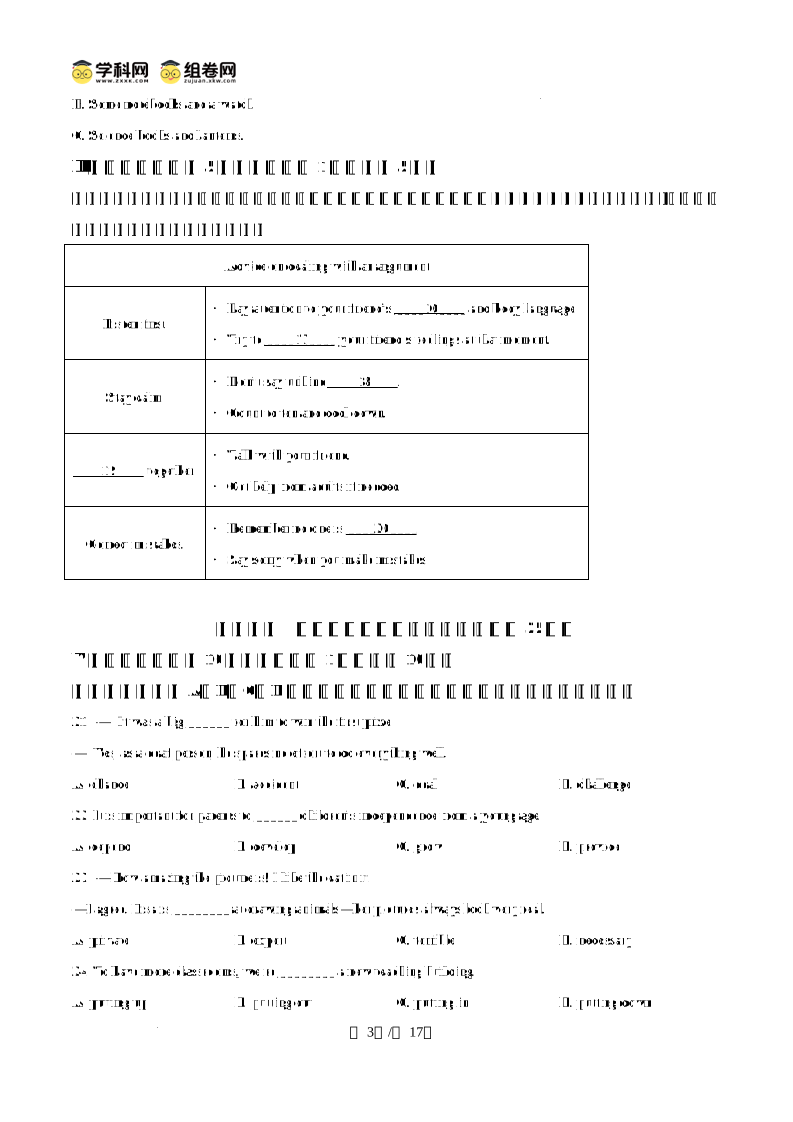
Advice on dealing with an argument
Listen first.
·Pay attention to your friend’s ____16____ and body language.
·Try to ____17____ your friend’s feelings at that moment.
Stay calm.
·Don’t say unkind ____18____.
·Count to ten and cool down.
____19____ together.
·Talk with your friend.
·Get help from adults if needed.
Correct mistakes.
·Remember no one is ____20____.
·Say sorry when you make mistakes.
第二部分 语言知识运用(共三大题,满分35分)
Ⅴ.单项填空(共10小题;每小题1分,满分10分)
从每小题所给的A、B、C、D四个选项中选出一个可以填入空白处的最佳选项。
21. — It was a big ______ for him to win the first prize.
— Yes, as a deaf person, he spares no effort to do everything well.
A. chance B. accident C. deal D. challenge
22. It is important for parents to ______ children’s independence from a young age.
A. depend B. develop C. grow D. provide
23. —How amazing the picture is! I like the cat in it.
—I agree. Lisa is ________ at drawing animals—her pictures always look very real.
A. private B. expert C. terrible D. necessary
24. To have more classrooms, we’re ________ a new teaching building.
A. putting up B. putting out C. putting in D. putting down
25. —The summer vacation is coming. I can’t wait to swim in the sea.
—Don’t swim in the deep area, ________ when you are alone.
A. probably B. possibly C. especially D. exactly
26. We need to tell people to just do one small thing well ________ 100 things poorly.
A. as well as B. instead of C. according to D. because of
27. —I called you this morning, but you didn’t answer the phone.
—Sorry, I ________ the flowers in the garden then.
A. water B. watered C. am watering D. was watering
28. —What have you learned after watching the movie Nezha II?
—We should never give up our dreams ________ we may meet with many difficulties.
A. although B. until C. while D. if
29. —I am considering ________I should join the summer farming camp.
—Just try it! It’s a great experience.
A. when B. where C. whether D. how
30. —Would you mind if I close the window?
—________. You know, we should keep the air fresh.
A. Never mind B. Of course not C. All right D. You’d better not
Ⅵ.完形填空(共20小题;每小题1分,满分20分)
阅读下列短文,从每小题所给的A、B、C、D四个选项中选出可以填入空白处的最佳选项。
A
Changing schools may be the worst thing in the world. Everyone knows each other already, so the newcomer almost always feels left out. Sadly, that “newcomer” was me.
I stood nervously (紧张地) in the ____31____ of my new classroom. Everyone welcomed me warmly, but I was too ____32____ to say much. I just said my name and quickly took my seat.
At break time, I went to the bathroom and filled my water bottle alone. I knew that some ____33____ would happen but experiencing it still felt heavy. Our first lesson was English. This school was moving much ____34____ than my old one. What’s more, my classmates’ pronunciation and grammar were much better than mine. All of this ____35____ on me.
Then came PE class. I was glad to finally take a ____36____. I sat under a tree, watching others play badminton. Suddenly, I heard a soft voice say: “Help…” I turned around and saw a girl who fainted (昏倒) in the hallway. Without thinking, I ____37____ to help her. “Help! Help!” I called to the teacher. Together, we carried her to the school nurse.
____38____, she just fell over because she didn’t have breakfast. After some rest, she was fine again. But when I got back to the classroom, something ____39____ happened. Some of my classmates asked me about the girl. Others said I was really caring. One person even asked if I wanted to walk home together after school.
At that moment, I was aware that I had found my place in this new school-not by trying to ____40____ in, but by helping someone when they needed it most.
31. A. back B. corner C. middle D. front
32. A. shy B. happy C. proud D. angry
33. A. greatness B. loneliness C. excitement D. danger
34. A. slower B. faster C. later D. earlier
35. A. depended B. moved C. weighed D. lived
36. A. photo B. break C. chance D. walk
37. A. hurried B. forgot C. managed D. happened
38. A. Luckily B. Sadly C. Hopefully D. Wisely
39. A. speechless B. incorrect C. powerful D. surprising
40. A. fill B. put C. fit D. take
B
Once in a village, there lived a rich man who built a huge garden. The garden was very beautiful, ___41___ it became popular soon. Lots of visitors even came from faraway places to visit it. The rich man had to serve them and manage the garden. With too much work to do, he needed a person with the ___42___ and experience to help him. Then he ___43___ a notice outside. It said that he’d like a garden keeper.
Seeing the notice, many people wanted to get the job. They knew the rich man would ___44___ a lot. However, the rich man refused to let them work after the ___45___. Many people said the rich man must have been so strict. He paid no attention to their words and kept looking for a keeper. He often sat in front of the door, watching visitors come and go.
One day, the rich man ___46___ a young man in old clothes who walked towards the garden. He asked the man, “Would you like to be my garden keeper?”
The man was ___47___. He said, “I have no experience. How can I manage such a big garden?”
“I believe you’re the ___48___ person for the job. On the way to the garden, I put a ___49___ on the ground. Many people fell over it. ___50___, no one moved the stone out of the way. Only you did it. It’s nice of you to think about others,” the rich man replied. At last, the young man became the keeper. He did a really good job there.
41. A. because B. when C. so D. if
42. A. reality B. condition C. benefit D. ability
43. A. put up B. looked up C. made up D. took up
44. A. protect B. pay C. require D. remind
45. A. interview B. context C. leadership D. speech
46. A. realised B. replaced C. noticed D. organised
47. A. bored B. tired C. interested D. surprised
48. A. necessary B. right C. common D. wet
49. A. flower B. bag C. stone D. card
50. A. However B. Still C. Just D. Perhaps
Ⅶ.补全对话(共5小题;每小题1分,满分5分)
根据对话内容,从方框内的选项中选出能填入空白处的最佳选项。其中有两个为多余选项。
A: Hey, Jane. You have borrowed lots of books from the library again. ____51____
B: They’re about AI. ____52____ Maybe I can teach machines to help doctors or farmers.
A: You’re a total AI supporter. ____53____
B: Why do you think so?
A: For example, so many students use AI to cheat on homework now.
B: That’s not AI’s fault. ____54____ We need to use it properly.
A: Yet AI could take the place of humans in certain jobs. My dad says his factory might use robots instead of workers next year.
B: But on the other hand, AI would create some new jobs. ____55____
A: Maybe you’re right. AI’s a tool, but fools let it rule.
A. AI is just a tool.
B. What are they about?
C. However, I’m worried about AI.
D. Why do you want to be an AI trainer?
E. I want to be an AI trainer in the future.
F. What if AI replaces human jobs, like factory workers?
G. So we need to study hard to keep up with social development.
第三部分 阅读(共两节,满分40分)
Ⅷ.阅读理解(共20小题;每小题2分,满分40分)
第一节 阅读下列短文,从每小题所给的A、B、C、D四个选项中选出最佳选项。
A
Are mosquitoes driving you crazy? This summer, make some mint oil to drive them away!
Mosquitoes are awful. They seem to be everywhere and may bite you badly. This makes mint (薄荷) oil a perfect gift for your family and friends in summer. This weekend, you can try making mint oil FOR FREE.
Time: 9:00 a.m.— 11:50 a.m. Saturday (July 5)
Place: Riverside Community Center
Please note:
♥ We’ll get all the tools and materials ready.
♥ For 40 people only. First come, first served.
♥ To book a place for the activity, please call Lucy at 345878 by 7:00 p.m. Friday.
For those who would like to practice it at home, here are the steps:
◆ Cut up the mint. Put it into a bottle with olive (橄榄) oil.
◆ Cover the bottle and place it in hot water.
◆ When the water cools down, move the bottle to a warm area and leave it there for at least two hours.
◆ Pour the mixture onto a thin piece of cotton cloth on top of a dark bottle. Let the oil go through the cloth into the bottle. Now you get your homemade mint oil.
56. When will this community event take place?
A. This Friday afternoon. B. Next Friday afternoon.
C. This Saturday morning. D. Next Saturday morning.
57. Why would people call Lucy before the event?
A. To win a gift. B. To book a place.
C. To get mint oil. D. To buy some tools.
58. What is the right order of the steps?
A. ③→①→②→④ B. ②→④→①→③
C. ②→①→③→④ D. ③→②→④→①
B
Ji Dezhong, known as “Chicken Chop Brother” in Jingdezhen, Jiangxi Province, is a 55-year-old man with a special story. For over 20 years, he has been selling delicious chicken chops on the street, but what makes him different is his love for English.
Every day after closing his food stall, Ji spends 2 to 3 hours learning English. He starts with basic words and sentences, and now he can have simple conversations with foreigners. Many tourists from other countries visit Jingdezhen for its famous porcelain (瓷器). When they pass Ji’s stall, they are surprised to hear him speak English. Ji often recommends local snacks and scenic spots to them in English, and sometimes he even helps them take photos.
Ji says learning English is not easy for him, but he never gives up. “I want to let more foreigners know about Jingdezhen and Chinese culture,” he says. His story has become popular online, and many people praise him for his perseverance (毅力). He proves that it’s never too late to learn something new.
59. Why does Ji learn English?
A. To travel abroad easily.
B. To help his food business make more money.
C. To let foreigners know about Jingdezhen and Chinese culture.
D. To teach English to other street sellers.
60. What can Ji do in English now?
A. Write long English articles.
B. Have simple conversations with foreigners.
C. Translate Chinese porcelain books into English.
D. Give English speeches in public.
61. What can we learn from Ji’s story?
A. It’s too late to learn new things when you are over 50.
B. Learning English is only for young people.
C. Perseverance can help you achieve your goals.
D. Selling food is the best way to meet foreigners.
C
Long ago, in ancient China, there was a story about the invention of silk. People believed that silk was first invented by Leizu, the wife of the Yellow Emperor. Leizu learned how to make cocoons (蚕茧) into soft and strong cloth. This magical cloth became known as “silk”, and it was so valuable that it was called “China’s Gold”. Following kings’ orders, the Chinese kept the secret of making silk for centuries.
But then, something amazing happened! During the Han Dynasty, the brave officer Zhang Qian traveled west as far as Central Asia and brought silk there. As years passed by, silk became so important that the trade road from Europe to China got its name—the Silk Road.
The Silk Road became a busy highway for traders who carried things across deserts and mountains. From China, people sold silk and tea. In return, they received treasures such as spices (香料), gold and silver from the West. At the very beginning, it was mainly about trade; then people began to share ideas, technologies and cultures. For example, Chinese inventions like papermaking were spread to the West, while new ideas about math and science came to China.
Most importantly, the Silk Road helped different cultures learn from each other. Art, music and even language were shared along this ancient road. In places like the Dunhuang Grottoes (敦煌石窟) in China, you can see how art pieces combined (融合) Eastern and Western styles into something distinctive. It can not be seen anywhere else.
The story of the Silk Road tells us how people from faraway lands could become friends through trade and shared ideas. Today, we remember the Silk Road as one of the greatest examples of cooperation and exchange in history. It shows us how important it is to learn about and respect each other’s traditions, and that different cultures can work together to create amazing things.
62. Who invented silk in ancient China?
A. Leizu. B. The kings. C. Zhang Qian. D. The Yellow Emperor.
63. What was spread from China to the West according to paragraph 3?
A. Silk and gold. B. Tea and papermaking. C. Spices and silver. D. New ideas of science.
64. What does the underlined word “distinctive” mean in paragraph 4?
A. Special. B. Public. C. Popular. D. Strong.
65. What does the story of the Silk Road mainly tell us?
A. The change of world trade. B. The introduction of silk cloth.
C. The influence of technology in history. D. The importance of cross-cultural communication.
D
Parents are the closest people to children, but it’s not always easy to deal with (处理) the parent-child relationship. Now the Internet Age brings a new difficulty. Parents and children have different ideas about the use of the Internet. Why does it happen?
Sometimes, children use the Internet for some useful information, but their parents don’t believe them enough. Parents always worry that it is bad for children to use the Internet. Many children really spend too much time playing on computers or smartphones.
What can we do to help improve the parent-child relationship? Experts said, “If you don’t want your parents to worry about you, you should share more with them and tell them that you can plan your time well. Children should do more for the healthy and close family relationship.”
Yang Li, a middle school student from Chengdu, said she believed the Internet brought her closer to her parents. She always shared some new apps with her parents. Sometimes she even taught her parents how to use them. After that, she found her parents understood her better and gradually came to trust her.
66. How does the writer organize Paragraph 4?
A. By asking questions. B. By giving examples.
C. By telling stories. D. By making a report.
67. What do most students do on the Internet?
A. They watch movies or download music. B. They study or work.
C. They play computer games. D. They chat with each other.
68. What can students do to help improve the parent-child relationship?
A. They can talk with their parents. B. They can share more with their parents.
C. They can tell their parents their time plan. D. B and C.
69. What is the theme (主题) of the passage?
A. The young people can do many things on the Internet.
B. It’s not easy to deal with the parent-child relationship.
C. The Internet brings us closer to our parents.
D. The Internet plays an important part in the parent-child relationship.
E
On November 26, 2025, a large fire broke out in Hong Kong. The fire started on the bamboo scaffolding (脚手架) and green safety netting (安全围网) of a building. The fire spread quickly to neighbouring towers. Firefighters, police, and doctors rushed to save people and control the fire.
By the next day, it was reported that at least 44 people had died, and many others were injured or missing. Hundreds left the area and stayed in safer places. This fire is considered the most serious fire in Hong Kong in 77 years and the first to reach a level-5 alarm—the highest fire alarm in 17 years.
In the accident, there were stories of courage and kindness. Neighbours helped elderly people run away when elevators could not be used. Some people knocked on doors to warn others about the fire. Citizens from other areas sent food and clothing to support the families. These actions showed that Hong Kong people care for one another even in dangerous situations.
This event reminds everyone how important fire safety is. People should know the escape (逃生) ways in their buildings, keep corridors (走廊) clear, and never use elevators during a fire. Staying calm and helping others are also very important.
70. How were the people in Hong Kong in such dangerous situations?
A. They were brave and kind. B. They were careless and selfish.
C. They were dangerous and terrible. D. They were polite and honest.
71. Why was the fire the most serious in Hong Kong in 77 years?
A. It was the first fire in a high-rise building.
B. It caused many deaths and was the first to reach a level-5 alarm in 17 years.
C. It started on the bamboo scaffolding of a building.
D. Firefighters, police, and doctors took a long time to control it.
72. Why does the writer write this passage?
A. To describe how the fire started and spread in Hong Kong.
B. To report the number of people who died in the accident.
C. To describe the fire and remind people about fire safety.
D. To explain why the fire spread in Hong Kong.
第二节 阅读下列短文,并用英语回答问题(请注意每小题的词数要求)。
F
阅读下面短文,并用英语回答问题(请注意每小题后面的词数要求)。
The eagle has amazing natural talents. It can fly high in the sky without any efforts. Its strong wings and sharp (尖锐的) eyes help it rule the sky and easily reach the top of the pyramid (金字塔).
The snail (蜗牛), though, doesn’t have such great abilities. Yet it can also reach great heights. Realizing its limitations (限制), the snail focuses on small but continuing progress. Each day, it moves slowly but never stops. It doesn’t give up when it meets difficulties.
This gives us an important life lesson. If we lack (缺乏) the eagle’s natural gifts to achieve goals quickly, we can learn the snail’s spirit. We should never give up and take small steps one by one. Life is like a piggy bank (存钱罐). Every small effort, whether studying a bit longer, learning a new skill, or working hard, accumulates (累加) over time. These efforts will be paid back in the end. By keeping it every day, we can get closer to our own “pyramid tops”.
73. What helps the eagle reach the top of the pyramid easily?(不超过10个词)
_______________________________________________________
74. What does the snail do when facing difficulties?(不超过10个词)
_______________________________________________________
75. What can we learn from the text?(不超过15个词)
_______________________________________________________
第四部分 写(共两大题,满分25分)
Ⅸ.单词拼写(共5小题;每小题1分,满分5分)
根据首字母及汉语提示,完成下列单词的拼写,使句意明确、语言通顺。
76. Eating vegetables and doing exercise are good for our health and have many ________ (好处).
77. Many young people think it’s well ________ (值得) watching.
78. Some ________ (宠物) can help people and even have jobs.
79. Bicycle riding is good exercise because it doesn’t c________(造成) air pollution.
80. I have never ________ (后悔) choosing to be kind, even when it was not easy.
X.书面表达(共1小题,满分20分)
81. 中小学“春假”制度(Spring Break Policy)的实施引发了社会的广泛关注,人们对此持不同的看法。请你根据以下表格内容,用英语写一篇短文谈谈你的看法。
支持者
学生有更多时间休息,缓解学业压力;发展个人爱好……
反对者
学生难以自主安排学习时间……
你的观点
……
要求:1. 文中不能出现真实的人名、地名和校名;
2. 词数80~100(开头已给出,不计入总词数);
3. 短文应包括所给内容要点,可适当发挥,使文章连贯。
The Spring Break Policy has been introduced in many schools. ______________________________________________________________________________________________________________________________________________________________________________________________________________________________________________________________________________________________________________________________________________________________________________________________________________________________________________________________________________________________________________________________________________________________________________________________________________________________
英 语(三)
注意事项:1.本试卷共8页,十个大题,满分120分,考试时间120分钟。
2.本试卷上不要答题,请按答题卡上注意事项的要求直接把答案填写在答题卡上。答在试卷上的答案无效。
第一部分 听力(共四大题,满分20分)
Ⅰ.短对话理解(共5小题;每小题1分,满分5分)
你将听到五段对话。每段对话后有一个小题,请在每小题所给的A、B、C三个选项中选出一个最佳选项。每段对话读两遍。
【1题答案】
【答案】C
【2题答案】
【答案】A
【3题答案】
【答案】B
【4题答案】
【答案】A
【5题答案】
【答案】B
Ⅱ.长对话理解(共5小题;每小题1分,满分5分)
你将听到两段对话。每段对话后有几个小题,请在每小题所给的A、B、C三个选项中选出一个最佳选项。每段对话读两遍。
【6~7题答案】
【答案】6. B 7. A
【8~10题答案】
【答案】8. C 9. B 10. B
Ⅲ.短文理解(共5小题;每小题1分,满分5分)
【11~15题答案】
【答案】11. C 12. B 13. C 14. B 15. A
Ⅳ.信息转换(共5小题;每小题1分,满分5分)
【16~20题答案】
【答案】16. face
17. imagine
18. words 19. Think
20. perfect
第二部分 语言知识运用(共三大题,满分35分)
Ⅴ.单项填空(共10小题;每小题1分,满分10分)
从每小题所给的A、B、C、D四个选项中选出一个可以填入空白处的最佳选项。
【21题答案】
【答案】D
【22题答案】
【答案】B
【23题答案】
【答案】B
【24题答案】
【答案】A
【25题答案】
【答案】C
【26题答案】
【答案】B
【27题答案】
【答案】D
【28题答案】
【答案】A
【29题答案】
【答案】C
【30题答案】
【答案】D
Ⅵ.完形填空(共20小题;每小题1分,满分20分)
阅读下列短文,从每小题所给的A、B、C、D四个选项中选出可以填入空白处的最佳选项。
A
【31~40题答案】
【答案】31. D 32. A 33. B 34. B 35. C 36. B 37. A 38. A 39. D 40. C
B
【41~50题答案】
【答案】41. C 42. D 43. A 44. B 45. A 46. C 47. D 48. B 49. C 50. A
Ⅶ.补全对话(共5小题;每小题1分,满分5分)
【51~55题答案】
【答案】51. B 52. E 53. C 54. A 55. G
第三部分 阅读(共两节,满分40分)
Ⅷ.阅读理解(共20小题;每小题2分,满分40分)
第一节 阅读下列短文,从每小题所给的A、B、C、D四个选项中选出最佳选项。
A
【56~58题答案】
【答案】56. C 57. B 58. D
B
【59~61题答案】
【答案】59. C 60. B 61. C
C
【62~65题答案】
【答案】62. A 63. B 64. A 65. D
D
【66~69题答案】
【答案】66. B 67. C 68. D 69. D
E
【70~72题答案】
【答案】70. A 71. B 72. C
第二节 阅读下列短文,并用英语回答问题(请注意每小题的词数要求)。
F
【73~75题答案】
【答案】73. Its strong wings and sharp eyes./ Its natural talents.
74. It doesn’t give up.
75. Never give up on the way to goals./ Small efforts lead to big success./ We should never give up and take small steps one by one.
第四部分 写(共两大题,满分25分)
Ⅸ.单词拼写(共5小题;每小题1分,满分5分)
根据首字母及汉语提示,完成下列单词的拼写,使句意明确、语言通顺。
【76题答案】
【答案】benefits
【77题答案】
【答案】worth
【78题答案】
【答案】pets
【79题答案】
【答案】(c)ause
【80题答案】
【答案】regretted
X.书面表达(共1小题,满分20分)
【81题答案】
【答案】例文
The Spring Break Policy has been introduced in many schools. Different people have different opinions about it.
Some people support it. They say students can get enough sleep and feel less stressed about schoolwork. And students can have the chance to develop their personal hobbies. However, others disagree. They think students may find it difficult to manage their study time independently, so their grades may drop.
In my opinion, it’s good for us to have the Spring Break Policy if we can manage our time wisely. We have more time to take part in physical exercise. But rest and study are both important. We should keep a balance between them.
第1页/共1页
学科网(北京)股份有限公司
$
资源预览图

1
2
3
相关资源
由于学科网是一个信息分享及获取的平台,不确保部分用户上传资料的 来源及知识产权归属。如您发现相关资料侵犯您的合法权益,请联系学科网,我们核实后将及时进行处理。