安徽芜湖市无为市新河中学等校2026年中考二模英语试题
 切换试卷
切换试卷
2026-05-27
|
19页
|
5人阅读
|
0人下载
资源信息
| 学段 | 初中 |
|---|---|
| 学科 | 英语 |
| 教材版本 | - |
| 年级 | 九年级 |
| 章节 | - |
| 类型 | 试卷 |
| 知识点 | - |
| 使用场景 | 中考复习-二模 |
| 学年 | 2026-2027 |
| 地区(省份) | 安徽省 |
| 地区(市) | 芜湖市 |
| 地区(区县) | 无为市 |
| 文件格式 | DOCX |
| 文件大小 | 3.30 MB |
| 发布时间 | 2026-05-27 |
| 更新时间 | 2026-05-27 |
| 作者 | 匿名 |
| 品牌系列 | - |
| 审核时间 | 2026-05-27 |
| 下载链接 | https://m.zxxk.com/soft/58082440.html |
| 价格 | 2.00储值(1储值=1元) |
| 来源 | 学科网 |
内容正文:
英语试题
注意事项
1. 本试卷共四部分,十大题,满分120分,考试时间为120分钟。
2. 全卷包括“试题卷”(8页)和“答题卡”(2页)两部分。
3. 请务必在“答题卡”上答题,在“试题卷”上答题无效。
4. 考试结束后,请将“试题卷”和“答题卡”一并交回。
第一部分 听力(共四大题,满分20分)
Ⅰ. 短对话理解(共5小题;每小题1分,满分5分)
你将听到五段对话。每段对话后有一个小题,请在每小题所给的A、B、C三个选项中选出一个最佳选项。每段对话读两遍。
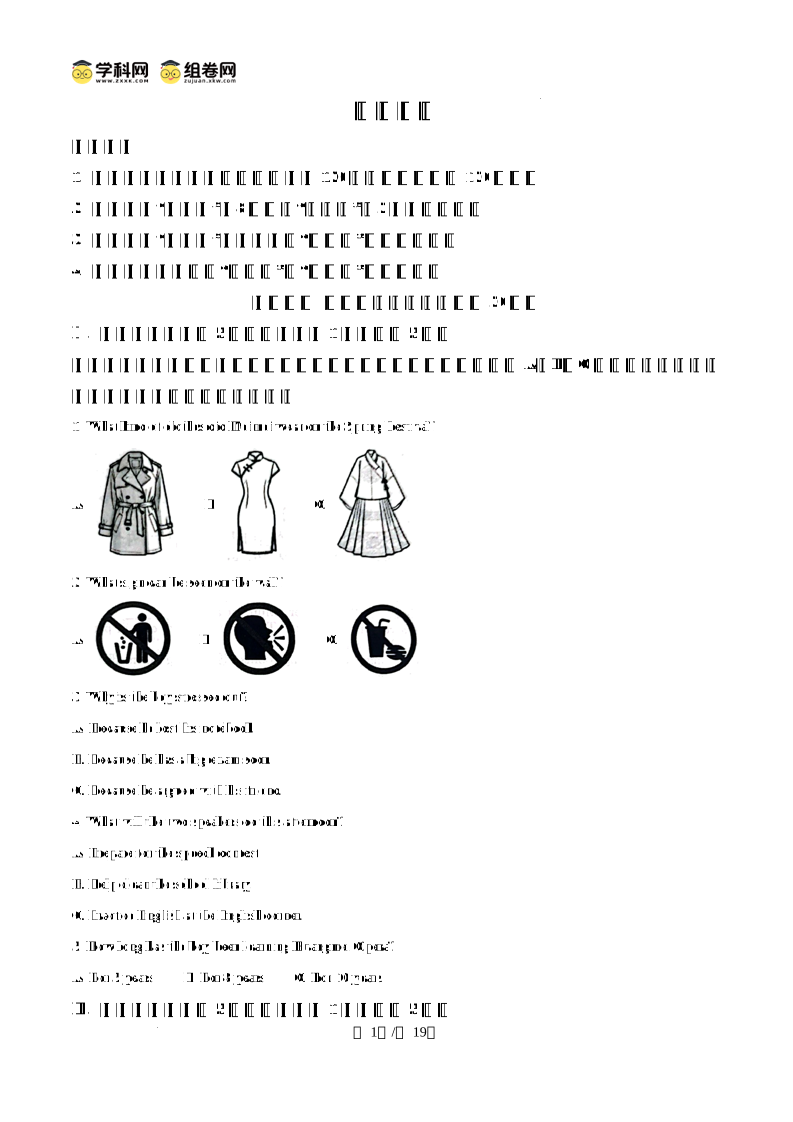
1. What kind of clothes did Meimei wear on the Spring Festival?
A. B. C.
2. What sign can be seen on the wall?
A. B. C.
3. Why is the boy stressed out?
A. Because he lost his notebook.
B. Because he has a big exam soon.
C. Because he argued with his friend.
4. What will the two speakers do this afternoon?
A. Prepare for the speech contest.
B. Help clean the school library.
C. Practice English at the English corner.
5. How long has the boy been learning Huangmei Opera?
A. For 5 years. B. For 8 years. C. For 10 years.
Ⅱ. 长对话理解(共5小题;每小题1分,满分5分)
你将听到两段对话。每段对话后有几个小题,请在每小题所给的A、B、C三个选项中选出一个最佳选项。每段对话读两遍。
6. What’s Lisa’s hobby?
A. Painting. B. Singing. C. Dancing.
7. How long does Tom practice the guitar daily?
A. For about half an hour. B. For about one hour. C. For about two hours.
听下面一段对话,回答第8至10题。
8. What is Leo preparing for?
A. A school environmental project.
B. A math competition.
C. A music show.
9. When will the activity start?
A. At 1:30 p. m. on Friday.
B. At 2:30 p. m. on Saturday.
C. At 3:30 p. m. on Sunday.
10. How will Leo and Sophie go to the school exhibition hall?
A. By bike. B. By bus. C. On foot.
Ⅲ. 短文理解(共5小题;每小题1分,满分5分)
你将听到一篇短文。短文后有五个小题,请根据短文内容,在每小题所给的A、B、C三个选项中选出一个最佳选项。短文读两遍。
11. Where does Linda come from?
A. Australia. B. France. C. Canada.
12. When did Linda come to study in Beijing?
A. 2 months ago. B. 3 months ago. C. 4 months ago.
13. How did Linda feel at first?
A. Lonely. B. Tired. C. Excited.
14. Who helped Linda with her study?
A. Her neighbors. B. Her teachers. C. Her parents.
15. Which place did Linda visit last Saturday?
A. The Great Wall. B. The Summer Palace. C. Tian’ anmen Square.
Ⅳ. 信息转换(共5小题;每小题1分,满分5分)
你将听到一篇短文。请根据短文内容,写出下面表格中所缺的单词,每空仅填一词。短文读两遍。
Make Our School Greener
Save 16. ________
●Turn off lights when leaving classrooms.
●Pull out plugs(插头)after using the computer.
Reduce rubbish
●Use cloth bags instead of 17. ________ ones.
●Write on both sides of paper.
Reuse old things
●Turn empty 18. ________ into small pots for little plants.
●Make old clothes into small bags.
Join in activities
●Help 19. ________ the school garden once a week.
●Take part in tree-planting in 20. ________.
第二部分 语言知识运用(共三大题,满分35分)
V. 单项填空(共10小题;每小题1分,满分10分)
从每小题所给的A、B、C、D四个选项中选出一个可以填入空白处的最佳选项。
1. —Our school held a ________ about “Space Exploration” last week. Many students shared ideas about Shenzhou-21.
—That must be meaningful!
A. story B. diary C. joke D. discussion
2. The mountain climbers ________ many challenges on the way up, but then they reached the top safely in the end.
A. faced B. invented C. saw D. touched
3. I think learning English is ________ because it opens a door to the world.
A. difficult B. cheap C. valuable D. convenient
4. Our teacher ________ an interesting game to make our English class more fun.
A. came up with B. caught up with C. kept up with D. put up with
5. During the speech, Li Ming spoke ________ so that even the students at the back could hear him.
A. finally B. loudly C. quietly D. quickly
6. ________ the support of the whole nation, Chinese space technology has made great progress in recent years.
A. Sounds like B. According to C. As for D. Thanks to
7. Our school ________ several activities about traditional culture every term, such as paper-cutting and calligraphy (书法).
A. is holding B. will hold C. holds D. has held
8. —Should we give up our hobbies when we’re busy with study?
—No. We should keep them ________ we meet pressure.
A. though B. until C. unless D. since
9. —Do you know ________ the athletes of the 15th National Games trained so hard for?
—Sure. They wanted to win honors for their hometown and show the spirit of sports.
A. how B. that C. what D. if
10. —I’m nervous about my English speech competition tomorrow. I’m afraid I’ll make mistakes.
—________. You’ve practiced hard and you’re sure to do well.
A. Never mind B. Take it easy
C. That’s all right D. You’re welcome
Ⅵ. 完形填空(共20小题;每小题1分,满分20分)
阅读下列短文,从每小题所给的A、B、C、D四个选项中选出可以填入空白处的最佳选项。
A
When I first came to China, learning Chinese felt like a huge challenge. My classmates picked up words and characters ____11____, but I often mixed up similar sounds and forgot strokes (笔画) easily. The only thing that ____12____ me going was my love for Chinese culture— those beautiful poems and interesting folk stories.
One day, my Chinese teacher asked me to introduce my hometown in class. I was nervous ____13____ still ready to try. I practiced day and night, asking my deskmate to correct my ____14____ again and again. When I stood in front of the class, I spoke slowly but clearly. To my surprise, everyone listened carefully and cheered when I finished. My teacher ____15____ me warmly, saying my efforts paid off.
After that, I became more confident. I ____16____ speaking Chinese with locals whenever I could— at the market, in the park, or even with street food sellers. Little by little, I made great ____17____. Now, I can not only have daily conversations but also ____18____ simple Chinese books. Learning Chinese teaches me that though there are difficulties, perseverance (坚持不懈) will ____19____ success. I’m glad I didn’t give up. It has opened a ____20____ to understand China better and helped me make many good friends along the way.
11. A. quickly B. quietly C. carefully D. suddenly
12. A. stopped B. kept C. saw D. led
13. A. so B. or C. but D. and
14. A. advice B. rubbish C. peace D. pronunciation
15. A. promised B. visited C. praised D. warned
16. A. avoided B. practiced C. finished D. minded
17. A. mistakes B. friends C. progress D. pictures
18. A. read B. write C. sell D. buy
19. A. depend on B. join in C. prepare for D. lead to
20. A. hotel B. door C. wall D. path
B
After graduating from college, Lina didn’t follow the crowd to work in an office. She has had a ____21____ love for flowers since childhood. Arranging them into beautiful bouquets (花束) always made her happy. So she decided to run after her dream and open her own flower shop.
At first, things were not easy. She spent days choosing ____22____ flowers from markets and learning professional arranging skills. Some friends doubted her choice, but her family ____23____ her all the way. When she first opened the shop, few ____24____ dropped by. But Lina never gave up. She offered personalized (个性化的)designs and greeted every guest with ____25____.
Slowly, people noticed her shop. Her bouquets, full of warmth and creativity, ____26____ popular soon. Many customers became regulars (常客)and recommended her shop to friends. Now, Lina’s shop is a local favorite. She even opens flower-arranging workshops (工作坊)to ____27____ her skills with others.
Looking back, Lina says, “It’s not easy to follow your passion (热爱), but if you stick to it, you’ll find your own ____28____.” Her story tells us that everyone has ____29____ shining points. What matters is to ____30____ what you love and keep going. Today, Lina not only runs a successful shop but also brings joy to others through flowers.
21. A. special B. bright C. weak D. terrible
22. A. past B. wide C. fresh D. delicious
23. A. questioned B. supported C. admired D. troubled
24. A. athletes B. reporters C. doctors D. customers
25. A. advice B. health C. kindness D. shyness
26. A. became B. remained C. carried D. reached
27. A. attend B. share C. miss D. avoid
28. A. food B. money C. weather D. light
29. A. hidden B. strange C. broken D. drunk
30. A. forget B. doubt C. discover D. change
Ⅶ. 补全对话(共5小题;每小题1分,满分5分)
根据对话内容,从选项中选出能填入空白处的最佳选项,其中有两个为多余选项。
A: Have you thought about what to do for the 2026 summer vacation?
B: Yes, I have. ____31____ I want to do something meaningful.
A: That sounds great! I’m also looking for volunteer activities. ____32____
B: I plan to be a volunteer at City Hospital. They need helpers to take care of patients.
A: ____33____ What will you do there?
B: Things like guiding patients to consulting rooms (诊疗室), handing out medicine lists, and chatting with the elderly. ____34____
A: Sure, I’d love to! But do we need to prepare anything in advance (提前)?
B: Yes. We have to attend a short training first. ____35____
A: No problem. Let’s sign up together this weekend!
A. Would you like to join me?
B. I’m thinking about being a volunteer.
C. How long will the volunteer work last?
D. That’s a wonderful choice for the vacation!
E. What volunteer activity are you going to take part in?
F. Do you know how many volunteers the hospital needs?
G. Someone in the hospital will teach us basic service skills.
第三部分 阅读(共两节,满分40分)
Ⅷ. 阅读理解(共20小题;每小题2分,满分40分)
第一节 阅读下列短文,从每小题所给的A、B、C、D四个选项中选出最佳选项。
A
INSIDE THE MAGAZINE July 2026
Life
Health
Tech
Culture
P3 Pet care tips
Easy ways to keep your cat/dog healthy.
P8 Sleep well
Why 8 hours’ sleep is key for teens.
P12 Smart bikes
A bike that can follow your voice.
P17 Traditional games
Old Chinese games kids still love.
P5 Home garden
Grow vegetables in small balconies.
P10 Healthy snacks
Delicious food that’s good for you.
P15 Portable chargers
A charger that lasts 3 days.
P20 Folk stories
Stories about the moon from 3 centuries ago.
Word bank: balcony (阳台); portable (便携的)
36. Which picture may appear on page 12?
A. B. C. D.
37. What can we read about on page 20?
A. Stories about the moon. B. How to grow vegetables.
C. A bike that follows voice. D. Tips for good sleep.
38. What can we know from the text?
A. How to buy the magazine easily.
B. The phone number of the writers.
C. The price of the magazine online.
D. Brief introductions to the magazine’s articles.
B
There are many cities in the world. One city in Thailand is famous for its monkeys. There are over one thousand monkeys in this city. Now, many people think they bring good luck to the city. The monkeys are everywhere in this city, even on cars and trains.
The city is a very busy one with a lot of traffic. People have to try to get out of their way. Some monkeys swing on the power lines. They can get hurt or even killed.
Monkeys can get sick. When one monkey is sick, others can get sick, too. Some monkeys fight with each other. Then, they can get hurt. So there are many sick and injured monkeys in this city. The monkeys are very important to this city and help to attract visitors to the city. The citizens have to find a way to take care of them.
There is even a hospital for the monkeys in the city. At the hospital, sick and injured monkeys are taken care of. When they are better, they will go back to the streets again. It’s hard to catch a monkey that needs help, because other monkeys try to protect it. Sometimes they even bite the person trying to help.
Every year the city has a feast (盛宴) for the monkeys. They walk all over the food and take food from each other. Many visitors come to watch the feast. The feast is to say thank you to the monkeys, and to say thank you for bringing people to the city.
39. How many monkeys are there in the city of Thailand according to the passage?
A. Less than 500. B. Over 1,000.
C. More than 1,500. D. More than 2,000.
40. What risk do the monkeys face when swinging on the power lines?
A. They may get lost in the city.
B. They may fight with other animals.
C. They may be hurt or even killed.
D. They may be brought home by citizens.
41. What can we infer about the relationship between the citizens and the monkeys?
A. The citizens hate the monkeys because they cause trouble.
B. The citizens only care about the monkeys to make more money.
C. The citizens are afraid of the monkeys and want to drive them away.
D. The citizens value the monkeys and take measures to care for them.
C
China launched the Shenzhou-21 spaceship on October 31st, 2025. The spaceship sent three astronauts to the space station for a six-month mission. The spaceship took off from Jiuquan Satellite Launch Center with a Long March-2F rocket.
The astronauts include Zhang Lu who joined Shenzhou-15 before and two first-time astronauts, Wu Fei and Zhang Hongzhang. They have different jobs as a space pilot, a flight engineer and a payload specialist.
There is a fun fact. Four mice (two male, two female) went to space, too! This is China’s first space experiment with mammals (哺乳动物). Mice are good for research because they are small, similar to humans in genes, and grow fast. They will stay on the station for 5—7 days, with lights on 7 a.m.—7 p.m. like on Earth. Their food is healthy and hard (good for their teeth), and a special air flow keeps their home clean.
Scientists will study how space’s weightlessness affects the mice. The mice will return to Earth later for more checks, which helps learn if humans can live in space for a long time.
The astronauts will do 27 new experiments like walking in space and taking part in science education activities. We are all proud of our country’s great space achievements.
42. How long will the astronauts of Shenzhou-21 stay on the space station?
A. For a week. B. For 1 month. C. For 6 months. D. For 1 year.
43. Who are on their first space mission?
A. Zhang Lu and Wu Fei.
B. Wu Fei and Zhang Hongzhang.
C. Zhang Lu and Zhang Hongzhang.
D. Zhang Lu, Wu Fei and Zhang Hongzhang.
44. What can the mice experiment help scientists learn?
A. How to feed mice in space.
B. How to build a space station.
C. What food is good for astronauts.
D. If humans can live in space for a long time.
45. What is the text mainly about?
A. Shenzhou-21: astronauts and space mice.
B. China’s Long March-2F rocket.
C. The jobs of space astronauts.
D. Mice’s life in space.
D
A hundred years ago, there were about 200,000 lions living in the wild. But today, fewer than 20,000 are left. The International Union for Conservation of Nature (IUCN), a group that protects nature, says lions are vulnerable. This means they might soon be in even bigger danger.
What’s making lions disappear? There are four main problems. First, lions are losing their homes because more and more people build towns and farms, leaving lions with less space to live in. Second, fights between humans and lions happen often. When lions eat farmers’ cows or sheep, farmers will kill them to protect their animals. Third, lions are running out of food because the animals they hunt are getting harder to find. Fourth, illegal (非法的) hunting is a big threat, too. Some people hunt lions for fun, and others sell their bones for traditional medicine.
In West and Central Africa, lions are in extra trouble. But there are ways to help them! In Kenya and Namibia, communities pay farmers when lions eat their livestock (牲畜), so farmers stop killing lions. Rangers use GPS collars to track lions and keep them safe. China bans (禁止) illegal lion product trade, supports African conservation projects and promotes global cooperation for lion protection.
Saving lions isn’t just about lions. It helps all the animals in their homes like birds and insects. Every step to protect lions keeps the whole ecosystem alive.
46. What does the underlined word “vulnerable” in Paragraph 1 probably mean?
A. Good at running. B. Easy to be hurt.
C. Popular with people. D. Strong in nature.
47. What is Paragraph 2 mainly about?
A. Why lions are becoming fewer.
B. What people trade lion bones for.
C. Where lions can find enough food.
D. How farmers protect their livestock.
48. What can we infer from the text?
A. Birds and insects have no connection with lion habitats.
B. China only helps protect lions by banning illegal trade.
C. Lions will disappear completely in 10 years.
D. Protecting lions helps the whole ecosystem.
E
From November 24 to 28, 2025, the “Check in China · Surging East—Hello, Anhui!” event was held in Anhui. An Egyptian influencer joined this trip and shared many wonderful moments online.
First, he visited Chishan Lake National Wetland Park. In early winter, the red and yellow metasequoia (水杉) trees and quiet lake made a beautiful picture. Black swans and other birds played and looked for food on the water. He was deeply impressed and said, “The environment here is well protected. People and nature live in peace with each other. It is truly very comforting!”
Then, in Huangshan’s Chengkan Ancient Village, he joined the lively fish lantern parade (游行). More than ten big fish lanterns moved with drumbeats. He loved the lanterns very much and told his global fans about them in a video. When he learned that “fish” stands for good luck, wealth and happiness in Chinese culture, he got excited: “Chinese ‘fish’ has a ‘good luck buff’! Knowing this, I love these lanterns even more!”
He also visited Xiaogang Village and admired the great changes brought by the reform (改革). He shared all these experiences online, helping more people know about Anhui’s beauty and Chinese culture.
49. When was the “Check in China · Surging East—Hello, Anhui!” event held?
A. In late December of 2025.
B. From November 24 to 28, 2025.
C. From November 14 to 18, 2025.
D. From October 14 to 18, 2025.
50. What does the underlined word “this” in the Paragraph 3 refer to (指的是)?
A. More than ten big fish lanterns moved with drumbeats.
B. He told his global fans about the fish lanterns in a video.
C. “Fish” stands for good luck, wealth and happiness in Chinese culture.
D. He joined the lively fish lantern parade in Chengkan Ancient Village.
51. What did the Egyptian influencer admire in Xiaogang Village?
A. The great changes brought by the reform.
B. The beautiful fish lantern parade.
C. The quiet lake and black swans.
D. The traditional Chinese snacks.
52. What is the best title for the text?
A. Beautiful Scenery in Anhui
B. The “Check in China” Event in 2025
C. Fish Lanterns in Chengkan Ancient Village
D. A Wonderful Trip to Anhui by an Egyptian Influencer
第二节 阅读下面短文,并用英语回答问题(请注意每小题的词数要求)。
F
When I was thirteen, my parents sent me to spend the vacation with my grandfather in his small village. I thought it would be awful, because there were no friends, no Internet, and nothing special to do. But when the vacation came to an end, I realized how wrong I was.
On my first day, he handed me a tiny seed and said, “Plant it with patience and care, and you’ll understand the mysteries of nature in the end.” I doubted his words at first. But with nothing better to do, I decided to take his advice. As days turned into weeks, I felt a growing sense of sadness and frustration (沮丧). And just when I was about to give up, a tiny green seedling finally came out.
One evening, as we sat watching the sunset, he said something I would never forget: “The most valuable things in life grow slowly.”
When I returned home, I wasn’t the same impatient teenager. And every time I see a seedling, I recall the unforgettable summer and my grandfather’s wisdom that changed my life forever.
53. What did the writer think of the vacation at first?(不超过10个词)
______________________________________________________________
54. Who said the unforgettable words to the writer?(不超过5个词)
______________________________________________________________
55. What can we learn from the story?(不超过15个词)
______________________________________________________________
第四部分 写(共两大题,满分25分)
IX. 单词拼写(共5小题;每小题1分,满分5分)
根据首字母及汉语提示,完成下列单词的拼写,使句意明确,语言通顺。
56. Make sure to l________ (上锁) the door when you leave.
57. A healthy d________ (饮食) usually helps your body to keep fit.
58. The giant panda baby w________ (重达) about 100 grams at birth and is loved by many people.
59. Her kind words and warm smile make her a p________ (漂亮的) girl in our class.
60. As volunteers, we will offer warm and thoughtful s________ (服务) to the old in the community.
X. 书面表达(共1小题;满分20分)
61. 天下最伟大的爱之一就是父爱。假设你是李辉,还有几天父亲节就要到了,你们学校英语社团将举办以“What will you do for Dad?”为主题的英语演讲比赛。请你用英文写一篇演讲稿参加比赛。
注意:1. 演讲稿须包含思维导图中的所有信息,请增加细节以使行文连贯;
2. 演讲稿中不能出现真实姓名和学校名称;
3. 词数80~100(开头和结尾已给出,但不计入总词数)。
Hello, everyone. I’m Li Hui. Father’s Day is coming in a few days.
_________________________________________________________________________________________________________________________________________________________________________________________________________________________________________________________________________________________________________________________________________________________________________________________________________________________________________________________________________________________________________
Thank you for your listening.
英语试题
注意事项
1. 本试卷共四部分,十大题,满分120分,考试时间为120分钟。
2. 全卷包括“试题卷”(8页)和“答题卡”(2页)两部分。
3. 请务必在“答题卡”上答题,在“试题卷”上答题无效。
4. 考试结束后,请将“试题卷”和“答题卡”一并交回。
第一部分 听力(共四大题,满分20分)
Ⅰ. 短对话理解(共5小题;每小题1分,满分5分)
你将听到五段对话。每段对话后有一个小题,请在每小题所给的A、B、C三个选项中选出一个最佳选项。每段对话读两遍。
1. What kind of clothes did Meimei wear on the Spring Festival?
A. B. C.
2. What sign can be seen on the wall?
A. B. C.
3. Why is the boy stressed out?
A. Because he lost his notebook.
B. Because he has a big exam soon.
C. Because he argued with his friend.
4. What will the two speakers do this afternoon?
A. Prepare for the speech contest.
B. Help clean the school library.
C. Practice English at the English corner.
5. How long has the boy been learning Huangmei Opera?
A. For 5 years. B. For 8 years. C. For 10 years.
Ⅱ. 长对话理解(共5小题;每小题1分,满分5分)
你将听到两段对话。每段对话后有几个小题,请在每小题所给的A、B、C三个选项中选出一个最佳选项。每段对话读两遍。
6. What’s Lisa’s hobby?
A. Painting. B. Singing. C. Dancing.
7. How long does Tom practice the guitar daily?
A. For about half an hour. B. For about one hour. C. For about two hours.
听下面一段对话,回答第8至10题。
8. What is Leo preparing for?
A. A school environmental project.
B. A math competition.
C. A music show.
9. When will the activity start?
A. At 1:30 p. m. on Friday.
B. At 2:30 p. m. on Saturday.
C. At 3:30 p. m. on Sunday.
10. How will Leo and Sophie go to the school exhibition hall?
A. By bike. B. By bus. C. On foot.
Ⅲ. 短文理解(共5小题;每小题1分,满分5分)
你将听到一篇短文。短文后有五个小题,请根据短文内容,在每小题所给的A、B、C三个选项中选出一个最佳选项。短文读两遍。
11. Where does Linda come from?
A. Australia. B. France. C. Canada.
12. When did Linda come to study in Beijing?
A. 2 months ago. B. 3 months ago. C. 4 months ago.
13. How did Linda feel at first?
A. Lonely. B. Tired. C. Excited.
14. Who helped Linda with her study?
A. Her neighbors. B. Her teachers. C. Her parents.
15. Which place did Linda visit last Saturday?
A. The Great Wall. B. The Summer Palace. C. Tian’ anmen Square.
Ⅳ. 信息转换(共5小题;每小题1分,满分5分)
你将听到一篇短文。请根据短文内容,写出下面表格中所缺的单词,每空仅填一词。短文读两遍。
Make Our School Greener
Save 16. ________
●Turn off lights when leaving classrooms.
●Pull out plugs(插头)after using the computer.
Reduce rubbish
●Use cloth bags instead of 17. ________ ones.
●Write on both sides of paper.
Reuse old things
●Turn empty 18. ________ into small pots for little plants.
●Make old clothes into small bags.
Join in activities
●Help 19. ________ the school garden once a week.
●Take part in tree-planting in 20. ________.
第二部分 语言知识运用(共三大题,满分35分)
V. 单项填空(共10小题;每小题1分,满分10分)
从每小题所给的A、B、C、D四个选项中选出一个可以填入空白处的最佳选项。
【1题答案】
【答案】D
【2题答案】
【答案】A
【3题答案】
【答案】C
【4题答案】
【答案】A
【5题答案】
【答案】B
【6题答案】
【答案】D
【7题答案】
【答案】C
【8题答案】
【答案】A
【9题答案】
【答案】C
【10题答案】
【答案】B
Ⅵ. 完形填空(共20小题;每小题1分,满分20分)
阅读下列短文,从每小题所给的A、B、C、D四个选项中选出可以填入空白处的最佳选项。
A
【11~20题答案】
【答案】11. A 12. B 13. C 14. D 15. C 16. B 17. C 18. A 19. D 20. B
B
【21~30题答案】
【答案】21. A 22. C 23. B 24. D 25. C 26. A 27. B 28. D 29. A 30. C
Ⅶ. 补全对话(共5小题;每小题1分,满分5分)
【31~35题答案】
【答案】31. B 32. E 33. D 34. A 35. G
第三部分 阅读(共两节,满分40分)
Ⅷ. 阅读理解(共20小题;每小题2分,满分40分)
第一节 阅读下列短文,从每小题所给的A、B、C、D四个选项中选出最佳选项。
A
【36~38题答案】
【答案】36. B 37. A 38. D
B
【39~41题答案】
【答案】39. B 40. C 41. D
C
【42~45题答案】
【答案】42. C 43. B 44. D 45. A
D
【46~48题答案】
【答案】46. B 47. A 48. D
E
【49~52题答案】
【答案】49. B 50. C 51. A 52. D
第二节 阅读下面短文,并用英语回答问题(请注意每小题的词数要求)。
F
【53~55题答案】
【答案】53. He thought it would be awful.
54. His grandfather.
55. The most valuable things in life grow slowly.
第四部分 写(共两大题,满分25分)
IX. 单词拼写(共5小题;每小题1分,满分5分)
根据首字母及汉语提示,完成下列单词的拼写,使句意明确,语言通顺。
【56题答案】
【答案】lock##ock
【57题答案】
【答案】diet##iet
【58题答案】
【答案】weighs##eighs
【59题答案】
【答案】pretty##retty
【60题答案】
【答案】service/ervice
X. 书面表达(共1小题;满分20分)
【61题答案】
【答案】例文
Hello, everyone. I’m Li Hui. Father’s Day is coming in a few days. Let me tell you what I will do for my dad.
My dad is crazy about sports. So, I’ll buy him a pair of new sports shoes as a gift. Then, I’ll learn to cook his favorite dish, fish. We will have a nice family dinner, talking about our daily life. Also, I’ll make a beautiful card for him, saying how thankful I am for his hard work and love. I love my dad deeply. I’ll study hard to achieve good results and make him proud.
Thank you for your listening!
第1页/共1页
学科网(北京)股份有限公司
$
资源预览图
1
2

3
相关资源
由于学科网是一个信息分享及获取的平台,不确保部分用户上传资料的 来源及知识产权归属。如您发现相关资料侵犯您的合法权益,请联系学科网,我们核实后将及时进行处理。