辽宁省鞍山市第一中学2025-2026学年高二下学期期中考试英语试卷
 切换试卷
切换试卷
2026-05-26
|
13页
|
67人阅读
|
1人下载
资源信息
| 学段 | 高中 |
|---|---|
| 学科 | 英语 |
| 教材版本 | - |
| 年级 | 高二 |
| 章节 | - |
| 类型 | 试卷 |
| 知识点 | - |
| 使用场景 | 同步教学-期中 |
| 学年 | 2026-2027 |
| 地区(省份) | 辽宁省 |
| 地区(市) | 鞍山市 |
| 地区(区县) | - |
| 文件格式 | DOCX |
| 文件大小 | 50 KB |
| 发布时间 | 2026-05-26 |
| 更新时间 | 2026-05-26 |
| 作者 | 匿名 |
| 品牌系列 | - |
| 审核时间 | 2026-05-26 |
| 下载链接 | https://m.zxxk.com/soft/58052929.html |
| 价格 | 1.00储值(1储值=1元) |
| 来源 | 学科网 |
内容正文:
2025-2026学年度下学期期中考试27届高二年级
英语科试卷
第一部分 听力(共两节,满分30分)
第一节(共5小题;每小题1.5分,满分7.5分)
听下面5段对话。每段对话后有一个小题,从题中所给的A、B、C三个选项中选出最佳选项。听完每段对话后,你都有10秒钟的时间来回答有关小题和阅读下一小题。每段对话仅读一遍。
例:How much is the shirt?
A. £ 19.15. B. £ 9.18. C. £ 9.15.
答案是C。
1. When might the woman’s party be held?
A. This Sunday. B. Next Saturday. C. Next Sunday.
2. Why does Steven arrive at school late?
A. He didn’t wake up on time. B. No one drove him to school. C. He didn’t catch the bus.
3. How does the woman feel about the lecture?
A. Disappointed. B. Interested. C. Admiring.
4. Where are the speakers probably?
A. At home. B. In the restaurant. C. At the airport.
5. What are the speakers mainly talking about?
A. Traffic rules in Britain.
B. Traffic rules in Europe.
C. Traffic accidents in Britain.
第二节(共15小题;每小题1.5分,满分22.5分)
听下面5段对话或独白。每段对话或独白后有几个小题,从题中所给的A、B、C三个选项中选出最佳选项。听每段对话或独白前,你将有时间阅读各个小题,每小题5秒钟;听完后,各小题将给出5秒钟的作答时间。每段对话或独白读两遍。
听第6段材料,回答第6、7题。
6. What is the relationship between the speakers?
A. Chef and customer. B. Fellow workers. C. Husband and wife.
7. When does the conversation probably take place?
A. On Tuesday. B. On Friday. C. On Sunday.
听第7段材料,回答第8、9题。
8. What does the man think of his interview?
A. Quite satisfactory. B. Very disappointing. C. Just-so-so.
9. What does the woman suggest the man do?
A. Contact. the interviewers actively.
B. Continue waiting for a call.
C. Look for another job.
听第8段材料,回答第10至12题。
10. What is the man doing?
A. Introducing the weekend plan.
B. Sharing his countryside life.
C. Planning a family reunion.
11. Who will definitely go to the farm?
A. The man’s cousin. B. The woman’s sister. C. The man’s sister.
12. What can the speakers do in the countryside?
A. Feed some animals. B. Watch the stars. C. Have a barbecue.
听第9段材料,回答第13至16题。
13. What does the woman do?
A. She’s an airport clerk. B. She’s a ticket seller. C. She’s a travel agent.
14. What kind of flight will the man take?
A. A morning one. B. An afternoon one. C. A night one.
15. What do we know about the man?
A. He will leave for Guangzhou.
B. He will travel with his family.
C. He prefers economy class.
16. How much did the man pay?
A. $ 630. B. $ 1,260. C. $ 1,890.
听第10段材料,回答第17至20题。
17. What was the third most popular emoji in the world?
A. The “laugh out loud” B. The “thumbs up”. C. The “red heart”.
18. What was the most confusing emoji in the world?
A. The “eggplant”. B. The “peach”. C. The “clown”.
19. What did 67% of emoji users say about using emojis?
A. It makes them express themselves more easily.
B. It makes them feel friendlier and funnier.
C. It makes them simplify communication.
20. How many emoji users think their mental health has been positively affected?
A.90% of them. B.55% of them. C.50% of them.
第二部分 阅读(共两节,满分50分)
第一节(共15小题;每小题2.5分,满分37.5分)
阅读下列短文,从每题所给的A、B、C和D四个选项中选出最佳选项。
A
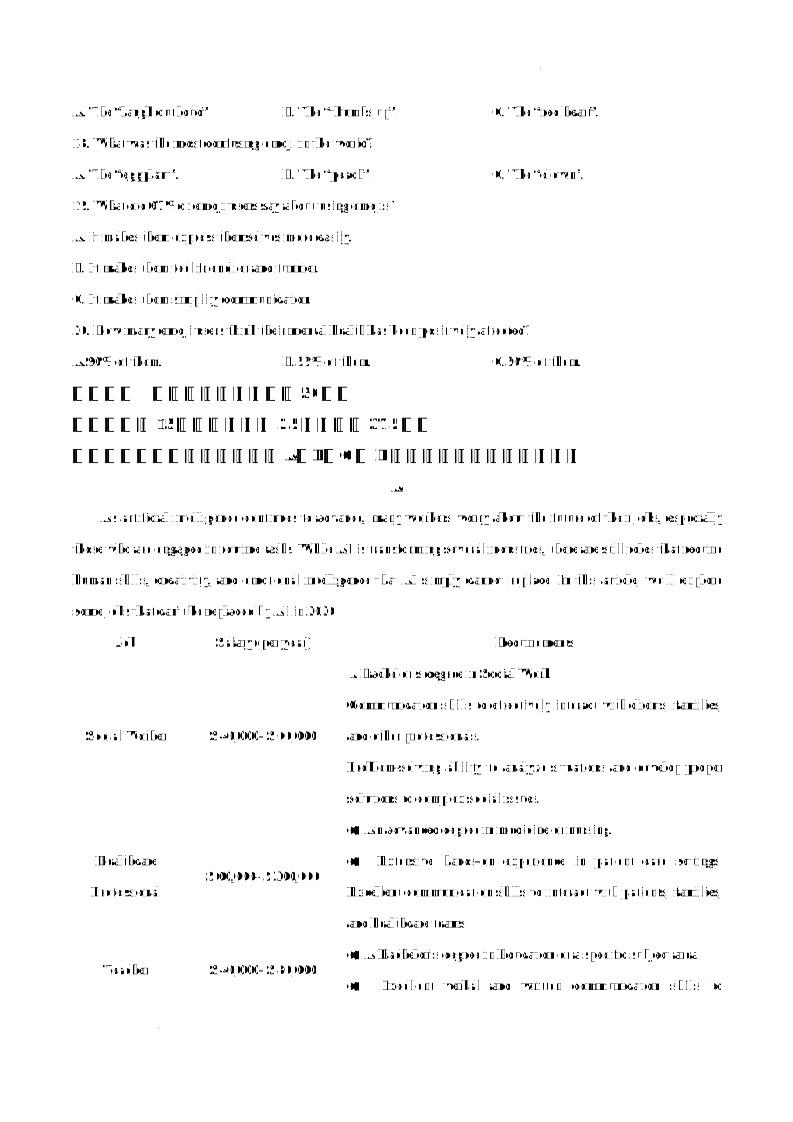
As artificial intelligence continues to advance, many workers worry about the future of their jobs, especially those who are engaged in routine tasks. While AI is transforming several industries, there are still roles that require human skills, creativity, and emotional intelligence that AI simply cannot replace. In this article, we’ll explore some jobs that can’t be replaced by AI in 2026.
Job
Salary (per year)
Requirements
Social Worker
$ 40,000- $ 60,000
A Bachelor’s degree in Social Work.
Communication skills to effectively interact with clients, families, and other professionals.
Problem-solving ability to analyze situations and develop proper solutions to complex social issues.
Healthcare Professional
$ 60,000- $ 300,000
● An advanced degree in medicine or nursing.
● Extensive hands-on experience in patient care settings. Excellent communication skills to interact with patients, families, and healthcare teams.
Teacher
$ 40,000- $ 80,000
● A Bachelor’s degree in Education or a specific subject area.
● Excellent verbal and written communication skills to effectively convey information. to students.
● Flexibility to adjust teaching methods based on classroom. dynamics and individual student needs.
Research Scientist
$ 77,000- $ 118,000
● A PhD or equivalent experience in a relevant scientific discipline.
● Strong ability to analyze data and process information from complex research studies.
● Innovative Thinking: Capacity to think outside the box and pursue novel research avenues.
The above job categories are not likely to be replaced by AI in the near future. If you are worried about the job replacement from AI technology, try to enhance your skills and make yourself irreplaceable.
21. Why are some occupations safe from AI replacement?
A. They are involved in repetitive and regular work.
B. They offer relatively high and stable income levels.
C. They demand little connection with real-life people.
D. They rely on unique human capabilities beyond AI’s reach.
22. What can be concluded about the four listed occupations?
A. Interpersonal competence is valued in most of the jobs.
B. Flexibility in working styles is a must for all practitioners.
C. Medical workers need the longest period of academic training.
D. Research scientists are bound to earn the highest annual salary.
23. Which position specially values the ability to break conventional thinking for new exploration?
A. Teacher. B. Research Scientist.
C. Social Worker. D. Healthcare Professional.
B
It had been more than ten years since the three sisters had been together like this, their eyes filled with tears. The eldest sister, 110-year-old Rubye, stayed warm under a soft blanket. Her two younger sisters — 104-year-old Ruth and 101-year-old Rose — held one of her hands each. They chatted about their favorite old stories, laughing happily.
This warm family get-together was made possible by Wish of a Lifetime, a charity group. It paid for Rose to fly from Florida and Ruth from Oklahoma, so they could visit Rubye at her nursing home in Rhode Island. The group was started by Jeremy Bloom, a former Olympic skier and football player. When he traveled around the world as an athlete, he found that people in other countries respected and cared for old people much more than people did in America.
Bloom first got the idea when he was 15. He went to Asia for a ski race and saw an old woman walking slowly to get on a bus. Many passengers offered to help her, which touched him deeply. The idea stayed in his mind for ten years before he turned it into the Wish of a Lifetime group: Though Bloom had many great moments in sports — competing in two Olympics, making a long football pass in college, and being chosen by a top football team, he often worried about finding a new goal after his sports career ended.
In 2008, Bloom set up the charity group. He copied the idea of the Make-A-Wish Foundation, which helps sick kids make their wishes come true, and used it to help old people. whether they were sick or not.
Today, Wish of a Lifetime has 26 full-time workers and about 25,000 volunteers across the country. It gets money from people’s donations and company support. So far, it has helped make 3,000 wishes come true. Bloom now works as the CEO of X Games, but he once spent all his time on this charity, hoping to change-as-many-old-people’s lives as possible.
24. What made the three sisters’ get-together possible?
A. A charity group provided financial support for their trip.
B. The three sisters saved money for the reunion for years.
C. Rubye’s nursing home offered free accommodation for her sisters.
D. Local volunteers helped the two younger sisters go to Rhode Island.
25. Who first inspired Jeremy Bloom to have the idea of setting up the charity?
A. A passenger who helped him on a bus in Asia.
B. An elderly woman he saw in Asia during a ski race.
C. His coach who encouraged him to help the elderly
D. A volunteer from the Make-A-Wish Foundation.
26. What can we infer about Jeremy Bloom from the text?
A. He learned the charity concept from his family members.
B. He came up with the charity idea when he was 25 years old.
C. He gave up his sports career to concentrate on running the charity.
D. He once felt uncertain about his future after his sports career ended.
27. What can be concluded about Wish of a Lifetime from the passage?
A. It aims to improve elderly people s medical conditions.
B. It totally depends on Jeremy Bloom’s personal efforts.
C. It draws inspiration from a well-known charity for children.
D. It has realized most senior citizens’ long-cherished wishes.
C
The recently held Central Economic Work Conference has reaffirmed a vital principle: development is the ultimate form of security. In the current context of growing global divisions, rising trade protectionism and widespread supply chain instability, China is advancing a comprehensive and systematic strategy to safeguard its economic foundations. It focuses on strengthening overall economic resilience, ensuring key resource self-reliance, and accelerating technological progress, so as to make security a solid springboard for high-quality development instead of a barrier to international cooperation.
China’s modern vision of national security expands far beyond the traditional military field, including political, economic, technological and resource-related dimensions. Of all these vital areas, economic security remains the fundamental of long-term social stability and national development. In response to frequent global disruptions and fragmented industrial chains, China has further prioritized improving domestic independent capacity and lowering its exposure to unpredictable external shocks. In this regard, the dual circulation policy serves as a vital guideline, which values the domestic economic cycle while maintaining steady and open international engagement.
To strengthen economic security in practice, China has adopted practical arrangements. It carries out a balanced energy strategy, guaranteeing stable traditional energy supply and promoting the rapid growth of renewable energy. Besides, food security is always regarded as an unshakable bottom line. By protecting limited farmland, raising agricultural productivity and maintaining sufficient grain reserves, the country can effectively prevent risks from global food market changes.
To sum up, economic security runs through China’s long-term development strategies. With continuous efforts in key independent research and domestic industrial upgrading, China aims to build stronger risk resistance and pursue stable development among a complex global situation.
28. What does the underlined word “springboard” in Paragraph 1 most probably mean?
A. An obstacle blocking cooperation.
B. A tool for international competition.
C. A foundation for further development.
D. A limit restricting economic growth
29. What is the core part of China’s overall national security strategy?
A. Economic security. B. Military strength.
C. Technological innovation. D. Resource protection.
30. What can we infer from Paragraph 3?
A. Traditional energy will be abandoned in the coming years.
B. Global food markets decide China’s food security situation.
C. China relies totally on renewable energy for future development.
D. Food self-reliance guards the nation against global economic risks.
31. What is the best title for the text?
A. Various Challenges of Global Economy.
B. The Importance of Food Self-reliance in China.
C. Economic Security Under China’s National Strategy.
D. Effective measures to Develop New Energy in China.
D
Over the last 1,400 years, populations of the Yangtze finless (江豚) porpoise have dramatically declined in China. But intensive surveys of its range only span the last couple of decades, leaving lots of gaps in scientists’ knowledge of the species. In a creative blend of art and science, a new study uses historical poetry to chart the critically endangered animal’s population across the river it calls home.
The finless porpoises once lived throughout the entire Yangtze River, which stretches from the Tibetan Plateau to the East China Sea. Now, the only known freshwater porpoise in the world has fewer than 1,800 individuals left in the wild.
The research team combed through databases of Chinese poetry to find references to the porpoise and map its past distribution. They found 724 poems that mentioned the animal, of which half noted where the porpoises were observed. Their findings were published in Current Biology.
“Having access to past data allows us to detect when declines began and correlate those changes with potential threats like habitat destruction, climate change, overhunting, disease or the introduction of invasive species,” says lead author Zhang Yaoyao, an ecologist at the Chinese Academy of Sciences.
The poems suggest the porpoise’s range has decreased by 65% since the Tang dynasty. Most of that decline happened in the river’s tributaries and lakes, where the animal’s range has decreased by 91%. While the population decrease was mostly gradual, the sharpest decline has occurred over the past 100 years. That sudden drop aligns with human activities on the river, especially dam construction in the 1950s that blocked off the porpoise’s movement to and from the river’s main channel.
The work highlights the connection between culture and science. “Poems are actually ancient citizen science, and many Chinese poets were “well-educated intellectuals’,” says Zhang. “These data are not perfect. But they do have a lot of information if you use them correctly.” This approach has potential for uncovering the pasts of other endangered species as well. Previously, scholars have used medieval and ancient texts to understand things like volcanic eruptions auroras and unusual whales.
32. What challenge do scientists face in their research about the porpoise?
A. Its population is hard to calculate accurately.
B. The long-term historical data are insufficient.
C. Its population has dropped off dramatically
D. Locating its habitats is increasingly difficult.
33. How did ancient poems help with the research?
A. By providing records of the porpoise’s past distribution.
B. By explaining the causes of the species’ gradual decline.
C. By showing how people protected the porpoise in history
D. By introducing effective ways to study endangered animals.
34. What mainly contributed to the dramatic fall of the porpoise’s populations?
A. Poor resistance to diseases. B. Climate changes over time.
C. Human impacts on its habitats. D. Competition with other species.
35. Why does the author mention “volcanic eruptions” in the last paragraph?
A. To show major threats to endangered wildlife.
B. To introduce challenges in ecological research.
C. To prove the value of ancient texts in research.
D. To reveal the wisdom of ancient Chinese poets.
第二节(共5小题;每小题2.5分,满分12.5分)
阅读下面短文,从短文后的选项中选出可以填入空白处的最佳选项。其中有两项为多余选项。
How to Use Digital Journals to Promote Your Self-Growth
Keeping a journal is a classic way to process thoughts, but digital journaling apps are making this practice more accessible and powerful than ever. 36 With the right strategies, however, these tools can become your most reliable companion for personal growth.
● Use journal prompts to beat writer’s block.
A blank page can feel discouraging when you don’t know where to start. Instead of staring at an empty screen, use pre-written prompts to kickstart your writing. For example, you might answer, “What’s one small win I had today?” or “What’s one thing I wish I could change about my routine?” 37
● 38
Digital journals aren’t just for writing — they’re for organizing your life. Many apps let you label entries by mood, topic, or goal. If you’re working on building a healthier lifestyle, you can label entries related to exercise, diet, or sleep; if you’re focusing on relationships, you can label conversations with friends or family. This makes it easy to spot patterns in your behavior over time.
● Review past entries to track your progress.
It’s easy to forget how far you’ve come when you’re caught up in daily stress. 39 Most digital journals let you search or filter entries by date, so you can read about how you felt a month, a year, or even five years ago. This habit not only helps you celebrate small wins but also reminds you of challenges you’ve already overcome.
● Use reminders to build a consistent habit.
Sticking to a journaling routine can be tough when life gets busy. Most apps let you set gentle daily or weekly reminders to write. 40 Over time, these small prompts help journaling become a natural part of your day, just like brushing your teeth or drinking coffee.
Digital journaling isn’t about perfection or long, poetic entries. By using these intentional strategies, you’ll turn it into a flexible, powerful tool that helps you grow, reflect, and stay peaceful.
A. Organize your entries with labels and categories.
B. Sort your journal entries into different categories.
C. You can even add photos, voice notes, or links to make entries feel more personal.
D. Many people use these apps only to write short notes, never realizing their full potential.
E. This turns journaling from a random task into a guided practice that builds self-awareness.
F. Apps often include features that let you view your progress in simple charts or summaries.
G. You can also customize the reminders to fit your schedule, whether you write morning or night.
第三部分 语言运用(共两节,满分30分)
第一节(共15小题;每小题1分,满分15分)
阅读下面短文,从每题所给的A、B、C和D四个选项中选出可以填入空白处的最佳选项。
Bob Weiser had been driving for Uber for more than six months when a conversation with an old friend sparked the idea. Everyone that rode in his car had a story to tell, a(n) 41 life experience or some wisdom they’d picked up along the way. What if he could collect “a slice of life” from each of the hundreds of people riding in his car whose only known 42 was that they ordered an Uber in Chicago and had Bob Weiser 43 them up in his car?
Bob Weiser, aged 66, is a former pilot who started driving for Uber last year as a way to keep 44 . “You never really retire, and you always have to do something,” he said. He 45 a black notebook. On the inside cover, he wrote “It belongs to all that read it with a(n) 46 heart and mind.”
Now, when passengers get in his car, he’ll pass them the 47 and ask if they’d take a moment to write something in it. He has 48 more than 800 entries from passengers from all over the world.
Weiser 49 one woman who wrote Mohandas Karamchand Gandhi’s “Be the change you want to see in the world.” Then she flipped back and saw someone else had used the same quote. She told him she was 50 and he said to her, “No, that’s okay That’s the type of energy that has been in this 51 , nothing but good energy.”
After his passengers write something, they’ll flip through the pages, 52 all the advice and opinions shared by the passengers who came before them.
He flips through it himself sometimes; it always 53 him that people have so much warmth and positivity to share. No one has written anything 54 , and only a handful have turned him down, 55 because they have carsickness.
41. A. complex B. thorough C. unique D. identical
42. A. dedication B. requirement C. assessment D. bond
43. A. launch B. pick C. lift D. pull
44. A. occupied B. passionate C. alive D. decent
45. A. attained B. reserved C. purchased D. donated
46. A. open B. immense C. tender D. desperate
47. A. album B. notebook C. column D. brochure
48. A. preserved B. rejected C. accepted D. collected
49. A. engaged B. appreciated C. recalled D. struck
50. A. confused B. disappointed C. awkward D. amused
51. A. prospect B. vehicle C. circumstance D. wisdom
52. A. taking in B. picking out C. putting down D. responding to
53. A. terrifies B. puzzles C. depresses D. astonishes
54. A. unfavorable B. sensitive C. faulty D. precious
55. A. consistently B. frequently C. deliberately D. mostly
第二节(共10个小题;每小题1.5分,满分15分)
阅读下面短文,在空白处填入1个适当的单词或括号内单词的正确形式。
The True Hero
In the history of medicine, few stories are as inspiring as 56 ________ of John Snow, a British doctor who is widely regarded as the father of modern epidemiology (流行病学). In the 19th century, cholera (霍乱) was one of the most feared diseases in the world, causing severe death. At that time, no one knew exactly 57 ________ the disease spread, leaving millions of people 58 ________ (expose) to the deadly threat.
John Snow, however, was determined to find the truth. He noticed that the disease seemed to spread in a particular way. He suspected: that the cause was not bad air, 59 ________ many people believed, but contaminated water. To prove his theory, he conducted a detailed investigation in London in 1854. He marked the locations of the deaths on a map, which helped him identify 60 ________ pattern.
His research showed that most of the victims had drunk water 61 ________ a specific pump on Broad Street. Snow concluded that the pump water was 62 ________ (blame) for the outbreak. He immediately suggested 63 ________ (remove) the handle of the pump so that people could not use it. Thanks to his painstaking efforts, the outbreak was eventually brought under control.
Snow’s work completely changed the way people understood public health. He proved his theory 64 ________ (precise) that clean water was essential for preventing diseases. His story reminds us that a true hero is not just someone with great strength, but someone who uses their knowledge to protect others. Even today, his methods 65 ________ (employ) by scientists around the world to fight against new diseases.
第四部分 写作(共两节,满分40分)
第一节(满分15分)
假定你是高二学生李华,你校将于下月举办“未来创想一造物集”活动(The Future Creators’ Fair),现面向全校招募三大板块(《文化展览、科幻创作、自然诗韵》)的内容创作者。请根据以下提示给学生会负责人写一封申请信,内容包括:
(1)申请的板块;
(2)创作构思;
(3)期待入选。
注意:
(1)写作词数应为80个左右;
(2)请按如下格式作答。
Dear Chairman,
Yours, Li Hua
第二节(满分25分)
阅读下面材料,根据其内容和所给段落开头语续写两段,使之构成一篇完整的短文。
As a young boy, I developed a wild passion for drawing. My crayons were my magic hands, turning blank paper into a colorful world. Almost every day, I would proudly present my new creations to Mom. Like any caring parent, she would pin my masterpieces onto our refrigerator, creating a colorful gallery for the whole kitchen. However, space on the fridge was limited. When a new drawing demanded attention, Mom would gently ask me to choose an old one to “retire.” She promised that the retired works would rest somewhere safe. It was a comforting lie to spare a child’s feelings, so I wouldn’t suppose my precious work was heading for the rubbish.
Years flew by. I grew up, left home; and eventually became a soldier. My life turned tough and disciplined, leaving little room for childish drawings or soft emotions. Decades later, tragedy struck. My mother gave in to cancer, and it fell on me to sort through her belongings. God knew how much emptier the house felt than ever before. With a heavy heart, I began to clear out her bedroom, tears blurring my vision as every object reminded me of her love While cleaning out her nightstand, my hand touched a dusty, old cardboard box resting beside it.
It was heavier than I had expected. I dragged it out; the edges were worn and yellow with age, but it had been sealed with great care. My heart skipped a beat. I had almost forgotten about the “safe place” she promised years ago.
注意:
(1)写作词数应为150个左右;
(2)请按如下格式作答。
Curious, I opened the box and was completely shocked by what lay inside.
Holding the box, I realized the depth of her love that I had never understood before.
学科网(北京)股份有限公司
$
资源预览图
1
2
3
相关资源
由于学科网是一个信息分享及获取的平台,不确保部分用户上传资料的 来源及知识产权归属。如您发现相关资料侵犯您的合法权益,请联系学科网,我们核实后将及时进行处理。