山东省烟台龙口2026年初中学业水平模拟考试英语试题
 切换试卷
切换试卷
2026-05-22
|
9页
|
81人阅读
|
3人下载
资源信息
| 学段 | 初中 |
|---|---|
| 学科 | 英语 |
| 教材版本 | - |
| 年级 | 九年级 |
| 章节 | - |
| 类型 | 试卷 |
| 知识点 | - |
| 使用场景 | 中考复习-一模 |
| 学年 | 2026-2027 |
| 地区(省份) | 山东省 |
| 地区(市) | 烟台市 |
| 地区(区县) | 龙口市 |
| 文件格式 | DOCX |
| 文件大小 | 42 KB |
| 发布时间 | 2026-05-22 |
| 更新时间 | 2026-05-22 |
| 作者 | 匿名 |
| 品牌系列 | - |
| 审核时间 | 2026-05-22 |
| 下载链接 | https://m.zxxk.com/soft/57995019.html |
| 价格 | 1.00储值(1储值=1元) |
| 来源 | 学科网 |
摘要:
**基本信息**
试卷以青少年生活、文化传承与科技环保为核心情境,通过论坛对话、成长叙事、传统技艺及绿色项目等真实语料,考查语言理解与表达能力,兼具文化浸润与思维训练,适配初中学业水平模拟需求。
**题型特征**
|题型|题量/分值|知识覆盖|命题特色|
|----|-----------|----------|----------|
|阅读理解|20题/35分|日常交流、个人成长、京绣文化、太阳能项目|A篇论坛对话贴近学生困惑,C篇融入非遗传承,D篇聚焦青少年环保实践,设题兼顾细节查找与推理判断|
|完形填空|10题/10分|人物故事、动词短语、情感词汇|以运动员宁忠岩励志经历为载体,考查语境中词汇运用,渗透成长价值观|
|语法填空|10题/15分|时态、代词、非谓语动词|通过演讲比赛个人经历,考查语法在真实情境中的应用|
|书面表达|2题/30分|环保项目概括、AI话题议论|阅读表达聚焦"绿色青年"实践,写作要求辩证分析AI利弊,培养批判性思维与表达能力|
内容正文:
2026 年初中学业水平模拟考试
英语试题 (时间:100 分钟)
第一部分 阅读理解(共两节,满分35分)
第一节(共15小题;每小题2分,满分30分)
阅读下列短文,从短文后每题所给的A、B、C和D四个选项中,选出最佳选项。
A篇
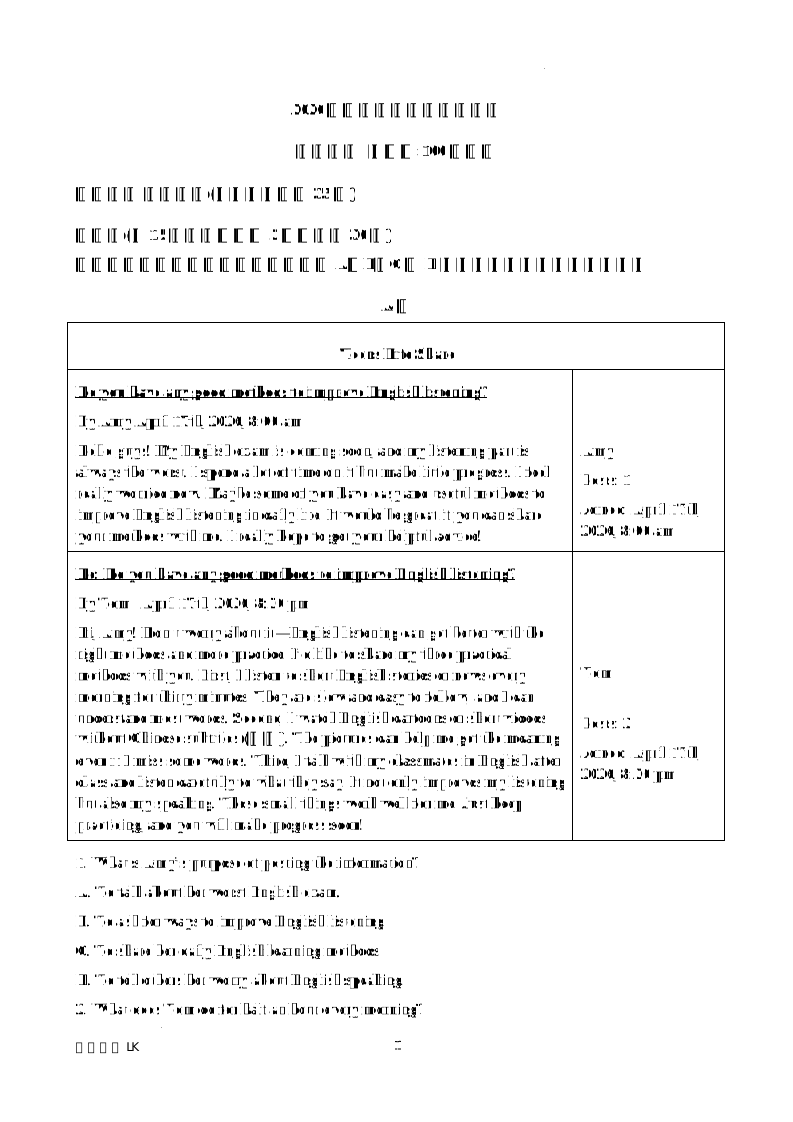
Teens Life Share
Do you have any good methods to improve English listening?
By Amy April 17th, 2026, 8:00 am
Hello guys! My English exam is coming soon, and my listening part is always the worst. I spend a lot of time on it but make little progress. I feel really worried now. Maybe some of you have easy and useful methods to improve English listening in daily life. It would be great if you can share your methods with me. I really hope to get your helpful advice!
Amy
Posts: 1
Joined: April 17th, 2026, 8:00 am
Re: Do you have any good methods to improve English listening?
By Tom April 17th, 2026, 8:20 pm
Hi, Amy! Don’t worry about it—English listening can get better with the right methods and more practice. I’d like to share my three practical methods with you. First, I listen to short English stories or news every morning for thirty minutes. They are slow and easy to follow, and I can understand most words. Second, I watch English cartoons or short videos without Chinese subtitles (字幕). The pictures can help me get the meaning even if I miss some words. Third, I talk with my classmates in English after class and listen carefully to what they say. It not only improves my listening but also my speaking. These small things work well for me. Just keep practicing, and you will make progress soon!
Tom
Posts: 2
Joined: April 17th, 2026, 8:20 pm
1. What’s Amy’s purpose of posting the information?
A. To talk about her worst English exam.
B. To ask for ways to improve English listening.
C. To share her daily English learning methods.
D. To tell others her worry about English speaking.
2. What does Tom do for half an hour every morning?
A. Watch English cartoons without subtitles.
B. Watch easy English videos.
C. Listen to short English stories or news.
D. Talk with classmates in English.
3. We can learn from Tom’s reply that ______.
A. English listening needs right methods and more practice
B. it’s useless to watch English videos with pictures
C. he only practices English listening at home alone
D. Chinese subtitles are necessary for English learning
B篇
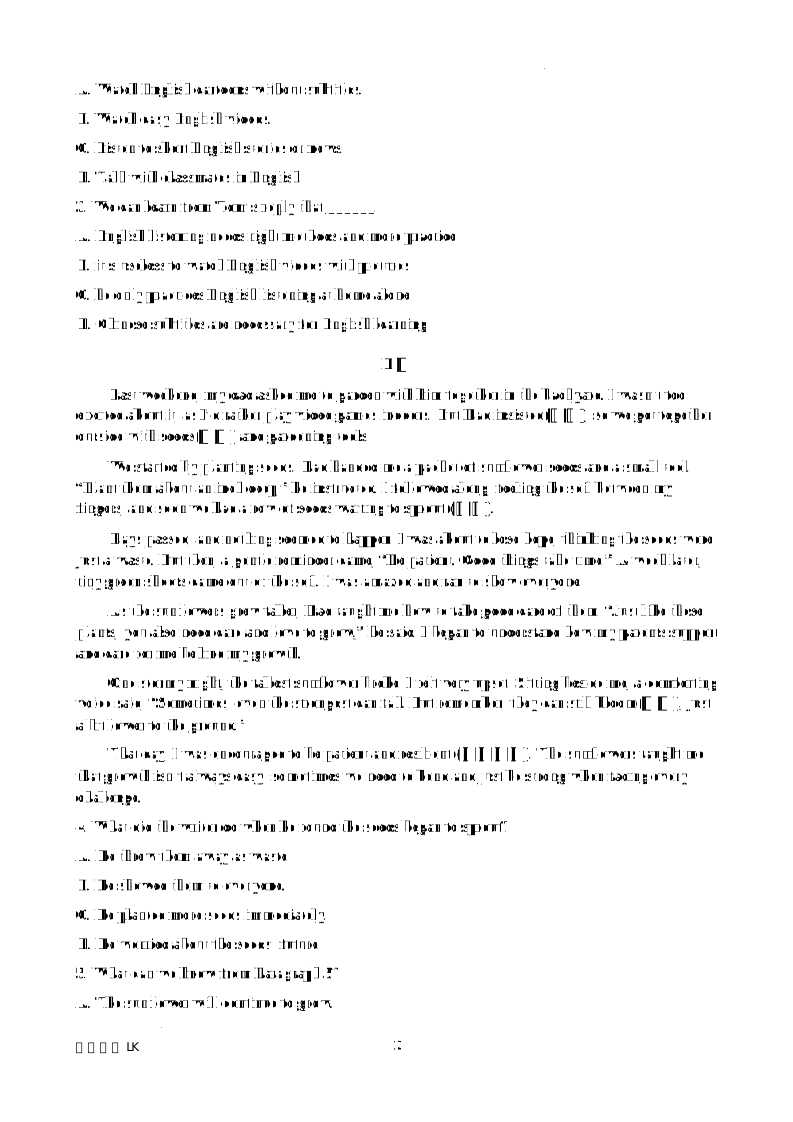
Last weekend, my dad asked me to garden with him together in the backyard. I wasn’t too excited about it, as I’d rather play video games indoors. But Dad insisted(坚持), so we got together outside with seeds(种子) and gardening tools.
We started by planting seeds. Dad handed me a packet of sunflower seeds and a small tool. “Plant them about an inch deep,” he instructed. I followed along, feeling the soil between my fingers, and soon we had a row of seeds waiting to sprout (发芽).
Days passed, and nothing seemed to happen. I was about to lose hope, thinking the seeds were just a waste. But then, a gentle reminder came, “Be patient. Good things take time.” A week later, tiny green shoots came out of the soil. I was amazed and ran to show everyone.
As the sunflowers grew taller, Dad taught me how to take good care of them. “Just like these plants, you also need care and love to grow,” he said. I began to understand how my parents support and care for me behind my growth.
One stormy night, the tallest sunflower broke. I felt very upset. Sitting beside me, a comforting voice said, “Sometimes, even the strongest can fall. But remember, they can still bloom(开花), just a bit lower to the ground.”
That day, I was encouraged to be patient and resilient (有弹性的). The sunflowers taught me that growth isn’t always easy, sometimes we need to bend and just be strong when facing every challenge.
4. What did the writer do when he found the seeds began to sprout?
A. He threw them away as waste.
B. He showed them to everyone.
C. He planted more seeds immediately.
D. He worried about the seeds’ future.
5. What can we know from Paragraph 5?
A. The sunflower will continue to grow.
B. The sunflower will never bloom again.
C. The sunflower will not grow any taller.
D. The sunflower will be easier to care for now.
6. How did the writer’s feelings change according to the story?
A. Bored→Excited→Amazed→Surprised→Upset→Thankful
B. Excited→Bored→Thankful→Angry→Doubtful→Encouraged
C. Hopeful→Disappointed→Surprised→Understanding→Upset→Patient
D. Uninterested→Hopeless→Amazed→Understanding→Sad→Encouraged
7. What did the writer learn from the experience with the sunflowers?
A. All the plants can grow very quickly.
B. Gardening is always a simple task.
C. Patience and care are important for growth.
D. Video games are more interesting than gardening.
C篇
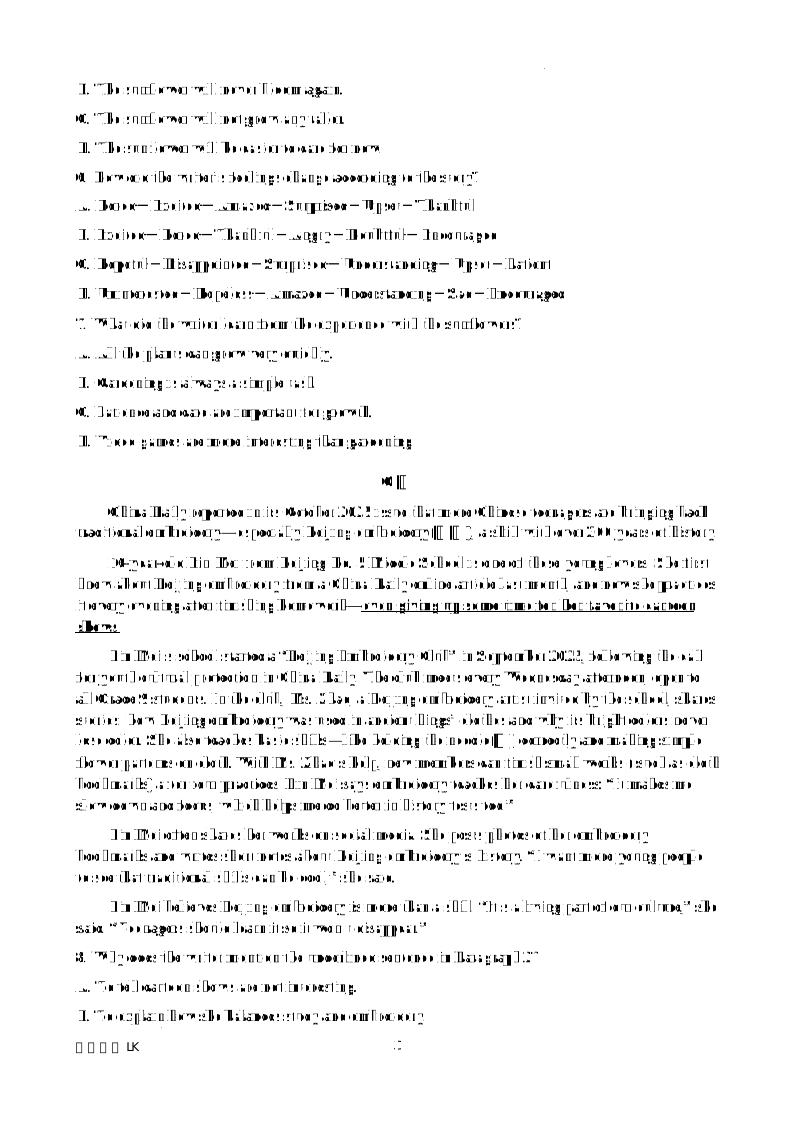
China Daily reported in its October 2025 issue that more Chinese teenagers are bringing back traditional embroidery—especially Beijing embroidery(京绣), a skill with over 300 years of history.
16-year-old Lin Mei from Beijing No. 5 Middle School is one of these young lovers. She first knew about Beijing embroidery from a China Daily online article last month, and now she practices it every evening after finishing homework—even giving up some time for her favorite cartoon shows.
Lin Mei’s school started a “Beijing Embroidery Club” in September 2025, following the call for youth cultural protection in China Daily. The club meets every Wednesday afternoon, open to all Grade 9 students. In the club, Ms. Zhao, a Beijing embroidery artist invited by the school, shares stories: how Beijing embroidery was used in ancient kings’ clothes and why its bright colors never lose color. She also teaches basic skills—like holding the needle(针) correctly and making simple flower patterns on cloth. With Ms. Zhao’s help, new members can finish small works ( such as cloth bookmarks) after four practices. Lin Mei says embroidery teaches her carefulness: “It makes me slow down and focus, which helps me do better in history tests too.”
Lin Mei often shares her works on social media. She posts photos of her embroidery bookmarks and writes short notes about Beijing embroidery’s history. “I want more young people to see that traditional skills can be cool,” she said.
Lin Mei believes Beijing embroidery is more than a skill. “It’s a living part of our culture,” she said. “Teenagers should learn it so it won’t disappear.”
8. Why does the writer mention the underlined sentence in Paragraph 2?
A. To tell cartoon shows are not interesting.
B. To explain how she balances study and embroidery.
C. To stress her strong interest in Beijing embroidery.
D. To tell readers to spend less time on entertainment.
9. What can we learn about the “Beijing Embroidery Club” from the passage?
A. It was set up by Ms. Zhao in September 2025.
B. It only accepts students who like reading.
C. Ms. Zhao teaches both embroidery stories and skills there.
D. Students need to buy expensive cloth and needles by themselves.
10. Why does Lin Mei write short notes about Beijing embroidery’s history when posting her works?
A. To help her classmates finish history homework.
B. To let more young people know about this traditional skill.
C. To show she is good at writing short articles.
D. To follow her teacher Ms. Zhao’s strict rules.
11. What does Lin Mei think of Beijing embroidery?
A. It can help students get better grades in all subjects.
B. It is a living part of Chinese culture with a long history.
C. It only needs simple tools to practice at home.
D. It was used in ancient cartoon designs long ago.
D篇
A group of middle school students in Guangzhou has started a “Solar School” project to promote(促进) green energy. The team, led by 14-year-old Li Jia, began planning in September 2025 after learning about solar power from a science column(栏目).
Li Jia’s team first surveyed their school’s energy use—they found the library’s lights and computers used too much electricity. With help from a local engineer, they designed small solar panels(太阳能板) to fit on the library’s windows. “We wanted to make something useful for our school,” Li Jia said. “Solar power is clean and cheap, so it’s perfect for us to try.”
After two months of work, the solar panels were put up in early November. Now, the library gets 30% of its electricity from the sun. The team also made posters to teach other students about solar energy—they put the posters in classrooms and the school hall. “Many classmates now ask us how to save electricity,” said team member Wang Tao. “It’s great to see everyone caring more about the environment.”
The school plans to expand(扩大) the project next year. Li Jia hopes their work will inspire more teens: “You don’t have to be an adult to help the planet. Small projects can make a big difference.” The headmaster praised the team, saying their project shows how young people can turn environmental ideas into action.
12. What was the first step of Li Jia’s "Solar School" project?
A. Putting up solar panels on the library windows.
B. Surveying the school’s energy use.
C. Making posters about solar energy.
D. Inviting an engineer to the school.
13. Why did Li Jia’s team choose solar power for their project?
A. Because it was clean and low – cost.
B. Because the headmaster asked them to use it.
C. Because it could power all the school’s buildings.
D. Because they learned about it from their science teacher.
14. What can we learn about the solar panels now?
A. They were put up in September 2025.
B. They provide all the library’s electricity.
C. They are placed on the library’s windows.
D. They were designed by the school’s teachers.
15. What does Li Jia want other teenagers to know?
A. Adults should do more to protect the planet.
B. Small environmental projects can be helpful.
C. Solar power is the best way to save energy.
D. Schools should teach more science lessons.
第二节 (共5小题;每小题1分,满分5分)
阅读下面短文,从短文后的选项中,选出可以填入空白处的最佳选项。选项中有一项为多余选项。
Anger is common in life. Maybe we get angry because of study pressure, misunderstandings with friends, or unexpected troubles. However, losing our temper(脾气) easily is harmful to our physical and mental health and may damage(损害) our relationships. 16
First, when we feel angry, we should stop talking and take a deep breath. 17 It can help us calm down quickly and avoid saying or doing things we regret. Second, we can communicate with people we trust, such as parents or friends. 18 Sharing our feelings can help us reduce pressure and get useful advice. Third, we can do something we enjoy to distract (转移) ourselves, like listening to music, drawing or going for a walk. 19 The enjoyable experience will make us forget our anger gradually.
20 It not only helps us stay healthy but also lets us make relationships better. By mastering these tips, we can face anger correctly and live a happier life.
A. Here are some useful tips on controlling anger.
B. Controlling anger is an important life skill.
C. Shouting at others can make them feel hurt and angry too.
D. This simple action slows down our heart rate and reduce nervousness.
E. Keeping our feelings inside may make the anger grow stronger.
F. Doing things we love moves our focus from the source(来源) of anger.
16. ______ 17. ______ 18. ______ 19. ______ 20. ______
第二部分 语言知识应用(共两节,满分25分)
第一节 完形填空(共10小题;每小题1分,满分10分)
阅读下面短文,从短文后各题所给的A、B、C和D四个选项中,选出可以填入空白处的最佳选项。
At the 2026 Milan Winter Olympics, a historic moment caught the world’s eyes. Ning Zhongyan, a 26yearold Chinese speed skater, won the gold medal in the men’s 1500m speed skating. He finished the race in 1 minute and 41.98 seconds, 21 the Olympic record. More importantly, he ended the 102year control of European and American skaters in this event.
Ning’s road to success was not smooth. Four years ago, at the Beijing Winter Olympics, he failed to win a medal. The result made him very sad. “I cried after the race,” he said. “I felt I let everyone down.” But the failure didn’t 22 him. He chose to train harder. To improve himself, Ning joined an international training club in the Netherlands. The training there used a lot of science. Coaches helped him change his skating 23 , especially his turning skills. Also, he had to live 24 in a foreign country, doing everything by himself from cooking to daily shopping. It was a hard and lonely journey, but he learned to compete with the world’s top skaters every day. In Milan, Ning met his biggest competitor — a young American skater. But Ning stayed 25 and skated perfectly. He kept a steady speed and 26 across the finish line first, beating his strong competitor by 0.77 seconds. After the race, Ning cried again, but this time, they were tears of 27 . He showed that Asian athletes can also reach the top in speed skating. Ning’s story tells us that success comes from hard work and keeping trying. As long as we 28 difficulties bravely and never give up, we will 29 our dreams one day. His spirit will always 30 young people to move forward.
21. A. breaking B. keeping C. marking D. watching
22. A. hurt B. beat C. surprise D. save
23. A. styles B. medals C. games D. races
24. A. quietly B. happily C. alone D. simply
25. A. silent B. nervous C. calm D. angry
26. A. rushed B. walked C. jumped D. passed
27. A. worry B. fear C. sadness D. joy
28. A. avoid B. hide C. refuse D. face
29. A. realize B. achieve C. create D. share
30. A. follow B. inspire C. ask D. protect
第二节 语法填空(共10小题;每小题1.5分,满分15分)
阅读下面短文,在空白处填入一个适当的单词或括号内单词的正确形式。
It was 31 unusual day when our teacher announced a speech competition in our class. Most of the students 32 (prefer) to avoid speaking in public, but this time, every student in our grade 33 (require) to take part. I felt nervous—giving a speech in front of the whole class seemed impossible, especially since I had never done anything like this before.
While I 34 (wonder) whether to give up or not, my English teacher noticed my hesitation(犹豫) and encouraged me to try. She said, “Don’t fear mistakes. Just speak from the heart.” “Believe in 35 (you), and you can make it.” Her kind words gave me the courage to make an important 36 (decide). I would have a try, no matter how scared I felt.
For the next two weeks, I worked hard, practicing my speech every day after school. I wanted to make sure I could present my thoughts clearly and 37 (correct). My parents praised me, though they reminded me that success wasn’t just about 38 (win). It was about doing my best.
On the competition day, my hands shook as I stood on the stage. To my surprise, as I began speaking, the audience was actually listening carefully. When I finished, several classmates came up to praise me. Later, when the judges announced the results, I couldn’t believe it. I had won second place!
This experience taught me some 39 (value) lessons. Encouragement from others can help us achieve things we thought were impossible. Sometimes we need to push through our fears 40 (discover) our true abilities. Now, whenever I feel nervous about speaking up, I remember that unusual day—the day I learned that every challenge is a chance for growth.
31. ________ 32. ________ 33. ________ 34. ________ 35. ________
32. ________ 37. ________ 38. ________ 39. ________ 40. ________
第三部分 书面表达(共两节,满分30分)
第一节 阅读表达(共5小题;每小题2分,满分10分)
阅读下面短文,完成短文后的问题。
China’s youth environmental protection program, Green Youth, has made great progress in building city forest parks in many cities since it started in 2023. The program aims to make cities greener and improve people’s living environment by encouraging teenagers to take an active part in treeplanting and various environmental protection activities.
On March 12th this year, over 10,000 students from 50 middle and primary schools in Guangzhou joined in the program’s largescale treeplanting activity. They worked with local gardeners and planted more than 8,000 young trees in the city’s western city forest park. With careful care and regular watering, over 90 percent of these trees have grown well till now. The green area of the park has increased by 20,000 square meters, making the air fresher and the surrounding environment more beautiful for local people.
Green Youth also organizes free environmental protection lectures and community wastesorting practice activities for students every month. These activities help teenagers learn more about environmental protection knowledge and develop a good green living habit in daily life.
Li Ming, a 14yearold middle school student from Guangzhou, said the program let him realize small actions can make a big difference to the environment. “We plant trees not just for today’s beauty, but for a greener and better future for everyone,” he said. With the efforts of teenagers across the country, Green Youth will continue to bring more green and beauty to China’s cities.
41. What’s the purpose of the Green Youth program?
____________________________________________________________________________
42. How many students joined in the treeplanting activity in Guangzhou on March 12th this year?
____________________________________________________________________________
43. What does the underlined word “these” in Paragraph 3 refer to?
____________________________________________________________________________
44. What can teenagers get from the activities organized by Green Youth according to the passage?
____________________________________________________________________________
45. Translate the underlined sentence in Paragraph 4 into Chinese.
____________________________________________________________________________
第二节 写作(满分:17分+3分卷面分)
人工智能AI(Artificial Intelligence)成为热门话题,科学技术的快速发展给人们的学习和生活带来了巨大的变化,同时也引发了人们对于人工智能取代人类的担忧。假如你是李华,请写一篇名为“AI in Our Life”的作文,谈谈那你对人工智能的看法。内容包括:
1. AI的优点;……
2. AI的缺点;……
3. 你的看法;……
要求:
1. 内容必须包括以上所给信息,可适当发挥;
2. 文中不得出现真实的人名、校名;
3. 开头已给出,不计入总词数;
4. 词数:100词左右。
5. 有卷面分。(1)书写正规 (2)卷面整洁 (3)间距合理
AI in Our Life
AI has become a hot topic among people in our society. It has become an important part of our life.____________________________________________________________________________
____________________________________________________________________________
____________________________________________________________________________
____________________________________________________________________________
____________________________________________________________________________
初四英语 LK1
学科网(北京)股份有限公司
$
资源预览图
1
2
3
相关资源
由于学科网是一个信息分享及获取的平台,不确保部分用户上传资料的 来源及知识产权归属。如您发现相关资料侵犯您的合法权益,请联系学科网,我们核实后将及时进行处理。