Unit 6 Crossing Cultures素能测评 2025-2026学年人教版八年级英语下册
2026-05-20
|
10页
|
264人阅读
|
8人下载
资源信息
| 学段 | 初中 |
|---|---|
| 学科 | 英语 |
| 教材版本 | 初中英语人教版八年级下册 |
| 年级 | 八年级 |
| 章节 | Unit 6 Crossing Cultures |
| 类型 | 作业-单元卷 |
| 知识点 | - |
| 使用场景 | 同步教学-单元练习 |
| 学年 | 2026-2027 |
| 地区(省份) | 全国 |
| 地区(市) | - |
| 地区(区县) | - |
| 文件格式 | DOCX |
| 文件大小 | 61 KB |
| 发布时间 | 2026-05-20 |
| 更新时间 | 2026-05-20 |
| 作者 | 《一路向前》 |
| 品牌系列 | - |
| 审核时间 | 2026-05-20 |
| 下载链接 | https://m.zxxk.com/soft/57953775.html |
| 价格 | 0.50储值(1储值=1元) |
| 来源 | 学科网 |
摘要:
**基本信息**
本卷为初中英语Unit 6 Crossing Cultures单元复习测评,以跨文化交际为核心,融合语言知识与文化意识,通过真实情境考查学生综合语言运用能力。
**题型特征**
|题型|题量/分值|知识覆盖|命题特色|
|----|-----------|----------|----------|
|单项选择|10题/10分|介词、连词、词汇辨析|结合日常情境,如"in one's forties"时间表达|
|完形填空|15题/15分|跨文化礼仪(餐厅行为、付账习惯)|对比中西方文化差异,培养文化意识|
|阅读理解|10题/20分|中国传统文化周、自我同情(原版外刊)|创新考法(写作手法、组合选择),提升思维品质|
|书面表达|1题/15分|跨文化交际建议(给外国友人回信)|真实社交情境,强化语言运用与跨文化沟通能力|
内容正文:
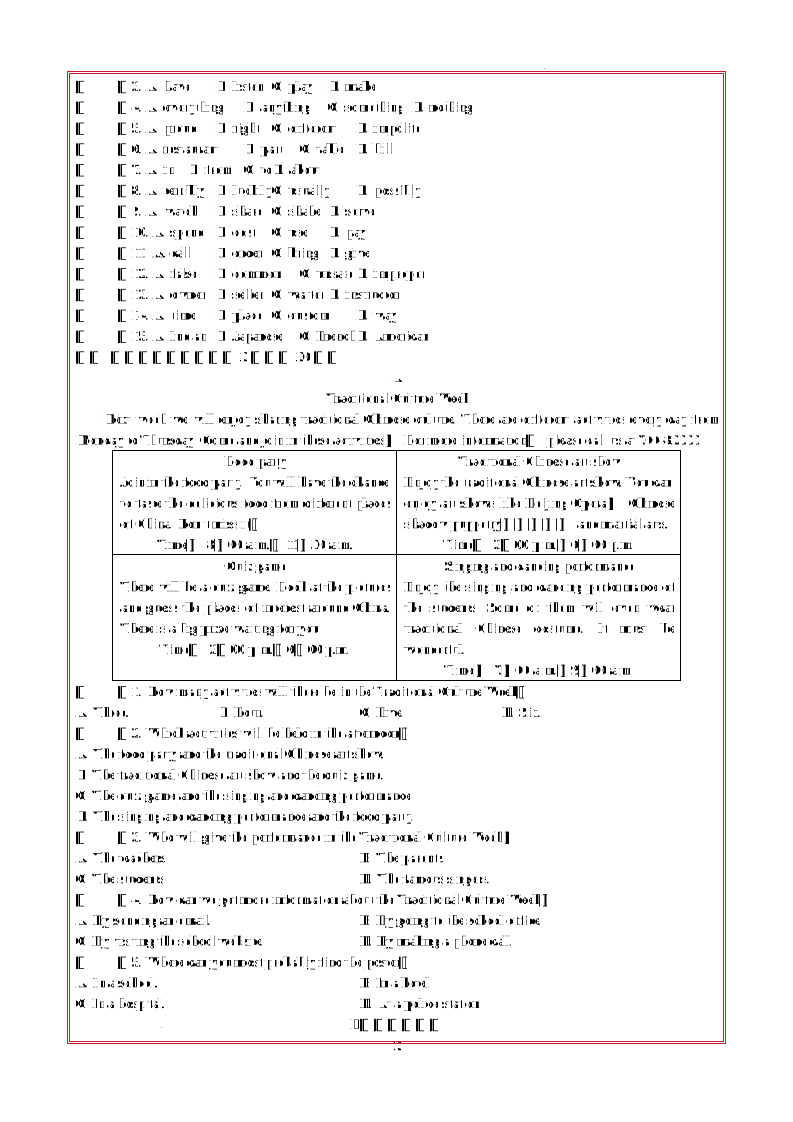
Unit 6 Crossing Cultures素能测评
一、 单项选择。(每小题1分,共10分)
( )1. Many people realize their life goals their forties after years of hard work.
A. at
B. to
C. in
D. on
( )2. The story is interesting everybody likes it very much.
A. very; that
B. so; that
C. such; that
D. such; because
( )3. Bringing a pet to school is because it can disturb other students.
A. proper
B. necessary
C. important
D. improper
( )4. I his letter of invitation, but I didn’t it.
A. accepted; receive
B. received; accept
C. accepted; take
D. received; get
( )5. The man gave us information about the place, so we couldn’t find it.
A. right
B. false
C. much
D. main
( )6. His novels describe life in Britain between the wars.
A. importantly
B. badly
C. nicely
D. nearly
( )7. At that new clothing store, I bought a for my mother last weekend.
A. stamp
B. postcard
C. poem
D. blouse
( )8. Don’t run around on the grass! Look at the sign! It says, “ the grass.”
A. Keep out
B. Keep off
C. Keep away
D. Keep on
( )9. Our family has a long-standing of gathering together for dinner every Sunday.
A. tradition
B. success
C. aim
D. culture
( )10. — Hi, Tom. I heard that you won first prize in the talent show yesterday.
— Thank you, Mike.
A. Congratulations!
B. Good luck!
C. Come on!
D.With pleasure
二、 完形填空。(每小题1分,共15分)
Around the world, people have different ideas about what good manners are. When you travel in a foreign country, you can find it so interesting to discover 1 differences.
2 you go to restaurants in different parts of the world, it’s important to know the right and wrong things to do. For example, in China, it’s normal to 3 a lot of noise in a restaurant. In fact, if a restaurant isn’t noisy or lively, you may think there’s 4 wrong with it. However, in many Western countries, restaurants are quiet places. If you talk too loudly, other people who are eating there might think you are 5 . They even complain to the owner of the 6 .
Paying the bill is also different 7 country to country. In China, one person 8 pays for everybody. In Western countries, one person pays if he or she is entertaining clients(宴请客户), but when friends eat together, they usually 9 the cost. This is called “going Dutch(均摊费用)”. Also, when Westerners 10 the bill, they usually leave some money for the waiter. They 11 this “leaving a tip”. Leaving a tip is thought to be polite. In the USA, it’s 12 to leave tips of 10%, 15%, or 20% of the bill, which is decided by how good the service is. A good 13 can make a lot of money!
The 14 people eat food is not the same in different parts of the world, but you can find the same kinds of foods in many countries. Chinese and 15 foods, for example, are popular all over the world. People think foods in China and India are so delicious.
( )1. A. cultural B. single C. clear D. negative
( )2. A. Until B. When C. Unless D. Though
( )3. A. have B. listen C. play D. make
( )4. A. everything B. anything C. something D. nothing
( )5. A. proud B. right C. different D. impolite
( )6. A. restaurant B. part C. table D. bill
( )7. A. in B. from C. to D. about
( )8. A. terribly B. luckily C. usually D. possibly
( )9. A. watch B. share C. shake D. serve
( )10. A. spend B. cost C. use D. pay
( )11. A. call B. order C. bring D. give
( )12. A. false B. common C. unsafe D. improper
( )13. A. owner B. seller C. waiter D. instructor
( )14. A. time B. place C. custom D. way
( )15. A. Indian B. Japanese C. French D. American
三、 阅读理解。(每小题2分,共20分)
A
Traditional Culture Week
Next week we will enjoy sharing traditional Chinese culture. There are different activities every day from Monday to Thursday. Come and join in these activities! For more information, please call us at 766-82333.
Food party
Join in the food party. You will have the chance to taste the delicious food from different places of China. Don’t miss it!
Time: 8:00 a.m.-11:30 a.m.
Traditional Chinese art show
Enjoy the traditional Chinese art show. You can enjoy art shows like Beijing Opera, Chinese shadow puppetry(皮影戏) and martial arts.
Time: 3:00 p.m.-6:00 p.m.
Quiz game
There will be a quiz game. Look at the pictures and guess the places of interest around China. There is a big prize waiting for you.
Time: 3:00 p.m.-6:00 p.m.
Singing and dancing performance
Enjoy the singing and dancing performance of the students. Some of them will even wear traditional Chinese costume. It must be wonderful.
Time: 7:00 a.m.-9:00 a.m.
( )1. How many activities will there be in the Traditional Culture Week?
A. Three.
B. Four.
C. Five.
D. Six.
( )2. Which activities will be held in the afternoon?
A. The food party and the traditional Chinese art show.
B. The traditional Chinese art show and the quiz game.
C. The quiz game and the singing and dancing performance.
D. The singing and dancing performance and the food party.
( )3. Who will give the performance in the Traditional Culture Week?
A. The teachers.
B. The parents.
C. The students.
D. The famous singers.
( )4. How can we get more information about the Traditional Culture Week?
A. By sending an email.
B. By going to the school office.
C. By visiting the school website.
D. By making a phone call.
( )5. Where can you most probably find the poster?
A. In a school.
B. In a hotel.
C. In a hospital.
D. At a police station.
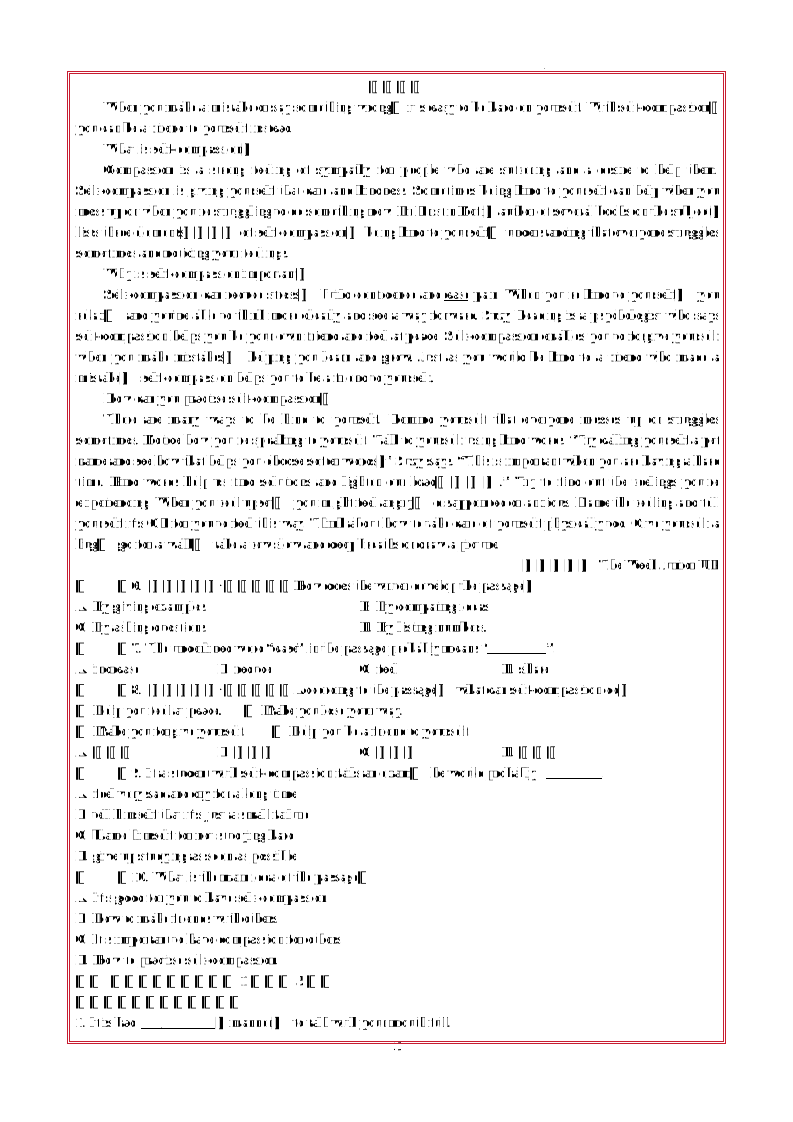
B(原版外刊)
自我同情
When you make a mistake or say something wrong, it’s easy to be hard on yourself. With self-compassion, you can be a friend to yourself instead.
What is self-compassion?
Compassion is a strong feeling of sympathy for people who are suffering and a desire to help them. Self-compassion is giving yourself that care and kindness. Sometimes being kind to yourself can help when you mess up or when you’re struggling to do something new. Dr Kristin Neff, author of several books on the subject, lists three elements(要素) of self-compassion: being kind to yourself, understanding that everyone struggles sometimes and noticing your feelings.
Why is self-compassion important?
Self-compassion can reduce stress, build confidence and ease pain. When you’re kind to yourself, you relax, and you’re able to think more clearly and see a way forward. Suzy Reading is a psychologist who says self-compassion helps you be your own friend and feel at peace. Self-compassion enables you to forgive yourself when you make mistakes, helping you learn and grow. Just as you would be kind to a friend who made a mistake, self-compassion helps you to be a friend to yourself.
How can you practise self-compassion?
There are many ways to be kind to yourself. Remind yourself that everyone messes up or struggles sometimes. Notice how you’re speaking to yourself. Talk to yourself using kind words. “Try calling yourself a pet name and see how that helps you choose softer words,” Suzy says. “This is important when you are having a hard time. Kind words help us find solutions and lighten our load(负担).” Try to find out the feelings you’re experiencing. When you feel upset, you might feel angry, disappointed or anxious. Name the feeling and tell yourself it’s OK for you to feel this way. Think about how to take care of yourself physically too. Give yourself a hug, go for a walk, take a few slow and deep breaths or draw a picture.
素材来源: The Week Junior UK
( )6. (创新考法·写作手法)How does the writer develop the passage?
A. By giving examples.
B. By comparing ideas.
C. By asking questions.
D. By listing numbers.
( )7. The underlined word “ease” in the passage probably means “ ”.
A. increase
B. reduce
C. feel
D. share
( )8. (创新考法·组合选择)According to the passage, what can self-compassion do?
① Help you feel at peace. ② Make you lose your way.
③ Make you forgive yourself. ④ Help you be a friend to yourself.
A. ①②③
B. ②③④
C. ①③④
D. ①②④
( )9. If a student with self-compassion fails an exam, he would probably .
A. feel very sad and cry for a long time
B. tell himself that it’s just a small failure
C. blame himself for not studying hard
D. give up studying as soon as possible
( )10. What is the main idea of the passage?
A. It’s good for you to have self-compassion.
B. How to make friends with others.
C. It’s important to have compassion for others.
D. How to practise self-compassion.
四、 词汇运用。(每小题1分,共5分)
用所给词的适当形式填空。
1. It is bad (manner) to talk with your mouth full.
2. Finally, he (refuse) our invitation to the party because he had to prepare for an important interview.
3. — When did you get (marry)? — In 2008.
4. For a little girl, going out alone at night is (safe).
5. They used (live) in a small town before moving to the city.
五、 补全对话。(每小题2分,共10分)
根据对话内容,从下面方框中选出适当的选项补全对话(有一个多余选项)。
A. What else? B. Could you please give me some advice?
C. Why are you nervous? D. You should eat with the knife and fork.
E. What should I do after dinner? F. You should eat with chopsticks.
A: Hey, Helen. You must be excited about going to a Chinese friend’s house for dinner.
B: Yeah, but I’m also a little nervous.
A: 1.
B: Because I don’t know how to behave at the dinner table. 2.
A: Of course. First of all, don’t be late. It’s not polite to arrive late for dinner.
B: I see. By the way, should I eat with the knife and fork?
A: Oh, no. 3. And remember not to put your chopsticks into your food when eating.
B: OK. 4.
A: Well, you shouldn’t make a loud noise when having soup.
B: 5.
A: After dinner, you should express your thanks for the meal.
B: Thanks a lot.
A: You’re welcome.
六、 选词填空。(每空1.5分,共15分)
阅读短文,选用方框中所给词的适当形式填空。
common bow they Indian low meaning express correct one culture
Body language is the act of communicating using anything other than your words. People all around the world use their bodies to express 1. : greeting someone with a hug or a handshake, smiling, waving, and so on. But the same gesture has different 2. in different countries. It’s not 3. .
In Japan, you bow when meeting a person for the 4. time, as well as when saying “goodbye” “thank you” and “I’m sorry”. Generally, the 5. you bow, the more respect you show the other person. Of course, the rules for 6. may be different.
Head shaking in India
In Western 7. , when you say “yes”, you nod your head. “No” is shaking the head from left to right. People from India, however, use their heads 8. so much more than a simple “yes” or “no”. In 9. , “yes” is expressed by tilting(倾斜) the head from one side towards the shoulder—the faster the shake is, the more certain the “yes” is.
“One” in Germany
You probably use your fingers to count things 10. . In Germany and some other European countries like France and Italy, they start counting with the thumb(拇指), and it plus the forefinger(食指) is “two”.
七、 (核心素养·语言能力)任务型阅读。(每小题2分,共10分)
拼音的作用
As we all know, Chinese has a history of thousands of years. 1. It is very necessary and important for everyone who learns Chinese because it tells people how to pronounce(发音) Chinese characters.
In 1958, Chinese linguist Zhou Youguang and his team made pinyin. Before that, Chinese people used many other ways to show how to pronounce Chinese characters. 2. Because of pinyin, more people learn how to pronounce Chinese characters.
Pinyin is a big part of our daily life. We learn to speak Putonghua with the help of pinyin. 3.
Pinyin is young. But it is now very popular outside China. 4. Many people around the world start to learn Chinese by learning pinyin. You might say “nihao” to mean “hello” to a foreign friend.
5. For example, fewer foreigners use “dumplings”. They like to use “jiaozi”. And “mantou” is for “steamed bun”. The Oxford English Dictionary has more than 100 Chinese words in pinyin, such as “hongbao” for “red envelope” and “guanxi” for “connection”.
根据短文内容,从下列选项中选出能填入空白处的最佳选项,选项中有两项多余。
A. People are using pinyin more often than before.
B. Pinyin and English letters look similar.
C. We write Chinese characters on computers by using pinyin.
D. Many foreigners find it hard to learn pinyin well.
E. But these ways are not as easy to use as pinyin.
F. It is becoming a bridge between China and the world.
G. But few people know that pinyin doesn’t.
八、 书面表达。(共15分)
假设你是李丹,近期,你在社交平台上看到了一个来自加拿大友人Paul的求助帖。请你阅读下面的帖文内容,用英语给他写一封回信,为他答疑解惑。
Hi everyone,
I’m Paul from Canada, and I’ll visit China soon! I’m super excited but a bit nervous. Can you help me with some questions?
Do I need to get to the train station very early before my train leaves? I don’t want to miss it!
Do Chinese restaurants usually have menus in both Chinese and English? I’m worried I won’t know what to order. Is it normal to give a tip when I am eating at a restaurant or taking a taxi? I’m not sure about the rules.
Thanks for your help! I hope to learn a lot from you all.
Yours,
Paul
注意:1. 不少于80词,已给出部分不计入总词数;2. 可适当增加细节,以使行文连贯;3. 文中不能出现真实姓名及学校名称。
Dear Paul,
I’m glad to hear you’re coming to China! Let me answer your questions.
Yours,
Li Dan
参考答案
Unit 6 Crossing Cultures素能测评
一、 单项选择。(每小题1分,共10分)
( C )1. Many people realize their life goals their forties after years of hard work.
A. at
B. to
C. in
D. on
( B )2. The story is interesting everybody likes it very much.
A. very; that
B. so; that
C. such; that
D. such; because
( D )3. Bringing a pet to school is because it can disturb other students.
A. proper
B. necessary
C. important
D. improper
( B )4. I his letter of invitation, but I didn’t it.
A. accepted; receive
B. received; accept
C. accepted; take
D. received; get
( B )5. The man gave us information about the place, so we couldn’t find it.
A. right
B. false
C. much
D. main
( C )6. His novels describe life in Britain between the wars.
A. importantly
B. badly
C. nicely
D. nearly
( D )7. At that new clothing store, I bought a for my mother last weekend.
A. stamp
B. postcard
C. poem
D. blouse
( B )8. Don’t run around on the grass! Look at the sign! It says, “ the grass.”
A. Keep out
B. Keep off
C. Keep away
D. Keep on
( A )9. Our family has a long-standing of gathering together for dinner every Sunday.
A. tradition
B. success
C. aim
D. culture
( A )10. — Hi, Tom. I heard that you won first prize in the talent show yesterday.
— Thank you, Mike.
A. Congratulations!
B. Good luck!
C. Come on!
D.With pleasure
二、 完形填空。(每小题1分,共15分)
Around the world, people have different ideas about what good manners are. When you travel in a foreign country, you can find it so interesting to discover 1 differences.
2 you go to restaurants in different parts of the world, it’s important to know the right and wrong things to do. For example, in China, it’s normal to 3 a lot of noise in a restaurant. In fact, if a restaurant isn’t noisy or lively, you may think there’s 4 wrong with it. However, in many Western countries, restaurants are quiet places. If you talk too loudly, other people who are eating there might think you are 5 . They even complain to the owner of the 6 .
Paying the bill is also different 7 country to country. In China, one person 8 pays for everybody. In Western countries, one person pays if he or she is entertaining clients(宴请客户), but when friends eat together, they usually 9 the cost. This is called “going Dutch(均摊费用)”. Also, when Westerners 10 the bill, they usually leave some money for the waiter. They 11 this “leaving a tip”. Leaving a tip is thought to be polite. In the USA, it’s 12 to leave tips of 10%, 15%, or 20% of the bill, which is decided by how good the service is. A good 13 can make a lot of money!
The 14 people eat food is not the same in different parts of the world, but you can find the same kinds of foods in many countries. Chinese and 15 foods, for example, are popular all over the world. People think foods in China and India are so delicious.
( A )1. A. cultural B. single C. clear D. negative
( B )2. A. Until B. When C. Unless D. Though
( D )3. A. have B. listen C. play D. make
( C )4. A. everything B. anything C. something D. nothing
( D )5. A. proud B. right C. different D. impolite
( A )6. A. restaurant B. part C. table D. bill
( B )7. A. in B. from C. to D. about
( C )8. A. terribly B. luckily C. usually D. possibly
( B )9. A. watch B. share C. shake D. serve
( D )10. A. spend B. cost C. use D. pay
( A )11. A. call B. order C. bring D. give
( B )12. A. false B. common C. unsafe D. improper
( C )13. A. owner B. seller C. waiter D. instructor
( D )14. A. time B. place C. custom D. way
( A )15. A. Indian B. Japanese C. French D. American
三、 阅读理解。(每小题2分,共20分)
A
Traditional Culture Week
Next week we will enjoy sharing traditional Chinese culture. There are different activities every day from Monday to Thursday. Come and join in these activities! For more information, please call us at 766-82333.
Food party
Join in the food party. You will have the chance to taste the delicious food from different places of China. Don’t miss it!
Time: 8:00 a.m.-11:30 a.m.
Traditional Chinese art show
Enjoy the traditional Chinese art show. You can enjoy art shows like Beijing Opera, Chinese shadow puppetry(皮影戏) and martial arts.
Time: 3:00 p.m.-6:00 p.m.
Quiz game
There will be a quiz game. Look at the pictures and guess the places of interest around China. There is a big prize waiting for you.
Time: 3:00 p.m.-6:00 p.m.
Singing and dancing performance
Enjoy the singing and dancing performance of the students. Some of them will even wear traditional Chinese costume. It must be wonderful.
Time: 7:00 a.m.-9:00 a.m.
( B )1. How many activities will there be in the Traditional Culture Week?
A. Three.
B. Four.
C. Five.
D. Six.
( B )2. Which activities will be held in the afternoon?
A. The food party and the traditional Chinese art show.
B. The traditional Chinese art show and the quiz game.
C. The quiz game and the singing and dancing performance.
D. The singing and dancing performance and the food party.
( C )3. Who will give the performance in the Traditional Culture Week?
A. The teachers.
B. The parents.
C. The students.
D. The famous singers.
( D )4. How can we get more information about the Traditional Culture Week?
A. By sending an email.
B. By going to the school office.
C. By visiting the school website.
D. By making a phone call.
( A )5. Where can you most probably find the poster?
A. In a school.
B. In a hotel.
C. In a hospital.
D. At a police station.
B(原版外刊)
自我同情
When you make a mistake or say something wrong, it’s easy to be hard on yourself. With self-compassion, you can be a friend to yourself instead.
What is self-compassion?
Compassion is a strong feeling of sympathy for people who are suffering and a desire to help them. Self-compassion is giving yourself that care and kindness. Sometimes being kind to yourself can help when you mess up or when you’re struggling to do something new. Dr Kristin Neff, author of several books on the subject, lists three elements(要素) of self-compassion: being kind to yourself, understanding that everyone struggles sometimes and noticing your feelings.
Why is self-compassion important?
Self-compassion can reduce stress, build confidence and ease pain. When you’re kind to yourself, you relax, and you’re able to think more clearly and see a way forward. Suzy Reading is a psychologist who says self-compassion helps you be your own friend and feel at peace. Self-compassion enables you to forgive yourself when you make mistakes, helping you learn and grow. Just as you would be kind to a friend who made a mistake, self-compassion helps you to be a friend to yourself.
How can you practise self-compassion?
There are many ways to be kind to yourself. Remind yourself that everyone messes up or struggles sometimes. Notice how you’re speaking to yourself. Talk to yourself using kind words. “Try calling yourself a pet name and see how that helps you choose softer words,” Suzy says. “This is important when you are having a hard time. Kind words help us find solutions and lighten our load(负担).” Try to find out the feelings you’re experiencing. When you feel upset, you might feel angry, disappointed or anxious. Name the feeling and tell yourself it’s OK for you to feel this way. Think about how to take care of yourself physically too. Give yourself a hug, go for a walk, take a few slow and deep breaths or draw a picture.
素材来源: The Week Junior UK
( C )6. (创新考法·写作手法)How does the writer develop the passage?
A. By giving examples.
B. By comparing ideas.
C. By asking questions.
D. By listing numbers.
( B )7. The underlined word “ease” in the passage probably means “ ”.
A. increase
B. reduce
C. feel
D. share
( C )8. (创新考法·组合选择)According to the passage, what can self-compassion do?
① Help you feel at peace. ② Make you lose your way.
③ Make you forgive yourself. ④ Help you be a friend to yourself.
A. ①②③
B. ②③④
C. ①③④
D. ①②④
( B )9. If a student with self-compassion fails an exam, he would probably .
A. feel very sad and cry for a long time
B. tell himself that it’s just a small failure
C. blame himself for not studying hard
D. give up studying as soon as possible
( A )10. What is the main idea of the passage?
A. It’s good for you to have self-compassion.
B. How to make friends with others.
C. It’s important to have compassion for others.
D. How to practise self-compassion.
四、 词汇运用。(每小题1分,共5分)
用所给词的适当形式填空。
1. It is bad manners (manner) to talk with your mouth full.
2. Finally, he refused (refuse) our invitation to the party because he had to prepare for an important interview.
3. — When did you get married (marry)? — In 2008.
4. For a little girl, going out alone at night is unsafe (safe).
5. They used to live (live) in a small town before moving to the city.
五、 补全对话。(每小题2分,共10分)
根据对话内容,从下面方框中选出适当的选项补全对话(有一个多余选项)。
A. What else? B. Could you please give me some advice?
C. Why are you nervous? D. You should eat with the knife and fork.
E. What should I do after dinner? F. You should eat with chopsticks.
A: Hey, Helen. You must be excited about going to a Chinese friend’s house for dinner.
B: Yeah, but I’m also a little nervous.
A: 1. C
B: Because I don’t know how to behave at the dinner table. 2. B
A: Of course. First of all, don’t be late. It’s not polite to arrive late for dinner.
B: I see. By the way, should I eat with the knife and fork?
A: Oh, no. 3. F And remember not to put your chopsticks into your food when eating.
B: OK. 4. A
A: Well, you shouldn’t make a loud noise when having soup.
B: 5. E
A: After dinner, you should express your thanks for the meal.
B: Thanks a lot.
A: You’re welcome.
六、 选词填空。(每空1.5分,共15分)
阅读短文,选用方框中所给词的适当形式填空。
common bow they Indian low meaning express correct one culture
Body language is the act of communicating using anything other than your words. People all around the world use their bodies to express 1. themselves : greeting someone with a hug or a handshake, smiling, waving, and so on. But the same gesture has different 2. meanings in different countries. It’s not 3. uncommon .
In Japan, you bow when meeting a person for the 4. first time, as well as when saying “goodbye” “thank you” and “I’m sorry”. Generally, the 5. lower you bow, the more respect you show the other person. Of course, the rules for 6. bowing may be different.
Head shaking in India
In Western 7. cultures , when you say “yes”, you nod your head. “No” is shaking the head from left to right. People from India, however, use their heads 8. to express so much more than a simple “yes” or “no”. In 9. India , “yes” is expressed by tilting(倾斜) the head from one side towards the shoulder—the faster the shake is, the more certain the “yes” is.
“One” in Germany
You probably use your fingers to count things 10. correctly . In Germany and some other European countries like France and Italy, they start counting with the thumb(拇指), and it plus the forefinger(食指) is “two”.
七、 (核心素养·语言能力)任务型阅读。(每小题2分,共10分)
拼音的作用
As we all know, Chinese has a history of thousands of years. 1. G It is very necessary and important for everyone who learns Chinese because it tells people how to pronounce(发音) Chinese characters.
In 1958, Chinese linguist Zhou Youguang and his team made pinyin. Before that, Chinese people used many other ways to show how to pronounce Chinese characters. 2. E Because of pinyin, more people learn how to pronounce Chinese characters.
Pinyin is a big part of our daily life. We learn to speak Putonghua with the help of pinyin. 3. C
Pinyin is young. But it is now very popular outside China. 4. F Many people around the world start to learn Chinese by learning pinyin. You might say “nihao” to mean “hello” to a foreign friend.
5. A For example, fewer foreigners use “dumplings”. They like to use “jiaozi”. And “mantou” is for “steamed bun”. The Oxford English Dictionary has more than 100 Chinese words in pinyin, such as “hongbao” for “red envelope” and “guanxi” for “connection”.
根据短文内容,从下列选项中选出能填入空白处的最佳选项,选项中有两项多余。
A. People are using pinyin more often than before.
B. Pinyin and English letters look similar.
C. We write Chinese characters on computers by using pinyin.
D. Many foreigners find it hard to learn pinyin well.
E. But these ways are not as easy to use as pinyin.
F. It is becoming a bridge between China and the world.
G. But few people know that pinyin doesn’t.
八、 书面表达。(共15分)
假设你是李丹,近期,你在社交平台上看到了一个来自加拿大友人Paul的求助帖。请你阅读下面的帖文内容,用英语给他写一封回信,为他答疑解惑。
Hi everyone,
I’m Paul from Canada, and I’ll visit China soon! I’m super excited but a bit nervous. Can you help me with some questions?
Do I need to get to the train station very early before my train leaves? I don’t want to miss it!
Do Chinese restaurants usually have menus in both Chinese and English? I’m worried I won’t know what to order. Is it normal to give a tip when I am eating at a restaurant or taking a taxi? I’m not sure about the rules.
Thanks for your help! I hope to learn a lot from you all.
Yours,
Paul
注意:1. 不少于80词,已给出部分不计入总词数;2. 可适当增加细节,以使行文连贯;3. 文中不能出现真实姓名及学校名称。
Dear Paul,
I’m glad to hear you’re coming to China! Let me answer your questions.
For the train station, it’s good to arrive 30 to 40 minutes early. Trains here are usually on time, but you need time to check in and find your platform. Don’t worry—there are clear signs in English to guide you.
Most restaurants in big cities have menus in both Chinese and English. Some even have pictures, which helps a lot. If you’re in a small place, just use simple words or gestures, and people will try to help you.
As for giving tips, it’s not necessary in China. Workers or drivers don’t expect tips in restaurants or taxis. It might differ from your country’s practice, but that’s our custom.
Enjoy your trip! If you have more questions, feel free to ask.
Yours,
Li Dan
1
学科网(北京)股份有限公司
$
资源预览图

1
2
3
相关资源
由于学科网是一个信息分享及获取的平台,不确保部分用户上传资料的 来源及知识产权归属。如您发现相关资料侵犯您的合法权益,请联系学科网,我们核实后将及时进行处理。