Unit 7 Section A (4a~4d) 课件 2025-2026学年人教版八年级英语下册
2026-05-19
|
22页
|
2131人阅读
|
9人下载
普通
资源信息
| 学段 | 初中 |
|---|---|
| 学科 | 英语 |
| 教材版本 | 初中英语人教版八年级下册 |
| 年级 | 八年级 |
| 章节 | Grammar Focus |
| 类型 | 课件 |
| 知识点 | - |
| 使用场景 | 同步教学-新授课 |
| 学年 | 2026-2027 |
| 地区(省份) | 全国 |
| 地区(市) | - |
| 地区(区县) | - |
| 文件格式 | PPTX |
| 文件大小 | 12.90 MB |
| 发布时间 | 2026-05-19 |
| 更新时间 | 2026-05-19 |
| 作者 | 匿名 |
| 品牌系列 | - |
| 审核时间 | 2026-05-19 |
| 下载链接 | https://m.zxxk.com/soft/57944764.html |
| 价格 | 0.50储值(1储值=1元) |
| 来源 | 学科网 |
摘要:
该初中英语课件聚焦现在完成时,涵盖结构、标志词(ever, never等)及与一般过去时的区别。通过Free Talk教师分享阅读《西游记》章节经历导入,结合例句引导学生归纳语法规则,搭建从语境感知到系统学习的支架。
其亮点在于情境化与任务型教学结合,Free Talk、4d采访活动提升语言能力,对比辨析培养思维品质,融入《三国演义》等中国经典增强文化意识。含视频辅助理解,课堂总结与思维导图作业帮助梳理,助力学生语法应用与文化认知,为教师提供丰富教学资源。
内容正文:
Unit 7
A Good Read
Section A Grammar Focus
To be able to recognize and state the basic structure of the present perfect tense, and understand the meanings and usages of ever, never, just, already, and yet.
To distinguish the usage differences between the present perfect tense and the simple past tense.
To use the present perfect tense to talk about recent events and experiences.
学习目标
1
2
3
Free Talk
Look, everyone! I've just finished the chapter about the Monkey King making havoc in heaven. It's so exciting!
In fact, I've already read this story many times. But I have never read the entire book in English.
Has anyone ever read the book or watched its TV drama or cartoon?
What other Chinese classics have you already read?
I've just finished the chapter about the Monkey King making havoc in heaven.
I have never read the entire book in English.
I’ve=I have
I've already read this story many times.
Has anyone ever read the book or watched its TV drama or cartoon?
What other Chinese classics have you already read?
What structure do all these sentences contain?
have/has+动词的过去分词
Present Perfect tense(现在完成时)
现在完成时:表示过去发生或已经完成的动作与现在有影响,强调对现在造成的影响、结果,或表示从过去开始一直持续到现在的动作或状态。
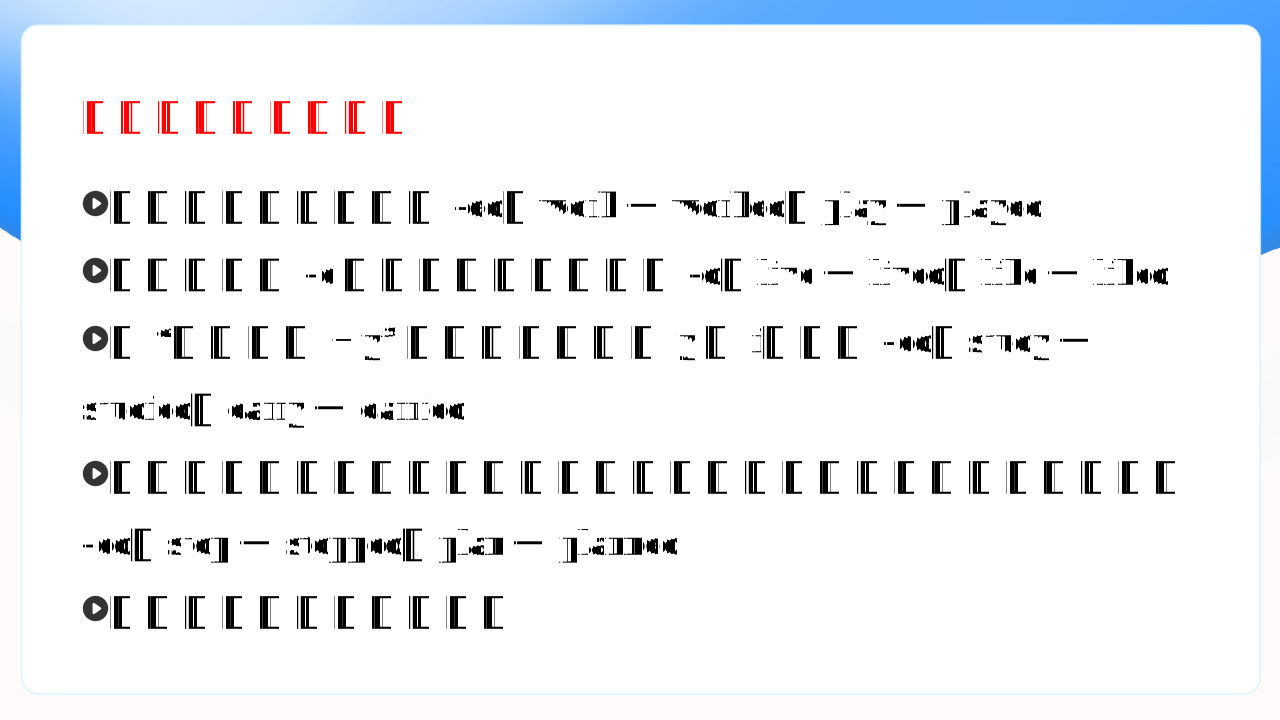
动词过去分词构成:
一般情况下,直接加 -ed:work → worked;play → played
以不发音的 -e 结尾的动词,直接加 -d:live → lived;like → liked
以 “辅音字母 + y” 结尾的动词,变 y 为 i,再加 -ed:study → studied;carry → carried
重读闭音节动词,末尾只有一个辅音字母,双写该辅音字母,再加 -ed:stop → stopped;plan → planned
不规则变化需要特殊记忆
Read and find.
4a
Have you decided on a book for your report? Yes, I have. /No, I haven’t.
Has Peter ever heard of this book? No, he’s never heard of it.
Has Chen Jie read this book yet? No, but she’s already borrowed it from the library.
What have you read recently? I’ve just finished The Romance of the Three Kingdoms.
肯定句:主语 + have/has + 动词过去分词 (done)
否定句:主语 + have/has + not + 动词过去分词 (done)
Read and find.
4a
Have you decided on a book for your report? Yes, I have. /No, I haven’t.
Has Peter ever heard of this book? No, he’s never heard of it.
Has Chen Jie read this book yet? No, but she’s already borrowed it from the library.
What have you read recently? I’ve just finished The Romance of the Three Kingdoms.
一般疑问句:Have/Has + 主语 + 动词过去分词 (done) + 其他?
肯定回答: Yes,主语+ have/has./ 否定回答:No,主语+have/has+not.
Read and find.
4a
Have you decided on a book for your report? Yes, I have. /No, I haven’t.
Has Peter ever heard of this book? No, he’s never heard of it.
Has Chen Jie read this book yet? No, but she’s already borrowed it from the library.
What have you read recently? I’ve just finished The Romance of the Three Kingdoms.
特殊疑问句:特殊疑问词 + have/has + 主语 + 过去分词 (done) + 其他?
即:特殊疑问词+一般疑问句
Pay attention to the bold words and find the rules.
4a
Have you decided on a book for your report? Yes, I have. /No, I haven’t.
Has Peter ever heard of this book? No, he’s never heard of it.
Has Chen Jie read this book yet? No, but she’s already borrowed it from the library.
What have you read recently? I’ve just finished The Romance of the Three Kingdoms.
ever
用法:用于 ,意为 “曾经”,放在过去分词之 。
例句:Have you ever been to Beijing? 你曾经去过北京吗?
疑问句
前
Pay attention to the bold words and find the rules.
4a
Have you decided on a book for your report? Yes, I have. /No, I haven’t.
Has Peter ever heard of this book? No, he’s never heard of it.
Has Chen Jie read this book yet? No, but she’s already borrowed it from the library.
What have you read recently? I’ve just finished The Romance of the Three Kingdoms.
never
用法:用于肯定句表否定,意为 “从不、从未”,位于过去分词之 。
例句:I have never seen such a beautiful flower. 我从未见过这么漂亮的花。
前
Pay attention to the bold words and find the rules.
4a
Have you decided on a book for your report? Yes, I have. /No, I haven’t.
Has Peter ever heard of this book? No, he’s never heard of it.
Has Chen Jie read this book yet? No, but she’s already borrowed it from the library.
What have you read recently? I’ve just finished The Romance of the Three Kingdoms.
yet
用法:用于否定句和疑问句 ,意为 “还、尚”。
例句:Have you finished your homework yet? 你做完作业了吗?
I haven’t done it yet. 我还没做。
句末
Pay attention to the bold words and find the rules.
4a
Have you decided on a book for your report? Yes, I have. /No, I haven’t.
Has Peter ever heard of this book? No, he’s never heard of it.
Has Chen Jie read this book yet? No, but she’s already borrowed it from the library.
What have you read recently? I’ve just finished The Romance of the Three Kingdoms.
already
用法:用于 句,意为 “已经”,放 或句末。
例句:I have already cleaned my room. 我已经打扫完房间了。
肯定
句中
Pay attention to the bold words and find the rules.
4a
Have you decided on a book for your report? Yes, I have. /No, I haven’t.
Has Peter ever heard of this book? No, he’s never heard of it.
Has Chen Jie read this book yet? No, but she’s already borrowed it from the library.
What have you read recently? I’ve just finished The Romance of the Three Kingdoms.
just
用法:表示 “刚刚”,动作刚发生不久,放 。
例句:He has just come back. 他刚回来。
句中
Practice
Complete the conversations with ever, never, just, already, or yet.
4b
1. A: Have you ________ heard of the book The Little Prince?
B: No, I’ve________heard of it.
A: I’ve_________finished reading it. It’s such a simple story, but you can learn a lot from it!
2. A: Have you chosen a book for your book report____?
B: Yes, I’ve chosen The Little Match Girl. It’s such a sad story, but I love it. I’ve _________ read it many times.
3. A: I’ve ______ read a classic novel before. Could you recommend one?
B: Well, I’ve______ finished Outlaws of the Marsh. It’s really good!
A: Oh, thanks! Could I borrow it?
B: Sure!
ever
never
already
yet
already
never
just
现在完成时与一般过去时的区别
现在完成时与一般过去时都表示在过去做的动作,但现在完成时强调这一动作与现在的关系,如对现在产生的结果、影响等。一般过去时只表示过去的事实,不表示和现在的关系。
一般过去时
例句:He closed the window.
只叙述他过去做过“关窗户”这个动作,现在窗户有也许是开的,也许是关的。
Grammar
现在完成时
例句:He has closed the window.
这个句子包含了两个意思:
一是他曾经关了窗户(He once closed the window.);
二是强调动作与现在的关系,即现在这扇窗户仍然是关着的(Now the window is closed.)
Let’s watch and learn!
Complete the passage with the simple past or present perfect forms of the verbs in brackets.
4c
________you ever ________(try) to read books from different countries? At the start of this year, I __________(decide) to read books from as many countries as possible. I_________(begin) with The Adventures of Tom Sawyer. Now I ________ already _____(read) twenty different books. These books____________(teach) me a lot about other cultures and societies, and they_____________(allow) me to see the world differently. In the past, I only______ (know) the names of different countries, but now I understand them a little bit better. This experience has been amazing so far. I never ________(realize) how big our world really is!
Have
tried
decided
began
have
read
have taught
have allowed
knew
realize
Practice
Production
Interview your classmates and find out who has done these activities.
4d
read all four Chinese literary classics
watched a movie based on a novel
read a book in a different language
read a book more than twice
read a book with more than 500 pages
joined a reading club
课堂总结
现在完成时
定义:过去的动作对现在有影响,或持续到现在还可能继续下去
肯定句:主语+have/has+done
否定句:主语+have/has not done
一般疑问句: Have/Has+主语+done...?
肯定回答:Yes, 主语+have/has
否定回答:No, 主语+have/has not.
特殊疑问句:
特殊疑问词+一般疑问句
现在完成时与一般过去时的区别
标志词:
already, yet, ever, never
过去分词变化规则
当堂检测
单项填空
1. —The task is finally done, let’s go eat something now.
—Great, I haven’t eaten anything ________ breakfast.
A. before B. since C. of D. from
2. I _____ back in the UK for three days, but it ______ like a century.
A. am; feel B. have been; feels C. have been; feel D. am; felt
3. The film Zootopia 2 ____ very popular since it was first shown on Nov. 26th.
A. became B. has become C. was becoming D. become
4. — ________ you ________ your homework yet?
—Yes. We ________ it three hours ago.
A. Did; finish; did B. Have; finished; have
C. Have; finished; did D. Have; finish; had
B
B
B
C
Homework
✍ 总结现在完成时的知识点,绘制一幅思维导图。
Lavf58.29.100
Packed by Bilibili XCoder v2.0.2
$
资源预览图
1
2

3

4
5

6
相关资源
由于学科网是一个信息分享及获取的平台,不确保部分用户上传资料的 来源及知识产权归属。如您发现相关资料侵犯您的合法权益,请联系学科网,我们核实后将及时进行处理。