Units7~8检测题 2025-2026学年人教版七年级英语下册
2026-05-19
|
6页
|
61人阅读
|
0人下载
资源信息
| 学段 | 初中 |
|---|---|
| 学科 | 英语 |
| 教材版本 | 初中英语人教版七年级下册 |
| 年级 | 七年级 |
| 章节 | Unit 7 A Day to Remember,Unit 8 Once upon a Time |
| 类型 | 题集-综合训练 |
| 知识点 | - |
| 使用场景 | 同步教学-阶段检测 |
| 学年 | 2026-2027 |
| 地区(省份) | 全国 |
| 地区(市) | - |
| 地区(区县) | - |
| 文件格式 | DOCX |
| 文件大小 | 88 KB |
| 发布时间 | 2026-05-19 |
| 更新时间 | 2026-05-19 |
| 作者 | 匿名 |
| 品牌系列 | - |
| 审核时间 | 2026-05-19 |
| 下载链接 | https://m.zxxk.com/soft/57939047.html |
| 价格 | 0.50储值(1储值=1元) |
| 来源 | 学科网 |
摘要:
**基本信息**
以Units7~8语言知识为核心,通过听、读、写多维度综合训练,系统整合日常活动描述与文化故事理解,强化语言能力与文化意识的融合。
**综合设计**
|模块|题量/典例|题型特征|知识逻辑|
|----|-----------|----------|----------|
|听力|4节30分|句子应答、对话理解、短文填空|围绕旅行、日常活动等主题,考查信息抓取与语境理解能力|
|语言运用|2节25分|完形填空(手工制作)、短文填空(孟姜女故事)|融合词汇运用与语法规则,体现文化意识与思维品质|
|阅读|2节40分|日记对比、寓言故事、旅行记述|通过不同体裁文本,培养推理判断与跨文化理解能力|
|写作|1题15分|“程门立雪”成语故事|结合传统文化,提升语言表达与文化传承能力|
内容正文:
人教版·七年级下册Units7~8检测题
(2025~2026下学期) (Full Marks: 120分 Time: 120 分钟)
Name: Class: Score:
第一部分 听力(共四节,满分30分)
第一节 听句子,选择最佳答语(共5小题;每小题1分,满分5分)
( )1. A. He was grey. B. He felt sad. C. He went away.
( )2. A. Yes, I did. B. Yes, I am. C. Yes, I do.
( )3. A. We saw some photos. B. It was a meaningful trip.
C. We should study hard.
( )4. A. Not at all. B. That sounds good. C. That's all right.
( )5. A. Lucky you. B. Thank you. C. I agree with you.
第二节 听对话和问题,选择正确答案(共13 小题;每小题1分,满分13分)
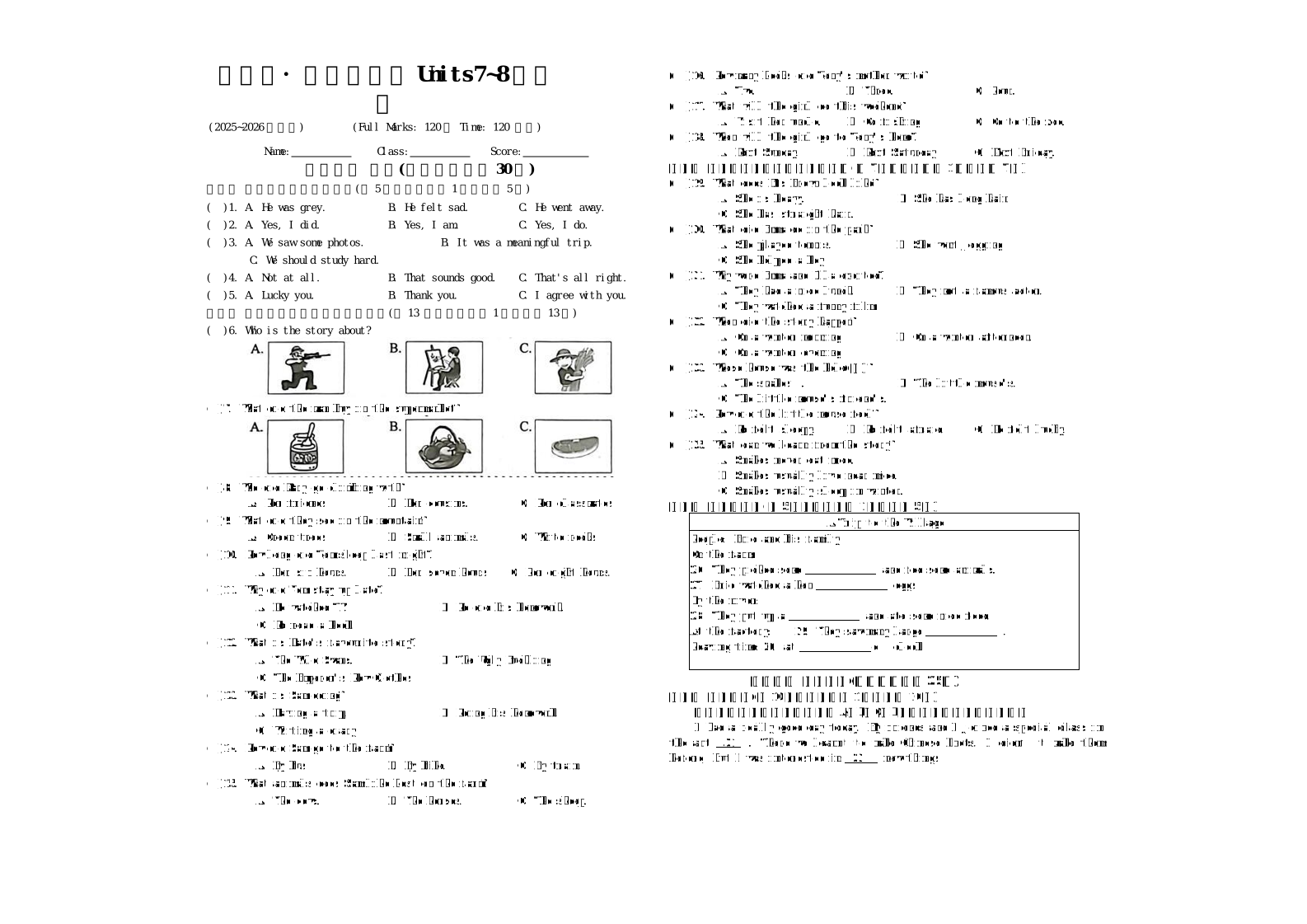
( )6. Who is the story about?
( )7. What did the man buy in the supermarket?
( )8. Who did Mary go climbing with?
A. Her friends. B. Her cousins. C. Her classmates.
( )9. What did they see in the mountain?
A. Green trees. B. Small animals. C. White rocks.
( )10. How long did Tom sleep last night?
A. For six hours. B. For seven hours. C. For eight hours.
( )11. Why did Tom stay up late?
A. He watched TV. B. He did his homework.
C. He read a book.
( )12. What is Kate's favourite story?
A. The Wild Swans. B. The Ugly Duckling.
C. The Emperor's New Clothes.
( )13. What is Sam doing?
A. Having a trip. B. Doing his homework.
C. Writing a diary.
( )14. How did Sam go to the farm?
A. By bus. B. By bike. C. By train.
( )15. What animals does Sam like best on the farm?
A. The cows. B. The horses. C. The sheep.
( )16. How many books did Tony's mother write?
A. Two. B. Three. C. Four.
( )17. What will the girl do this weekend?
A. Visit her uncle. B. Go fishing. C. Go to the zoo.
( )18. When will the girl go to Tony's home?
A. Next Sunday. B. Next Saturday. C. Next Friday.
第三节 听短文和问题,选择正确答案(共7小题;每小题1分,满分7分)
( )19. What does Mrs Brown look like?
A. She is heavy. B. She has long hair.
C. She has straight hair.
( )20. What did Emma do in the park?
A. She played tennis. B. She went jogging.
C. She helped a boy.
( )21. Why were Emma and Ella excited?
A. They had a nice lunch. B. They met a famous actor.
C. They watched a funny film.
( )22. When did the story happen?
A. On a winter morning. B. On a winter afternoon.
C. On a winter evening.
( )23. Whose house was the hole(洞)?
A. The snakes’. B. The little mouse's.
C. The little mouse's friend's.
( )24. How did the little mouse feel?
A. He felt sleepy. B. He felt afraid. C. He felt lucky.
( )25. What can we learn from the story?
A. Snakes never eat mice.
B. Snakes usually live near mice.
C. Snakes usually sleep in winter.
第四节 听短文填空(共5小题;每小题1分,满分5分)
A Trip to the Village
People: Eric and his family
On the farm:
26. They picked some and fed some animals.
27. Eric watched a hen eggs.
By the river:
28. They put up a and ate some nice food.
At the factory: 29. They saw many large .
Leaving time:30. at o’ clock
第二部分 语言运用(共两节,满分25分)
第一节 完形填空(共10小题;每小题1分,满分10分)
阅读下面短文,从每题所给的A、B、C、D四个选项中选出最佳选项。
I had a really good day today. My friends and I joined a special class in the art 31 . There we learnt to make Chinese knots. I didn’ t make them before, but I was interested in 32 new things.
When we 33 in the art room of the museum, we saw some strings(细绳) on the table. A friendly teacher 34 us how to start with a common knot called square knot(平结). It usually means the best wishes for safety and good luck.
At first, I found it really hard to follow the 35 . My strings kept getting tangled(缠结的). I felt unhappy, but the teacher was very patient(耐心的). She showed the 36 to us again and again. It was 37 for us to learn how to make square knots.
After trying many times, I 38 made my first square knot! It wasn't perfect, even a little 39 , but it was my first handicraft(手工艺品). And I 40 that mistakes are part of learning . I could become better and better after learning from these mistakes.
( )31. A. school B. factory C. theatre D. museum
( )32. A. explaining B. exploring C. tasting D. recording
( )33. A. met up B. called back C. held on D. worked out
( )34. A. ordered B. taught C. guessed D. served
( )35. A. rules B. goals C. steps D. habits
( )36. A. process B. menu C. spirit D. match
( )37. A. awful B. tiring C. boring D. difficult
( )38. A. finally B. often C. already D. hardly
( )39. A. lovely B. magical C. ugly D. bright
( )40. A. lied B. realized C. hoped D. agreed
第二节 短文填空(共15小题;每小题1分,满分15分)
阅读下面短文,在空白处填入一个适当的单词或填入括号内单词的正确形式。
Dear Wang Juan,
How are you these days? Today I'd like 41. (share) a famous love story with you.
Long ago, there was 42. beautiful girl and her name was Meng Jiangnü. When she 43. (grow) up, she married (嫁)a man named Fan Xiliang. He was one of Meng's 44. (neighbour). At that time, there were many 45. (war), and people all lived hard lives. To protect(保护) the people from danger, the46. (power) emperor wanted to build the Great Wall. His officials began to ask all young men to leave their homes and join in47. (build) the Great Wall.
After Fan left, Meng waited 48. him for many years.49. Fan didn’ t come back. So she decided50. (search) for him. However, when Meng finally came to the Great Wall, she didn't find Fan. Someone told her the 51. (true) that Fan died years ago. She didn't believe it. She cried so sadly that some parts of the Great Wall collapsed(倒塌) 52. (sudden).
Later, Meng's story spread(传播)53. (quick), and people praised Meng for her true love for her husband. Many people still like this
story today. Do you fall 54. love with it? Please tell 55. (I) what your favourite story is.
Yours,
Li Ying
第三部分 阅读(共两节,满分40分)
第一节 阅读理解(共15小题;每小题2分,满分30分)
阅读下列短文,从每题所给的A、B、C、D四个选项中选出最佳选项。
A
Helen and Jim are in Class 1, Grade 7. Today their class went on a school trip. Let's read the two students' diary entries.
Wednesday, 1 April
Today I went on a school trip. We visited the science museum and it was really interesting. We got there so fast by train. We saw some farms and villages along the way. At the museum, I learnt a lot about robots. I didn’ t know they could play chess with us. It was so cool! Then the guide(导游)taught us how to make a model robot. I took a lot of great photos too. After that, I went to the gift shop and bought some lovely gifts for my parents.They weren't expensive(昂贵的). All in all, it was an exciting day.
—— Helen
Wednesday, 1 April
I think today's school trip was terrible. We took the train to the science museum. It was so hot on the slow train. The museum was big and boring.Everything was about robots and I'm not interested in that. The rooms were really dark and it was difficult to take photos, so I didn't take any. There were also too many people and I couldn't see or hear the guide. The things in the gift shop were so expensive. I didn't like the trip at all.
—— Jim
( )56. What did Helen learn in the science museum?
A. How to take photos. B. How to become a guide.
C. How to play chess. D. How to make a model robot.
( )57. How did Jim feel about the school trip?
A. It was exciting. B. It was cool.
C. It was terrible. D. It was interesting.
( )58. What can we know from the text?
A. Helen and Jim are in Class 2, Grade 7.
B. Helen and Jim went on the same school trip.
C. Helen thought the train was slow.
D. Jim bought some lovely gifts for his parents.
B
Once upon a time, there was a monkey. He always played tricks on big animals in the mountain. But the big animals couldn't catch him because he was very small and ran very quickly.
学科网(北京)股份有限公司
One day, a flea(跳蚤) set up his new home on the monkey's back. When he was hungry, he would bite the monkey.
“I must catch you one day!” the monkey shouted. All the time, the monkey was busy catching the flea. ▲
One day, when the flea went into the monkey's nose, the monkey blew his nose quickly — he succeeded in catching the flea!
“You are really bad! I' ll punish(惩罚) you,” said the monkey.
“But I'm just like you!” said the flea.
“What? You’ re not like me!” The monkey said angrily, “You’ re small and always jump here and there.”
“Aren’ t you always jumping around really big animals, and aren’ t they angry with you?”
The monkey thought for a while, and he knew he was wrong.
( )59. Where did the flea set up his new home at first?
A. On one big animal's head. B. On the monkey's back.
C. In the monkey's mouth. D. In the monkey's nose.
( )60. Which of the following can we put in ▲ ?
A. But the flea was too small to catch.
B. He wanted to bite the flea too.
C. So the flea played games with the monkey.
D. He wanted to make friends with the flea.
( )61. What might the monkey do after hearing the flea's words?
A. He might punish the flea and kill it.
B. He might find another mountain to live in.
C. He might keep playing tricks on other big animals.
D. He might say sorry to the big animals he played tricks on.
C
Last summer holiday, I took a trip to Beijing with my brother. My brother was eighteen years old and was in Grade 9 of high school. He knew a lot about the history of Beijing. He told me a lot about it and helped me know more about Beijing and our country on this trip.
We went to the Palace Museum (故宫博物院) on the first day. We learnt more about our history. We bought some gifts there — a book for my sister, a T-shirt for my father and a bag for my mother. And we also bought some cards.
My brother was interested in universities(大学) in Beijing and wanted to study in one of them. So we visited the universities in Beijing in the next two days. We had a good time walking by the lake in Peking University.
On the fourth day, we went to the Great Wall. It was beautiful and there were a lot of people. On the fifth day, we went shopping, tasted much special food and went boating in the Summer Palace (颐和园). The sixth day was a rainy day, and we didn't go out.
We spent six days in Beijing, from 19 July to 24 July. We were very happy and got a lot from the trip.
( )62. What did the writer buy for his sister?
A. A card. B. A T-shirt. C. A book. D. A bag.
( )63. Where did the writer and his brother go boating?
A. In the Palace Museum. B. In Peking University.
C. Near the Great Wall. D. In the Summer Palace.
( )64. Which of the following is NOT true?
A. The writer knew a lot about Beijing before the trip.
B. They visited the universities in Beijing on 20 July and 21 July.
C. They saw a lot of people on the Great Wall.
D. They didn't go out on 24 July because it was rainy.
( )65. What is the best title(标题) for the text?
A. The History of Beijing B. Special Chinese Food
C. A Happy Trip in Beijing D. Good Universities in China
D
There were many plants in a forest. When spring came, a big tree saw a red rose(玫瑰) nearby and said, “What a beautiful flower!”
The rose proudly (骄傲地) said, “It seems that I am the most beautiful flower in this forest.” Then the rose looked at a cactus (仙人掌) and said,“Look at that ugly plant full of thorns(刺)!”
“What a proud flower!” thought the trees.
As the days passed, the red rose often looked at the cactus and said bad words about it, like“This plant is not useful at all. How sorry I am to be his neighbour!”
The cactus never got angry and even said, “Everything has its use in the world.”
Spring passed, and the weather became very hot. As there was no rain,the red rose began to wilt(枯萎).
One day, the rose saw birds put their beaks (喙) into the cactus and then fly away. The rose asked the big tree what the birds were doing. The big tree explained that the birds were getting water from the cactus.
“The cactus has water?” asked the rose.
“Yes, you can also drink some from it. The birds can bring water to you if you ask the cactus for help.”
The red rose felt too ashamed (羞愧的) to ask for water from the cactus. But finally it did ask for help. The cactus kindly agreed.
The rose learnt a lesson and never laughed at anyone by their looks again.
( )66. Who thought the cactus was ugly at first?
A. The rose. B. The big tree.
C. The birds. D. The thorns.
( )67. Why did the red rose begin to wilt?
A. Spring came. B. The weather became cold.
C. There was no rain. D. The cactus got angry.
学科网(北京)股份有限公司
( )68. According to the text, which is the right order of the story?
a. The rose saw birds put their beak s into the cactus.
b. The big tree praised the red rose.
c. The cactus agreed to give its water to the rose.
d. The rose laughed at the cactus.
A. b-a-d-c B. b-d-a-c C. d-a-b-c D. d-b-c-a
( )69. Which of the following best describes(描述) the cactus?
A. Proud. B. Beautiful. C. Friendly. D. Dangerous.
( )70. What can we know from the text?
A. The big tree gave the cactus a lesson.
B. The birds liked to eat the thorns of the cactus.
C. The cactus was between the big tree and the red rose.
D. The red rose realized she was wrong in the end.
第二节 阅读表达(共5小题;每小题2分,满分10分)
阅读下面短文,简略回答问题。
Long ago in China, there was a state called Qi. King Xuan of Qi loved music very much. His hobby was listening to others play a Chinese instrument called the yu. One day, he decided to find three hundred musicians(音乐家) who could play the yu. The king hoped to put them together to play wonderful music. He said he would treat them well.
A man named Nanguo did not know how to play the yu. But when he heard about that, he thought it was a good way to get delicious meals. So he found a way to join the king's band. Every time the band played for the king,Nanguo just stood there and acted like the others. No one knew he was making no sound at all. After the shows, he always enjoyed good meals with the others.
But the good times didn't last long. The king died later and his son became King Min. Although King Min also liked listening to the yu, he wanted something different. Guess what? He ordered the musicians to play the yu one by one instead of playing together.
When Nanguo heard the news, he was afraid. He knew he couldn't cheat(欺骗) others any more, so he ran away quickly.
71. How many musicians were there in King Xuan's band?
72. Why did Nanguo want to join the band?
73. What did King Min order the musicians to do?
74. What did Nanguo do in the end?
75. 开放性设问 What can you learn from the story?
第四部分 情景交际(满分10分)
补全对话(共5小题;每小题2分,满分10分)
根据下面的对话情景,在空白处填入一个适当的句子,使对话的意思连贯、完整。
Carol: Welcome to my home, Mike.
Mike: Thanks, Carol. 76.
Carol: Our school trip was tiring but great fun!
Mike: Did you go to the mountains?
Carol: 77. We went to a farm.
Mike: Really? What did you do there?
Carol: First, we cut branches and leaves from the tomato plants.
Mike: 78.
Carol: The farmer told us that helps the plants to grow more tomatoes.
Mike: Oh, I see. What did you do then?
Carol: 79. Would you like to taste them? The farmer let us take some strawberries home.
Mike: 80. Thank you.
第五部分 写作(满分 15分)
书面表达
81.假如你是李华,你的英国笔友 Lisa来信说她最近正在学习汉语,在学习过程中遇到“程门立雪”这一成语,不解其意。请你根据下面的提示,用英语给她回信,简要叙述这个成语故事,并谈谈自己的理解和感悟。
注意:(1)语言规范,语句通顺,可适当发挥;
(2)词数70个左右(开头和结尾已给出,不计入总词数)。
参考词汇: idiom成语;during the Northern Song Dynasty 北宋时期;have a nap 小憩;wake up 醒来;moved感动的;trouble 打扰
Dear Lisa,
I'm glad to hear from you. In your letter, you say you don't understand the meaning of the idiom“Cheng Men Li Xue”. Now let me tell you the story about it.
Yours,
Li Hua
月考卷 Units 7~8检测题参考答案
第一部分
第一节1-5 BACBC
第二节 6-9 ABBC 10-12 BCA 13-15 CBC 16-18 CAB
第三节 19-21 CAB 22-25 BABC
第四节26. cucumbers 27. lay 28. tent 29. machines 30. five/5
第二部分
第一节31-35 DBABC 36-40 ADACB
第二节41. to share 42. a 43. grew 44. neighbours 45. wars
46. powerful 47. building 48. for 49. But 50. to search 51. truth
52. suddenly 53. quickly 54. in 55.me
第三部分
第一节56-58DCB 59-61 BAD 62-65 CDAC 66-70ACBCD
第二节 71. Three hundred/300.
72. Because he thought it was a good way to get delicious meals.
73. He ordered them to play the yu one by one instead of playing together. 74. He ran away quickly.
75. We should always be a person of real learning and we shouldn't cheat others.(言之有理即可)
第四部分
76. How was your school trip? 77. No, we didn’ t.
78. Why did you do that? 79. We picked some strawberries.
80. Yes,I'd like/ love to.(答案不唯一)
第五部分
81. One possible version:
Dear Lisa,
I'm glad to hear from you. In your letter, you say you don't understand the meaning of the idiom“Cheng Men Li Xue”. Now let me tell you the story about it.
During the Northern Song Dynasty, there was a famous teacher called Cheng Yi. One day, two young men came to the teacher's house to learn from him. One of them was Yang Shi. It was snowy and the teacher was having a nap. The other man said,“Let’ s go inside and ask the teacher for help.” But Yang Shi said, “No, the teacher is having a nap. We should wait outside.”
After some time, the teacher woke up. When he found the two young men standing outside in the big snow, he was moved and asked them to come in. Yang Shi said,“I'm sorry to trouble you.”
The story tells us that we should be polite and respect our teachers.I hope it can help you!
Yours,
Li Hua
学科网(北京)股份有限公司
$
资源预览图
1
2
相关资源
由于学科网是一个信息分享及获取的平台,不确保部分用户上传资料的 来源及知识产权归属。如您发现相关资料侵犯您的合法权益,请联系学科网,我们核实后将及时进行处理。