山东省青岛市胶州市2026年九年级第二次模拟考试英语试题
 切换试卷
切换试卷
2026-05-19
|
13页
|
294人阅读
|
11人下载
资源信息
| 学段 | 初中 |
|---|---|
| 学科 | 英语 |
| 教材版本 | - |
| 年级 | 九年级 |
| 章节 | - |
| 类型 | 试卷 |
| 知识点 | - |
| 使用场景 | 中考复习-二模 |
| 学年 | 2026-2027 |
| 地区(省份) | 山东省 |
| 地区(市) | 青岛市 |
| 地区(区县) | 胶州市 |
| 文件格式 | DOCX |
| 文件大小 | 1.15 MB |
| 发布时间 | 2026-05-19 |
| 更新时间 | 2026-05-19 |
| 作者 | 匿名 |
| 品牌系列 | - |
| 审核时间 | 2026-05-19 |
| 下载链接 | https://m.zxxk.com/soft/57935954.html |
| 价格 | 1.00储值(1储值=1元) |
| 来源 | 学科网 |
摘要:
**基本信息**
聚焦真实情境与思维能力,整合语言运用与文化理解,适配中考二模综合评估需求
**题型特征**
|题型|题量/分值|知识覆盖|命题特色|
|----|-----------|----------|----------|
|书面表达|1/15|应用文写作、观点表达|结合科技前沿情境,考查语言组织与批判思维,体现语言能力与思维品质|
|阅读理解|4/40|细节理解、推理判断|选用中外文化对比素材,强化跨文化认知,提升文化意识与信息整合能力|
内容正文:
九年级英语
(考试时间:100分钟;满分:90分)
友情提示:Hi,亲爱的同学,欢迎参加本次考试,祝你答题成功!
本试卷由第Ⅰ卷和第Ⅱ卷两部分组成。第Ⅰ卷为选择题,包含完形填空和阅读理解;第Ⅱ卷为非选择题,包含综合填空、阅读表达和书面表达。所有题目均在答题卡上作答,在试题上作答无效。
第Ⅰ卷(满分40分)
Ⅰ.完形填空(共10小题,每小题1分,共10分)
阅读下面短文,从每题所给的A、B、C、D四个选项中选出可以填入空白处的最佳选项。
Lynn and Len Richards once saved a baby kangaroo. They 1 her as their pet and gave her the name Lulu. The little kangaroo soon became part of their family. When Lulu was about four years old, a terrible storm hit their farm and caused a lot of 2 .
After the storm, Len noticed a large broken branch (树枝) hanging 3 high in a tall tree. It was much too big and high for him to take down alone. He checked the branch carefully but could not move it at all, so he decided to fix it later when he had better 4 .
Suddenly, the heavy branch fell and hit Len on the head. He fell to the ground and blacked out at once. Lulu quickly noticed that Len was seriously hurt. 5 kangaroos usually stay quiet, she cried loudly for about 15 minutes to call for help.
Hearing the strange noise, Lynn 6 to the place. Len’s relative Brendan also ran quickly and arrived first. They were greatly surprised to see Lulu standing 7 Len’s head, still making loud noises.
Len was foaming (吐白沫) at the mouth and in great danger. If he lay on his back, he couldn’t 8 . However, Lulu used her strong feet to make him on his side, keeping him 9 until help arrived.
No one knows 10 Lulu learned to do this, but her quick and clever action saved Len’s life. This true story shows us the deep friendship and love between humans and animals, and makes it clear that kindness to animals is always returned.
1. A. realized B. praised C. fed D. created
2. A. process B. trouble C. mystery D. list
3. A. completely B. simply C. bravely D. dangerously
4. A. tools B. signs C. doubts D. invitations
5. A. Until B. Because C. If D. Although
6. A. separated B. rushed C. canceled D. kicked
7. A. above B. on C. beside D. under
8. A. breathe B. smell C. cough D. blow
9. A. safe B. caring C. painful D. valuable
10. A. whose B. how C. what D. which
Ⅱ.阅读理解(共20小题,每小题1.5分,共30分)
阅读A、B、C三个文本,从每题所给的A、B、C、D四个选项中,选出最佳选项。
A
Project: The “Broken” Straw Mystery
Project Background
Sunshine Middle School organizes a science activity about light. Students will find out why a straw looks broken in water. Sun Jie is the leader of a five-member team. They make a good plan and work together to finish the project.
Team Project Plan (4 steps)
Step
Tasks
Member
1
Prepare experiment materials, such as a glass, clean water, and a straw.
Li Hua
2
Do the experiment, watch carefully and record what they see.
Wang Lin
3
Study the experiment and explain how light works in this case.
Zhang Na
4
Organize all information and finish the final project report.
Sun Jie & Zhao Yang
Experiment Principle
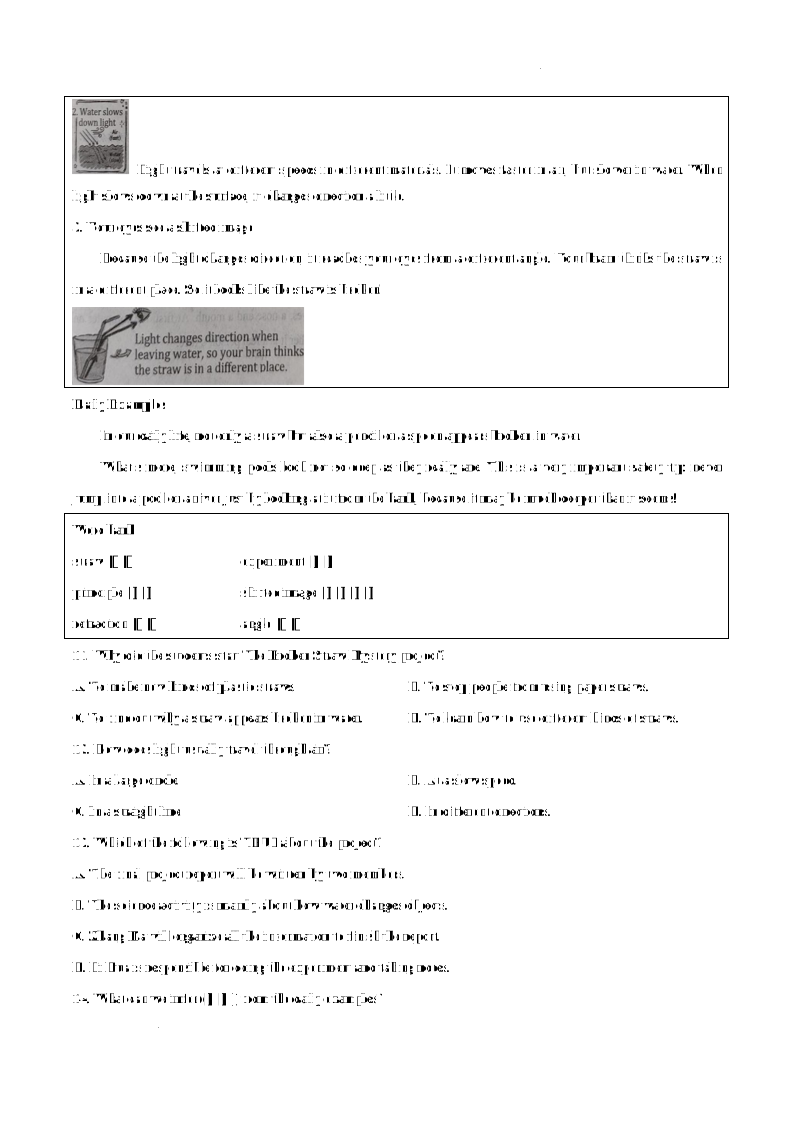
Why Does a Straw Look Broken in Water?
Light usually travels in straight lines through the air. This is how we normally see objects clearly.
Light travels at different speeds in different materials. It moves faster in air, but slower in water. When light slows down at the surface, it changes direction a little.
3. Your eyes see a shifted image
Because the light changes direction, it reaches your eyes from a different angle. Your brain thinks the straw is in a different place. So it looks like the straw is broken!
Daily Examples
In our daily life, not only a straw but also a pencil or a spoon appears broken in water.
What’s more, swimming pools look not so deep as they really are. This is a very important safety tip: never jump into a pool or a river just by looking at it from the bank, because it may be much deeper than it seems!
Word bank
straw 吸管 experiment 实验
principle 原理 shifted image 位移现象
refraction 折射 angle 角度
11. Why did the students start The Broken Straw Mystery project?
A. To make new kinds of plastic straws. B. To stop people from using paper straws.
C. To find out why a straw appears broken in water. D. To learn how to use different kinds of straws.
12. How does light usually travel through air?
A. In a large circle. B. At a slow speed.
C. In a straight line. D. In different directions.
13. Which of the following is TRUE about the project?
A. The final project report will be written by two members.
B. The science activity is mainly about how water changes objects.
C. Zhang Na will organize all the information to finish the report.
D. Li Hua is responsible for doing the experiment and taking notes.
14. What can we infer (推断) from the daily examples?
A. Swimming in cold water is good for our eyes.
B. We can often see things clearly in clean water.
C. Our eyes can tell us the real depth of water quickly.
D. Swimming pools look less deep than their real depth.
15. We can’t make sure the real positions of the fish in the water. Why does this happen?
A. Light travels in straight lines in the water.
B. Fish swim too fast to show their real positions.
C. Our eyes can’t see things clearly in bright water.
D. Light changes direction when moving from water to air.
B
People who teach and encourage us are our greatest heroes. For Jim Abbott, his heroes were his teacher and parents. They taught him to work hard, think creatively, and be brave. These lessons helped him reach the Major Leagues (职业棒球大联盟) in baseball.
Jim Abbott was born without a right hand. When he was young at school, he felt upset when his shoelaces (鞋带) became untied. Other children often laughed at him, and he had to ask teachers for help.
One day, his third-grade teacher showed him a special way to tie shoelaces with only one hand. The teacher practiced with him many times until Jim could do it himself. Jim felt so proud.
That day, Jim learned an important lesson: he could solve difficult problems with creativity and hard work. So he decided to play baseball, even though some people thought it was impossible.
Jim also had very supportive parents. With his father’ help, he invented a way to throw and catch. He put his glove on his right arm, threw the ball, and then quickly moved the glove to his left hand to catch. He practiced for hours every day. His hard work paid off. In 1988, Jim became a Major League pitcher (投手). He played so well that the other team could not get any hits.
Now, Jim wants to help other children. He spends a lot of time talking and writing to kids with disabilities. He tells them: with courage, creativity and hard work, anything is possible.
16. Why did Jim feel upset when his shoelaces became untied?
A. Because his teacher didn’t help him.
B. Because he was afraid of losing his shoes.
C. Because he couldn’t tie them with only one hand.
D. Because this would make him lose the baseball game.
17. What did Jim’s teacher and parents do for him?
① Asked the teachers for help.
② Taught him to tie shoelaces with one hand.
③ Helped him invent a way to throw and catch a baseball.
④ Practiced with him to learn independently.
A. ①②③ B. ①②④ C. ①③④ D. ②③④
18. Which can explain how Jim played baseball with one hand?
A. His teacher and parents always encouraged him to be creative.
B. He played so well that the other team could not get any hits.
C. He kept trying and finally became a successful baseball pitcher.
D. He put the glove on his right arm and then moved it to his left hand.
19. What does the sentence “His hard work paid off” mean?
A. His hard work made him tired. B. His hard work got good results.
C. He spent much money on baseball. D. He didn’t need to work hard anymore.
20. Tom is a one-armed boy and wants to learn swimming. What can he learn from Jim?
A. Think too much about others’ opinions of his swimming.
B. Keep trying and find his own proper way to swim well.
C. Depend on others for help with swimming practice.
D. Follow old ways and seldom try new swimming skills.
C
These days, a new trend (潮流) is sweeping across China: young people visit museums not only to enjoy ancient cultural treasures, but also for tasty and cheap meals in museum canteens (便民餐厅). This mix of art and daily life is very popular among teenagers and young adults.
Visiting a large museum often takes hours and makes people tired and hungry. In the past, visitors had few good food choices. Some museums only sold expensive snacks, and if they left to eat, they had to enter again or even buy a new ticket. Now many museums have opened canteens to solve this problem.
Young people love these canteens for two main reasons. First, the food is affordable and delicious. Sichuan Museum offers local dishes from 3 to 12 yuan, and Anhui Museum’s set meal costs less than 30yuan.The food is clean, healthy and full of local tastes. Second, the food is connected with culture. Many museums make special dishes with cultural elements (元素). Hebei Museum has noodles shaped like the Changxin Palace Lantern, and Hunan Museum sells cute cakes like ancient bronze objects (青铜器). They are great for photos and online sharing.
Opening canteens also helps museums develop better. The cheap food makes museums more friendly to common people, making visitors stay 1.5 to 2.5 hours longer. Many local people come to eat and visit the exhibitions (展览), becoming new museum fans. Museums turn from quiet places into warm cultural spaces.
Of course, this trend brings small problems such as long lines and more cleaning work. Museums are solving them with online ordering and more seats. Experts say food services will not weaken museums’ cultural role, as long as museums put culture first and use food as a nice part. This creative way helps more people fall in love with culture and history easily.
21. Why do many museums open canteens?
A. To sell expensive local snacks. B. To take the place of all outside restaurants.
C. To make more money from food sales. D. To meet visitors’ need for food during visits.
22. Which is the correct order of the change of museums?
① Museums become warm cultural spaces.
② Museums open cheap and cultural canteens.
③ Visitors stayed longer in museums.
④ Visitors feel tired and hungry with no good food choices.
A. ②③④① B. ④②③① C. ③②④① D. ④③②①
23. What do experts think of food services in museums?
A. They bring too many problems for museums.
B. They are good if museums still put culture first.
C. They make museums lose their main cultural role.
D. They are more important than museum exhibitions.
24. What is the writer’s purpose in writing this passage?
A. To tell people not to eat in museums.
B. To teach people how to cook cultural food.
C. To show how to visit museums more safely.
D. To introduce a new trend of museum canteens.
25. What should museums do to develop better according to the passage?
A. Close the canteens to protect cultural treasures.
B. Put culture first and run good canteens properly.
C. Make food the most important part of museums.
D. Ask visitors to buy new tickets when they go out to eat.
D
阅读下面短文,从短文后的选项中选出能填入空白处的最佳选项。选项中有一项为多余选项。
Face recognition (识别) is an amazing technology that helps computers tell people’s faces apart. We can use this technology in many different places.
26
How Does a Machine Learn to Recognise You?
Step 1: Finding a Face
The camera looks for basic parts of a face — two eyes, a nose and a mouth. At first, the computer only finds a shape that looks like a face. It doesn’t know whether it is a real person’s face.
Step 2: Mapping Facial Features (特点)
Once a face is found, the system carefully checks the key features. It studies how far the two eyes are apart, where the nose is, and how the mouth looks. All these form a person’s information. 27
Step 3: Turning Faces into Data (数据)
After your key features turn into numbers, the face becomes a set of data. Computers are good at processing numbers, so this data of your face is stored on the machine or compared with a large database (数据库). 28
Step 4: Learning with AI
With the help of AI technology, the computer studies thousands of face photos. 29 Smiling, wearing glasses or growing older will not fool the system.
Step 5: Matching and Decision-Making
Instead of giving a direct yes or no, the system provides a similarity score. A high enough score means a successful match, allowing your phone to unlock or letting you enter.
Today, face recognition is widely used to unlock phones and organize photos. Airports also use it to check important lists. 30 Luckily, scientists and engineers are trying hard to improve it. They hope to make it safer and more useful for everyone.
A. It can tell how people feel from their faces.
B. However, the technology still has some problems.
C. It slowly learns which parts of the face never change.
D. For example, we can see it from smartphones to airport safety systems.
E. If the new data matches the saved one, the system knows who you are.
F. The information is turned into numbers, creating a special “faceprint” for each person.
第Ⅱ卷(满分50分)
Ⅲ.短文填空。(本题10小题,每小题1.5分,共15分)
阅读下面短文,在空白处填入1个适当的单词或括号内单词的正确形式。
In Zhangjiajie, Hunan province, there is a special art called sandstone painting. It is different from traditional paintings. These works look rough (粗糙的) and thick. Artists make them with local natural materials 31 sand stones, bamboo covers and tree bark (树皮).
In 1986, Kong Jingping and her partner Li Junsheng saw a worker putting colored stone pieces on the wall in Dunhuang. While they 32 (look) at the wall paintings, they got the idea for this special art. They tried using sand and stones to create this art. 33 the work was difficult at first, after many tests, their special and creative works soon became popular in Changsha.
Making sandstone paintings 34 (mean) “Using hands instead of brushes”. Drawing real people takes six months. Artists use small stones to show details (细节), such as an old 35 (woman) kind eyes in a painting.
Their 1988 trip to Zhangjiajie was a turning point. Loving 36 (it) beautiful mountain s and sea of clouds, they decided to show this scenery (景色) through sandstone paintings. They developed a special strong adhesive (粘合剂) to make the works 37 (strong) and longer-lasting. With this key improvement, their art changed from simple tourist gifts into valuable collectible art.
In 1992, their paintings became famous around the world. They 38 (sell) to the US, Japan, South Korea and many other countries, and 39 (gradual) turned into an important cultural symbol of Zhangjiajie. Later, they worked on their sandstone paintings in Zhangjiajie.
Today, they still keep on creating new works, and work with other artists to improve this special art. They 40 (share) the beauty of sandstone paintings with more people around the world in the future. They hope more people will love this special art form.
Ⅳ.阅读表达(本题9小题,共20分)
A
阅读下面文本,完成41至43小题。(共9分)
Xujiadai, a small village in Zhejiang Province, has become China’s most famous baseball village by holding over 100 baseball and softball games. It sets a wonderful example of using sports to push forward rural revitalization (乡村振兴), turning the quiet village into a lively and hopeful place with just one creative idea.
Ten years ago, most villagers made a living by keeping pigs. The environment was polluted, and the village couldn’t develop well.
Everything changed in 2017, when Liu Jianqun became the village Party secretary (党支部书记). He wanted to find a new way to improve the village. Liu found a great chance: Many business people loved baseball, but they had no nearby field. At the same time, the village had some empty land. So he came up with a brave plan — to build a baseball field there.
The first field was completed in 2018 and soon held its first big game. To everyone’s surprise, baseball became very popular. As the village became well-known, it held more top-level games. A new international baseball stadium (体育场) opened in 2025, making it possible to host great competitions for both young and adult players.
Baseball has brought great changes to Xujiadai. As more visitors come to watch baseball games, the income of the village has risen greatly, from 1.3 million yu an in 2018 to more than 6.9 million yuan in 2024.The village has built a new industry chain. It covers sports, tourism, food and farm picking. As a result, it provides over 500 jobs for local people every year. Baseball is now part of local daily life. For example, the village has a youth baseball team named the”Little Dragons”. The team has won many prizes and even took second place in an international competition.
Today, Xujiadai shows the world that with clear goals and hard work, a small village can achieve great success.
41. Finish the mind map. No more than 2 words for each blank.(5分)
42. What changes has baseball brought to Xujiadai?(每条不超过8个单词,2分)
①Th e income of the village has risen greatly.
②__________________________________________③__________________________________________
43. What can you learn from Xujiadai’s story?(2分)
__________________________________________________________________________________________
B
阅读下面文本,完成44至48小题。(共11分)
The students in the Science Club learned about the solar system in class. They were really excited about the planets and stars. After class, they finished a project on space — making a class book together. Here’s part of it.
Our Amazing Solar System (太阳系)
Contents (目录)
1. Fun facts ……………………………………….1
2. Sun’s energy ……………………………………5
3. Our exploration…………………………………8
4. Love for space………………………….…....12
5. Ways to protect our Earth................................16
The solar system is full of amazing facts! It’s made up of the sun and everything that travels around it, including eight planets. The sun is a huge, hot star at the center, giving us light and heat. The eight planets go around the sun in order. Earth is the third planet from the sun. It is our home and the only known planet with life. Mercury (水星) is the closest to the sun, and Neptune (海王星) is the farthest. Unlike Earth, some planets do not have a hard surface.
—1—
Last weekend, we went to visit the Space Museum together. Our teacher told us a lot about space life.
There is almost no gravity in space. Everything seems weightless and does not fall down. Astronauts can even fly around freely. Astronauts eat special food and exercise everyday. They work hard and explore space bravely.
We were all deeply moved by the astronauts. We decided to study hard and learn more about the amazing space.
—?—
Chinese people have a deep love for the sky. In ancient times, people watched the sun and stars carefully. They created the 24 solar terms (节气). They also created many beautiful traditional stories, such as Chang’e flying to the moon.
Today, China has made great achievements in space. We built the Tiangong Space Station, finished Mars exploration and sent many satellites (卫星) into space.
Space connects the past and the present. Chinese people always keep active and never stop studying nature and space.
—12—
44. Look at the picture of the solar system. What planets are they?(只填写字母代号)(3分)
A. Mercury B. Neptune C. Earth
①__________________
②__________________
③__________________
45. What does the word “gravity” mean in Chinese?(2分)
__________________________________________________________________________________________
46. On which page can you find information about students’ experience?(1分)
__________________________________________________________________________________________
47. If you are in the Science Club, which way will you write on page 16?(写出一种即可)(2分)
__________________________________________________________________________________________
48.根据短文内容填空。(每空不超过2个单词,共3分)
Chinese people show great love for the sky. The 24 solar terms and many beautiful traditional stories ① by ancient people. Today, China has made great progress in space, such as ② the Tiangong Space Station. Space is like a ③ between the past and the present. Chinese people never give up learning about nature and space.
Ⅴ.书面表达(15分)
我校英文刊物《青春之声》新开设了“故事与成长”专栏,面向全体同学征集稿件。下面是征稿内容,请按要求为该专栏写一篇文章。
One day, our class planned to climb a mountain. At first, all of us were excited. But halfway up, some students felt tired and wanted to go back. My partner Li Hua kept walking and encouraged everyone to move on. We cheered each other on and finally reached the top together. The beautiful view at the top made all of us happy and proud.
1.读了这个故事你有什么感悟?请结合故事简要说明。
2.叙述一段你自己的亲身经历来体现上述感悟。
要求:
(1)包含所有要点,可适当发挥;
(2)文中不得出现真实姓名、校名;
(3)词数80-100.
From the story, we learn that __________________________________________________________________________________________________________________________________________________________________________________________________________________________________________________________________________________________________________________________________________________
________________________________________________________________________________________________________________________________________________________________________________________
学科网(北京)股份有限公司
$
资源预览图

1

2
3

相关资源
由于学科网是一个信息分享及获取的平台,不确保部分用户上传资料的 来源及知识产权归属。如您发现相关资料侵犯您的合法权益,请联系学科网,我们核实后将及时进行处理。