江苏省南京市2025~2026学年初三下学期中考英语考前冲刺卷1(南京专用)
2026-05-17
|
17页
|
80人阅读
|
4人下载
资源信息
| 学段 | 初中 |
|---|---|
| 学科 | 英语 |
| 教材版本 | - |
| 年级 | 九年级 |
| 章节 | - |
| 类型 | 试卷 |
| 知识点 | - |
| 使用场景 | 同步教学-期中 |
| 学年 | 2026-2027 |
| 地区(省份) | 江苏省 |
| 地区(市) | 南京市 |
| 地区(区县) | - |
| 文件格式 | DOCX |
| 文件大小 | 17.96 MB |
| 发布时间 | 2026-05-17 |
| 更新时间 | 2026-05-17 |
| 作者 | CuiEnglish |
| 品牌系列 | - |
| 审核时间 | 2026-05-17 |
| 下载链接 | https://m.zxxk.com/soft/57907188.html |
| 价格 | 0.50储值(1储值=1元) |
| 来源 | 学科网 |
摘要:
**基本信息**
这份中考冲刺卷以太阳能公路、无人机配送等科技前沿,苗族刺绣文化传承及海洋保护等社会热点为情境,融合语言能力与思维品质,适配初三期中复习需求。
**题型特征**
|题型|题量/分值|知识覆盖|命题特色|
|----|-----------|----------|----------|
|单项填空|15题/15分|时态、非谓语、介词等语法|科技情境中考查基础语言知识|
|完形填空|10题/20分|词汇辨析、上下文理解|环保主题培养逻辑推理能力|
|阅读理解|13题/13分|细节查找、推理判断|多元话题提升信息获取与思维品质|
|书面表达|1题/15分|观点表达、建议提出|生活技能主题促进批判性思维与表达能力|
内容正文:
江苏省南京市2025~2026学年初三下学期英语中考
考前冲刺卷1(南京专用)
满分:90分 考试时间:90分钟
一、单项填空(共15小题;每小题1分,满分15分)
A) 共5小题;每小题1分,满分5分
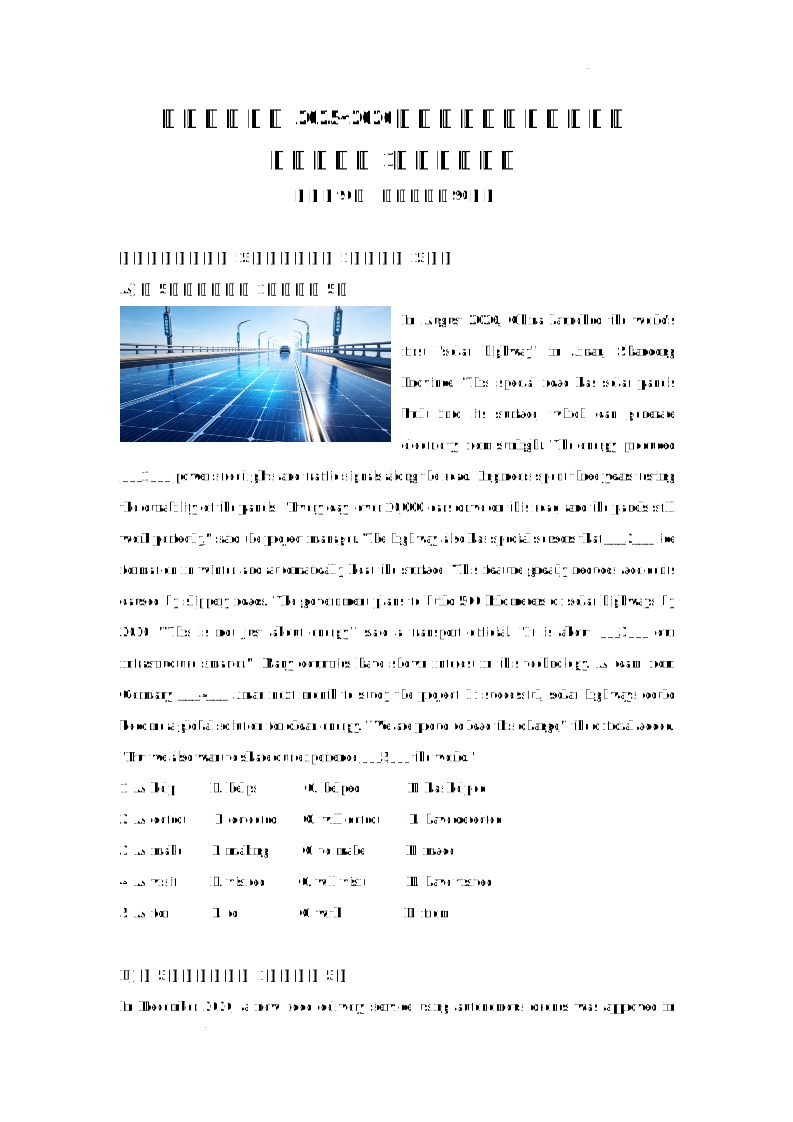
In August 2026, China launched the world's first "solar highway" in Jinan, Shandong Province. This special road has solar panels built into its surface, which can generate electricity from sunlight. The energy produced ___1___ power streetlights and traffic signals along the road. Engineers spent three years testing the durability of the panels. "Every day, over 10,000 cars drive on this road, and the panels still work perfectly," said the project manager. The highway also has special sensors that ___2___ ice formation in winter and automatically heat the surface. This feature greatly reduces accidents caused by slippery roads. The government plans to build 500 kilometers of solar highways by 2030. "This is not just about energy," said a transport official. "It is about ___3___ our infrastructure smarter." Many countries have shown interest in this technology. A team from Germany ___4___ Jinan next month to study the project. If successful, solar highways could become a global solution for clean energy. "We are proud to lead this change," the official added. "But we also want to share our experience ___5___ the world."
1. A. help B. helps C. helped D. has helped
2. A. detect B. detected C. will detect D. have detected
3. A. make B. making C. to make D. made
4. A. visit B. visited C. will visit D. have visited
5. A. for B. to C. with D. from
B) 共5小题;每小题1分,满分5分
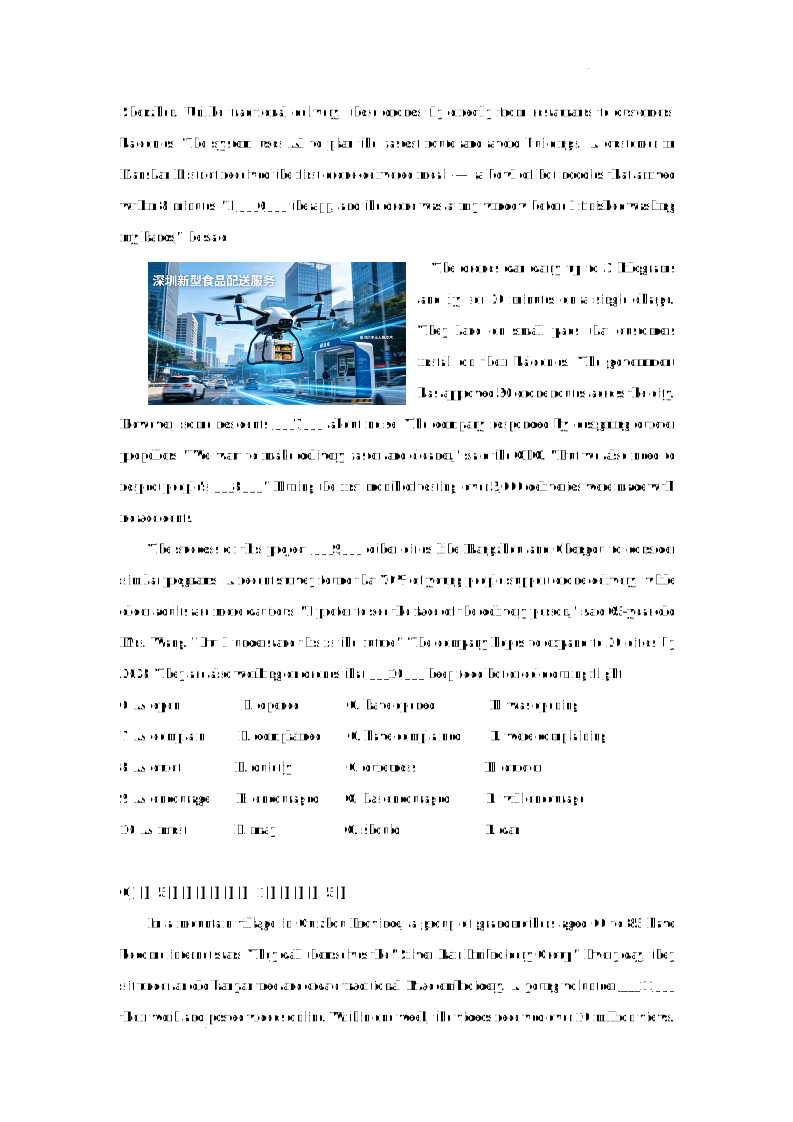
In December 2026, a new food delivery service using autonomous drones was approved in Shenzhen. Unlike traditional delivery, these drones fly directly from restaurants to customers' balconies. The system uses AI to plan the fastest route and avoid buildings. A customer in Nanshan District received the first drone-delivered meal — a bowl of hot noodles that arrived within 8 minutes. "I ___6___ the app, and the drone was at my window before I finished washing my hands," he said.
The drones can carry up to 3 kilograms and fly for 30 minutes on a single charge. They land on small pads that customers install on their balconies. The government has approved 50 drone routes across the city. However, some residents ___7___ about noise. The company responded by designing quieter propellers. "We want to make delivery faster and cleaner," said the CEO. "But we also need to respect people's ___8___." During the first month of testing, over 5,000 deliveries were made with no accidents.
The success of this project ___9___ other cities like Hangzhou and Chengdu to consider similar programs. A recent survey found that 70% of young people support drone delivery, while older adults are more cautious. "I prefer to see the face of the delivery person," said 65-year-old Mrs. Wang. "But I understand this is the future." The company hopes to expand to 20 cities by 2028. They are also working on drones that ___10___ keep food hot or cold during flight.
6. A. open B. opened C. have opened D. was opening
7. A. complain B. complained C. have complained D. were complaining
8. A. quiet B. quietly C. quietness D. quieter
9. A. encourage B. encouraged C. has encouraged D. will encourage
10. A. must B. may C. should D. can
C) 共5小题;每小题1分,满分5分
In a mountain village in Guizhou Province, a group of grandmothers aged 60 to 85 have become internet stars. They call themselves the "Silver Hair Embroidery Group." Every day, they sit under an old banyan tree and create traditional Miao embroidery. A young volunteer ___11___ their work and posted videos online. Within one week, the videos received over 10 million views. "I ___12___ never imagined people so far away would like our patterns," said 72-year-old Grandma Yang. The money from selling their embroidery pieces now supports the entire village. They have built a small school and a clinic. "We ___13___ just sit and wait for help," said another grandmother. "We can help ourselves."
The group now has over 50 members. They teach young girls in the village the ancient skills. "If we don't pass this on, it ___14___ disappear," Grandma Yang said. The local government has provided them with a workshop and better materials. Tourists come from big cities to watch them work and buy their products. "These grandmothers taught us that age is not a limit," said a visitor. "They turned their hobby into a movement." The group has been invited to show their work at a museum in Beijing next spring. "We are nervous but excited," said Grandma Yang. "Our needles are small, but our dreams ___15___ big."
11. A. film B. filmed C. has filmed D. was filming
12. A. do B. did C. have D. had
13. A. can B. may C. could D. must
14. A. will B. would C. should D. must
15. A. is B. am C. are D. be
二、完形填空(共10小题;每小题2分,满分20分)
Last spring, I joined a three-week ocean conservation program in Hainan Province. Our mission was to restore coral reefs damaged by rising sea temperatures. When I first put on my diving gear, I was ___16___ by the beauty below the surface. Colorful fish swam among broken coral pieces. But our instructor pointed to the white, dead coral. "This was alive two years ago," she said sadly.
We split into teams of four. My team was responsible for planting young coral onto special frames. The work was ___17___ — we had to hold our breath for long periods while tying tiny coral pieces to metal structures. The first week, I failed many times. My fingers were too clumsy, and the current kept pushing me away.
The most ___18___ moment came on the tenth day. While planting near a large rock, I saw a sea turtle trapped in an old fishing net. It was struggling weakly. My teammate signaled me to stay back, but I swam closer. Together, we carefully cut the net with special scissors. The turtle swam away slowly, turning its head as if to say thank you. We all cheered through our breathing tubes.
Not every day was exciting. Most days were filled with small, repetitive tasks: cleaning algae off frames, recording data, checking water temperatures. But our instructor taught us that these small actions ___19___. "A reef is built by millions of tiny polyps working together," she said. "You are the polyps now."
On our last day, we visited a reef that had been restored five years ago. It was full of life — clownfish, groupers, even a small shark. "This is what you are working for," she said. "You may not see the results tomorrow. But someone will."
Since returning home, I have made changes. I stopped using sunscreen that harms coral. I joined a local beach cleanup group. I also started a ___20___ club at my school where we discuss ocean issues. It is not much, but it is something.
That program changed how I see the world. I used to think environmental problems were too big for one person. Now I know that every action ___21___, no matter how small. The ocean is vast, but it is also fragile. It needs all of us.
Before we left, our instructor shared one final lesson: "The ocean does not need us. We need the ocean." I will never ___22___ those words. Whenever I am about to throw away a plastic bottle, I ___23___ and find a recycling bin instead.
I still keep the small coral-shaped medal they gave me. It reminds me of the turtle, the polyps, and the ___24___ of patience. I am now planning to study marine biology in university. My parents were surprised at first, but they support me. "You found your passion," my mother said. "That is worth more than any grade."
The ocean gave me a purpose. I hope one day I can give something back to it. Not everyone can dive and plant coral. But everyone can ___25___ something — even if it is just using less plastic. That is the real lesson.
16. A. scared B. amazed C. bored D. worried
17. A. easy B. relaxing C. challenging D. dangerous
18. A. forgettable B. unforgettable C. useless D. hopeless
19. A. fail B. count C. sleep D. die
20. A. cooking B. reading C. cleaning D. discussion
21. A. matters B. ends C. hurts D. disappears
22. A. remember B. forget C. repeat D. understand
23. A. plan B. try C. stop D. continue
24. A. speed B. noise C. value D. color
25. A. take B. break C. lose D. change
三、阅读理解(共13小题;每小题1分,满分13分)
A
BEIJING UNDERGROUND FARM
Opened in September 2026, this is the world's first commercial farm built inside an abandoned subway station. The farm grows fresh vegetables using LED lights and water recycling technology.
Location: Former Line 8 platform, Dongdaqiao Station, Beijing (entrance at Exit C)
Opening Hours:
- Farm tour: 10:00 – 18:00 (Tuesday to Sunday, closed Monday)
- Volunteer farming: 15:00 – 17:00 (daily, must book online)
Admission:
- Regular tour: ¥50 (adults), ¥25 (children under 12)
- Volunteer farming: free (you keep what you harvest)
What You Can Do:
- Pick your own lettuce, tomatoes, and strawberries
- Learn about vertical farming technology
- Buy fresh produce at the underground market (open 16:00 – 19:00)
Rules:
- No touching of the LED lights.
- Wear the provided shoe covers.
- Children under 10 must be accompanied by an adult.
Contact: www.beijingundergroundfarm.cn or call 010-6633XXXX
26. When can you take a regular tour of the farm?
A. At 2:00 p.m. on Monday. B. At 11:00 a.m. on Wednesday.
C. At 7:00 p.m. on Friday. D. At 9:00 a.m. on Sunday.
27. How much does it cost for a 10-year-old child to take a regular tour?
A. Free. B. ¥25. C. ¥50. D. ¥75.
28. Where would you most likely see this text?
A. In a city travel guide. B. In a history textbook.
C. On a weather forecast. D. In a sports magazine.
B
Have you heard of "sound healing"? It is an ancient practice that has become very popular in Chinese cities since 2025. The idea is simple: certain sounds and vibrations can help reduce stress, improve sleep, and even relieve physical pain. Special "sound baths" use instruments like singing bowls, gongs, and tuning forks.
Scientists have studied sound healing for many years. Research from Fudan University in 2026 followed 300 people with anxiety disorders. Half of them attended weekly sound bath sessions for three months. The other half received no treatment. The results showed that the sound bath group reported 45% lower anxiety levels and better sleep quality.
But how does it work? Dr. Lin, a neuroscientist at Peking University, explains that sound vibrations can affect our brain waves. When we hear slow, rhythmic sounds, our brain shifts from "beta" waves (active thinking) to "alpha" and "theta" waves (relaxation and meditation). This change can lower heart rate and reduce stress hormones.
However, sound healing is not a cure for serious medical conditions. "It is a complementary tool, not a replacement for medicine," says Dr. Lin. "If you have depression or chronic pain, you should still see a doctor."
Many people in China have embraced sound healing as a way to escape their busy lives. "I sit in front of a computer for 10 hours a day," says Ms. Wang, a 28-year-old office worker in Shanghai. "The sound bath helps my brain finally shut up."
Critics argue that the effects are short-lived and that people are paying too much for something that free meditation apps can provide. A single sound bath session in Beijing costs between ¥150 and ¥400.
So should you try sound healing? The answer is simple: if it helps you relax and you can afford it, why not? But don't expect magic. The real healing, as always, comes from within.
29. What is "sound healing" according to the passage?
A. Taking medicine to cure anxiety.
B. Using sounds and vibrations to relax the body and mind.
C. Listening to loud music to reduce stress.
D. Avoiding all sounds to improve sleep.
30. What did the 2026 study from Fudan University find?
A. Sound healing cured all anxiety disorders.
B. Sound healing had no effect on anxiety.
C. Sound healing reduced anxiety by 45%.
D. Sound healing made anxiety worse.
31. What is the writer's final advice on sound healing?
A. Everyone should try it immediately.
B. It is a complete cure for depression.
C. Try it if it helps you relax, but don't expect miracles.
D. Never try it because it is a waste of money.
C
In October 2026, a 16-year-old student from a small town in Hunan Province named Zhao Lei won the National Young Inventor Award. His invention? A pair of smart glasses that help people with visual impairments "see" using sound.
Zhao Lei's grandfather lost his eyesight due to diabetes five years ago. Watching his grandfather bump into furniture and struggle to walk outside broke Zhao Lei's heart. "I wanted to give him back his freedom," he said in his award speech.
The glasses look like ordinary sunglasses but contain tiny cameras and sensors. The cameras capture the environment in front of the user. An AI chip inside the glasses then converts visual information into sound patterns. For example, a chair in front of the user produces a low humming sound that gets louder as the user gets closer. A door produces a high-pitched beep. The user learns to interpret these sounds over time.
The project took two and a half years. Zhao Lei learned programming, AI, and hardware design by watching free online courses from MIT. He broke five pairs of glasses and rewrote his code over 300 times. His family is poor, so he collected old cameras from broken phones at a recycling center to use in his prototypes.
The final device costs only ¥300 to make — a fraction of the cost of existing assistive technologies, which can cost tens of thousands of yuan. A local company has agreed to produce the glasses for free. The government of Hunan Province plans to distribute 10,000 pairs to visually impaired citizens next year.
"My grandfather can now walk to the park by himself," Zhao Lei said with a smile. "He told me it feels like he can see again." When asked what he wants to do next, Zhao Lei said he wants to add GPS to the glasses so users can navigate unfamiliar places. "I am not a genius," he told reporters. "I just love my grandfather very much."
32. What problem did Zhao Lei want to solve?
A. The high cost of glasses.
B. His grandfather's difficulty moving around due to blindness.
C. The lack of online courses in his town.
D. The poor quality of cameras in phones.
33. How do Zhao Lei's smart glasses work?
A. They show enlarged images on a small screen.
B. They use cameras and AI to turn visual information into sound.
C. They connect directly to the user's brain.
D. They use a robot voice to describe everything.
34. What can we learn from Zhao Lei's story?
A. Love and determination can lead to amazing inventions.
B. Only wealthy people can invent useful things.
C. Teenagers cannot solve real-world problems.
D. You need a university degree to invent anything.
D
On a windy morning in September 2026, a group of cave explorers in Guangxi Province made an extraordinary discovery. While exploring a previously unmapped cave system, they found a massive underground hall filled with crystal-clear pools. But the most surprising thing was what lived in those pools — dozens of white, eyeless fish that have never been seen by scientists before.
The fish, now named the "Guangxi Ghost Fish," are about 10 centimeters long. They have no eyes and no pigment, giving them a ghostly white appearance. "They look like living shadows," said Dr. Wei, a biologist from Guangxi University who was part of the expedition. The fish have survived in complete darkness for millions of years, evolving special sensors on their skin to detect movement in the water.
What makes this discovery even more significant is the age of the cave. Geologists estimate that the cave has been sealed off from the surface for at least 5 million years. "This is like finding a time capsule," said Dr. Wei. "These fish evolved in complete isolation. They can teach us a lot about how life adapts to extreme environments."
The expedition team took water samples and photographed the fish but did not remove any. "We cannot risk harming this fragile ecosystem," said the team leader. "One small change in water temperature or chemistry could wipe them out." The government has already declared the cave a protected area. No one is allowed to enter without special permission.
Scientists from around the world have expressed interest in studying the fish. However, Dr. Wei insists that any research must be done in the cave, not by removing the fish. "We have a responsibility to protect what we found," she said. "These fish have lived here for millions of years. They were here long before us. We are just visitors."
The discovery has been published in an international science journal. Some scientists believe there may be more unknown species in the same cave system. "This is just the beginning," said Dr. Wei. "The underground world still holds many secrets. We just need to look — carefully."
35. Where was the Guangxi Ghost Fish found?
A. In a river in Guangxi. B. In an underground cave pool.
C. In a museum in Nanning. D. In a fish market.
36. Why are the fish white and eyeless?
A. Because they are sick. B. Because they evolved in complete darkness.
C. Because they are a new species. D. Because they were born that way.
37. What did the expedition team do with the fish?
A. They brought some back to the lab.
B. They photographed them but left them in the cave.
C. They sold them to a research institute.
D. They moved them to a safer location.
38. Which word best describes Dr. Wei's attitude toward protecting the fish?
A. Careless. B. Responsible. C. Indifferent. D. Greedy.
四、填空(共15小题;每小题1分,满分15分)
A) 请根据括号中所给的汉语写出单词,使短文意思完整正确。(共5小题;每小题1分,满分5分)
In November 2026, the city of Wuhan opened its first "panda-shaped" library to celebrate the 10th anniversary of the local panda conservation center. The building, designed by a young Chinese architect, took ___39___(三) years to complete. The library has over 500,000 books and a special children's area shaped like a panda's paw. Visitors can read in "bamboo huts" on the rooftop garden. "I ___40___(带来) my daughter here every weekend," said Mr. Liu, a local resident. "She loves the panda theme." The library also uses solar panels and collects rainwater for the garden. "We want to ___41___(教) children to love reading and love nature," said the head librarian. The government plans to build three more themed libraries in the next five years. The cost of building the panda library was about 50 million yuan, but officials say it is ___42___(值得) every penny. Since opening, over 200,000 people have visited. "This is not just a library," said the architect. "It is a ___43___(礼物) to the people of Wuhan."
B) 请根据短文内容,用括号中所给单词的适当形式填空。(共5小题;每小题1分,满分5分)
Panda-shaped libraries are not completely new. A similar library was built in Chengdu in 2023. But Wuhan's project is the ___44___(large) and most detailed. The building's surface is covered with 10,000 white panels that look like panda fur from a distance. The eyes of the panda are two large circular windows.
The library has a "panda museum" on the third floor. It tells the story of panda ___45___(protect) in China using interactive screens. Children can watch videos of baby pandas ___46___(play) in real time through a live feed from the nearby conservation center. "We want to make learning fun," said the designer.
However, some critics say the building is too expensive and that the money could have been used to buy more books. The government has responded by ___47___(point) out that the building itself attracts tourists, which brings money to the local economy. Since the library opened, nearby shops and restaurants have reported a 30% increase in business.
The library is open every day except Monday. Admission is free, but visitors must book online in advance because the building can only hold 500 people at a time. The popularity of the library ___48___(show) that people love creative architecture. "We hope this inspires other cities to think differently about public buildings," said the mayor.
C) 请阅读下面短文,从方框中选择适当的单词或短语填空,使短文内容完整正确。注意有一个词是多余的。(共5小题;每小题1分,满分5分)
record; instead of; reduce; dangerous; government; plastic
In 2025, the city of Xiamen became the first city in China to ban single-use plastics at all tourist sites. The ban covers water bottles, bags, straws, and food containers. The ___49___ made this decision after finding that plastic waste on beaches had increased by 25% in just two years.
Tourists who bring their own reusable bottles get discounts at attractions. Local restaurants have switched to bamboo or paper products ___50___ plastic. "It was difficult at first, but now we are used to it," said one restaurant owner. The city has also set up water fountains every 500 meters so tourists can refill their bottles for free.
The ban has helped ___51___ the amount of plastic waste by 40% in one year. However, some tourists still bring plastic bottles from other cities. To solve this, the government has placed recycling bins at all ferry terminals and airports.
The city also uses drones to monitor beaches for ___52___ waste. When the drones spot a plastic bottle, they ___53___ its location so a cleanup team can pick it up within 30 minutes. Xiamen hopes to become completely plastic-free by 2029.
五、任务型阅读与首字母填空(共12小题;每小题1分,满分12分)
A) 请认真阅读下面短文,并根据所读内容在文章后表格中的空格里填入一个最恰当的单词。注意:每个空格只填1个单词。(共6小题;每小题1分,满分6分)
In September 2026, a new type of "silent library" opened in Hangzhou. Unlike traditional libraries, this one has no staff and no checkout counters. Visitors use their phones to borrow and return books. The library uses RFID tags on every book and sensors on every shelf.
The idea came from a group of university students who wanted to create a library experience with zero human interaction for people who feel anxious in social situations. "Some people just want to read in peace without being asked if they need help," said the founder.
To enter the library, visitors scan their Alipay QR code at the door. The door opens automatically. Inside, there are no librarians — only soft, warm lighting and comfortable chairs. When a visitor picks up a book, the shelf sensor detects it and automatically checks it out to the visitor's account. To return a book, visitors simply place it on any shelf. The sensors update the system within seconds.
The library has 10,000 books and is open 24 hours a day, 365 days a year. During its first month, over 8,000 people visited. The most borrowed books were poetry collections and graphic novels. "I came at 2 a.m. because I couldn't sleep," said one visitor. "It was so peaceful. I read for two hours and left feeling calm."
However, the library has had some problems. Three books were stolen in the first week because the system cannot physically stop someone from walking out with a book. The library now has a camera at the exit that records faces. If a book is not returned within 30 days, the visitor's Alipay account is automatically charged.
Despite these issues, the library has been very popular. The government plans to open five more silent libraries in Hangzhou next year. "This is the future of public libraries," said a city official. "Not because we don't like people, but because we respect everyone's need for quiet."
Silent Libraries in Hangzhou
Introduction
Silent libraries have no staff and no checkout counters. Visitors use their ___54___ to borrow and return books.
How it works
RFID tags and shelf sensors detect when books are picked up or put down. Books are automatically checked ___55___ or returned.
Opening hours
24 hours a day, ___56___ days a year
Problem
Books can be stolen. The system charges the visitor's Alipay account if a book is not returned within ___57___ days.
Future plan
The government plans to open ___58___ more silent libraries in Hangzhou next year.
Question
Do you think silent libraries without staff are a good idea? Why or why not? (At least 15 words) 59. ___________________________________
__________________________________________________________
B) 请根据短文内容及首字母提示,填写所缺单词。(共6小题;每小题1分,满分6分)
Have you ever heard of "urban sketching"? It is a global movement where artists draw what they see in cities — buildings, street scenes, people — directly on location, without using photos. The goal is not to create perfect art, but to capture the feeling of a place and the moment.
The movement started in 2007 but has become extremely popular in China since 2025. Thousands of people now gather in parks, markets, and old neighborhoods every weekend to sketch together. "I used to spend hours scrolling on my phone," said Ms. Li, a 30-year-old office worker in Shanghai. "Now I spend hours looking at buildings and drawing them. It c___60___ my life."
Scientists have studied the psychological benefits of urban sketching. A 2026 study from Nanjing Normal University followed 200 people who took up urban sketching. After six months, 85% reported lower stress levels and better focus. "Drawing forces you to look c___61___," said Dr. Zhou, who led the study. "You notice things you would otherwise ignore — the texture of a wall, the shadow of a tree. This mindfulness reduces anxiety."
Urban sketching does not require expensive tools or artistic talent. A simple pen and notebook are enough. The key is to be present. "Do not worry about making a m___62___," said one experienced sketcher. "Your sketch does not need to look like a photograph. It just needs to feel like you were there."
Some cities in China are now creating "sketching trails" — marked walking routes that pass through interesting buildings and scenic spots. The city of Suzhou launched its first sketching trail in April 2026. Over 10,000 people have used it. The city provides small benches and shaded areas along the route s___63___ sketchers can sit comfortably.
Urban sketching has also become a social activity. Many cities have "sketch walks" where strangers meet, draw together, and then share their work. "Looking at how different people see the same street is f___64___," said one participant. "Ten people can draw the same building, and you will get ten completely different drawings."
So next time you have a free afternoon, try it. Take a notebook, find a street corner, and draw. Do not judge your work. Just look, see, and draw. Your brain will t___65___ you. And who knows? You might discover a hidden talent.
六、书面表达(满分15分)
主题:The Importance of Learning Basic Life Skills in School
要求:
1. 内容涵盖所有要点,全文连贯通顺;
2. 词数为80左右;
3. 文中不能出现真实姓名及学校名称。
要点提示:
1. 基本生活技能的重要性(自理能力、解决问题、应对紧急情况等);
2. 目前学校教育和家庭教育的不足(只重视分数、家长包办代替等);
3. 你个人对如何在学校开展生活技能教育的建议。
_____________________________________________________________________________________________________________________________________________________________________________________________________________________________________________
______________________________________________________________________________________________________________________________________________________________
______________________________________________________________________________________________________________________________________________________________
______________________________________________________________________________________________________________________________________________________________
______________________________________________________________________________________________________________________________________________________________
______________________________________________________________________________________________________________________________________________________________
______________________________________________________________________________________________________________________________________________________________
______________________________________________________________________________________________________________________________________________________________
______________________________________________________________________________________________________________________________________________________________
答案
一、单项填空
1-5: B A B C C
6-10: B A C D D
11-15: B B C A C
二、完形填空
16-20: B C B B D
21-25: A B C C D
三、阅读理解
26-28: B B A
29-31: B C C
32-34: B B A
35-38: B B B B
四、填空
39. three 40. bring 41. teach 42. worth 43. gift
44. largest 45. protection 46. playing 47. pointing 48. shows
49. government 50. instead of 51. reduce 52. plastic 53. record
五、任务型阅读与首字母填空
54. phones 55. out 56. 365 57. 30 58. five
59. (开放性答案) Yes, because they provide peace and privacy for people who feel anxious in social situations. / No, because without staff, books can be stolen and there is no one to help visitors.
60. changed 61. closely/carefully 62. mistake 63. so 64. fascinating 65. thank
六、书面表达(示例)
The Importance of Learning Basic Life Skills in School
Basic life skills like cooking, cleaning, and first aid are very important. They help us take care of ourselves and solve problems. However, many schools only care about test scores, and parents do everything for their children.
In my opinion, schools should offer life skills classes. Students can learn to cook simple meals, wash clothes, and treat small injuries. Schools can also organize camping trips where students practice these skills. Learning life skills makes us more independent and confident. It is as important as math and Chinese.
学科网(北京)股份有限公司
$
资源预览图
1
2
3
相关资源
由于学科网是一个信息分享及获取的平台,不确保部分用户上传资料的 来源及知识产权归属。如您发现相关资料侵犯您的合法权益,请联系学科网,我们核实后将及时进行处理。