河北省保定市第十七中学2025-2026学年七年级下学期英语期中试卷
 切换试卷
切换试卷
2026-05-17
|
10页
|
20人阅读
|
0人下载
资源信息
| 学段 | 初中 |
|---|---|
| 学科 | 英语 |
| 教材版本 | - |
| 年级 | 七年级 |
| 章节 | - |
| 类型 | 试卷 |
| 知识点 | - |
| 使用场景 | 同步教学-期中 |
| 学年 | 2026-2027 |
| 地区(省份) | 河北省 |
| 地区(市) | 保定市 |
| 地区(区县) | - |
| 文件格式 | DOCX |
| 文件大小 | 276 KB |
| 发布时间 | 2026-05-17 |
| 更新时间 | 2026-05-17 |
| 作者 | 匿名 |
| 品牌系列 | - |
| 审核时间 | 2026-05-17 |
| 下载链接 | https://m.zxxk.com/soft/57906689.html |
| 价格 | 1.00储值(1储值=1元) |
| 来源 | 学科网 |
内容正文:
七年级英语试题
命题人:任胜欣 付凤霞 审核人:杨晓 陈雪楼
注意事项:1、本试卷共8页,总分120分,含卷面分5分,是对整张试卷进行评分,考试时间120分钟。
2、请将正确答案清晰工整地写在答题纸上。
3、答案须用黑色字迹的钢笔或签字笔书写。
第一部分 听力(满分30分)
第一节 听句子,选择最佳答语(共5题;每题1分,满分5分)
1. A. We have many fun classes.
B. It’s beautiful.
C. My school life is exciting.
2. A. My Chinese teacher. B. He is kind. C Well done.
3. A. You can join some clubs in your school.
B. I like dancing.
C. We are with you.
4. A. Good idea! B. Have a good time. C. Good luck!
5. A. Yes, that sounds great.
B. Bad luck.
C. That’s right.
第二节 听对话和问题,选择正确答案(共13题;每题1分,满分13分)
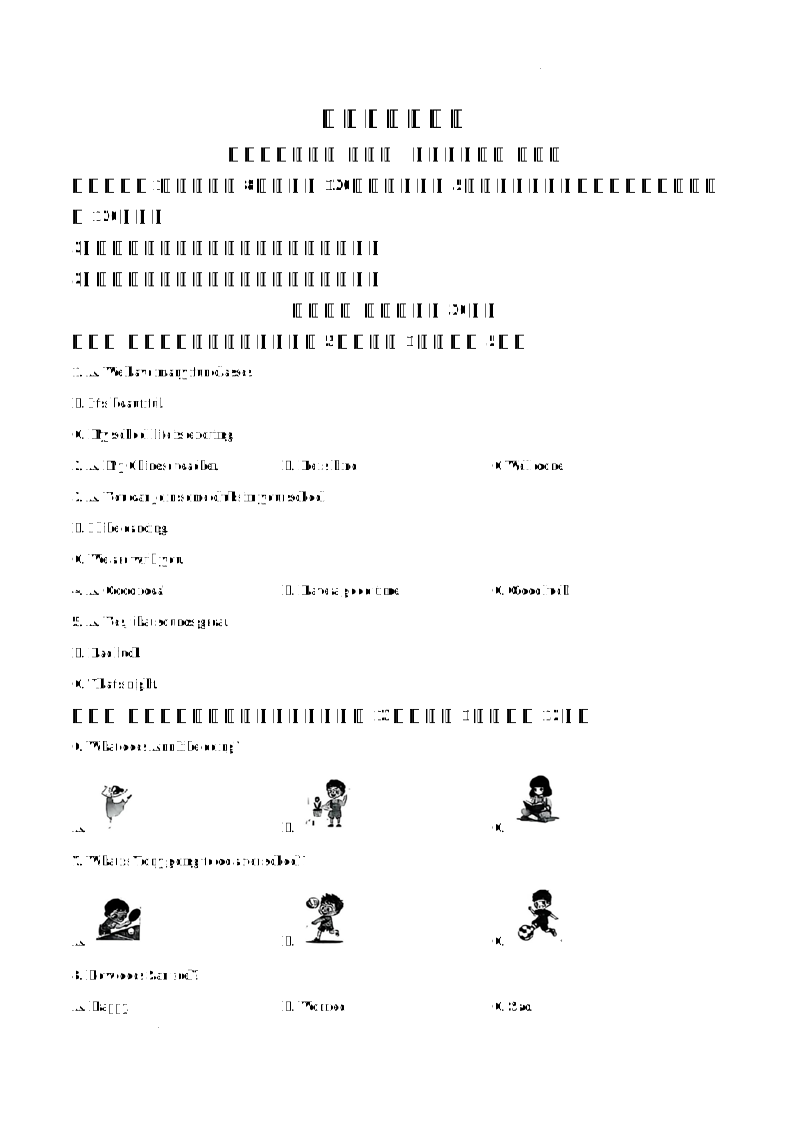
6. What does Ann like doing?
A. B. C.
7. What is Tony going to do after school?
A. B. C.
8. How does San feel?
A. Happy. B. Worried. C. Sad.
9. What would Sam like to do?
A. To have maths classes. B. To join a maths club. C. To play games.
10. What did Robert take part in last term?
A. The long jump. B. The high jump. C. Swimming.
11. When will Robert and Lucy have the sports meet this term?
A. Next Sunday. B. Next Tuesday. C. This Tuesday.
12. How long does Robert run for the long jump every morning?
A. 20 minutes. B. 30 minutes. C. 40 minutes.
13. Who does Jim want to visit Wuhan with?
A. His father. B. His sister. C. His mother.
14. Why didn’t Jim go to Wuhan last winter vacation?
A. Because of something special.
B. Because of something boring.
C. Because of much homework.
15. How may the girl go to Shenzhen?
A. By car. B. By train. C. By plane.
16. When will Bob go to Sanya?
A. On January 16. B. On January 26. C. on February 26.
17. How is the weather in Sanya?
A. It’s cool and cloudy. B. It’s cold and snowy. C. It’s hot and sunny.
18. Where does Lisa want to go?
A. To Sanya. B. To Qingdao. C. To Rizhao.
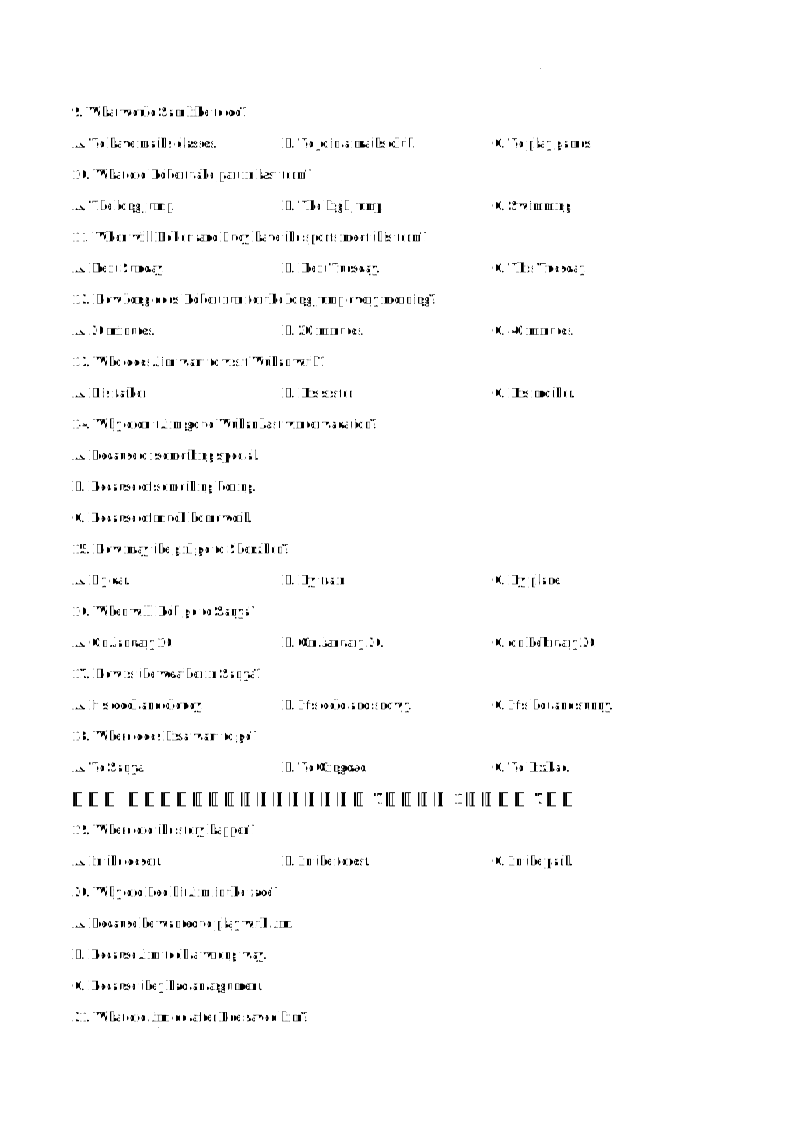
第三节 听短文和问题,选择正确答案(共7题;每题1分,满分7分)
19. Where did the story happen?
A. In the desert. B. In the forest. C. In the park.
20. Why did Leo hit Jim in the face?
A. Because he wanted to play with Jim.
B. Because Jim took a wrong way.
C. Because they had an argument.
21. What did Jim do after Lee saved him?
A. He thanked Lee.
B. He wrote some words in the sand.
C. He wrote some words on a stone.
22. How often does the running club hold a race?
A. Once a week. B. Twice a week. C. Once a month.
23. Who is the running club for?
A. Students. B. Teachers C. Parents.
24. Why does the race set no prizes?
A. To keep safe. B. To save money. C. To show running is fur
25. What will all runners get for free before the race?
A. Running shoes. B. Bottled water. C. Healthy food.
第四节 听短文填空(共5题;每题1分,满分5分)
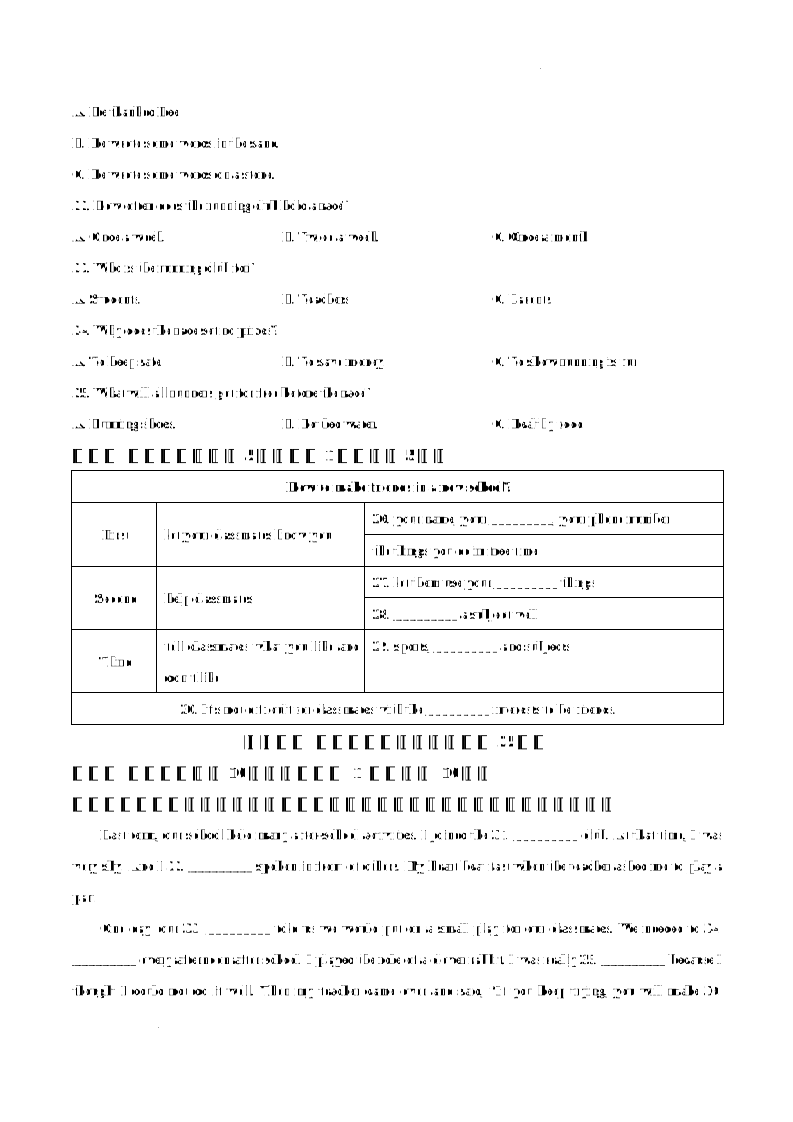
How to make friends in a new school?
First
let your classmates know you
26. your name, your _________, your phone number
the things you do in free time
Second
help classmates
27. let them use your _________ things
28. _________ a subject well
Third
tell classmates what you like and don’t like
29. sports, _________ and subjects
30. It’s not difficult for classmates with the _________ interests to be friends.
第二部分 语言运用(共两节,满分25分)
第一节 完形填空(共10小题;每小题 1 分,满分 10分)
阅读下面短文,掌握其大意,然后从各小题所给的四个选项中选出最佳选项。
Last term, our school held many after-school activities. I joined the 31. _________ club. At that time, I was very shy. And I 32. _________ spoken in front of others. My heart beat fast when the teacher asked me to play a part.
One day, our 33. _________ told us we would put on a small play for our classmates. We needed to 34. _________ every afternoon after school. I played the role of a clever rabbit. I was really 35. _________ because I thought I could not do it well. Then my teacher came over and said, “If you keep trying, you will make 36. _________.” His words made me feel better.
Before each practice, I tried my best to 37. _________. I took some deep breaths (深呼吸) and then told myself. “I can do it.” As time went by, I found the show was not as hard as I had thought. I also learned to keep a positive (积极的) 38. _________. When I made a mistake (错误), I stopped feeling sad. Instead, I would 39. _________ how to do better next time.
Now, I have 40. _________ a lot. I am not that shy girl anymore. Theatre has made me better. I have made new friends and learned to show myself. It was a wonderful experience!
31. A music B. theatre C. science D. reading
32. A. always B usually C. seldom D. often
33. A. teacher B. worker C. farmer D. driver
34. A. choose B. dream C. guess D. practice
35. A rich B. sweet C. afraid D. smart
36. A. mistakes B. progress C. noises D. trouble
37. A. relax R miss C. discuss D. drive
38. A grade B group C. mind D. building
39. A. think about B look for C. put up D. play with
40. A. played B. improved C. read D. painted
第二节 短文填空(共15小题;每题1分,满分15分)
阅读下面短文,在文中的横线上填写适当的单词或用括号内单词的正确形式填空。
Friends are important. What kind of friends would you like, 41. _________ (have)? Different people have different 42. _________ (answer).
Alan: I think a good friend should be a good listener. 43. _________ (I) best friend is Eric. Yesterday I was sad and he just 44. _________ (sit) next to me. He listened so me quietly and then 45. _________ (give) me some advice. Of course, he is very 46. _________ (friend), too. When I feel lonely at school, he always cares 47. _________ me. He works very hard and I think he 48. _________ (make) progress in the final exam (期末考试).
Marla: I don’t think it is important for my friend to be 49. _________ same as me. Li Jing and I are friends, but she is different 50. _________ me. She wears glasses 51. _________ has long hair. She is good at 52. _________ (dance) and she practices it after school every day. She won the 53. _________ (one) place in the dance match last year. Li Jing 54. _________ (hope) to be a dance teacher. But I want to be a 55. _________ (sing). What do you want to be?
第三部分 阅读(共两节,满分40分)
第一节 阅读理解(共15题;每题2分,满分30分)
阅读A、B、C、D四篇材料,然后从各小题所给的四个选项中选出最佳选项。
A
It's barbecue (烧烤) time!
The summer holiday is coming. If you want to stay healthy and enjoy a great barbecue, you can’t miss our Three B trip! This is a three-day barbecue trip. We have a lot of interesting activities. You can enjoy 3B (Bike, Bed and Barbecue) with your family and friends.
Day 1 We can enjoy the soft wind and fresh (清新的) air along the road by bus. Then, have lunch at Tree Hotel. Stay at River Camp at night.
Day 2 Keep going on our trip! It will be no meat day then. We will pick fresh vegetables and fruit as Happy Farm. Although (虽然) we won’t have meat that day, you will like the delicious vegetables and fruit picked by yourself. Stay at Queen Hotel at night.
Day 3 After breakfast, we can do some exercise to shake off (甩掉) fat. The barbecue is at 12:00 and we will say goodbye after lunch.
Kids under 6: $30
Kids aged 6-12: $60
People over 12: $120
56. People can enjoy the soft wind and fresh air _________.
A on Happy Farm B. at Tree Hotel
C. on the way to Tree Hotel D. at Queen Hotel
57. People will ride _________ kilometers on the second day.
A. nine B. fifteen C. fourteen D. twenty-four
58. Which of the following is right about the Three B trip?
A. You will have no meat on the third day.
B. You will have a barbecue at noon on the third day.
C. You will have lunch at Tree Hotel on the second day.
D. If you go with your 8-year-old son, you need to pay $150.
B
Hans is a very clever boy and he can learn everything very quickly. He doesn’t think what the teacher teaches in class is useful. It was a Monday morning. When the teacher, Mr. Brown, walked into the classroom with books in his hands, he heard a low voice, “Here’s the teacher. I’m sure this boring man is going to talk about how to use commas (逗号). I know how to use them.”
It was a boy’s voice and the teacher knew who he was. But the teacher didn’t get angry. He said nothing about it and began to talk about how to use commas. The students listened very carefully. Then he wrote a sentence on the blackboard, “Hans says the teacher is a boring man.” The class laughed and Hans’s face turned red.
“Now,” said the teacher. “I’ll tell you the importance of commas.” He put two comma s in the sentence, and then he read, “Hans, says the teacher, is a boring man.” All the students laughed again. Hans felt very embarrassed (尴尬的) first, and later his face turned much redder. He laughed with the other students, too.
From then on, Hans began to study carefully.
59. What can we infer (推断) about Hans from the first paragraph?
A. He is a hard-working student. B. He is afraid of his teacher.
C. He thinks Mr. Brown’s class is useful. D. He doesn’t like his teacher.
60. How did Hans’s feelings change during the story?
A. Happy → angry → sad B. Proud → embarrassed → relaxed
C. Bored → excited → worried D. Surprised → shy → happy
61. What’s the best title of the story?
A. A Clever Boy B. A Funny Teacher
C. A Lesson in Commas D. An Embarrassing Day
C
This year, many Chinese students got wonderful news — their first spring break! Wang Siyuan, an eight-year-old boy, was especially excited. On the first day of his holiday, he went to a science museum in Hefei with his parents. “It feels like we are walking in space!” he said cheerfully.
Spring break usually comes around the Qingming Festival. This year, nearly 100 cities in China, such as Jiangsu, Anhui and Sichuan, have started giving students two or three days’ holiday.
Schools encourage students to do outdoor activities, spend time with family and learn by doing. In Nanjing, kids can take nature walks or visit old cultural places. In Hefei, some、students go to science museums to learn about new technologies.
The idea first started in Hangzhou in 2004. It has become more popular since China’s “double reduction” policy (双减政策) made schoolwork lighter. Now, even some companies are helping. They give parents “paid leave” so families can travel together.
Because of this, more and more people are booking trips. Museums, zoos and theme parks are very popular. It is said that spring trips now are more about having fun experiences than just sightseeing(观光). As one teacher said. “This break helps students relax, learn outside class and grow happily. It also helps students reduce stress (减压) from schoolwork. With a clear mind, students can focus (专注) well when they return to class.”
62. How did Wang Siyuan feel about his first spring break?
A. Bored and tired. B. Excited and happy.
C. Interested but worried. D. Relaxed but lonely.
63. What do schools encourage students to do during spring break?
A. Take after-school classes. B. Do more outdoor activities.
C. Get ready for exams at home. D. Do more online homework.
64. What do the underlined words “paid leave” probably mean in paragraph 4?
A. Rest with pay (薪水) B. Rest without pay.
C. Traveling with family for free. D. Working on holidays for more money.
65. What is the main idea of the text?
A. How students spend their weekends. B. The double reduction policy in China.
C. Famous places to visit during holidays. D. Spring break becomes popular in China.
D
Now many students have mobile phones. So mobile phone use among students is a big problem. Some middle schools in Australia stop students from taking mobile phones to school. And in China, most middle school students can’t take mobile phones to school.
So, why should we have the rule? Because we want to protect (保护) students’ eyes and make students listen to the teachers carefully. More than 70% of middle school-students in Hebei wear glasses. People think the government (政府), schools, parents and students can work together to cut down (减少) on the number in the future. Wang Jing, the mother of two school students says, “My children like using the mobile phones very much and it makes their health and school grades go bad. So I understand why schools do this. I think the rule is great.” Teachers also say that sometimes students may use mobile phones to play games or cheat (作弊) on the exam.
And of course schools should have some regulations for the use of mobile phones. For example, teachers should not ask students to do their homework on mobile phones. And a schools should give public phones (公用电话) for talking between parents and students.
66. What percent (百分比) of middle school students in Hebei wear glasses according to (根据) the text?
A. More than 30%. B. More than 60%. C. More than 70%. D. More than 90%.
67. What does Wang Jing think of the rule?
A. She likes it. B She doesn’t care.
C. She thinks it’s boring. D She thinks it’s dangerous.
68. What is Paragraph 2 mainly (主要) about?
A. Why do we need the rule?
B. What do students do in class?
C. How do parents feel about the rule?
D. When does the rule help students’ studies?
69. What does the underlined word “regulations” mean?
A. Rules. B. Games. C. Cultures. D. Languages.
70. What’s the best title (标题) for the text?
A. More Phones for Students B. The Apps on Mobile Phones
C. No Mobile Phones at School D. No Homework on Mobile Phones
第二节 阅读表达(共5题,每题2分,满分10分)
阅读下面短文,简略回答问题。
When the teacher asks a question in class, some students never raise (举起) their hands. This situation (情况) is very common (普遍的) at middle schools. This 15-year-old boy always waits for other classmates or the teacher to give the answer. “What is my answer is wrong?” Wang asked.
Wang said only six or seven students in his class raised their hands when the teacher asked a question. “I think it is a problem that may affect (影响) our studies, but I am afraid of making mistakes in front of my classmates.” he said.
When we asked the teacher, Hu Wei, why the students didn’t raise their hands, he said, “They are afraid of making mistakes, or they’re afraid of losing face by giving wrong answers.”
To encourage students to raise their hands in class, Hu suggests (建议) that teachers should repeat (重复) the question, and try to guide (引导) and encourage (鼓励) students to give their answers. Hu also advises students not to be shy, but to be brave enough to try.
Sun Pin, 16, always raises her hand as soon as she gets the answer, even if she isn’t sure it is right. Sun can’t understand why some of her classmates keep silent (沉默的) in class. She enjoys raising her hand a lot. “It keeps me active and confident (自信的) to show my idea,” Sun said. “Raising my hand has really made me excellent.”
71. What situation is very common at middle schools?
____________________________________________________________________________________________
72. How many students in Wang’s class would like to raise their hands to answer questions in class?
____________________________________________________________________________________________
73. What does Hu suggest?
____________________________________________________________________________________________
74. What will Sun Pin probably do if she isn’t sure about her answer?
____________________________________________________________________________________________
75. Will you raise your hand in class? Why or why not?
____________________________________________________________________________________________
第四部分 情景交际(满分10分)
补全对话(共5题:每题2分,满分10分)
根据下面的对话情景,在空白处填上一个适当的句子,使对话意思连贯,完整。
(David and Helen are talking about Helen’s weekend.)
David: Hi, Helen! Where did you go last weekend?
Helen: 76. ____________________________ It was exciting and poetic (富有诗意的).
David: Who did you go to Dongfeng Park with?
Helen: 77. ____________________________.
David: Your classmates? I see. It’s not so far from here. 78. ____________________________.
Helen: We went there by bike.
David: Sounds amazing! 79. ____________________________
Helen: We enjoyed a lot of ancient poetry (古诗) and drew some pictures of the beautiful scenery (景色) there.
David: Sounds great! 80. ____________________________
Helen: We came back at about six o’clock. We had great fun there.
David: Wow! I’d like to go there, too.
第五部分 写作(满分10分)
书面表达(满分10分)
81.假如你是李华,你校下个月将迎来一位来华交流的友好学校的学生Rhian,她将入住你家并与你一同学习生活一周。以下是Rhian发来的邮件,请根据邮件内容写一封回信:
要求:(1)短信须回答Rhian想了解的所有问题。可适当发挥;
(2)短信中不要出现真实的地名、校名和人名;
(3)词数70左右(开头已给出,不计人总词数)。
Hello, Rhian. Welcome to my school and my home. _____________________________________________
________________________________________________________________________________________________________________________________________________________________________________________________________________________________________________________________________________________________________________________________________________________________________________
82.卷面书写(5分)
要求:工整、清晰、规范书写所有试题答案。
学科网(北京)股份有限公司
$
资源预览图
1
2
3

相关资源
由于学科网是一个信息分享及获取的平台,不确保部分用户上传资料的 来源及知识产权归属。如您发现相关资料侵犯您的合法权益,请联系学科网,我们核实后将及时进行处理。