Unit5-Unit6 月考模拟卷 2025-2026学年译林版八年级英语下册
2026-05-17
|
10页
|
1789人阅读
|
31人下载
资源信息
| 学段 | 初中 |
|---|---|
| 学科 | 英语 |
| 教材版本 | 初中英语译林版八年级下册 |
| 年级 | 八年级 |
| 章节 | Unit 5 Good manners,Unit 6 Sunshine for all |
| 类型 | 试卷 |
| 知识点 | - |
| 使用场景 | 同步教学-阶段检测 |
| 学年 | 2026-2027 |
| 地区(省份) | 江苏省 |
| 地区(市) | - |
| 地区(区县) | - |
| 文件格式 | DOCX |
| 文件大小 | 33 KB |
| 发布时间 | 2026-05-17 |
| 更新时间 | 2026-05-22 |
| 作者 | 匿名 |
| 品牌系列 | - |
| 审核时间 | 2026-05-17 |
| 下载链接 | https://m.zxxk.com/soft/57902480.html |
| 价格 | 1.00储值(1储值=1元) |
| 来源 | 学科网 |
摘要:
**基本信息**
以志愿者服务与跨文化礼仪为情境主线,覆盖译林版八年级下册Unit5-Unit6核心语法(it句型、enough/too结构)与词汇(volunteer, homeless),通过真实生活场景融合语言能力与文化意识考查。
**题型特征**
|题型|题量/分值|知识覆盖|命题特色|
|----|-----------|----------|----------|
|单项选择|15题/15分|it句型、enough/too结构、情景交际|基础语法与礼仪情境结合,如图书馆礼仪(rude)、志愿者品质(kind)|
|完形填空|10题/10分|so...that结构、副词运用|以教老人用智能手机为真实场景,渗透耐心品质培养|
|阅读理解|15题/30分|跨文化礼仪(日/英/印)、志愿者项目|通过不同国家礼仪对比与小善举案例,提升文化意识与思维品质|
|书面表达|1题/15分|it is句型、enough/too结构|要求描述志愿者经历,强化语言综合运用与社会责任感|
内容正文:
译林版八年级英语下册 Unit5-Unit6 月考模拟卷
考试时间:90分钟 满分:100分
班级:________ 姓名:________ 得分:________
Ⅰ. 单项选择(每小题1分,共15分)
从A、B、C、D四个选项中,选出最佳选项。
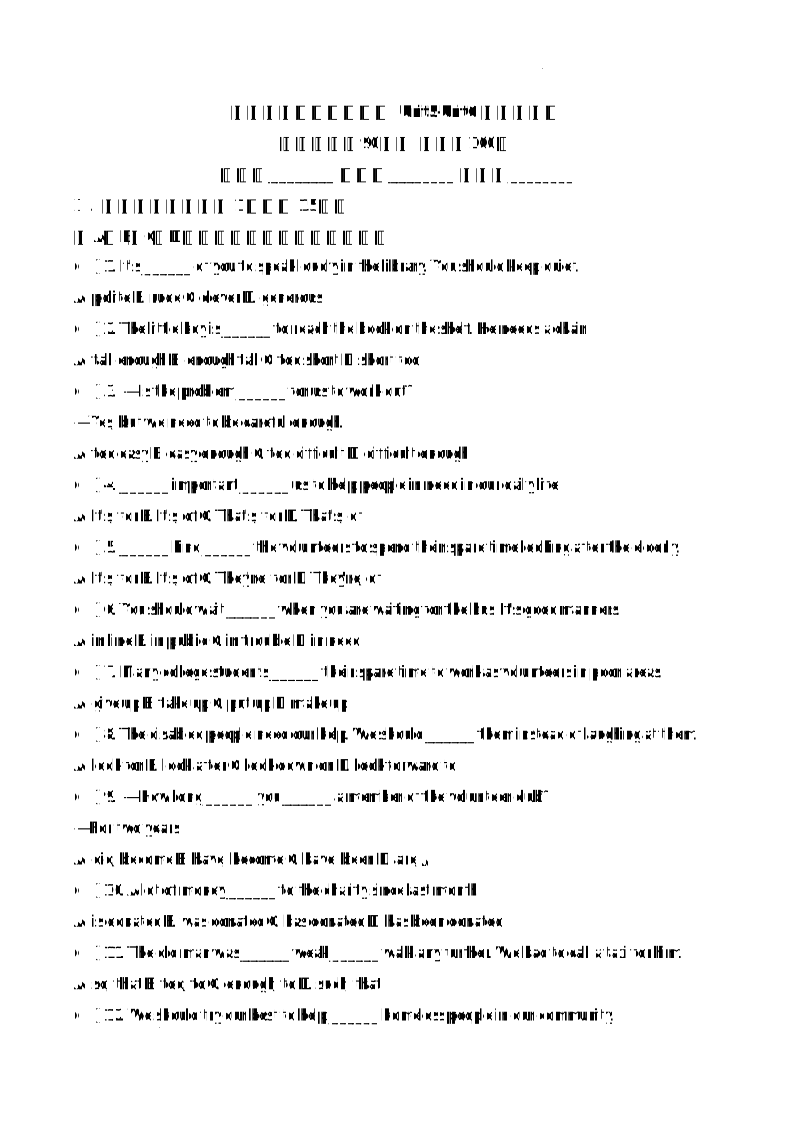
( ) 1. It's ______ of you to speak loudly in the library. You should keep quiet.
A. polite B. rude C. clever D. generous
( ) 2. The little boy is ______ to reach the book on the shelf. He needs a chair.
A. tall enough B. enough tall C. too short D. short too
( ) 3. —Is the problem ______ for us to work out?
—Yes, but we need to be careful enough.
A. too easy B. easy enough C. too difficult D. difficult enough
( ) 4. ______ important ______ us to help people in need in our daily life.
A. It's; for B. It's; of C. That's; for D. That's; of
( ) 5. ______ kind ______ the volunteers to spend their spare time looking after the elderly.
A. It's; for B. It's; of C. They're; for D. They're; of
( ) 6. You should wait ______ when you are waiting for the bus. It's good manners.
A. in line B. in public C. in trouble D. in need
( ) 7. Many college students ______ their spare time to work as volunteers in poor areas.
A. give up B. take up C. put up D. make up
( ) 8. The disabled people need our help. We should ______ them instead of laughing at them.
A. look for B. look after C. look down on D. look forward to
( ) 9. —How long ______ you ______ a member of the volunteer club?
—For two years.
A. did; become B. have; become C. have; been D. are; /
( ) 10. A lot of money ______ to the charity since last month.
A. is donated B. was donated C. has donated D. has been donated
( ) 11. The old man was ______ weak ______ walk any further. We had to call a taxi for him.
A. so; that B. too; to C. enough; to D. such; that
( ) 12. We should try our best to help ______ homeless people in our community.
A. a B. an C. the D. /
( ) 13. ______ it was raining heavily, the volunteers still went to the old people's home to help.
A. Though B. Because C. If D. So
( ) 14. —I think we should do something to support the charity.
—______ Let's organize a charity sale this weekend.
A. Never mind. B. Good idea! C. It's nothing. D. You're welcome.
( ) 15. —Could you tell me ______ I can be a good volunteer?
—You should be patient and polite to everyone you help.
A. what B. how C. why D. when
Ⅱ. 完形填空(每小题1分,共10分)
阅读短文,从A、B、C、D中选出最佳答案。
Last Saturday, I took part in a volunteer activity at the community center. Our task was to help the elderly people learn how to use smartphones. I was a little nervous at first 16 I thought I wasn't patient enough.
When I got there, I saw many old people waiting 17 . An old grandma came up to me and asked for help. She was 18 soft-spoken that I felt relaxed soon. I taught her 19 to make video calls to her grandson who was studying in another city. She listened carefully and took notes. When she finally made a call successfully, she was 20 happy that she thanked me again and again.
During the activity, I found that most old people were 21 slow to learn new things, but they were very hard-working. I also realized that it was important to speak 22 and clearly to them. Sometimes, I had to repeat the same thing several times, 23 I never got bored.
After three hours, the activity ended. I felt tired but very happy. It was 24 meaningful experience for me. I learnt that being a good volunteer not only means helping others, but also means being polite and patient. Small acts of kindness can make a big 25 to people's lives.
( ) 16. A. if B. because C. though D. until
( ) 17. A. in line B. in public C. in trouble D. in need
( ) 18. A. very B. too C. so D. such
( ) 19. A. what B. how C. why D. when
( ) 20. A. so B. too C. very D. quite
( ) 21. A. a little B. little C. a few D. few
( ) 22. A. quick B. quickly C. slow D. slowly
( ) 23. A. and B. but C. or D. so
( ) 24. A. a B. an C. the D. /
( ) 25. A. mistake B. decision C. difference D. problem
Ⅲ. 阅读理解(每小题2分,共30分)
A
Good manners are very important in our daily life. Different countries have different customs and manners. Here are some examples of public manners in different countries.
In Japan, people are very polite. They always wait in line patiently, even if there are only two people. When they meet someone, they usually bow to show respect. It is considered rude to talk loudly in public places like trains or buses.
In the UK, people also value good manners. They always queue for buses, trains and in shops. It is impolite to jump the queue. When you are invited to someone's home, you should arrive on time or a few minutes early. It is polite to bring a small gift, such as flowers or chocolates.
In India, people have different manners. They usually greet each other by putting their hands together and saying "Namaste". It is considered rude to touch someone's head, because the head is the most important part of the body in Indian culture. Also, you should not eat with your left hand, because the left hand is considered unclean.
( ) 26. What do Japanese people usually do when they meet someone?
A. They shake hands. B. They bow.
C. They hug. D. They kiss.
( ) 27. What is considered impolite in the UK?
A. Waiting in line. B. Arriving on time for a party.
C. Jumping the queue. D. Bringing a small gift.
( ) 28. Why is it rude to touch someone's head in India?
A. Because the head is considered unclean.
B. Because the head is the most important part of the body.
C. Because people don't like being touched.
D. Because it is a sign of disrespect.
( ) 29. Which of the following is TRUE according to the passage?
A. People in Japan talk loudly on trains.
B. People in the UK never bring gifts to their hosts.
C. People in India eat with their left hands.
D. Good manners are important in all countries.
( ) 30. What is the main idea of the passage?
A. How to be a polite person.
B. Different manners in different countries.
C. The importance of good manners.
D. Public manners in Japan.
B
Volunteering is becoming more and more popular in China. There are many different kinds of volunteer projects for people to take part in. One of the most popular projects is "Helping the Disabled".
This project was started in 2010 by a group of college students. Its aim is to help disabled people live a better life. Volunteers go to the homes of disabled people every weekend. They help them with housework, such as cleaning the house, washing clothes and cooking meals. They also read books to them, talk with them and take them for walks.
Li Ming, a 16-year-old student, has been a volunteer in this project for two years. He helps a disabled boy named Wang Wei. Wang Wei lost his legs in a car accident when he was 10 years old. He couldn't go to school, so Li Ming teaches him English and Maths every Saturday. "It's great to see Wang Wei making progress," said Li Ming. "I feel very happy when I help him."
The project also organizes some activities for disabled people, such as painting competitions and music concerts. These activities help disabled people make more friends and feel more confident.
If you want to be a volunteer, you can join this project. You just need to be kind and patient. Even a small help can make a big difference to a disabled person's life.
( ) 31. When was the "Helping the Disabled" project started?
A. In 2008. B. In 2010. C. In 2012. D. In 2015.
( ) 32. What do volunteers NOT do for disabled people?
A. Help with housework. B. Read books to them.
C. Teach them subjects. D. Give them money.
( ) 33. How long has Li Ming been a volunteer?
A. For one year. B. For two years. C. For three years. D. For four years.
( ) 34. What does the underlined word "confident" mean in Chinese?
A. 自信的 B. 害羞的 C. 难过的 D. 骄傲的
( ) 35. What can we learn from the passage?
A. Only college students can be volunteers.
B. Disabled people don't need any help.
C. Volunteering can make both volunteers and disabled people happy.
D. The project organizes sports competitions for disabled people.
C
Many people think that only big acts of kindness can make a difference. But I think small acts of kindness are just as important. They can make someone's day brighter and bring warmth to the world.
Last week, I saw a little girl helping an old man cross the street. The old man was walking very slowly and looked worried. The girl held his hand and walked with him step by step. When they got to the other side, the old man thanked her with a big smile. The girl smiled back and ran away. That small act of kindness made me feel warm inside.
Another time, I was in a supermarket. A woman dropped her shopping bag and all the things fell out. Many people walked past, but a young man stopped to help her pick up the things. The woman thanked him, but he just said "It's nothing" and left.
These small acts of kindness happen every day around us. They may not be reported in the news, but they are very important. They show that there is still love and kindness in the world.
Being kind doesn't mean you have to do something big. You can be kind by holding the door for someone, by giving your seat to the elderly on the bus, or by just smiling at a stranger. These small things don't cost anything, but they can mean a lot to someone.
Let's start with small acts of kindness. If everyone does a little something kind every day, the world will become a better place.
( ) 36. What does the writer think of small acts of kindness?
A. They are not important. B. They are as important as big acts.
C. They don't make any difference. D. They are reported in the news.
( ) 37. What did the little girl do for the old man?
A. She helped him cross the street. B. She gave him some money.
C. She bought him some food. D. She helped him carry his bag.
( ) 38. Why did the young man help the woman?
A. Because he wanted to get a reward.
B. Because he was a kind person.
C. Because the woman asked him for help.
D. Because he knew the woman.
( ) 39. Which of the following is NOT a small act of kindness according to the passage?
A. Holding the door for someone. B. Giving your seat to the elderly.
C. Smiling at a stranger. D. Donating a lot of money to charity.
( ) 40. What is the writer's purpose in writing this passage?
A. To tell us some stories about kindness.
B. To show us how to be a volunteer.
C. To encourage us to do small acts of kindness.
D. To talk about the importance of big acts of kindness.
Ⅳ. 信息还原(每小题2分,共10分)
选择合适选项,有两项多余。
A. You should also be patient with them.
B. What should I do to be a good volunteer?
C. It's also important to be polite to everyone.
D. Volunteering is a great way to help others.
E. You need to be kind and warm-hearted.
F. You can join a volunteer club first.
G. You should never give up when you meet difficulties.
A: Hi, Amy. I want to be a volunteer, but I don't know what to do. 41. ______
B: Don't worry. Let me give you some advice. First, 42. ______ If you are not kind, no one will want your help.
A: I know. I will try my best to be kind to everyone.
B: 43. ______ You should say "please" and "thank you" when you talk to people. It will make them feel comfortable.
A: That's right. Good manners are very important.
B: 44. ______ Some people may be slow to learn things, but you should not get angry with them.
A: I see. I will be patient.
B: And 45. ______ You can meet many other volunteers there and learn from them.
A: Thank you for your advice. I will start from now on.
41. ______ 42. ______ 43. ______ 44. ______ 45. ______
Ⅴ. 词汇运用(每小题1分,共10分)
A) 根据首字母及中文提示写单词
46. It's i________ (不礼貌的) to talk with your mouth full.
47. We should be p________ (耐心的) with children and elderly people.
48. Many v________ (志愿者) went to help the people in the earthquake-hit area.
49. The government has built many houses for the h________ (无家可归的) people.
50. We should s________ (支持) charities by donating money or things.
B) 用所给词适当形式填空
51. It's meaningful for us ________ (help) the disabled people.
52. The old man was too tired ________ (walk) any further.
53. Many books ________ (send) to the poor children last month.
54. He is kind enough ________ (give) his seat to the elderly on the bus.
55. We should try our best to help people in ________ (need).
Ⅵ. 任务型阅读(每小题2分,共10分)
每小题答案不超过10个单词。
Good manners are not only important in public places, but also important in volunteer work. When you are a volunteer, you should follow some basic manners to make the people you help feel comfortable.
First, you should be on time. It is rude to be late for a volunteer activity, because it will make other people wait for you. If you can't come on time, you should call and tell them in advance.
Second, you should be polite to everyone. You should say "hello" when you meet people, and "thank you" when someone helps you. You should not use rude words or talk loudly in front of the people you help.
Third, you should be patient. Some people may be slow to understand things, or they may need your help many times. You should not get angry or impatient with them. You should try your best to explain things clearly and help them patiently.
Finally, you should respect the people you help. You should not ask them personal questions, such as their age, income or family problems. You should treat them as equals and respect their opinions.
56. Where are good manners important?
_______________________________________________________________
57. What should you do if you can't come to a volunteer activity on time?
_______________________________________________________________
58. What should you not do in front of the people you help?
_______________________________________________________________
59. Why should you be patient with the people you help?
_______________________________________________________________
60. What personal questions should you not ask?
_______________________________________________________________
Ⅶ. 书面表达(共15分)
主题:My volunteer experience
要点:
1. 你参加过的一次志愿者活动(时间、地点、内容);
2. 你在活动中遇到的问题及如何解决的;
3. 你从这次活动中学到了什么(结合礼仪和帮助他人的意义);
4. 你未来的计划。
要求:80-100词,语句通顺、语法正确,至少使用3个it is句型和2个enough/too结构。
_______________________________________________________________
_______________________________________________________________
_______________________________________________________________
_______________________________________________________________
_______________________________________________________________
参考答案及易错点拨
Ⅰ. 单项选择
1-5 BCBAB 6-10 AABCD 11-15 BCABB
易错点拨
- 第5题:形容词kind描述人的品质,用of;若形容词描述事情的性质(如important, difficult),用for。
- 第9题:how long与延续性动词连用,become是短暂性动词,需改为be。
- 第10题:since last month用现在完成时,且money与donate是被动关系,用现在完成时的被动语态。
Ⅱ. 完形填空
16-20 BACBA 21-25 ADBAC
易错点拨
- 第18题:so...that...结构,表示"如此……以至于……"。
- 第24题:meaningful以辅音音素开头,用a。
Ⅲ. 阅读理解
26-30 BCBDB 31-35 BDBAC 36-40 BABDC
易错点拨
- 第34题:词义猜测题,结合上下文"这些活动帮助残疾人交更多朋友",可推断confident意为"自信的"。
- 第40题:主旨题,文章最后一段点明作者目的:鼓励大家从小善举做起。
Ⅳ. 信息还原
41-45 BECAF
Ⅴ. 词汇运用
A)
46. impolite 47. patient 48. volunteers 49. homeless 50. support
B)
51. to help 52. to walk 53. were sent 54. to give 55. need
Ⅵ. 任务型阅读
56. In public places and volunteer work.
57. Call and tell them in advance.
58. Use rude words or talk loudly.
59. Because some people are slow to understand things.
60. Age, income or family problems.
Ⅶ. 书面表达参考范文
My volunteer experience
Last Sunday, I volunteered at the old people's home with my classmates. We helped the elderly clean their rooms and sing songs for them.
At first, I was too shy to talk to them. But I soon realized it is important to be patient and polite. I talked with an old grandma about her past. She was happy enough to share her stories with me.
It was a meaningful experience. It is great to help others, and it is also important to respect the elderly. I plan to volunteer there once a month in the future.
学科网(北京)股份有限公司
$
资源预览图
1

2

3
相关资源
由于学科网是一个信息分享及获取的平台,不确保部分用户上传资料的 来源及知识产权归属。如您发现相关资料侵犯您的合法权益,请联系学科网,我们核实后将及时进行处理。