2025-2026学年重庆市鲁能巴蜀中学校七年级下学期英语期中试卷
 切换试卷
切换试卷
2026-05-17
|
14页
|
11人阅读
|
0人下载
资源信息
| 学段 | 初中 |
|---|---|
| 学科 | 英语 |
| 教材版本 | - |
| 年级 | 七年级 |
| 章节 | - |
| 类型 | 试卷 |
| 知识点 | - |
| 使用场景 | 同步教学-期中 |
| 学年 | 2026-2027 |
| 地区(省份) | 重庆市 |
| 地区(市) | - |
| 地区(区县) | - |
| 文件格式 | DOCX |
| 文件大小 | 799 KB |
| 发布时间 | 2026-05-17 |
| 更新时间 | 2026-05-17 |
| 作者 | 匿名 |
| 品牌系列 | - |
| 审核时间 | 2026-05-17 |
| 下载链接 | https://m.zxxk.com/soft/57899391.html |
| 价格 | 0.50储值(1储值=1元) |
| 来源 | 学科网 |
内容正文:
英 语
第Ⅰ卷(共90分)
Ⅰ.听力测试.(共35分)
第一节(每小题1分,共6分)
听两遍。根据你所听到的句子,从A、B、C三个选项中选出最恰当的答语,并把答题卡上对应题目的答案标号涂黑。
1. A. OK. B. Hardly ever. C. Yes, it’s mine.
2. A. Of course. B. I’m sorry. C. Nothing much.
3. A. Bamboo. B. In the forest. C. Black and white.
4. A. Yes, please. B. Thank you. C. Hold on, please.
5. A. Good idea. B. You’re welcome. C. In the restaurant.
6. A. No, I don’t. B. Juice, please. C. Yes, I’d love to.
第二节(每小题1.5分,共9分)
听两遍。根据你所听到的对话和问题,从A、B、C三个选项中选出正确答案,并把答题卡上对应题目的答案标号涂黑。
7. A. /ə'raɪv/ B. /rɪ'zʌlt/ C. /'rɪvə(r)/
8. A. At home. B. At school. C. In the zoo.
9. A. Don’t talk loudly. B. Don’t eat in class. C. Don’t run in class.
10. A. Once a week. B. Twice a week. C. Three times a week.
11. A. He is reading. B. He is sleeping. C. He is cleaning the library.
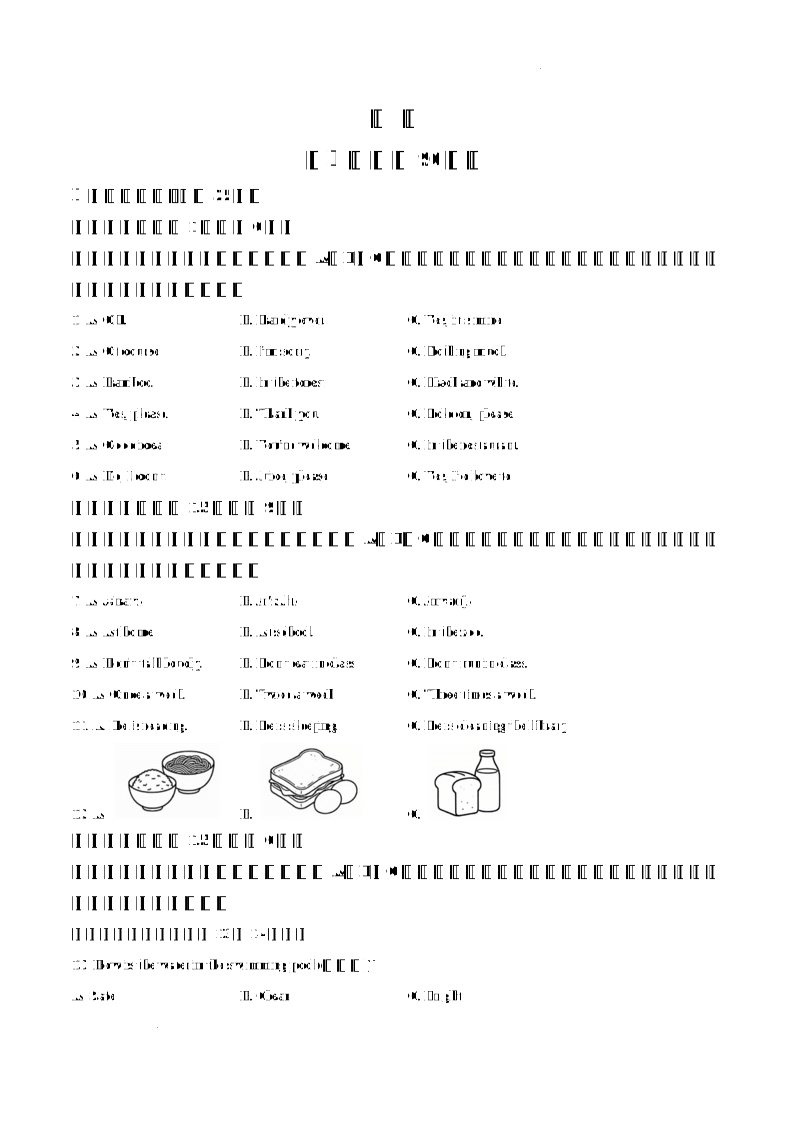
12. A. B. C.
第三节(每小题1.5分,共6分)
听两遍。根据你所听到的长对话,从A、B、C三个选项中选出正确答案,并把答题卡上对应题目的答案标号涂黑。
听第一段材料,回答第13和14小题。
13. How is the water in the swimming pool (游泳池)?
A. Safe. B. Clean. C. Bright.
14. What sport does the man’s son like?
A. Swimming. B. Ping-pong. C. Tennis.
听第二段材料,回答第15和16小题。
15. Why doesn’t the boy want to eat breakfast?
A. Because he gets up late.
B. Because he is not hungry.
C. Because he doesn’t feel well.
16. What food does the boy want to have?
A. Eggs. B. Milk. C. Orange juice.
第四节(每小题1.5分,共6分)
听两遍。根据你所听到的短文内容,从A、B、C三个选项中选出正确答案,并把答题卡上对应题目的答案标号涂黑。
17. Where is the speaker now?
A. In a coffee shop.
B. On the busy street.
C. In the shopping mall.
18. What are the children doing in the park?
A. They are drawing pictures.
B. They are resting and talking.
C. They are flying kites and playing games.
19. Why do a group of students stop at the street corner?
A. Because they want to buy something.
B. Because there are cars and buses coming and going.
C. Because they want to listen to the young artist singing.
20. How does the speaker feel about the city life?
A. Bored. B. Happy. C. Tired.
第五节(每小题2分,共8分)
听两遍。根据你所听到的短文内容,在横线处补全思维导图所缺信息。每空1词,并把答案填写在答题卡上对应位置。
Last, the speaker thinks we can 24. ________ ourselves by (通过) practising sports.
Ⅱ.语法选择.(每小题1分,共10分)
根据短文内容,从A、B、C三个选项中选出一个语法正确的答案,并把答题卡上对应题目的答案标号涂黑.
Different eating habits can change a lot about us.
Leo is 25 11-year-old boy, and he is good at running. But he loves eating junk food (垃圾食品). He eats hamburgers and drinks sweet cola every day. 26 , he often feels sleepy in class and puts on much weight. One day, 27 PE teacher, Mr. Clark, notices this. “Leo, if you want to run fast and keep 28 , you must eat well,” says Mr. Clark. He gives Leo a very interesting piece of advice: “Eat the rainbow (彩虹).”
At first, Leo doesn’t 29 . Does he need to eat the sky? Mr. Clark laughs and explains that “eating the rainbow” means eating fruits and vegetables of different colors, 30 red apples, orange carrots, and green cabbages. Every color has special things to help the body grow strong.
From then on, Mr Clark encourages Leo 31 his eating habits. Leo starts to choose fresh fruits instead of unhealthy snacks. At lunch, he always makes sure his dish is colorful and he 32 eats junk food. Now, Leo even becomes an excellent 33 in his class. 34 into good eating habits is really important. It helps him live a happy life.
25. A. a B. an C. the
26. A. Or B. So C. However
27. A. he B. him C. his
28. A. health B. healthy C. healthily
29. A. understand B. understands C. understanding
30. A. like B. with C. among
31. A. change B. changing C. to change
32. A. hard B. hardly C. always
33. A. run B. runner C. running
34. A. Get B. Gets C. Getting
Ⅲ.完形填空.(每小题1分,共10分)
根据短文内容,从A、B、C、D四个选项中选出一个能填入对应空格内的最佳答案,并把答题卡上对应题目的答案标号涂黑。
Suanni is an international student studying in the UK. She comes from 35 , and she loves sharing stories with her friends. One day, she stands near Big Ben (大本钟) in London. She 36 Big Ben and remembers her English textbook. There is also a Big Ben on 37 ! Then she has an idea that she can share the book with all Chinese
Later, she posts a short 38 on Rednote (小红书). In the video she says, “This is Big Ben on the cover (封面) of my English textbook! Now I’m really here! If you are also Chinese and see my post, you can find it and 39 some words here.”
She puts the book 40 behind the second trash bin (垃圾桶) so that the street cleaner won’t take it away, and then she marks the place in her post. The next day, she checks her phone and happily sees that a Chinese student takes photos 41 her book and writes some words on the opening page.
In the following days, more Chinese students and visitors find the book. Now, it’s full of 42 — wishes for world peace and for our country, hopes for the future, and words of encouragement to one another. This is a 43 way for Chinese people to pass love and warm feelings. Only Chinese can understand this fun game! 44 the kindness behind it reaches (触及) people all over the world. Now, more and more people are looking forward to finding this book in London!
35. A. China B. America C. Australia D. Singapore
36. A. looks like B. puts up C. works on D. looks at
37. A. it B. us C. her D. them
38. A. word B. film C. email D. newsletter
39. A. get B. read C. leave D. bring
40. A. quietly B. quickly C. luckily D. politely
41. A. in B. on C. with D. about
42. A. news B. games C. questions D. messages
43. A. hard B. boring C. common D. special
44. A. Or B. So C. But D. And
Ⅳ.阅读理解.(每小题2分,共30分)
阅读下列材料,从A、B、C、D四个选项中选出最佳答案,并把答题卡上对应题目的答案标号涂黑。
A
Materials
◇ A wide glass jar with a lid (盖子)
◇ Very hot water
◇ Some ice
◇ A box of matches
Very important! Only parents can deal with (处理) matches!!!
Steps
1. Turn the lid upside down (翻转) and make it full of ice.
2. Fill the jar with very hot water.
3. Ask your parent to light a match. Then blow out the match just above the jar. Hold the smoking (有烟的) match inside and let the smoke fill the jar.
4. Quickly put the lid with ice on the jar. Cover (覆盖) the jar.
5. Wait for a few minutes. Then take the lid off and meet the cloud!
Result
A real cloud comes up. But it is not round and it disappears (消失) soon.
45. Which are the two people in the picture talking about?
A. Clouds. B. Flowers. C. Rabbits. D. Matches.
46. What is the right order of “making the cloud”?
A. ②①③⑤④ B. ①③⑤②④ C. ①②③⑤④ D. ②①④③⑤
47. What is the result of the experiment (实验)?
A. A real cloud comes up.
B. The jar is full of smoke.
C. The cloud doesn’t disappear.
D. The cloud lasts (持续) a few hours.
B
Do you feel nervous (紧张的) when you read loudly in front of your classmates? Many students do. They are afraid of making mistakes. What about making a dog your listener?
In many libraries across America, a special program called “Reading to Dogs” is becoming popular. The rules are easy: children pick a book, sit down, and read to a friendly dog. These dogs are specially trained and quiet. They never judge humans. When humans do something wrong, the dogs don’t laugh at them.
Seven-year-old Emma doesn’t like reading at all. She always reads very slowly and feels shy. But today, she meets a dog named Barnaby at the library. When Emma reads to Barnaby, he just rests his head on her legs and listens quietly. If Emma makes a mistake in a word, Barnaby doesn’t do anything. He only wags (摇) his tail from time to time and enjoys the reading time with the little girl. Because of this, Emma begins to relax. “Barnaby loves my stories,” she tells her mother happily.
Now, Emma visits the library every Saturday. She practices reading at home for her dear friend. Librarians (图书管理员) say that reading to dogs helps children stop worrying about their mistakes and just enjoy the moment. For these young readers, the library is not only a place to find great books but also a happy home to share stories with their lovely animal friends!
48. What is a rule for children in the “Reading to Dogs” program?
A. They can feed the dogs.
B. They can run with the dogs.
C. They can sit next to librarians.
D. They can pick a book to read with the dogs.
49. Which sentence uses “judge” with the same meaning as the underlined word (划线词)?
A. It’s hard to judge how old the big tree is.
B. The police will take the bad man to the judge.
C. My PE teacher works as a judge in our sport meet.
D. Please don’t judge your friends when they make mistakes.
50. According to the passage, which of the following is TRUE?
A. Barnaby is Emma’s pet dog.
B. Students enjoy making mistakes.
C. Emma goes to the library once a week.
D. Emma reads to her dear friend at home.
51. Why does the writer write this passage?
A. To ask kids to read in the library.
B. To show the importance of reading.
C. To tell us how to keep a friendly dog.
D. To introduce a helpful reading activity.
C
Many people in China’s south-eastern coastal areas (东南沿海地区) and Taiwan Island live by fishing. Every day, they sail (航行) on the dangerous sea. Fishermen all hope to come back safely with many fishes and live happily with their family. So they ask a kind sea goddess (海神) for help. Her name is Mazu. Do you know her story?
In 960 AD, a baby girl named Lin Mo, also called Lin Moniang, was born in a small fishing village on Meizhou Island in Putian, Fujian. She didn’t cry at birth, so her parents named her “Mo (默)”.
Lin was special when she was young. She loved reading books and learned a lot about the sea. ▲ . She helped them stay safe. Because of this, people called her “fishermen’s helper”.
There are many stories about how she died (死亡). In one story, she lost her life to save fishermen in a terrible storm (风暴). To thank her, people built a temple (庙宇) on the island. They began to look on her as their sea goddess and showed great respect for her.
Even today, people still celebrate Mazu’s birthday with all kinds of activities in Taiwan, Meizhou Island, and many other places. Even with modern technology (现代科技), many people still pray (祭拜) to Mazu before going out to sea.
Mazu is a symbol of Chinese traditional culture. We should remember her and carry on her good values.
52. According to the passage, what do fishermen ask Mazu for?
A. Good jobs and babies. B. Big houses and much money.
C. Good weather every day. D. Safety, fishes and happy lives.
53. Which sentence can be put in the ▲ ?
A. Fishermen didn’t know the sea at all
B. She could tell when storms would come
C. She liked drawing pictures of fish and boats
D. Fishermen asked her for advice before sailing
54. Which words best describes Mazu in the passage?
A. Quiet and lucky. B. Kind and helpful.
C. Funny and clever. D. Careful and successful.
55. What can we infer from the passage?
A. People built the temple for money.
B. Mazu helps fishermen and keeps them safe.
C. Mazu is still important to many people today.
D. Fishermen don’t believe technology but Mazu.
D
What to dress for the day can sometimes be a big problem. When you leave home in the morning, it is cold, so you put on a heavy coat. However, a few hours later, the sun comes out and you feel very hot. You have to take off the coat and carry it everywhere. Now, imagine (想象) a magic jacket that changes with the weather!
Scientists are making a new kind of technology called “smart clothes”. These clothes look like our everyday jackets, but they have small sensors (传感器) inside. They act like a second brain (大脑). They can easily feel the weather outside and the temperature (温度) of your body at the same time.
How do they work in winter? When the sensors feel that you are cold, they send a quick message to small heaters (加热器) inside the jacket. Then, they turn on and make you warm. You don’t need to wear three or four heavy clothes anymore. Just one light smart jacket is enough to keep you away from the cold wind.
What about in the hot summer? The jacket can also help you cool down. If you play sports and sweat (出汗) a lot, the clothes will change a little. The small holes (洞) on the jacket will open up. This lets the hot air out and brings the cool wind in. It keeps your body dry and comfortable all day.
Today, these smart clothes are still new and a little expensive. You might only see sports players wearing them. But scientists are working hard to make them better and cheaper. In the future, everyone might have one. We won’t need to check the weather report before going out. Smart clothes make our life very easy! Technology changes life.
56. Why does the writer talk about wearing a heavy coat in Paragraph 1?
A. To tell a funny story.
B. To show our daily life.
C. To show that we need smart clothes.
D. To teach us how to carry a heavy coat.
57. Which of the following can best describe the picture?
A. Let the cold wind in. B. Small holes open up.
C. Small heaters turn on. D. The jacket becomes heavy.
58. According to the passage, how does the smart jacket “know” when to change?
A. The sensors send messages.
B. The sensors listen to our orders.
C. The sensors check the weather report.
D. The sensors check our heartbeats (心跳).
59. What is the right structure (结构) of the passage?
A. B. C. D.
V.口语应用.(每小题1分,共5分)
阅读下面对话,从方框内7个选项中选择5个恰当的句子完成此对话,并把答题卡上对应题目的答案标号涂黑。
Emma: Hi! Are you Mike?
Mike: Yes! Emma? Long time no see!
Emma: Yeah! Oh, I see your post online. You have new family members. 60
Mike: Yes, I do!
Emma: Nice! What pets do you have?
Mike: 61
Emma: Umm… are they dogs?
Mike: Yes! Two lovely dogs. I often run with them these days. It’s also a good way to keep fit.
Emma: Great! 62
Mike: I usually play basketball with my classmates after school.
Emma: That sounds great! 63
Mike: At 20:30. Then I can relax and go to bed early.
Emma: 64
Mike: Yes. Good sleep helps me study better the next day.
A. Good idea!
B. But when do you finish your homework?
C. I like dogs best.
D. What else do you do to keep fit?
E. Guess! They are friendly and clever.
F. Do you keep pets?
G. You have a healthy life!
第Ⅱ卷(共60分)
VI.任务型阅读.(65-66小题,每小题2分;67-68小题,每小题3分;共10分)
阅读贴文并回答问题.
Do you know that students now have another two holidays in some parts of China? They are spring and autumn breaks. For most students, it’s great news that makes them happy and excited.
In 2026, cities such as Hangzhou, Ningbo, Yibin, and Chongqing introduce spring break plans. Some cities put the holiday near the Qingming Festival or the May Day holiday. This gives students a longer vacation (假期). Some people support (支持) the idea, but others worry (担忧) about it. So spring break becomes a hot topic.
Why do some people support spring break? They believe it helps students relax and learn a lot. For example, students can go to nature parks to have fun. They can also go to cultural places to learn about history. Some parents say that spring break gives families a chance to travel together and connect (联系) what students learn at school with their trips (旅途). Teachers also say that through spring activities, students can learn about traditional festivals and the Chinese culture behind them.
However, why do some people worry about spring break?
First, some parents worry that spring break may make students have less time for study. In some places, there are fewer than 80 teaching days this term, but the schoolwork is almost the same. Some students may not have enough time to learn things well.
Second, spring break may be difficult for working families. Many parents work full-time and cannot have the same holiday. If children stay at home, safety will be a big problem. Parents have to make many phone calls to care for their children or ask grandparents to look after them. It brings more problems to busy parents.
Anyway, we can’t have everything perfect. We should listen to students’ ideas about spring and autumn breaks.
65. According to the passage, do most students support the new holidays?
____________________________________________________________________________________________
66. Where can students go to relax and learn during spring break?
____________________________________________________________________________________________
67. What makes some parents worry about the new holidays?
____________________________________________________________________________________________
68. What can you do to make your parents less (少) worried during spring and autumn breaks? (At least 30 words.)
____________________________________________________________________________________________________________________________________________________________________________________________________________________________________________________________________________________
Ⅶ.根据首字母或音标或所给词的恰当形式提示填空.(每空1分,共10分)
69. The pandas are in great /ˈdeɪndʒə(r)/ _______ because people are cutting down the forests.
70. The little girl has a very sweet v_______. Everyone likes listening to her songs.
71. He is always kind and helpful, so he can s_______ in winning others’ respect.
72. Our books are on the desk. And those in the drawers are _______ (they).
73. You look very tired. What about _______ (relax) for a while?
74. Don’t study all the time. You also need to play sports to keep a _______ (balance) life.
75. It is important for everyone _______ (follow) the school rules.
76. The old man cannot walk fast. He walks very _______ (slow) in the park.
77. The tiger is very _______ (scare). Many small animals run away when they see it.
78. Look! The students _______ (jog) on the playground.
Ⅷ.完成句子.(79-82题,每空1分,83小题2分,共10分)
79. Tom is reading science books, too.(改为否定句)
Tom _______ reading science books, _______.
80. I would like to have some chicken and rice for dinner.(改为一般疑问句)
_______ _______ like to have some chicken and rice for dinner?
81. Peter has to practice baseball twice a week.(对划线部分提问)
_______ _______ does Peter have to practice baseball?
82.这个箱子太重了,以至于无法搬动.(完成句子)
The box is _______ heavy _______ carry.
83. are, animals, how, lives, our, part of(连词成句)
________________________________________________________?
Ⅸ.原文填空.(每空1分,共5分)
It’s 8 p.m. in Chongqing, China. Some people are rushing to get home 84 work. But others are not in a 85 ! They are enjoying the 86 at night. Lights are 87 brightly across the city, and colourful boats are moving slowly down the river. People are eating 88 food, such as Chongqing hot pot and noodles.
VIII.概要补全.(89和90小题,每小题2分;91和92小题,每小题3分;共10分)
When we live in a room full of things we don’t need, even some litter, it’s easy for us to feel messy (混乱的). What’s more, we can’t find things we need in an untidy room or it takes us much time to look for them. That’s why we need to clean up our rooms from time to time (时不时). After all, an untidy room always brings us problems in our life.
Lucy, a 13-year-old girl, has lots of problems because of her untidy room. For example, when she studies in the room, she may look at the toys under her bed or look for her notebooks. Also, She can’t do her homework carefully. Her parents have to ask her headteacher Mr. Liang for help.
He advises Lucy to live in a room with everything in order. In this way, it may not take her so much time to look for things. And she can fully enjoy the things she is doing. A tidy room can make her have a clear mind. That helps her live a better life.
However, keeping a room in order is not so easy. To make it, we can start doing it with small tasks. Also, we can listen to music and think about the tidy rooms while cleaning. With these useful ways, it’s easy for us to keep rooms tidy.
As a famous saying goes, “Tidy space, tidy mind.” Now we know what we should do so that we can live a better life.
We may feel messy and 89 looking for things in untidy rooms. So we need to clean them up. Lucy can’t 90 what she is doing in her room. With Mr. Liang’s help, her parents know when she can keep her room in order, she may not have the problem. And to keep a tidy room, 91 . If we want to live a better life, we know that 92 .
XI.书面表达.(共15分)
学校品宣部为倡导“健康人生,美好生活”拍摄短视频。假设你是李华。你不仅被选为视频主角,还受邀为视频写脚本。请你:
1.按before school — at school — three meals a day — after school的顺序,逐一介绍图片内容(你正在做什么),并至少选取两件事例,说明你这么做的原因;
2.至少分享一条图片内容以外的建议,帮助我们拥有健康且快乐的生活;
3.在脚本的结尾分享你“如图所示”过完一天的感悟;
4.呼吁大家要过健康且快乐的生活。
参考信息:
▶ start a new day well 开启美好的一天 / get into good habits 养成良好的习惯 / stay positive 保持积极
▶ spend time with... 与……一起度过时光 / get on well with... 与……和睦相处
▶ stay away from... 远离…… / spend less time on... 在……少花时间
▶ in spare time 在闲暇时
要求:
1.80—120词,开头已给出,不计入总词数;
2.文中不能出现自己的姓名和所在学校的名称。
Hello, everyone! I’m Li Hua. Today I would like to share my happy and healthy day with you._____________
________________________________________________________________________________________________________________________________________________________________________________________
学科网(北京)股份有限公司
$
资源预览图
1
2
3
相关资源
由于学科网是一个信息分享及获取的平台,不确保部分用户上传资料的 来源及知识产权归属。如您发现相关资料侵犯您的合法权益,请联系学科网,我们核实后将及时进行处理。