Unit4 Space Exploration Reading and Thinking 课件-2025-2026学年高中英语人教版必修第三册
2026-05-13
|
30页
|
1411人阅读
|
2人下载
普通
资源信息
| 学段 | 高中 |
|---|---|
| 学科 | 英语 |
| 教材版本 | 高中英语人教版必修第三册 |
| 年级 | 高一 |
| 章节 | Reading and Thinking |
| 类型 | 课件 |
| 知识点 | - |
| 使用场景 | 同步教学-新授课 |
| 学年 | 2026-2027 |
| 地区(省份) | 全国 |
| 地区(市) | - |
| 地区(区县) | - |
| 文件格式 | PPTX |
| 文件大小 | 67.79 MB |
| 发布时间 | 2026-05-13 |
| 更新时间 | 2026-05-13 |
| 作者 | 微信用户 |
| 品牌系列 | - |
| 审核时间 | 2026-05-13 |
| 下载链接 | https://m.zxxk.com/soft/57843346.html |
| 价格 | 2.00储值(1储值=1元) |
| 来源 | 学科网 |
内容正文:
Unit 4 Space exploration
Reading and Thinking
Lead-in
Do you believe there are other planets for people to live on?
Now let’s enjoy some videos to learn something about humans’ space exploration
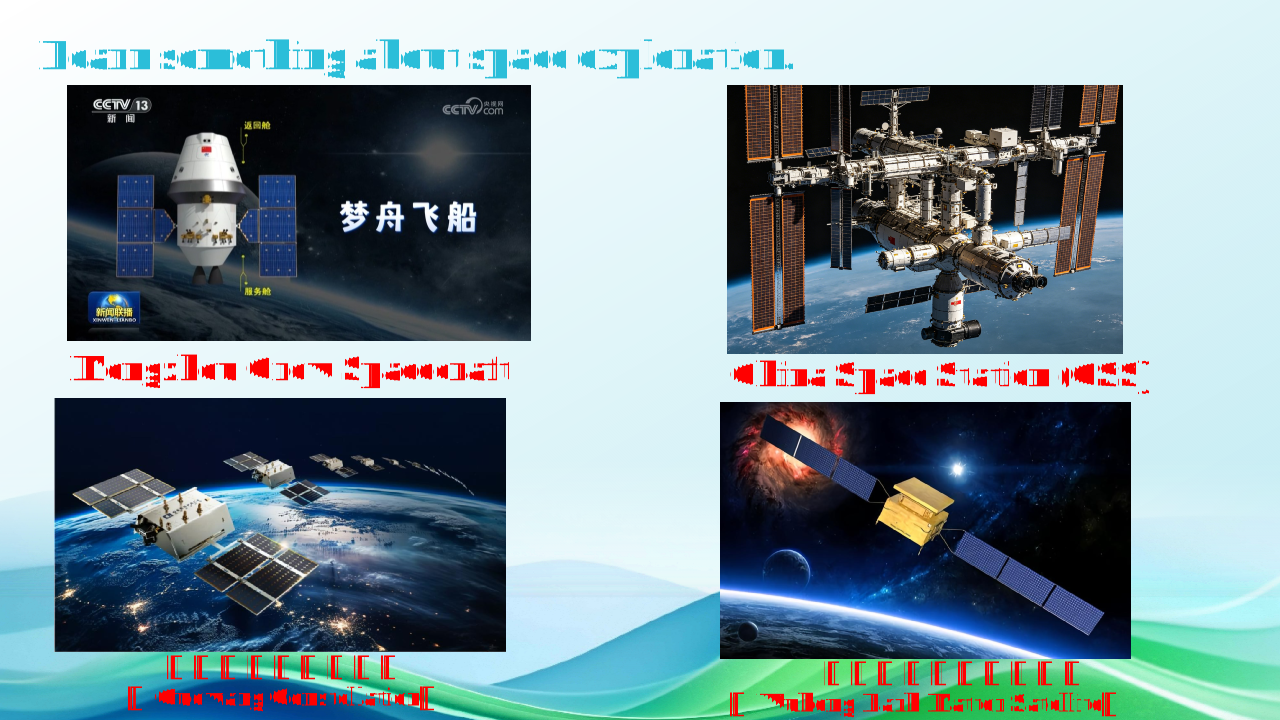
Learn something about space exploration.
Mengzhou Crew Spacecraft
China Space Station (CSS)
低轨互联网星座卫星
(Guowang Constellation)
悟空号暗物质探测卫星
(Wukong Dark Matter Satellite)
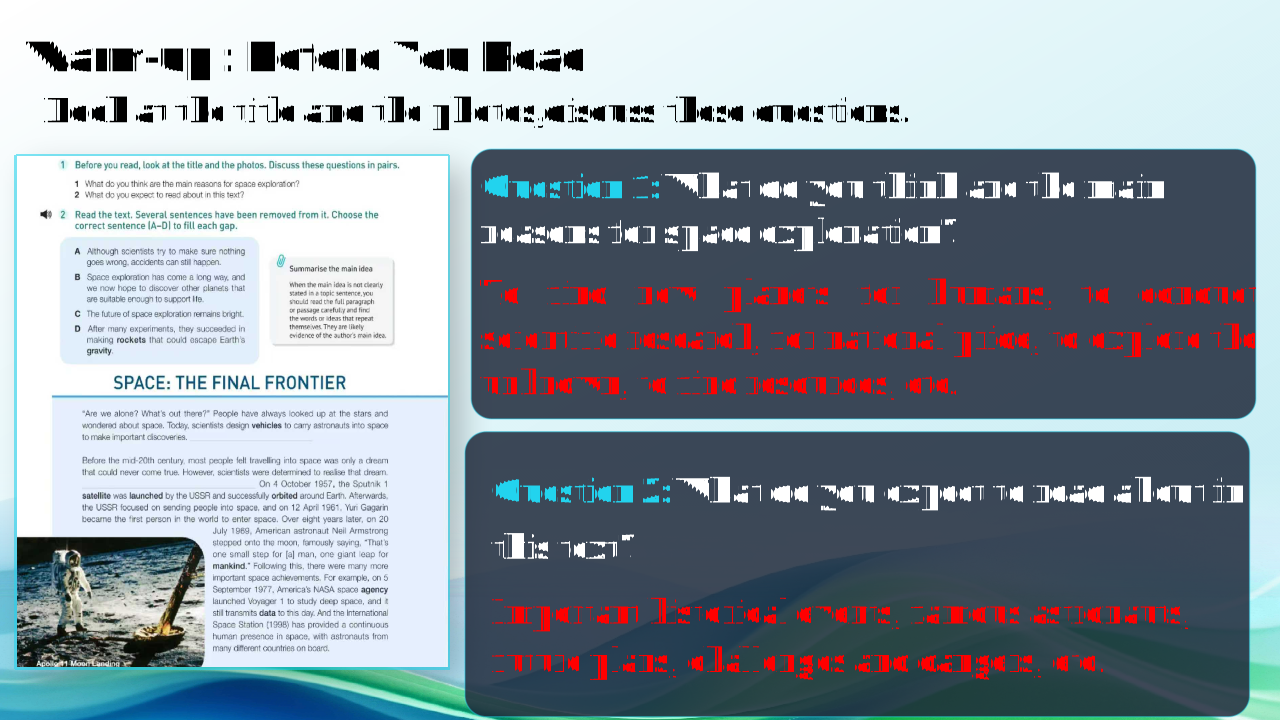
Warm-up : Before You Read
Question 1:What do you think are the main reasons for space exploration?
To find new planets for humans, to conduct scientific research, for national pride, to explore the unknown, to find resources, etc.
Question 2:What do you expect to read about in this text?
Important historical events, famous astronauts, future plans, challenges and dangers, etc.
Look at the title and the photos,discuss these questions.
1. What is the type of the article?
A. A novel.
B. A travel journal.
C. A popular science article.
D. A piece of news.
科普文章:不是高深专业论文,是普通人能看懂的科学知识
2. Where can you find this kind of passage?
A. Science Fiction
B. Novel
C. Health Magazine
D. Science book
Activity 1: Read the passage quickly, and choose the answers.
Fast reading
Fast reading
Activity 2: Read the text. Several sentences have been removed from it. Choose the correct sentence (A-D) to fill each gap.
A. Although scientists try to make sure nothing goes wrong, accidents can still happen.
B. Space exploration has come a long way, and we now hope to discover other planets that are suitable enough to support life
C. The future of space exploration remains bright.
D.After many experiments, they succeeded in making rockets that could escape Earth's gravity.
Summarise the main idea
When the main idea is not clearly stated in a topic sentence, you should read the full paragraph or passage carefully and find the words or ideas that repeat themselves. They are likely evidence of the author's main idea.
A. Although scientists try to make sure nothing goes wrong, accidents can still happen.
B. Space exploration has come a long way, and we now hope to discover other planets that are suitable enough to support life.
C. The future of space exploration remains bright.
D.After many experiments, they succeeded in making rockets that could escape Earth's gravity.
虽然科学家们极力确保万无一失,但事故仍时有发生。
太空探索已经取得了长足的进步,我们现在希望能发现其他适合生命生存的行星。
太空探索的前景依旧一片光明。
经过无数次试验,他们成功制造出了能够脱离地球引力的火箭。
Para 1
B
A. Although scientists try to make sure nothing goes wrong, accidents can still happen.
B. Space exploration has come a long way, and we now hope to discover other planets that are suitable enough to support life.
C. The future of space exploration remains bright.
D.After many experiments, they succeeded in making rockets that could escape Earth's gravity.
虽然科学家们极力确保万无一失,但事故仍时有发生。
太空探索已经取得了长足的进步,我们现在希望能发现其他适合生命生存的行星。
太空探索的前景依旧一片光明。
经过无数次试验,他们成功制造出了能够脱离地球引力的火箭。
Para 2
D
Before the mid-20th century, most people felt travelling into space was only a dream that could never come true. However, scientists were determined to realise that dream. _____________. On 4 October 1957, the Sputnik 1satellite was launched by the USSR and successfully orbited around Earth, Afterwards,the USSR focused on sending people into space, and on 12 April 1961, Yuri Gagarin became the first person in the world to enter space. Over eight years later, on 20 July 1969, American astronaut Neil Armstrong stepped onto the moon, famously saying, "That's one small step for man, one giant leap for mankind."......
A. Although scientists try to make sure nothing goes wrong, accidents can still happen.
B. Space exploration has come a long way, and we now hope to discover other planets that are suitable enough to support life.
C. The future of space exploration remains bright.
D.After many experiments, they succeeded in making rockets that could escape Earth's gravity.
虽然科学家们极力确保万无一失,但事故仍时有发生。
太空探索已经取得了长足的进步,我们现在希望能发现其他适合生命生存的行星。
太空探索的前景依旧一片光明。
经过无数次试验,他们成功制造出了能够脱离地球引力的火箭。
Para 3
A
_________. For example, all the astronauts on the Soyuz 11, Challenger, and Columbia spacecrafts died during their missions. However, while such disasters brought much sadness and disappointment, the desire to explore the universe did not die. This is because people believe in the importance of carrying on space exploration despite the huge risks.
A. Although scientists try to make sure nothing goes wrong, accidents can still happen.
B. Space exploration has come a long way, and we now hope to discover other planets that are suitable enough to support life.
C. The future of space exploration remains bright.
D.After many experiments, they succeeded in making rockets that could escape Earth's gravity.
虽然科学家们极力确保万无一失,但事故仍时有发生。
太空探索已经取得了长足的进步,我们现在希望能发现其他适合生命生存的行星。
太空探索的前景依旧一片光明。
经过无数次试验,他们成功制造出了能够脱离地球引力的火箭。
Para 5
C
_________. Many countries have plans to further study planets like Mars and Jupiter. Despite the difficulties, scientists hope to make more valuable discoveries that will enable the human race to survive well into the future.
Fast reading
Activity 3: Summarise the main idea for each paragraph.
Para. 1
Para. 2
Para. 3
Para. 4
Para. 5
The future of space exploration remains bright.
Scientists want to explore the universe.
Humans have realized their dreams to explore space.
Humans carry on space exploration despite huge risks.
China's achievements in exploring space.
Careful reading ---- Para 1
"Are we alone? What's out there?" People have always looked up at the stars and wondered about space. Today, scientists design vehicles to carry astronauts into space to make important discoveries. Space exploration has come a long way, and we now hope to discover other planets that are suitable enough to support life.
1.The underlined word “wondered” is closest in meaning to ______.
A. admired
B. doubted
C. felt curious and puzzled
D. regretted
2.We can infer from Para.1 that ______.
A. Only scientists are interested in space
B. Space exploration is driven by human curiosity
C. We have already solved all space mysteries
D. Space vehicles are useless without astronauts
Careful reading ---- Para 2
Before the mid-20th century, most people felt (that) travelling into space was only a dream that could never come true. However, scientists were determined to realise that dream. After many experiments, they succeeded in making rockets that could escape Earth's gravity. On 4 October 1957, the Sputnik 1 satellite was launched by the USSR and successfully orbited around Earth.Afterwards,the USSR focused on sending people into space, and on 12 April 1961, Yuri Gagarin became the first person in the world to enter space. Over eight years later, on 20 July 1969, American astronaut Neil Armstrong stepped onto the moon, famously saying, "That's one small step for (a) man, one giant leap for mankind."Following this, there were many more important space achievements. For example, on 5 September 1977, America's NASA space agency launched Voyager 1 to study deep space, and it still transmits data to this day. And the International Space Station (1998) has provided a continuous human presence in space, with astronauts from many different countries on board.
Which statement of the following is true ?
A. Space exploration has gradually become a global cause.
B. All space achievements were made only by the two countries.
C. People’s dream of space travel will never come true.
D. Voyager 1 only studies the moon nearby.
Careful reading ---- Para 3
Although scientists try to make sure nothing goes wrong, accidents can still happen. For example, all the astronauts on the Soyuz 11, Challenger, and Columbia spacecrafts died during their missions. However, while such disasters brought much sadness and disappointment, the desire to explore the universe did not die. This is because people believe in the importance of carrying on space exploration despite the huge risks.
1.What is the real reason for continuing space exploration despite disasters?
A. Astronauts are not afraid of death at all.
B. People recognize its great value despite potential risks.
C. Disasters never cause real sadness to humans.
D. Other countries force each other to carry on.
2.We can infer that the writer’s attitude towards space exploration is ______.
A. critical
B. supportive and positive
C. doubtful
D. uninterested
Careful reading ---- Para 4
China's space programme started later than those of Russia and the US, but it has made great progress in a short time. China became the third country in the world to independently send humans into space in 2003, when Yang Liwei successfully orbited Earth in the Shenzhou 5 spacecraft. Then Shenzhou 6 and 7 completed a second manned orbit and the first Chinese spacewalk, followed by the vehicle Jade Rabbit being sent to the moon to study its surface.On 23 July 2020 China sent Tianwen 1 to explore the surface of Mars. It arrived in February 2021 and then sent back lots of valuable information, And from 2021 to 2022, China completed a number of rocket missions to establish its own space station. In 2022, the launch of the Mengtian module signalled the basic completion of the Tiangong Space Station. This modern space station will allow astronauts to conduct many important experiments, greatly furthering our understanding of the universe.
Which statement is NOT true according to Paragraph 4?
A. China carried out its space programme later than Russia and the US.
B. Yang Liwei was the first Chinese astronaut orbiting Earth alone.
C. China has sent astronauts to land on the moon successfully.
D. Tianwen 1 brought back valuable information from Mars.
Careful reading ---- Para 5
The future of space exploration remains bright. Many countries have plans to further study planets like Mars and Jupiter. Despite the difficulties, scientists hope to make more valuable discoveries that will enable the human race to survive well into the future.
1.What is the final purpose of future space exploration?
A. To study Mars and Jupiter for fun.
B. To help human beings survive long-term in the future.
C. To move all humans to other planets at once.
D. To stop all difficulties on the earth.
2.We can infer from Para.5 that ______.
A. Scientists are optimistic about future space exploration
B. Difficulties will stop all space exploration plans
C. Space exploration has nothing to do with human future
D. Only studying Mars can save humans
What does the title “Space: The final frontier” mean
to you?
The title "Space: The Final Frontier" means:
1.Space is the last, most unknown and challenging place for humans to explore.
2. It shows that space is full of mysteries we haven't solved yet.
3.It encourages us to keep exploring and learning about the universe, even though it's difficult and dangerous.
Post-reading
Complete the passage with words from the text.
________ is exploring space in the hope of finding out more about the __________. However, exploring space is both dangerous and challenging. One of the most dangerous parts of space exploration is helping people to escape Earth's _________. If there is a mistake during the _________, it can lead to an accident that kills everyone on __________. Getting out of _______ and back to Earth's surface is also very dangerous. Despite the huge risks though, people will always continue to explore this final __________ so as to learn its secrets.
Post-reading
Man
universe
gravity
launch
board
orbit
frontier
单击此处编辑母版标题样式
Language points and translation
SPACE: THE FINAL FRONTIER
"Are we alone? What's out there?" People have always looked up at the stars and wondered about space. Today, scientists design vehicles to carry astronauts into space to make important discoveries. Space exploration has come a long way, and we now hope to discover other planets that are suitable enough to support life.
1.out there
在外面,在遥远的外面、在太空深处、在天外
2.look up at sth /sb
向上看着某人或某物
3.wonder about ...
想知道 ;对...感到惊奇
4.space n. 太空,
零冠词用法,不可数名词
5.carry sb/sth into space
把某人/某物送入太空
6.make important discoveries
有重要发现
7.hope to do sth 希望做某事
8.that引导定语从句,在从句中做主语,先行词是planets。
太空:最后的边疆
我们是孤独的吗?外太空有什么?” 人们总是仰望星空,对宇宙充满好奇。如今,科学家们设计航天器,将宇航员送入太空,以期做出重要发现。太空探索已经取得了长足的发展,如今我们希望能发现其他适宜生命生存的行星。
Before the mid-20th century, most people felt (that) travelling into space was only a dream that could never come true. However, scientists were determined to realise that dream. After many experiments, they succeeded in making rockets that could escape Earth's gravity. On 4 October 1957, the Sputnik 1 satellite was launched by the USSR and successfully orbited around Earth.
1.mid-20th century 20 世纪中叶
2.felt 后接宾语从句,连接词that省略;travelling...space是动名词短语做主语。
3. that could never...是定语从句,修饰dream
4. come true 实现(梦想)
5. be determined to do 下定决心做某事
6. realise that dream 实现这个梦想
7.succeed in 成功做某事
8. that引导定语从句,修饰rockets
9.escape Earth's gravity 脱离地球引力
10.orbit around Earth 环绕地球运行
在 20 世纪中叶之前,大多数人都觉得太空旅行只是一个永远无法实现的梦想。然而,科学家们下定决心要实现这个梦想。经过无数次试验,他们成功研制出了能够脱离地球引力的火箭。1957 年 10 月 4 日,苏联发射了斯普特尼克 1 号人造卫星,卫星成功环绕地球运行。
Afterwards,the USSR focused on sending people into space, and on 12 April 1961, Yuri Gagarin became the first person in the world to enter space. Over eight years later, on 20 July 1969, American astronaut Neil Armstrong stepped onto the moon, famously saying, "That's one small step for (a) man, one giant leap for mankind."
1.focus on专注于 集中
2. send ...into space 发送....到太空
3.the first person in the world to enter
space, person 前有first序数词修饰,
用to enter..不定式短语做后置定语,
修饰person
4.famously saying....是现在分词短语做
伴随状语。
5. mankind n. 人类, 是不可数名词,
零冠词用法
同义词:
man 不可数, 不加冠词
humankind 不可数,不加冠词
the human race 用单数
humans 用复数
human beings 用复数
此后,苏联致力于将人类送入太空;1961 年 4 月 12 日,尤里・加加林成为世界上进入太空的第一人。八年后,1969年7月20日,美国宇航员尼尔·阿姆斯特朗踏上月球,他说了一句名言:“这是我个人的一小步,却是人类的一大步。”
Following this, there were many more important space achievements. For example, on 5 September 1977, America's NASA space agency launched Voyager 1 to study deep space, and it still transmits data to this day. And the International Space Station (1998) has provided a continuous human presence in space, with astronauts from many different countries on board.
1.following prep. 在…… 之后
2.deep space 深太空
3.to this day 直到今天
4.presence n. 存在
5. in space 在太空中
6. with + n. (astronauts from many different countries)+ 介词短语(on board),在句中做状语
7. on board 在(飞船 / 空间站)上
在此之后,还有许多更重要的太空成就。例如,1977年9月5日,美国国家航空航天局发射了旅行者1号来研究深空,它至今仍在传输数据。1998年的国际空间站(InternationalSpace Station)也为人类在太空中提供了持续的存在,来自许多不同国家的宇航员都在上面。
Although scientists try to make sure nothing goes wrong, accidents can still happen. For example, all the astronauts on the Soyuz 11, Challenger, and Columbia spacecrafts died during their missions. However, while such disasters brought much sadness and disappointment, the desire to explore the universe did not die. This is because people believe in the importance of carrying on space exploration despite the huge risks.
1. although 引导让步状语从句
2. make sure 确保
3. go wrong 发生故障 ;出毛病
4.while 引导让步状语从句
5.to explore the unverse 是不定式短语做后置定语,修饰desire
6. because 引导表语从句
7. believe in sth 相信
8. carry on sth 继续某事
9. space exploration 太空探索
尽管科学家们试图确保一切顺利,但事故仍有可能发生。例如,联盟11号、挑战者号和哥伦比亚号宇宙飞船上的所有宇航员都在执行任务期间死亡。然而,尽管这些灾难带来了许多悲伤和失望,但探索宇宙的愿望并没有消失。这是因为人们相信尽管有巨大的风险,但进行太空探索的重要性。
China's space programme started later than those of Russia and the US, but it has made great progress in a short time. China became the third country in the world to independently send humans into space in 2003, when Yang Liwei successfully orbited Earth in the Shenzhou 5 spacecraft. Then Shenzhou 6 and 7 completed a second manned orbit and the first Chinese spacewalk, followed by the vehicle Jade Rabbit being sent to the moon to study its surface.
1.those 是替代词,替代前面的space programme,还原应该是space programmes
2.to independently send ..是不定式短语做后置定语,修饰有序数词修饰的country。
3. when引导非限制性定语从句,修饰先行词2003
4.followed by ...是过去分词短语做伴随状语
5. being sent to...是过去分词的进行时做后置定语,修饰Jade Rabbit.
中国的太空计划起步晚于俄罗斯和美国,但在短时间内取得了巨大进展。2003年,杨利伟成功驾驶神舟5号飞船绕地球轨道飞行,中国成为世界上第三个独立将人类送入太空的国家。随后,神舟6号和7号完成了第二次载人飞行和中国首次太空行走,随后,玉兔号被送往月球研究其表面。
On 23 July 2020 China sent Tianwen 1 to explore the surface of Mars. It arrived in February 2021 and then sent back lots of valuable information, And from 2021 to 2022, China completed a number of rocket missions to establish its own space station. In 2022, the launch of the Mengtian module signalled the basic completion of the Tiangong Space Station. This modern space station will allow astronauts to conduct many important experiments, greatly furthering our understanding of the universe.
1. a number of 许多的
2. signal vt. 标志着,预示
3. allow sb to do sth 允许某人做某事
4.conduct experiments 做实验
5. greatly furthering ... 是现在分词短语v
做结果状语。
2020年7月23日,中国发射了“天文一号”探测火星表面。它于2021年2月抵达,然后发回了许多有价值的信息。从2021年到2022年,中国完成了一系列火箭任务,建立了自己的空间站。2022年,梦天舱的发射标志着天宫空间站的基本建成。这个现代空间站将允许宇航员进行许多重要的实验,极大地促进我们对宇宙的理解。
The future of space exploration remains bright. Many countries have plans to further study planets like Mars and Jupiter. Despite the difficulties, scientists hope to make more valuable discoveries that will enable the human race to survive well into the future.
1. remain bright 前景光明、依旧光明
2. have plans to do 计划做...
3. further study 进一步研究
4. despite the difficulties 尽管困难重重
5. that 引导定语从句,修饰discoveries
6. enable sb to do sth 使某人能够做某事
7. the human race 人类(= mankind /humans/man/ human beings )
8.into the future 在未来;长久往后
太空探索的未来依然光明。许多国家都计划进一步研究火星和木星等行星。尽管困难重重,科学家们还是希望能有更多有价值的发现,使人类能够在未来生存得更好。
单击此处编辑母版标题样式
Thank you
$
资源预览图
1

2

3
4
5
6
相关资源
由于学科网是一个信息分享及获取的平台,不确保部分用户上传资料的 来源及知识产权归属。如您发现相关资料侵犯您的合法权益,请联系学科网,我们核实后将及时进行处理。