Unit 3 The world of Science Developing ideas 课件-2025-2026学年高一下学期英语外研版必修第三册
2026-05-10
|
14页
|
1216人阅读
|
21人下载
普通
资源信息
| 学段 | 高中 |
|---|---|
| 学科 | 英语 |
| 教材版本 | 高中英语外研版必修第三册 |
| 年级 | 高一 |
| 章节 | Developing ideas |
| 类型 | 课件 |
| 知识点 | - |
| 使用场景 | 同步教学-新授课 |
| 学年 | 2026-2027 |
| 地区(省份) | 全国 |
| 地区(市) | - |
| 地区(区县) | - |
| 文件格式 | PPTX |
| 文件大小 | 677 KB |
| 发布时间 | 2026-05-10 |
| 更新时间 | 2026-05-13 |
| 作者 | 悦悦青鸟 |
| 品牌系列 | - |
| 审核时间 | 2026-05-10 |
| 下载链接 | https://m.zxxk.com/soft/57789557.html |
| 价格 | 0.50储值(1储值=1元) |
| 来源 | 学科网 |
摘要:
该高中英语课件围绕富兰克林风筝实验的真实性展开,通过头脑风暴激活学生对科学家的已知认知,结合标题预测引导阅读期待,搭配词汇预览扫清科学实验相关术语障碍,搭建从经典科学故事到批判性探究的学习支架。
其亮点在于以“质疑-验证-结论”探究路径为核心,融合思维品质(批判性思维培养)、文化意识(科学精神跨文化价值)和语言能力(科学词汇与表达应用)。通过史料辨析、科学原理论证等段落分析,结合角色扮演(历史学家访谈)、辩论(质疑历史事件重要性)等活动,强化语言输出与理性思维。总结提炼科学精神本质,作业引导自主探究其他科学故事,助力学生提升探究能力,也为教师提供清晰的跨学科教学实施路径。
内容正文:
FLTRP High School English Compulsory 3 · Unit 3 Developing Ideas
Franklin's Experiment:
How much is true?
Duration: 45 minutes
Target Audience: Grade 10 Students
Contents
Teaching Objectives
教学目标
Title Analysis
标题分析
Text Structure
课文结构
Paragraph Analysis
段落解读
Main Idea
文章主旨
Discourse Purpose
语篇设计意图
Teaching Activities
配套教学活动
Summary & Assignment
总结与作业
Teaching Objectives
Linguistic Competence
Master core vocabulary and expressions related to scientific experiments, comprehensively enhancing English reading comprehension and critical thinking expression abilities.
Cultural Awareness
Understand Benjamin Franklin's life and scientific contributions, deeply comprehending the cross-cultural significance and universal value of the scientific spirit.
Thinking Quality
Develop critical thinking skills, learn to distinguish facts from legends, and approach historical events with a rational attitude.
Learning Ability
Master reading methods and strategies for popular science texts, effectively enhancing collaborative inquiry learning skills.
Title Analysis
Main Title
Franklin's Experiment
Identifies the core event of the text and activates students' prior knowledge of classic scientific stories
Subtitle
How much is true?
Uses an interrogative structure to create suspense and signals the text's critical inquiry nature
Function of Title
Guides readers from
"accepting facts"
"questioning and verifying"
Embodies the dialectical thinking characteristic of popular science texts
Text Structure
Introduction
Introduce the widely circulated version of Franklin's kite experiment
Development
Raise questions about the authenticity of the experiment and list historical evidence
In-depth Analysis
Analyze the reasons for the spread of the experiment and its historical background
Conclusion
Summarize the nature of scientific inquiry and guide rational thinking
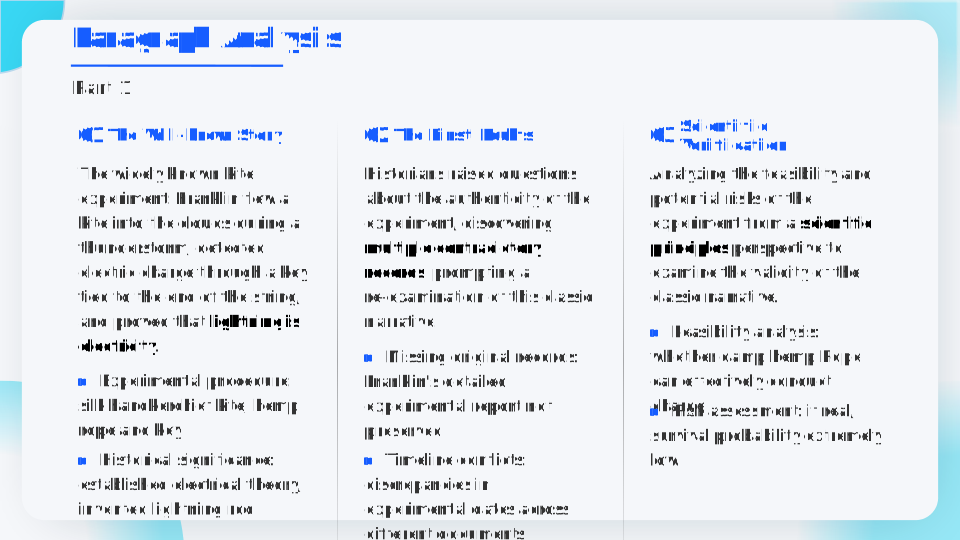
Paragraph Analysis
Part 1
01
The Well-known Story
The widely known kite experiment: Franklin flew a kite into the clouds during a thunderstorm, detected electric charge through a key tied to the end of the string, and proved that lightning is electricity.
▸ Experimental procedure: silk handkerchief kite, hemp rope and key
▸ Historical significance: established electrical theory, invented lightning rod
Classic textbook narrative
02
The First Doubts
Historians raised questions about the authenticity of the experiment, discovering multiple contradictory records, prompting a re-examination of this classic narrative.
▸ Missing original records: Franklin's detailed experimental report not preserved
▸ Timeline conflicts: discrepancies in experimental dates across different documents
The emergence of critical inquiry
03
Scientific Verification
Analyzing the feasibility and potential risks of the experiment from a scientific principles perspective to examine the validity of the classic narrative.
▸ Feasibility analysis: whether damp hemp Rope can effectively conduct charge
▸ Risk assessment: if real, survival probability extremely low
Rational verification approach
Paragraph 4: Historical Context
Analyze the social context in which the story was transmitted, revealing how Franklin's personal image was shaped and disseminated by the historical context of the era.
Paragraph 5: The Core of Science
Elevate the theme and clarify that the core of scientific inquiry lies in the adherence to empirical spirit, rather than the celebration of heroic legends.
Paragraph 6: Conclusion
Guide readers to view historical events dialectically, cultivating a truth-seeking and fact-based scientific attitude and critical thinking.
Paragraph Analysis - Part 2
Main Idea
Explore historical truths and cultivate critical thinking and scientific inquiry skills
Subject of Inquiry
The authenticity of Benjamin Franklin's famous kite experiment
Core Finding
Reveal the difference between historical events and popular legends, restoring the true nature of scientific exploration
Deep Implication
The essence of scientific exploration is a continuous process of questioning, verifying, and seeking truth
Rather than blindly worshiping authority and classic stories, examine every "established fact" with an open and prudent attitude
Discourse Purpose
DIMENSION 01
Instructional Dimension
Disrupt students' fixed perception of "established facts," cultivate critical reading skills, and enable students to learn to question and verify.
DIMENSION 02
Content Dimension
Integrate knowledge from history, science, and language disciplines, broaden knowledge horizons through discourse reading, and construct interdisciplinary thinking.
DIMENSION 03
Thinking Dimension
Guide students to master the inquiry approach of "raise questions — seek evidence — draw conclusions", establishing a scientific thinking pathway.
DIMENSION 04
Value Dimension
Convey the scientific spirit of "pursuing truth and seeking facts", cultivate core competencies of rational thinking, and shape responsible readers.
Teaching Activities — Pre-reading Activities
01
Brainstorming
Ask:What do you know about Benjamin Franklin?
Guide students to share prior knowledge and activate background knowledge
02
Prediction
Display the title, ask:What do you think the text will talk about?
Activate reading expectations and develop prediction strategies
03
Vocabulary Preview
Learn key vocabulary:experiment, electricity, lightning, verify
Clear reading obstacles and improve comprehension efficiency
Teaching Activities
While-reading Activities
01
Fast Reading
→
Task: Match each paragraph with its main idea
02
Careful Reading
→
Task: Complete the fact sheet about the experiment and doubts
03
Discussion
→
Topic: Do you think the experiment really happened? Why?
Teaching Activities - Post-reading Activities
1
Role-play
角色扮演
Scenario: Interview with a historian about Franklin's experiment
Objective: Simulate authentic interview scenarios to enhance language application skills
2
Debate
辩论活动
Motion: Is it important to question famous historical events?
Objective: Stimulate diverse perspectives and foster Critical Thinking skills
3
Writing
写作练习
Task: Write a short paragraph about the importance of critical thinking
Objective: Organize logical arguments and reinforce language output practice
Summary & Assignment
Lesson Summary
Reviewing the core arguments of the text, we recognize the crucial role of critical thinking in scientific inquiry. Scientific progress depends on the spirit of daring to question and verifying—rejecting blind obedience to authority, not credulously accepting hearsay, but seeking truth with a scientific spirit.
"The essence of science is skepticism, not blind belief."
—— The True Meaning of Scientific Spirit
Homework
1 Memorize the paragraph describing the experimental process, master key vocabulary and sentence patterns, and appreciate the rigorous expression of scientific description.
2 Research the authenticity of another famous scientific story, distinguish truth from falsehood, and share your findings in the next class.
3 Complete the reading exercises in the corresponding unit of the workbook to consolidate what you have learned in this lesson.
Questions & Answers
Thank You
$
资源预览图

1

2

3

4

5
6
相关资源
由于学科网是一个信息分享及获取的平台,不确保部分用户上传资料的 来源及知识产权归属。如您发现相关资料侵犯您的合法权益,请联系学科网,我们核实后将及时进行处理。