8.2 Cooking Skills-Reading&Culture Corner(教学设计)-《英语 基础模块3》(语文版2022版)《上好课》
2026-04-28
|
6页
|
69人阅读
|
0人下载
精品
内容正文:
课程名称
《英语 基础模块3》(语文版2022版)
Unit 8 Cooking Skills-Reading&Culture corner
教材分析
This lesson focuses on reading passages about Chinese cooking methods and the cultural philosophy behind Chinese cuisine. It aims to:
1 Build on the vocabulary and concepts introduced in the previous listening lesson.
2 Develop students' reading comprehension skills, specifically the ability to identify main ideas and key details.
3 Introduce cultural knowledge, such as the principles of Yin-Yang and Five Elements, which adds depth to the language learning.
4 The text is structured with clear headings and pictures, making it accessible for students with a basic English level.
学情分析
Knowledge Base: Students have learned basic vocabulary for cooking methods (e.g., boil, steam, stir-fry) and are familiar with the topic.
Ability Level: They can read short, simple texts but struggle with longer sentences and abstract cultural concepts.
Interest & Attitude: Students are highly interested in food topics, which can motivate them to engage with the reading.
Learning Difficulties: Key challenges include understanding complex sentence structures, grasping abstract cultural ideas, and expressing their understanding in English.
教学目标
(1) Knowledge Objectives
1 Master key vocabulary: boiling, steaming, stir-frying, fame, ingredient, wok, steamer, balance, cuisine.
2 Understand the definitions, processes, and typical dishes for boiling, steaming, and stir-frying.
3 Learn about the cultural concepts of Yin-Yang and Five Elements as they relate to Chinese cooking.
(2) Skill Objectives
4 Reading: Improve the ability to scan for specific information (e.g., the process of stir-frying) and to identify the main idea of a paragraph.
5 Speaking: Enhance skills to describe a cooking method using simple English.
6 Critical Thinking: Develop the ability to compare different cooking methods.
(3) Emotional & Cultural Objectives
7 Foster an appreciation for the depth and sophistication of Chinese culinary culture.
8 Build confidence in reading and discussing cultural topics in English.
9 Encourage students to value their own cultural heritage.
教学重难点
Key Points: Understanding the key information about each cooking method and mastering the new vocabulary.
Difficult Points: Grasping the abstract cultural concepts (Yin-Yang, balance) and explaining a cooking method in English.
教学方法
Task-Based Language Teaching (TBLT): Students complete reading tasks to achieve
specific learning goals.
Visual Aids Method: Use pictures, videos, and realia to explain abstract concepts and
vocabulary.
Cooperative Learning Method: Encourage pair and group work to facilitate discussion and
peer learning.
课前准备
(1) Teacher Preparation
Tools: A computer, projector, and realia (a small wok, a steamer basket, and toy food models).
Backup Plan: Prepare a simplified version of the reading text for students with weaker foundations.
(2) Student Preparation
Review the cooking vocabulary learned in the previous lesson.
Think about their favorite Chinese dish and be ready to share how it is cooked.
教学媒体
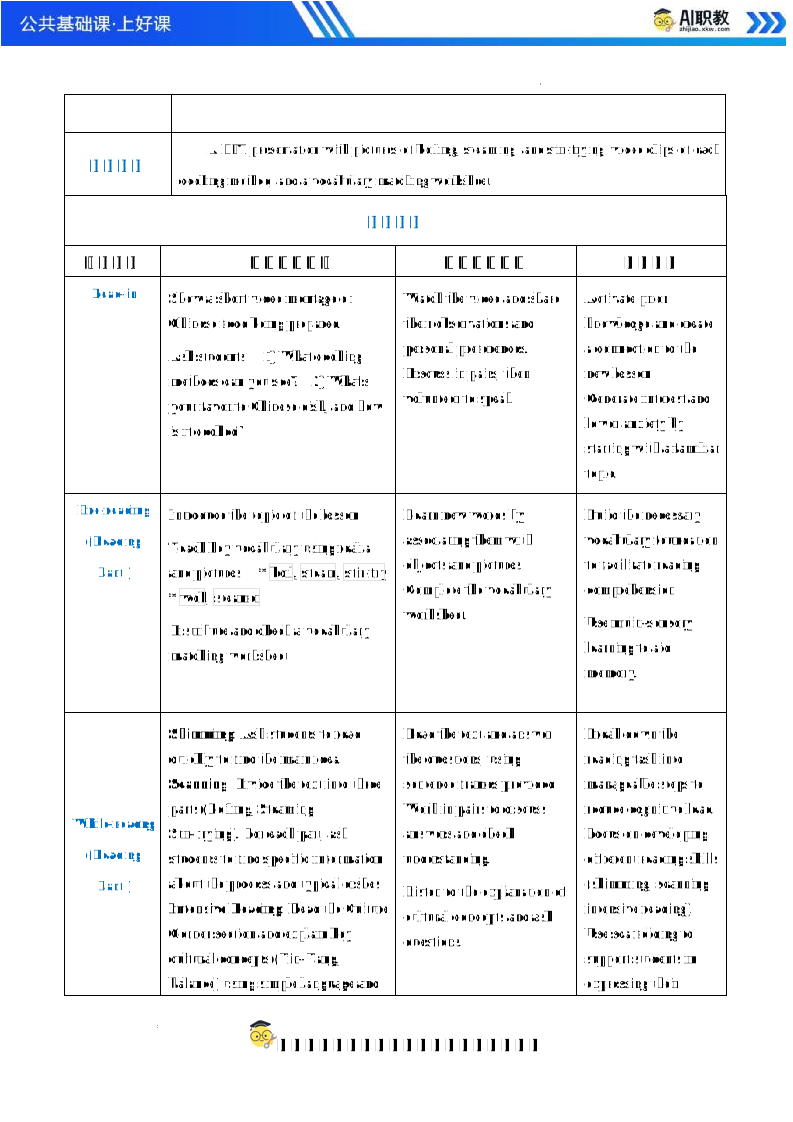
A PPT presentation with pictures of boiling, steaming, and stir-frying, video clips of each cooking method, and a vocabulary matching worksheet.
教学过程
教学环节
教师活动设计
学生活动设计
设计意图
Lead-in
Show a short video montage of Chinese food being prepared.
Ask students: 1) What cooking methods can you see? 2) What's your favorite Chinese dish, and how is it cooked?
Watch the video and share their observations and personal preferences. Discuss in pairs, then volunteer to speak.
Activate prior knowledge and create a connection to the new lesson. Generate interest and lower anxiety by starting with a familiar topic.
Pre-reading
(Reading Part )
Introduce the topic of the lesson.
Teach key vocabulary using realia and pictures: * boil, steam, stir-fry * wok, steamer
Distribute and check a vocabulary matching worksheet.
Learn new words by associating them with objects and pictures. Complete the vocabulary worksheet.
Build the necessary vocabulary foundation to facilitate reading comprehension.
Use multi-sensory learning to aid memory.
While-readng
(Reading Part )
Skimming: Ask students to read quickly to find the main idea. Scanning: Divide the text into three parts (Boiling, Steaming, Stir-frying). For each part, ask students to find specific information about the process and typical dishes. Intensive Reading: Read the Culture Corner section and explain key cultural concepts (Yin-Yang, balance) using simple language and examples.
Read the text and answer the questions, using sentence frames provided. Work in pairs to discuss answers and check understanding.
Listen to the explanation of cultural concepts and ask questions.
Break down the reading task into manageable steps to reduce cognitive load. Focus on developing different reading skills (skimming, scanning, intensive reading). Use scaffolding to support students in expressing their understanding.
Post-reading
(Reading Part )
Divide the class into groups of
3. Assign each group one cooking method and ask them to create a short presentation explaining: 1) The name of the method. 2) The cooking process. 3) One typical dish. - Circulate to offer help.
Work in groups to prepare presentations, using the text and their own words. Present their work to the class and answer questions.
Provide a meaningful context for students to practice using the new vocabulary and information. Encourage collaboration and develop presentation skills.
Summary &Homework
Summarize key information about each cooking method and the cultural concepts.
Assign homework: 1) Write a short paragraph describing how to cook their favorite dish. 2) Find a picture of a dish cooked by boiling, steaming, or stir-frying and bring it to the next class.
Blackboard design
Unit 8 Cooking Skills
Warm-up:
My favorite dish is... It is cooked by...
Key Vocabulary:
boil, steam, stir-fry, ingredient, wok, steamer
Cooking Methods:
| Method | Process | Typical Dishes
| Boiling | Place food in boiling water. | Noodles, soup |
| Steaming | Put food in a steamer basket over water. | Buns, dumplings |
| Stir-frying| Cook ingredients in hot oil in a wok. | Fried rice, vegetables|
Cultural Corner:
Yin-Yang & Balance
Chinese cuisine = Culture + Health
Teaching Evaluation
(1) Formative Assessment
1 Observation: Monitor students' participation in group discussions and presentations.
2 Questioning: Ask individual students to explain the process of a cooking method.
3 Worksheet Check: Review the completed vocabulary worksheets and reading comprehension answers.
(2) Summative Assessment
Evaluate the students' written homework paragraphs for content accuracy and vocabulary usage.
(3) Self-Assessment
Ask students to rate their own understanding of the cooking methods (1-5 scale) at the end of the lesson.
Teaching reflection
(1) Successes
1 The use of realia and videos significantly increased student engagement and understanding.
2 Group work allowed students to practice speaking in a low-pressure environment.
(2) Areas for Improvement
1 Some students struggled with the Culture Corner text. In future, I will pre-teach more of the key cultural terms.
2 More time should be allocated for group work to ensure all students contribute.
(3) Future Adjustments
1 Differentiate the reading tasks by providing two versions of the text: one with more vocabulary support for weaker students, and one with fewer clues for stronger students.
2 Integrate a tasting activity in the next lesson, where students can try foods cooked by different methods, to make the learning more memorable.
精品资源学科网独家享有版权,侵权必究!
学科网(北京)股份有限公司
学科网(北京)股份有限公司
$
资源预览图

1

2
3

由于学科网是一个信息分享及获取的平台,不确保部分用户上传资料的 来源及知识产权归属。如您发现相关资料侵犯您的合法权益,请联系学科网,我们核实后将及时进行处理。