非谓语动词现在分词、过去分词学案-2026届高三英语二轮复习
2026-04-21
|
2份
|
12页
|
930人阅读
|
1人下载
普通
资源信息
| 学段 | 高中 |
|---|---|
| 学科 | 英语 |
| 教材版本 | - |
| 年级 | 高三 |
| 章节 | - |
| 类型 | 学案-学习任务单 |
| 知识点 | 非谓语动词 |
| 使用场景 | 高考复习-二轮专题 |
| 学年 | 2026-2027 |
| 地区(省份) | 全国 |
| 地区(市) | - |
| 地区(区县) | - |
| 文件格式 | ZIP |
| 文件大小 | 85 KB |
| 发布时间 | 2026-04-21 |
| 更新时间 | 2026-04-21 |
| 作者 | xkw_086619817 |
| 品牌系列 | - |
| 审核时间 | 2026-04-21 |
| 下载链接 | https://m.zxxk.com/soft/57456174.html |
| 价格 | 2.00储值(1储值=1元) |
| 来源 | 学科网 |
内容正文:
非谓语动词--现在分词、过去分词
Part 1
I. 参照示例,试着用分词 (-ing/-ed) 改写划线句子。
An opportunity that is lost never returns.
A lost opportunity never returns.
1. The driver who was injured in the accident was taken to hospital.
___________________________________________________________________________________
2. Do you know the girl who is playing the violin?
___________________________________________________________________________________
3. The men who were working on the building site were in some danger.
___________________________________________________________________________________
4. There are 13 million items that are listed on taobao.
___________________________________________________________________________________
5. Here is a list of the top 10 highest-paying jobs a teacher who has retired can pursue.
___________________________________________________________________________________
思考:
1. 何时用现在分词(-ing)改写?何时用过去分词(-ed)改写?
___________________________________________________________________________________
2. 改写后的句子中,现在分词(-ing)和过去分词(-ed)的功能和逻辑是什么?
___________________________________________________________________________________
3. 改写前的句子有几个谓语动词?改写后呢?
___________________________________________________________________________________
II. 观察下列短语,判断分词的意义和功能,并将其归类。
falling stones, fallen leaves,
the setting sun, the risen sun,
injured soldiers, a developing country,
boiled water, running water,
a broken cup, trained employees,
a retired teacher, escaped prisoners
分词的意义和功能
短语
现在分词 (doing)
表示主动意义,与逻辑主语构成主谓关系,表示正在进行的动作
过去分词 (done)
1) 对于及物动词而言,过去分词表示被动意义,与逻辑主语/所修饰的名词构成动宾关系,表示完成的动作
2) 对于不及物动词而言,过去分词表示主动意义,与逻辑主语构成主谓关系,表示完成的动作
III. 用括号中动词的适当形式填空。
1. A _________ (grow) man never lets anyone else make his decision.
2. _________ (grow) children need good nourishment.
3. The _________ (fall) snow was frozen hard.
4. I love the noise of _________ (fall) rain.
5. Dick jumped out of the way of the _________ (approach) train.
6. More traffic will be able to pass on the _________ (widen) road.
7. Clint can’t bear the smell of _________ (burn) bread.
8. Stay away from the _________ (burn) coal.
9. After jumping into the water, the lifeguard rescued the _________ (drown) child.
10. The mother of the _________ (drown) child was grieved to death.
11. The manager needs another copy of the _________ (sign) contract.
12. One should always be careful with _________ (load) guns.
13. The composer was very happy to hear his works _________ (play) by the famous orchestra.
14. If I correct someone, I will do it in a considerate way as if I were the one _________ (correct).
15. The _________ (age) population is a serious problem in Japan.
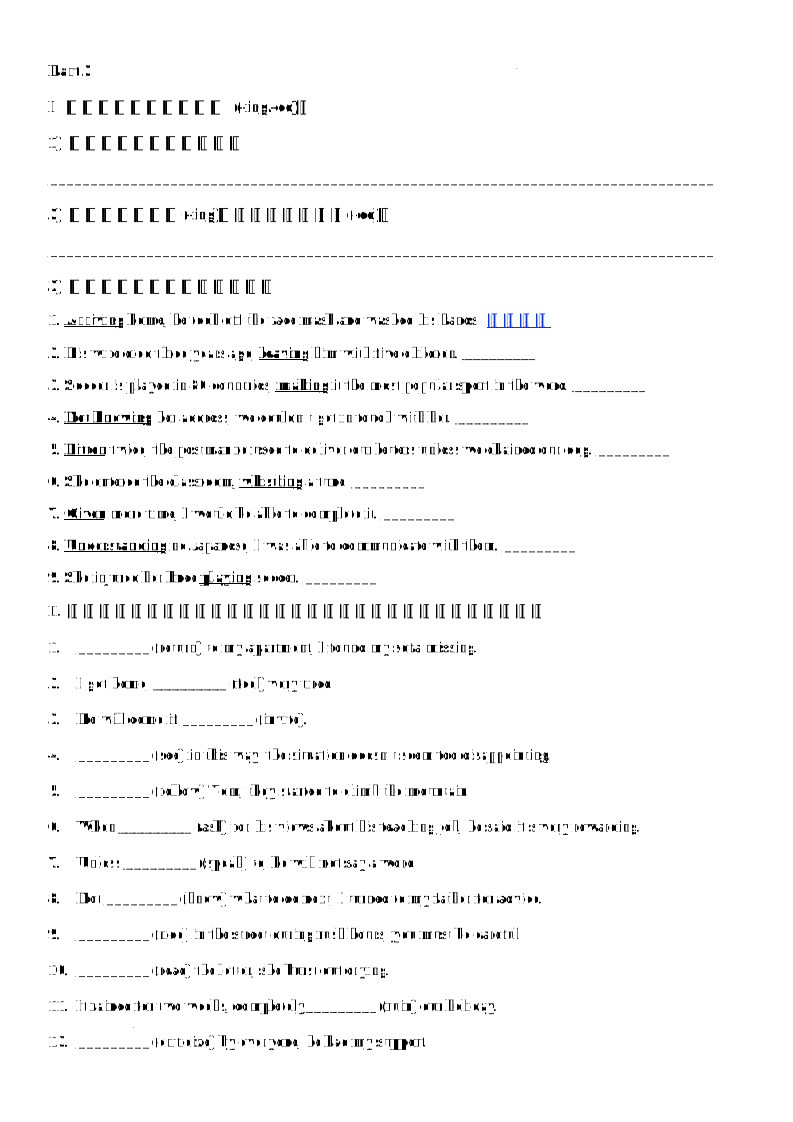
Part 2
I. 观察下列句子中的分词 (-ing/-ed),
1) 句子中有几个谓语动词?
___________________________________________________________________________________
2) 何时用现在分词(-ing)?何时用过去分词(-ed)?
___________________________________________________________________________________
3) 这些分词表示的逻辑是什么?
1. Arriving home, he took off the face mask and washed his hands. 时间状语
2. His wife died three years ago, leaving him with five children. _________
3. Soccer is played in 80 countries, making it the most popular sport in the word. _________
4. Not knowing her address, we couldn’t get in touch with her. _________
5. Bitten twice, the postman refused to deliver our letters unless we chained our dog. _________
6. She entered the classroom, whistling a tune. _________
7. Given more time, I would be able to complete it. _________
8. Understanding no Japanese, I was able to communicate with them. _________
9. She injured her knee playing soccer. _________
II. 用括号中动词的适当形式填空。判断所填分词的功能和逻辑是什么。
1. _________ (return) to my apartment, I found my sofa missing.
2. I got home, _________ (feel) very tired.
3. He will come if _________ (invite).
4. _________ (see) in this way, the situation doesn’t seem too disappointing.
5. _________ (follow) Tom, they started to climb the mountain.
6. When _________ (ask) for his views about his teaching job, he said it’s very rewarding.
7. Unless _________ (speak) to, he will not say a word.
8. Not _________ (know) what to do next, I turned to my father for advice.
9. _________ (ride) in the street during rush hours, you must be careful.
10. _________ (read) the letter, she burst out crying.
11. It rained for two weeks, completely_________ (ruin) our holiday.
12. _________ (criticize) by everyone, he had my support.
Part 3
I. 观察下列句子中的分词 (-ing/-ed),
1) 句子中有几个谓语动词?这些谓语动词有什么特征?
___________________________________________________________________________________
2) 这些分词的功能是什么?
___________________________________________________________________________________
3) 何时用现在分词(-ing)?何时用过去分词(-ed)?
___________________________________________________________________________________
1. His words left me wondering about his real intention.
2. He has his hair cut every 20 days.
3. Next time I catch you stealing from others, I will turn you into the police.
4. You will see this product advertised wherever you go.
5. They will have you arrested if you don’t pay your taxes.
6. The dying soldier had the message sent straight to the commander.
II. 用括号中动词的适当形式填空。
1. The manager promised to keep me _________ (inform) of how our business was going on.
2. Paul had his bag _________ (steal) while he was traveling.
3. When are you going to get the roof _________ (repair)?
4. Don’t leave the water _________ (run) while you brush your teeth.
5. Security is very strict at the airport. We all have our bags _________ (search).
6. He has kept the machine _________ (run) for eight hours.
7. Can you smell something _________ (burn)?
8. We looked everywhere for Paul, and finally we found him _________ (sit) under a tree in the garden.
9. I can feel something _________ (crawl) up my leg! It must be an insect.
10. Her pronunciation is terrible. She can hardly make herself _________ (understand) when she speaks English.
第一部分:使用动词的正确形式填空。并判断这些分词的功能。
1. A great number of students _________ (question) said they were forced to practice the piano.
2. _________ (strike) by his wisdom and humor at their first meeting, the chairman immediately invited him to attend the coming Science Conference.
3. Lots of rescue workers were working around the clock, _________ (send) supplies to Yushu, Qinghai Province after the earthquake.
4. 21,880 persons applied for the torch relay of the 2008 Olympic Games, _________ (make) it the biggest in the Games’ history.
5. The wild flowers looked like a soft orange blanket _________ (cover) the desert.
6. With all the problems _________ (solve), you can finally sit back and enjoy life.
7. No matter how frequently _________ (perform), the works of Beethoven still attract people all over the world.
8. _________ (know) as one of the most important inventions of the time, the computer helps people living in different countries to do a lot of things.
9. _________ (compare) with the size of the whole earth, the biggest ocean does not seem big at all.
10. _________ (found) in the early 20th century, the school keeps on inspiring children’s love of art.
11. Time, _________ (use) correctly, is money in the bank.
12. He had his ankle _________ (injure) in the game yesterday.
13. Before driving into the city, you are required to get your car _________ (wash).
14. It was so cold that they kept the fire _________ (burn) all night.
15. Sarah pretended to be cheerful, _________ (say) nothing about the argument.
16. You shouldn’t come to his party unless _________ (invite).
17. Recently a survey _________ (compare) prices of the same goods in two different supermarkets has caused heated debate among citizens.
18. The players _________ (select) from the whole country expected to bring us honor in this summer game.
19. He saw smoke _________ (rise) from behind the house.
20. _________ (feel) tired, I went to bed early.
第二部分:短文填空
One day, about ten years ago, while ___1___ (work) at the cash register in the gift shop at my University Museum of Natural History, I saw an elderly couple ___2___ (come) in with a little girl in a wheelchair. ___3___ (look) closer at this girl, I found that she ___4___ (fix) on her chair. I then ___5___ (realize) she had no arms or legs, just a head, a neck and upper body, ___6___ (dress) in a little white skirt.
学科网(北京)股份有限公司
$
非谓语动词--现在分词、过去分词
Part 1
I. 参照示例,试着用分词 (-ing/-ed) 改写划线句子。
An opportunity that is lost never returns.
A lost opportunity never returns.
1. The driver who was injured in the accident was taken to hospital.
The driver injured in the accident was taken to hospital.
2. Do you know the girl who is playing the violin?
Do you know the girl playing the violin?
3. The men who were working on the building site were in some danger.
The men working on the building site were in some danger.
4. There are 13 million items that are listed on taobao.
There are 13 million item listed on taobao.
5. Here is a list of the top 10 highest-paying jobs a teacher who has retired can pursue.
Here is a list of the top 10 highest-paying jobs a retired teacher can pursue.
思考:
1. 何时用现在分词(-ing)改写?何时用过去分词(-ed)改写?
参照被修饰的名词,如果表达主动的、正在发生的动作用现在分词(-ing)改写;如果表达被动的、完成的动作用过去分词(-ed)改写。
2. 改写后的句子中,现在分词(-ing)和过去分词(-ed)的功能和逻辑是什么?
现在分词(-ing)和过去分词(-ed)都做定语,修饰某个名词,功能类似定语从句。
如果单个分词作定语,一般置于被修饰名词的前面。
如果分词短语作定语,一般置于被修饰名词的后面。
3. 改写前的句子有几个谓语动词?改写后呢?
改写前的句子都含定语从句,有关系词,可以有两个谓语动词。
改写后,无关系词,只能有一个谓语动词,因此分词结构被称为非谓语。
II. 观察下列短语,判断分词的意义和功能,并将其归类。
falling stones, fallen leaves,
the setting sun, the risen sun,
injured soldiers, a developing country,
boiled water, running water,
a broken cup, trained employees,
a retired teacher, escaped prisoners
分词的意义和功能
短语
现在分词 (doing)
表示主动意义,与逻辑主语构成主谓关系,表示正在进行的动作
falling stones, the setting sun,
a developing country, running water,
过去分词 (done)
1) 对于及物动词而言,过去分词表示被动意义,与逻辑主语/所修饰的名词构成动宾关系,表示完成的动作
injured soldiers, boiled water,
a broken cup, trained employees,
2) 对于不及物动词而言,过去分词表示主动意义,与逻辑主语构成主谓关系,表示完成的动作
the risen sun, fallen leaves,
a retired teacher, escaped prisoners
III. 用括号中动词的适当形式填空。
1. A grown (grow) man never lets anyone else make his decision.
2. Growing (grow) children need good nourishment.
3. The fallen (fall) snow was frozen hard.
4. I love the noise of falling (fall) rain.
5. Dick jumped out of the way of the approaching (approach) train.
6. More traffic will be able to pass on the widened (widen) road.
7. Clint can’t bear the smell of burnt (burn) bread.
8. Stay away from the burning (burn) coal.
9. After jumping into the water, the lifeguard rescued the drowning (drown) child.
10. The mother of the drowned (drown) child was grieved to death.
11. The manager needs another copy of the signed (sign) contract.
12. One should always be careful with loaded (load) guns.
13. The composer was very happy to hear his works played (play) by the famous orchestra.
14. If I correct someone, I will do it in a considerate way as if I were the one corrected (correct).
15. The ageing (age) population is a serious problem in Japan.
Part 2
I. 观察下列句子中的分词 (-ing/-ed),
1) 句子中有几个谓语动词?
只有一个谓语动词
2) 何时用现在分词(-ing)?何时用过去分词(-ed)?
参照句子的主语,表达主动的、正在发生的动作用现在分词(-ing),表达被动的、完成的动作用过去分词(-ed).
3) 这些分词表示的逻辑是什么?
1. Arriving home, he took off the face mask and washed his hands. 时间状语
2. His wife died three years ago, leaving him with five children. 结果状语,一般放句末。
3. Soccer is played in 80 countries, making it the most popular sport in the word. 结果状语,一般放句末。
4. Not knowing her address, we couldn’t get in touch with her. 原因状语
5. Bitten twice, the postman refused to deliver our letters unless we chained our dog. 原因状语
6. She entered the classroom, whistling a tune. 伴随状语
7. Given more time, I would be able to complete it. 条件状语
8. Understanding no Japanese, I was able to communicate with them. 让步状语
9. She injured her knee playing soccer. 伴随状语
II. 用括号中动词的适当形式填空。判断所填分词的功能和逻辑是什么。
1. Returning (return) to my apartment, I found my sofa missing. 时间状语
2. I got home, feeling (feel) very tired. 伴随状语
3. He will come if invited (invite). 条件状语
4. Seen (see) in this way, the situation doesn’t seem too disappointing. 条件状语
5. Following (follow) Tom, they started to climb the mountain. 伴随状语
6. When asked (ask) for his views about his teaching job, he said it’s very rewarding. 时间状语
7. Unless spoken (speak) to, he will not say a word. 条件状语
8. Not knowing (know) what to do next, I turned to my father for advice. 原因状语
9. Riding (ride) in the street during rush hours, you must be careful. 条件状语
10. Reading (read) the letter, she burst out crying. 时间状语
11. It rained for two weeks, completely ruining (ruin) our holiday. 结果状语
12. Criticized (criticize) by everyone, he had my support. 让步状语
Part 3
I. 观察下列句子中的分词 (-ing/-ed),
1) 句子中有几个谓语动词?这些谓语动词有什么特征?
只有一个谓语动词。这些谓语动词多为感官动词 (see, watch, notice, observe, hear, feel)以及使役动词make/have/get/keep/leave等。
2) 这些分词的功能是什么?
这些分词作“宾语补足语”,描述宾语的动作或状态。
3) 何时用现在分词(-ing)?何时用过去分词(-ed)?
参照句子的宾语,如果表达主动的、正在发生的动作用现在分词(-ing),如果表达被动的、完成的动作用过去分词(-ed).
1. His words left me wondering about his real intention.
2. He has his hair cut every 20 days.
3. Next time I catch you stealing from others, I will turn you into the police.
4. You will see this product advertised wherever you go.
5. They will have you arrested if you don’t pay your taxes.
6. The dying soldier had the message sent straight to the commander.
II. 用括号中动词的适当形式填空。
1. The manager promised to keep me informed (inform) of how our business was going on.
2. Paul had his bag stolen (steal) while he was traveling.
3. When are you going to get the roof repaired (repair)?
4. Don’t leave the water running (run) while you brush your teeth.
5. Security is very strict at the airport. We all have our bags searched (search).
6. He has kept the machine running (run) for eight hours.
7. Can you smell something burning (burn)?
8. We looked everywhere for Paul, and finally we found him sitting (sit) under a tree in the garden.
9. I can feel something crawling (crawl) up my leg! It must be an insect.
10. Her pronunciation is terrible. She can hardly make herself understood (understand) when she speaks English.
第一部分:使用动词的正确形式填空
1. A great number of students questioned (question) said they were forced to practice the piano. 定语
2. Struck (strike) by his wisdom and humor at their first meeting, the chairman immediately invited him to attend the coming Science Conference. 原因状语
3. Lots of rescue workers were working around the clock, sending (send) supplies to Yushu, Qinghai Province after the earthquake. 伴随状语
4. 21,880 persons applied for the torch relay of the 2008 Olympic Games, making (make) it the biggest in the Games’ history. 结果状语
5. The wild flowers looked like a soft orange blanket covering (cover) the desert. 定语
6. With all the problems solved (solve), you can finally sit back and enjoy life. 宾语补足语
7. No matter how frequently performed (perform), the works of Beethoven still attract people all over the world. 让步状语
8. Known (know) as one of the most important inventions of the time, the computer helps people living in different countries to do a lot of things. 定语
9. Compared (compare) with the size of the whole earth, the biggest ocean does not seem big at all. 时间状语
10. Founded (found) in the early 20th century, the school keeps on inspiring children’s love of art. 定语
11. Time, used (use) correctly, is money in the bank. 条件状语
12. He had his ankle injured (injure) in the game yesterday. 宾语补足语
13. Before driving into the city, you are required to get your car washed (wash). 宾语补足语
14. It was so cold that they kept the fire burning (burn) all night. 宾语补足语
15. Sarah pretended to be cheerful, saying (say) nothing about the argument. 伴随状语
16. You shouldn’t come to his party unless invited (invite). 条件状语
17. Recently a survey comparing (compare) prices of the same goods in two different supermarkets has caused heated debate among citizens. 定语
18. The players selected (select) from the whole country expected to bring us honor in this summer game. 定语
19. He saw smoke rising (rise) from behind the house. 宾语补足语
20. Feeling (feel) tired, I went to bed early. 原因状语
第二部分:短文填空
One day, about ten years ago, while 1. working (work) at the cash register in the gift shop at my University Museum of Natural History, I saw an elderly couple 2. coming/come (come) in with a little girl in a wheelchair. 3. Looking (look) closer at this girl, I found that she 4. was fixed (fix) on her chair. I then 5. realized she had no arms or legs, just a head, a neck and upper body, 6. dressed (dress) in a little white skirt.
学科网(北京)股份有限公司
$
资源预览图

1

2
3
相关资源
由于学科网是一个信息分享及获取的平台,不确保部分用户上传资料的 来源及知识产权归属。如您发现相关资料侵犯您的合法权益,请联系学科网,我们核实后将及时进行处理。