Unit 3 Food and ethics-Grammar activity 教案-2025-2026学年高中英语沪教版选择性必修第四册
2026-04-20
|
5页
|
14人阅读
|
0人下载
普通
资源信息
| 学段 | 高中 |
|---|---|
| 学科 | 英语 |
| 教材版本 | 高中英语沪教版选择性必修第四册 |
| 年级 | 高二 |
| 章节 | Grammar activity |
| 类型 | 教案 |
| 知识点 | - |
| 使用场景 | 同步教学-新授课 |
| 学年 | 2026-2027 |
| 地区(省份) | 全国 |
| 地区(市) | - |
| 地区(区县) | - |
| 文件格式 | DOCX |
| 文件大小 | 100 KB |
| 发布时间 | 2026-04-20 |
| 更新时间 | 2026-04-20 |
| 作者 | 匿名 |
| 品牌系列 | - |
| 审核时间 | 2026-04-20 |
| 下载链接 | https://m.zxxk.com/soft/57428469.html |
| 价格 | 1.00储值(1储值=1元) |
| 来源 | 学科网 |
内容正文:
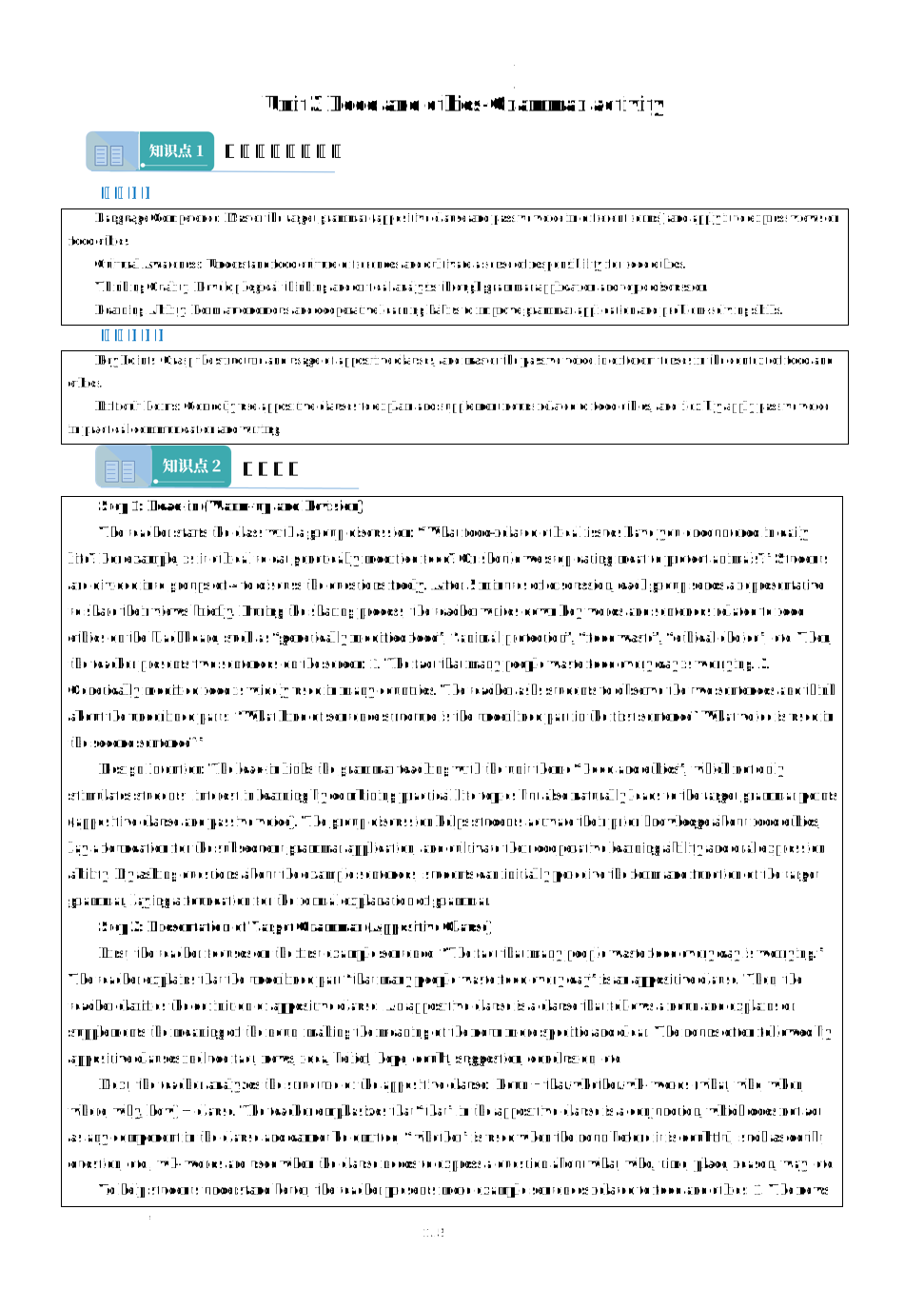
Unit 3 Food and ethics-Grammar activity
教学目标和重难点
教学目标
Language Competence: Master the target grammar (appositive clause and passive voice in different forms) and apply it to express views on food ethics.
Cultural Awareness: Understand food culture differences and cultivate a sense of responsibility for food ethics.
Thinking Quality: Develop logical thinking and critical analysis through grammar application and topic discussion.
Learning Ability: Form autonomous and cooperative learning habits to improve grammar application and problem-solving skills.
教学重难点
Key Points: Grasp the structure and usage of appositive clauses, and master the passive voice in different tenses in the context of food and ethics.
Difficult Points: Correctly use appositive clauses to explain and supplement nouns related to food ethics, and flexibly apply passive voice in practical communication and writing.
教学过程
Step 1: Lead-in (Warm-up and Revision)
The teacher starts the class with a group discussion: “What food-related ethical issues have you encountered in daily life? For example, is it ethical to eat genetically modified food? Or should we stop eating meat to protect animals?” Students are divided into groups of 4 to discuss the questions freely. After 5 minutes of discussion, each group sends a representative to share their views briefly. During the sharing process, the teacher writes down key words and sentences related to food ethics on the blackboard, such as “genetically modified food”, “animal protection”, “food waste”, “ethical choice”, etc. Then, the teacher presents two sentences on the screen: 1. The fact that many people waste food every day is worrying. 2. Genetically modified food is widely used in many countries. The teacher asks students to observe the two sentences and think about the underlined parts: “What kind of sentence structure is the underlined part in the first sentence? What voice is used in the second sentence?”
Design Intention: The lead-in links the grammar teaching with the unit theme “Food and ethics”, which not only stimulates students’ interest in learning by combining practical life topics but also naturally leads to the target grammar points (appositive clause and passive voice). The group discussion helps students activate their prior knowledge about food ethics, lay a foundation for the subsequent grammar application, and cultivate their cooperative learning ability and oral expression ability. By asking questions about the example sentences, students can initially perceive the form and function of the target grammar, laying a foundation for the formal explanation of grammar.
Step 2: Presentation of Target Grammar (Appositive Clause)
First, the teacher focuses on the first example sentence: “The fact that many people waste food every day is worrying.” The teacher explains that the underlined part “that many people waste food every day” is an appositive clause. Then, the teacher clarifies the definition of appositive clause: An appositive clause is a clause that follows a noun and explains or supplements the meaning of the noun, making the meaning of the noun more specific and clear. The nouns often followed by appositive clauses include fact, news, idea, belief, hope, doubt, suggestion, conclusion, etc.
Next, the teacher analyzes the structure of the appositive clause: Noun + that/whether/wh- words (what, who, when, where, why, how) + clause. The teacher emphasizes that “that” in the appositive clause is a conjunction, which does not act as any component in the clause and cannot be omitted; “whether” is used when the noun before it is doubtful, such as doubt, question, etc.; wh- words are used when the clause needs to express a question about what, who, time, place, reason, way, etc.
To help students understand better, the teacher presents more example sentences related to food and ethics: 1. The news that our school will hold a food ethics lecture is true. 2. We have no doubt that everyone should save food. 3. The question whether we should eat cloned food is still controversial. 4. I have no idea how we can promote food ethics in daily life. For each example sentence, the teacher asks students to point out the noun, the conjunction and the appositive clause, and explains the usage of different conjunctions in detail. Then, the teacher invites students to try to make simple appositive clauses with the given nouns (fact, idea, suggestion) and conjunctions, and corrects their mistakes in time.
Design Intention: The teacher adopts the inductive method to present the appositive clause. By analyzing example sentences related to the unit theme, students can not only master the definition, structure and usage of appositive clauses but also closely combine grammar with the unit theme, avoiding the isolation of grammar teaching. The interactive link of making sentences by students can test their initial mastery of grammar, help the teacher find out the problems in students’ learning in time, and lay a foundation for the subsequent consolidation exercises. At the same time, it can cultivate students’ logical thinking ability and language expression ability.
Step 3: Presentation of Target Grammar (Passive Voice in Different Forms)
After mastering the appositive clause, the teacher turns to the second example sentence: “Genetically modified food is widely used in many countries.” The teacher points out that this sentence uses the passive voice. Then, the teacher reviews the basic structure of the passive voice: Subject + be + past participle (PP) + by + agent. On this basis, the teacher focuses on introducing the passive voice in different tenses, which are closely related to the topic of food and ethics.
The teacher lists the passive voice of common tenses with example sentences related to food and ethics: 1. Simple Present Tense: Many kinds of healthy food are produced in our country every year. 2. Simple Past Tense: A lot of food was wasted in the restaurant yesterday. 3. Simple Future Tense: More measures will be taken to protect food safety. 4. Present Perfect Tense: Some genetically modified foods have been banned in some countries. 5. Present Continuous Tense: The food is being cooked in the kitchen now. For each tense, the teacher explains the structure of the passive voice in detail, emphasizes the changes of the verb “be” and the form of the past participle, and guides students to compare the active voice and passive voice of the same sentence, such as “People produce many kinds of healthy food in our country every year.” (Active) and “Many kinds of healthy food are produced in our country every year.” (Passive).
The teacher also summarizes the usage scenarios of the passive voice in the context of food and ethics: when emphasizing the object (food, measures, etc.), when the agent is unknown or not important, or when the focus is on the action itself rather than the doer. Then, the teacher invites students to convert several active sentences related to food ethics into passive sentences, such as “People should save food.” → “Food should be saved.”, “Farmers grow vegetables in the field.” → “Vegetables are grown in the field by farmers.”
Design Intention: The teacher combines the review of the basic passive voice with the expansion of different tenses, which conforms to the students’ cognitive law from easy to difficult. The example sentences are closely related to the unit theme, which makes students realize that grammar is not abstract but can be used to express practical content. By comparing active and passive voices and converting sentences, students can deeply understand the differences between active and passive voices and master the usage of passive voice in different tenses. This link also lays a foundation for the comprehensive application of the two grammar points later.
Step 4: Consolidation Exercise 1 (Single Grammar Point Practice)
This step is divided into two parts: appositive clause practice and passive voice practice, to help students consolidate the two grammar points separately.
For the appositive clause practice, the teacher designs three types of exercises: 1. Fill in the blanks with proper conjunctions (that, whether, what, how). For example: ① The fact ______ food waste is a serious problem surprises many people. ② I have a question ______ we can reduce food waste in daily life. ③ No one knows ______ will happen to the food industry in the future. 2. Judge whether the following sentences are correct. If not, correct them. For example: ① The news that he told me is about food ethics. (Incorrect: The news which/that he told me is about food ethics. Or: The news that our school will hold a food ethics lecture is true.) ② I doubt that he will come to the food ethics discussion. (Incorrect: I doubt whether he will come to the food ethics discussion.) 3. Complete the sentences according to the hints. For example: ① The idea ______ (我们应该拒绝垃圾食品) is widely accepted. (that we should refuse junk food) ② We all believe the suggestion ______ (政府应该制定更严格的食品法规). (that the government should make stricter food regulations)
For the passive voice practice, the teacher also designs three types of exercises: 1. Fill in the blanks with the correct form of the passive voice. For example: ① Rice ______ (grow) in the south of China. (is grown) ② A new food safety law ______ (make) last year. (was made) ③ More attention ______ (pay) to food ethics in the future. (will be paid) 2. Convert the active sentences into passive sentences. For example: ① People eat a lot of fruits every day. → A lot of fruits are eaten every day. ② The government has taken measures to improve food safety. → Measures have been taken to improve food safety by the government. 3. Choose the correct answer. For example: ① Many kinds of food ______ in this factory every month. A. produce B. are produced C. produced D. will produce (Answer: B) ② The question ______ by the students in the class yesterday. A. is raised B. was raised C. raises D. raised (Answer: B)
After students finish the exercises independently, the teacher checks the answers in class, focuses on explaining the error-prone points, such as the omission of “that” in the appositive clause, the wrong form of “be” in the passive voice, and the confusion between appositive clause and attributive clause. For the wrong sentences made by students, the teacher guides students to find out the mistakes and correct them by themselves, so as to deepen their understanding.
Design Intention: The consolidation exercises are designed in a hierarchical way, from filling in the blanks, judging and correcting to sentence completion and multiple-choice questions, which can comprehensively test students’ mastery of the two grammar points. The exercises are closely related to the unit theme, which not only consolidates the grammar knowledge but also strengthens the connection between grammar and the theme. Letting students finish the exercises independently first can cultivate their autonomous learning ability, and the teacher’s comment and guidance can help students solve the problems in time, correct the wrong understanding, and lay a solid foundation for the comprehensive application of grammar.
Step 5: Consolidation Exercise 2 (Comprehensive Application of Grammar)
On the basis of consolidating the single grammar points, this step focuses on the comprehensive application of appositive clauses and passive voice, combining grammar with the topic of food and ethics, so as to improve students’ ability to use grammar in practical communication and writing.
First, the teacher designs a group task: Each group is given a topic related to food ethics, such as “Genetically Modified Food”, “Food Waste”, “Vegetarian Diet” and “Food Safety”. The group members need to discuss the topic and write a short passage (about 80-100 words), which must include at least 2 appositive clauses and 2 passive sentences. During the discussion and writing process, the teacher walks around the classroom, provides guidance for each group, helps students solve the problems encountered in grammar application and content organization, and reminds students to pay attention to the correct use of appositive clauses and passive voice.
After each group finishes writing, the teacher invites 2-3 groups to present their passages in class. The other students listen carefully and evaluate the passages from two aspects: whether the grammar is used correctly (appositive clauses and passive voice) and whether the content is closely related to the topic and has clear logic. Then, the teacher makes a summary comment, affirms the advantages of each group, points out the problems in grammar application and content expression, and puts forward suggestions for improvement. For example, if a group uses the appositive clause incorrectly, the teacher guides the group to correct it; if the passive voice is not used appropriately, the teacher explains how to use it more naturally in the context.
In addition, the teacher designs an oral communication task: Students work in pairs to talk about their views on food ethics, using at least 1 appositive clause and 1 passive sentence in the conversation. For example, Student A: “I hold the belief that we should stop food waste.” Student B: “I agree with you. A lot of food is wasted every day, which is a great pity.” After the pair conversation, the teacher invites several pairs to perform their conversations in class, and comments on their oral expression and grammar application.
Design Intention: The comprehensive application exercise combines grammar with oral communication and writing, which conforms to the requirements of English core literacy, and can effectively improve students’ comprehensive language application ability. The group task not only cultivates students’ cooperative learning ability but also makes students actively apply the learned grammar to express their views on food ethics, realizing the integration of grammar teaching and theme teaching. The oral communication task can exercise students’ oral expression ability, make students use grammar more flexibly in daily communication, and deepen their understanding of the unit theme. The evaluation link by students and teachers can help students find their own shortcomings and learn from each other, improving their learning effect.
Step 6: Topic Expansion and Emotional Education
After the grammar practice, the teacher leads students to carry out a theme expansion activity: “How can we practice food ethics in daily life?” The teacher presents some pictures and videos about food waste, genetically modified food, and animal protection, and guides students to discuss the specific ways to practice food ethics, such as saving food, refusing to eat wild animals, choosing environmentally friendly food, etc. During the discussion, the teacher encourages students to use the appositive clauses and passive voice they have learned to express their views. For example, “The suggestion that we should take our own tableware when eating out is practical.” “Wild animals should not be hunted and eaten.”
Then, the teacher makes a summary: Food ethics is closely related to our daily life, and everyone has the responsibility to practice food ethics. We should not only master the relevant grammar knowledge but also apply it to express our views on food ethics, and take practical actions to protect food resources, respect life, and build a harmonious relationship between man and nature.
Design Intention: The theme expansion activity combines grammar teaching with emotional education, which not only consolidates the grammar knowledge but also deepens students’ understanding of the unit theme “Food and ethics”, cultivates their sense of social responsibility and environmental awareness, and realizes the goal of cultural awareness and thinking quality in core literacy. The use of pictures and videos makes the theme more intuitive and vivid, which can stimulate students’ emotional resonance and enhance their sense of participation. Encouraging students to use the learned grammar to express their views can further improve their grammar application ability and realize the practical value of grammar learning.
Step 7: Summary and Homework
First, the teacher leads students to summarize the key points of this lesson: 1. The definition, structure and usage of appositive clauses, especially the usage of conjunctions (that, whether, wh- words). 2. The structure of passive voice in different tenses and its application in the context of food and ethics. 3. The comprehensive application of appositive clauses and passive voice in oral communication and writing.
Then, the teacher assigns homework: 1. Finish the grammar exercises in the textbook (Grammar activity part), and check the answers by themselves after finishing. 2. Write a short essay (about 120 words) about “My Views on Food Ethics”, using at least 3 appositive clauses and 3 passive sentences. 3. Discuss with family members about food ethics, and try to use the grammar learned in this lesson to express views in English.
Design Intention: The summary link helps students sort out the knowledge system of this lesson, deepen their memory and understanding of the target grammar points. The homework is designed in a hierarchical way, including basic exercises, writing tasks and practical communication tasks. The basic exercises can consolidate the grammar knowledge, the writing task can improve students’ writing ability and grammar application ability, and the practical communication task can let students apply the grammar to real life, realizing the connection between classroom learning and daily life. At the same time, the homework also strengthens the connection between students and family members, and promotes the popularization of food ethics.
1 / 1
学科网(北京)股份有限公司
学科网(北京)股份有限公司
学科网(北京)股份有限公司
$
资源预览图
1

2
相关资源
由于学科网是一个信息分享及获取的平台,不确保部分用户上传资料的 来源及知识产权归属。如您发现相关资料侵犯您的合法权益,请联系学科网,我们核实后将及时进行处理。