Unit 2 Grammar课件2025-2026学年沪教版七年级上册英语
2026-04-17
|
15页
|
895人阅读
|
121人下载
普通
摘要:
该初中英语课件聚焦一般现在时,涵盖用法(日常习惯、客观事实)、动词第三人称单数变化规则、否定句与疑问句形式及频率副词。课堂导入通过“Look and Say”活动描述跑步、读书等日常动作,搭建已知到新知的学习支架。
其亮点是注重语言能力与思维品质培养,通过机械练习(填空、句型转换)巩固基础,自由输出(小组调查采访)提升应用能力。动词变化规则分类呈现助学生归纳,分层作业满足不同需求,学生能在实践中掌握知识,教师可高效开展教学。
内容正文:
Unit 2 Grammar
The Simple Present Tense
一般现在时
1.7.2013
Hello, everyone! Welcome back. Today, we're going to dive into a very important grammar topic in Unit 2: The Simple Present Tense. This tense helps us talk about our daily lives, habits, and facts. Let's get started!
‹#›
Lesson Flow
课堂流程设计与安排
01
Warm-up &
Lead-in
热身与导入
02
Presentation
& Concept
新知呈现与讲解
03
Controlled
Practice
机械练习与巩固
04
Production
& Application
自由输出与应用
05
Summary
& Homework
课堂总结与作业
1.7.2013
Here's our plan for today's lesson. We'll start with a warm-up, then move on to the presentation of new grammar points. After that, we'll practice what we've learned, use the language in a fun activity, and finally, wrap up with a summary and some homework.
‹#›
Warm-up: Look and Say
What do they do? (Let's describe the actions)
He runs.
Action: Physical Exercise
She reads a book.
Action: Gaining Knowledge
We have classes.
Action: Group Learning
1.7.2013
Let's start with a warm-up. Look at these pictures. What are these people doing? Yes, we can say: He runs. She reads a book. We have classes. These sentences describe actions that happen regularly. This is what we're going to learn today.
‹#›
2. Presentation: When do we use it?
Habits & Routines
描述长期形成的个人习惯或频繁发生的日常活动,强调动作的规律性。
• I get up at 6:30 every morning.
• She plays the piano for an hour after school.
Facts & Truths
陈述客观存在的科学事实、普遍真理或亘古不变的自然规律,不受时间限制。
• The earth goes around the sun.
• Cats like eating fish and milk.
1.7.2013
So, when do we use the simple present tense? We use it in two main situations. First, to talk about our habits and daily routines, like getting up or playing the piano. Second, to state facts that are always true, like the earth going around the sun.
‹#›
2. Presentation: Verb Form (Third Person Singular)
Pay attention to 'he', 'she', or 'it' !
When the subject is one single person or thing, we usually need to add a suffix to the verb.
Rule 1: Simply add '-s'
• work →works
• get →gets| like →likes
Rule 2: Add '-es' (s/x/ch/sh/o)
• pass →passes| watch →watches
• do →does| go →goes
Rule 3: Change 'y' to 'i' + '-es'
• study → studies(study - y + ies)
• try → tries(try - y + ies)
Irregular: The Special One
We don't use 'haves'. Remember:
have ➔has
1.7.2013
Now, here comes the most important part. When the subject is 'he', 'she', or 'it', the verb changes! We usually add '-s'. But for some verbs, we add '-es', or change 'y' to 'i' and add '-es'. And remember the special one: 'have' becomes 'has'.
‹#›
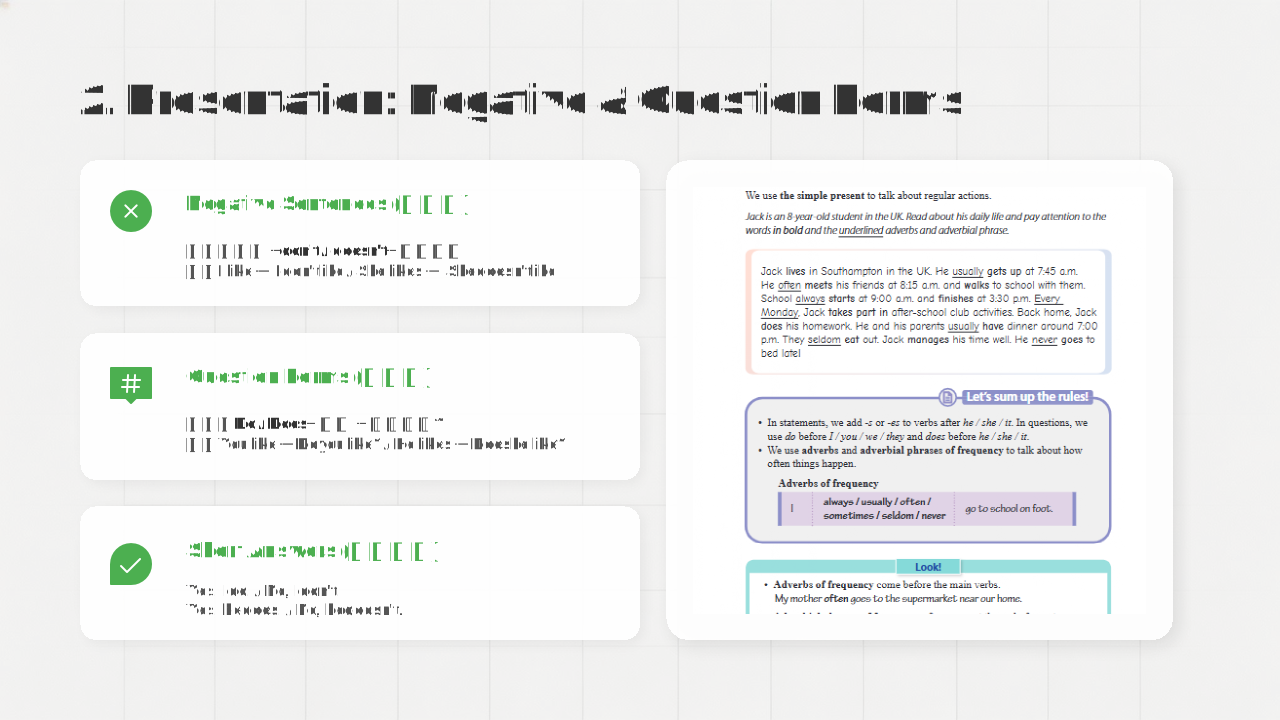
2. Presentation: Negative & Question Forms
Negative Sentences (否定句)
公式:主语 +don't / doesn't+ 动词原形
例:I like → Idon'tlike / She likes → Shedoesn'tlike
Question Forms (疑问句)
公式:Do / Does+ 主语 + 动词原形?
例:You like →Doyou like? / He likes →Doeshe like?
Short Answers (简短回答)
Yes, Ido. / No, Idon't.
Yes, hedoes. / No, hedoesn't.
1.7.2013
To make negative sentences or ask questions, we use 'do' and 'doesn't'. Remember the rule: Use 'do' with 'I, you, we, they', and 'does' with 'he, she, it'. And a very important point: after 'do' or 'does', the verb must be in its original form!
‹#›
2. Presentation: Adverbs of Frequency
How often do we do things?
Always • Usually • Often • Sometimes • Never
Sentence Position (核心位置规则)
After 'be' verb:Sheis alwayshappy.
Before main verb:Iusually getup early.
After 'do/does' (Q):Do youoften goto the cinema?
1.7.2013
We also use adverbs of frequency with the simple present tense to say how often we do something. Words like 'always', 'usually', 'often', 'sometimes', and 'never'.
Remember their positions in a sentence:
1. After the 'be' verb (am, is, are).
2. Before the main verb (the action verb).
3. After 'do' or 'does' in questions.
‹#›
3. Practice: Fill in the blanks
Quick Response! (Present Simple Tense)
01.My father usually _______ (read) newspapers after dinner.
02.She _______ (go) to school by bus every day.
03.They often _______ (play) basketball on weekends.
04.I _______ (not like) milk very much.
05._______ he _______ (get) up at seven o'clock every morning?
06.The earth _______ (move) around the sun.
Read carefully & Fill in!
1.7.2013
Okay, time to practice! Let's do a quick response exercise. Please fill in the blanks with the correct form of the verbs. Pay attention to the subject and the rules we just learned. Let's do the first one together: 'My father usually...' What's the answer? Yes, 'reads'. Now you try the rest.
‹#›
3. Practice: Sentence Transformation
Rewrite the sentences according to the prompts below.
01
改为否定句
Original:
He plays football every afternoon.
He doesn't play football every afternoon.
02
一般疑问句(否定回答)
Original:
They watch TV in the evening.
Q: Do they watch TV in the evening?
A: No, they don't.
03
对划线部分提问
Original:
She does her homework at home.
Where does she do her homework?
1.7.2013
Great job! Now let's try transforming sentences. Change these sentences into negative, question forms, or answer questions based on the prompts. This will help you master the structure of the simple present tense.
‹#›
3. Practice: Pair Work
Collaborate & Communicate
Talk about your habits (Template)
A:What do you usually do on weekends?
B:I usually_______. Sometimes I_______. What about you?
A:I always_______. I never_______.
Example Dialogue
A: What do you usually do on weekends?
B: I usually read books. Sometimes I play basketball. What about you?
A: I always watch movies at home. I never get up late on Sundays.
1.7.2013
Now, let's practice speaking. Work with a partner. Ask and answer questions about your weekend habits. Try to use the adverbs of frequency we learned, like 'usually', 'sometimes', 'always', and 'never'. Let's look at the example first. Now, you start!
‹#›
3. Practice: Complete the conversation
Look at the conversation and fill in the blanks withdoordoes.
01.S1: What time _______ Jack usually get up?
S2: He usually gets up at 7:45 a.m.
02.S1: How _______ Jack and friends go to school?
S2: They walk to school together.
03.S1: When _______ school finish every day?
S2: It usually finishes at 3:30 p.m.
04.S1: What _______ Jack do on Mondays?
S2: He joins after-school club activities.
05.S1: When _______ Jack's family have dinner?
S2: They usually eat around 7:00 p.m.
06.S1: How often _______ they eat out?
S2: They seldom go to restaurants.
1.7.2013
Let's do one more practice from your textbook. Look at this conversation about Jack's daily life. Please fill in the blanks with 'do' or 'does'. This exercise will test your understanding of when to use each one. Let's check the answers together.
‹#›
4. Production: Let's Survey!
My Classmate's Weekdays
01. Conduct Interviews
Find 3 classmates to interview. Prepare a simple form to take notes during your conversation.
02. Ask Key Questions
• What time do you get up in the morning?
• How do you usually go to school?
• What do you like to have for lunch?
• What activities do you do after school?
03. Share Your Findings
Ex: "I interviewed Li Lei. He gets up at 7:00 and walks to school every day."
1.7.2013
It's time to use the language in a real situation! Let's do a survey. Please stand up, walk around, and interview three of your classmates about their daily routines. Use the questions on the screen. Take notes, and then I'll ask some of you to share what you found.
‹#›
5. Summary: What have we learned?
The Simple Present Tense
USAGE:Used for daily Habits and general Facts.
BASIC FORM:Base verb (v.) / Verb + -s (for 3rd person singular).
-S/-ES RULES:4 main spelling rules (+ irregular: have → has).
NEGATIVE & QUESTION:Use "don't/doesn't + v." for negatives, and "Do/Does + subj + v.?" for questions.
Adverbs of Frequency
COMMON ADVERBS
always, usually, often, sometimes, rarely, never.
KEY POSITION RULES
• After the verb "be" (am/is/are).
• Before the main verb (except "be").
IMPORTANT: Adverbs describe "how often".
1.7.2013
Let's summarize what we've learned today. We focused on the Simple Present Tense. We learned its two main uses, the rules for the third person singular verb form, how to make negative sentences and questions with 'do' and 'does', and the usage of adverbs of frequency.
‹#›
5. Homework
Level A
基础巩固 | Basic Practice
• 完成练习册中关于一般现在时的专项练习题。
• 背诵并默写动词第三人称单数(Verb 3rd Person Singular)的变化规则表。
Level B
拓展应用 | Advanced Task
• 写作任务:撰写一篇约50词的短文,标题为 "My Daily Life"。
• 要求:描述你的日常活动,并在文中至少使用3个频率副词(如 always, usually, often 等)。
Tips: 请根据自己的实际情况选择适合的难度等级完成作业,下节课我们将进行分享。
1.7.2013
Here is your homework for today. There are two levels. Level A is for basic practice, focusing on the grammar rules we learned. Level B is a bit more challenging, asking you to write a short passage about your own daily life using the adverbs of frequency.
Please choose the level that suits you best. If you feel confident, you can try Level B directly.
See you in the next class.
‹#›
THANK YOU!
Thanks for your active participation
See You Next Time
1.7.2013
That's all for today's lesson. You all did a great job! Thank you for your active participation. See you next time!
‹#›
$
资源预览图

1

2

3

4

5
6
相关资源
示范课
由于学科网是一个信息分享及获取的平台,不确保部分用户上传资料的 来源及知识产权归属。如您发现相关资料侵犯您的合法权益,请联系学科网,我们核实后将及时进行处理。