Unit 6 课时3 Section A(Grammar Focus)(情境教学课件)英语新教材人教版八年级下册
2026-04-15
|
3份
|
30页
|
5826人阅读
|
34人下载
精品
资源信息
| 学段 | 初中 |
|---|---|
| 学科 | 英语 |
| 教材版本 | 初中英语人教版八年级下册 |
| 年级 | 八年级 |
| 章节 | Grammar Focus |
| 类型 | 课件 |
| 知识点 | - |
| 使用场景 | 同步教学-新授课 |
| 学年 | 2026-2027 |
| 地区(省份) | 全国 |
| 地区(市) | - |
| 地区(区县) | - |
| 文件格式 | ZIP |
| 文件大小 | 209.48 MB |
| 发布时间 | 2026-04-15 |
| 更新时间 | 2026-04-15 |
| 作者 | Jenica166 |
| 品牌系列 | 上好课·上好课 |
| 审核时间 | 2026-04-15 |
| 下载链接 | https://m.zxxk.com/soft/57346222.html |
| 价格 | 3.00储值(1储值=1元) |
| 来源 | 学科网 |
内容正文:
Unit 6
Crossing Cultures
Section A How different are
our cultures?
课型:语法课
课时:Grammar Focus
能够理解并在语境中准确使用 unless 引导的条件状语从句、so … that引导的结果状语从句和 as soon as 引导的时间状语从句;能够理解后缀为-ing和-ed的形容词的意义区别,并在语境中恰当运用这两类形容词。(学习理解)
01
能够理解世界文化的多元性和丰富性,培养对不同文化的好奇心和同理心,不断积累文化知识,拓宽文化视野。(迁移创新)
03
能够将 unless、so. that、as soon as引导的状语从句和后缀为-ing和-ed 的形容词综合运用于文化冲击相关内容的语篇。(应用实践)
02
教学目标
Lead-in
01
v4-1600px-Have-Good-Table-Manners-Summary-Version-3.jpg.webp
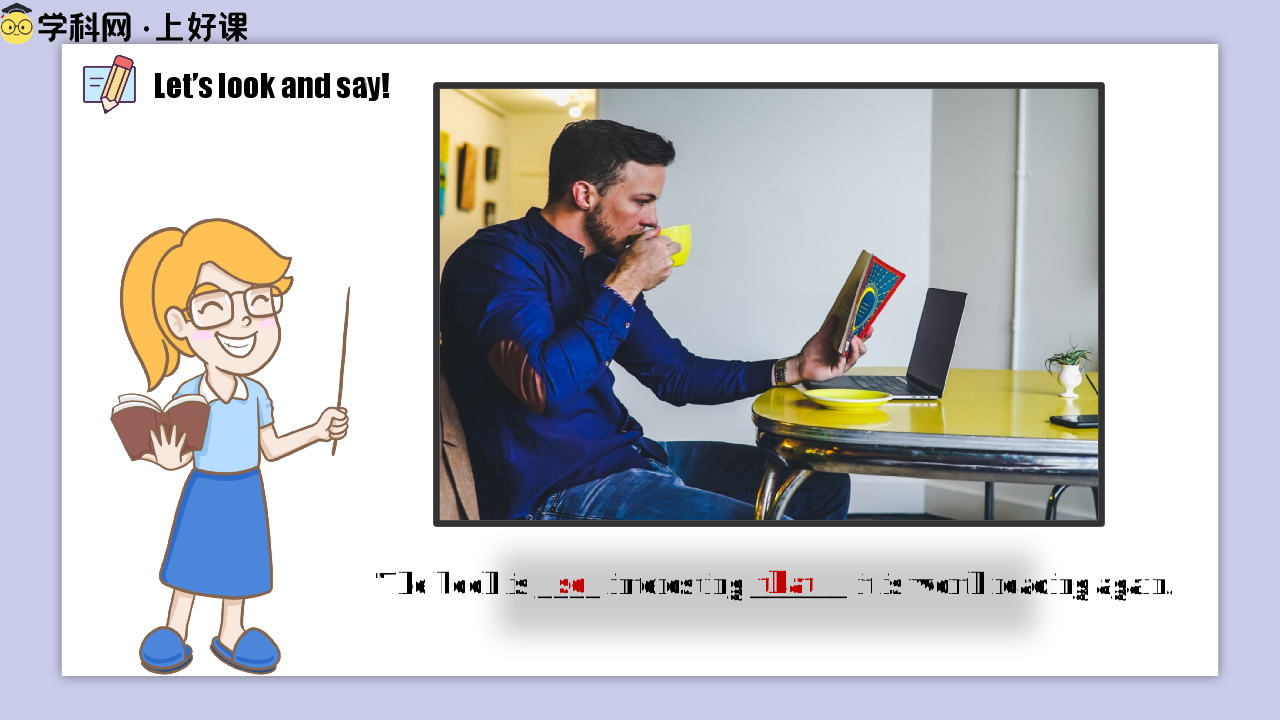
Let’s look and say!
The book is ____ interesting ______ it is worth reading again.
so that
v4-1600px-Have-Good-Table-Manners-Summary-Version-3.jpg.webp
Let’s look and say!
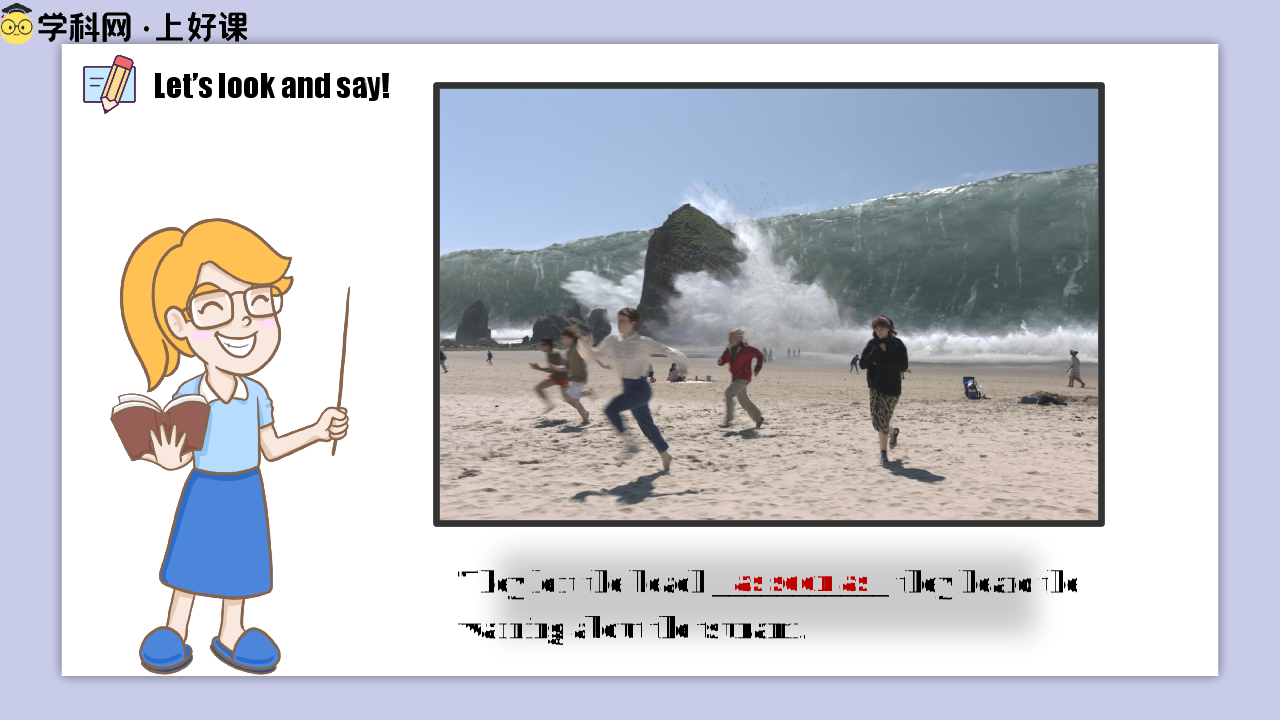
They left the beach ___________ they heard the warning about the tsunami.
as soon as
v4-1600px-Have-Good-Table-Manners-Summary-Version-3.jpg.webp
Let’s look and say!
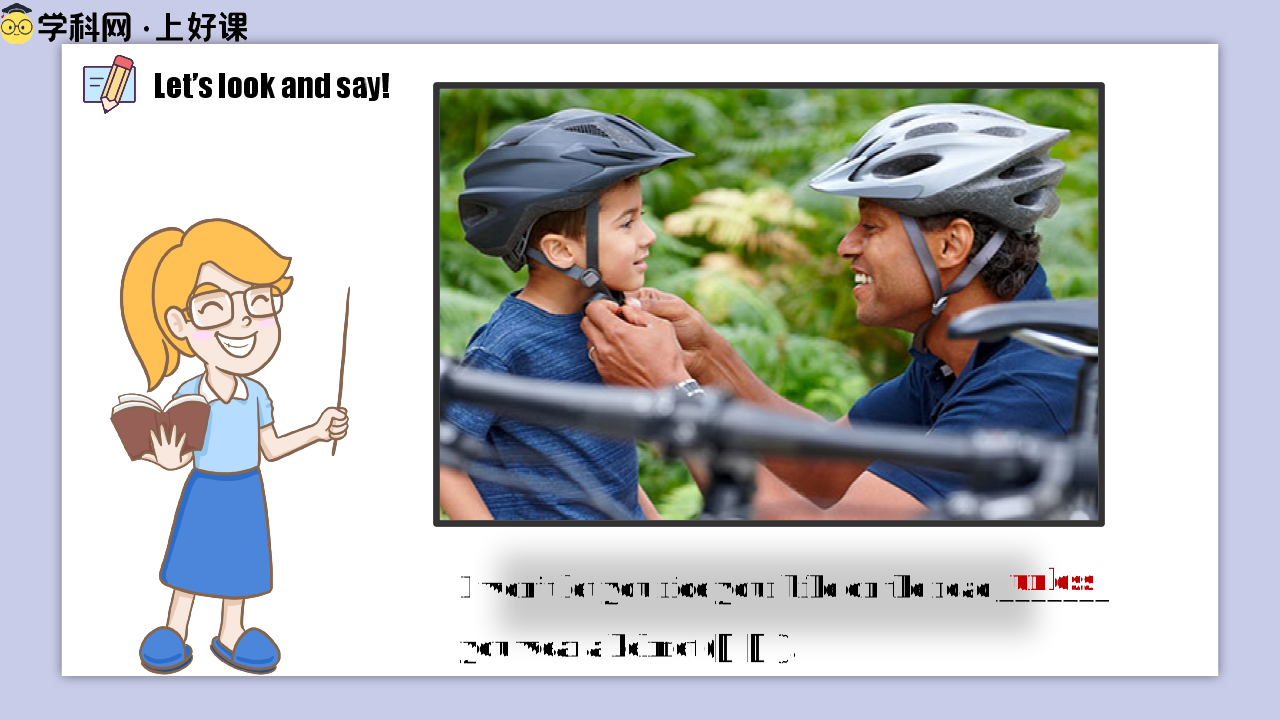
I won’t let you ride your bike on the road _______
you wear a helmet (头盔).
unless
Presentation
02
v4-1600px-Have-Good-Table-Manners-Summary-Version-3.jpg.webp
Read the sentences. What do the words in red mean? How are the pairs of words in blue used differently?
4a
Do you ever bow? No, that’s so formal that we don’t do it these days.
Should I bring something? Sure. Bring a small gift, but don’t bring food unless the host asks you to.
I was surprised by your bow. We usually just say “hello” or shake hands in the US. That’s surprising! In Japan, we bow as soon as we meet a teacher.
Don't look so embarrassed! But it is embarrassing!
还记得红色的这些连词表示的是什么逻辑关系吗?
8
v4-1600px-Have-Good-Table-Manners-Summary-Version-3.jpg.webp
Read the sentences. What do the words in red mean? How are the pairs of words in blue used differently?
4a
Do you ever bow? No, that’s so formal that we don’t do it these days.
Should I bring something? Sure. Bring a small gift, but don’t bring food unless the host asks you to.
I was surprised by your bow. We usually just say “hello” or shake hands in the US. That’s surprising! In Japan, we bow as soon as we meet a teacher.
Don't look so embarrassed! But it is embarrassing!
as soon as: 一……就;引导时间状语从句
so … that … : 太……以至于;引导结果状语从句
unless: 除非;引导条件状语从句
9
v4-1600px-Have-Good-Table-Manners-Summary-Version-3.jpg.webp
Let’s learn and summarize!
语法结构 意义及用法
so … that
unless
as soon as
如此……以至于;引导结果状语从句
so后接_____________,强调程度,that引导的从句表示结果。
形容词或副词
除非;引导条件状语从句
相当于_______,意“除了……之外”,表示唯一条件。
if not
一……就;引导时间状语从句,表示两个动作在时间上紧密相连,几乎同时发生
as soon as引导的从句表示将来意义时,需用___________。
一般现在时
unless和as soon as引导的从句位置比较灵活,可放在主句后或主句前。
主将从现
v4-1600px-Have-Good-Table-Manners-Summary-Version-3.jpg.webp
Read the sentences. What do the words in red mean? How are the pairs of words in blue used differently?
4a
Do you ever bow? No, that’s so formal that we don’t do it these days.
Should I bring something? Sure. Bring a small gift, but don’t bring food unless the host asks you to.
I was surprised by your bow. We usually just say “hello” or shake hands in the US. That’s surprising! In Japan, we bow as soon as we meet a teacher.
Don't look so embarrassed! But it is embarrassing!
形容词 –ing 后缀和 –ed 后缀在使用上有什么区别呢?
11
v4-1600px-Have-Good-Table-Manners-Summary-Version-3.jpg.webp
Let’s learn and summarize!
-ing -ed
The ending of the movie was surprising.
Studying English is interesting.
Jim’s improper table manners were embarrassing.
The novel tells a confusing story. I was surprised at the movie’s ending.
I am interested in studying English.
Jim felt embarrassed about his improper table manners.
I got confused trying to make sense of the story.
形容词后缀 -ing 意为“____________”,通常用来描述事物的属性或特性,有时也可用来表述人的特性。
形容词后缀 -ed 意 “___________________”,一般用来描述人的感受或情绪。
含有后缀 –ing 的形容词表示某物或人的特性,具有主动意义;而含有后缀 -ed 的形容词则表示某人因受影响而产生的感受或情绪,具有被动意义。
令人……的
使(人)感到……的
Let’s watch and learn.
Practice
03
v4-1600px-Have-Good-Table-Manners-Summary-Version-3.jpg.webp
Let’s fill in the blanks with creative forms of the verbs.
1. The film was so ________ that we left it in the middle. (bore)
2. The students were __________ in examining the dead body in the mortuary. (interest)
3. It's ____________ to be caught telling a lie. (embarrass)
4. The children are ________ about the holiday in Spain. (excite)
5. It was so _________ to hear that the project was a great success. (satisfy)
6. They were ____________ about the result. (disappoint)
7. He was _________ to discover that he had left no money. (shock)
8. He was ________ when he heard that there had been an accident. (worry)
boring
interested
embarrassing
excited
satisfying
disappointed
shocked
worried
15
v4-1600px-Have-Good-Table-Manners-Summary-Version-3.jpg.webp
Combine the sentences using the words in brackets.
4b
1. Türkiye: People don’t kiss one another on the cheek. They can do so if they are good friends. (unless) ________________________________________________________________________
2. Japan: Take off your shoes. You do this when you enter someone's home. (as soon as) ________________________________________________________________________
3. Kenya: Being late is very common. You should be patient and not expect people to be on time. (so ... that) ________________________________________________________________________
________________________________________________________________________
In Türkiye, people don’t kiss one another on the cheek unless they are good friends.
In Japan, you should take off your shoes as soon as you enter someone's home.
In Kenya, being late is so common that you should be patient and not expect people to be on time.
16
v4-1600px-Have-Good-Table-Manners-Summary-Version-3.jpg.webp
Combine the sentences using the words in brackets.
4b
4. China: Sticking chopsticks into a bowl of rice is very rude. You should avoid it. (so ... that) ________________________________________________________________________
5. Mexico: Don’t use someone’s first name if you don’t know him or her well. You can use it if the person invites you to do so. (unless)
________________________________________________________________________
________________________________________________________________________
In China, sticking chopsticks into a bowl of rice is so rude that you should avoid it.
In Mexico, don’t use someone’s first name unless you know him or her well.
In Mexico, don’t use someone’s first name unless the person invites you to do so.
通过使用这些连词,可以让句子更通顺、逻辑更明显,表达更完整流畅。
17
v4-1600px-Have-Good-Table-Manners-Summary-Version-3.jpg.webp
Complete the passage with the words in the box. Can you tell where the writer is from?
4c
surprising surprised interesting interested so ... that as soon as unless
Do you know what culture shock is? You may feel it when you experience a new culture, because the new culture is ____ different from your own ______ you feel _________. For example, I experienced this __________ I got off the plane in Peru last year. People were standing on my right and left, even though there was plenty of space on the bus! That was really _________ to me. In Germany, people usually like more personal space, and we don't stand close to someone _______ we know them very well. But once I was used to it, I became more curious and __________ in learning about the culture there. It's so
___________ to discover cultural differences like this!
so
that
surprised
interested
surprising
unless
as soon as
interesting
18
ab455601-9760-48e3-bd4f-469187ccd654.jpeg
Let’s discuss and answer the questions.
1. Where is the writer from?
2. What is the writer's culture shock?
The writer is from Germany.
Different cultures have different customs, and we should keep an open mind when meeting new cultures.
3. What can you learn from the writer’s experience?
The writer felt surprised by how people stood very close to each other in Peru, which is different from Germany's focus on personal space.
Let’s watch and learn more about culture shock.
Production
04
v4-1600px-Have-Good-Table-Manners-Summary-Version-3.jpg.webp
Let’s think and complete the sentences!
You can’t enter the room
unless you take off your shoes first.
v4-1600px-Have-Good-Table-Manners-Summary-Version-3.jpg.webp
Let’s think and complete the sentences!
It is so cold outside
that I have to stay at home.
v4-1600px-Have-Good-Table-Manners-Summary-Version-3.jpg.webp
Let’s think and complete the sentences!
the students run out of the classroom.
As soon as the bell rings,
Exercises
05
That’s ________ formal ________ we don’t do it these days.
A.so; that B.such; that C.too; to D.enough; to
2
Nobody can hear you ________ you speak in a louder voice.
A.until B.as soon as C.unless D.so that
3
In Japan, we bow ________ we meet a teacher.
A.as soon as B.unless C.although D.because
1
Multiple choice.
1. There are many ________ (culture) differences between these two countries.
2. It’s ____________ (embarrass) to make such a careless mistake in front of the class.
3. She isn’t used to ______ (live) in the countryside now.
4. I won’t let you go unless you _____ (tell) me the truth.
5. —Have a safe trip!
—OK, Dad. I _________ (give) you a call as soon as I arrive there.
6. We Chinese may be _________ (surprise) that Americans treat their pets like their own children. Sometimes even better.
7. I became more _________ (interest) in learning about the culture there.
cultural
用单词的适当形式填空。
embarrassing
living
tell
will give
surprised
interested
Homework
06
1. Memorize the new words and phrases.
2. Practice the conversations with your partner using the
sentence patterns we have learned .
3. Finish the exercises.
Homework
OIP-C - 2026-04-10T162738.365.webp
Thanks!
Lavf58.29.100
Packed by Bilibili XCoder v2.0.2
Lavf59.27.100
Packed by Bilibili XCoder v2.0.2
$Since you bit in china, what's your biggest culture shock? I had to get used to them just looking at me. And that is what happens like, no, their board I walk to and they can get excited. They have anything, they have something to talk about forever. I thought I was a joke, so vena been angry. They're to think all of angry, cultivated, expect. And that is you all happy and then don't give me like a heart. Religion is a big one for sure. A lot people in america, Christians, I feel like here, a lot of people that either claim to have no religion or maybe their family is budd's or something like. for example, the the most famous one when you go to the restaurant is like sharing, sharing dishes. Everything is sharing to each other and around the wrong table, and you you make the table spending and you you share everything othe wise in europe, when you eat, you eat your own dish. Everyone is. When I was in shanghai, me and my friends would go out sometimes and see what the nightlife was like. And we were all really surprised by how like out a lot of the clubs and bars and stuff, the chinese people wouldn't really dance, that they just can't sit around and like drink and hang out. But IT wasn't dancing and like crazy, like in america, kind of really weird. us. The nightlife scene was . very different. The chinese mentality is somehow different to the german, that if they dislike something they don't say, I just to your head, they make a little turn around, they talk about anything else, maybe after and our. So they come to the point, and that are not used . to the many yeah. the people are more direct what they want or what they is like. And here is they always smile, but if not really sure if if the smile is real at the moment, all somehow piece. uh, once SHE came, a SHE called me, and he was like, really, really here and he was really, absolutely mad. And I have, and I like, i'm never gonna chinese anymore and I ask, like one chinese guy, her days of the drive flowers, I don't remember he was dressed or flowers. But in russia, this type for you, great. You know, like you gave IT and someone e's died. So if you really usually bring IT for funeral, and he gave IT to her, why you do you so you would, because you, like. I cannot handle, understand. This is Normal in, especially like small children in the oil, like three, four jackets, like how I can fit on. I mean, if you go in more north, like in beijing, that's not really like the cause. Yeah so that's always kind. At my university, there was lots of chinese students, mostly from wangdi. I think my chinese friend, one day he asked me, why did australians never wear shoes in restaurant? And then I realized that was those different as pretty common yeah if maybe if you've just gone to the beach or something, people would be worries. I think a lot of people, do you like to walk around bare food? I guess you won't. You wouldn't . want to do that. What i'm really quite surprised. I can see very often the older generation, they are still, they are not drinking coffee that I really like. So I germany, everybody to coffee like and corner dancing, I really like germany. What do older . people do because they have some activities. It's community. I mean, in germany by everybody y's more by himself. They don't care. They don't care about other people so much. It's titular. So I really enjoying on spit here. It's what's your biggest culture shock? You've been in china, you to fight to pay the bill. Do you like that or no? I think it's it's nice to feel like appreciated, like you can also like to be.
Before we get started, i'm sorry, but my neighbour has decided to have some sort of monday afternoon party in and if you hear in a music, it's not me, it's them. So it's would but i'm too british to say anything. I'm just going to alone today. I've got a very short but very useful little video for you. It's all about objectives, the end in ING, objectives, the end in E, D, and why different. And when we use each one, I have so many people using these objectives in correlate. So he's help you. Now i'm going to give you two phrases. The first one, I am boring, and the second one, I am bored. What do they mean and why are they different? what? So adjectives that end in E, D, describe emotions. They tell us how someone feels about something. Okay, so I feel tired. I'm going to go to bed, or I was bored in the math lesson, I almost fell asleep. objectives. The end in ig described the thing that causes the emotion. So a boring math lesson makes you feel bored. The math lesson is what causes you to feel bored. So the math lesson is boring. So you could say, I could watch Lucy videos for hours because they are so interesting. This means that you are interested by my videos. My videos interest you. Or I could say that the food was disgusting. I was disgusted by the food. Now going to give you some more adjectives that can be used in both the E. D. Form and the I. N. G. form. So the first one, amused, amusing. Okay, the film was so amusing. IT made me really laugh. Or I was really amused by the film. We got annoyed and annoying. I was very annoyed with the way that finish spoke to me. We've got confused and confusing. Sorry, I don't understand. English grammar is way too confusing. If you feel confused, you should watch Lucy videos. K, then we've got excited and exciting. I'm so excited to go on holiday this year. Frightened and frightening. My dog ran away on a walk because he was frightened, satisfied and satisfying. I find cooking a meal from scratch really satisfying, shocked and shocking. I'm so shocked that he didn't warn me that he wasn't going to come to birthday part. So this video is really short, but it's really, really simple. Now you ve seen this video. You shouldn't get wrong again. Just they described how somebody feels about something. And then with IN, G, described the thing that causes the emotion, so we need to remember is a boring lesson makes you feel bored. That's the key sentence there. Alright guys, thank you so much for watching.
资源预览图
1
2
3
4
5
6

相关资源
由于学科网是一个信息分享及获取的平台,不确保部分用户上传资料的 来源及知识产权归属。如您发现相关资料侵犯您的合法权益,请联系学科网,我们核实后将及时进行处理。