Unit 3 Helping people-Grammar and composition 教案-2025-2026学年高中英语译林版选修第二册
2026-04-11
|
6页
|
74人阅读
|
0人下载
普通
内容正文:
Unit 3 Helping people-Grammar and composition
教学目标和重难点
1. 教学目标
Language Competence: Master the usage of relative clauses and connecting words, and be able to use them correctly in writing to express the process and significance of helping others.
Cultural Awareness: Understand the connotation of helping others in different cultures, cultivate a sense of responsibility and kindness, and form a positive outlook on life.
Thinking Quality: Develop logical thinking through analyzing sentence structures and organizing writing ideas, and improve the ability to analyze and solve problems in the context of helping others.
Learning Ability: Cultivate autonomous learning and cooperative inquiry abilities, master effective grammar learning and writing strategies, and lay a foundation for lifelong English learning.
2. 教学重难点
Key Points: Grasp the usage of restrictive and non-restrictive relative clauses, and the proper use of connecting words (such as who, whom, which, that, whose) in the context of helping people; master the basic structure of argumentative writing about helping others, including topic sentences, supporting details and conclusions.
Difficult Points: Distinguish the differences between restrictive and non-restrictive relative clauses and use them flexibly; combine grammar knowledge with writing practice, and write coherent, logical and meaningful passages about helping others.
教学过程
Step 1: Lead-in (Warm-up and Activation)
The teacher starts the class by showing a set of pictures and short videos about helping others, such as volunteers helping the elderly cross the road, students donating books to children in poor areas, and doctors saving patients. After playing the videos and displaying the pictures, the teacher asks students the following questions in English: “Have you ever helped others? What did you do? How did you feel after helping others? What kinds of people need help in our daily life?” Then, the teacher invites 3-4 students to share their own experiences and ideas with the whole class. After the sharing, the teacher makes a brief comment: “Helping others is a kind of virtue that is cherished in all cultures. It not only brings happiness to others but also enriches our own spiritual world. Today, we will learn the grammar related to helping others and practice writing passages about this meaningful topic.”
Design Intention: The visual materials (pictures and videos) can quickly attract students’ attention and arouse their emotional resonance, making them actively participate in the class discussion. By asking questions and inviting students to share their own experiences, the teacher can activate students’ prior knowledge and life experience related to helping others, lay an emotional and contextual foundation for the subsequent grammar learning and writing practice. At the same time, it can also cultivate students’ sense of responsibility and kindness, which is in line with the requirement of cultural awareness in key competencies.
Step 2: Grammar Teaching — Relative Clauses
2.1 Presentation of Grammar Points
The teacher writes two groups of sentences on the blackboard, which are closely related to the theme of “helping people”:
Group 1 (Restrictive Relative Clauses):
1. The girl who helped the old man cross the road is my classmate.
2. The book which we donated to the children is very interesting.
3. The volunteer whose name is Li Ming often helps the disabled.
Group 2 (Non-restrictive Relative Clauses):
1. My mother, who is a teacher, often helps her students with their studies.
2. We went to the community center, where many volunteers were working.
3. He donated a lot of money to the poor, which moved all of us.
Then, the teacher guides students to observe the two groups of sentences and asks them to find out the differences between the two groups. The teacher helps students summarize the definitions and characteristics of restrictive and non-restrictive relative clauses: Restrictive relative clauses are used to modify the antecedent and cannot be omitted, because they are essential to the meaning of the sentence; there is no comma between the antecedent and the relative clause. Non-restrictive relative clauses are used to add additional information to the antecedent, which can be omitted without affecting the main meaning of the sentence; there is a comma between the antecedent and the relative clause.
Next, the teacher focuses on explaining the usage of relative pronouns (who, whom, which, that, whose) and relative adverbs (where, when, why) in the two types of relative clauses, combining with the sentences on the blackboard. For example, “who” is used to refer to people and acts as the subject or object in the relative clause; “whom” is used to refer to people and acts as the object; “which” is used to refer to things and acts as the subject or object; “that” can be used to refer to both people and things, but it cannot be used in non-restrictive relative clauses; “whose” is used to indicate possession, referring to both people and things; “where” is used to refer to places and acts as the adverbial of place in the relative clause.
Design Intention: By presenting the grammar points through sentences related to the unit theme, students can better connect grammar knowledge with the practical context, avoiding the boredom of pure grammar explanation. Guiding students to observe and summarize by themselves can cultivate their logical thinking ability and autonomous learning ability, which is in line with the requirement of thinking quality and learning ability in key competencies. The detailed explanation of relative pronouns and adverbs helps students grasp the key points of grammar and lay a foundation for their correct use in writing.
2.2 Controlled Practice
After the explanation, the teacher arranges controlled practice to help students consolidate the grammar points they have just learned. The practice is divided into two parts:
Part 1: Fill in the blanks with proper relative pronouns or adverbs. The sentences are all related to helping people. For example:
1. The man ______ helped the lost child find his parents is a policeman.
2. The hospital ______ my father works often provides free medical services for the poor.
3. She gave me a book ______ tells many stories about volunteers.
4. My friend, ______ father is a volunteer, often participates in community service activities.
Students complete the exercises independently, and then the teacher checks the answers with the whole class, explaining the reasons for each answer in detail, especially the differences between restrictive and non-restrictive relative clauses. For students who make mistakes, the teacher helps them find out the reasons and correct them in time.
Part 2: Combine two sentences into one using relative clauses. For example:
1. The girl is my deskmate. She helped an old woman carry her bags.
2. We visited a nursing home. Many elderly people live there.
Students work in pairs to complete the exercises, and then each pair shares one of their answers with the whole class. The teacher makes comments on their answers, affirming the correct parts and pointing out the existing problems, such as the wrong use of relative pronouns or the missing comma in non-restrictive relative clauses.
Design Intention: Controlled practice is an important link to consolidate grammar knowledge. By setting exercises related to the theme of helping people, students can not only practice the usage of relative clauses but also deepen their understanding of the unit theme. The combination of independent practice and pair work can meet the learning needs of different students, cultivate their cooperative learning ability, and help the teacher find out the weak links of students in grammar learning in time, so as to carry out targeted guidance.
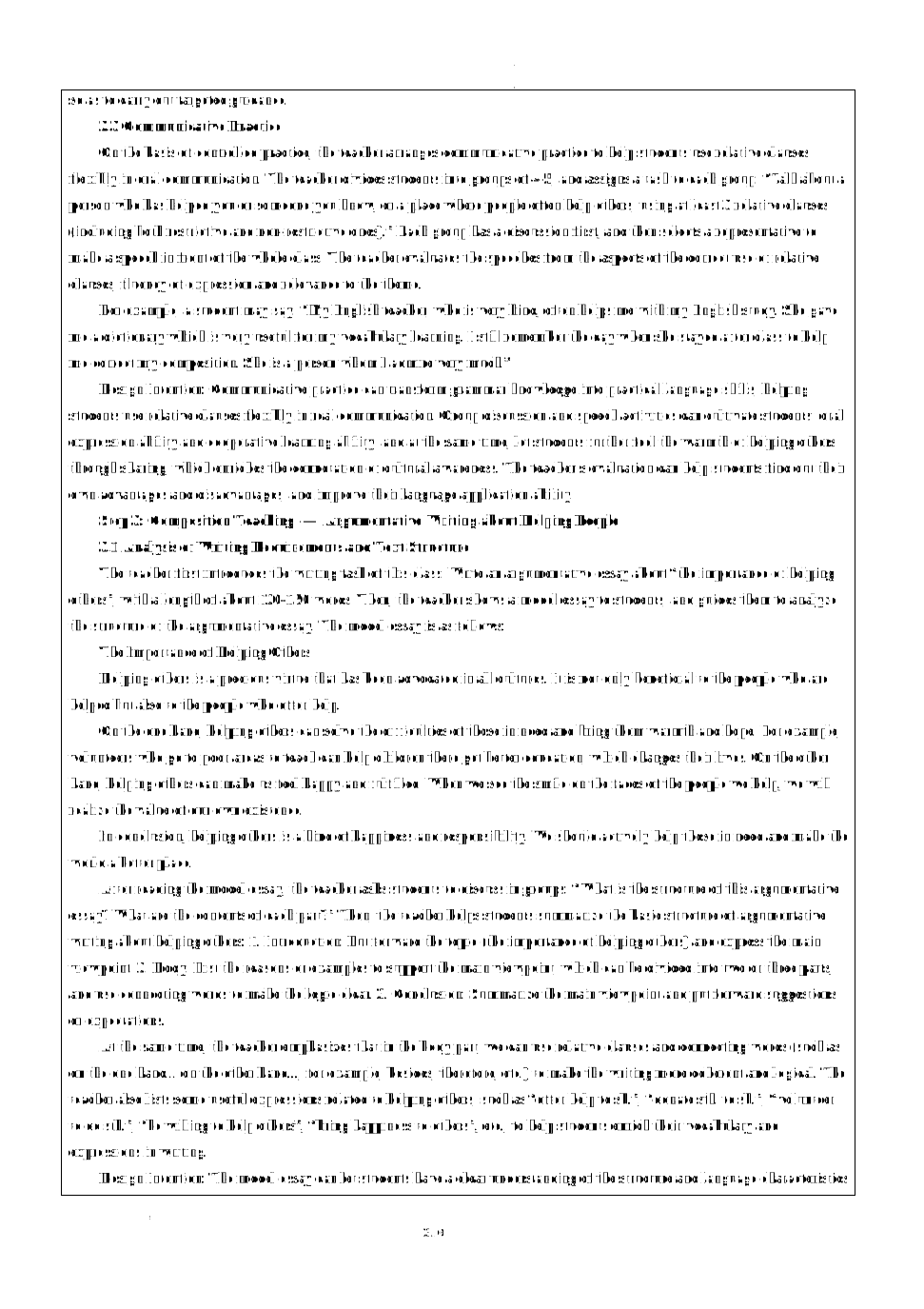
2.3 Communicative Practice
On the basis of controlled practice, the teacher arranges communicative practice to help students use relative clauses flexibly in oral communication. The teacher divides students into groups of 4-5, and assigns a task to each group: “Talk about a person who has helped you or someone you know, or a place where people often help others, using at least 3 relative clauses (including both restrictive and non-restrictive ones).” Each group has a discussion first, and then selects a representative to make a speech in front of the whole class. The teacher evaluates the speeches from the aspects of the correct use of relative clauses, fluency of expression and relevance to the theme.
For example, a student may say: “My English teacher, who is very kind, often helps me with my English study. She gave me a dictionary which is very useful for my vocabulary learning. I still remember the day when she stayed after class to help me correct my composition. She is a person whom I admire very much.”
Design Intention: Communicative practice can transform grammar knowledge into practical language skills, helping students use relative clauses flexibly in real communication. Group discussion and speech activities can cultivate students’ oral expression ability and cooperative learning ability, and at the same time, let students further feel the warmth of helping others through sharing, which enriches the connotation of cultural awareness. The teacher’s evaluation can help students find out their own advantages and disadvantages, and improve their language application ability.
Step 3: Composition Teaching — Argumentative Writing about Helping People
3.1 Analysis of Writing Requirements and Text Structure
The teacher first introduces the writing task of this class: Write an argumentative essay about “the importance of helping others”, with a length of about 120-150 words. Then, the teacher shows a model essay to students, and guides them to analyze the structure of the argumentative essay. The model essay is as follows:
The Importance of Helping Others
Helping others is a precious virtue that has been advocated in all cultures. It is not only beneficial to the people who are helped but also to the people who offer help.
On the one hand, helping others can solve the difficulties of those in need and bring them warmth and hope. For example, volunteers who go to poor areas to teach can help children there get better education, which changes their lives. On the other hand, helping others can make us feel happy and fulfilled. When we see the smile on the faces of the people we help, we will realize the value of our own existence.
In conclusion, helping others is a kind of happiness and responsibility. We should actively help those in need and make the world a better place.
After reading the model essay, the teacher asks students to discuss in groups: “What is the structure of this argumentative essay? What are the contents of each part?” Then, the teacher helps students summarize the basic structure of argumentative writing about helping others: 1. Introduction: Put forward the topic (the importance of helping others) and express the main viewpoint. 2. Body: List the reasons or examples to support the main viewpoint, which can be divided into two or three parts, and use connecting words to make the logic clear. 3. Conclusion: Summarize the main viewpoint and put forward suggestions or expectations.
At the same time, the teacher emphasizes that in the body part, we can use relative clauses and connecting words (such as on the one hand... on the other hand..., for example, besides, therefore, etc.) to make the writing more coherent and logical. The teacher also lists some useful expressions related to helping others, such as “offer help to sb.”, “donate sth. to sb.”, “volunteer to do sth.”, “be willing to help others”, “bring happiness to others”, etc., to help students enrich their vocabulary and expressions in writing.
Design Intention: The model essay can let students have a clear understanding of the structure and language characteristics of argumentative writing about helping others. Guiding students to analyze the model essay by themselves can cultivate their ability to summarize and analyze, which is in line with the requirement of thinking quality. The provision of useful expressions and the emphasis on the use of grammar knowledge (relative clauses and connecting words) can help students solve the problems of insufficient vocabulary and poor logic in writing, laying a foundation for their independent writing.
3.2 Guided Writing
The teacher guides students to carry out writing step by step, combining grammar knowledge with writing practice. First, the teacher helps students determine the topic and main viewpoint: The importance of helping others. Then, the teacher guides students to think about the reasons to support the main viewpoint. For example, “helping others can promote interpersonal relationships”, “helping others can make the society more harmonious”, “helping others can improve our own quality”, etc. The teacher also encourages students to think of specific examples to support their viewpoints, such as the deeds of volunteers, the help between classmates, etc.
Next, the teacher guides students to organize their writing ideas and outline. The teacher asks students to write an outline according to the structure of the argumentative essay. The outline includes the introduction, body (reasons and examples) and conclusion. For example:
Outline:
1. Introduction: Helping others is a virtue that everyone should have. It plays an important role in our life.
2. Body:
a. Reason 1: Helping others can bring warmth to those in need. (Example: A student helped a classmate who was ill with his studies.)
b. Reason 2: Helping others can strengthen our friendship and promote interpersonal relationships. (Example: When I was in trouble, my friend helped me, and our friendship became closer.)
3. Conclusion: We should help others actively and make our world full of love.
After students finish writing the outline, the teacher checks some students’ outlines randomly, makes comments and puts forward suggestions for improvement. For example, if a student’s outline lacks specific examples, the teacher suggests that he add a simple example to make the viewpoint more convincing; if the logic of the outline is not clear, the teacher helps him adjust the order of the reasons.
Then, the teacher asks students to start writing the first draft according to their own outlines. During the writing process, the teacher walks around the classroom, answers students’ questions in time, and helps students solve the problems they encounter, such as the wrong use of relative clauses, the improper use of connecting words, the lack of vocabulary, etc. For students with weak writing ability, the teacher gives more guidance, such as helping them organize sentences, choose appropriate words and expressions.
Design Intention: Guided writing step by step can help students clarify their writing ideas and avoid the confusion of not knowing how to start writing. The outline writing can help students sort out their logic and ensure that the writing is coherent and focused. The teacher’s on-site guidance can timely solve the problems encountered by students in writing, help them apply the grammar knowledge and useful expressions they have learned to writing, and improve their writing ability. At the same time, it can also cultivate students’ independent learning ability and problem-solving ability.
3.3 Peer Evaluation and Revision
After students finish writing the first draft, the teacher arranges peer evaluation. Students exchange their first drafts with their deskmates, and evaluate each other’s works according to the evaluation criteria formulated by the teacher. The evaluation criteria include: 1. Whether the structure is complete (introduction, body, conclusion). 2. Whether the main viewpoint is clear and supported by sufficient reasons and examples. 3. Whether the relative clauses and connecting words are used correctly and flexibly. 4. Whether the vocabulary and expressions are appropriate and rich. 5. Whether there are grammatical errors, spelling errors or punctuation errors.
Each student fills in a peer evaluation form, writes down the advantages and disadvantages of their deskmate’s work, and puts forward suggestions for revision. For example, “Your writing structure is complete, and the examples are specific, but you used the wrong relative pronoun in the second sentence. You can change ‘which’ to ‘who’ because it refers to a person.”
After the peer evaluation, students revise their own first drafts according to the suggestions given by their deskmates and the teacher’s guidance. During the revision process, students can consult the teacher or their deskmates if they have any questions. The teacher checks the revised drafts of some students, and gives further guidance to help them improve their writing.
Design Intention: Peer evaluation can help students learn from each other, find out their own problems in writing through evaluating others’ works, and improve their ability to appreciate and evaluate articles. The revision process is an important link to improve writing quality, which can help students deepen their understanding of writing requirements and grammar knowledge, and cultivate their rigorous learning attitude. At the same time, it can also cultivate students’ cooperative learning ability and communication ability.
Step 4: Consolidation and Expansion
4.1 Consolidation Exercise
The teacher arranges a comprehensive consolidation exercise, which combines grammar and writing. The exercise content is: Complete the following passage with proper relative pronouns or adverbs, and then rewrite the passage in your own words, adding your own ideas and examples. The passage is as follows:
There are many people ______ need help in our society. For example, the elderly ______ live alone, the children ______ have no parents, and the disabled ______ have difficulty in life. We should do our best to help them. The volunteer organization ______ I joined last year often organizes various activities to help those in need. I still remember the day ______ we went to the nursing home to help the elderly. We talked with them, sang songs for them, and helped them clean their rooms. The smiles ______ were on their faces made us very happy. Helping others is a kind of happiness, ______ everyone should experience.
Students complete the exercise independently, and then rewrite the passage. After finishing, the teacher invites some students to share their rewritten passages with the whole class, and makes comments on their works, affirming their progress and pointing out the areas that need to be improved.
Design Intention: The comprehensive consolidation exercise can help students integrate grammar knowledge and writing skills, and further consolidate the knowledge and skills they have learned in this class. Rewriting the passage can cultivate students’ ability to reprocess information and express their own ideas, which is conducive to improving their language application ability and thinking quality.
4.2 Expansion Activity
The teacher arranges an expansion activity: “Design a volunteer activity to help others, and write a short plan for the activity, using at least 5 relative clauses and some connecting words.” Students work in groups to design the activity plan, which includes the theme of the activity, the time, the place, the participants, the content of the activity and the significance of the activity. Each group writes a plan and selects a representative to introduce the plan to the whole class. The teacher evaluates the plans from the aspects of feasibility, creativity, the correct use of grammar knowledge and the clarity of expression.
For example, a group may design a volunteer activity with the theme of “Helping Left-behind Children”. Their plan may include: “We will organize a volunteer activity to help left-behind children in the countryside, which will be held on the weekend. The volunteers who participate in the activity will bring books and stationery to the children. We will teach them English, which can help them improve their English level. We will also play games with them, which can make them feel happy and not lonely. This activity, which is meaningful and helpful, can let the left-behind children feel the warmth of the society and encourage more people to care about them.”
Design Intention: The expansion activity can extend the teaching content to real life, help students apply the grammar knowledge and writing skills they have learned to practical activities, and cultivate their ability to solve practical problems. Group cooperation can cultivate students’ cooperative learning ability and creativity. The activity is closely related to the theme of helping others, which can further strengthen students’ sense of responsibility and kindness, and promote the development of their cultural awareness.
Step 5: Summary and Homework
5.1 Summary
The teacher summarizes the content of this class: “In this class, we have learned the usage of restrictive and non-restrictive relative clauses, and mastered the basic structure and writing skills of argumentative essays about helping others. We also practiced using grammar knowledge in oral communication and writing, and understood the importance of helping others. I hope you can remember what we have learned today, apply the grammar knowledge and writing skills to your daily English learning, and actively help those in need in your life.”
Design Intention: The summary can help students sort out the knowledge and skills they have learned in this class, strengthen their memory and understanding, and form a systematic knowledge structure. At the same time, it can also further emphasize the theme of helping others, guide students to integrate the knowledge learned in class into their life, and realize the organic combination of language learning and moral education.
5.2 Homework
The teacher assigns the following homework:
1. Finish the consolidation exercise and the expansion activity plan, and revise them according to the teacher’s and classmates’ suggestions.
2. Write a formal argumentative essay about “the importance of helping others” with a length of 150-200 words, using at least 6 relative clauses and proper connecting words. Pay attention to the structure, logic and language accuracy of the essay.
3. Observe the people around you who help others, record their deeds, and share them in the next class, using relative clauses to describe them.
Design Intention: The homework is designed to consolidate the knowledge and skills learned in class, and extend the learning from class to after class. The first homework can help students further improve their grammar application ability and writing level; the second homework can let students practice independent writing and improve their writing ability; the third homework can let students pay more attention to the life around them, feel the warmth of helping others, and further deepen their understanding of the unit theme, which is conducive to the all-round development of their key competencies.
1 / 1
学科网(北京)股份有限公司
学科网(北京)股份有限公司
学科网(北京)股份有限公司
$
资源预览图

1

2
3
相关资源
示范课
由于学科网是一个信息分享及获取的平台,不确保部分用户上传资料的 来源及知识产权归属。如您发现相关资料侵犯您的合法权益,请联系学科网,我们核实后将及时进行处理。