Unit 9 Learning Lesson 3 The Secrets of Your Memory(课件)英语北师大版必修第三册
2026-04-07
|
43页
|
2001人阅读
|
2人下载
精品
资源信息
| 学段 | 高中 |
|---|---|
| 学科 | 英语 |
| 教材版本 | 高中英语北师大版必修第三册 |
| 年级 | 高一 |
| 章节 | Lesson 3 The Secrets of Your Memory |
| 类型 | 课件 |
| 知识点 | - |
| 使用场景 | 同步教学-新授课 |
| 学年 | 2026-2027 |
| 地区(省份) | 全国 |
| 地区(市) | - |
| 地区(区县) | - |
| 文件格式 | PPTX |
| 文件大小 | 56.59 MB |
| 发布时间 | 2026-04-07 |
| 更新时间 | 2026-04-07 |
| 作者 | Coco英语老师 |
| 品牌系列 | 上好课·上好课 |
| 审核时间 | 2026-04-07 |
| 下载链接 | https://m.zxxk.com/soft/57211455.html |
| 价格 | 3.00储值(1储值=1元) |
| 来源 | 学科网 |
内容正文:
高中英语北师大版必修第三册
Unit 9 Learning
Lesson 3
The Secrets of Your Memory
To read a text about memory
To read for detail and correct false statements
To understand the main theme of each paragraph in an extended text
To discuss tips on memory improvement
Contents
1. Lead in
2. Pre-reading
3. While Reading
4. Post Reading
5. Summary
6. Language Focus
7. Homework
目录页
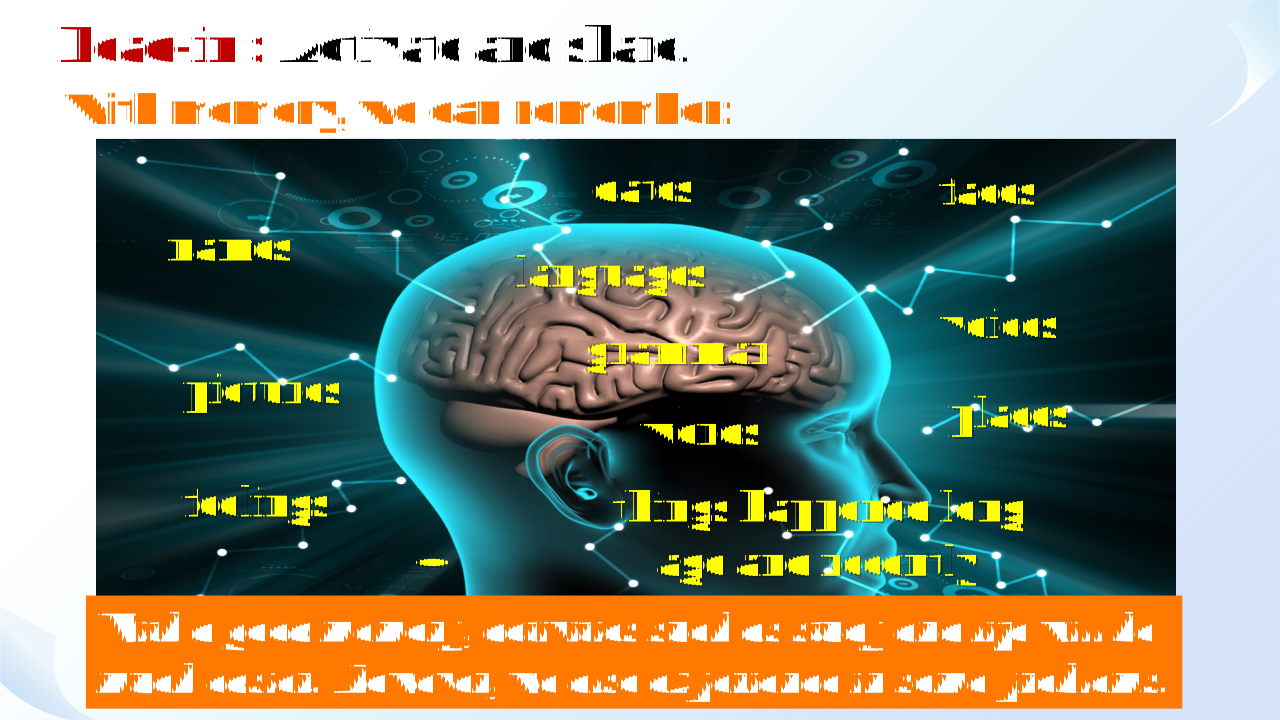
With memory, we can remember:
names
faces
dates
pictures
places
grammar
feelings
languages
words
voices
things happened long ago and recently
…
With a good memory, activities such as study and life will be much easier. However, we also experience in some problems.
Lead-in : Activate and share.
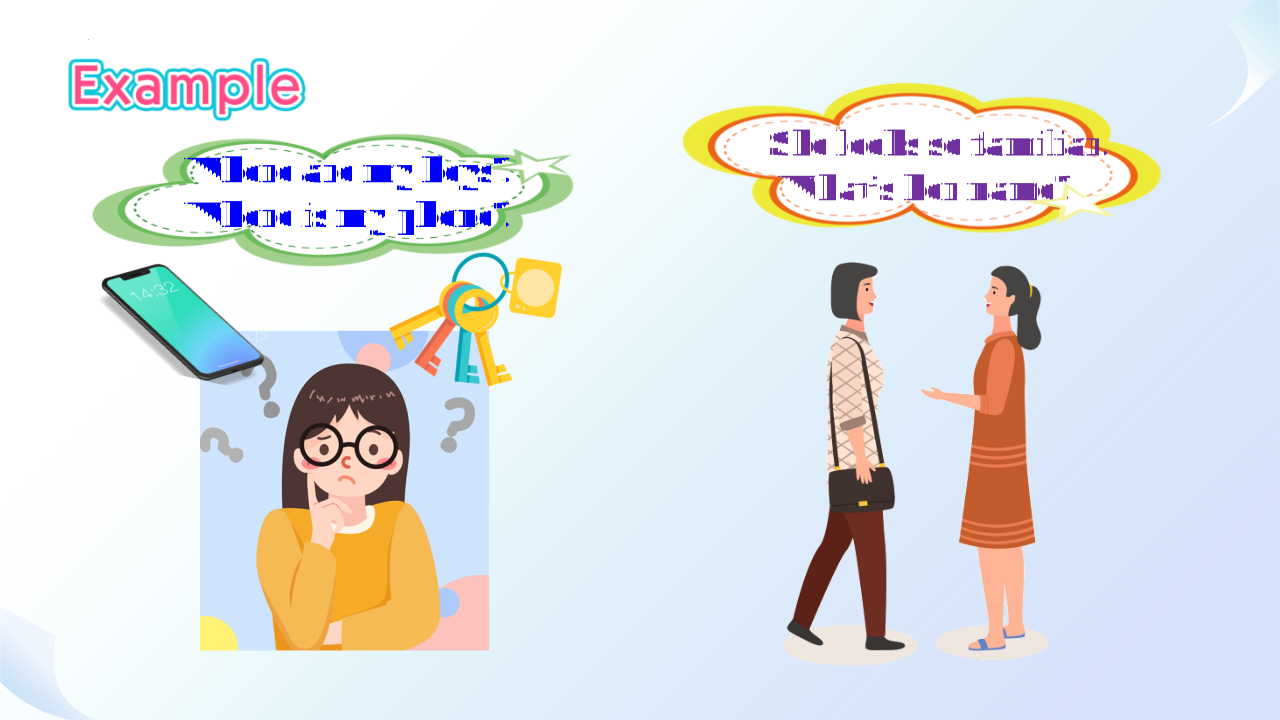
Watch the video and try to tell us: what is the thing that we can’t remember?
Things without thinking (remember unconsciously).
Where are my keys?
Where is my phone?
She looks so familiar.
What’s her name?
Which of the following things do you find easy to remember? Can you explain why?
names and faces
numbers: telephone numbers, passwords, etc.
stories
facts and arrangements
things that happened long ago
things that happened recently
Pre-reading
If you were going to meet a memory expert, what questions would you ask him / her?
Why do some of my classmates remember things faster than me?
Does age play a role in the human’s brain ability to store and recall information?
Is there any special food that helps memory?
How can I improve my memory?
Read the text quickly. Does the text answer any of your questions in Activity 2?
Skim through the text quickly and find out if any of the questions you noted down are answered by the memory expert.
Fast-reading
Memory expert Jemima Gryaznov answers four questions in this text, they are:
1. Why can I remember events in my childhood but not what happened last week?
2. Do some people really have a photographic memory?
3. Why do I forget the new words that I learnt yesterday?
4. I’m 16, but I sometimes forget things. Is my memory getting worse?
Read the text and find out the basic truths.
Topic sentences
Basic truths
Read the text carefully and dig into the truths.
Question Truth
Why can I remember events in my childhood but not what happened last week? We can remember things that have 1. _________ connections in our mind, especially emotional connections, and childhood memories are often very emotional.
Retelling events helps fix experiences in our memories and interesting or funny stories from our 2. __________ are often told again and again.
strong
childhood
While-Reading
Question Truth
Do some people really have a photographic memory? Some people do have amazing memories.
Why do I forget the new words that I learnt yesterday? The 3. __________ loss of memory occurs during the very early period after learning.
I’m 16, but I sometimes forget things. Is my memory getting worse? Our memory reaches its full power at the age of 25.
After 25, the brain starts to get 8. ________.
By middle age, our memory is significantly worse than when we were young.
sharpest
smaller
Read the text again. Write T (true) or F (false). Correct the false statements.
We remember certain events in our childhood, because we experienced many of them for the first time, and we felt strongly about them at the time.
When we tell a story many times, we forget important details.
we can remember them clearly.
3. Stephen Wiltshire has a photographic memory because he can draw a detailed picture of a city from memory after flying over it.
He is good at remembering particular things but does not have a photographic memory.
4. It has been proved that some people have a photographic memory.
No one has been proved to have a photographic memory.
15
5. The sharpest loss of memory occurs during the first five days.
The sharpest loss of memory occurs during the very early period after learning.
Our memory starts to get worse after the age of 25.
6. Our memory starts to get worse in middle age.
What suggestions would you provide for each of the four questions discussed? Discuss with your partner.
Read each paragraph in the text and discuss further advice that you would suggest.
Post-Reading
Watch the video about Stephen Wiltshire and talk about his amazing memory.
Match the following suggestions with the four questions and put them back in the text. Compare your suggestions with the expert's suggestions.
What can we learn from all this? When remembering something new, try to connect it to our emotions. It is important to connect it with what we already know. Also, we can try to retell what we have learnt to a few others.
A
Therefore, one of the golden rules to increase how much we remember is to review the material periodically, especially during the first day after learning. This “spaced review” soon after learning helps build stronger memories and it is more effective than waiting to review everything before exams.
B
So take it easy. You are at a good age in terms of your memory. Make good use of it.
C
As most of us do not have amazing memories like them, when memorising detailed learning materials, we simply need to focus on the important ideas and be curious about what we learn. Asking questions about what we learn also helps with memorisation. Another effective technique to remember things is to group similar ideas or information together so that they can be easily connected to things that are already known.
D
What truths about memory does Jemima Gryaznov discuss in the text? What advice does she give to improve one’s memory?
Truth: We remember things that have strong connections in our mind, especially emotional connections.
Advice: We need to make strong connections with things we want to remember in our mind, especially emotional connections.
Truth: Nobody has a photographic memory.
Advice: We need to focus on the important ideas and be curious about what we learn when memorising complex learning materials.
Truth: The sharpest loss of memory occurs during the very early period after learning.
Advice: We need to review the information at regular intervals, especially in the first day after learning it.
Truth: Our memory reaches its full power at the age of 25.
Advice: We need to train our memory to remember more when we’re older.
How has the expert tried to make her statements to each question convincing? What methods has she used and what signal words can you find?
To make her statements convincing the expert used:
examples: For example…
figures: a famous forgetting curve
quote: According to…
numbers: 25, 200, 40
2. Are there any answers given by Jemima Gryaznov that are not convincing to you? What are your doubts?
Replace the underlined words and phrase with the words from the text.
Jemima Gryaznov thinks people remember things that have strong sentimental attachment.
When we do things with enthusiasm, we tend to remember them well.
When we try to remember detailed materials, we should focus on the important ideas.
emotional
excitement
memorise
4. Jemima Gryaznov suggested another effective method to remember things: grouping similar ideas or information together.
5. A good strategy to increase memory is to review the material you are trying to remember often.
technique
periodically
Read the tips for improving your memory. Which tips seem most / least useful? Which, if any, would be useful for English learning?
Five Tips for Improving Your Memory
1 Sleep well: If you don't sleep properly, you “lose” many of your memories.
2 Do physical exercise: When you exercise, more oxygen goes to your brain and makes your memory work better.
3 Do mental exercise: It is important to exercise your brain just like your body. New activities are more challenging than familiar ones.
Summary
4 Be interested: Ask yourself questions about what you are learning. We learn better if we are interested.
5 Form a mental picture: For example, if you want to remember the name “John Keys”, imagine his face with a big key on it. The stranger the picture, the better!
Teacher: Ok, everyone. Let’s discuss something that many of you find difficult —1 ___________ new words. Does anyone have any 2 __________ advice on the best way to do this?
Student 1: I think it’s good to try and organize new words by 3 _______. So, for example, if I have words related to “school”, I can write a 4 ________ list of all the vocabulary I can think of under that heading.
Student 2: That’s a good idea but even if I write lists, I still forget so many words. I think I just have a bad 5 _________.
memory significantly effective particular theme
materials focus therefore detailed memorising
memorising
particular
theme
detailed
memory
Focus on Language: Important words and phrases
Student 3: Well, when you learn new words in your coursebook it’s also useful to try and find them in other English language 6 ________. Read online articles or English literature and keep an eye out for the new words.
Student 4: That’s good advice but I wouldn’t 7 _______ too much on simply reading words. When you learn a new word, use it in spoken English. It 8 ___________ improves your ability to remember words if you’ve already used them in a conversation. 9 ___________, you must develop your speaking skills.
Teacher: Good ideas, everyone. I agree that speaking is the most 10 ________ way of remembering new words and phrases but everyone is different, so find the approach that works best for you.
materials
focus
significantly
Therefore
effective
Focus on Language: Important words and phrases
1. Retelling events _______ (help) fix experiences in our memories.
2. There ________ (be) some people who do have amazing memories.
3. They _______ (be) both good at remembering particular things for a limited time.
4. One of the golden rules to increase how much we remember ___ (be) to review the material periodically.
Sentence Builder
Circle the subjects of the sentences in the sentence builder. Then use the correct form of the verbs to complete the sentences.
Focus on Grammar: Subject-Verb Agreement
helps
are
are
is
主谓一致是指主语和谓语要保持人称和数上的一致,主语的“人称”和“数”决定谓语动词的变化。
但是如果主语不是单一的,或主语名词的数比较特殊时,其主谓一致一般要根据语法一致\意义一致\就近原则.
Focus on Grammar: Subject-Verb Agreement
1. and连接两个或两个以上单数名词或者代词作主语的时候,谓语动词用复数。
(1) He and I ____ both students of this school.
(2) Both rice and wheat grown in this part of China. (be)
注意:由and连接的两个并列主语指同一个人或物,谓语动词用单数,这时后面的名词前没有冠词。
1) The worker and writer ______ our school today. (visit)
2) The worker and the writer _________ to the meeting. (have come / has come)
have come
visits
are
are
语法一致原则
Focus on Grammar: Subject-Verb Agreement
2. 当主语后面跟有as well as, as much as, along with, with, together with , like, rather than, but, except, besides, including等引导的词组时,其谓语动词的单、复数由主语的单、复数而定。
The teacher with two students ______ (be) at the meeting .
E-mail, as well as the telephones, ____________ (play) an important part in daily communication.
A library with five thousand books ___ (be) offered to the nation as a gift.
Nobody but Jane ________ (know) the secret.
is
is playing
is
knows
语法一致原则
Focus on Grammar: Subject-Verb Agreement
3.当主语由不定式、动名词或疑问词引导的句子充当时,谓语动词用单数。
1) To hold the Olympic Games ____ (be) a rich prize for a country. 2) Choosing what to eat ___ no longer as easy as it once was.
3) What we need ____ (be) more time and more materials.
由what, who, why, how, whether等引导的主语从句,谓语动词通常用单数,(但所指的具体内容为复数意义,则可以用复数形式: (What we need are teachers.)
is
is
is
语法一致原则
Focus on Grammar: Subject-Verb Agreement
1. Collective nouns(集体名词)
由集体名词,如group, family, class, government, team, enemy, crowd, company, audience等作主语时,如果看一个整体,谓语动词用单数形式,如果看成其中各成员,则用复数形式。
注意:集体名词为 people, police, 谓语动词用复数
eg: The police are searching for the thief.
意义一致原则
Focus on Grammar: Subject-Verb Agreement
2. Indefinite pronouns(不定代词)
不定代词everybody, everyone, everything, anyone, anybody, anything, someone, somebody, something, nobody, no one, nothing, each, the other 等作主语时,谓语动词用单数。
1. Nothing _____ (be) difficult in the world if you set your mind to it.
2. Everything (be) ready.
3. Someone _______ (want) to see you.
is
is
wants
意义一致原则
Focus on Grammar: Subject-Verb Agreement
就近原则
Focus on Grammar: Subject-Verb Agreement
A or B
Not A but B
Either A or B
Neither A nor B
Not only A but also B
+ Verb
Here
There
+ Verb
A and B
A , B and C
1. Not only you but also he ____ wrong. (is / are)
2. Neither you nor he ___ right. (is / are)
3. There ____ two shops and a cinema beside the railway station. (is / are)
4. Here ____ a map and a handbook for you. (is / are)
is
is
are
is
就近原则
Focus on Grammar: Subject-Verb Agreement
English is a must in your study, and you need to remember a lot when learning it. How do you remember all the English words and rules? Write a short passage about your memorizing.
Lavf60.4.100
Bilibili VXCode Swarm Transcoder v0.2.30(gap_fixed:False)
Lavf58.28.100
Bilibili VXCode Swarm Transcoder r0.2.61(gap_fixed:False)
$
资源预览图

1
2
3
4
5
6

相关资源
由于学科网是一个信息分享及获取的平台,不确保部分用户上传资料的 来源及知识产权归属。如您发现相关资料侵犯您的合法权益,请联系学科网,我们核实后将及时进行处理。