Unit 3 The World of Science-Using language 教案-2025-2026学年高中英语外研版必修第三册
2026-03-28
|
6页
|
913人阅读
|
1人下载
普通
摘要:
该高中英语教案聚焦“科学世界”主题,核心涵盖现在完成时被动语态、科学职业词汇及发明故事听说技能。通过展示3D打印机等发明图片开展头脑风暴讨论,结合主动被动句对比观察,搭建从生活情境到语法感知的学习支架,衔接词汇语法教学。
该资料以核心素养为导向,语言能力上通过“记者采访科学家”角色扮演提升综合表达,思维品质上引导学生自主总结语法规则,学习能力上设计分层作业(基础巩固、实践采访、拓展报告)。听力结合录音多轮训练,写作任务整合词汇语法,助力学生深化科学主题理解,教师可直接应用以提升教学效率。
内容正文:
Unit 3 The World of Science-Using language
内容导航
This section focuses on language practice, including Present Perfect Passive, vocabulary about careers in science, and listening & speaking about invention stories. It guides students to master language points and apply them in real contexts to deepen understanding of scientific themes.
教学目标和重难点
1. 教学目标
Language Ability: Master scientific vocabulary and Present Perfect Passive, and improve abilities in listening, speaking, reading and writing to communicate about science.
Cultural Awareness: Understand attitudes towards science in different cultures and foster cross-cultural communication ability.
Thinking Quality: Cultivate critical and creative thinking through exploring scientific knowledge.
Learning Strategies: Master effective vocabulary and grammar learning methods, and improve autonomous learning ability through cooperation and exploration.
2. 教学重难点
Key Points: Grasp the form, meaning and usage of Present Perfect Passive; master core vocabulary related to scientific careers and inventions; use the target language to introduce scientists, their achievements and invention stories.
Difficult Points: Distinguish contexts to correctly use Present Perfect Passive; flexibly apply target vocabulary and grammar in real communication; understand the deep meaning of invention stories to stimulate scientific exploration spirit.
教学过程
Step 1: Lead-in (导入)
Activity 1: Brainstorming and Discussion
The teacher shows some pictures of great scientific inventions (such as 3D printers, flexible batteries, and virtual reality devices) on the screen and asks students the following questions: “Which of these inventions do you know? How have these inventions changed our daily life? Have you ever thought about how these inventions were created?” Then, organize students to discuss in pairs for a few minutes and invite 2-3 pairs to share their ideas with the whole class.
Design Intention: This activity takes familiar scientific inventions as the starting point, which is closely related to the unit theme “The World of Science” and can quickly arouse students’ interest in learning. By asking open-ended questions, it guides students to think actively and recall relevant knowledge, laying a foundation for the subsequent learning of vocabulary, grammar and listening. At the same time, pair discussion helps to cultivate students’ cooperative learning awareness and oral expression ability.
Activity 2: Sentence Observation
The teacher writes two groups of sentences on the blackboard: Group 1: 1. I guess you have been asked about the title of your book before. 2. 3D printers have been used to make replacement hearts and bone parts. Group 2: 1. Someone has asked you about the title of your book before. 2. People have used 3D printers to make replacement hearts and bone parts. Then ask students to observe the two groups of sentences and discuss: “What is the difference between the two groups of sentences? What is the structure of the sentences in Group 1? Why does the author use such a structure?”
Design Intention: Through observing and comparing the active and passive forms of Present Perfect Tense, students can initially perceive the form and function of Present Perfect Passive, which conforms to the “form-meaning-use” three-dimensional dynamic grammar teaching concept. It guides students to discover rules independently instead of passively accepting knowledge, which helps to improve their thinking ability and lays a foundation for the subsequent detailed explanation of grammar.
Step 2: Vocabulary Teaching (词汇教学)
Activity 1: Vocabulary Presentation and Explanation
The teacher focuses on teaching core vocabulary related to “Careers in Science” and scientific inventions, including capable, flexible, inspire, press, shoot, desire, in addition, thanks to, in terms of, etc. For each word or phrase, the teacher first presents the pronunciation and spelling, then explains the meaning with simple English, combines the textbook original sentences and real-life examples to help students understand, and guides students to master word formation (such as flexible → flexibility, capable → capability) and collocations (such as be capable of doing sth., inspire sb. to do sth.).
For example, when teaching “capable”, the teacher says: “Capable is an adjective, which means having the ability to do something. The textbook sentence is ‘It is capable of using GPS technology to travel to different places.’ We can also say ‘She is capable of finishing the task on time.’ Its noun form is capability, which means ability.” When teaching “thanks to”, the teacher gives an example: “Thanks to the development of science and technology, our life has become more convenient.”
Design Intention: Vocabulary is the foundation of language learning. Combining textbook context and real-life examples to teach vocabulary can help students understand the meaning and usage of words more deeply, avoiding mechanical memorization. Guiding students to master word formation and collocations can help them expand their vocabulary and improve their ability to use vocabulary flexibly. At the same time, the selected vocabulary is closely related to the unit theme, which can lay a foundation for the subsequent listening, speaking and grammar application.
Activity 2: Vocabulary Practice
1. Fill in the blanks: The teacher designs fill-in-the-blank questions based on the taught vocabulary and asks students to complete them individually. After completion, invite students to answer and correct mistakes in time. For example: (1) She is ______ (有能力的) of solving difficult problems. (2) The ______ (灵活的) battery makes the wearable tech more convenient. (3) ______ (多亏) his help, we finished the experiment successfully. (4) His speech ______ (激励) us to work harder.
2. Word Matching: The teacher prepares word cards and meaning cards, invites students to come to the front of the classroom to match them, and other students judge whether they are correct. This activity can enhance the interactivity of the class and help students consolidate the meaning of words.
Design Intention: Through fill-in-the-blank and word matching exercises, students can consolidate the newly learned vocabulary in time, check their mastery of vocabulary, and find out and correct mistakes in time. The interactive form of word matching can arouse students’ learning enthusiasm and make vocabulary learning more interesting.
Step 3: Grammar Teaching (语法教学)
Activity 1: Summarize Grammar Rules
Based on the sentence observation activity in the lead-in part, the teacher guides students to summarize the form, meaning and usage of Present Perfect Passive together. First, the form: Subject + have/has been + past participle. Then, explain the meaning: It is used to express an action that started in the past, continued to the present, and has a connection with the present, or an action that was completed in the past but has an impact on the present, and the subject is the receiver of the action.
Then, the teacher explains the usage scenarios of Present Perfect Passive with examples: 1. When the doer of the action is unknown or not important. For example: “The letter has been sent.” (We don’t need to know who sent the letter.) 2. When emphasizing the receiver of the action. For example: “Great progress has been made in science and technology in recent years.” (Emphasize “great progress”.) 3. When the action has a connection with the present. For example: “The experiment has been finished, so we can analyze the results.”
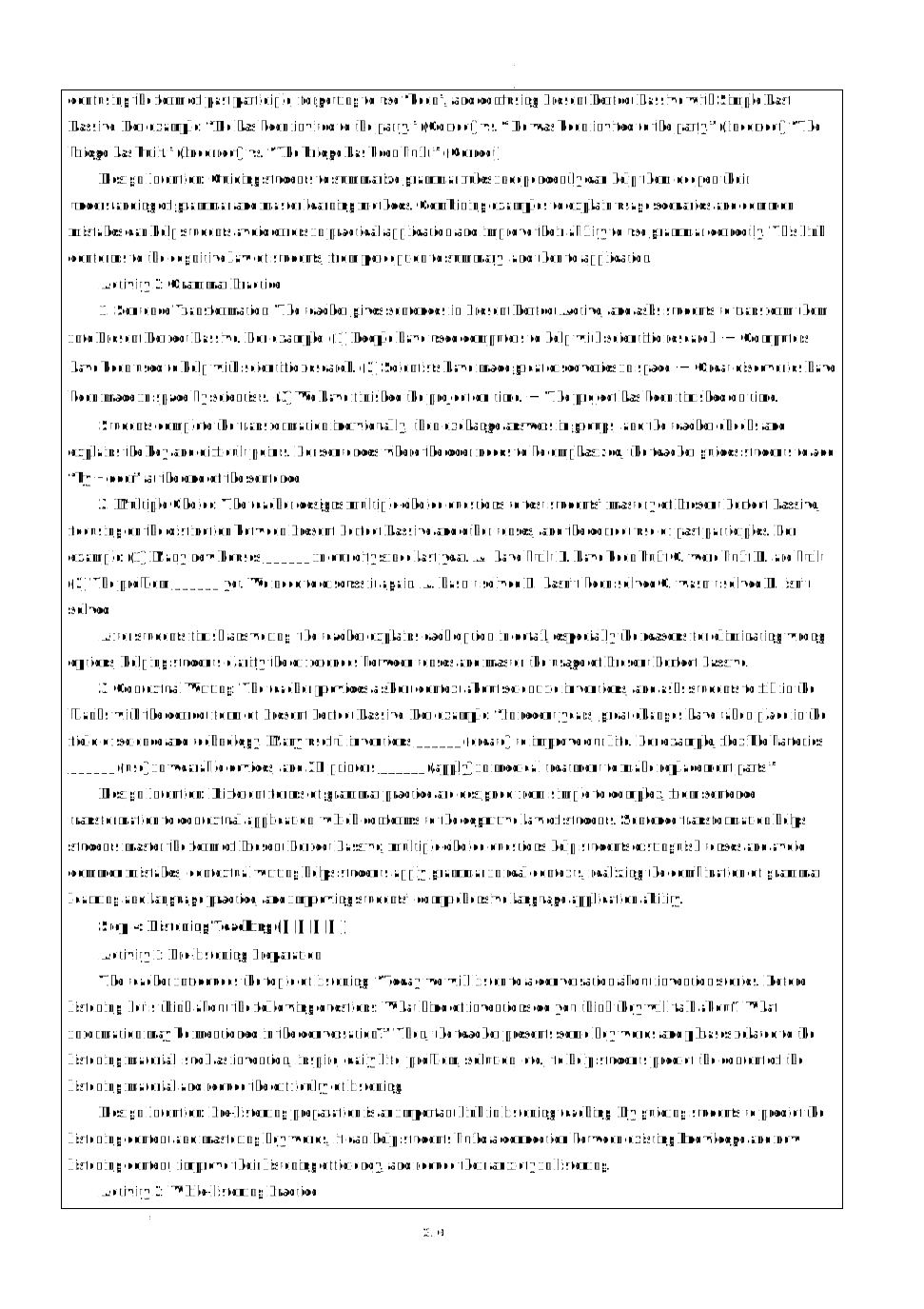
At the same time, the teacher reminds students of the common mistakes in using Present Perfect Passive, such as confusing the form of past participle, forgetting to use “been”, and confusing Present Perfect Passive with Simple Past Passive. For example: “He has been invited to the party.” (Correct) vs. “He was been invited to the party.” (Incorrect) “The bridge has built.” (Incorrect) vs. “The bridge has been built.” (Correct)
Design Intention: Guiding students to summarize grammar rules independently can help them deepen their understanding of grammar and master learning methods. Combining examples to explain usage scenarios and common mistakes can help students avoid errors in practical application and improve their ability to use grammar correctly. This link conforms to the cognitive law of students, from perception to summary, and then to application.
Activity 2: Grammar Practice
1. Sentence Transformation: The teacher gives sentences in Present Perfect Active, and asks students to transform them into Present Perfect Passive. For example: (1) People have used computers to help with scientific research. → Computers have been used to help with scientific research. (2) Scientists have made great discoveries in space. → Great discoveries have been made in space by scientists. (3) We have finished the project on time. → The project has been finished on time.
Students complete the transformation individually, then exchange answers in groups, and the teacher checks and explains the key and difficult points. For sentences where the doer needs to be emphasized, the teacher guides students to add “by + doer” at the end of the sentence.
2. Multiple Choice: The teacher designs multiple-choice questions to test students’ mastery of Present Perfect Passive, focusing on the distinction between Present Perfect Passive and other tenses, and the correct use of past participles. For example: (1) Many new houses ______ in our city since last year. A. have built B. have been built C. were built D. are built (2) The problem ______ yet. We need to discuss it again. A. hasn’t solved B. hasn’t been solved C. wasn’t solved D. isn’t solved
After students finish answering, the teacher explains each option in detail, especially the reasons for eliminating wrong options, helping students clarify the differences between tenses and master the usage of Present Perfect Passive.
3. Contextual Writing: The teacher provides a short context about scientific inventions, and asks students to fill in the blanks with the correct form of Present Perfect Passive. For example: “In recent years, great changes have taken place in the field of science and technology. Many useful inventions ______ (create) to improve our life. For example, flexible batteries ______ (use) in wearable devices, and 3D printers ______ (apply) in medical treatment to make replacement parts.”
Design Intention: Different forms of grammar practice are designed from simple to complex, from sentence transformation to contextual application, which conforms to the cognitive law of students. Sentence transformation helps students master the form of Present Perfect Passive; multiple-choice questions help students distinguish tenses and avoid common mistakes; contextual writing helps students apply grammar in real contexts, realizing the combination of grammar learning and language practice, and improving students’ comprehensive language application ability.
Step 4: Listening Teaching (听力教学)
Activity 1: Pre-listening Preparation
The teacher introduces the topic of listening: “Today we will listen to a conversation about invention stories. Before listening, let’s think about the following questions: What kind of inventions do you think they will talk about? What information may be mentioned in the conversation?” Then, the teacher presents some key words and phrases related to the listening material, such as invention, inspire, daily life, problem, solution, etc., to help students predict the content of the listening material and reduce the difficulty of listening.
Design Intention: Pre-listening preparation is an important link in listening teaching. By guiding students to predict the listening content and mastering key words, it can help students build a connection between existing knowledge and new listening content, improve their listening efficiency, and reduce their anxiety in listening.
Activity 2: While-listening Practice
1. First Listening: Ask students to listen to the recording once and answer the general question: “What is the conversation mainly about?” (It is mainly about two people talking about their favorite inventions and the stories behind the inventions.) After listening, invite students to answer and confirm the main idea of the listening material.
2. Second Listening: Ask students to listen to the recording again and fill in the blanks with the key information. The blanks mainly involve the name of the invention, the reason for the invention, and the impact of the invention. For example: (1) The woman’s favorite invention is the ______, which was invented to solve the problem of ______. (2) The man’s favorite invention is the ______, which has helped people ______.
After listening, the teacher plays the recording again, pauses at the key points, and checks the answers with students, explaining the difficult sentences and key information in the listening material.
3. Third Listening: Ask students to listen to the recording again and pay attention to the pronunciation, intonation and emotional expression of the speakers. Then, invite students to role-play the conversation in pairs, imitating the pronunciation and intonation of the speakers.
Design Intention: The while-listening practice is carried out step by step, from understanding the main idea to grasping the key details, and then to imitating the pronunciation and intonation, which conforms to the process of listening comprehension. Multiple listenings help students fully understand the listening material, and role-playing helps students combine listening with speaking, improving their oral expression ability and listening comprehension ability.
Activity 3: Post-listening Extension
The teacher asks students to discuss in groups: “What other inventions do you know that have changed our life? What problems did these inventions solve? If you could invent something, what would you invent and why?” Then, invite several students from each group to share their ideas with the whole class. The teacher comments on students’ answers, affirms their creative ideas, and guides them to use the newly learned vocabulary and grammar in their expressions.
Design Intention: Post-listening extension connects listening with real life, guides students to think creatively, and stimulates their interest in scientific invention. Group discussion and sharing help to cultivate students’ cooperative learning ability and oral expression ability, and also provide an opportunity for students to apply the newly learned language knowledge, realizing the integration of listening and speaking.
Step 5: Speaking Teaching (口语教学)
Activity 1: Topic Discussion
The teacher puts forward the discussion topic: “Talk about a famous scientist and his/her achievements.” First, the teacher gives an example: “Stephen Hawking was a famous physicist. He has made great contributions to the study of black holes and the origin of the universe. His book A Brief History of Time has been translated into many languages and is popular all over the world.” Then, guide students to use the newly learned vocabulary (such as capable, inspire, contribution, etc.) and Present Perfect Passive to introduce scientists and their achievements.
Organize students to discuss in groups of 4, and each student introduces a famous scientist. During the discussion, the teacher walks around the classroom, provides guidance for students who have difficulties in expression, and reminds students to use the target language correctly.
Design Intention: Taking famous scientists as the topic of discussion is closely related to the unit theme and can help students understand the spirit of scientific exploration. The teacher’s example can help students clarify the direction of expression, and group discussion provides a relaxed environment for students to practice speaking, helping them overcome the fear of speaking English and improve their oral expression ability.
Activity 2: Role-play
The teacher designs a role-play scenario: “Suppose you are a reporter and your partner is a famous scientist. You are going to interview the scientist about his/her scientific research and achievements.” The teacher provides some interview questions for reference: (1) What inspired you to engage in scientific research? (2) What great achievements have you made so far? (3) How have your achievements influenced the world? (4) What suggestions do you have for young people who are interested in science?
Students prepare the role-play in pairs for a few minutes, then invite 2-3 pairs to perform in front of the whole class. After the performance, the teacher and other students comment on their performance, focusing on the correctness of language use, the fluency of expression and the appropriateness of role performance.
Design Intention: Role-play is a practical oral practice form, which can simulate real communication scenarios and help students apply the target language flexibly. The interview scenario is close to real life, which can stimulate students’ participation enthusiasm and improve their ability to communicate in real contexts. Comments after the performance help students find their own shortcomings and improve their oral expression ability.
Step 6: Comprehensive Application (综合应用)
Activity: Writing Practice
The teacher assigns a writing task: “Write a short passage about an invention that you think is the most useful. In your passage, you should introduce the invention, the reason why it was invented, its impact on our life, and your feelings about it. You should use at least 5 newly learned words and 3 sentences in Present Perfect Passive.”
Before writing, the teacher guides students to sort out their ideas: first, determine the invention to be introduced; then, introduce the basic information of the invention; next, explain the reason for the invention and its impact; finally, express their own feelings. The teacher also reminds students to pay attention to the correct use of vocabulary and grammar, and the coherence and fluency of the passage.
Students write individually, and the teacher walks around the classroom to provide guidance for students who have difficulties in writing, such as helping them organize their ideas, correct grammar mistakes, and improve the expression of sentences. After students finish writing, invite several students to read their passages in front of the class, and the teacher comments on their passages, affirming their advantages and putting forward suggestions for improvement.
Design Intention: Writing practice is an important way to test students’ comprehensive language application ability. Combining the unit theme and the newly learned language knowledge to design writing tasks can help students integrate vocabulary, grammar, listening and speaking skills, and improve their writing ability. Teacher’s guidance and comments help students find their own shortcomings and improve their writing level.
Step 7: Summary and Homework (总结与作业)
Activity 1: Summary
The teacher guides students to summarize the key points of this lesson together: “What have we learned today? We have learned some core vocabulary related to science and inventions, mastered the form, meaning and usage of Present Perfect Passive, and practiced listening, speaking and writing around the theme of scientific inventions. Who can briefly summarize the usage of Present Perfect Passive? Who can list some key words we have learned today?” Invite students to answer, and the teacher supplements and sorts out to help students consolidate the knowledge learned in this lesson.
Design Intention: Summarizing the key points of the lesson together can help students sort out the knowledge system, deepen their understanding and memory of the knowledge learned, and cultivate their ability to summarize and sort out knowledge.
Activity 2: Homework
1. Basic Homework: Review the vocabulary and grammar learned in this lesson, copy the key words and sentences 3 times, and complete the grammar exercises in the textbook.
2. Practical Homework: Interview your family members or friends about their favorite scientific inventions, take notes, and write a short interview report (about 80-100 words), using the target vocabulary and Present Perfect Passive.
3. Extended Homework: Surf the Internet to find information about a famous scientist, and prepare a 2-minute oral report to be shared in the next class.
Design Intention: The homework is designed at different levels, including basic homework, practical homework and extended homework, which can meet the needs of different students. Basic homework helps students consolidate the knowledge learned; practical homework connects classroom learning with real life, improving students’ practical application ability; extended homework helps students expand their knowledge and improve their autonomous learning ability and oral expression ability.
1 / 1
学科网(北京)股份有限公司
学科网(北京)股份有限公司
学科网(北京)股份有限公司
$
资源预览图

1

2
3
相关资源
示范课
由于学科网是一个信息分享及获取的平台,不确保部分用户上传资料的 来源及知识产权归属。如您发现相关资料侵犯您的合法权益,请联系学科网,我们核实后将及时进行处理。