UNIT 6 Section Ⅳ Writing a journal entry about living in space(课时跟踪检测)(学用Word)-【优学精讲】2025-2026学年高中英语选择性必修第四册(外研版)
2026-06-02
|
2份
|
9页
|
34人阅读
|
0人下载

内容正文:
Section Ⅳ Writing a journal entry about living in space
Ⅰ.阅读理解
A
What do you do when nobody is around to take your picture?You take a selfie.But what about selfies in space?NASA astronaut Buzz Aldrin, who famously became the second man to walk on the Moon in July 1969, said that he took the first selfie in space during the Gemini 12 mission in 1966.
“For me, it needs to be digital to be a selfie,” argues Jennifer Levasseur, who is in charge of the Smithsonian National Air and Space Museum.According to Levasseur,the concept of a selfie is directly linked to Internet culture and the human desire to interact on social platforms.“The thing that makes a selfie is sharing it,” she says.
Still, astronauts have been carrying cameras aboard space vehicles since the 1960s.In 1966, Aldrin used a Hasselblad camera designed specifically for space.Hasselblad also painted the first camera in space matte black (磨砂黑) to reduce reflections in the window of the orbiter.But cameras used in space need to survive extreme conditions, like temperature swinging from-149 °F to 248 °F, so Hasselblad painted later models silver.
Astronauts had to pull the film magazines (胶卷盒) out and leave their cameras behind when they returned to the Earth, because early space missions were restricted by a weight limit on the return trip.
A big change in space camera technology came after the sad loss of the space shuttle Columbia, which broke apart on its return to the Earth in 2003.“Fearing that they would never be able to bring the film back from space and lose all that hard work accelerated the push for being digital,” Levasseur says.
Today, astronauts can have access to the Internet and social platforms in space and post true space selfies taken by digital cameras.
1.How did the Hasselblad camera adapt to space temperature changes?( )
A.By changing its inner design. B.By reducing its reflections.
C.By making it stronger. D.By painting it silver.
2.Why were cameras left in space on early space missions?( )
A.To lighten the load of the spaceship. B.To test cameras under extreme conditions.
C.To prepare for the next space exploration. D.To take more pictures on the next trip.
3.What advanced space camera technology?( )
A.The invention of new films.
B.The popularity of space selfies.
C.The concern about the loss of valuable data.
D.The fear of falling behind in the space race.
4.What is the best title for the text?( )
A.The Origin of Selfies in Space B.The History of Selfies in Space
C.The Significance of Selfies in Space D.The Technique of Selfies in Space
B
Mars is no stranger to life. Seven US spacecraft have successfully landed there, and all of them took microbes to the planet’s surface (though the bugs probably did not survive for long). Yet the world’s space agencies continue to maintain strict spacecraft sterilization (消毒) procedures in the hope of minimizing the spread of Earth life beyond our planet. For decades this idea — known as planetary protection — is widespread. Now, some scientists say, these procedures are preventing the search for life beyond Earth by raising costs and preventing innovative missions — without meaningful benefits.
Of all missions to Mars to date, only the Vikings, the first trip to the Red Planet, were intended to test for life. Spacecraft that went later did not have that ability. But a future mission will, and the protectionist thinking goes, a spacecraft might not be able to distinguish between a life form native to Mars and one with origins on Earth. In July 2013 astrobiologists Dirk Schulze-Makuch and Alberto Fairén argued against this in Nature Geoscience.
“If Earth life can thrive on Mars, they almost certainly already do,” the authors write. “If they cannot, the transfer of Earth life to Mars should be of no concern, as it would simply not survive.”
With clear evidence of a watery history and some signs of water present, Mars could be where we find life in our solar system. And with the development of Curiosity’s precise landing system, we can finally reach the mysterious parts of the planet. But it’s these areas that require a craft sterilization process.
In the 1970s Vikings 1 and 2 revealed what seemed like a dead planet, so planetary-protection requirements were relaxed. Now, with more knowledge of Mars’ environment, missions set to visit areas with evidence of flowing water below the surface have to meet the strict-and more costly-Vikings standards.
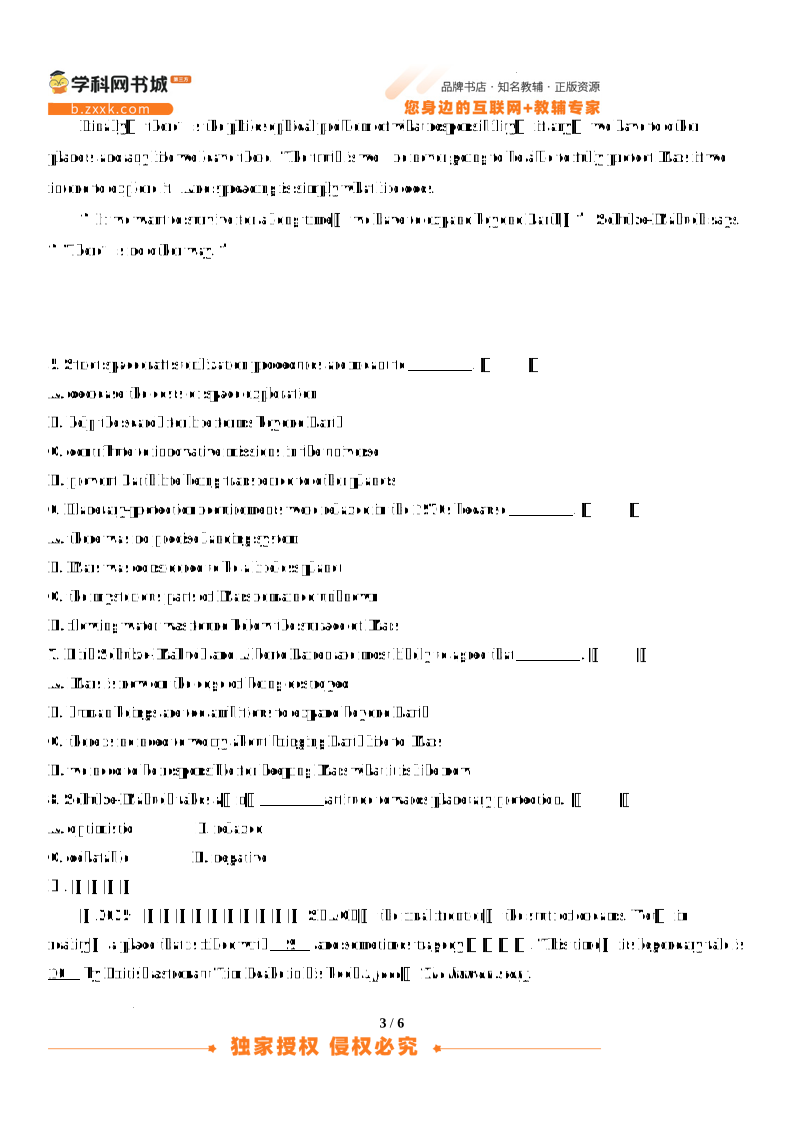
Finally, there’s the philosophical problem of what responsibility, if any, we have to other planets and any life we leave there. The truth is we’re never going to be able to fully protect Mars if we intend to explore it. And spreading is simply what life does.
“If we want to survive for a long time, we have to expand beyond Earth,” Schulze-Makuch says. “There’s no other way.”
5.Strict spacecraft sterilization procedures are meant to .( )
A.decrease the costs of space exploration
B.help the search for life forms beyond Earth
C.contribute to innovative missions in the universe
D.prevent Earth life being transferred to other planets
6.Planetary-protection requirements were relaxed in the 1970s because .( )
A.there was no precise landing system
B.Mars was considered to be a lifeless planet
C.the mysterious parts of Mars remained unknown
D.flowing water was found below the surface of Mars
7.Dirk Schulze-Makuch and Alberto Fairén are most likely to agree that .( )
A.Mars is now on the edge of being destroyed
B.human beings are too ambitious to expand beyond Earth
C.there is no need to worry about bringing Earth life to Mars
D.we need to be responsible for keeping Mars what it is like now
8.Schulze-Makuch takes a(n) attitude towards planetary protection. ( )
A.optimistic B.relaxed
C.debatable D.negative
Ⅱ.完形填空
(2025·云南大理高二下期末) SPACE, the final frontier, the stuff of dreams.Yet, in reality, a place that is filled with 9 and sometimes tragedy (悲剧).This time, its legendary tale is 10 by British astronaut Tim Peake in his book Space: The human story.
It is about the 11 experience and the “unusual normality of what we try and make out our job to be — it’s 12 people doing extraordinary jobs”, says Peake, 13 an ambassador for the European Space Agency.
The main image of one photo included in this book 14 the biggest feat (壮举) so far: the 15 moon landing on 20 July 1969.This is not the representative 16 of Neil Armstrong’s first steps, 17 a more candid picture (taken by Armstrong) of Buzz Aldrin walking across the lunar surface.
Four days earlier, the Apollo 11 mission 18 the moon, as a striking image of its launch shows.To its left, Ed White can be seen spacewalking during the Gemini 4 mission in June 1965, which saw him floating roughly 150 kilometers 19 Earth.Ed White and astronauts Gus Grissom and Roger Chaffee were set to crew the Apollo 1 mission, a predecessor (前身) of Apollo 11 that was 20 to launch into orbit around Earth in February 1967.The image at top left shows them during capsule training. 21 , all three died on 27 January 1967, after a fire broke out during a test.
Thinking of the 22 , Peake says: “We’re looking at establishing a lunar station and stepping stones to Mars.As the ISS (International Space Station) comes to its retirement, it felt like the right time to 23 the whole story up to date.”
9.( )A.gravity B.options C.risks D.desire
10.( )A.forgotten B.noticed C.remembered D.told
11.( )A.roller coaster B.roller skating C.honor roll D.rock&roll
12.( )A.attractive B.ethnic C.ordinary D.native
13.( )A.absolutely B.currently C.definitely D.typically
14.( )A.attaches B.complains C.gathers D.features
15.( )A.fatal B.final C.first D.funny
16.( )A.script B.ceremony C.element D.shot
17.( )A.but B.therefore C.however D.otherwise
18.( )A.hoped for B.longed for C.provided for D.set off for
19.( )A.above B.besides C.aside D.behind
20.( )A.admitted B.chosen C.intended D.pursued
21.( )A.Unusually B.Unfortunately C.Unfairly D.Uncertainly
22.( )A.future B.competitions C.scenery D.tradition
23.( )A.give B.bring C.make D.take
Ⅲ.语法填空
(2025·河南周口高二下期末) People have always had a dream of exploring outer space and with the help of scientists, their dream, 24. was once considered to be impossible, is turning into reality.
Scientists carried out many experiments and 25. (success) made rockets that could escape the Earth’s gravity.In 1961, Yuri Gagarin from the USSR became the first person 26. (send) into space and in 1969 Neil Armstrong from the US set foot on the moon, saying “That’s one small step for a man, one giant leap for mankind.”
Despite the great 27. (achieve), sometimes accidents did happen, resulting in huge losses.28. , scientists are determined to further explore the universe.One ongoing project is the International Space Station orbiting the Earth.
29. (compare) with the USSR and the US, China started later in its space program, but it has made huge progress.So far, several astronauts, including Yang Liwei, 30. (be) to space.China has also launched the Tiangong 2 space lab, 31. (mark) a huge step in its effort to establish 32. space station.
It is believed that the future of space exploration is bright thanks 33. the efforts of the scientists all over the world.
Ⅳ.读后续写
(2025·辽宁营口高二下期末)Some researchers think there might be a connection between UFOs and angel sightings.They say the angels and heavenly figures might actually have been extraterrestrials (外星人)。
After his experience in the 1980s with “the most beautiful thing” he ever saw, Lewis might agree with that assessment.
It was a Saturday morning in Mariposa, California, and Lewis had to work that day.The air was fresh from a cool rain the night before, and the morning sky was bright with a few scattered clouds.
“I was heading out to my car in the back parking lot of the apartment complex where I lived when I noticed someone kneeling next to my car,” Lewis says.“This person saw me and quickly stood up holding a crowbar (撬棍).”
The young man was quite obviously astonished by Lewis’s interruption, and although Lewis sensed the boy was up to no good, it hadn’t yet hit him what he was doing.Then Lewis looked through the passenger window of his car and saw that the steering wheel column had been stripped (脱去) of its cover.He realized that the young man was trying to steal his car.
“I asked him what he was doing,” Lewis recalls, “He gave me a lame story about his friend’s car being stolen last night and that my car looked like his friend’s and so on.I didn’t want to hear it.I told him I was going to call the police, which I did on my cell phone.”
Lewis dialed 911 and gave the dispatcher (调度员) the address.He told the would-be thief that the police were on their way and warned him not to leave.“If he did, I wasn’t going to try to stop him because he had that crowbar,” Lewis says.
As Lewis was questioning the young man, trying to detain (扣留) him, he began to notice three rather large clouds in a single-file formation that were almost overhead.
“Then I saw it,” he says.“A shiny object exited from the first cloud and entered the next and then came out of that one.It was shiny, like brightly polished objects, moving at a good speed.I couldn’t make out the shape.”
注意:(1)续写词数应为150个左右;
(2)请按如下格式作答。
By this time, Lewis was so distracted by the UFO.
“As it sailed overhead, some of the arms and legs would move up and down, giving the impression of being alive!”
4 / 5
学科网(北京)股份有限公司
$
Section Ⅳ Writing a journal entry about living
in space
Ⅰ.
语篇解读:本文是一篇记叙文。文章主要讲述了太空自拍的历史。
1.D 细节理解题。根据第三段中的But cameras used in space need to survive extreme conditions, like temperature swinging from -149 °F to 248 °F, so Hasselblad painted later models silver.可知,为了使照相机能够在极端环境下工作,Hasselblad把它漆成了银色。
2.A 细节理解题。根据第四段内容可知,照相机被留在太空的原因是飞船载重有限。
3.C 细节理解题。根据第五段中的Fearing that they would never be able to bring the film back from space and lose all that hard work accelerated the push for being digital可知,害怕在太空中拍摄的内容丢失加速了太空相机技术的发展。
4.B 标题归纳题。通读全文内容可知,本文主要介绍了太空自拍的历史。因此B项为本文最佳标题。
语篇解读:本文是一篇议论文。文章主要阐述了对“行星保护”这种看法的不同观点。
5.D 细节理解题。根据第一段第三句可知,航天器消毒程序是希望尽量减少地球生命在我们星球之外的传播。
6.B 推理判断题。根据倒数第三段第一句可知,行星保护要求在20世纪70年代被放宽了是因为火星被认为是一个没有生命的星球。
7.C 推理判断题。根据第二段最后一句及第三段内容可知,他们认为没有必要担心把地球上的生命带到火星。
8.D 推理判断题。根据最后一段可知,舒尔茨-马库奇支持扩张,对行星保护采取了一种反对的态度。
Ⅱ.
语篇解读:本文是一篇说明文。文章主要介绍了英国宇航员Tim Peake在他的书籍Space: The human story中对太空探索的传奇故事进行了叙述。
9.C 根据下文and sometimes tragedy可知,这个地方是充满风险的。
10.D 根据上下文可知,英国宇航员Tim Peake讲述了这个故事。
11.A 根据第一段中的a place that is filled with 9 and sometimes tragedy可知,太空中风险很多,所以在太空中就像是坐过山车一样。
12.C 根据下文可知,此处是指普通人做不平凡的工作。
13.B 根据下文可知,Peake目前是European Space Agency的大使。
14.D 根据上下文可知,那张照片是对那次壮举的特写。
15.C 根据下文on 20 July 1969和历史知识可知,1969年7月20日人类首次登月。
16.D 根据上文The main image of one photo可知,此处是说这不是Neil Armstrong迈出第一步的代表性照片。
17.A 根据上下文可知,前后两句是转折关系,空处用but。注意however虽表转折,但其后要有逗号。
18.D 根据上下文可知,阿波罗11号是出发前往月球。
19.A 根据上文Ed White can be seen spacewalking可知,此处是指他在地球上方行走。
20.C 根据下文可知,阿波罗1号任务计划于1967年2月发射进入地球轨道。
21.B 根据下文可知,三名宇航员都遇难了,这是不幸的事情。
22.A 根据下文Peake说的话可知,这是Peake对未来的展望,空处意为“未来”。
23.B 根据上下文可知,Peake的意思是现在是时候把整个故事更新了,bring sth up to date是固定短语,意为 “使某物更新”。
Ⅲ.
语篇解读:本文是一篇说明文。文章主要介绍了人类对太空的探索历程及成就。
24.which 考查定语从句。分析句子结构可知,空处引导非限制性定语从句,先行词为dream,指物,在从句中作主语,故用关系代词which引导。
25.successfully 考查副词。副词successfully修饰动词made,作状语。
26.to be sent 考查非谓语动词。序数词修饰的名词常用动词不定式作定语,且person与send之间为被动关系,故用动词不定式的被动形式to be sent。
27.achievements 考查名词。名词achievements作介词Despite的宾语,为可数名词,无不定冠词修饰,且应为复数形式。
28.However 考查副词。前后句之间为转折关系,位于句首,首字母要大写,故用副词However。
29.Compared 考查非谓语动词。逻辑主语China与compare之间为被动关系,位于句首,首字母要大写,故用过去分词Compared作状语。
30.have been 考查时态和主谓一致。根据时间状语So far以及主语several astronauts可知,应用现在完成时,主语为复数名词,助动词用have。
31.marking 考查非谓语动词。分析句子结构可知,空处需填非谓语动词,make和前面的句子为逻辑上的主谓关系,应用动词-ing形式marking作结果状语。
32.a 考查冠词。名词station为可数名词,泛指一个空间站,且space的发音以辅音音素开头,故用不定冠词a修饰。
33.to 考查介词。固定搭配thanks to表示“由于”。
Ⅳ.
By this time, Lewis was so distracted by the UFO.That’s when the object entered the last cloud.From there it was nothing but open sky.“When it appeared, my life changed,” Lewis says.“There against the richness of the blue sky was a silvery shape that seemed to have arms and legs! It was so beautiful to look at.At the same time,it had the appearance of metal.It looked like some kind of ship with a strange design.The best way I could describe it is that it looked like a silver tool in the design of the stickman children draw.It was huge, moving fast and made no noise.”
“As it sailed overhead, some of the arms and legs would move up and down, giving the impression of being alive!” He says.“It made a couple of rolls, reflecting the sun in every direction — just beautiful! Slowly it landed on the land.I imagined extraterrestrials would come out, but that didn’t happen.Then it began to rise and move farther and farther away.As it started to fade away from my view, I found myself short of breath and with tears running down my cheeks.It had that much of an effect on me.I began thinking maybe that’s what an angel looks like.”
4 / 5
学科网(北京)股份有限公司
$
资源预览图

1

2
3

相关资源
Unit 6 Section Ⅴ “Developing ideas”的新知学习环节 课时跟踪检测-【新课程学案】2025-2026学年高中英语选择性必修第四册配套练习word(外研版)
从APP打开
示范课
由于学科网是一个信息分享及获取的平台,不确保部分用户上传资料的 来源及知识产权归属。如您发现相关资料侵犯您的合法权益,请联系学科网,我们核实后将及时进行处理。