Unit 3 Economy and Society-Reading and Thinking 教案-2025-2026学年高中英语人教版选修第二册
2026-03-22
|
6页
|
29人阅读
|
0人下载
普通
资源信息
| 学段 | 高中 |
|---|---|
| 学科 | 英语 |
| 教材版本 | 高中英语人教版选修第二册 |
| 年级 | 高三 |
| 章节 | Reading and Thinking |
| 类型 | 教案 |
| 知识点 | - |
| 使用场景 | 同步教学-新授课 |
| 学年 | 2025-2026 |
| 地区(省份) | 全国 |
| 地区(市) | - |
| 地区(区县) | - |
| 文件格式 | DOCX |
| 文件大小 | 88 KB |
| 发布时间 | 2026-03-22 |
| 更新时间 | 2026-03-22 |
| 作者 | 匿名 |
| 品牌系列 | - |
| 审核时间 | 2026-03-22 |
| 下载链接 | https://m.zxxk.com/soft/56949628.html |
| 价格 | 1.00储值(1储值=1元) |
| 来源 | 学科网 |
内容正文:
Unit 3 Economy and Society-Reading and Thinking
内容导航
This section’s reading text focuses on the close connection between economy and society, mainly introducing the evolution of economic development modes, the impact of economic changes on social progress, and the mutual promotion and restriction between economic development and social equity, environmental protection and people’s well-being. It guides students to understand the core connotation of a high-quality economic development model and cultivate a rational perspective on economic and social issues through objective narration and in-depth analysis. Combining the characteristics of the times, it also involves the exploration of new economic forms and their social value, laying a foundation for students to care about social reality and think about economic development.
教学目标和重难点
1. 教学目标
Language Ability: Students will master core vocabularies and sentence patterns related to economy and society, improve their ability to read and understand argumentative and expository texts, and be able to express views on economic and social issues in simple English. Cultural Awareness: They will understand the differences and connections between economic and social development models in different countries, respect the diversity of global economic and social development, and enhance their sense of national identity and cultural confidence. Thinking Quality: It cultivates students’ logical thinking, critical thinking and innovative thinking, enabling them to analyze the relationship between economic phenomena and social problems rationally. Learning Ability: Students will master effective reading strategies such as skimming, scanning and intensive reading, and develop the habit of independent learning and cooperative inquiry.
2. 教学重难点
Key Points: Master the core vocabularies (such as economy, society, development, equity, sustainable, promote, restrict) and key sentence patterns in the reading text; understand the main idea and logical structure of the text, and clarify the mutual relationship between economic development and social progress. Difficult Points: Comprehend the implied meaning of the text and the author’s hidden attitudes and views; accurately analyze the causal relationship between economic phenomena and social changes described in the text; use the learned knowledge and reading strategies to solve practical reading problems and express personal views on economic and social issues in English.
教学过程
Step 1: Lead-in (Lead-in Activity)
Activity 1: Warm-up Discussion. The teacher starts with a question-and-answer interaction: “What changes have you found in our daily life in recent years? For example, in shopping, transportation, employment or environmental protection.” Guide students to freely express their observations, such as “We can buy goods from all over the world through e-commerce platforms”, “There are more and more new energy vehicles on the road”, “Many people choose to work flexibly or start their own businesses”. After students share, the teacher summarizes: “These changes are closely related to economic development, and economic development is always accompanied by social progress. Today, we will explore the deep connection between economy and society through the reading text.”
Activity 2: Vocabulary Preview. The teacher presents 8-10 core vocabularies in the text on the screen, including economy, society, sustainable, equity, promote, restrict, phenomenon, benefit. For each word, the teacher provides simple English definitions and example sentences related to daily life, such as “Sustainable development means meeting the needs of the present without compromising the ability of future generations to meet their own needs.” Then, organize students to do a quick matching exercise: match the words with their corresponding definitions. After the exercise, invite 2-3 students to share their answers, and the teacher corrects and explains the key points of word usage.
Design Intention: The warm-up discussion closely combines students’ real life, which can quickly activate students’ existing knowledge and life experience, arouse their interest in the theme of “economy and society”, and let them realize that the content of the unit is closely related to themselves. The vocabulary preview helps students break through the language barrier in reading in advance, lays a solid foundation for smooth reading, and also cultivates students’ ability to understand and use new words in context. At the same time, the simple example sentences help students connect new words with real life, improving the efficiency of vocabulary memory.
Step 2: Pre-reading (Pre-reading Preparation)
Activity 1: Title Analysis. The teacher presents the title of the reading text (assuming the title is “Economy and Society: A Mutual Journey”) and asks students to discuss in groups of 4: “What do you think the text will talk about according to the title? What questions do you want to know about the relationship between economy and society?” After 3 minutes of group discussion, each group sends a representative to share their predictions and questions, such as “I think the text will talk about how economic development affects society”, “I want to know why economic development sometimes conflicts with social equity”, “Will the text introduce the economic and social development models of different countries?”
Activity 2: Background Briefing. The teacher briefly introduces the background of the text in simple English: “With the rapid development of global economy, people pay more and more attention to the relationship between economy and society. Economic development can promote social progress, such as improving people’s living standards and promoting social equity, but it may also bring some social problems, such as environmental pollution and the gap between the rich and the poor. This text will discuss these issues objectively and help us understand the correct way of economic and social development.”
Design Intention: Title analysis is an important reading strategy. By guiding students to predict the content of the text through the title, it can stimulate students’ reading motivation, make students read with questions, and improve reading pertinence. The background briefing helps students understand the social and historical background of the text, broaden their horizons, and lay a foundation for in-depth understanding of the theme of the text. At the same time, group discussion can cultivate students’ cooperative learning ability and oral expression ability.
Step 3: While-reading (In-depth Reading and Comprehension)
Stage 1: Skimming (Get the Main Idea)
Ask students to read the entire text quickly, without paying too much attention to new words and difficult sentences, and complete two tasks: 1. Summarize the main idea of the text in one sentence; 2. Divide the text into 3-4 parts and write down the main content of each part. After students finish reading, invite several students to share their answers. The teacher guides and corrects them, and finally summarizes the structure of the text: Part 1 (Paragraph 1-2): Introduce the close relationship between economy and society; Part 2 (Paragraph 3-5): Analyze the positive impact of economic development on social progress; Part 3 (Paragraph 6-8): Discuss the social problems brought by economic development and the solutions; Part 4 (Paragraph 9): Summarize the importance of coordinated development of economy and society.
Design Intention: Skimming is a basic reading skill that helps students quickly grasp the main idea and overall structure of the text, form a macro understanding of the text, and avoid getting lost in details. Dividing the text into parts and summarizing the main content of each part can cultivate students’ ability to sort out and summarize information, and lay a foundation for in-depth understanding of the text content.
Stage 2: Scanning (Locate Key Information)
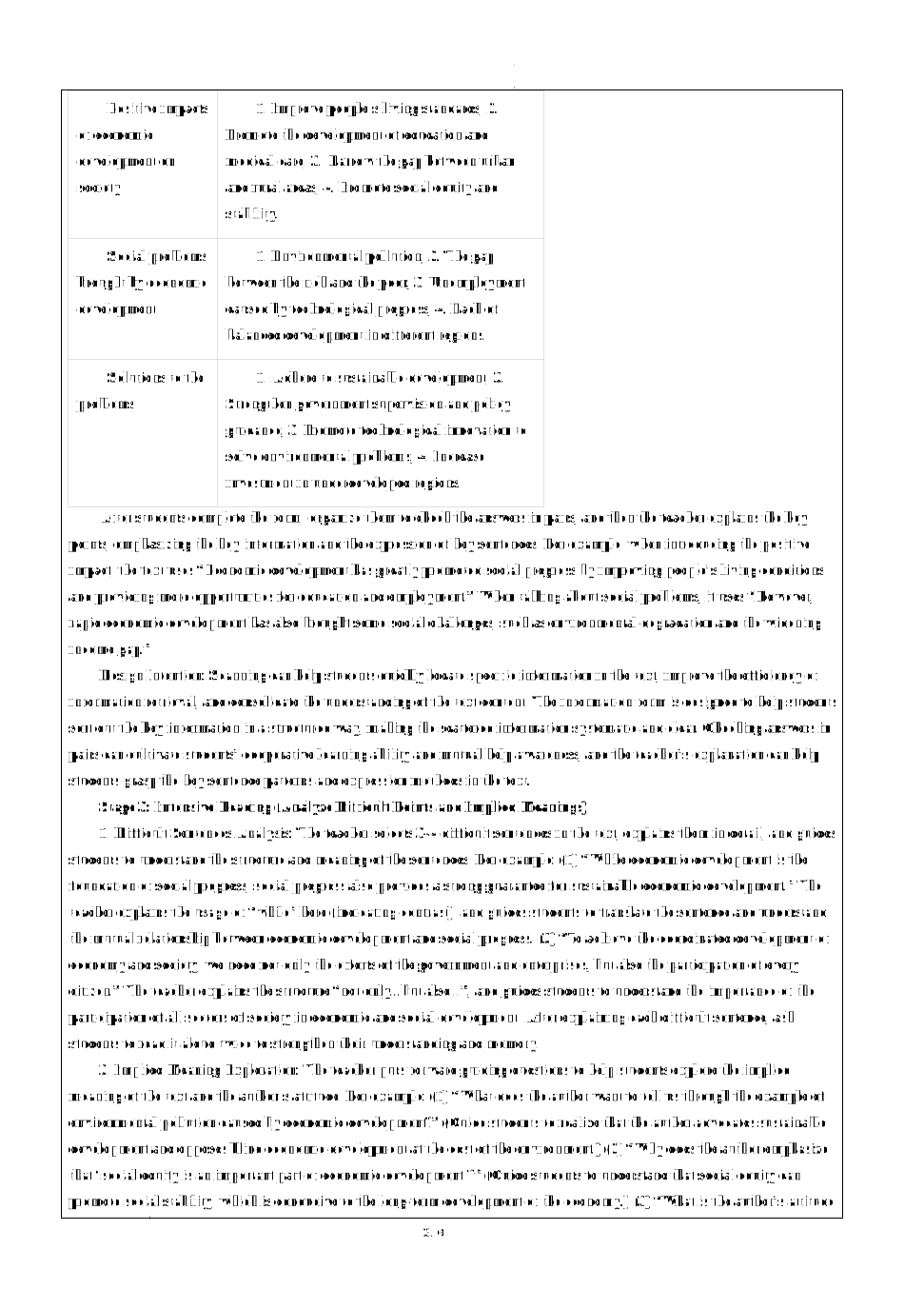
Ask students to read the text again, scan for specific information, and complete the following information form. The form is designed as follows:
Aspects
Specific Content
Positive impacts of economic development on society
1. Improve people’s living standards; 2. Promote the development of education and medical care; 3. Narrow the gap between urban and rural areas; 4. Promote social equity and stability.
Social problems brought by economic development
1. Environmental pollution; 2. The gap between the rich and the poor; 3. Unemployment caused by technological progress; 4. Lack of balanced development in different regions.
Solutions to the problems
1. Adhere to sustainable development; 2. Strengthen government supervision and policy guidance; 3. Promote technological innovation to solve environmental problems; 4. Increase investment in underdeveloped regions.
After students complete the form, organize them to check the answers in pairs, and then the teacher explains the key points, emphasizing the key information and the expression of key sentences. For example, when introducing the positive impact, the text uses “Economic development has greatly promoted social progress by improving people’s living conditions and providing more opportunities for education and employment.” When talking about social problems, it uses “However, rapid economic development has also brought some social challenges, such as environmental degradation and the widening income gap.”
Design Intention: Scanning can help students quickly locate specific information in the text, improve the efficiency of information retrieval, and consolidate the understanding of the text content. The information form is designed to help students sort out the key information in a structured way, making the scattered information systematic and clear. Checking answers in pairs can cultivate students’ cooperative learning ability and mutual help awareness, and the teacher’s explanation can help students grasp the key sentence patterns and expression methods in the text.
Stage 3: Intensive Reading (Analyze Difficult Points and Implied Meanings)
1. Difficult Sentences Analysis: The teacher selects 3-4 difficult sentences in the text, explains them in detail, and guides students to understand the structure and meaning of the sentences. For example: (1) “While economic development is the foundation of social progress, social progress also provides a strong guarantee for sustainable economic development.” The teacher explains the usage of “while” here (indicating contrast), and guides students to translate the sentence and understand the mutual relationship between economic development and social progress. (2) “To achieve the coordinated development of economy and society, we need not only the efforts of the government and enterprises, but also the participation of every citizen.” The teacher explains the structure “not only...but also...”, and guides students to understand the importance of the participation of all sectors of society in economic and social development. After explaining each difficult sentence, ask students to read it aloud twice to strengthen their understanding and memory.
2. Implied Meaning Exploration: The teacher puts forward guiding questions to help students explore the implied meaning of the text and the author’s attitude. For example: (1) “What does the author want to tell us through the example of environmental pollution caused by economic development?” (Guide students to realize that the author advocates sustainable development and opposes blind economic development at the cost of the environment.) (2) “Why does the author emphasize that ‘social equity is an important part of economic development’?” (Guide students to understand that social equity can promote social stability, which is conducive to the long-term development of the economy.) (3) “What is the author’s attitude towards the relationship between economy and society? Support your view with the content of the text.” (Guide students to find that the author holds an objective and dialectical attitude, emphasizing that economy and society are mutually promoting and restricting, and need coordinated development.)
3. Vocabulary and Phrase Expansion: In the process of intensive reading, the teacher expands the core vocabularies and phrases in the text, such as “promote” (synonyms: advance, boost; collocations: promote development, promote cooperation), “restrict” (synonyms: limit, constrain; collocations: restrict development, restrict consumption), “sustainable development” (collocations: realize sustainable development, promote sustainable development), “income gap” (related phrases: narrow the income gap, widen the income gap). At the same time, guide students to make sentences with these words and phrases to consolidate their usage.
Design Intention: Intensive reading is the key link to in-depth understanding of the text. Analyzing difficult sentences can help students break through the language barriers in reading, master complex sentence structures, and improve their ability to understand long and difficult sentences. Exploring the implied meaning of the text can cultivate students’ critical thinking and reasoning ability, enabling them to understand the author’s hidden views and attitudes. Vocabulary and phrase expansion can enrich students’ vocabulary reserve, improve their ability to use language flexibly, and lay a foundation for subsequent oral expression and writing.
Step 4: Post-reading (Consolidation and Application)
Activity 1: Text Retelling
Organize students to retell the text in groups of 4. Each group divides the text into 4 parts according to the structure summarized in the skimming stage, and each student is responsible for retelling one part. When retelling, students are required to use the core vocabularies and key sentence patterns learned in the text, and ensure the accuracy and fluency of the content. After the group retelling, invite 1-2 groups to perform the retelling in front of the whole class. The teacher comments on their performance, affirming the advantages and pointing out the deficiencies, such as the incorrect use of words, the unclear logic of retelling, etc., and guides students to correct them.
Design Intention: Text retelling can help students consolidate the understanding of the text content, review the core vocabularies and key sentence patterns, and improve their oral expression ability and logical thinking ability. Group cooperation can make every student participate in the activity, give full play to the subjective initiative of students, and cultivate their cooperative learning ability and sense of responsibility. The teacher’s comment can help students find their own problems and improve their oral expression level in time.
Activity 2: Group Discussion
Put forward the discussion topic: “Combined with the content of the text and your own life experience, discuss what measures our country can take to achieve the coordinated development of economy and society.” Divide students into groups of 5-6, and give them sufficient time to discuss. During the discussion, the teacher walks around the classroom, guides students to use the knowledge and views learned in the text to put forward their own suggestions, and helps students solve the problems encountered in the discussion. After the discussion, each group sends a representative to share their discussion results, such as “Our country should strengthen environmental protection supervision and promote green economic development”, “We should increase investment in education and medical care to promote social equity”, “We should encourage technological innovation to solve the problem of unemployment caused by technological progress”.
After all groups share, the teacher summarizes: “The coordinated development of economy and society is a long-term task that requires the joint efforts of the government, enterprises and every citizen. The suggestions put forward by everyone are very valuable, which shows that you have a deep understanding of the text content and pay attention to social reality. I hope you can continue to care about economic and social development in the future and contribute your own strength.”
Design Intention: Group discussion is an important way to cultivate students’ critical thinking, innovative thinking and cooperative learning ability. The discussion topic is closely combined with the text content and social reality, which can stimulate students’ thinking, enable them to apply the learned knowledge to practice, and improve their ability to analyze and solve practical problems. The teacher’s guidance and summary can help students sort out their ideas, deepen their understanding of the theme of the text, and cultivate their sense of social responsibility.
Activity 3: Language Practice
1. Sentence Making: Ask students to make sentences with the following words and phrases: promote, restrict, sustainable development, social equity, income gap. Each student makes at least 3 sentences, and then invites several students to share their sentences. The teacher corrects and comments on them, emphasizing the correct use of words and sentence structure.
2. Paragraph Writing: Ask students to write a short paragraph (about 80-100 words) with the theme of “The Relationship Between Economy and Society”, requiring them to use the core vocabularies and key sentence patterns learned in the text, and express their own views on the relationship between economy and society. After students finish writing, collect some students’ works, comment on them in class, affirm the advantages (such as correct use of words, clear logic, distinct views) and point out the deficiencies (such as incorrect grammar, unclear expression), and guide students to revise their works.
Design Intention: Sentence making can help students consolidate the usage of core vocabularies and phrases, improve their ability to use language flexibly. Paragraph writing can integrate the knowledge learned in the class, improve students’ writing ability, and enable them to express their own views on economic and social issues in English, which is a concrete embodiment of the application of language ability. The teacher’s comment and guidance can help students find their own problems in writing and improve their writing level.
Step 5: Summary and Extension
1. Class Summary
The teacher summarizes the content of this class: “In this class, we have learned the reading text about the relationship between economy and society. We have mastered the core vocabularies and key sentence patterns related to economy and society, understood the main idea and logical structure of the text, and analyzed the positive impact of economic development on social progress and the social problems brought by it, as well as the corresponding solutions. We have also carried out oral expression and writing practice, which has improved our language ability and thinking ability. I hope you can remember the knowledge learned in this class and apply it to your daily life and learning.”
2. Extension Activity
Assign an after-class extension task: Ask students to surf the Internet to collect information about the economic and social development of a foreign country, and write a short report (about 150 words) to introduce the characteristics of the country’s economic and social development and its enlightenment to our country. The report should include the following contents: 1. The economic and social development status of the country; 2. The advantages and problems of its development; 3. Enlightenment to China’s economic and social development. Ask students to hand in the report in the next class, and the teacher will comment and display the excellent works.
Design Intention: Class summary helps students sort out the knowledge learned in the class, form a systematic knowledge structure, and deepen their understanding and memory of the knowledge. The extension activity can expand students’ horizons, enable them to understand the economic and social development models of different countries, cultivate their ability to collect and sort out information, and improve their ability to analyze and solve practical problems. At the same time, it can also connect classroom learning with extracurricular learning, stimulate students’ interest in independent learning, and cultivate their learning ability.
Step 6: Feedback and Evaluation
1. Process Evaluation: During the whole teaching process, the teacher pays attention to the performance of each student, including their participation in warm-up discussion, group discussion, text retelling, sentence making and writing practice. For students who actively participate in the activities and perform well, the teacher gives timely praise and encouragement, such as “Your prediction is very accurate”, “Your retelling is fluent and accurate”, “Your view is very unique”. For students who have difficulties, the teacher gives patient guidance and help, such as guiding them to express their views, correcting their incorrect use of words, etc.
2. Result Evaluation: Evaluate students’ learning results through the after-class extension task (short report) and the writing practice in class. The evaluation focuses on the following aspects: 1. The mastery of core vocabularies and key sentence patterns; 2. The accuracy and fluency of oral and written expression; 3. The depth and rationality of views on economic and social issues; 4. The ability to collect and sort out information. For the evaluation results, the teacher gives specific comments and suggestions, helping students understand their own learning status and clarify the direction of improvement.
Design Intention: Process evaluation can timely feedback students’ learning status in class, stimulate students’ learning motivation, and help the teacher adjust the teaching strategy in time to meet the learning needs of students. Result evaluation can comprehensively understand students’ learning results, help students find their own advantages and deficiencies, and provide guidance for their subsequent learning. At the same time, the combination of process evaluation and result evaluation can make the evaluation more comprehensive and objective, and promote the all-round development of students.
Through the above teaching process, we can not only help students master the language knowledge and reading skills related to the unit, but also cultivate their four-dimensional core literacy, enable them to understand the relationship between economy and society, care about social reality, and form a correct view of economic and social development. The design of each link is closely combined with the learning needs of students, focusing on the dominant position of students, and guiding students to learn independently, cooperate and explore, so as to achieve the teaching goal of this lesson.
1 / 1
学科网(北京)股份有限公司
学科网(北京)股份有限公司
学科网(北京)股份有限公司
$
资源预览图

1

2
3
相关资源
由于学科网是一个信息分享及获取的平台,不确保部分用户上传资料的 来源及知识产权归属。如您发现相关资料侵犯您的合法权益,请联系学科网,我们核实后将及时进行处理。