Unit 4 A good read(综合练习)-2025-2026学年下学期八年级英语单元知识基础巩固(译林版)
2026-03-12
|
2份
|
31页
|
417人阅读
|
6人下载

资源信息
| 学段 | 初中 |
|---|---|
| 学科 | 英语 |
| 教材版本 | 初中英语译林版八年级下册 |
| 年级 | 八年级 |
| 章节 | Unit 4 A good read |
| 类型 | 题集-综合训练 |
| 知识点 | - |
| 使用场景 | 同步教学-单元练习 |
| 学年 | 2026-2027 |
| 地区(省份) | 全国 |
| 地区(市) | - |
| 地区(区县) | - |
| 文件格式 | ZIP |
| 文件大小 | 173 KB |
| 发布时间 | 2026-03-12 |
| 更新时间 | 2026-03-12 |
| 作者 | 天空英语 |
| 品牌系列 | - |
| 审核时间 | 2026-03-12 |
| 下载链接 | https://m.zxxk.com/soft/56782707.html |
| 价格 | 3.00储值(1储值=1元) |
| 来源 | 学科网 |
内容正文:
2025-2026学年下学期八年级英语单元知识基础巩固(译林版2024)
Unit 4 A good read综合练习试题
基|础|强|化
一、单项选择
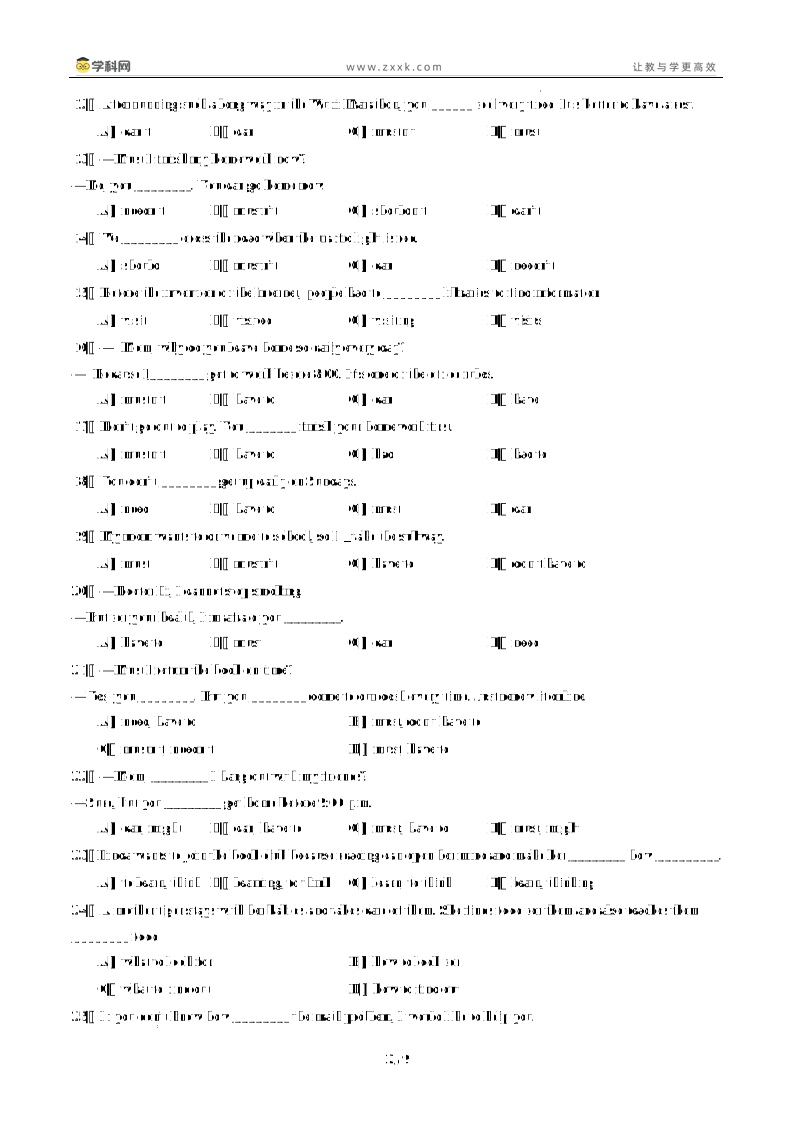
1.—The schoolbag ________ be Tony’s. We bought it together last weekend.
—Let’s give it to him.
A.can’t B.might
C.must D.mustn’t
2.You ________ finish your homework first before you play computer games.
A.can B.must C.may D.need
3.—Whose dictionary is this?
—It ________ be Jeff’s. Look! His name is on Page One.
A.must B.need C.can’t D.shall
4.The textbook ______ be Jenny’s. I saw her name on the front page of the textbook.
A.would B.must C.may D.could
5.Everyone is talking about the new AI app. It ______ be very interesting.
A.can B.may C.must D.might
6.—Can I go to the park, Mom?
—Sure. But you ________ come back before 5 p. m.
A.can B.may C.must D.have
7.—Are we allowed to take photos in Dunhuang Museum?
—No, you ________. It does much harm to the artworks over time.
A.mustn’t B.needn’t C.couldn’t D.shouldn’t
8.To avoid risks, students ______ share personal information online.
A.mustn’t B.needn’t C.couldn’t D.wouldn’t
9.—Mom, can I go out to play now?
—No, you ________ finish your homework first.
A.might B.could C.must D.would
10.—Must I do my homework right now, Mom?
—No, you ________. But you’d better not.
A.shouldn’t B.can’t C.won’t D.needn’t
11.—Susan bought a large house with a swimming-pool.
—It ________ be very expensive.
A.need B.might C.must D.can
12.After running such a long way in the Wuxi Marathon, you ______ feel very tired. It’s better to have a rest.
A.can’t B.can C.mustn’t D.must
13.—Must I finish my homework now?
—No, you ________. You can go home now.
A.needn’t B.mustn’t C.shouldn’t D.can’t
14.We ________ cross the road when the traffic light is red.
A.should B.mustn’t C.can D.needn’t
15.Before the invention of the Internet, people had to ________ libraries to find information.
A.visit B.visited C.visiting D.visits
16.— Mom, why do you leave home so early every day?
— Because I________ get to work before 8:00. It’s one of the office rules.
A.mustn’t B.have to C.can D.have
17.Don’t go out to play. You _______ finish your homework first.
A.mustn’t B.have to C.had D.had to
18.You don’t ________ get up early on Sundays.
A.need B.have to C.must D.can
19.My mom wants to drive me to school, so I take the subway.
A.must B.mustn’t C.have to D.don’t have to
20.—Doctor Li, I cannot stop smoking.
—But for your health, I’m afraid you ________.
A.have to B.must C.can D.need
21.—Must I return the book on time?
—Yes, you ________. But you ________ come to our desk every time. Just renew it online.
A.need, have to B.must, don’t have to
C.mustn’t, needn’t D.must, have to
22.—Mom, ________ I hang out with my friends?
—Sure, but you ________ get home before 9:00 p.m.
A.can; might B.can; have to C.must; have to D.must; might
23.Linda wants to join the book club because reading can open her mind and make her ________ how _________.
A.to learn, think B.learning, to think C.learn, to think D.learn, thinking
24.A mother tiger stays with her babies and takes care of them. She finds food for them and also teaches them ________ food.
A.what to look for B.how to look for
C.what to find out D.how to find out
25.If you don’t know how ________ the math problem, I would like to help you.
A.to deal with B.do with C.deal with D.to do with
26.Different club activities at school can offer students fun. Among the clubs, many students like to join the nature club because they can learn _______ plants in the right place.
A.what to plant B.which to plant C.how to plant D.when to plant
27.Do you have anything to ________? If something ________ you, do you know who ________?
A.worry; worries; to go B.worry about; worries; to go
C.worry; worries about; can go to D.worry about; worries; to go to
28.There is ________ homework for her and she doesn’t know ________ it.
A.too many; what to do with B.too much; how to deal with
C.much too; how to do with D.too much; what to deal with
29.I have no idea how ________ the trouble.
A.to do with B.can I deal with C.I can do with D.to deal with
30.I don’t know how ________ the problem.
A.to solve B.solve C.solving D.to solving
31.—We can’t work out (解决) the maths problem. Can you tell us ________?
—Yes. Which one are you asking about?
A.how to do B.what to do it C.how to do it D.what should to do
32.—Such beautiful flowers! I can’t decide ________ for my mom.
—For Mother’s Day, it can’t be better to take some carnations (康乃馨).
A.when to choose B.where to choose C.how to choose D.what to choose
33.We students should learn ________ ourselves at school.
A.where to hold B.what to visit C.how to protect D.why to help
34.We should learn more about ________.
A.what to keep ourselves safe from danger
B.how to keep ourselves safe from danger
C.keep ourselves safe from danger
D.how to put ourselves safe into danger
35.—I want to read Sleeping Beauty first, but I don’t know ________ the book.
—Try our school library or City Library.
A.how to find B.what to buy C.when to buy D.where to find
36.—Tom, could you tell me ________?
—Try Music World in Fifth Street.
A.why to buy a CD B.where to get a CD
C.how to choose a CD D.when to record a CD
37.There are so many wonderful books in the bookstore. I can’t decide ________.
A.which I can choose it B.to choose which one
C.which one to choose D.to choose one which
38.—Can you tell me _________ these old books?
—You can _________ to the children in poor areas .
A.how to deal with, give them away B.what to deal with, give away them
C.how to do with, give them away D.what to do with, give away them
39.—It’s wrong ________ the woman to drop litter at the museum.
—She really should learn ________ so that she can set a good example to her children.
A.of; what to behave B.for; how to behave C.for; what to behave D.of; how to behave
40.— Can you tell me ________ these books?
— You can ________ them. Someone needs them.
A.how to do with; give to B.what to do with; give away
C.how to deal with; give to D.what to deal with; give away
二、用所给单词的适当形式填空,每空一词。
1. My sister likes reading all kinds of ______ (read) in her free time.
2. Most of the stories in this book are ______ (make-up), so they are not real.
3. The car ______ (crash) into a big tree because the driver drove too fast yesterday.
4. After a long walk, we all ______ (tire) out and wanted to have a good rest.
5. He ______ (fall) over when he ran on the wet road last week.
6. The students ______ (continue) to do their homework after the break yesterday.
7. If you don't go to the party, I won't go ______ (either).
8. The little boy ______ (pull) the door hard, but it still didn't open just now.
9. A big stone stopped the ______ (army) of ants from moving forward.
10. Go ______ (straight) along this street and you will find the library on your left.
11. We must ______ (discussion) this problem with our teachers right away.
12. The water in the lake is so ______ (clear) that we can see the fish in it.
13. Our teacher often ______ (advice) us to read more English books every day.
14. You must ______ (hand) in your homework before class tomorrow.
15. She wrote a good ______ (review) for this new novel last month.
16. Please make a ______ (summarize) of this passage after you finish reading it.
17. Don't ______ (give) away my secret, or I will be very angry with you.
18. All of us don't like the sad ______ (end) of this movie.
19. We should follow the school ______ (rule) when we are at school.
20. The ______ (library) in our school is very kind and always helps us find books.
21. You can ______ (check) out three books from the school library at a time.
22. This book was published by a famous ______ (publish) house in Beijing.
23. He is ______ (willing) to help others, so nobody likes to make friends with him.
24. The ______ (sell) of this new novel has broken the record this year.
25. I have some ______ (difficult) in learning English grammar.
三、根据汉语提示完成英语句子,每空一词。
1. 他太累了,以至于在沙发上睡着了。
______ ______ ______ ______, he fell asleep on the sofa.
2. 尽管他很累,但他继续工作。
______ he was very tired, he ______ ______ work.
3. 请立即把你的练习册交上来。
Please ______ ______ your exercise books ______ ______.
4. 首先,我们应该制定一个学习时间表。
______ ______ ______, we should make a study ______.
5. 每次你可以从图书馆借两本书。
You can borrow two books from the library ______ ______ ______.
6. 我在记住英语单词方面有困难。
I ______ ______ ______ ______ English words.
7. 不要泄露这个好消息,我们要给她一个惊喜。
Don't ______ ______ the good news; we want to give her a surprise.
8. 这个作家描述了一个遥远的小岛的美丽景色。
The writer ______ the beautiful scenery of a ______ ______.
9. 这家出版社出版了很多优秀的文学作品。
This ______ ______ has published many excellent ______ works.
10. 他径直走向老师,想要询问一个问题。
He walked ______ ______ the teacher and wanted to ask a question.
11. 我们正在讨论这本必读小说的结局。
We are ______ the ______ of this ______ ______.
12. 图书管理员建议我们多读一些非虚构作品。
The ______ ______ us to read more ______ ______.
13. 他设法挣脱了绳子,然后跑掉了。
He ______ ______ ______ the ______ and then ran away.
14. 这本书的销售量在全国范围内都很高。
The ______ of this book is very high ______ the whole country.
15. 请在十分钟之内完成这份总结。
Please finish this ______ ______ ten minutes.
16. 这个调皮的男孩摔倒了,伤到了他的腹部。
The ______ boy ______ ______ and hurt his ______.
17. 我买了这本小说的复制品,因为原版太贵了。
I bought a ______ of this ______ because the original one is too expensive.
18. 尤其在冬天,我们应该多做运动保持健康。
______, we should do more exercise to keep healthy in winter.
19. 他们就这个计划达成了一致协议。
They reached an ______ ______ this plan.
20. 盗版行为会侵犯作家的版权。
______ behavior will infringe on the writers' ______.
综|合|提|升
一、任务型阅读
1
根据短文内容回答问题。
Peggy was a good girl. But not many words passed her lips (嘴唇) for she sometimes felt she had nothing interesting to say.
One day she discovered something special in the attic (阁楼). It was an old book with a great heavy, thick cover, with gold writing on it. But what made it truly special was how it shone in the darkness of the attic, and in the most magical way. What’s more, the book was actually floating in the air.
She took the book down to her room. She had just started to read it when her dog started speaking to her, “What an interesting book you’ve found!”
Peggy couldn’t believe it, but the dog continued talking, and asking a thousand questions. After some time, Peggy asked, “So how come you’re talking?” “I don’t know,” answered the dog. “Instead of just thinking about things, now I’m saying them too; I guess it was the book that did it, though.”
Peggy decided to do some research on the matter, and she thought she would show the book to some other animals, one after another, the animals all started talking, and, before long Peggy was chatting with three cats and a parrot. All of them had some interesting stories to tell!
One day, the book disappeared and with it went the animals’ voices. Peggy looked everywhere, but couldn’t find that book. In a few days, she missed the chats with her animal friends so much that she could hardly think of anything else. She was in great disappointment. Then she realized that she hardly ever spoke at all to her classmates, and they probably had some interesting stories to tell!
So, from that day on, little by little, Peggy started talking more to her schoolmates, trying to find out about their lives. In the end, she came to have more friends than anyone else in the whole school.
1.Why did Peggy hardly ever talk?
2.What was the special thing she found in the attic?
3.How many kinds of animals started to talk?
4.How did she feel after the animals’ voices disappeared?
5.What was she like in the end?
2
根据短文内容补全表格中所缺信息。
Fables (寓言) are short stories about life, nature, love, friendship and being a good person. They can teach us important lessons. They have been passed down over time and are still popular today.
Fables are so popular because they are easy to understand. They use the least words to describe the main character’s stories and use very simple language to show a clear lesson in the end. When children finish reading, they can know what the meaning of the story is.
Another reason is that they are entertaining. The animal characters in fables are often funny and interesting. This helps make people be interested in reading them. Fables also help develop children’s moral consciousness (道德意识).
By reading these stories, children can have a clear feeling of the differences between good behavior and bad behavior. Fables help children avoid getting into trouble. The characters in the fables are brave to face the difficulties and solve problems by themselves. Children can gain power from them.
Fables
What are fables
They are short stories about life, nature and so on.
Why are fables 6
• They are easy to 7 for children with the least words
and simple language. Children can know the 8 of the story and learn from it.
• They are fun to read. People can easily get 9 in reading them.
Why are fables good for children?
• Help children know what is good or bad.
• Help children avoid getting into trouble.
• Help children face the 10 and solve problems on their own bravely.
二、选词填空
1
用方框中所给单词的适当形式填空,使短文完整正确。(每个单词限用一次,每空限填一个单词。
fight we voice use writer final student young be hope
Lu Xun is a famous writer in China. Reading his articles has become a common memory of Chinese 11 . From a young age, we study his articles such as From Baicao Garden to Sanwei Study and My Old Home. We get to know Runtu and Kong Yiji under his pen.
Born on September 25, 1881, the great 12 real name is Zhou Shuren. He once dreamed of being a doctor, so he went abroad to study medicine. But later he dropped out and started writing. He 13 his words could encourage people. After returning to China, Lu Xun worked for several years teaching at local secondary schools and colleges before 14 finding a job at the Ministry of Education.
In the 1930s, Lu Xun encouraged more 15 artists to produce woodcuts. Lu Xun thought it was a 16 art form to spread knowledge, culture and new ideas.
Though Lu Xun’s works are written in his time, they 17 still part of pop culture. His words are often used in stories, videos and creative products. In 18 life, Lu Xun is also the most talked-about (被提及的) writer.
Today, Lu Xun’s 19 is still heard. A modern Chinese writer thinks it is a good thing. Lu Xun was never afraid to draw attention. “Lu Xun was brave enough to 20 against the unfair rules. If you want him to be silent, he would speak out,” he wrote.
2
根据本单元对话和课文内容,从方框里选择单词并用其适当形式填空,使短文完整、通顺。每空一词。
lucky join what difference so interest try from with other
We read a lot of old and 21 stories. The following are my favourite ones.
Once upon a time, a big and grey duckling was 22 from other five small and yellow ducklings. They laughed at him and told him to go away. The ugly duckling was 23 sad that he decided to search for a new home. After he was refused (被拒绝) by birds, a cat and a hen, he saw three beautiful swans 24 long necks and white feathers. In the end, the ugly duckling turned into a beautiful white swan. 25 a surprising story!
Once a farmer lost his horse. After some days, the horse came back with seven 26 horses. After some days, his son broke one of his legs when he 27 to ride a horse. As a result, the son didn’t 28 a war and only stayed at home because of his broken leg. 29 things may turn out well, and good things could go wrong too. Many wonderful stories mean a lot to us. We can learn some rich experience 30 them.
三、短文填空
1
阅读下面短文,在空白处填入一个适当的词,或填入括号中所给单词的正确形式。
In this story The Secret Garden, Mary Lennox, a 10-year-old girl goes to live with her uncle Mr. Craven, after her parents pass away. Her uncle has a huge house, 31 he is seldom there. At night she often hears crying coming 32 somewhere. One day, Mary hears about a beautiful garden. It belonged to her uncle’s wife. After she died, the garden became a 33 (pain) memory for him, so he locked it up. No one 34 (see) it for ten years. One morning, Mary finds 35 old key. When she opens the door, she discovers the secret garden inside! 36 (sad), nobody has looked after the plants. Later, Mary tells her secret to a new friend, Dickon. They work together 37 (make) the garden beautiful again. One night, Mary hears someone crying again and discovers Colin, her cousin. He is unhappy and not strong 38 he has lived alone. He has not walked for years because he thinks he has an 39 (ill). Mary and Dickon tell him stories about the garden and take 40 (he) to see it. Over time, Colin grows stronger. The three friends spend time together in the garden and grow happier.
2
阅读下面短文,在空白处填入一个适当的词,或填入括号中所给单词的正确形式。
Have you read Treasure Island? It is one of the 41 (famous) novels by Robert Louis Stevenson from the UK. Since Treasure Island first came out in 1883, the story 42 (become) very popular.
The main character is a boy called Jim Hawkins. He lived in a safe and 43 (peace) world with his parents at the beginning. One day, an old seaman came to his 44 (parents) hotel with a treasure map that everyone was looking for. Blind Pew, Black Dog and other pirates (海盗) followed him 45 they all wanted to get the map. Jim was lucky enough to get the treasure map and began to find the treasure with his friends. But another pirate, one-legged Silver wanted all the treasure too, so he 46 (hide) in Jim’s group. When they got to the Treasure Island, some of Jim’s friends were killed by Silver. Jim found it dangerous to stay with the pirates, so he and his friends left the group in silence. Luckily, they met Ben Gunn. With the help of Ben Gunn, Jim and his friends found the treasure, and at last they came back home 47 plenty of treasure. Jim’s search for treasure is a process (过程) of his search for himself. During the adventure, the boy 48 (try) his best to fight bravely against pirates and he also grew into a great young man.
In this book, 49 (read) can enjoy the adventure and they 50 (experience) the exciting travel all the time. So it can be said that if Chinese children grow up reading Journey to the West, then Western children grow up reading Treasure Island.
(
1
/
1
)学科网(北京)股份有限公司
学科网(北京)股份有限公司
$
2025-2026学年下学期八年级英语单元知识基础巩固(译林版2024)
Unit 4 A good read综合练习试题
基|础|强|化
一、单项选择
1.—The schoolbag ________ be Tony’s. We bought it together last weekend.
—Let’s give it to him.
A.can’t B.might
C.must D.mustn’t
2.You ________ finish your homework first before you play computer games.
A.can B.must C.may D.need
3.—Whose dictionary is this?
—It ________ be Jeff’s. Look! His name is on Page One.
A.must B.need C.can’t D.shall
4.The textbook ______ be Jenny’s. I saw her name on the front page of the textbook.
A.would B.must C.may D.could
5.Everyone is talking about the new AI app. It ______ be very interesting.
A.can B.may C.must D.might
6.—Can I go to the park, Mom?
—Sure. But you ________ come back before 5 p. m.
A.can B.may C.must D.have
7.—Are we allowed to take photos in Dunhuang Museum?
—No, you ________. It does much harm to the artworks over time.
A.mustn’t B.needn’t C.couldn’t D.shouldn’t
8.To avoid risks, students ______ share personal information online.
A.mustn’t B.needn’t C.couldn’t D.wouldn’t
9.—Mom, can I go out to play now?
—No, you ________ finish your homework first.
A.might B.could C.must D.would
10.—Must I do my homework right now, Mom?
—No, you ________. But you’d better not.
A.shouldn’t B.can’t C.won’t D.needn’t
11.—Susan bought a large house with a swimming-pool.
—It ________ be very expensive.
A.need B.might C.must D.can
12.After running such a long way in the Wuxi Marathon, you ______ feel very tired. It’s better to have a rest.
A.can’t B.can C.mustn’t D.must
13.—Must I finish my homework now?
—No, you ________. You can go home now.
A.needn’t B.mustn’t C.shouldn’t D.can’t
14.We ________ cross the road when the traffic light is red.
A.should B.mustn’t C.can D.needn’t
15.Before the invention of the Internet, people had to ________ libraries to find information.
A.visit B.visited C.visiting D.visits
16.— Mom, why do you leave home so early every day?
— Because I________ get to work before 8:00. It’s one of the office rules.
A.mustn’t B.have to C.can D.have
17.Don’t go out to play. You _______ finish your homework first.
A.mustn’t B.have to C.had D.had to
18.You don’t ________ get up early on Sundays.
A.need B.have to C.must D.can
19.My mom wants to drive me to school, so I take the subway.
A.must B.mustn’t C.have to D.don’t have to
20.—Doctor Li, I cannot stop smoking.
—But for your health, I’m afraid you ________.
A.have to B.must C.can D.need
21.—Must I return the book on time?
—Yes, you ________. But you ________ come to our desk every time. Just renew it online.
A.need, have to B.must, don’t have to
C.mustn’t, needn’t D.must, have to
22.—Mom, ________ I hang out with my friends?
—Sure, but you ________ get home before 9:00 p.m.
A.can; might B.can; have to C.must; have to D.must; might
23.Linda wants to join the book club because reading can open her mind and make her ________ how _________.
A.to learn, think B.learning, to think C.learn, to think D.learn, thinking
24.A mother tiger stays with her babies and takes care of them. She finds food for them and also teaches them ________ food.
A.what to look for B.how to look for
C.what to find out D.how to find out
25.If you don’t know how ________ the math problem, I would like to help you.
A.to deal with B.do with C.deal with D.to do with
26.Different club activities at school can offer students fun. Among the clubs, many students like to join the nature club because they can learn _______ plants in the right place.
A.what to plant B.which to plant C.how to plant D.when to plant
27.Do you have anything to ________? If something ________ you, do you know who ________?
A.worry; worries; to go B.worry about; worries; to go
C.worry; worries about; can go to D.worry about; worries; to go to
28.There is ________ homework for her and she doesn’t know ________ it.
A.too many; what to do with B.too much; how to deal with
C.much too; how to do with D.too much; what to deal with
29.I have no idea how ________ the trouble.
A.to do with B.can I deal with C.I can do with D.to deal with
30.I don’t know how ________ the problem.
A.to solve B.solve C.solving D.to solving
31.—We can’t work out (解决) the maths problem. Can you tell us ________?
—Yes. Which one are you asking about?
A.how to do B.what to do it C.how to do it D.what should to do
32.—Such beautiful flowers! I can’t decide ________ for my mom.
—For Mother’s Day, it can’t be better to take some carnations (康乃馨).
A.when to choose B.where to choose C.how to choose D.what to choose
33.We students should learn ________ ourselves at school.
A.where to hold B.what to visit C.how to protect D.why to help
34.We should learn more about ________.
A.what to keep ourselves safe from danger
B.how to keep ourselves safe from danger
C.keep ourselves safe from danger
D.how to put ourselves safe into danger
35.—I want to read Sleeping Beauty first, but I don’t know ________ the book.
—Try our school library or City Library.
A.how to find B.what to buy C.when to buy D.where to find
36.—Tom, could you tell me ________?
—Try Music World in Fifth Street.
A.why to buy a CD B.where to get a CD
C.how to choose a CD D.when to record a CD
37.There are so many wonderful books in the bookstore. I can’t decide ________.
A.which I can choose it B.to choose which one
C.which one to choose D.to choose one which
38.—Can you tell me _________ these old books?
—You can _________ to the children in poor areas .
A.how to deal with, give them away B.what to deal with, give away them
C.how to do with, give them away D.what to do with, give away them
39.—It’s wrong ________ the woman to drop litter at the museum.
—She really should learn ________ so that she can set a good example to her children.
A.of; what to behave B.for; how to behave C.for; what to behave D.of; how to behave
40.— Can you tell me ________ these books?
— You can ________ them. Someone needs them.
A.how to do with; give to B.what to do with; give away
C.how to deal with; give to D.what to deal with; give away
参考答案
1.C
【解析】句意:——这个书包一定是托尼的。我们上周末一起买的。——我们把它给他吧。
考查情态动词的用法。can’t不可能;might可能;must一定;mustn’t禁止。根据“We bought it together last weekend.”可知,说话人非常确定书包是托尼的,因此用must表示肯定的推测。故选C。
2.B
【解析】句意:在你玩电脑游戏之前,你必须先完成你的作业。
考查情态动词辨析。can能,可以;must必须;may可以,可能;need需要。根据“You ...finish your homework first before you play computer games.”可知,此处表示一种强制性的要求或规定,强调“必须”做作业。故选B。
3.A
【解析】句意:——这是谁的字典?——它一定是杰夫的。看!他的名字在第一页上。
考查情态动词辨析。must一定,表示肯定的推测;need需要;can’t不可能,表示否定的推测;shall将,用于第二、三人称时,通常表示说话者给对方命令、警告、允诺或威胁等。根据“Look! His name is on Page One.”可知,此处表示肯定的推测,即字典一定是杰夫的,应用must。故选A。
4.B
【解析】句意:这本课本一定是珍妮的。我在课本的首页看到了她的名字。
考查动词辨析。would将会;must一定;may可能;could能够。根据“The textbook…of the textbook.”可知,此处指的是非常肯定地推测这本课本“一定”是Jenny的,故选B。
5.C
【解析】句意:每个人都在谈论这个新的人工智能应用程序。它一定非常有趣。
考查情态动词辨析。can能,会;may可能;must一定,必须;might可能,是may的过去式,也可表示比may语气更弱的可能性。根据“Everyone is talking about the new AI app.”可知,每个人都在谈论这个新的人工智能应用程序,由此可推测出这个应用程序一定非常有趣,所以此处用must表示肯定的推测。故选C。
6.C
【解析】句意:——妈妈,我能去公园吗?——当然,但你必须在下午5点前回来。
考查动词辨析。can可以;may也许;must必须;have有。根据“come back before 5 p. m”可知,此处要求对方五点之前必须回来,用must。故选C。
7.A
【解析】句意:——我们被允许在敦煌博物馆拍照吗?——不,你们禁止拍照。随着时间的推移,它对艺术品造成了很大的伤害。
考查情态动词。mustn’t禁止;needn’t不必;couldn’t不能;shouldn’t不应该。根据“It does much harm to the artworks over time.”可知,拍照的行为会对艺术品造成很大的伤害,应是禁止拍照。故选A。
8.A
【解析】句意:为避免风险,学生不得在网上共享个人信息。
考查must否定表示禁止。mustn’t不得,千万不要;needn’t不必;couldn’t不能;wouldn’t不会。根据“students...share personal information online”可知,学生禁止在网上共享个人信息,mustn’t意为“不得”,表示禁止,故选A。
9.C
【解析】句意:——妈妈,我现在可以出去玩吗?——不行,你必须先完成作业。
考查情态动词。might可能;could能够;must必须;would将要。根据“can I go out to play now”以及“No, you…finish your homework first.”可知,此处表示“必须先完成作业”,应用must。故选C。
10.D
【解析】句意:——我必须现在做作业吗,妈妈?——不,不必。但你最好别拖延。
考查情态动词用法。shouldn’t不应该;can’t不能;won’t不将;needn’t不需要。Must开头的疑问句,否定回答需No, you needn’t.或No, you don’t have to。故选D。
11.C
【解析】句意:——苏珊买了一栋带游泳池的大房子。——它一定很贵。
考查情态动词。need需要;might可能;must一定;can能够。根据“a large house with a swimming-pool”可知,带游泳池的大房子价格一定很高,表示肯定的推测用must。故选C。
12.D
【解析】句意:在无锡马拉松跑了这么长的路之后,你一定感到很累。最好休息一下。
考查情态动词辨析。can’t不能;can可以;mustn’t禁止;must一定。根据“After running such a long way in the Wuxi Marathon, you …feel very tired.”可知,跑步后感到疲惫是合理且必然的推测,需用must表示肯定推测。故选D。
13.A
【解析】句意:——我必须现在完成作业吗?——不,你不需要。你现在可以回家了。
考查情态动词的用法。needn’t不需要;mustn’t禁止;shouldn’t不应该;can’t不可能。根据“No”可知,此处作否定回答;而以“Must I...?”提问的一般疑问句的否定回答是“No, you needn’t/don’t have to.”。故选A。
14.B
【解析】句意:当交通灯是红色时,我们不能过马路。
考查情态动词辨析。should应该;mustn’t表示禁止、不许;can可以;needn’t不需要。根据时间状语从句“when the traffic light is red.”可推知,应是禁止过马路。故选B。
15.A
【解析】句意:互联网发明之前,人们不得不去图书馆查找信息。
考查have to后接动词原形的用法。根据 have to后接动词原形可知,此处应用动词原形visit。故选A。
16.B
【解析】句意:——妈妈,你为什么每天这么早就离开家呢?——因为我必须在 8 点之前赶到公司上班。这是办公室的规定之一。
考查情态动词用法。mustn’t禁止;have to不得不,必须;can能够;have有。根据“why do you leave home so early every day”及“get to work before 8:00”可知,早早地离开家是因为必须 8 点之前赶到公司上班,故选B。
17.B
【解析】句意:不要出去玩。你必须先完成你的作业。
考查情态动词。mustn’t禁止;have to不得不,必须;had有;had to必须。根据“Don’t go out to play. You ... finish your homework first.”可知,此处指必须要先完成作业,且此处是现在的情况。故选B。
18.B
【解析】句意:你不必在星期天早起。
考查情态动词。need需要;have to不得不;must必须;can能够。根据“don’t”可知,情态动词否定直接加not,所以排除C和D选项;need的否定为don’t need to或needn’t,所以A选项错误;B选项don’t have to“不必”符合语境,故选B。
19.D
【解析】句意:我妈妈想开车送我去学校,所以我不必坐地铁。
考查情态动词。must必须;mustn’t禁止;have to不得不;don’t have to不必。根据“My mom wants to drive me to school”可知不必坐地铁。故选D。
20.A
【解析】句意:——李医生,我戒不了烟。——但是为了你的健康,恐怕你必须。
考查情态动词。have to不得不,指客观上要做的事;must必须,指主观上要做的事;can能;need需要;根据“for your health”可知,此处医生交代病人客观原因要求他必须戒烟,而不管他主观上愿不愿意,应用have to。故选A。
21.B
【解析】句意:——我必须按时还书吗?——是的,你必须这样做。但你不必每次都来我们这里。只需在线续借即可。
考查情态动词。need需要;needn’t不必;must必须;mustn’t不准;have to不得不;don’t have to不必。“Must I do sth”意为“我必须做某事吗”,肯定回答是“Yes, you must”意为“是的,你必须”;根据“Just renew it online.”可知,你可以在网上续借,不必来我们这里,故第二空用needn’t或don’t have to。故选B。
22.B
【解析】句意:——妈妈,我能和朋友们出去闲逛吗?——当然,但你必须晚上九点前到家。
考查情态动词。can可以;might可以;have to必须,不得不;must必须。根据“Sure”可知问句请求允许,用情态动词can;再由“get home before 9:00 p.m.”可知必须晚上九点前到家,第二空用have to。故选B。
23.C
【解析】句意:琳达想加入读书俱乐部,因为阅读可以开阔她的思维,让她思考如何学习。
考查非谓语动词。第一个空,make sb. do sth.为固定搭配,意为“让某人做某事”,所以第一个空应填动词原形learn;第二个空,根据“how...”可知,此处是“疑问词+动词不定式”结构作宾语,所以第二个空应填to learn。故选C。
24.B
【解析】句意:母老虎会和幼崽待在一起并照顾它们。它会为幼崽觅食,还会教它们如何寻找食物。
考查疑问词+不定式的用法及动词短语辨析。what to look for寻找什么;how to look for如何寻找;what to find out查明什么;how to find out如何查明。look for强调动作,而find out强调经过调查、探究后的结果。根据“She finds food for them and also teaches…”语境可知,此处指母老虎教幼崽寻找食物的方式,强调过程,用how to look for。故选B。
25.A
【解析】句意:如果你不知道如何处理这个数学问题,我愿意帮助你。
考查疑问词+不定式结构及短语动词辨析。to deal with处理;do with处理;deal with处理;to do with与……有关。此处为“疑问词+不定式”结构,根据“the math problem”可知,此处指处理这个数学问题,A项符合。故选A。
26.C
【解析】句意:不同的学校俱乐部活动可以给学生带来乐趣。在众多俱乐部中,许多学生喜欢加入自然俱乐部,因为他们可以学习如何在正确的地方种植植物。
考查“疑问词+不定式”的用法及上下文匹配。句子结构为“learn+疑问词+to plant+plants in the right place”,其中“plants”是“plant”的宾语,因此选项需语法正确且语义通顺。选项A“what to plant”和B“which to plant”本身已隐含宾语(“what”或“which”作宾语),不能再接“plants”,会造成语法错误;选项D“when to plant”强调时间,不符合语境;选项C“how to plant”表示方式方法,可带宾语“plants”,且“如何种植”与“在正确的地方”在语境中自然搭配,指学习种植的方法和位置选择,符合自然俱乐部的活动特点。故选C。
27.D
【解析】句意:你有什么担心的事吗?如果有事困扰你,你知道去找谁吗?
考查动词短语、动词时态以及非谓语动词。worry使……担心;worry about担心,及物动词短语。第一空,表示“担心某事”,应用worry about,排除A和C;第二空,主语是something,为第三人称单数,谓语动词用三单形式,即worries;第三空,此处表示“去找谁”,应用动词不定式,且go为不及物动词,后接宾语需加介词to,即to go to。故选D。
28.B
【解析】句意:她的作业太多了,她不知道该怎么处理这些作业。
考查副词短语和动词不定式结构。选项A中“too many”表示“太多”修饰可数名词复数,“what to do with”表示“如何处理”;选项B中“too much”表示“太多”修饰不可数名词,“how to deal with”表示“如何处理”;选项C中“much too”表示“太”修饰形容词/副词,“how to do with”为错误搭配;选项D中“what to deal with”也为错误搭配。题干中“homework”为不可数名词,所以应用“too much”来修饰。故选B。
29.D
【解析】句意:我不知道该如何处理这个麻烦。
考查“疑问词+不定式”结构。do with“处理”,强调处理的对象,常与what搭配;deal with“处理”,强调处理的方式,常与how搭配。宾语从句应为陈述句语序,排除B项。故选D。
30.A
【解析】句意:我不知道如何解决这个问题。
考查非谓语动词。know后是宾语,用“疑问词+动词不定式”结构,how to solve the problem“如何解决这个问题”。故选A。
31.C
【解析】句意:——我们解不出这道数学题。你能告诉我们如何做它吗?——可以。你们问的是哪一道?
考查“疑问词+不定式”结构的用法。how to do如何做;what to do it做什么它,what本身可作宾语,it多余,逻辑错误;how to do it如何做它;what should to do语法错误。根据前文“We can’t work out the maths problem”可知,此处是想询问“如何解这道题”,how to do it“如何做它”表达正确。故选C。
32.D
【解析】句意:——这些花太美了!我决定不了为妈妈选择什么(种类的花)了。——对母亲节来说,买一些康乃馨再好不过了。
考查疑问词辨析。when什么时候,对时间提问;where哪里,对地点提问;how如何,对方式提问;what什么,对事物提问。根据“For Mother’s Day, it can’t be better to take some carnations.”可知,答语中的“康乃馨”属于事物,应该用what。故选D。
33.C
【解析】句意:我们学生应该学会如何在学校保护自己。
考查疑问词+不定式。where to hold在哪里举行;what to visit参观什么;how to protect如何保护;why to help为什么帮助。根据“ourselves at school”以及语境可知是学会如何在学校保护自己。故选C。
34.B
【解析】句意:我们应该更多地了解如何保护自己免受危险。
考查疑问词 + 不定式结构。what to keep ourselves safe from danger表述错误;how to keep ourselves safe from danger如何保护自己免受危险;keep ourselves safe from danger保护自己免受危险;how to put ourselves safe into danger如何把自己安全地置于危险之中。根据“learn more about”可知,是学习如何做某事,用how to do sth,疑问词+不定式结构。故选B。
35.D
【解析】句意:——我想先读《睡美人》,但我不知道在哪找到这本书。——试试我们学校的图书馆或城市图书馆。
考查疑问词+动词不定式结构。根据回答“Try our school library or City Library.” 可知,此处应该询问地点。故选D。
36.B
【解析】句意:——Tom,你能告诉我哪里可以买到光盘吗?——去第五街的音乐世界试试看。
考查疑问词+动词不定式。why to buy a CD为什么要买光盘;where to get a CD在哪里可以买到光盘;how to choose a CD如何选择一个光盘;when to record a CD什么时候记录一个光盘。根据“Try Music World in Fifth Street.”可知,回答的是一个地点,因此提问位置应用where来提问。故选B。
37.C
【解析】句意:书店里有这么多好书,我无法决定选哪一本。
考查“疑问词 + 不定式”作宾语。根据“There are so many wonderful books in the bookstore. I can’t decide...”可知,后跟宾语,“疑问词 + 不定式”结构在句中可作宾语,选项C正确。选项B、D语序错误;选项A中,which在从句中作宾语,因此it应删除。故选C。
38.A
【解析】句意:——你可以告诉我如何处理这些旧书吗?——你可以把他们捐给贫困地区的孩子。
考查疑问词和代词用法。how to deal with和what to do with都表示“如何做某事”,故B与C选项错误;give away是“动词+副词”构成的动词短语,代词要放在中间,故选A。
39.D
【解析】句意:——那个女人在博物馆乱扔垃圾是错误的。——她真的应该学会如何行为,以便为她的孩子树立一个好榜样。
考查介词和动词短语的搭配。第一空,根据句意,表示“某人做某事是错误的”,应使用“It’s wrong of sb. to do sth.”结构,故排除B、C项;第二空,表示“学会如何行为”,应使用“how to behave”,故排除A项。故选D。
40.B
【解析】句意:——你能告诉我怎么处理这些书吗?——你可以把它们捐赠出去。有人需要它们。
考查动词短语辨析。do with处理,常与what搭配;deal with处理,常与how搭配;故排除A和D;give away捐赠,赠送;give to送给,赠给,通常使用“give sth. to sb.”短语。空后的“them”是指“这些书”,give away符合语境,故选B。
二、用所给单词的适当形式填空,每空一词。
1. My sister likes reading all kinds of ______ (read) in her free time.
2. Most of the stories in this book are ______ (make-up), so they are not real.
3. The car ______ (crash) into a big tree because the driver drove too fast yesterday.
4. After a long walk, we all ______ (tire) out and wanted to have a good rest.
5. He ______ (fall) over when he ran on the wet road last week.
6. The students ______ (continue) to do their homework after the break yesterday.
7. If you don't go to the party, I won't go ______ (either).
8. The little boy ______ (pull) the door hard, but it still didn't open just now.
9. A big stone stopped the ______ (army) of ants from moving forward.
10. Go ______ (straight) along this street and you will find the library on your left.
11. We must ______ (discussion) this problem with our teachers right away.
12. The water in the lake is so ______ (clear) that we can see the fish in it.
13. Our teacher often ______ (advice) us to read more English books every day.
14. You must ______ (hand) in your homework before class tomorrow.
15. She wrote a good ______ (review) for this new novel last month.
16. Please make a ______ (summarize) of this passage after you finish reading it.
17. Don't ______ (give) away my secret, or I will be very angry with you.
18. All of us don't like the sad ______ (end) of this movie.
19. We should follow the school ______ (rule) when we are at school.
20. The ______ (library) in our school is very kind and always helps us find books.
21. You can ______ (check) out three books from the school library at a time.
22. This book was published by a famous ______ (publish) house in Beijing.
23. He is ______ (willing) to help others, so nobody likes to make friends with him.
24. The ______ (sell) of this new novel has broken the record this year.
25. I have some ______ (difficult) in learning English grammar.
答案与解析:
1. readings:read作名词时表示“读物”,all kinds of后接可数名词复数形式,故填readings。
2. made-up:该词为形容词,意为“不真实的,编造的”,在句中作表语,无需变形。
3. crashed:根据yesterday可知句子用一般过去时,crash的过去式为crashed。
4. were tired out:be tired out是固定短语,意为“累极了”,根据wanted可知用一般过去时,主语we对应的be动词为were。
5. fell:根据last week可知句子用一般过去时,fall的过去式为fell。
6. continued:根据yesterday可知句子用一般过去时,continue的过去式为continued。
7. either:either作副词,意为“也”,用于否定句末尾,无需变形。
8. pulled:根据just now可知句子用一般过去时,pull的过去式为pulled。
9. army:an army of是固定短语,意为“一大群”,故填army。
10. straight:straight可作副词,意为“径直;笔直地”,go straight为固定搭配,无需变形。
11. discuss:must是情态动词,后接动词原形,discussion的动词形式为discuss。
12. clear:clear作形容词,意为“清澈的”,so后接形容词原级,无需变形。
13. advises:根据every day可知句子用一般现在时,主语Our teacher是第三人称单数,advice的动词形式为advise,第三人称单数形式为advises。
14. hand:must是情态动词,后接动词原形,hand in为固定短语,故填hand。
15. review:a后接可数名词单数,review作名词意为“评论”,故填review。
16. summary:a后接可数名词单数,summarize的名词形式为summary,意为“总结”。
17. give:Don't后接动词原形,give away为固定短语,故填give。
18. ending:the后接名词,end的名词形式ending意为“结尾,结局”,根据this movie可知用单数。
19. rules:school rules为固定搭配,意为“校规”,常用复数形式。
20. librarian:the后接名词,librarian意为“图书管理员”,根据is可知用单数。
21. check:can是情态动词,后接动词原形,check out为固定短语,故填check。
22. publishing:publishing house为固定短语,意为“出版社”,用动名词作定语。
23. unwilling:be unwilling to do sth是固定短语,意为“不愿意做某事”,故填unwilling。
24. sale:the后接名词,sale意为“销售量”,为不可数名词,故填sale。
25. difficulty:have difficulty (in) doing sth是固定短语,意为“做某事有困难”,difficult的名词形式为difficulty,此处可作不可数名词。
三、根据汉语提示完成英语句子,每空一词。
1. 他太累了,以至于在沙发上睡着了。
______ ______ ______ ______, he fell asleep on the sofa.
2. 尽管他很累,但他继续工作。
______ he was very tired, he ______ ______ work.
3. 请立即把你的练习册交上来。
Please ______ ______ your exercise books ______ ______.
4. 首先,我们应该制定一个学习时间表。
______ ______ ______, we should make a study ______.
5. 每次你可以从图书馆借两本书。
You can borrow two books from the library ______ ______ ______.
6. 我在记住英语单词方面有困难。
I ______ ______ ______ ______ English words.
7. 不要泄露这个好消息,我们要给她一个惊喜。
Don't ______ ______ the good news; we want to give her a surprise.
8. 这个作家描述了一个遥远的小岛的美丽景色。
The writer ______ the beautiful scenery of a ______ ______.
9. 这家出版社出版了很多优秀的文学作品。
This ______ ______ has published many excellent ______ works.
10. 他径直走向老师,想要询问一个问题。
He walked ______ ______ the teacher and wanted to ask a question.
11. 我们正在讨论这本必读小说的结局。
We are ______ the ______ of this ______ ______.
12. 图书管理员建议我们多读一些非虚构作品。
The ______ ______ us to read more ______ ______.
13. 他设法挣脱了绳子,然后跑掉了。
He ______ ______ ______ the ______ and then ran away.
14. 这本书的销售量在全国范围内都很高。
The ______ of this book is very high ______ the whole country.
15. 请在十分钟之内完成这份总结。
Please finish this ______ ______ ten minutes.
16. 这个调皮的男孩摔倒了,伤到了他的腹部。
The ______ boy ______ ______ and hurt his ______.
17. 我买了这本小说的复制品,因为原版太贵了。
I bought a ______ of this ______ because the original one is too expensive.
18. 尤其在冬天,我们应该多做运动保持健康。
______, we should do more exercise to keep healthy in winter.
19. 他们就这个计划达成了一致协议。
They reached an ______ ______ this plan.
20. 盗版行为会侵犯作家的版权。
______ behavior will infringe on the writers' ______.
答案与解析
1. He was tired out
【解析】“太累了”用固定短语be tired out,主语是he,结合后文fell可知用一般过去时,故填He was tired out。
2. Though; continued to
【解析】“尽管”用连词though,句首首字母大写;“继续做某事”用continue to do sth,根据was可知用一般过去时,continue的过去式为continued。
3. hand in; right away
【解析】“提交,上交”用固定短语hand in,本句是祈使句,用动词原形;“立即,马上”用固定短语right away。
4. First of all; timetable
【解析】“第一,首先”用固定短语First of all,句首首字母大写;“时间表”用名词timetable,a后接单数形式。
5. at a time
【解析】“每次”用固定短语at a time,直接填入即可。
6. have difficulty in remembering
【解析】“做某事有困难”用固定短语have difficulty (in) doing sth,“记住”用remember,此处用动名词形式remembering,主语I为第一人称,谓语动词用have。
7. give away
【解析】“泄露”用固定短语give away,本句是否定祈使句,Don't后接动词原形。
8. described; faraway island
【解析】“描述”用动词describe,结合句意可知用一般过去时,过去式为described;“遥远的”用形容词faraway,“岛”用island,a后接单数形式。
9. publishing house; literature
【解析】“出版社”用固定短语publishing house,this后接单数形式;“文学作品”用literature works,literature作定语修饰works,无需变形。
10. straight to
【解析】“径直走向”用walk straight to,straight为副词修饰动词walk,to后接宾语。
11. discussing; ending; must-read novel
【解析】根据are可知本句用现在进行时,“讨论”用discuss,现在分词为discussing;“结局”用ending,the后接单数形式;“必读的”用must-read,作定语修饰“小说”novel,this后接单数形式。
12. librarian advises; non-fiction works
【解析】“图书管理员”用librarian,结合句意可知用一般现在时,主语为单数,“建议”用advise,第三人称单数形式为advises;“非虚构作品”用non-fiction works,为复数形式。
13. broke free from; rope
【解析】“设法逃脱,努力挣脱”用break free from,根据ran可知用一般过去时,break的过去式为broke;“绳子”用rope,此处表特指,用单数形式。
14. sale; within
【解析】“销售量”用名词sale,为不可数名词;“在……范围内”用介词within。
15. summary; within
【解析】“总结”用名词summary,this后接单数形式;“在……之内”用介词within。
16. naughty; fell over; stomach
【解析】“顽皮的”用形容词naughty,作定语修饰boy;“摔倒”用fall over,根据hurt可知用一般过去时,fall的过去式为fell;“腹部”用stomach,此处用单数形式。
17. copy; novel
【解析】“复制品”用copy,a后接单数形式;“小说”用novel,this后接单数形式。
18. Especially
【解析】“尤其,特别”用副词especially,句首首字母大写。
19. agreement on
【解析】“达成一致协议”用reach an agreement on,为固定搭配,故填agreement on。
20. Pirate; copyright
【解析】“盗版的”用Pirate,作定语修饰behavior,句首首字母大写;“版权”用copyright,此处表泛指,用复数形式copyrights也可,单数形式copyright也符合句意。
综|合|提|升
一、任务型阅读
1
根据短文内容回答问题。
Peggy was a good girl. But not many words passed her lips (嘴唇) for she sometimes felt she had nothing interesting to say.
One day she discovered something special in the attic (阁楼). It was an old book with a great heavy, thick cover, with gold writing on it. But what made it truly special was how it shone in the darkness of the attic, and in the most magical way. What’s more, the book was actually floating in the air.
She took the book down to her room. She had just started to read it when her dog started speaking to her, “What an interesting book you’ve found!”
Peggy couldn’t believe it, but the dog continued talking, and asking a thousand questions. After some time, Peggy asked, “So how come you’re talking?” “I don’t know,” answered the dog. “Instead of just thinking about things, now I’m saying them too; I guess it was the book that did it, though.”
Peggy decided to do some research on the matter, and she thought she would show the book to some other animals, one after another, the animals all started talking, and, before long Peggy was chatting with three cats and a parrot. All of them had some interesting stories to tell!
One day, the book disappeared and with it went the animals’ voices. Peggy looked everywhere, but couldn’t find that book. In a few days, she missed the chats with her animal friends so much that she could hardly think of anything else. She was in great disappointment. Then she realized that she hardly ever spoke at all to her classmates, and they probably had some interesting stories to tell!
So, from that day on, little by little, Peggy started talking more to her schoolmates, trying to find out about their lives. In the end, she came to have more friends than anyone else in the whole school.
1.Why did Peggy hardly ever talk?
2.What was the special thing she found in the attic?
3.How many kinds of animals started to talk?
4.How did she feel after the animals’ voices disappeared?
5.What was she like in the end?
2
根据短文内容补全表格中所缺信息。
Fables (寓言) are short stories about life, nature, love, friendship and being a good person. They can teach us important lessons. They have been passed down over time and are still popular today.
Fables are so popular because they are easy to understand. They use the least words to describe the main character’s stories and use very simple language to show a clear lesson in the end. When children finish reading, they can know what the meaning of the story is.
Another reason is that they are entertaining. The animal characters in fables are often funny and interesting. This helps make people be interested in reading them. Fables also help develop children’s moral consciousness (道德意识).
By reading these stories, children can have a clear feeling of the differences between good behavior and bad behavior. Fables help children avoid getting into trouble. The characters in the fables are brave to face the difficulties and solve problems by themselves. Children can gain power from them.
Fables
What are fables
They are short stories about life, nature and so on.
Why are fables 6
• They are easy to 7 for children with the least words
and simple language. Children can know the 8 of the story and learn from it.
• They are fun to read. People can easily get 9 in reading them.
Why are fables good for children?
• Help children know what is good or bad.
• Help children avoid getting into trouble.
• Help children face the 10 and solve problems on their own bravely.
二、选词填空
1
用方框中所给单词的适当形式填空,使短文完整正确。(每个单词限用一次,每空限填一个单词。
fight we voice use writer final student young be hope
Lu Xun is a famous writer in China. Reading his articles has become a common memory of Chinese 11 . From a young age, we study his articles such as From Baicao Garden to Sanwei Study and My Old Home. We get to know Runtu and Kong Yiji under his pen.
Born on September 25, 1881, the great 12 real name is Zhou Shuren. He once dreamed of being a doctor, so he went abroad to study medicine. But later he dropped out and started writing. He 13 his words could encourage people. After returning to China, Lu Xun worked for several years teaching at local secondary schools and colleges before 14 finding a job at the Ministry of Education.
In the 1930s, Lu Xun encouraged more 15 artists to produce woodcuts. Lu Xun thought it was a 16 art form to spread knowledge, culture and new ideas.
Though Lu Xun’s works are written in his time, they 17 still part of pop culture. His words are often used in stories, videos and creative products. In 18 life, Lu Xun is also the most talked-about (被提及的) writer.
Today, Lu Xun’s 19 is still heard. A modern Chinese writer thinks it is a good thing. Lu Xun was never afraid to draw attention. “Lu Xun was brave enough to 20 against the unfair rules. If you want him to be silent, he would speak out,” he wrote.
2
根据本单元对话和课文内容,从方框里选择单词并用其适当形式填空,使短文完整、通顺。每空一词。
lucky join what difference so interest try from with other
We read a lot of old and 21 stories. The following are my favourite ones.
Once upon a time, a big and grey duckling was 22 from other five small and yellow ducklings. They laughed at him and told him to go away. The ugly duckling was 23 sad that he decided to search for a new home. After he was refused (被拒绝) by birds, a cat and a hen, he saw three beautiful swans 24 long necks and white feathers. In the end, the ugly duckling turned into a beautiful white swan. 25 a surprising story!
Once a farmer lost his horse. After some days, the horse came back with seven 26 horses. After some days, his son broke one of his legs when he 27 to ride a horse. As a result, the son didn’t 28 a war and only stayed at home because of his broken leg. 29 things may turn out well, and good things could go wrong too. Many wonderful stories mean a lot to us. We can learn some rich experience 30 them.
三、短文填空
1
阅读下面短文,在空白处填入一个适当的词,或填入括号中所给单词的正确形式。
In this story The Secret Garden, Mary Lennox, a 10-year-old girl goes to live with her uncle Mr. Craven, after her parents pass away. Her uncle has a huge house, 31 he is seldom there. At night she often hears crying coming 32 somewhere. One day, Mary hears about a beautiful garden. It belonged to her uncle’s wife. After she died, the garden became a 33 (pain) memory for him, so he locked it up. No one 34 (see) it for ten years. One morning, Mary finds 35 old key. When she opens the door, she discovers the secret garden inside! 36 (sad), nobody has looked after the plants. Later, Mary tells her secret to a new friend, Dickon. They work together 37 (make) the garden beautiful again. One night, Mary hears someone crying again and discovers Colin, her cousin. He is unhappy and not strong 38 he has lived alone. He has not walked for years because he thinks he has an 39 (ill). Mary and Dickon tell him stories about the garden and take 40 (he) to see it. Over time, Colin grows stronger. The three friends spend time together in the garden and grow happier.
2
阅读下面短文,在空白处填入一个适当的词,或填入括号中所给单词的正确形式。
Have you read Treasure Island? It is one of the 41 (famous) novels by Robert Louis Stevenson from the UK. Since Treasure Island first came out in 1883, the story 42 (become) very popular.
The main character is a boy called Jim Hawkins. He lived in a safe and 43 (peace) world with his parents at the beginning. One day, an old seaman came to his 44 (parents) hotel with a treasure map that everyone was looking for. Blind Pew, Black Dog and other pirates (海盗) followed him 45 they all wanted to get the map. Jim was lucky enough to get the treasure map and began to find the treasure with his friends. But another pirate, one-legged Silver wanted all the treasure too, so he 46 (hide) in Jim’s group. When they got to the Treasure Island, some of Jim’s friends were killed by Silver. Jim found it dangerous to stay with the pirates, so he and his friends left the group in silence. Luckily, they met Ben Gunn. With the help of Ben Gunn, Jim and his friends found the treasure, and at last they came back home 47 plenty of treasure. Jim’s search for treasure is a process (过程) of his search for himself. During the adventure, the boy 48 (try) his best to fight bravely against pirates and he also grew into a great young man.
In this book, 49 (read) can enjoy the adventure and they 50 (experience) the exciting travel all the time. So it can be said that if Chinese children grow up reading Journey to the West, then Western children grow up reading Treasure Island.
参考答案
一、
1
1.Because she sometimes felt she had nothing interesting to say. 2.An old book that shone in the dark and floated in the air. 3.Three kinds. 4.She felt disappointed./She was in great disappointment. 5.She had more friends than anyone else in the whole school.
【解析】本文是一篇记叙文(童话故事)。讲述了平时不太爱说话的Peggy在阁楼发现一本神奇的书,这本书能让动物开口说话,她因此与动物们成为了朋友。当书消失后,她虽然失落,但也因此开始与同学们交流,最终交到了很多朋友。
1.根据第一段“But not many words passed her lips for she sometimes felt she had nothing interesting to say.”可知,Peggy几乎不讲话是因为她有时觉得自己没什么有趣的话可说。故填Because she sometimes felt she had nothing interesting to say.
2.根据第二段描述,她在阁楼发现了一本古老的书,书在黑暗中会发光,并且神奇地漂浮在空中。故填An old book that shone in the dark and floated in the air.
3.根据第三段和第五段内容,书中提到狗、猫和鹦鹉都开始说话了,共三种动物。故填Three kinds.
4.根据第七段“She was in great disappointment.”可知,动物们的声音消失后,她感到非常失望。故填She felt disappointed./She was in great disappointment.
5.根据最后一段“In the end, she came to have more friends than anyone else in the whole school.”可知,最终她交到的朋友比学校里任何人都多。故填She had more friends than anyone else in the whole school.
2
6.popular 7.understand 8.meaning 9.interested 10.difficulties
【解析】本文说明了寓言的定义、特点及对儿童的好处,包括故事短小易懂、语言简单、有趣味性,并能帮助儿童分辨是非、避免麻烦和勇敢面对困难。
6.根据“Fables are so popular because they are easy to understand.”可知,寓言很受欢迎,空处应填“受欢迎的”相关词,可用“popular”表示。故填popular。
7.根据“They use the least words to describe the main character’s stories and use very simple language to show a clear lesson in the end.”可知,寓言用最少的文字和简单语言让孩子理解故事,空处应填“理解”相关词,可用“understand”表示。故填understand。
8.根据“Children can know what the meaning of the story is.”可知,孩子可以明白故事的含义,空处应填“含义”相关词,可用“meaning”表示。故填meaning。
9.根据“This helps make people be interested in reading them.”可知,寓言故事让人对阅读产生兴趣,空处应填“感兴趣”相关词,可用“interested”表示。故填interested。
10.根据“The characters in the fables are brave to face the difficulties and solve problems by themselves.”可知,寓言中的角色勇敢面对困难,空处应填“困难”相关词,可用“difficulties”表示。故填difficulties。
二、
1
11.students 12.writer’s 13.hoped 14.finally 15.young 16.useful 17.are 18.our 19.voice 20.fight
【解析】本文介绍了中国著名作家鲁迅的生平、创作经历及深远影响,体现了他的思想与精神至今仍被广泛传播和铭记。
11.句意:阅读他的文章已成为中国学生的共同记忆。“Chinese ____”表示“中国的……”,结合后文“From a young age, we study his articles”可知,此处指“学生”,且应用复数形式表泛指。选项“student”变为复数students符合此语法与语义。其他单词无法表达“学生”的含义。
12.句意:生于1881年9月25日,这位伟大作家的真名是周树人。“the great ____ real name”表示“这位伟大……的真名”,此处需用名词所有格修饰“real name”,指代鲁迅的身份“作家”。选项“writer”变为所有格writer’s符合此语法功能。其他单词无法表达“作家的”这一所属含义。
13.句意:他希望他的文字能鼓舞人们。句子主语为“He”,结合上下文时态(一般过去时),此处需用动词过去式作谓语,表达“希望”的含义。选项“hope”变为过去式hoped符合此语法与时态要求。其他单词无法表达“希望”的动作。
14.句意:回到中国后,鲁迅在当地中学和大学任教数年,最终在教育部找到了一份工作。“before ____ finding a job”表示“在……找到工作之前”,此处需用副词修饰动词“finding”,表达“最终”的含义。选项“final”变为副词finally符合此语法功能。其他单词无法表达“最终”的时间顺序含义。
15.句意:20世纪30年代,鲁迅鼓励更多年轻艺术家创作版画。“more ____ artists”表示“更多……的艺术家”,此处需用形容词修饰名词“artists”,表达“年轻的”含义。选项“young”为形容词,直接使用young符合此语法要求。其他单词无法表达“年轻的”这一描述性含义。
16.句意:鲁迅认为这是一种传播知识、文化和新思想的有用艺术形式。“a ____ art form”表示“一种……的艺术形式”,此处需用形容词修饰名词“art form”,表达“有用的”含义。选项“use”变为形容词useful符合此语法功能。其他单词无法表达“有用的”这一描述性含义。
17.句意:尽管鲁迅的作品写于他的时代,但它们仍是流行文化的一部分。句子主语为“they”(指代 works),此处需用 be 动词构成主系表结构,结合一般现在时表客观事实的用法,应使用are。其他单词无法构成主系表结构表达“是”的含义。
18.句意:在我们的生活中,鲁迅也是被提及最多的作家。“In ____ life”表示“在……的生活中”,此处需用形容词性物主代词修饰名词“life”,表达“我们的”含义。选项“we”变为形容词性物主代词our符合此语法功能。其他单词无法表达“我们的”这一所属含义。
19.句意:如今,鲁迅的声音仍被听到。“Lu Xun’s ____”表示“鲁迅的……”,此处需用名词作主语,表达“声音”的含义。选项“voice”为名词,直接使用voice符合此语法要求。其他单词无法表达“声音”这一名词含义。
20.句意:鲁迅足够勇敢,敢于与不公平的规则作斗争。“to ____ against”为不定式结构,需用动词原形构成“fight against”(与……作斗争)的固定搭配,表达“斗争”的含义。选项“fight”为动词原形,直接使用fight符合此语法与固定搭配要求。其他单词无法构成“与……作斗争”的含义。
2
21.interesting 22.different 23.so 24.with 25.What 26.other 27.tried 28.join 29.Unlucky 30.from
【解析】本文主要介绍了《丑小鸭》和《塞翁失马》两个经典故事,并从中提炼出“祸福相依”的道理,告诉我们可以从故事中学习经验。
21.句意:我们读了很多古老又有趣的故事。根据“old and ... stories”可知,此处需要一个形容词来修饰“stories”,与“old”并列。备选词interest“兴趣”符合语境,需要变为形容词形式interesting“有趣的”来描述事物的性质。故填interesting。
22.句意:从前,一只又大又灰的小鸭子和其他五只又小又黄的鸭子不一样。根据“... from other five small and yellow ducklings”可知,这里用到固定搭配“be different from”,表示“与……不同”。备选词difference“不同”符合语境,需要变为形容词形式different“不同的”。故填different。
23.句意:这只丑小鸭如此伤心,以至于他决定去寻找一个新家。根据“... sad that he decided ...”可知,这里用到固定结构“so ... that ...”,表示“如此……以至于……”。备选词so“如此”符合语境。故填so。
24.句意:在被鸟、猫和母鸡拒绝后,他看到了三只有着长脖子和白色羽毛的美丽天鹅。根据“three beautiful swans ... long necks and white feathers”可知,此处需要一个介词表示“具有、带有”。备选词with“带有”符合语境。故填with。
25.句意:多么令人惊讶的一个故事啊!根据“... a surprising story!”可知,这是一个感叹句,修饰名词“story”要用“What”。备选词what“多么”符合语境,句首首字母需大写。故填What。
26.句意:几天后,这匹马带着另外七匹马回来了。根据“seven ... horses”可知,此处需要一个形容词表示“其他的”。备选词other“其他的”符合语境。故填other。
27.句意:几天后,他的儿子在试着骑马时摔断了一条腿。根据“... to ride a horse”可知,这里表示“尝试做某事”,用“try to do sth.”结构。故事发生在过去,所以用一般过去时。备选词try“尝试”符合语境,需要变为过去式tried。故填tried。
28.句意:结果,这个儿子没有参加战争,因为腿断了只能待在家里。根据“didn’t ... a war”可知,这里表示“参加”,用“join a war”。助动词“didn’t”后接动词原形。备选词join“参加”符合语境。故填join。
29.句意:不幸的事情可能会变成好事,好事也可能变坏。根据 “... things may turn out well”可知,这里与后文“good things”形成对比,需要一个形容词表示“不幸的”。备选词lucky“幸运的”符合语境,需要变为反义词Unlucky“不幸的”,句首首字母需大写。故填Unlucky。
30.句意:我们可以从它们身上学到一些丰富的经验。根据“learn some rich experience ... them”可知,这里用到固定搭配“learn ... from ...”,表示“从……中学习”。备选词from“从……”符合语境。故填from。
三、
1
31.but 32.from 33.painful 34.has seen 35.an 36.Sadly 37.to make 38.because 39.illness 40.him
【解析】本文主要讲述了经典小说《秘密花园》的故事情节。
31.句意:她叔叔有一栋大房子,但他很少在那里。“有一栋大房子”和“很少在那里”是转折关系,用but“但是”连接句子。
32.句意:晚上,她经常听到某处传来哭声。come from“来自”。
33.句意:她死后,花园对他来说成了痛苦的回忆,所以他把它锁了起来。pain“疼痛;痛苦”,名词,此处用其形容词形式painful“痛苦的”修饰名词memory。
34.句意:十年来没有人见过它。根据“for ten years”可知,时态用现在完成时“have/has+过去分词”,主语为“No one”,助动词用has,see“看见”的过去分词为seen。
35.句意:一天早上,玛丽发现了一把旧钥匙。此处泛指“一把旧钥匙”,old以元音音素开头,用不定冠词an修饰。
36.句意:遗憾的是,没有人照顾这些植物。sad“难过的”,此处用其副词形式sadly“令人遗憾的是”修饰整个句子,首字母大写。
37.句意:他们共同努力,使花园再次变得美丽。此处用make“使,让”的不定式形式to make作目的状语。
38.句意:他不快乐,也不强壮,因为他一个人住。“他一个人住”是“他不快乐,也不强壮”的原因,用because“因为”引导原因状语从句。
39.句意:他已经好几年没走路了,因为他觉得自己生病了。ill“生病的”为形容词,不可直接跟在an后面,此处用其名词形式illness“疾病”。
40.句意:玛丽和迪肯给他讲花园的故事,带他去看花园。he“他”,人称代词主格,动词take后面用其宾格him。
2
41.most famous 42.has become 43.peaceful 44.parents’ 45.because 46.hid 47.with 48.tried 49.readers 50.can experience
【解析】本文主要介绍了英国作家罗伯特•路易斯•史蒂文森的小说《金银岛》的故事梗概——主人公吉姆•霍金斯和朋友们一起去岛上寻找宝藏、与西尔弗等海盗斗争,在这次冒险中,吉姆成长为一个勇敢的年轻人。
41.句意:这是英国作家罗伯特•路易斯•史蒂文森最著名的小说之一。“one of the+形容词最高级+名词复数”是固定搭配,意为“最……之一”,空处是famous的最高级。
42.句意:自从1883年《金银岛》问世以来,这个故事就非常受欢迎。“Since...”表明句子用现在完成时,强调某状态从过去持续到现在。
43.句意:起初,他和父母生活在一个安全、和平的世界里。空后是名词world,空处应是peace的形容词形式peaceful,作定语。
44.句意:一天,一个老水手带着一张大家都在寻找的藏宝图来到他父母住的旅馆。空后是名词hotel,空处应是parents的所有格形式。
45.句意:Blind Pew、Black Dog和其他海盗都跟踪他,因为他们都想得到那张地图。“想得到那张藏宝图”是“其他人跟踪他”的理由,“they all wanted to get the map”是从句,空处应是because。
46.句意:但是另一个海盗,一条腿的西尔弗也想要所有的宝藏,所以他躲在吉姆的队伍里。“wanted”提示了句子用一般过去时,谓语动词用过去式。
47.句意:在本•甘恩的帮助下,吉姆和他的朋友们找到了宝藏,最后他们带着大量财宝回到了家。他们带着大量财宝回到家,with符合语境,表示伴随状态。
48.句意:在这次冒险中,这个男孩竭尽全力勇敢地对抗海盗,最终成长为一名优秀的青年。“grew”提示了句子用一般过去时,谓语动词用过去式。
49.句意:在这本书中,读者可以尽情享受这场冒险,全程都能体验到激动人心的旅程。“In this book, ...(read) can enjoy the adventure”说明“读者在书中可以享受到冒险”,reader“读者”符合题意,是可数名词,空前无限定词,空处应是其复数形式,表示泛指。
50.句意:在这本书中,读者可以尽情享受这场冒险,全程都能体验到激动人心的旅程。前面有“can enjoy”,句中有“and”,与其并列,空处也应是can experience。
(
1
/
1
)学科网(北京)股份有限公司
学科网(北京)股份有限公司
$
资源预览图

1
2

3

相关资源
由于学科网是一个信息分享及获取的平台,不确保部分用户上传资料的 来源及知识产权归属。如您发现相关资料侵犯您的合法权益,请联系学科网,我们核实后将及时进行处理。